
Psychological impact of online reviews and consumer trust
Introduction
In the digital marketplace, the traditional mechanisms of consumer trust have been fundamentally restructured. Physical inspection and face-to-face seller interactions have been largely replaced by electronic word-of-mouth (eWOM), primarily in the form of online consumer reviews and ratings 123. Operating as digital social proof, these user-generated evaluations function as the primary trust-building mechanism for prospective buyers navigating asymmetric information environments 45. Empirical studies indicate that the vast majority of consumers - frequently exceeding 90% - consult online reviews prior to making a purchasing decision, highlighting their role as a critical determinant of product competitiveness, conversion rates, and overall brand equity 172.
The psychology underlying how consumers process, interpret, and trust these reviews is highly complex. Trust is not derived linearly from a high volume of five-star ratings; rather, it is moderated by cognitive biases, platform architectures, cultural contexts, and the evolving digital literacy of different demographic cohorts 3456. Furthermore, the integration of artificial intelligence in review synthesis and the shift toward video-based evaluations are continuously altering the landscape of consumer validation 789. Analyzing the psychological drivers behind review generation and consumption reveals nuanced mechanisms of risk reduction, normative influence, and social validation that ultimately govern e-commerce success.
Cognitive Mechanisms in Review Processing
The Negativity Bias and Loss Aversion
The disproportionate weight consumers place on negative information - the negativity bias - is a well-documented psychological phenomenon that heavily dictates online review processing 310. Consumers exhibit heightened attentional biases toward negative stimuli, an evolutionary survival mechanism that translates into highly risk-averse behavior in e-commerce environments 1112. Neurological studies utilizing event-related potentials demonstrate that negative online reviews elicit larger N400 amplitudes than positive reviews, indicating that negative stimuli trigger more substantial emotional and cognitive conflicts 13.
Behavioral economics attributes this asymmetry to loss aversion, wherein the psychological pain of a poor purchase or financial loss outweighs the pleasure of a satisfactory acquisition of equal magnitude 1020. Consequently, negative reviews are frequently perceived as more diagnostic and useful than positive ones, particularly for experience goods where ex-ante uncertainty is high 1314. While positive reviews incrementally build brand trust and increase purchase intention by signaling normative compliance, negative reviews are highly potent in rapidly establishing risk perceptions that deter buyers 2215. A single extreme negative review can significantly offset the persuasive power of multiple positive evaluations, fundamentally altering the perceived value of the product and acting as a severe anchor in the consumer's decision-making process 1416.
Visual Heuristics and Rating Formats
The formatting of aggregate ratings significantly alters cognitive processing and subsequent evaluation. Consumers rely heavily on visual heuristics to minimize cognitive load when navigating high-information environments. A primary example is the presentation of fractional ratings (e.g., 3.5 out of 5). Experimental research highlights a "visual-completion effect" when ratings are presented as visual stars versus Arabic numerals. When consumers view a 3.5-star rating displayed with half of a star icon filled, the brain automatically attempts to complete the picture, causing consumers to overestimate the rating, often rounding it up to a 4 17. Conversely, when the identical 3.5 rating is displayed solely as an Arabic numeral, consumers anchor on the left digit (the "3"), leading to systemic underestimation of the product's quality 17.
These findings suggest that the brain representations activated during the processing of symbolic images differ substantially from those activated by numeric data, presenting a unique challenge for platforms determining how to display aggregate scores without inadvertently skewing consumer perception 17.
Binary Bias in Rating Evaluation
Furthermore, consumers exhibit a "binary bias" when evaluating full distributions of review scores. Rather than processing the exact weighted average or standard deviation, individuals tend to categorize ratings into binary bins: positive (4 and 5 stars) and negative (1 and 2 stars) 26. Within these categories, consumers frequently fail to sufficiently distinguish between the extremes (5s and 1s) and the moderates (4s and 2s).
As a result, subjective representations of product quality are heavily influenced by the sheer imbalance between the total number of positive versus negative reviews, rather than the precise mathematical mean. This is often formalized as an "imbalance score" - the difference between the total number of positive ratings and negative ratings 26. Because consumers collapse the variance within the positive and negative bins, a distribution that is heavily "top-heavy" will drive purchase intention similarly, regardless of whether those top-heavy scores are entirely 5s or a mix of 4s and 5s 26.
Distribution Dynamics and Trust Thresholds
The J-Shaped Bimodal Distribution
Aggregate online ratings rarely follow a normal Gaussian distribution. Instead, empirical analyses of major e-commerce platforms reveal that online reviews consistently exhibit an asymmetric bimodal, or J-shaped, distribution 1819. This distribution is characterized by a massive concentration of 5-star ratings, a secondary but notable spike in 1-star ratings, and a relative absence of moderate 2-, 3-, and 4-star evaluations 2920.
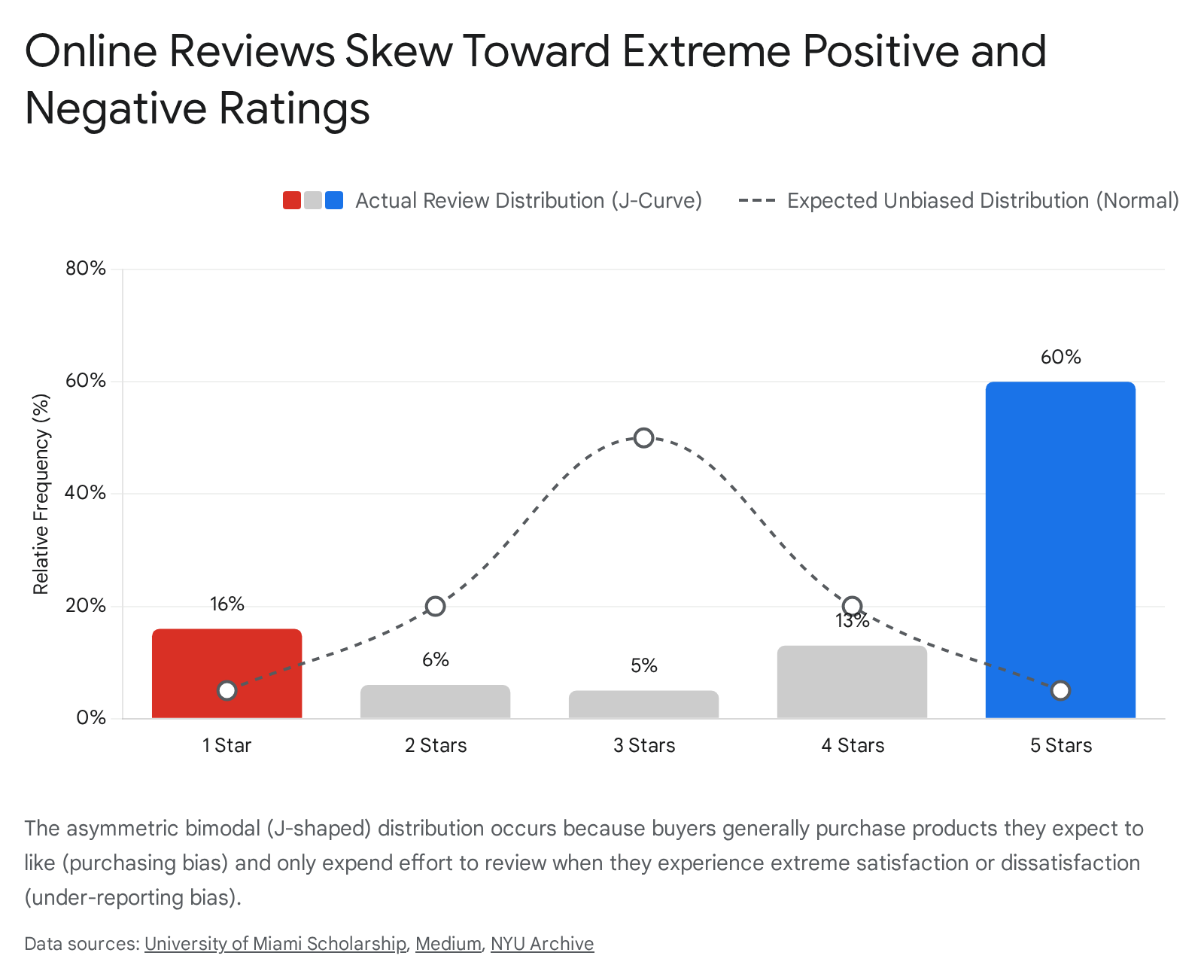
This J-shaped curve is driven by two primary self-selection biases: 1. Purchasing Bias: Consumers typically only purchase items they already have a favorable disposition toward. Consequently, the baseline pool of potential reviewers is pre-skewed toward a positive experience, heavily inflating the number of 5-star ratings 1831. 2. Under-reporting Bias: The motivation to expend the cognitive effort and time to write a review is inextricably linked to emotional arousal. Consumers with extreme experiences - either intense delight or severe frustration - are highly motivated to "brag or moan," whereas consumers with moderate, satisfactory experiences lack the emotional impetus to report their feedback 1819.
Because of these inherent biases, the arithmetic mean of a product's reviews is often a statistically biased estimator of true product quality 2920. Controlled laboratory experiments where all participants are mandated to leave a review (eliminating under-reporting bias) consistently yield normal, unimodal distributions, confirming that the J-shape observed in the wild is a byproduct of self-selection rather than true bipolar product quality 1819.
The Optimal Star Rating Heuristic
The widespread prevalence of the J-shaped distribution has conditioned consumers to approach perfect scores with acute skepticism. This manifests in the "too good to be true" heuristic. While businesses instinctively strive for a flawless 5.0-star average, robust market research consistently demonstrates that purchase probability actually declines as an aggregate rating approaches a perfect score 2122.
Consumers inherently expect a natural variance in product experiences. A flawless rating profile signals potential manipulation, triggering suspicions of filtered negative feedback, incentivized reviews, or outright fraud 143423. Studies indicate that the optimal average star rating - where conversion rates and purchase likelihood reach their absolute maximum - typically falls between 4.2 and 4.7 out of 5 2212224. Within this optimal band, the presence of negative reviews paradoxically enhances the perceived authenticity of the positive reviews. These negative reviews act as credibility markers, demonstrating platform transparency and giving buyers the confidence that they are evaluating a realistic, unfiltered spectrum of consumer experiences 2134. Furthermore, the impact of these ratings is amplified for expensive items in high-consideration categories, where financial or safety risks increase the consumer's reliance on peer validation 22.
Review Attributes and Trust Formation
Meta-Analytic Perspectives on Consumer Trust
To quantify the relative importance of specific trust antecedents, recent meta-analyses synthesizing five decades of consumer trust research (encompassing over 2,147 effect sizes across 71 countries) offer definitive conclusions 252627. The data establishes that integrity-based antecedents - factors signaling honesty, benevolence, and transparency - are significantly more effective at driving consumer trust than reliability-based antecedents, which merely signal competence or technical capability 2526. Consequently, elements within online reviews that verify the reviewer's integrity carry disproportionate weight in the consumer's cognitive processing.
Verification Markers and Source Credibility
The presence of a "Verified Purchase" badge is one of the most powerful heuristics for establishing review integrity. Utilizing the Theory of Reasoned Action and the Elaboration Likelihood Model, verified tags serve dual cognitive purposes. On a peripheral level, they act as rapid, low-effort cues that instantly elevate the review's perceived legitimacy 28. On a central processing level, they assure the reader that the detailed textual arguments are grounded in actual product ownership and financial commitment, thereby increasing the diagnosticity of the information 2841. Unverified reviews, conversely, are viewed with inherent skepticism, given the widespread awareness of astroturfing and review manipulation, with up to 75% of consumers expressing concern over encountering fake reviews 172328.
Multimedia Elements and Information Quality
The inclusion of user-generated multimedia (photos and videos) dramatically enhances review diagnosticity and conversion probability. Visual evidence acts as a tangible reference point, reducing the perceived risk associated with experiential or visually dependent products, such as apparel, cosmetics, or travel accommodations 2943.
Reviews featuring customer photos consistently receive higher "helpfulness" votes, as they provide unfiltered proof of product quality, true dimensions, and real-world application 2944. This visual social proof directly combats the polished, heavily edited, and often misleading nature of official marketing imagery. Data indicates that 62% of consumers are more likely to make a purchase after viewing customer-generated photos or videos, and 22% actively seek before-and-after photos for service-based businesses to validate performance claims 744.
Volume and Recency Signals
Review volume and recency serve as continuous market signals. Review volume operates as a proxy for product popularity and market acceptance; a high volume of reviews dilutes the statistical impact of extreme outliers and reassures the buyer that the product is a safe, normative choice 1245. Products displaying at least five reviews enjoy up to a 270% increase in purchase likelihood compared to products with zero reviews 223.
Recency is equally critical for maintaining the integrity signal. A product with a high average rating but no recent reviews is often viewed with suspicion, as consumers assume product quality, manufacturing standards, or customer service may have degraded over time 230. Recent reviews confirm that the current iteration of the product aligns with historical expectations, functioning as an up-to-date validation of the seller's ongoing reliability 247.
The relative impact of various review attributes is summarized in the following table:
| Review Attribute | Primary Psychological Function | Impact on Consumer Behavior |
|---|---|---|
| Verified Purchase Tag | Establishes source integrity and authenticity 2841. | Reduces skepticism; strongly increases reliance on the review's text 28. |
| User-Generated Photos | Mitigates visual uncertainty and quality risk 2944. | High impact on experiential goods; increases conversion by bridging expectations vs. reality 229. |
| Review Volume | Signals market popularity and normative consensus 145. | Reduces perceived purchase risk; establishes baseline brand credibility 2. |
| Recent Timestamps | Validates current operational consistency 230. | Prevents trust decay; assures buyers that past quality is still applicable 2. |
Psychological Motivations for Review Generation
Self-Determination Theory
Understanding why consumers expend uncompensated effort to write detailed reviews requires examining intrinsic psychological drivers. Self-Determination Theory (SDT) provides a robust theoretical framework, proposing that individuals are motivated by the fulfillment of three basic psychological needs: autonomy, competence, and relatedness 3132.
In the context of review generation, writing allows consumers to exercise autonomy by freely expressing their personal opinions and self-regulating their emotional responses to a product without external constraint 31. The act fulfills the need for competence when reviewers feel their expertise is recognized, particularly when platforms provide gamified feedback mechanisms such as "Helpful" votes from peers. This recognition is internalized as a personal achievement, incentivizing the creation of longer, more detailed, and analytically rigorous reviews 32. Finally, reviews fulfill the need for relatedness by connecting the reviewer to a broader community of consumers or enthusiasts, fostering a sense of social belonging and shared experience 3133.
Emotional Venting and Identity Signaling
Beyond SDT, review generation is heavily driven by emotional regulation and identity construction. For dissatisfied customers, venting serves as a primary catalyst. Negative shopping experiences create psychological tension, and writing a critical review acts as a mechanism for emotional catharsis, allowing the consumer to recover from the negative experience, warn others, and seek social support 323334. Because negative emotions tend to generate more complex and diverse cognitive processes, negative reviews are frequently longer and more detailed than positive ones 32.
Conversely, positive reviews are frequently utilized for identity signaling. By publicly evaluating specific brands, media, or high-involvement products, consumers construct and project their personal identity to their peers 3233. Furthermore, altruism acts as a significant intrinsic motivator; many consumers write reviews out of a genuine desire to assist fellow shoppers in making informed decisions, or to reward companies that provided exceptional service 323334. While extrinsic rewards (e.g., discounts, sweepstakes) can stimulate review volume, highly internalized, intrinsic motivations consistently yield reviews of higher textual quality and emotional authenticity 3135.
Artificial Intelligence in Review Summarization
Cognitive Load and Perceived Diagnosticity
The exponential growth in review volume has led to severe information overload, prompting major e-commerce platforms to deploy Generative Artificial Intelligence (GenAI) to synthesize customer feedback into concise AI-generated review summaries (AGRS) 73637. Grounded in Cognitive Load Theory (CLT), AI overviews reduce extraneous cognitive load by synthesizing vast amounts of textual data into intuitive formats, allowing consumers to preserve their limited cognitive resources for deeper central-route processing 7.
This mechanism significantly enhances the perceived usefulness of the review section, but its efficacy is moderated by the consumer's Need for Cognition (NFC). For consumers with a low NFC, AI overviews significantly increase perceived usefulness by acting as a necessary cognitive aid. Conversely, for high-NFC consumers, the presence of an AI summary offers negligible differences in perceived usefulness, as these individuals intrinsically prefer to engage in elaborate information processing and direct text analysis themselves 7.
The Sentiment Convergence Effect
The introduction of AGRS systematically alters the broader review ecology through a phenomenon termed the "sentiment convergence effect" 16. Because AI summaries are inherently designed to be rational, objective, and devoid of extreme emotional intensity, they act as an "emotion-compressed cognitive anchor" at the top of a product page 16.
When prospective reviewers read this neutral summary, they perceive its structured linguistic pattern as the platform's normative standard for acceptable feedback. Consequently, subsequent human reviewers unconsciously adapt their own writing, suppressing extreme emotional vocabulary (e.g., avoiding words like "terrible" or "flawless") and converging toward a more moderate, rational narrative style 16. This convergence effect is highly pronounced in low-rating environments, where users adopt the neutralized tone as a socially safe template. However, it is weakened in contexts involving healthy foods or highly ethical purchases, where consumers exhibit "compensatory expression" to assert their identity 16.
The Authenticity Gap and Persuasion Knowledge
While AGRS mitigate information overload, their impact on consumer trust is highly contingent. An emerging body of literature identifies an "authenticity gap" associated with AI-generated content. When consumers are made aware that content is AI-authored, it can activate persuasion knowledge and diminish perceived authenticity, which subsequently erodes brand trust and purchase intention 738.
This effect is nuanced. In high-trust contexts involving established brands, AI disclosure has a minimal negative impact, as pre-existing brand equity buffers the risk 3638. Experimental evidence suggests that AGRS have relatively little standalone influence on trust unless they are summarizing exclusively positive reviews, which immediately triggers consumer skepticism regarding systemic bias 36. To counteract this trust erosion, platforms utilizing AI overviews must ensure transparency and maintain traceable source references - linking AI claims directly back to specific human reviews - to preserve the diagnostic value and credibility of the synthesis 7. Attempts to mask the AI through anthropomorphism often backfire, producing a delayed backlash when consumers recognize the human-like framing as inauthentic manipulation 38.
Generational Shifts in Social Validation
The mechanisms of social validation are undergoing a profound demographic shift. Generation Z (Gen Z) relies on online reviews to a significantly higher degree than preceding generations, but their methodology for sourcing and evaluating this information differs drastically 556. While 39% of all U.S. adults report trusting online reviews less than they did five years ago due to the proliferation of fake reviews, Gen Z leads all demographics in retaining trust for peer evaluations, provided they meet specific format criteria 56.
Gen Z and the Independent Validation Gap
Despite growing up alongside the influencer economy, Gen Z exhibits a structural divide in how they evaluate brand credibility, known as the "Independent Validation Gap" 39. Recent large-scale surveys indicate that 72% of Gen Z consumers cite independent customer reviews as their most trusted source for evaluating a brand 3940.
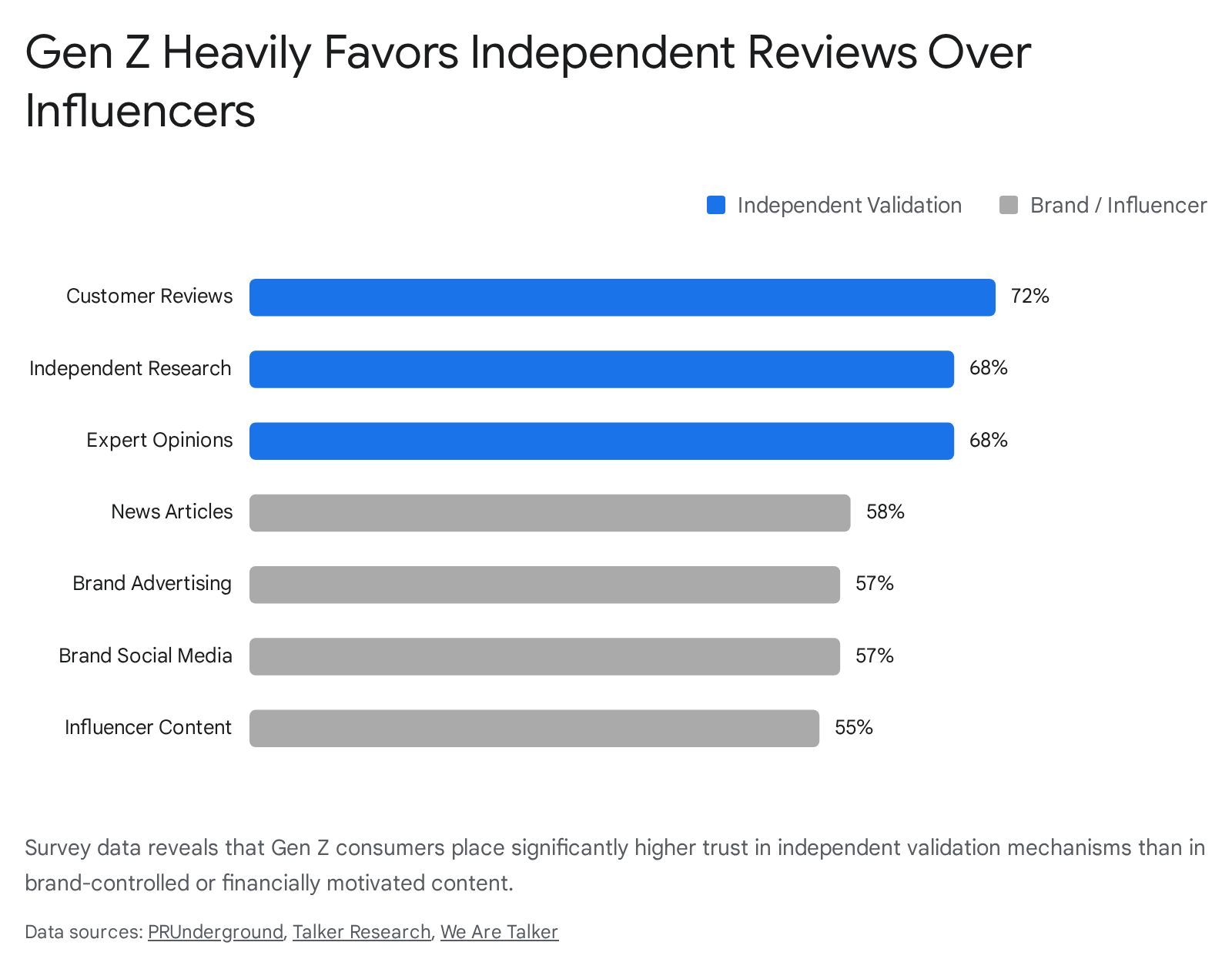
In stark contrast, only 55% view influencer content as credible, and brand-controlled advertising and PR stunts rank even lower (57% and 46%, respectively) 394041.
This disparity highlights a growing skepticism toward financially motivated promotion. Gen Z consumers are highly attuned to the difference between independent signals and promotional messaging 39. They demand authenticity, preferring raw, unfiltered perspectives from actual buyers over polished, sponsored content 541.
Video-Centric Information Search
The modality of reviews is equally critical to younger cohorts. Gen Z demonstrates a pronounced preference for mobile-first, visual validation. Platforms like TikTok and Instagram have evolved from mere social networks into primary product discovery and review engines, actively challenging traditional text-heavy platforms like Google and Amazon as the starting point for consumer journeys 54261.
For these digital natives, text-based reviews often lack the multidimensional context provided by video. Over 53% of Gen Z consumers report making purchases based directly on short-form video reviews 5. From a theoretical perspective utilizing the Technology Acceptance Model (TAM) and Flow Theory, video reviews - featuring real-time reactions, unboxings, and visual demonstrations - serve as high-fidelity social proof that triggers a "flow state" of continuous engagement 8. They allow the viewer to instantly assess the reviewer's authenticity, observe the product's actual dimensions and performance, and gauge the emotional tone of the evaluation, satisfying the demand for rapid, transparent information far faster than reading a dense paragraph 5842.
Generational Evaluation Paradigms
The following table summarizes the divergent paradigms of review evaluation across key demographic groups 556:
| Consumer Cohort | Primary Discovery Platforms | Preferred Review Modality | Review Reading Volume | Trust Trajectory |
|---|---|---|---|---|
| Generation Z | TikTok, Instagram, Snapchat | Short-form video, user photos | High (Average ~8 reviews) | Highest trust; demands authenticity and visual proof. Responds quickly to negative reviews 5. |
| Millennials | Amazon, Google, Facebook | Mixed (Text with images) | Moderate (Average ~6 reviews) | High trust; balances text detail with platform credibility. Highly influenced by peers 5. |
| Generation X / Boomers | Google, Amazon, Retailer Sites | Long-form, detailed text | Low (Average 2-4 reviews) | Declining trust; heavily skeptical of fake reviews. Prefers traditional customer service channels 556. |
Cross-Cultural Variances in Consumer Trust
The mechanisms by which online reviews foster trust are not universal; they are heavily mediated by national culture. Anthropologist Edward T. Hall's framework of high-context versus low-context cultures provides a critical lens for understanding how geographic cohorts interact with digital social proof 4344.
High-Context Versus Low-Context Information Processing
In low-context cultures (predominantly Western nations such as the United States, Germany, and the Netherlands), communication is explicit, direct, and heavily reliant on verbal or textual clarity 4344. Consumers in these highly individualistic cultures tend to approach e-commerce with a higher baseline of skepticism and rely on rigorous analytical processing 4445. Consequently, they prioritize objective product features, usability metrics, and detailed, argument-driven textual reviews. Low-context consumers frequently analyze individual negative reviews for specific functional failures and are highly reliant on expert reviewers and specific behavioral consensus cues (e.g., "Best Seller" badges indicating high market share) to mitigate risk 64546.
Conversely, in high-context cultures (predominantly Eastern nations such as China, Japan, and India), communication relies heavily on implicit cues, non-verbal signals, and the establishment of relational trust over time 4344. Rooted in collectivist values, consumers in high-context environments seek social harmony and are more heavily influenced by group norms and peer opinions 612. When evaluating products, they focus less on utilitarian features and more on product aesthetics, holistic presentation, and the overall tone of the collective feedback 6. Furthermore, high-context consumers are more forgiving of non-expert reviewers, viewing peer advice as a form of communal social connection, and they respond significantly more strongly to attitudinal consensus cues (e.g., "Top Rated" badges indicating group preference) than behavioral ones 4546.
Platform Architectures and Cultural Alignment
These cognitive differences necessitate distinct architectural designs in e-commerce platforms to properly facilitate trust.
| Cultural Context | Communication Style | E-Commerce Focus | Trust Drivers in Online Reviews | Platform Examples |
|---|---|---|---|---|
| Low-Context (Western) | Explicit, direct, detail-oriented | Usability, functionality, transaction efficiency | Expert status, detailed argumentation, explicit product feature analysis, behavioral consensus | Amazon, Yelp, Google Reviews |
| High-Context (Eastern) | Implicit, relational, holistic | Aesthetics, social interaction, brand identity | Peer consensus, normative influence, live streaming interaction, attitudinal consensus | Taobao, Shopee, Pinduoduo |
For instance, platforms dominating high-context markets, such as Taobao and Shopee, integrate highly interactive, community-driven features like integrated live streaming (e.g., Shopee Live). These features allow for real-time seller-buyer interactions, bridging the gap left by the absence of physical retail and heavily catering to the high-context need for interpersonal connection and dynamic social proof 47. The visual and interactive richness of these platforms acts as an essential trust-building layer that text alone cannot achieve in a high-context culture 4748. Furthermore, negative reviews on platforms like Taobao carry immense weight, as they disrupt social harmony and drastically increase perceived risk, prompting merchants to invest heavily in community management and responsive customer service 4969.
Conclusion
The psychology of online reviews is rooted in the complex interplay of human cognition, emotional regulation, and social validation. While the basic premise remains that positive feedback drives sales and negative feedback deters them, the actual mechanics of consumer trust are far from linear. Because consumers process information through the lenses of loss aversion and the negativity bias, they actively seek out negative reviews to establish authenticity, recognizing that perfect 5-star ratings are statistically improbable and inherently suspicious.
Furthermore, the landscape of social validation is shifting dynamically. Generational turnover is driving a preference for rapid, highly authentic visual validation over traditional text, with Gen Z elevating independent video reviews above all other forms of brand communication. Concurrently, the deployment of artificial intelligence in synthesizing reviews is beginning to reshape the tone and cognitive burden of review consumption altogether, presenting new challenges regarding authenticity and persuasion knowledge. To successfully leverage electronic word-of-mouth, commercial entities must prioritize transparency, foster intrinsic reviewer motivations through community building, and align their feedback mechanisms with the specific cultural and demographic contexts of their target audiences. Ultimately, in digital environments devoid of physical interaction, the verified, nuanced experiences of the peer collective remain the absolute arbiter of consumer trust.