
Impact of AI Chatbots on Consumer Trust and Purchase Behavior
Introduction to Conversational Artificial Intelligence
The integration of artificial intelligence into consumer-facing digital environments has fundamentally altered the mechanics of digital commerce, customer service, and digital marketing. Driven by rapid advancements in large language models and natural language processing, the consumer landscape has transitioned from rigid, deterministic interfaces to dynamic, conversational ecosystems 12. The global chatbot market, valued at approximately $9.56 billion in 2025, is projected to expand at a compound annual growth rate of over 23%, with forecasts suggesting it could reach between $27 billion and $61.69 billion by the early 2030s 345. Furthermore, the broader artificial intelligence-enabled e-commerce market is expected to scale from $8.65 billion in 2025 to $64.03 billion by 2034 34.
This aggressive market expansion is mirrored by rapid consumer adoption rates. Data from the Federal Reserve Bank indicates that 54.6% of adults aged 18 to 64 utilized generative artificial intelligence between August 2024 and August 2025, an adoption velocity that outpaces both early personal computer and internet penetration rates 5. In the retail sector, approximately 89% of organizations are actively using or assessing artificial intelligence projects to optimize supply chains, enhance product discovery, and automate customer support 45.
Despite this widespread technological integration and optimistic market forecasting, the psychological dimensions of human-computer interaction remain highly complex and frequently paradoxical. As businesses deploy generative algorithms to drive personalization, automate support ticketing, and influence purchasing decisions, consumer responses oscillate between enthusiastic adoption and entrenched skepticism. While modern conversational systems process user intent, context, and sentiment at unprecedented speeds, their presence introduces new cognitive and affective variables into the consumer decision-making process 26.
This research report synthesizes current empirical literature on artificial intelligence-driven chatbots, focusing heavily on the psychological mechanisms that govern consumer trust. The analysis examines the dichotomy of algorithm aversion and appreciation, the consequences of explicit technological transparency, and the boundary conditions imposed by anthropomorphism, privacy concerns, and cross-cultural variations. Finally, the report reviews structural equation models governing technology acceptance and addresses prevailing methodological gaps in the current research literature.
Technical Architectures and Performance Metrics
To understand the psychological impact of chatbots, it is necessary to distinguish between the two primary technical architectures utilized in the market: rule-based systems and generative artificial intelligence systems. The fundamental architectural differences directly dictate the boundaries of the user experience and, consequently, the psychological response of the consumer 178.
Rule-Based Architecture
Traditional rule-based chatbots operate on deterministic decision trees and conditional logic frameworks 1. These systems rely entirely on keyword matching, regular expressions, and pre-scripted dialogue flows. If a user query deviates from the programmed script, contains complex syntactic structures, or utilizes colloquial phrasing, the system inevitably fails. This failure often results in a continuous loop of unhelpful, repetitive responses 1910.
While rule-based architectures are highly cost-effective for automating highly predictable, routine queries - such as verifying operational hours, executing simple password resets, or retrieving basic shipping statuses - their inability to maintain context or interpret unstructured text introduces significant friction into the customer journey 1814. Consequently, interactions with rule-based bots frequently result in consumer frustration, high escalation rates to human customer service representatives, and diminished overall customer satisfaction 189. Consumer surveys indicate that older generation chatbots are often viewed unfavorably, primarily because they force the user to adapt to the machine's rigid communication requirements rather than the machine adapting to natural human dialogue 211.
Generative Artificial Intelligence Architecture
Generative artificial intelligence chatbots, powered by large language models, represent a paradigm shift in human-computer interaction. These systems utilize deep learning and natural language processing to read, interpret, and generate human language dynamically without relying on deterministic scripts 123. Generative architectures extract intent from unstructured text, retain conversational context across multiple turns of dialogue, and adjust tone and style in real time to match the user's emotional state 914.
This architectural capability allows for sophisticated applications across e-commerce and digital service environments. Generative chatbots facilitate contextual product discovery, execute proactive cart abandonment recovery through personalized messaging, and manage complex post-purchase support issues 3910. By parsing vast amounts of product metadata and aligning it with real-time consumer inputs, generative systems can simulate the consultative nature of a human sales associate, fundamentally altering the user's cognitive engagement with the digital storefront 161213.
Operational and Behavioral Outcomes
The deployment of generative artificial intelligence has yielded measurable behavioral shifts in consumer purchasing patterns. Current industry data demonstrates that e-commerce platforms utilizing conversational artificial intelligence report conversion rates up to four times higher than unassisted shopping sessions (12.3% versus a baseline of 3.1%) 34. Furthermore, visitors arriving at retail sites via generative artificial intelligence referrers converted at rates 31% higher than traditional traffic sources during the 2025 holiday season, indicating that these assisted shoppers possess clearer purchase intent and better-informed expectations prior to navigating the site 514.
Generative models are also highly effective in retention strategies. Automated, proactive chat interventions recover approximately 35% of abandoned digital shopping carts, while personalized product recommendations generated by conversational systems have been shown to lift overall revenue by 5% to 15%, with top-performing implementations reaching up to a 25% revenue lift 314.
However, despite these objective performance improvements in sales metrics, overarching customer satisfaction data indicates a lingering preference for human interaction in complex scenarios. Extensive analysis of 21,806 chatbot conversations reveals that human customer service agents still achieve higher satisfaction ratings (87%) compared to current generative chatbots (62%) 20.
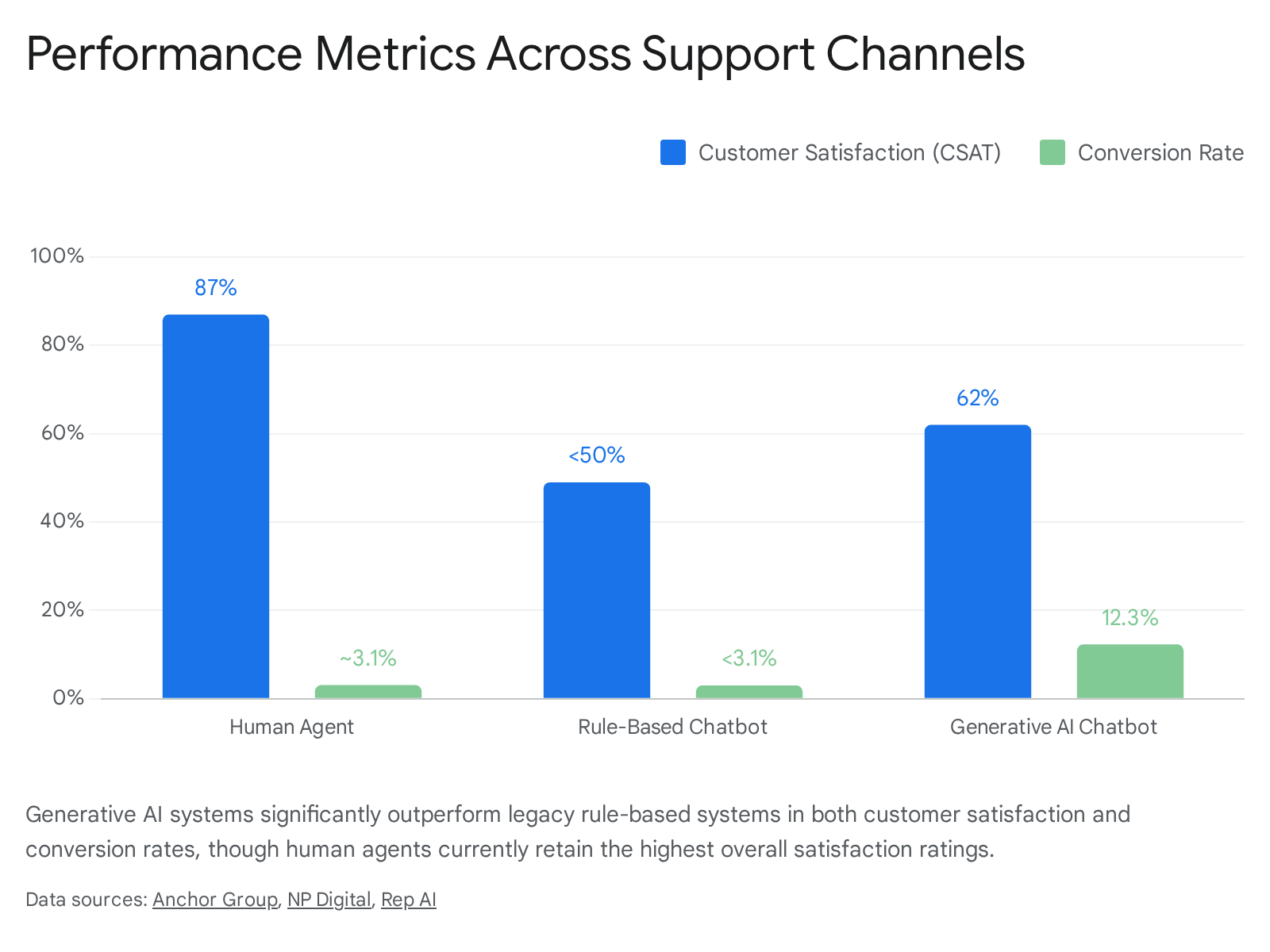
This satisfaction gap is largely attributed to the human capacity for handling emotional nuance, navigating highly sensitive ethical or financial exceptions, and offering unstructured reassurance - areas where even the most advanced large language models continue to struggle 2021.
Algorithm Aversion and Algorithm Appreciation
A central pillar of the psychological research on human-computer interaction is the investigation of consumer algorithmic trust. The academic literature establishes a spectrum of trust characterized by two opposing behavioral phenomena: algorithm aversion and algorithm appreciation 1516. The propensity for a consumer to fall onto either side of this spectrum is highly dependent on the nature of the task and the type of product involved 1718.
Foundations of Algorithm Aversion
Algorithm aversion describes the psychological resistance to technology, wherein consumers systematically prefer human judgment over algorithmic advice, even in scenarios where the algorithm's performance has been empirically proven to be identical or superior to human performance 1617. The foundational causes of this aversion stem from deeply held beliefs that algorithms are inherently inflexible, fail to incorporate qualitative nuances, lack situational awareness, and are fundamentally dehumanizing 16.
This aversion is particularly pronounced in tasks deemed inherently human, subjective, or emotion-oriented. In domains requiring empathy, moral judgment, or the evaluation of hedonic products (e.g., luxury goods, fine art, creative writing), consumers exhibit high resistance to artificial intelligence recommendations 162619. Consumers operate under the assumption that machines cannot comprehend the subjective, affective elements that drive hedonic consumption.
Furthermore, algorithm aversion is highly sensitive to technological failure. Research indicates that when consumers witness an algorithm commit an error, their trust in the system drops precipitously. This loss of trust is significantly more severe, and substantially harder to rebuild, compared to scenarios where consumers witness a human make the exact same error 17. Humans are generally afforded a margin of error attributed to natural fatigue or cognitive limitations, whereas algorithms are expected to be infallible; a single error shatters the illusion of machine perfection 1617.
Foundations of Algorithm Appreciation
Conversely, algorithm appreciation occurs when consumers exhibit a clear preference for algorithmic processing over human judgment 161718. This phenomenon is driven by the belief that machines are inherently objective, consistent, mathematically superior, and immune to the cognitive biases, heuristics, and fatigue that plague human decision-making 1619.
A comprehensive meta-analysis synthesizing 442 effect sizes from 163 distinct studies reveals that algorithm appreciation frequently manifests in tasks that are quantitative, highly structured, or strictly utilitarian 1819. In scenarios involving data-heavy financial portfolio management, complex logistical routing, medical imaging diagnostics, or objective product parameter analysis (e.g., comparing laptop specifications), consumers tend to place higher trust in algorithms 161819. In these contexts, the sheer volume of data required for optimal decision-making surpasses human cognitive capacity, leading the consumer to logically defer to the computational superiority of the machine 16.
The Capability-Personalization Framework
To reconcile the conflicting behavioral patterns of aversion and appreciation, researchers have introduced the Capability-Personalization Framework 18. This theoretical model posits that a consumer's decision to trust an artificial intelligence agent over a human agent depends simultaneously on the interplay of two primary dimensions:
- Perceived Capability: The degree to which the artificial intelligence is viewed as competent, accurate, and efficient in executing the specific task compared to a human.
- Necessity for Personalization: The degree to which the decision context requires nuanced, individualized, and emotionally intelligent input.
According to this framework, algorithm appreciation dominates when artificial intelligence is perceived as highly capable and the need for deep emotional personalization is remarkably low 18. Conversely, when the necessity for personalization and contextual empathy is high (e.g., healthcare consultations, high-stakes subjective purchases, complex service recovery), algorithm aversion prevails unless the system can perfectly simulate human empathy - a threshold current technology struggles to cross without triggering other psychological barriers 1819.
| Dimension | Algorithm Aversion | Algorithm Appreciation |
|---|---|---|
| Primary Psychological Driver | Desire for human empathy, qualitative understanding, and subjective context. | Belief in machine objectivity, data processing superiority, and flawless consistency. |
| Typical Task Contexts | Hedonic purchases, emotional support, moral logic, unstructured subjective tasks. | Utilitarian purchases, objective analysis, financial calculations, structured quantitative tasks. |
| Consumer Perception of AI | Rigid, emotionless, lacking in contextual nuance, inherently dehumanizing. | Efficient, accurate, free from human cognitive biases, heuristics, and fatigue. |
| Reaction to System Errors | Rapid and severe loss of trust; highly unforgiving of statistical anomalies. | Generally more tolerant of minor statistical margins of error if overall accuracy remains high. |
Artificial Intelligence Label Effects and Transparency
As the generative capabilities of artificial intelligence have expanded to produce highly realistic text, images, and video, regulatory bodies and ethical frameworks have increasingly mandated operational transparency. Initiatives such as the European Union's AI Act and evolving guidelines from the Federal Trade Commission necessitate the clear labeling of artificial intelligence-generated content to protect consumers from deception 2021. However, this regulatory imperative has exposed a significant "disclosure paradox" in consumer psychology, broadly classified in the academic literature as the "AI label effect" 2223.
Activation of Persuasion Knowledge
Empirical research demonstrates that explicit disclosure - labeling an advertisement, artwork, or chatbot response as "AI-generated" - systematically reduces consumer trust, perceived authenticity, and subsequent purchase intent 22233224. The psychological mechanism driving this decline is deeply rooted in the Persuasion Knowledge Model.
When a consumer becomes aware that an interaction or digital advertisement is algorithmically driven, it activates "persuasion knowledge" - a cognitive defense mechanism wherein the consumer explicitly recognizes they are the target of an automated, and potentially manipulative, influence attempt 212224. This activation causes the consumer to shift immediately from heuristic processing (automatic, surface-level acceptance) to systematic processing (deliberate, critical, and highly skeptical evaluation). Consequently, the consumer scrutinizes the content with heightened vigilance, resulting in a downgrade of perceived credibility and brand trustworthiness 2224.
Mediation by Emotional Trust
While cognitive trust (the belief in the system's technical competence) may remain relatively stable following an artificial intelligence disclosure, the AI label effect specifically corrodes emotional trust. Emotional trust functions as a critical mediator in the consumer's decision-making pathway 243425.
For example, studies conducted in the hospitality, tourism, and broader service sectors indicate that the mere inclusion of the term "Artificial Intelligence" in a product description directly suppresses purchase intentions by severing the emotional bond between the brand and the consumer 243425. Because consumers logically perceive algorithms as lacking a "mind," possessing no genuine intention, and incapable of true emotion, the perceived authenticity of the communication drops precipitously 26.
Product Involvement Boundary Conditions
The severity of the AI label effect is not uniform; it is heavily moderated by the consumer's level of product involvement and the inherent nature of the good being evaluated 2227.
- Low-Involvement Products: For fast-moving consumer goods, utilitarian items, or routine purchases (e.g., basic snacks, household cleaning supplies), the AI label effect is relatively minor. The decision-making process for these low-stakes items requires minimal cognitive effort, and consumers are more forgiving of algorithmic involvement because authenticity, craftsmanship, and human touch are not primary purchase drivers 2227.
- High-Involvement Products: For high-stakes, expensive, or highly hedonic purchases (e.g., laptops, luxury apparel, fine art), the AI label effect is highly detrimental. Consumers rely heavily on perceived authenticity, human craftsmanship, and social signaling when making these purchases 222728. Disclosing artificial intelligence involvement in these categories is frequently perceived as a shortcut that devalues the product, triggering an "inverse skills bias" and even feelings of existential threat regarding the displacement of human creativity 2623.
The power of the AI label effect is perhaps best illustrated by its function as a negative heuristic that can override the objective quality of the content. In controlled experiments, high-quality human-generated content that was falsely labeled as "AI-generated" suffered the exact same penalty in trust and purchase intent as actual algorithmic content. Conversely, algorithm-generated content that was falsely labeled as "human-generated" enjoyed significantly higher subjective evaluations, proving that the label itself carries more psychological weight than the actual quality of the output 2227.
Anthropomorphism and Mind Perception
To counteract algorithm aversion and mitigate the friction of the AI label effect, software developers and marketers frequently design conversational agents with anthropomorphic features. Anthropomorphism involves imbuing non-human agents with human-like traits, such as names, conversational filler words, empathetic phrasing, simulated typing delays, and graphical avatars 26293031. While moderate anthropomorphism can successfully enhance user engagement and system accessibility, excessive or inappropriate humanization triggers severe psychological and ethical friction.
Agency and Experience Dimensions
The effectiveness of anthropomorphic design is governed by mind perception theory. This psychological framework suggests that humans evaluate entities based on two distinct dimensions: agency (the ability to plan, calculate, and act autonomously) and experience (the capacity to feel emotion, sense pain, and possess consciousness) 26.
Consumers readily grant conversational algorithms high levels of agency; they understand the machine can execute tasks rapidly. However, consumers are fundamentally aware that software lacks genuine experience 2631. When a chatbot utilizes conversational cues to express warmth, empathy, or shared human experiences (e.g., stating "I completely understand how frustrating that situation is," or "I love that specific product as well"), it attempts to simulate the experience dimension.
In certain low-stakes service recovery scenarios, this simulated empathy can help de-escalate consumer tension by mirroring human social protocols 31. However, because the consumer logically knows the software cannot actually "feel" frustration or "love" a product, this simulation often backfires if the interaction is not carefully calibrated, leading the consumer to feel patronized or manipulated 262931.
Dishonest Anthropomorphism and the Uncanny Valley
When a chatbot's design aggressively mimics human emotion or utilizes artificial typing indicators to create the deliberate illusion of a human agent, it crosses the ethical threshold into "dishonest anthropomorphism" 2930. This intentional exploitation of the consumer's heuristic processing can initially trick users into over-trusting the system. This misplaced trust frequently leads consumers to disclose highly sensitive personal, medical, or financial information to a machine - a vulnerability known as the ELIZA effect 293233.
However, once this illusion is broken - either through an unnatural, robotic response to a complex query or a formal regulatory disclosure - the consumer experiences a severe psychological backlash 2930. This phenomenon aligns closely with the "uncanny valley" effect originally identified in robotics and animation, adapted here for conversational text interfaces and virtual influencers 62131. Highly anthropomorphic text or avatars that are almost but not perfectly human evoke profound feelings of eeriness, moral disgust, and psychological discomfort, ultimately destroying the trust the system attempted to build 631.
The Personalization Paradox and Privacy Reactance
Advanced generative chatbots utilize vast amounts of historical behavioral data and real-time inputs to personalize interactions. However, this hyper-personalization presents a complex operational paradox. While tailored recommendations objectively increase relevance and conversion probabilities, overly intimate personalization delivered by an artificial agent frequently triggers feelings of vulnerability and "privacy-related reactance" 34354636.
If a chatbot demonstrates knowledge of a consumer's behavior that was collected covertly (e.g., referencing items viewed on a different device or mentioning past browsing history without context), the consumer perceives a stark loss of control over their data 3546. The anthropomorphic nature of the bot exacerbates this reactance; being "watched" and analyzed by a human-like algorithm feels substantially more invasive and threatening than being processed by a transparently mechanical system 30.
Consequently, the consumer recoils, abandoning the interaction and lowering their long-term trust in the broader brand. To mitigate this reactance, organizations must implement robust trust-building strategies and explicit, transparent data-use disclosures to offset the vulnerability induced by algorithmic hyper-personalization 3546.
Cultural Variations in Artificial Intelligence Acceptance
Consumer psychological responses to conversational artificial intelligence are not universally uniform. Reactions are heavily mediated by cultural background, religious history, and established societal values. Current cross-cultural psychology research highlights a significant, quantifiable divergence in chatbot acceptance between East Asian and Western populations 3749383940.
Animism and East Asian Receptivity
Extensive studies involving large-scale samples across the United States, Canada, China, and Japan demonstrate that East Asian consumers exhibit significantly higher baseline levels of anthropomorphism and a much greater willingness to form social and emotional bonds with conversational agents 373840.
Cross-cultural researchers attribute this variance to the deep historical and philosophical roots of animistic religions in East Asia, specifically Shintoism and Buddhism 373840. These philosophical frameworks do not enforce a strict, binary delineation between humans, the natural world, and artificial objects. In Shintoism, for instance, spirits (kami) can inhabit physical tools and inanimate objects, while Buddhism posits that all things possess a fundamental interconnectedness and the potential for a form of consciousness 40.
Consequently, East Asian consumers are culturally and philosophically predisposed to view social chatbots, robots, and virtual avatars as entities that may possess a degree of mind or spirit. This cultural lens makes these populations significantly more receptive to artificial intelligence companionship and automated emotional support systems, mitigating the harshness of the uncanny valley effect 373840.
Individualism and Western Skepticism
In stark contrast, Western cultures - characterized by high levels of individualism and a strong philosophical emphasis on human exceptionalism - tend to view artificial intelligence strictly as an inanimate, utilitarian tool 373940. In North America and Western Europe, consumers are significantly more skeptical of automated agents, perceiving the technology as a potential threat to human autonomy, personal agency, and data privacy 39.
In highly individualistic societies, the automation of decision-making by an external, non-human force is often interpreted as an infringement on personal control 39. When an algorithm attempts to simulate empathy or dictate a choice, the Western consumer frequently responds with psychological reactance. As a result, multinational businesses deploying chatbots across global markets cannot rely on a monolithic implementation strategy. Research indicates that highly anthropomorphized chatbots are highly effective for frontline engagement and support in East Asian markets, whereas Western consumers demand faster escalation to human agents, transparent algorithmic mechanics, and strictly utilitarian interactions devoid of faux-emotional intimacy 493940.
| Cultural Context | Dominant Philosophy | Attitude Toward Chatbots | Psychological Reaction to AI Agency | Optimal Market Strategy |
|---|---|---|---|---|
| East Asian Markets (e.g., Japan, China) | Collectivism, Animism (Shintoism, Buddhism). | High receptivity; willing to form social/emotional bonds. | Viewed as an extension of the self or natural world; accepted. | Deploy highly anthropomorphized agents; focus on companionship and empathetic dialogue. |
| Western Markets (e.g., US, Europe) | Individualism, Human Exceptionalism. | High skepticism; preference for strict utilitarian function. | Viewed as a threat to personal autonomy and privacy; resisted. | Deploy transparent, tool-oriented agents; avoid faux-empathy; offer rapid human escalation. |
Psychological Mechanisms and Structural Equation Models
To empirically quantify the complex variables influencing consumer purchase intent in algorithmically mediated environments, marketing researchers frequently employ Structural Equation Modeling (SEM). These quantitative models, which are often robust extensions of the traditional Technology Acceptance Model (TAM) and the Theory of Planned Behavior (TPB), map the intricate mathematical pathways between system characteristics, cognitive appraisals, and eventual behavioral outcomes 414243.
The Extended AIDUA Framework
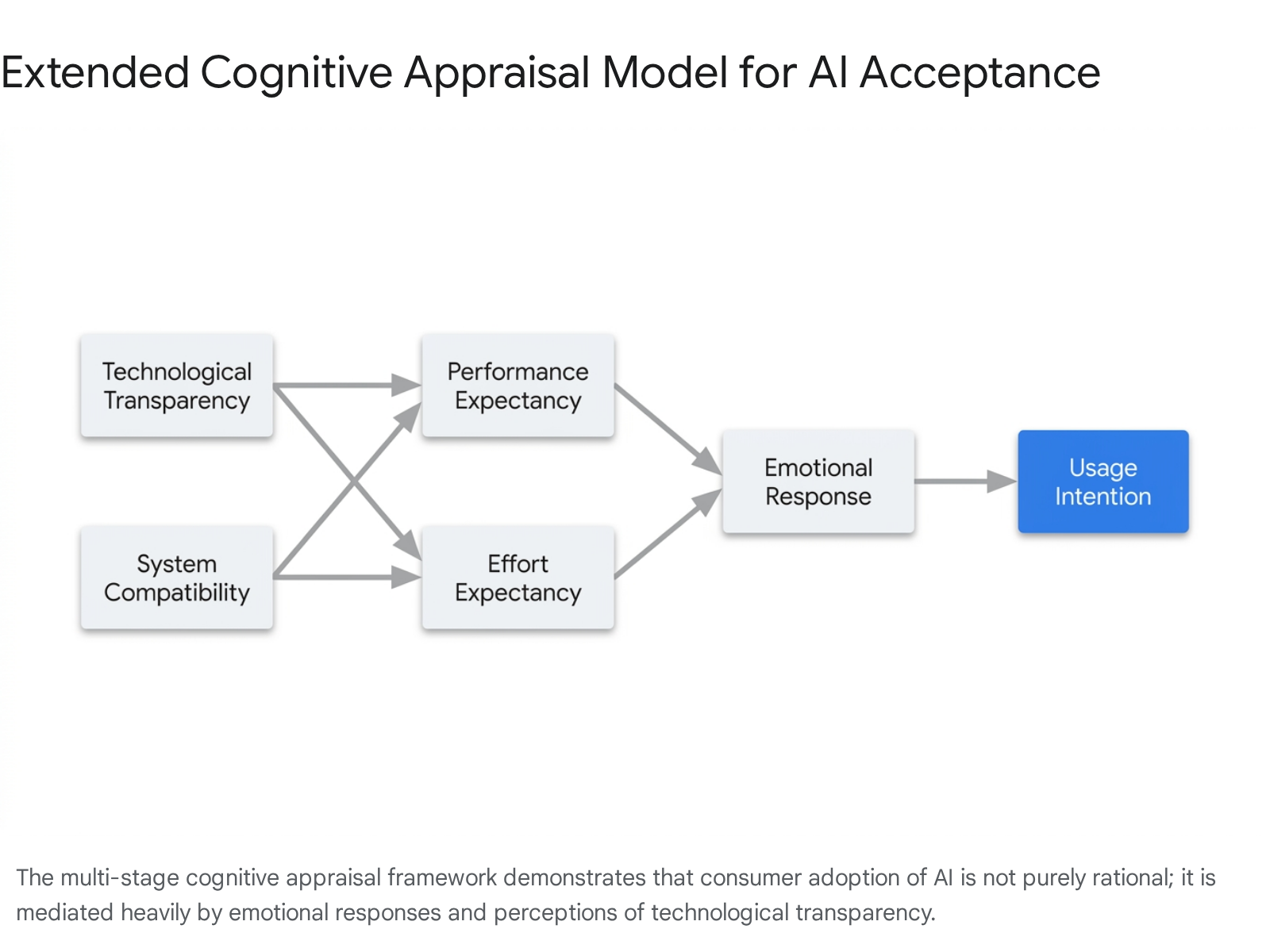
The Artificial Intelligence Device Use Acceptance (AIDUA) model has recently been extended by researchers to properly accommodate the unique conversational, emotional, and generative capabilities of modern chatbots 42. This advanced framework utilizes a multi-stage cognitive appraisal process to predict user behavior:
- Initial Appraisal Phase (Expectancy): Consumers evaluate the chatbot based on two primary cognitive metrics: Performance Expectancy (the belief that the system will efficiently and accurately solve their problem) and Effort Expectancy (the perceived cognitive difficulty, time, and friction required to interact with the system) 42.
- Deep Appraisal Phase (Emotional Response): The initial interaction triggers a powerful affective response. High effort expectancy, repetitive rule-based loops, or uncanny anthropomorphism generate negative emotions such as anxiety, frustration, or unease. Conversely, seamless, context-aware assistance generates positive hedonic value 42.
- Integrative Decision Phase (Usage Intention): The final purchase or continued usage decision is not purely rational; it is synthesized by the consumer combining their cognitive assessments with their immediate emotional experiences 42.
Direct Influences on Purchase Intentions
Recent empirical studies utilizing these structural equation models reveal critical insights into which specific chatbot features drive actual sales. In a study of 400 online consumers, data revealed that artificial intelligence-driven interactive virtual assistance exerts the strongest direct influence on consumer purchase decisions, yielding highly significant path coefficients (e.g., β = 0.466) 41. This conversational engagement proved far more influential than static artificial intelligence product recommendations (β = 0.219) or socially influenced algorithmic cues (β = 0.242) 41.
A critical antecedent variable moderating these pathways is Technological Transparency. When a chatbot's decision-making logic, data usage parameters, and artificial nature are made clear to the consumer, it significantly enhances performance expectancy (β = 0.428) while simultaneously mitigating effort expectancy 42.
The Role of Artificial Intelligence Literacy
Furthermore, structural models highlight that a consumer's baseline Artificial Intelligence Literacy functions as a vital cognitive resource. Higher technological literacy shifts the consumer's evaluation process from peripheral (heuristic, emotion-based) processing to central (systematic, logic-based) processing 25. This shift increases their confidence in navigating algorithmic interfaces, thereby directly bolstering purchase intentions and mitigating the paralyzing effects of privacy-related reactance, particularly in digital commerce environments 25.
Methodological Gaps in Current Literature
While the academic literature surrounding consumer psychology and artificial intelligence is expanding at an unprecedented rate, systematic literature reviews employing the PRISMA (Preferred Reporting Items for Systematic Reviews and Meta-Analyses) protocol indicate a severe methodological gap in the current evidence base 445745.
Reliance on Self-Reported Data
The vast majority of contemporary studies on the AI label effect, algorithm aversion, and anthropomorphism rely almost exclusively on self-reported survey data and highly controlled laboratory experiments 444647. These studies typically ask participants to evaluate simulated chatbot interfaces or hypothetical product descriptions.
While these methodological approaches are effective for measuring attitudinal outcomes (what consumers explicitly claim they feel or intend to do), they frequently suffer from profound hypothetical bias 1857. Participants in a laboratory setting who state they would abandon a purchase due to an AI label may behave entirely differently in a real-world e-commerce environment where convenience, pricing discounts, and time pressure override their stated philosophical aversions 4445. Consequently, existing models often fail to accurately predict actual behavioral outcomes (verified purchasing actions).
The Need for Transactional Data
There is a critical and widely acknowledged scarcity of research integrating longitudinal, real-world transactional data 444647. Assessing actual e-commerce conversion rates, customer relationship management (CRM) interaction logs, and long-term customer lifetime value (LTV) across A/B tested cohorts (artificial intelligence assistance versus human assistance) is absolutely necessary to validate current psychological theories 224445.
For example, transactional data is required to determine if negative phenomena like the AI label effect decay over time as consumers habituate to the technology, or if they cause permanent, measurable brand harm and churn 224445. Without integrating robust behavioral analytics and server-side transactional datasets, the field's understanding of conversational artificial intelligence's true economic impact remains fragmented, relying heavily on proxy intentions rather than verified economic actions 445745.
Conclusion
The current body of research indicates that the integration of generative artificial intelligence chatbots into consumer environments represents a complex psychological double-edged sword. Functionally, modern generative systems vastly outperform legacy rule-based technologies, driving measurably higher conversion rates, recovering abandoned revenue, and creating vast operational efficiencies through unprecedented personalization and intent recognition.
Psychologically, however, consumers exhibit a profound and enduring ambivalence toward non-human agency. Trust in artificial intelligence is not granted uniformly; it is actively negotiated based on the specific context of the task and the cultural background of the user. Consumers appreciate algorithms for objective, analytical, and highly structured tasks but demonstrate acute aversion when software encroaches on emotional, subjective, or high-involvement domains.
Efforts by corporations to bridge this trust gap through anthropomorphism must be executed with extreme caution. The uncanny valley, dishonest empathy simulation, and privacy-related reactance can easily override the intended benefits of conversational warmth, particularly in individualistic Western cultures. Furthermore, the mandatory disclosure of algorithmic involvement frequently triggers persuasion knowledge, eroding emotional trust and penalizing the perceived authenticity of the brand.
To successfully navigate this complex psychological landscape, organizations must balance technological efficiency with ethical transparency. Strategic implementation should prioritize functional competency, user control, and clear data governance over deceptive human mimicry. By doing so, businesses can allow consumers to build cognitive trust in the system's utility without feeling manipulated by a synthetic persona, ultimately harmonizing the operational power of artificial intelligence with the psychological needs of the modern consumer.