
Scarcity heuristic influence on consumer decisions and product value
Theoretical Foundations of the Scarcity Heuristic
The scarcity heuristic represents a fundamental psychological mechanism wherein individuals systematically assign elevated value to goods, services, or opportunities that are perceived to be rare, restricted, or fleeting. Rooted extensively in behavioral economics and evolutionary psychology, this heuristic operates as a cognitive shortcut (System 1 processing), allowing consumers to execute rapid evaluations under conditions of environmental uncertainty. The core premise assumes that resource constraint inherently signals utility, quality, and desirability, thereby prompting immediate acquisition behaviors to secure the asset before depletion 122.
Commodity Theory and Perceived Distinctiveness
The psychological efficacy of product scarcity is predominantly explained by commodity theory, originally formalized by Timothy Brock in 1968. Commodity theory postulates that any good, service, or piece of information will be valued to the extent that it is unavailable or subject to restriction 1345. Under this theoretical framework, scarcity fundamentally enhances a product's perceived distinctiveness. The possession of a scarce commodity allows consumers to convey personal uniqueness and segregate themselves from the broader population 34. Consequently, consumers do not evaluate the product solely based on its intrinsic functional or utilitarian properties; rather, they integrate the product's rarity into their overarching valuation. Individuals frequently operate under the assumption that what is less common is inherently of higher quality or higher market value 456. This dynamic is conspicuously evident in luxury and artisanal markets, where limited availability is a core component of the value proposition, transforming standard consumer goods into premium, status-signaling commodities 178.
Psychological Reactance and the Preservation of Choice
Beyond augmenting perceived value, scarcity reliably activates psychological reactance, a concept introduced by Jack Brehm in 1966. Reactance theory suggests that human beings experience acute psychological discomfort when they perceive that their behavioral freedom or freedom of choice is being threatened, restricted, or eliminated 137910. When a product's market availability diminishes, the consumer's future freedom to acquire that product is directly threatened. To restore this threatened freedom and mitigate the associated psychological friction, the consumer exhibits an intensified desire for the restricted item and is driven to secure it immediately 13910. This oppositional, defensive response translates into elevated purchase intentions, as the act of buying functions as a mechanism to reassert individual autonomy in the face of external market constraints.
Loss Aversion and the Fear of Missing Out
The emotional and cognitive responses to scarcity are heavily amplified by loss aversion, a central tenet of Prospect Theory developed by Kahneman and Tversky (1979). Loss aversion dictates that the psychological pain associated with losing an asset is roughly twice as powerful as the pleasure derived from gaining an equivalent asset 23711. Marketers routinely leverage this cognitive asymmetry by framing scarcity-based purchasing decisions as potential losses rather than potential gains. Consumers are motivated not merely by the desire to own the product, but by the urgent, preemptive need to avoid the anticipated regret of missing an exclusive opportunity 237.
In contemporary digital environments, this loss aversion manifests prominently as the Fear of Missing Out (FOMO). FOMO introduces a potent social dimension to loss aversion, driven by the anxiety that peers are acquiring a valuable asset or experiencing a beneficial event from which the consumer is excluded 371112. When combined with real-time digital visibility via social media, FOMO creates a high-pressure environment that consumes cognitive bandwidth. This phenomenon leads to a "tunneling effect," wherein consumers narrow their focus on acquiring the scarce item, overriding deliberative, analytical decision-making in favor of hasty, emotion-driven impulses 1313.
The Bandwidth Tax and Resource Scarcity Mindset
Extending beyond isolated product scarcity, broader experiences of resource scarcity (such as a lack of time or financial constraints) impose a significant "bandwidth tax" on the consumer's cognitive capacity. Research by Mullainathan and Shafir demonstrates that a scarcity mindset occupies substantial mental bandwidth, leaving fewer cognitive resources available for analytical tasks or long-term planning 121314. This reduction in cognitive capacity shifts focus to immediate, short-term survival tactics - a focus on the "here and now." Consequently, consumers operating under a scarcity mindset are highly susceptible to heuristic cues and are more likely to engage in compensatory consumption, impulsive buying, and, in severe cases, unethical or antisocial market behaviors as they prioritize self-preservation over broader societal or ethical concerns 13141516.
Categorizations of Scarcity Cues in Marketing
Scarcity is not a monolithic construct; its market implementation and subsequent psychological impact vary significantly based on how the restriction is framed and the underlying cause of the limitation. Academic literature broadly categorizes scarcity along several distinct axes, each triggering divergent consumer inferences.
| Scarcity Typology | Definition | Primary Psychological Mechanism | Optimal Product Match |
|---|---|---|---|
| Time-Based (Deadline) | Availability is restricted to a specific temporal window (e.g., "Sale ends in 2 hours"). | Urgency, FOMO, Anticipated Regret. | High-involvement products, promotional sales, utilitarian goods 31117. |
| Quantity-Based (Supply) | Availability is restricted by production or stock limits (e.g., "Only 5 left in stock"). | Psychological Reactance, Need for Uniqueness. | Luxury goods, experiential products, hedonic goods 3717. |
| Demand-Based | Scarcity caused by excessive consumer interest or popularity. | Social Proof, Bandwagon Effect, Conformity. | Utilitarian products, mass-market trends, low-involvement goods 31718. |
| Supply-Based | Scarcity caused by deliberate restriction of production or natural limits. | Exclusivity, Status Signaling, Rarity. | Enduring luxuries, collectibles, premium segments 71719. |
Time-Based Versus Quantity-Based Scarcity
Time-based scarcity, often operationalized through countdown timers, flash sales, and expiring promotional codes, limits the duration of an offer rather than the physical availability of the product itself. This format guarantees availability provided the consumer acts before the deadline, shifting the cognitive burden to time management and rapid decision-making 3. It is highly effective for accelerating the purchase cycle and reducing digital cart abandonment, but it relies heavily on maintaining a state of emotional arousal and urgency 112120.
Conversely, quantity-based scarcity limits the absolute number of items available, creating an environment of direct competition among consumers 37. Messages such as "Limited Edition" or "While Supplies Last" suggest that action alone is insufficient; the consumer must outpace their peers. This approach is highly effective in luxury and premium markets because it directly links to commodity theory, signaling that the product possesses inherent rarity and exclusivity 721. A comprehensive meta-analysis of 131 studies reveals that supply-based (quantity) scarcity is most effective for hedonic and experiential products, whereas demand-based scarcity tends to perform better for utilitarian goods 1724.
Actual Versus Artificial Scarcity
A critical distinction in modern consumer perception lies between actual and artificial scarcity. Actual scarcity occurs due to genuine supply chain constraints, natural resource limits, or organic surges in consumer demand 4925. Consumers generally perceive actual scarcity as a valid market condition, and it often functions as a reliable heuristic cue for product quality or broad popularity 4.
Artificial scarcity, however, is a manufactured market condition where a brand deliberately restricts the supply of a product capable of mass production solely to inflate its perceived value and desirability 252627. This strategy is pervasive in the luxury fashion, sneaker, and horology industries, where stringent allocation systems and multi-year waitlists are utilized to cultivate an aura of prestige 2622. In digital retail environments, artificial scarcity is frequently deployed via aggressive user interface designs, such as programmed countdown timers that automatically reset upon page refresh or arbitrary, algorithmic stock warnings 2324. As digital literacy increases, consumers are becoming increasingly adept at distinguishing between actual market limitations and artificial marketing manipulation, leading to complex implications for brand equity 2525.
Impacts on Consumer Decision Making and Perceived Value
The efficacy of the scarcity heuristic is heavily documented in empirical marketing literature, behavioral lab studies, and industry-level A/B testing. When deployed optimally, scarcity cues override deliberative evaluation, significantly lifting short-term sales metrics and altering perceived financial value.
Conversion Rates and A/B Testing Outcomes
In digital marketing, A/B testing provides robust quantitative evidence of scarcity's impact on consumer funnels. Marketers utilize split testing to evaluate how specific variables - such as the presence of a countdown timer or a low-stock indicator - affect user behavior. Industry surveys from 2025 indicate that 84% of marketing operations run A/B tests at least monthly, with conversion rate (45%) and customer retention (46%) serving as the primary evaluative metrics 26.
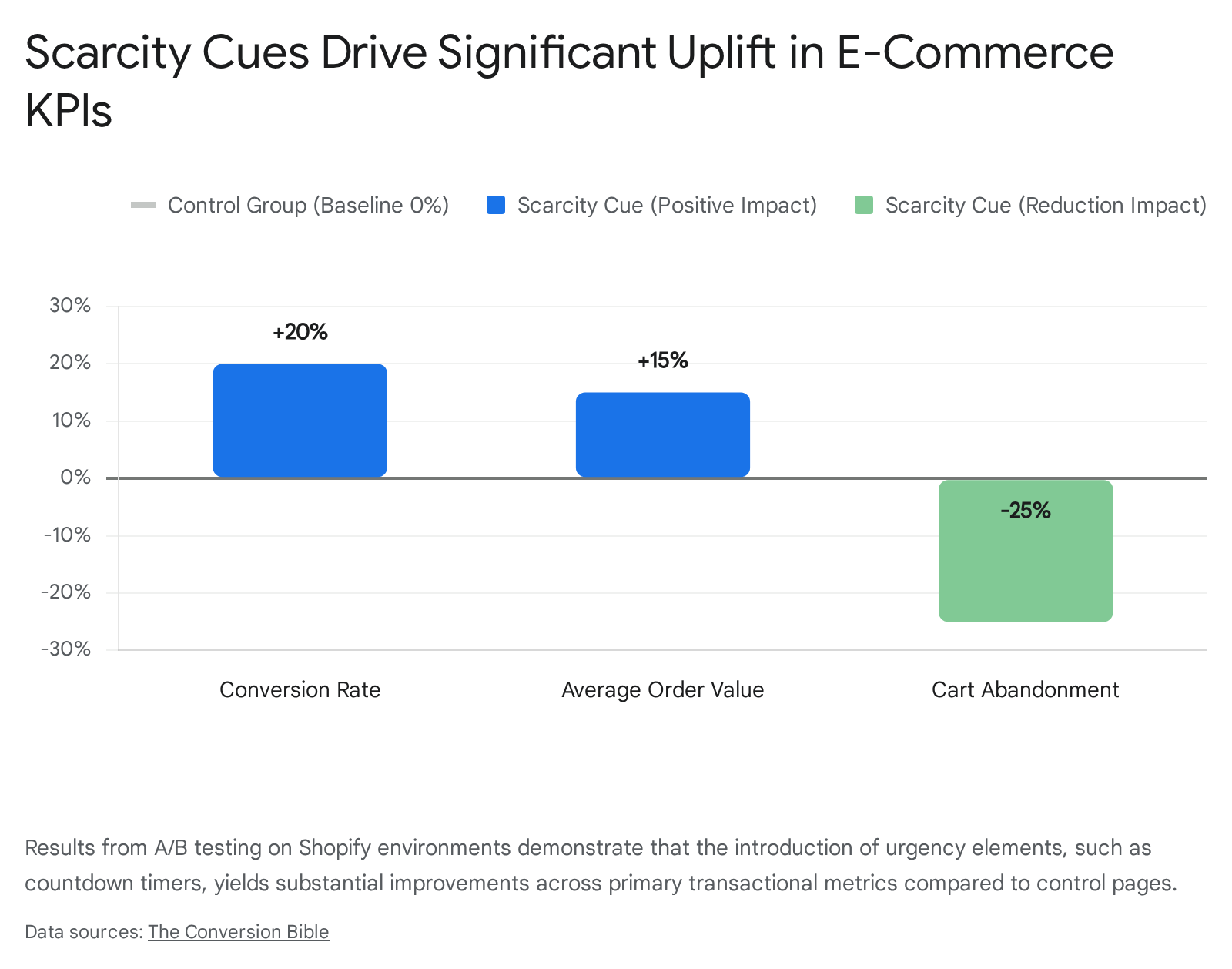
Controlled experiments consistently demonstrate that scarcity cues drive measurable, statistically significant increases in conversion. For instance, e-commerce sites implementing authentic visual countdown timers alongside real-time stock updates have recorded conversion rate increases ranging from 8% to 30% during promotional periods 2123. Specific A/B tests conducted on Shopify ecosystems revealed that product pages equipped with countdown timers experienced a 20% increase in total sales compared to control pages lacking timers 33. Furthermore, the introduction of urgency elements yielded a 25% reduction in cart abandonment rates and a 15% increase in average order value (AOV), suggesting that consumers not only check out more reliably but also consolidate purchases to capitalize on limited windows 33.
The architectural placement and duration of these cues significantly modulate their effectiveness. Studies indicate that cart countdown timers are optimal when set between 10 and 30 minutes; durations under 5 minutes are perceived as overly manipulative and increase user friction, while durations exceeding 60 minutes fail to generate the necessary psychological arousal to expedite the purchase 23. The presentation format also matters; a randomized field experiment by HP comparing quantity-integrated formats (showing stock remaining at the point of decision) against sequential formats demonstrated an 11.68% higher conversion rate for the integrated presentation, highlighting the power of immediate heuristic anchoring 27. Moreover, integrating social proof - such as indicating how many other consumers are currently viewing or have purchased the item - acts as an amplification mechanism, creating a competitive feedback loop that heightens both urgency and perceived desirability 1.
Willingness to Pay and Premium Pricing
The scarcity heuristic directly influences a consumer's price sensitivity and willingness to pay (WTP). Under perceived time or supply constraints, the cognitive reliance on heuristics rather than deliberative comparison reduces the consumer's propensity to search for lower-priced alternatives or evaluate competitor offerings 511. Behavioral economics studies confirm that limited-edition items and products framed as rare consistently command significant price premiums 27.
However, recent empirical research identifies critical boundary conditions governing the relationship between scarcity and WTP. In evaluating luxury products, the interaction between scarcity and other intrinsic attributes, such as sustainability, can yield complex results. A 2024 study demonstrated that perceived natural rarity significantly and positively influences consumers' willingness to pay more, a relationship heavily mediated by their baseline desire for luxury goods 5. Consumers are highly willing to pay premiums when natural rarity and sustainable sourcing are jointly utilized to evoke desire 5.
The Inversion of Value in Social Digital Assets
A notable exception to the traditional scarcity-value paradigm emerges within certain digital asset ecosystems. If a consumer's willingness to pay is highly contingent upon a product's widespread social visibility, excessive scarcity can threaten that social utility, thereby depressing rather than elevating WTP 28.
In the context of Non-Fungible Tokens (NFTs), the scarcity heuristic operates contrarian to physical collectibles. Research indicates that for physical collectibles, scarcity primarily enhances intrinsic value and inferred social value, reliably leading to higher prices 28. However, for digital assets like NFTs, intrinsic physical utility is minimal, and value is overwhelmingly derived from social visibility, community identity, and broad cultural recognition 828. Consequently, if the issuance of a digital token is too restricted, it fails to achieve the critical mass necessary to generate social buzz and status signaling. Large-scale data from NFT trading platforms reveals that when social buzz is minimal, scarcity positively predicts price. However, as evidence of social value becomes the primary driver, extreme scarcity severely attenuates willingness to pay, resulting in an inverted relationship where hyper-rarity destroys asset value 28.
Extreme Behaviors and In-Store Competition
The anxiety induced by scarcity can escalate beyond mere willingness to pay, triggering aberrant behavioral responses in retail environments. Qualitative and statistical analyses of physical retail environments demonstrate that strategically imposed scarcity environments generate intense perceived competition among shoppers 9. This competitive arousal frequently leads to deviant shopping behaviors, such as in-store hoarding (accumulating items in a cart without immediate intent to purchase) and in-store hiding (concealing products on obscure shelves to prevent others from purchasing them while the consumer deliberates) 9. These behaviors are particularly pronounced among consumers exhibiting high trait competitiveness and strong hedonic shopping motivations, highlighting how scarcity can temporarily suspend standard social norms in favor of acquisition 9.
Digital Scarcity and the Virtual Economy
The proliferation of digital economies and the metaverse has fundamentally challenged traditional notions of scarcity, which historically relied on the finite nature of physical materials, geographical constraints, and manufacturing bottlenecks. Digital goods, inherently reproducible at near-zero marginal cost, require artificially engineered constraints to generate psychological value.
The Drop Strategy in E-Commerce
Luxury brands, streetwear labels, and specialized e-commerce platforms have successfully mapped the psychology of physical scarcity onto digital environments through the "drop" model 2129. Pioneered by brands like Supreme and subsequently adopted by heritage luxury houses, the digital drop relies on strict temporal windows and deliberately constrained inventory allocations to mimic the anticipation, rarity, and frenzy of physical luxury shopping 829.
Digital environments utilize immersive 3D store rendering, rich audio-visual design, and gamification to revive the hedonic pleasure associated with exclusive retail experiences 83031. For example, the use of interactive 360-degree product spins, virtual configurators, and token-gated access has been shown to raise perceived exclusivity, effectively substituting the tactile scarcity of physical goods with visual and experiential scarcity 831. This digital exclusivity fosters dedicated brand communities where participation, waitlist navigation, and successful acquisition become potent forms of social currency 212932. Brands like Pop Mart have weaponized this by injecting constant energy into their communities through games, points systems, collector challenges, and limited drops, thereby driving extreme stickiness, high purchase frequency, and sustained digital word-of-mouth 32.
Non-Fungible Tokens and Virtual Goods
The advent of blockchain technology and Non-Fungible Tokens (NFTs) provided the technical infrastructure necessary to enforce and verify digital scarcity mathematically. NFTs create unique, indivisible digital assets, allowing brands to establish proven rarity, authenticity, and price premiums in a virtual space 82130. Luxury conglomerates, including Gucci and Balenciaga, have built temporary flagship experiences inside gaming environments like Roblox and Fortnite, utilizing NFTs to provide verifiable ownership of virtual garments 8. Token authentication confirms authenticity - acting as a root cue to heritage - and avatar customization mechanisms enable users to co-produce personal identities, thus preserving the core attributes of luxury (scarcity, authenticity, price premium, and community identity) in entirely virtual spaces 8.
Cross-Cultural Variances in Scarcity Efficacy
Consumer susceptibility to the scarcity heuristic is not uniform across global markets; it is heavily moderated by cultural orientations. The broad psychosocial dimensions of individualism and collectivism dictate the specific psychological triggers - uniqueness versus conformity - that make scarcity appeals effective.
| Cultural Dimension | Dominant Scarcity Preference | Primary Psychological Driver | Behavioral Outcome |
|---|---|---|---|
| Individualistic (e.g., USA, Western Europe) | Supply-Based Scarcity (Limited Quantity) | Need for Uniqueness, Self-Differentiation, Autonomy. | Consumers actively seek rare products to stand out, express personal identity, and avoid mass conformity 3183334. |
| Collectivistic (e.g., East Asia) | Demand-Based Scarcity (High Popularity) | Social Proof, Group Conformity, Relational Harmony. | Consumers prefer products that are scarce due to high demand, utilizing scarcity as a proxy to validate the group's choice 318333536. |
| High Indulgence | Both Supply and Demand | Impulsivity, Hedonic Gratification. | Higher general susceptibility to scarcity and elevated purchase intentions compared to low indulgence cultures 18. |
Individualistic Market Responses
In individualistic cultures, societal norms prioritize personal freedom, autonomy, and self-expression 333537. When evaluating scarcity cues, individualists exhibit significantly higher susceptibility to supply-based scarcity - situations where an item is scarce due to limited production or restricted distribution 173436. This preference aligns seamlessly with Uniqueness Theory (Snyder & Fromkin, 1977), which suggests that consumers in these societies utilize scarce goods as mechanisms for self-differentiation 333. Owning a product that few others possess enhances the individual's sense of distinctiveness. Consequently, marketing strategies in individualistic contexts overwhelmingly emphasize exclusivity, limited editions, and the enhancement of personal status through verifiable rarity 73538.
Collectivistic Market Responses
Conversely, in collectivistic cultures, the collective good, familial ties, and social cohesion take precedence over individual distinction 33353739. In these contexts, consumers process scarcity through the lens of social validation rather than personal differentiation. Therefore, demand-based scarcity - where a product is scarce because it is highly sought after by others - is significantly more persuasive 3183436. The scarcity of the product acts as social proof; if the broader community desires the item, it is deemed valuable, safe, and appropriate to acquire. The motivation is not to stand out, but to align with the group consensus, build social capital, and avoid social exclusion 35363839.
Furthermore, anthropological research distinguishes between horizontal and vertical collectivism. In vertically collectivistic societies (which emphasize strict hierarchy and power distance), scarcity appeals heavily influence status-driven conformity, where consumers defer to authority figures and in-group trends, whereas horizontal cultures show much lower levels of product-choice conformity 3337.
The Persuasion Knowledge Model and Consumer Skepticism
While the short-term efficacy of scarcity marketing is well-established, its chronic, aggressive deployment carries substantial psychological risks. The transition from utilizing scarcity as an occasional, authentic promotional lever to a perpetual operational strategy has profound implications for consumer psychology.
Activation of Persuasion Knowledge
The mechanisms by which consumers detect, evaluate, and resist scarcity manipulation are best understood through the Persuasion Knowledge Model (PKM), formulated by Friestad and Wright (1994). The PKM posits that as consumers navigate modern marketplaces, they develop a complex repository of knowledge regarding marketers' goals, underlying motives, persuasion tactics, and deceptive practices 2540414243.
When a consumer encounters a scarcity cue - such as a countdown timer or a "low stock" warning - they rapidly evaluate its authenticity through a "change-of-meaning" process 25. If the cue is perceived as artificial, vague, or overly aggressive, it triggers persuasion knowledge activation 4041. This activation acts as a psychological circuit breaker, shifting the consumer from automatic, heuristic-based processing (System 1) to critical, defensive processing (System 2) 254244.
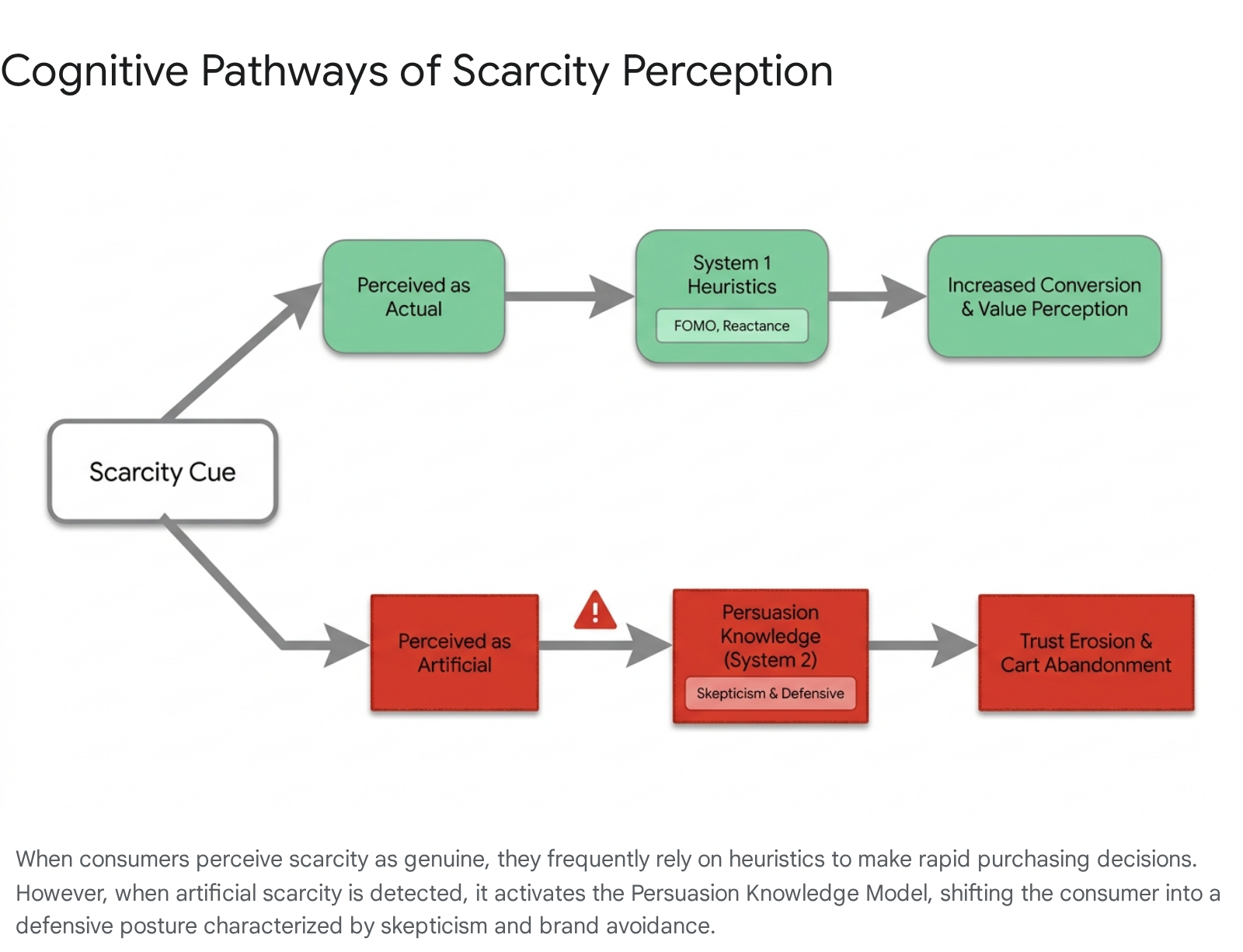
Once persuasion knowledge is activated, consumers deploy coping mechanisms characterized by profound skepticism, counterarguing, and psychological reactance directed against the brand itself 404245. Empirical studies demonstrate that supply-related scarcity appeals tend to be more effective than demand-related appeals specifically because they are perceived as more concrete and verifiable, thus activating less consumer skepticism and manipulation-detection 43. Vague terms drastically reduce the effectiveness of supply-related appeals because they fail to bypass the consumer's persuasion knowledge filters 43. Furthermore, transparent disclosures regarding the use of Artificial Intelligence in generating promotional content serve as novel persuasion-knowledge triggers, frequently reducing downstream trust and purchase intentions by reminding the consumer of the synthetic nature of the marketing effort 40.
Artificial Scarcity and Dark Patterns
The aggressive application of artificial scarcity is increasingly categorized by regulators and academics under the umbrella of "dark patterns" - manipulative, adversarial user interface designs intended to subvert user autonomy, restrict informed choice, and provoke impulsive action 24424647. Tactics such as false low-stock notifications, perpetual flash sales, and "confirmshaming" (making a consumer feel guilty for not taking a deal) impose a high cognitive burden and exact a severe emotional toll on consumers 2447.
A comprehensive 2023 empirical study assessing the impact of scarcity cues on e-commerce user experience (UX) found that the presence of limited-time cues significantly degraded the pragmatic usability of websites and induced frustration-related negative emotions, including stress and acute annoyance 24. Similarly, limited-quantity cues significantly lowered the hedonic experience scores, making sites appear opportunistic rather than neat or premium 24. The presence of these dark patterns directly diminished the perceived benevolence of the online vendor, clearly signaling to the consumer that the brand prioritizes short-term transactional extraction over customer welfare and transparent service 2446.
Consumer advocacy groups and regulators are increasingly scrutinizing these practices. Digital environments make it easy to display fake scarcity signals while preventing consumers from verifying actual stock levels, yet consumers are utilizing browser extensions, social media cross-referencing, and data tracking to expose brands that regularly repeat "limited time" offers or frequently restock "rare" items 25. This capacity to detect fake scarcity renders manufactured restrictions highly risky in highly networked consumer bases.
Long-Term Implications for Brand Trust and Loyalty
The dichotomy between short-term conversion gains and long-term relationship building is central to assessing the true return on investment of scarcity marketing.
Brand Erosion and Post-Purchase Dissonance
In saturated digital markets, transparency is paramount. Studies indicate that misleading scarcity tactics lead to immediate post-purchase dissonance, acute consumer regret, and intense backlash, significantly diminishing the likelihood of repeat purchases 12484950. When a consumer discovers that a "sold out" item was artificially restricted or immediately restocked, the resulting breach of trust damages brand credibility. As consumer trust indexes decline globally - with Edelman reporting notable drops in trust toward digital businesses - maintaining brand credibility has become a vital competitive differentiator 4851. Misusing consumer data or employing deceptive scarcity can decrease customer retention by up to 18% within a single year 48.
Impact on Customer Lifetime Value
The misuse of the scarcity heuristic poses a severe mathematical threat to Customer Lifetime Value (LTV) - the total projected revenue a business expects from a single customer account over the duration of their relationship 2252. While an aggressive countdown timer may forcefully extract a single transaction, the ensuing feelings of manipulation generate high churn rates 3122252. Considering that acquiring a new customer costs approximately six to seven times more than retaining an existing one, marketing strategies that alienate the customer base for an immediate, singular gain are financially sub-optimal and highly destructive to long-term profitability 2252.
Spillover Effects and Umbrella Branding
Conversely, when scarcity is applied authentically, strategically, and sparingly, it can actually enhance long-term brand equity and LTV. A robust empirical study of the Japanese consumer market investigated the long-term effects of limited-time product launches within the beverage industry. Utilizing seemingly unrelated regression models on individual-level transaction data, researchers found that authentic scarcity (seasonal limited-time beers) drove a rapid initial surge in demand 5354.
Crucially, this strategy generated a profound, positive long-term spillover effect for the parent brand (umbrella branding). The excitement, novelty, and exclusivity of the limited-time product revitalized consumer interest in the brand's standard, non-scarce portfolio. This dynamic created sustained sales lifts for regular products that persisted long after the scarce item was removed from the market, proving that authentic scarcity can function as a powerful loss-leader for broad brand engagement 5354.
Synthesis
The scarcity heuristic remains one of the most powerful psychological phenomena in consumer behavior, capable of driving profound shifts in purchasing decisions by exploiting deep-seated cognitive biases related to loss aversion, uniqueness, and competitive arousal. Its capacity to dramatically elevate conversion rates, shorten decision cycles, and justify premium pricing is unequivocally supported by decades of empirical research and contemporary digital analytics.
However, the modern consumer landscape demands a highly calibrated, ethical approach to scarcity. The ubiquity of digital commerce has exponentially accelerated consumer literacy regarding marketing manipulation. Consequently, the reliance on artificial scarcity and dark patterns yields diminishing returns, activating defensive persuasion knowledge, inducing post-purchase regret, and eroding the fundamental trust required for long-term brand equity.
To sustainably harness the scarcity heuristic, organizations must prioritize authenticity, verifiable constraints, and contextual alignment. Scarcity cues must reflect genuine supply constraints or structurally sound temporal limitations. Furthermore, strategies must adapt to specific cultural orientations, deploying uniqueness-driven supply limitations in individualistic markets and consensus-driven demand signals in collectivistic environments. Ultimately, the strategic value of scarcity lies not in its capacity to coerce a consumer into a single, friction-filled transaction, but in its potential to elevate perceived brand value, foster authentic community engagement, and sustainably increase Customer Lifetime Value.