
Social Comparison Theory for Corporate Professionals
Social Comparison Theory postulates that individuals possess a fundamental, innate drive to evaluate their own abilities, opinions, and socio-professional standing by comparing themselves to others, particularly when objective or non-social metrics are unavailable or ambiguous. Originally formulated in the mid-twentieth century, this psychological framework has become a critical lens through which organizational behavior, team dynamics, and human resource management are analyzed. In contemporary corporate environments - which are increasingly defined by digital transparency, algorithmic management, and fluid organizational structures - the mechanisms of social comparison exert a profound influence on employee well-being, motivation, and overall organizational productivity.
Foundations of Social Comparison Theory
The foundational premise of Social Comparison Theory is that human beings rely on social referents to establish a stable and accurate appraisal of their own identity and capabilities 12. This continuous evaluative process is neither inherently beneficial nor detrimental; rather, it functions as a baseline cognitive mechanism for navigating complex social hierarchies and establishing behavioral norms.
Directional Comparison Mechanisms
Social comparisons are systematically categorized along three distinct directional axes, each serving different psychological motives and yielding varying emotional responses:
- Upward Social Comparison: This involves evaluating oneself against an individual or group perceived to be superior in terms of skills, achievements, or organizational status 34. Upward comparisons are often driven by a motivation for self-improvement and goal-setting. However, because they inherently highlight a discrepancy between the observer's current state and a higher standard, they can also trigger feelings of inadequacy and self-threat 56.
- Downward Social Comparison: This mechanism involves contrasting oneself with individuals perceived as inferior, less successful, or worse off. Downward comparisons are typically ego-defensive, utilized to protect self-esteem, alleviate psychological distress, and generate feelings of relief or gratitude during periods of occupational hardship or failure 17.
- Lateral Social Comparison: Also known as similarity testing, this occurs when individuals evaluate themselves against peers of roughly equal standing. The primary goal of lateral comparison is self-evaluation and normative alignment, allowing employees to gauge acceptable behavior, coordinate efforts, and maintain an accurate self-concept within a team setting 28.
The frequency and intensity of these comparisons are mediated by an individual's Social Comparison Orientation (SCO) - a dispositional trait reflecting a person's chronic sensitivity to social comparison information. Employees with high SCO invest significant cognitive resources into monitoring their environment, rendering them highly reactive to the emotional and behavioral consequences of peer benchmarking 91011.
The Selective Accessibility Model
The cognitive processing of comparative data is best understood through the Selective Accessibility Model. This framework argues that comparing oneself to a social standard actively alters the accessibility of specific self-knowledge, thereby driving downstream self-evaluative and behavioral outcomes 1213.
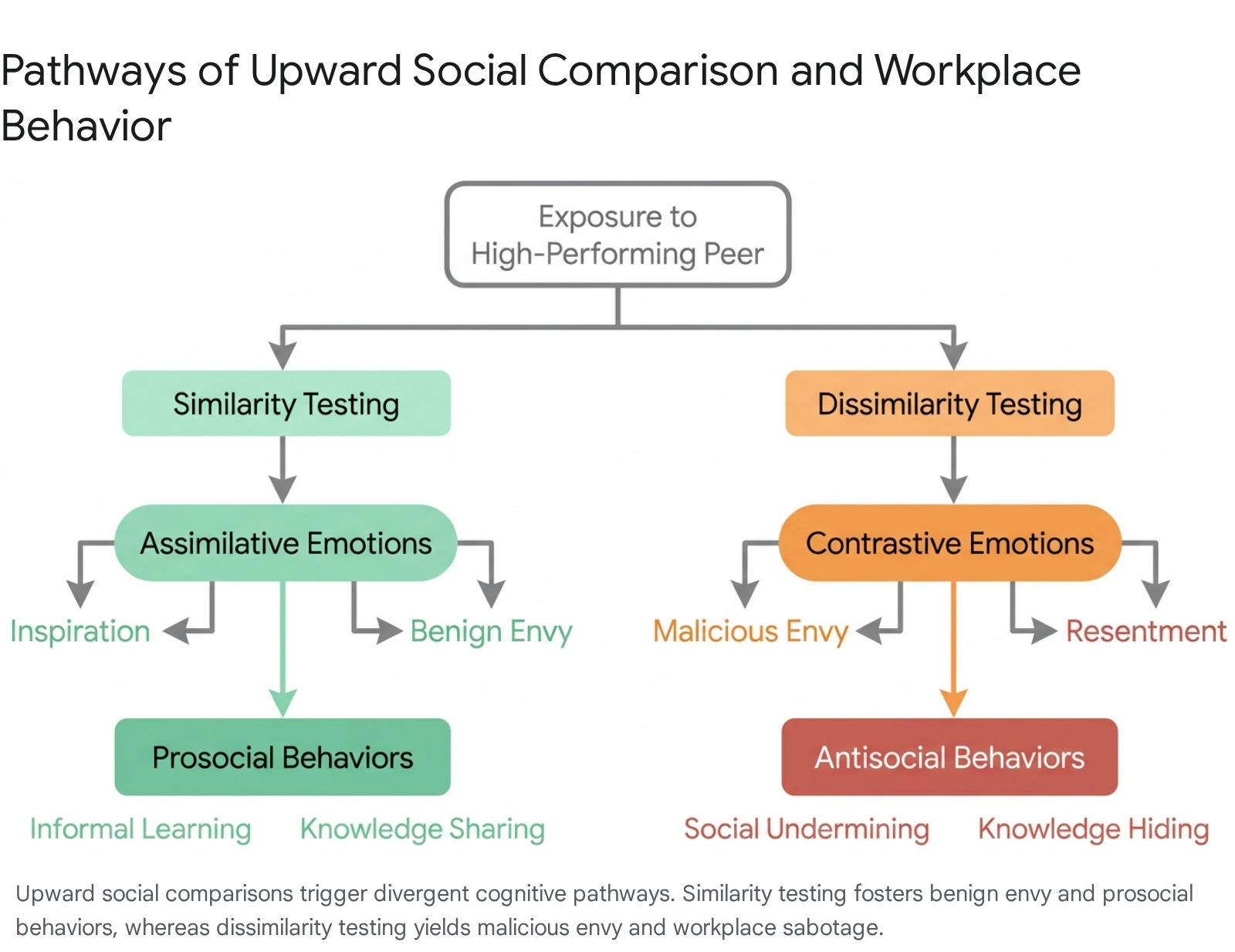
When an employee engages in a comparison, they unconsciously select between two evaluative cognitive paths: 1. Similarity Testing: If an employee perceives a high-performing colleague as fundamentally similar to themselves (e.g., similar educational background or tenure), they engage in similarity testing. This process selectively retrieves self-knowledge that aligns with the colleague's success, leading to an "assimilation" effect. The employee evaluates themselves more positively and feels capable of mirroring those achievements 121415. 2. Dissimilarity Testing: If the employee perceives the high performer as fundamentally different or possessing unattainable systemic advantages, they engage in dissimilarity testing. This selectively activates self-knowledge that highlights the employee's own shortcomings and constraints, resulting in a "contrast" effect characterized by lowered self-esteem and negative affect 121316.
Ability Versus Opinion Comparisons
The impact of social comparison is further delineated by the specific dimension being evaluated. Research distinguishing between ability-based comparisons (evaluating skills, output, and performance metrics) and opinion-based comparisons (evaluating beliefs, attitudes, and values) reveals differing impacts on subjective well-being.
Exposure to ability-related social comparisons, particularly in transparent or highly competitive environments, consistently elicits lower subjective well-being and higher anxiety than exposure to opinion-related comparisons 17. Ability comparisons emphasize a hierarchical ranking of competence that directly threatens professional self-efficacy, whereas opinion comparisons emphasize social integration and consensus-building without necessarily implying inferiority 1117.
Psychological and Behavioral Outcomes
The affective reactions triggered by social comparison subsequently govern employee behavior. In the workplace, these reactions dictate whether individuals engage in prosocial, self-improving actions or resort to antisocial, destructive behaviors aimed at restoring equity.
The Dual Nature of Workplace Envy
When employees compare themselves upwardly to superior peers, the outcome is heavily influenced by the nature of the emotion elicited: benign or malicious envy. These two distinct emotional states represent the "bright" and "dark" sides of upward comparison in organizational life 1819.
Benign envy is characterized by a desire for self-improvement and an acknowledgment that the superior peer's success is deserved, legitimate, and potentially attainable 518. In organizational settings, upward social comparison mediated by benign envy correlates positively with job performance, informal workplace learning, and self-development initiatives 51018. Employees experiencing benign envy attempt to bridge the performance gap by engaging in constructive behaviors, often viewing high performers as valuable sources of work resources and expertise 19.
Conversely, malicious envy is a painful emotional experience rooted in feelings of inferiority, frustration, and a perceived unfair distribution of systemic resources 59. When upward social comparisons trigger malicious envy, individuals focus not on elevating themselves, but on tearing down the comparison target. This manifests in toxic organizational behaviors, including social undermining, the reduction of interpersonal citizenship behaviors, and deliberate isolation of the target 5919.
Knowledge Sharing Versus Knowledge Sabotage
The cognitive appraisal of resource availability directly influences knowledge management within teams. From a cognitive perspective, employees may view high performers either as beneficial sources of work resources (opportunities to learn new skills) or as threats who deplete access to limited material or social capital (promotions, status) 19.
When an employee feels inspired or perceives a potential gain in resources, they are more likely to engage in knowledge sharing - voluntarily providing their own expertise and information to high performers to maintain positive social proximity 19. However, triggered by malicious envy or perceived resource loss, employees may purposefully withhold work-related information that a high performer has requested, a practice known as knowledge hiding 1919. In extreme cases, employees may engage in knowledge sabotage, deliberately supplying incorrect or incomplete information to undermine a peer's performance and artificially restore comparative equity 19.
Downward Comparison and Adversarial Growth
While downward comparisons are often dismissed as mere ego-defense mechanisms, they play a critical role in how employees process severe adversity and workplace stress. Studies indicate that individuals facing occupational hardship who engage in downward social comparisons - evaluating themselves against peers in even more difficult situations - often experience enhanced "adversarial growth" 1.
This growth is statistically mediated by increased self-acceptance and gratitude. By observing others facing greater challenges, employees with high interpersonal sensitivity are able to contextualize their own difficulties, mitigating emotional exhaustion and rebuilding their internal professional identity 113. However, the utility of downward comparison is context-dependent. In stable, non-adverse environments, chronic reliance on downward comparisons can lead to professional complacency, reduced innovation, and a decrease in motivation for continuous improvement 7.
Structural Contexts and Status Dynamics
The formal and informal structures of an organization dictate the availability of comparative data and shape how that data is processed. The ongoing transition from traditional corporate hierarchies to agile, flat organizational models has profound implications for social comparison.
Formal Hierarchies and Seniority Pressures
In traditional, steep hierarchies, organizational status is formally codified. While this provides clarity regarding reporting lines, it also creates high-stakes environments for social comparison among senior personnel. Empirical evidence from both field data and experimental scenarios demonstrates that employees higher in an organizational hierarchy are substantially more likely to engage in deceptive behaviors when confronted with negative social comparisons 20.
Because highly successful, senior individuals have deeply internalized their high-status identities, they face a disproportionately greater psychological loss from negative lateral or upward comparisons compared to junior staff 20. When their reported performance metrics fall slightly below a meaningful peer standard, the pressure to restore relative standing often incentivizes status-enhancing deception over legitimate performance improvement. Specific career concerns, such as impending tenure reviews or job mobility, do not strongly predict this deceptive behavior; rather, the protection of hierarchical status itself is the primary driver 20.
Informal Status Hierarchies in Flat Organizations
Many contemporary organizations attempt to eliminate formal management layers to create "flat" structures, seeking faster decision-making, enhanced agility, and increased employee autonomy 212223. However, sociological research demonstrates that human collectives are rarely devoid of hierarchy. In the absence of formal authority, "informal status hierarchies" rapidly emerge based on perceived competence, social influence, and historical contribution 2425.
In flat models, employees lack clear, codified benchmarks for career progression, leading to a heightened reliance on lateral social comparisons to determine their relative standing 2728. This intense comparative environment can lead to role ambiguity and peer rivalry. Team performance in these environments is heavily dependent on a specific dispositional trait known as "status acuity" - the ability of individuals to accurately perceive the informal status hierarchies within their group 24. Teams composed of individuals with high status acuity experience less status conflict and demonstrate superior collective intelligence, as they intuitively understand and navigate the unwritten comparative rankings governing team dynamics 2426.
| Organizational Structure | Primary Source of Comparison | Comparison Dynamics | Key Vulnerabilities |
|---|---|---|---|
| Traditional Hierarchical | Formal titles, defined pay bands, top-down metrics. | Upward comparisons dominate; status is highly visible. | Senior-level deception to maintain status; silos; slowed communication 2028. |
| Flat / Agile | Peer influence, output visibility, informal networks. | Lateral comparisons dominate; ambiguity drives continuous benchmarking. | High status conflict if status acuity is low; role ambiguity; burnout from over-contribution 222427. |
| Hybrid | Centralized strategy with decentralized tactical execution. | Combination of formal upward and informal lateral comparisons. | Misalignment between formal evaluation and informal team contribution 22. |
The Digitization of Social Comparison
The widespread transition to remote and hybrid work environments has fundamentally digitized social comparison. Physical cues of effort, status, and dedication have been replaced by digital signals, fundamentally altering how employees evaluate their relative standing.
Performative Presence and the Green Status Effect
In remote work environments, the ambient visibility of the traditional office is absent. Consequently, employees increasingly rely on digital indicators - most notably the "green dot" active status indicator on platforms like Slack or Microsoft Teams - to signal their diligence 313233. This phenomenon, termed the "green status effect," subtly shifts the organizational focus from objective output to continuous visibility and responsiveness 31.
This environment forces employees into continuous lateral comparisons regarding response times and digital availability. The pressure to maintain a performative presence leads to digital anxiety, frequent interruptions that destroy capacity for deep work, and high risks of cognitive fatigue 3133. When visibility becomes the primary metric of engagement, organizations suffer from "productivity theater," a state where the performative signaling of work supersedes the completion of actual, strategic tasks 323334.
Platform Architecture: Public Channels and Awareness
The choice of digital collaboration platforms inherently shapes comparison dynamics. Market data indicates that platform architecture influences perceived empowerment; roughly 65% of Slack users report feeling empowered to make strategic decisions, compared to 46% of Microsoft Teams users, correlating with Slack's heavier adoption in flat, agile startup environments versus Teams' dominance in structured, hierarchical enterprises 35.
The use of public communication channels (as opposed to isolated direct messages) serves to democratize information but also amplifies comparison. Transitioning to open, public channels increases situational awareness and cross-team collaboration, allowing junior engineers to spot optimization opportunities previously siloed in private groups 28. However, this extreme transparency means that praise, critique, and work cadence are continuously broadcast, providing a relentless stream of data for upward and lateral social comparison.
Enterprise Social Media and Impostor Thoughts
The adoption of internal Enterprise Social Media (ESM) platforms creates a highly transparent environment where colleagues' achievements, public praise, and project milestones are visible to the entire organization. While intended to foster a connected culture, ESM visibility provides an unavoidable stream of data for upward social comparison 11.
When employees observe the highly curated, seemingly effortless successes of their peers on ESM, those with a high Social Comparison Orientation frequently experience workplace impostor thoughts - a psychological state characterized by self-doubt and the fear of being exposed as a professional fraud 11. The transparency of ESM exacerbates the contrastive effects of upward comparison. This dynamic leads to diminished workplace well-being and a defensive reduction in knowledge-sharing behaviors, as employees attempt to conceal their perceived inadequacies from the broader digital audience 11.
Algorithmic Management and Performance Benchmarking
The integration of Artificial Intelligence (AI) and data analytics into human resource functions has formalized Algorithmic Management (AM) - the use of data-driven systems to automate work allocation, digital monitoring, and performance evaluation 192930. Algorithmic Management institutionalizes social comparison by generating continuous, hyper-quantified comparative benchmarks.
Psychological Ownership and Algorithm Transparency
While algorithms promise objective performance evaluations theoretically free of human bias, their implementation often triggers severe psychological pushback. When employee behaviors and task completion rates are algorithmically tracked and compared against digital benchmarks, individuals frequently experience a loss of psychological ownership over their personal knowledge and output 19. The perception that an algorithm dictates professional value leads to feelings of alienation, which subsequently drives increased knowledge hiding as employees attempt to subvert algorithmic surveillance 19.
The negative effects of algorithmic comparison can be heavily mitigated through "algorithm transparency." When organizations explicitly disclose the mathematical principles, data inputs, and specific decision criteria utilized by the algorithm, employees perceive the evaluation process as procedurally just 2931. High transparency shifts the employee's cognitive focus from interpersonal comparison (measuring oneself against a peer) to criteria-based comparison (measuring oneself against a defined algorithmic standard). This alignment enhances perceived fit and stimulates proactive job crafting and innovation 2930.
Social Expectation Pressure and Turnover Intentions
The proliferation of digital performance metrics and external professional networking sites (e.g., LinkedIn) subjects employees to intense "social expectation pressure" 32. Employees continuously measure their career velocity, compensation, and organizational support against idealized benchmarks visible across digital platforms 324133.
This chronic upward social comparison strongly mediates employee turnover intention. When an employee perceives a deficit in organizational justice or compensation relative to their digital peers, their job embeddedness decreases, and their intention to leave the organization rises significantly 323435. Generational studies indicate that Millennials and Generation Z are particularly sensitive to these comparative disparities. These cohorts exhibit markedly higher turnover intentions when subjected to rigid hierarchical cultures that restrict their autonomy and limit their ability to achieve parity with the upward comparisons they observe online 3235.
Cross-Cultural Dimensions of Comparison
The mechanisms of social comparison are deeply embedded in the broader cultural context of the workforce. Differences between individualistic and collectivistic organizational cultures determine both the preferred targets of comparison and the behavioral responses to comparison data 363747.
Individualistic Organizational Cultures
In individualistic cultures - predominantly found in the United States, Western Europe, and Australia - the workplace is viewed as a platform for personal achievement, self-expression, and individual autonomy 474838. Social comparisons in these environments are primarily driven by cost-benefit analyses related to personal advancement. Individualists prefer to use social comparisons to differentiate themselves from the group, establishing a unique value proposition 3639.
When faced with extreme job demands or stress, employees in individualistic cultures are more likely to utilize individual-oriented job resources (such as seeking personal control or using specific social support networks) to protect their self-esteem, as they are culturally conditioned to prioritize their own well-being and career progression over group cohesion 3740.
Collectivistic Organizational Cultures
Conversely, collectivistic workplace cultures - common in many Asian, Latin American, and African contexts - prioritize group harmony, interdependence, and the subordination of personal ambitions to overarching organizational goals 36483840. In these settings, employees define their professional identity through their relationships and their standing within the organizational "in-group" 4739.
Social comparison in collectivistic environments is frequently utilized to ensure normative alignment and conformity, rather than individual differentiation. Employees engage in lateral and upward comparisons to identify the standard behaviors required to maintain group harmony 4741. Furthermore, because relationships in collectivistic cultures are viewed as less voluntary and more governed by obligation, employees may hesitate to seek individual social support to relieve strain, fearing it may disrupt the collective equilibrium or impose undue burdens on peers 37.
| Cultural Orientation | Primary Focus | Comparison Objective | Response to High Job Demands |
|---|---|---|---|
| Individualistic | Personal achievement, autonomy, uniqueness. | Differentiation from peers; competitive advantage. | Seeks individual resources; engages in downward comparison to protect self-esteem 363739. |
| Collectivistic | Group harmony, interdependence, loyalty. | Normative alignment; assessing contribution to the group. | Suppresses individual strain to maintain group harmony; relies on collective resources 363747. |
Practical Implications for Corporate Professionals
Understanding the granular mechanics of Social Comparison Theory allows corporate leaders and human resource professionals to design environments that maximize the motivational benefits of benign comparison while systematically neutralizing the toxic effects of malicious envy, impostor syndrome, and performative anxiety.
Mitigating Productivity Theater via Asynchronous Communication
To combat the "green status effect" and the resulting epidemic of productivity theater, managers must explicitly decouple digital presence from performance evaluation. Organizations should transition toward asynchronous communication models where updates are periodic and explicitly focused on deliverables rather than instant availability 313453. By assessing employees strictly on output and strategic impact, managers eliminate the superficial lateral comparisons regarding who responds fastest or logs off last, thereby drastically reducing digital burnout, anxiety, and the compulsion to fake visibility 323334.
Trajectory Visibility and Feedback Structuring
Unstructured upward comparisons naturally breed malicious envy, particularly when organizational resources, promotions, or praise are perceived as zero-sum games. Managers must structure feedback and visibility to highlight the attainability of success.
Instead of solely celebrating the final achievements of high performers, leadership should implement "trajectory visibility." New or junior workers frequently suffer from a fundamental attribution bias, assuming that the superior performance of senior colleagues is the result of innate, unmatchable ability 42. By making the historical progression of these individuals visible - showcasing their early struggles, learning curves, and accumulated experience - management shifts the junior employee's cognitive appraisal from dissimilarity testing to similarity testing. This intervention drastically reduces the psychological costs of comparison, fostering inspiration and benign envy rather than resentment 42.
Designing Peer Recognition Systems
When implementing Peer Recognition Points (PRP) or public praise dashboards on platforms like Slack, the recognition must be meticulously tied to specific, core organizational values rather than generic popularity 4344. By explicitly linking praise to collaborative behaviors or specific competencies, the focus of the social comparison shifts from the individual receiving the praise to the behavior being praised. This alignment encourages peers to emulate the constructive behavior, effectively utilizing the human drive for comparative status to reinforce positive organizational culture rather than triggering interpersonal rivalry 43.
Identity Safety and Rejecting Toxic Positivity
Corporate cultures that attempt to suppress natural social comparison through "toxic positivity" - such as insisting the workplace is a "family" - frequently backfire. These narratives force artificial conformity and make it psychologically unsafe for employees to voice legitimate concerns regarding inequity, burnout, or comparative struggle 45.
Instead, leaders must prioritize "identity-safety." This is particularly critical for minority or underrepresented employees (e.g., Black women with "duo status" in predominantly white corporate environments), who experience a significantly higher cognitive load from constant, highly visible social comparisons 46. These individuals often face heightened concerns about assimilation and representation. Acknowledging structural differences, ensuring equitable access to mentorship, and allowing for structured, constructive complaining provides safe avenues for the emotional processing of comparison data. Cultivating environments where psychological safety supersedes performative positivity ultimately builds a more resilient, collaborative, and high-performing corporate culture 465947.