
Social media social comparison and envy-based purchasing behavior
Theoretical Foundations of Digital Social Comparison
The intersection of digital social networking and consumer psychology has fundamentally altered the mechanics of status signaling and acquisition. At the core of this transformation is social comparison theory, originally formulated by Leon Festinger in 1954, which posits that individuals possess an innate drive to evaluate their own progress, abilities, and social standing by comparing themselves to others 1234. In offline environments, social comparison is bounded by geographic, temporal, and social limitations, providing natural buffers against constant self-evaluation. However, the architecture of modern social media platforms removes these friction points, exposing users to a perpetual, curated stream of idealized lifestyles, conspicuous consumption, and peer achievements 15.
This environment hyper-stimulates upward social comparison, a phenomenon characterized by comparing oneself to individuals perceived as possessing superior wealth, attractiveness, or social status 567. Constant exposure to aspirational content invokes aversive psychological states defined by feelings of inferiority, self-threat, and relative deprivation 89. Because inferiority operates as an uncomfortable emotional state, consumers are deeply motivated to alleviate it and restore a sense of personal superiority or parity 810. Within digital ecosystems, this psychological restitution is predominantly achieved through consumer behavior, effectively transforming social media platforms into potent catalysts for envy-induced purchasing.
Extensive research indicates that over 70% of consumers report their purchasing decisions are influenced by social media, with significantly higher rates of impulse buying observed among active platform users compared to non-users 1112. Consumers influenced by social media ecosystems and celebrity influencers are recorded as spending four times more on impulse purchases than individuals isolated from these digital environments 12. The velocity of this behavior is driven by the fact that digital self-presentation directly fuels the social comparison tendencies of the observer, which subsequently triggers conspicuous consumption as a primary coping mechanism 814.
The Dichotomy of Social Media Envy
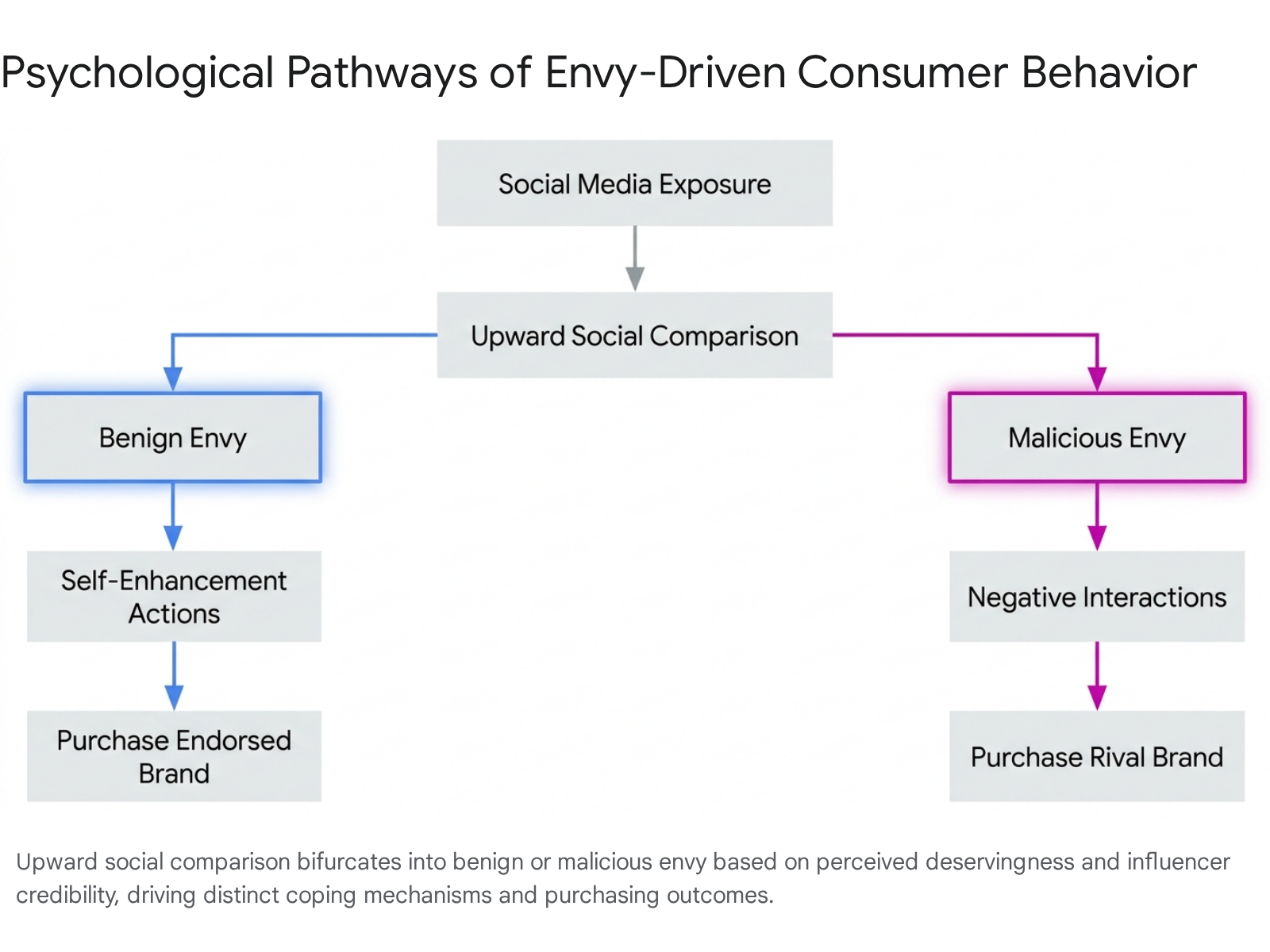
Envy operates as the primary emotional mediator between upward social comparison and subsequent purchasing behavior 5613. However, clinical and consumer psychology delineates social media envy into two distinct motivational dynamics: benign envy and malicious envy 51014. The specific typology of envy experienced by the consumer dictates not only their psychological well-being but also their distinct brand choices and behavioral interactions on social networking sites.
Benign Envy and Aspirational Consumption
Benign envy is an upward comparison-based emotion devoid of hostility. It is characterized by a desire for self-improvement and a motivation to elevate one's own status to match that of the envied individual 515. When a consumer experiences benign envy after viewing a social media influencer's luxury purchase or curated experience, the emotion stimulates a desire to acquire the coveted possessions to emulate the influencer's success 11416.
This emotional state is strongly associated with aspirational consumption. Consumers experiencing benign envy exhibit a significantly higher intention to purchase the exact same brand endorsed or showcased by the envied influencer 517. The psychological mechanism at play is emulation; the consumer believes that acquiring the specific endorsed product will transfer the influencer's social capital and status to themselves. Furthermore, benign envy is positively correlated with constructive social networking actions. Individuals driven by benign envy are more likely to engage in positive interactions, such as liking or commenting on the influencer's posts, and are motivated to perform self-enhancement actions, such as posting high-quality content of their own to improve their social standing and reinforce their sense of belonging 15.
Malicious Envy and Differentiative Consumption
Conversely, malicious envy is a hostile, pain-driven emotion characterized by resentment and a desire to denigrate the envied person's advantage or pull them down to a lower social tier 515. Rather than fostering a motivation for self-improvement, malicious envy generates intense frustration regarding the consumer's inability to achieve the portrayed lifestyle, which frequently correlates with increased depressive symptoms, self-objectification, and a deep sense of social isolation 146.
In terms of consumer behavior, malicious envy drives differentiative consumption. A maliciously envious consumer will actively avoid purchasing the specific brand endorsed by the influencer. Instead, they demonstrate a higher intention to purchase a rival brand that is perceived as similar but ultimately superior in status or quality 51617. By choosing a superior rival product, the consumer attempts to differentiate themselves and subtly suppress the status of the envied influencer. Behaviorally on digital platforms, malicious enviers engage in maladaptive coping mechanisms, such as unfollowing the envied account, leaving negative comments, or engaging in external gossip, which ultimately diminishes their own sense of belonging and exacerbates negative self-perceptions 1315.
Antecedents of Envy Orientation
Whether an upward social comparison results in benign or malicious envy depends on several mediating variables regarding how the influencer and the showcased product are perceived by the consumer. Extensive empirical analysis, including studies published in the Journal of Research in Interactive Marketing surveying hundreds of social media users, identifies four primary factors that influence this bifurcation 517.
Perceived homophily, defined as the degree of perceived similarity between the consumer and the influencer regarding values, preferences, and social status, strongly triggers the arousal of both benign and malicious envy 520. Similarly, high product symbolism - the degree to which a product communicates a distinctive self-image - amplifies both forms of envy 517.
The divergence between the two envy states relies heavily on influencer credibility and perceived deservingness. An influencer's perceived credibility, encompassing their expertise, attractiveness, and trustworthiness, has a significant positive effect on benign envy but a strong negative effect on malicious envy 5. Highly credible influencers inspire aspiration rather than resentment. Furthermore, if the consumer believes the influencer earned their lifestyle or rewards through hard work or talent, malicious envy is significantly reduced. Perceived deservingness actively mitigates hostility, though research demonstrates it has no significant direct effect on benign envy 516.
Finally, perceived control operates as a powerful behavioral moderator. A consumer's belief in their financial or social ability to acquire the envied object amplifies the effects of benign envy, driving them strongly toward the endorsed brand. However, the effect of malicious envy on the choice to purchase rival brands is largely uninfluenced by the consumer's perceived control, as the primary drive is psychological differentiation rather than literal acquisition 517.
Psychological Pathways to Compulsive Buying
Beyond isolated, rational purchase decisions, the persistent cycle of social media comparison frequently leads to problematic and maladaptive consumer behavior. The Interaction of Person-Affect-Cognition-Execution (I-PACE) model provides a structural framework for understanding how upward social comparison transitions into online compulsive buying 6.
Under the I-PACE framework, upward social comparison elicits specific affective responses - most notably envy - which interact intensely with preexisting cognitive traits, such as materialism. Materialism acts as a sequential mediator in this process. Perpetual exposure to aspirational influencer content normalizes the belief that self-worth and happiness are intrinsically tied to material possessions 69. This cognitive baseline subsequently intensifies feelings of envy when a consumer observes a peer's conspicuous consumption.
Empirical studies examining large cohorts of university students demonstrate that this combination of materialism and envy significantly increases the likelihood of compulsive, impulsive buying 618. Consumers attempt to rapidly resolve their psychological self-discrepancies and feelings of social isolation through immediate acquisition, utilizing platforms that prioritize instant gratification 619. Furthermore, passive social media usage - defined as infinite scrolling without active social engagement - has been shown to exacerbate these feelings of inadequacy, rendering consumers exceptionally susceptible to the psychological triggers of influencer marketing 9.
Conversely, specific cognitive traits act as protective buffers against compulsive acquisition. Consumers demonstrating high self-esteem or self-compassion are fundamentally less likely to internalize upward social comparisons as threats to their core identity. Self-compassion reduces the tendency toward self-objectification, thereby decreasing appearance anxiety and the subsequent drive for compensatory consumption 47.
Adaptation and Measurement of Social Media Envy
The robust impact of these emotions on market dynamics has necessitated advanced psychometric tools to measure platform-induced jealousy. The Social Media Envy Scale (SMES) was developed to quantify the complex, mixed emotions arising from the perception of lacking superior qualities or possessions showcased online 10. Recent cross-cultural validations of the SMES, including a comprehensive study adapting the scale to Turkish culture across 410 participants, have demonstrated significant criterion validity. The data reveals that high scores on the SMES correlate moderately negatively with general life satisfaction and positively with clinical symptoms of depression, anxiety, and stress, underscoring the severe psychological friction generated by curated digital feeds 1013.
The Moderating Role of Product Categorization
The degree of envy elicited by a social media post is not uniform across all product categories. Extensive research highlights a critical distinction between experiential purchases, such as luxury vacations, bespoke dining, or exclusive events, and material purchases, including designer clothing, high-end electronics, and vehicles.
In a natural, unprompted browsing state, experiential purchases trigger significantly more envy than material purchases 2021. This phenomenon is rooted in the concept of self-relevance. Consumers view experiences as deeply central to personal identity, memory formation, and holistic well-being compared to physical objects. When an individual compares their overall happiness and life satisfaction to an influencer's curated experiential posts, the resulting self-discrepancy feels profound and intimately personal 320.
However, this dynamic flips completely when the consumer is prompted to compare a specific online purchase to an equivalent purchase they already own. When the comparison shifts from abstract well-being to concrete product features, material purchases elicit substantially greater envy 321. Material goods possess objective, easily comparable metrics - such as brand tier, retail price, and technical specifications - making an upward comparison sharper, less subjective, and more definitive 20. Consequently, influencers showcasing material wealth tend to trigger immediate conspicuous consumption urges through direct product comparison, while those showcasing experiential wealth trigger broader lifestyle envy and long-term aspirational longing.
Platform Architecture and Comparison Triggers
The mechanisms of social comparison and subsequent purchasing behavior are not solely determined by the user's psychology; they are heavily dictated by the underlying architecture of the social media platform itself. The algorithms, content formats, and social graphs of a given network fundamentally determine what type of comparison is triggered and how seamlessly that envy can be converted into a commercial transaction.
Visual Grids Versus Algorithmic Feeds
Platforms such as Instagram are built on static visual grids and heavily favor follower-based social graphs. Content is generally highly polished, heavily curated, and aesthetically driven. Because users predominantly consume content from established macro-influencers and peers they have actively chosen to follow, the platform serves as an engine for lifestyle envy, body image comparison, and appearance anxiety 2425. The curation inherent to Instagram fosters an environment where conspicuous consumption is evaluated through the lens of aesthetic perfection and established social hierarchies.
Conversely, platforms like TikTok and Douyin operate as entertainment-first, discovery-driven video engines governed by hyper-personalized behavioral algorithms 262728. Users are continuously exposed to viral content from unknown creators, resulting in social comparison centered less on permanent lifestyle wealth and more on immediate creativity, cultural relevance, and trend participation 2. The rapid, short-form nature of the content normalizes fast-paced consumerism, creating an environment where impulse buying thrives on spontaneous, trend-driven urges rather than long-term aspirational planning 2930. Data from 2025 indicates that TikTok's algorithm strongly favors discoverability, averaging roughly 6,268 impressions per post compared to Instagram's 2,635, exposing users to a vastly wider array of comparison triggers outside their immediate social circle 30.
The Chinese Social Commerce Ecosystem
The most advanced manifestations of digital envy and frictionless social commerce currently exist within the Chinese digital ecosystem. In this landscape, platforms operate not merely as media networks, but as fully integrated consumer infrastructures where social interaction, e-commerce, and customer relationship management are entirely centralized 313233.
| Platform | Primary Content Architecture | Social Comparison Mechanism | Commerce Integration Strategy |
|---|---|---|---|
| Xiaohongshu (RED) | Search-driven reviews, tutorials, visual lifestyle guides | Taste, social capital, KOC trust | Deep social commerce integration; functions as a visual search engine for high-intent product research. |
| Private domain, strong-tie messaging, closed social feeds | Peer-to-peer trust, local community standing, relational consumption | Frictionless "Mini Programs" facilitating transactions within the app; prioritizes long-term retention. | |
| Douyin | Algorithmic short-form video, rapid entertainment | Trend participation, virality, talent, impulse desire | Native storefronts and aggressive live streaming; maximizes impulse buys through instant gratification. |
Xiaohongshu (RED): Operating as a hybrid of a social network, lifestyle guide, and visual search engine, Xiaohongshu is fundamentally driven by high purchase intent and peer trust. The platform's architecture promotes in-depth product reviews, educational tutorials, and lifestyle guides crafted by Key Opinion Consumers (KOCs) 262733. Xiaohongshu blurs the line between digital engagement and physical consumption. A prime example is the "Chic Coffee" phenomenon, where acquiring and posting about niche coffee evolved from an act of consuming a beverage to consuming social capital. Users compare themselves based on local, digitally mediated cultural practices rather than sheer financial wealth .
WeChat: As a "private domain" super-app reliant on strong interpersonal ties, WeChat fosters a vastly different comparison dynamic. Social comparison on WeChat Moments (a closed, friend-only social feed) is deeply relational and tied to trust among acquaintances 283536. The platform prioritizes long-term brand loyalty and retention over rapid virality. E-commerce is seamlessly facilitated through "Mini Programs" - lightweight, native applications that allow users to discover a product via a friend's post, consult an official brand account, and complete a transaction using WeChat Pay without ever leaving the ecosystem 372239.
Douyin: As the domestic equivalent of TikTok, Douyin relies on an aggressive recommendation algorithm to deliver high-energy, short-form videos to its 750 million monthly active users 40. The platform excels in driving immediate awareness and sales through viral challenges and live streaming. Douyin's personalized content triggers instant gratification mechanisms and impulse buying, particularly among younger, student-aged demographics, turning casual viewers into cultural consumers whose identities are rapidly shaped by algorithmic trends 4042.
The Financial Impact of Frictionless Social Commerce
Historically, a profound vulnerability in social media marketing was the friction inherent in the customer journey. A user might experience intense envy upon seeing a product, but would ultimately abandon the purchase if forced to navigate away from the platform, wait for an external website to load, manually enter payment details, and complete a cumbersome checkout process. The advent of native social commerce - such as TikTok Shop, Instagram Checkout, and WeChat Mini Programs - has structurally eliminated this friction 432345.
By embedding native checkout capabilities directly into the content feed, digital platforms have effectively collapsed the traditional marketing funnel. A consumer can now discover a product, experience the psychological pang of envy or the fear of missing out, and execute a purchase within a matter of seconds. This unified commerce approach capitalizes entirely on the emotional spike before rational, cognitive deliberation can intervene to halt the transaction 124345.
The financial implications of this structural friction reduction are massive. Projections for 2026 indicate that the United States social commerce market will surpass $100 billion, representing over 7% of all U.S. e-commerce sales, while the global market is projected to reach $8.5 trillion by 2030 23. Data indicates that native social commerce experiences yield conversion rates that vastly outpace traditional digital retail. For example, TikTok Shop consistently achieves an average conversion rate of 4.7%, more than double that of Instagram Shopping at 2.1%, and nearly triple the global standalone e-commerce average of roughly 1.9% 2346.
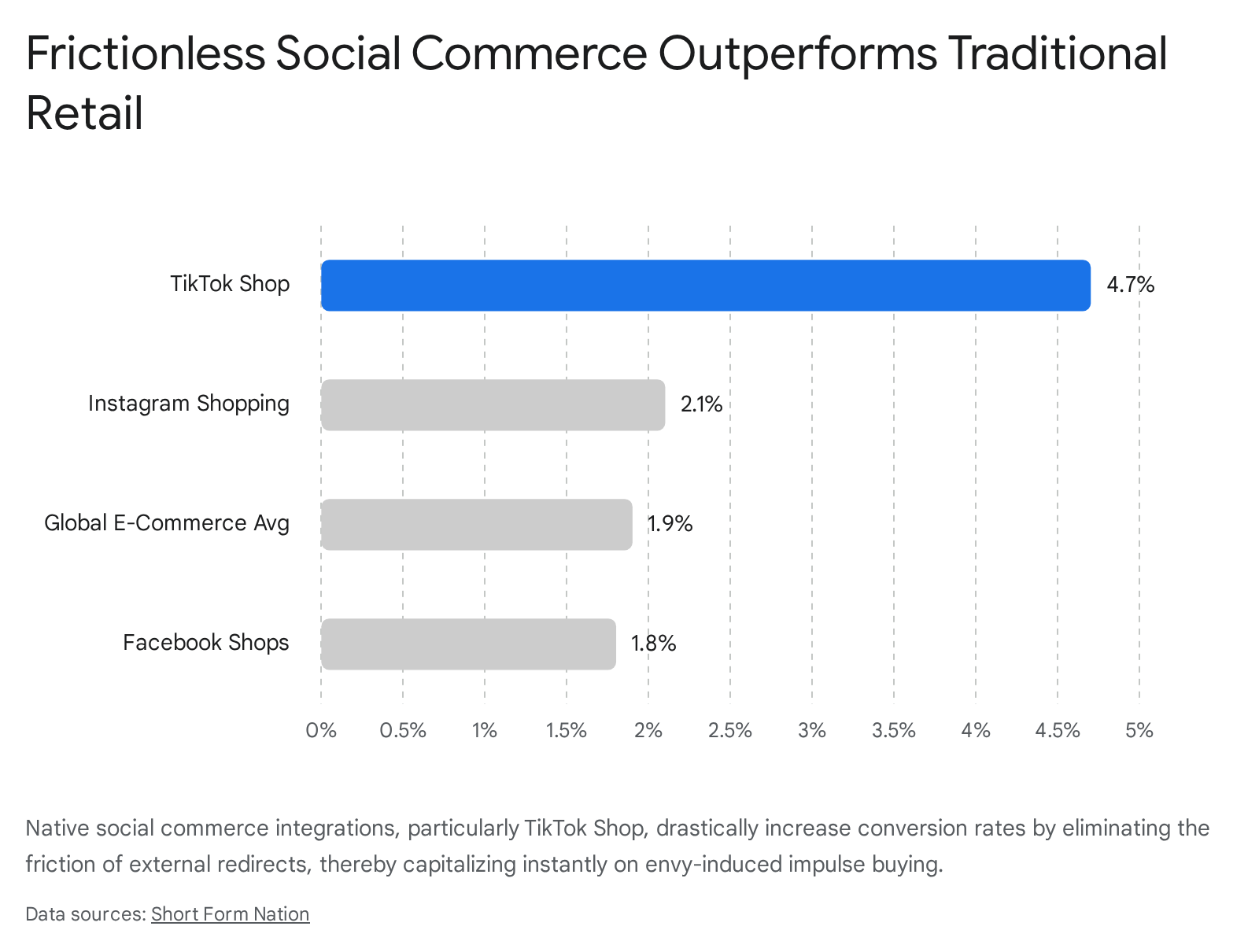
TikTok Shop alone is projected to generate $23.4 billion in U.S. e-commerce sales in 2026, driven entirely by an algorithm-driven discovery engine that merges content and commerce 2346.
Parasocial Relationships and Live Streaming Commerce
The efficacy of frictionless commerce is further amplified by the integration of live streaming, a format that merges social interaction, entertainment, and e-commerce into a single viewing experience. Live commerce heavily leverages parasocial relationships - the one-sided emotional bonds developed between viewers and digital influencers 1224. Through real-time Q&A sessions, live product demonstrations, and interactive engagement, live streamers cultivate a deep sense of intimacy, authority, and trust with their audience 2526.
Research targeting Generation Z consumers reveals that impulse buying during live streams is driven less by utilitarian value (practical need or functional benefit) and almost entirely by hedonic and symbolic value 26. The live environment artificially induces scarcity and urgency through limited-time discounts and exclusive promotional bundles, while simultaneously fulfilling the consumer's desire for social connection and self-expression. During these broadcasts, the host acts as both an aspirational figure and a trusted peer, ensuring that the social proof required to validate the purchase is provided in real-time, effectively bypassing traditional cognitive skepticism 452550.
Counter-Movements: De-Influencing and Minimalist Status Signaling
The relentless cycle of algorithmic exposure, hyper-consumerism, and consequent social exhaustion has birthed a prominent digital counter-movement that seeks to disrupt the envy-purchasing pipeline. Emerging primarily on TikTok and expanding across global platforms, trends such as "de-influencing" and the "underconsumption core" urge users to reject trend-based impulse buying, extend the lifecycle of their possessions, and embrace minimalist, mindful consumption 272853.
Macroeconomic factors heavily inform this cultural shift. With significant spikes in the cost of living - such as a 135% increase in United States rent costs against a mere 77% increase in incomes between 1999 and 2022 - younger consumers find the curated, hyper-wealthy influencer lifestyle increasingly unattainable and financially ruinous to pursue 5429. Faced with a digital economy where the influencer lifestyle is impossible to sustain, the underconsumption trend functions partially as a psychological coping mechanism, rebranding economic precarity and budget constraints as a deliberate, ethically superior lifestyle choice 285429.
Performative Anti-Consumption
However, while de-influencing advocates for sustainability and financial restraint, it operates on the exact same psychological architecture of social comparison and status signaling as the hyper-consumerism it critiques. Underconsumption on social media remains a deeply performative act; users are not simply consuming less in private, they are actively documenting their restraint to garner social validation and community approval 5430. The act of showcasing a five-year-old water bottle, sharing a "no-buy list," or flaunting an upcycled garment becomes a novel form of conspicuous consumption. In this emerging paradigm, the currency of comparison is moral superiority, authenticity, and environmental consciousness rather than sheer financial wealth 575831.
Despite its paradoxical and performative nature, this movement is highly influential in shaping actual market behaviors. De-influencing content has been shown to reduce impulse buying by up to 13% among Generation Z consumers, shifting consumer preferences away from fast fashion and toward durable, ethical, or second-hand goods 60. Influencers who engage in "anti-hauls" - specifically detailing which overhyped products not to buy - receive a measurable credibility boost. Current research indicates that 62% of Generation Z consumers trust peer-driven skepticism over traditional sponsored endorsements, and 76% prioritize sustainability in their purchasing decisions, often willing to pay premiums for ethical alternatives 60.
Consequently, the parameters of digital envy are undergoing a complex evolution. Consumers increasingly compare themselves not just against those who possess more material wealth, but against those who signal a more authentic, sustainable, and untethered relationship with material goods, creating new avenues for brands to cultivate loyalty through values-based engagement rather than sheer aspirational aesthetics 576032.
Synthesis of Digital Comparison Mechanisms
Social comparison processes on digital platforms represent a highly structured psychological funnel that reliably converts human insecurity and aspiration into commercial revenue. The continuous exposure to upward social comparison triggers distinct emotional responses: benign envy, which drives consumers toward aspirational brand emulation and self-enhancement, and malicious envy, which spurs differentiative consumption of rival brands and maladaptive online behaviors.
This psychological engine is systematically optimized by platform architecture. Visual grids curate lifestyle envy and appearance anxiety, algorithmic video feeds provoke trend-based impulse purchases, and closed-network super-apps leverage peer trust and relational dynamics. By integrating frictionless native checkout systems and live streaming parasocial interactions, digital platforms have stripped away the cognitive deliberation historically associated with retail purchasing, ensuring that the emotional spike of envy is immediately monetized.
Even as macroeconomic pressures, inflation, and climate anxieties give rise to prominent counter-movements like de-influencing and the underconsumption core, the foundational mechanisms of digital status signaling remain firmly intact. Social media platforms continue to function as the primary arenas for social negotiation, where both conspicuous consumption and conspicuous restraint are utilized by consumers to manage self-discrepancies, signal identity, and navigate the increasingly complex social hierarchies of the digital age.