Psychology of social comparison on Instagram
Foundational Principles of Social Comparison Theory
Social comparison is an intrinsic cognitive mechanism that governs how individuals evaluate their own opinions, capabilities, and overall social standing. The foundational psychological framework for this phenomenon was established by social psychologist Leon Festinger in 1954 through his Social Comparison Theory 123. Festinger's original theoretical framework encompasses nine primary hypotheses, grounded in the premise that humans possess an innate, fundamental drive to evaluate themselves to reduce uncertainty and accurately define the self 134.
According to Festinger's postulates, individuals prefer to utilize objective, non-social means for self-evaluation. However, when objective benchmarks - such as standardized performance metrics or physical measurements - are unavailable, people turn to social reality, utilizing peers as a "social mirror" 13. Festinger hypothesized that the tendency to compare oneself to another individual decreases as the difference between their respective opinions and abilities diverges, suggesting that humans naturally seek out similar peers to ensure accurate self-assessments 34. From an evolutionary psychology perspective, this tendency likely functioned as a social survival mechanism, enabling individuals to remain attuned to shifting group dynamics, enforce social norms, and avoid ostracization 45.
Subsequent psychological research has expanded upon Festinger's original emphasis on objective standards. Contemporary studies demonstrate that even when objective benchmarks are readily accessible, social context frequently overrides absolute performance in determining psychological outcomes. For instance, empirical research has demonstrated that individuals' emotional and behavioral responses are shaped more significantly by how their performance compares to that of their peers than by the objective quality of their own performance 5. This indicates that social comparison serves functions beyond mere self-evaluation, extending into emotional regulation, ego protection, and the reinforcement of social identity 5.
Directionality of Social Comparison
The cognitive process of social comparison operates along three distinct directional vectors: upward, downward, and lateral. Each vector serves specific psychological functions and elicits divergent emotional and motivational responses.
Upward social comparison occurs when an individual evaluates themselves against someone perceived as superior in a specific domain, such as physical attractiveness, intelligence, professional success, or socioeconomic status 126. The psychological literature indicates that upward comparison yields bifurcated outcomes. On one hand, it can serve an assimilative function, acting as a motivational catalyst that inspires self-improvement, skill enhancement, and the setting of aspirational benchmarks 278. On the other hand, upward comparison frequently triggers a contrastive response. When the perceived gap between the observer and the superior target is deemed insurmountable, it can lead to feelings of inadequacy, diminished global self-esteem, frustration, and significant psychological distress 6910.
Downward social comparison involves evaluating oneself against individuals perceived as inferior, less successful, or less fortunate. This directional comparison primarily serves a self-enhancement function. By highlighting an individual's relative advantages, downward comparison can temporarily uplift self-esteem, alleviate frustration, and provide a sense of emotional relief 126. However, researchers observe that while downward comparison may offer fleeting consolation, it is an inconsistent coping mechanism that can foster relational stress, diminish empathetic engagement, and cultivate a precarious sense of superiority 6911.
Lateral comparison takes place when individuals assess themselves against peers who are perceived to be at a roughly equivalent level of ability or status. This form of comparison is utilized primarily for accurate self-evaluation and validation 611. Lateral comparisons assist individuals in reinforcing social norms, confirming the validity of their opinions, and occasionally fostering a localized competitive spirit 36.
Transition from Physical to Digital Environments
Historically, the scope and intensity of social comparison were naturally constrained by physical geography and social proximity. Individuals evaluated their status against immediate neighbors, classmates, or local colleagues - a localized phenomenon colloquially referred to as "keeping up with the Joneses" 2. In these physical environments, comparison targets generally shared similar socioeconomic contexts, and observers had access to the comprehensive reality of the target's life, encompassing both successes and mundane failures.
The proliferation of digital social networking sites has fundamentally reconfigured the parameters of social comparison. The digital environment removes geographic boundaries, exposing users to a limitless, global pool of comparison targets 612. Instead of comparing themselves to local peers, individuals routinely evaluate their lives against celebrities, highly optimized influencers, and distant acquaintances 1213. Furthermore, digital platforms are characterized by selective self-presentation, wherein users curate, filter, and project hyper-idealized versions of their lives while deliberately omitting negative or mundane aspects 1014.
This transition has radically intensified the frequency and extremity of upward social comparison. Longitudinal cohort research comparing undergraduate students across a 27-year span provides robust empirical evidence of this shift. Utilizing event-contingent experience sampling, researchers compared naturalistic social comparisons made by a 1997-1998 cohort ($N = 232$) against a 2024-2025 cohort ($N = 234$), analyzing a total of 4,660 comparison events 12. The results revealed substantial cohort effects: compared to youth in the 1990s, students in the 2020s are significantly more prone to compare themselves automatically, to compare themselves with distant rather than close others, to compare upwardly focusing on desirable attributes, and to experience degraded self-evaluations following the comparison 12.
Instagram Architecture and Algorithmic Amplification
The architectural evolution of visual-centric platforms like Instagram has demonstrably maximized user engagement while simultaneously amplifying the psychological mechanisms of social comparison. Historically, Instagram was anchored by the "curated grid" - a static feed of meticulously edited photographs 1718. For influencers and general users, the grid functioned as a digital portfolio designed to showcase a polished brand identity and document aesthetic milestones 171815. While the grid facilitated upward comparison, its dissemination was largely restricted to a user's actively chosen follower base.
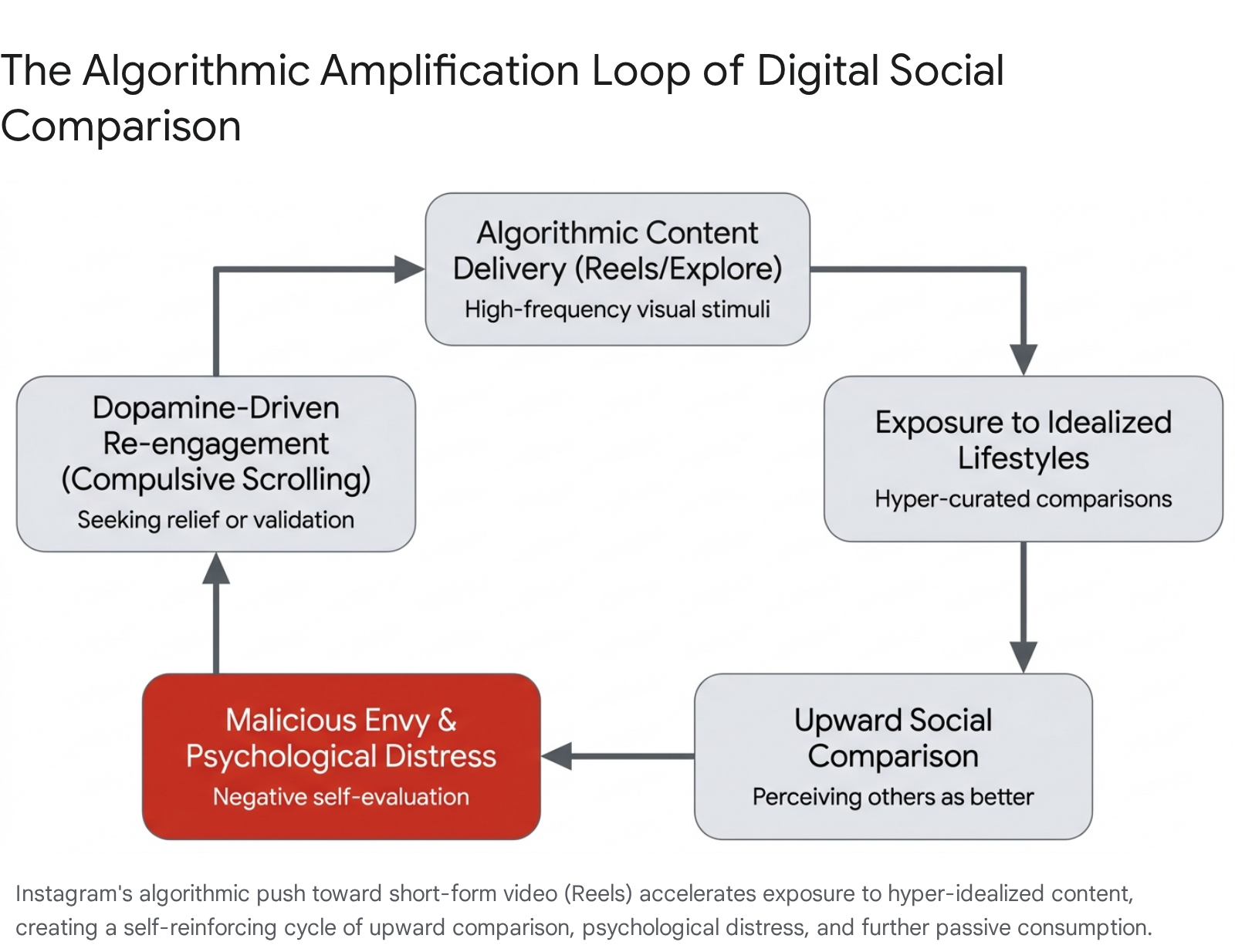
In recent years, platform architecture has pivoted aggressively toward algorithmic, short-form video, specifically Instagram Reels. This represents a structural paradigm shift in content distribution and consumption. Unlike grid posts, Reels are prioritized by Instagram's discovery algorithms, delivering a continuous, personalized stream of content from unknown creators directly to users' Explore pages 1715. Industry data indicates that algorithmic short-form video serves as the primary growth engine on social media, with Instagram's algorithm explicitly favoring Reels over static photos to maximize user watch time and retention 17. Consequently, engagement rates reflect this architectural push; influencer data shows that Reels achieve an average engagement rate of 2.08%, compared to 1.17% for traditional photo posts 17.
This shift toward rapid-scroll, algorithmic delivery has uniquely intensified exposure to upward social comparison. The continuous stream of Reels frequently showcases hyper-idealized lifestyles, extreme fitness standards, and beauty norms at a highly accelerated pace, leaving users minimal cognitive space to contextualize or critically evaluate the media 1617. A cross-sectional survey of 2,285 adults (mean age 22.6 years) assessed the specific mental health associations of Instagram Reels engagement 16. Hierarchical regressions, controlling for age and gender, demonstrated that greater engagement with Reels was significantly associated with higher anxiety and lower overall well-being. Notably, social comparison acted as a moderating variable in the relationship between Reels usage and anxiety, adding a measurable amount of explained variance ($\Delta R^2 \approx 0.002$) 16.
The Role of Quantified Metrics in Self-Evaluation
Digital platforms facilitate comparison not merely through visual imagery, but through the public quantification of social approval. On social media platforms, highly subjective concepts - such as personal popularity, aesthetic appeal, and social value - are converted into explicit, tracked metrics 1823. Follower counts, likes, impressions, virality rates, and engagement ratios function as absolute numeric benchmarks that enable instantaneous social ranking 182425.
These vanity metrics provide the exact "objective, non-social means of evaluation" that Festinger noted humans inherently seek, yet in the digital realm, these metrics are deeply distorted by algorithmic distribution and manufactured curation 3523. The visibility of these data points forces users to continuously monitor their digital status against both close peers and global influencers. This quantification alters the social comparison paradigm; users evaluate their self-worth against concrete data points that serve as proxies for social inclusion. Research indicates that the pressure to maintain these metrics, or the observation of poor performance relative to peers, reliably triggers feelings of inadequacy, rejection, and isolation, further fueling the drive for upward comparison 2519.
Active Versus Passive Social Media Use
The behavioral mechanics of user interaction with social media fundamentally mediate the psychological outcomes of the social comparison process. The academic literature consistently differentiates between active and passive social media use, though findings regarding their respective impacts remain highly debated and complex.
Passive social media use is defined as the observation of content without direct interaction - characterized by mindless scrolling, browsing feeds, and viewing posts without leaving a digital footprint through likes or comments 202122. Theoretical models frequently link passive engagement to adverse mental health outcomes, positing that it maximizes exposure to idealized content and triggers unchecked upward social comparison 202123. By acting as a silent observer, the user absorbs a curated reality without the mediating, grounding effects of actual social interaction, which can lead to profound feelings of isolation, malicious envy, and cognitive fatigue due to information overload 21.
Active social media use involves producing content, interacting via comments, direct messaging, and participating actively in digital communities 2122. Some psychological frameworks suggest that active use mitigates distress by fostering genuine social connection, providing eudaimonic well-being, and reducing feelings of loneliness 2123.
However, recent extensive empirical studies present a deeply mixed consensus regarding the active/passive dichotomy, requiring significant calibrated uncertainty. A meta-analysis of 141 studies encompassing approximately 145,000 participants found that the relationships between both active and passive social media use and mental health outcomes generally yielded negligible effect sizes ($|r| < .10$) 23. Similarly, a longitudinal survey of 15,836 UK adults utilizing Understanding Society data found no robust evidence of an association between the frequency of passive viewing and mental health problems in the following year 22.
Conversely, a 9-year longitudinal study investigating the "epidemic of loneliness" concluded that both extensive passive and active social media use failed to alleviate feelings of loneliness and, over time, exacerbated them, suggesting a continuous negative feedback loop regardless of the interaction style . Furthermore, age demographics appear to alter these outcomes. A 2023 study monitoring 925 volunteers (ages 17-97) found a significant positive correlation between passive use and mental ill-being among younger cohorts, whereas older participants exhibited a negative correlation, indicating that older demographics may benefit from passive content consumption without the pressure of active engagement 24.
| Behavioral Mode | Definition & Typical Actions | Hypothesized Psychological Mechanisms | Documented Empirical Outcomes |
|---|---|---|---|
| Passive Use | Browsing feeds, watching short-form video, reading comments without participating. | Observation of curated highlights; unchecked upward social comparison; cognitive fatigue 21. | Highly mixed. Linked to depressive symptoms and isolation in youth 2021, but massive longitudinal studies show negligible overall effect sizes 2223. |
| Active Use | Posting media, commenting, messaging, engaging in digital communities. | Pursuit of digital validation; maintenance of curated identity; active social comparison based on metrics. | Mixed. Can offer temporary social support, but linked to self-presentation anxiety, cyberbullying involvement, and longitudinal increases in loneliness 2023. |
Psychological Outcomes of Digital Upward Comparison
Benign Envy Versus Malicious Envy
Upward social comparison in digital environments rarely results in a neutral affective state. According to Cognitive Appraisal Theory, such comparisons generate one of two distinct forms of envy: benign or malicious 2526. The bifurcation of envy is essential for understanding why exposure to idealized media inspires self-improvement in some users while causing severe psychological harm to others.
Benign envy manifests when an individual observes a superior target but perceives the target's success as legitimate, deserved, and, crucially, attainable 825. This affective state serves an assimilative function, acting as a motivational catalyst. It inspires the observer to improve their own skills, engage in proactive self-enhancement, and push for personal flourishing 82627. In the context of Instagram, a user experiencing benign envy upon viewing a peer's professional achievement might feel motivated to enhance their own career trajectory.
Conversely, malicious envy emerges when the gap between the observer and the target is perceived as insurmountable, or when the target's success is viewed as an acute threat to the observer's self-concept 2526. Malicious envy generates a threat-focused response characterized by frustration, hostility, and a desire to see the target lose their advantage or suffer a setback 82627. On visually driven platforms like Instagram, the algorithmic amplification of extreme wealth, heavily filtered aesthetic lifestyles, and unrealistic beauty standards disproportionately triggers malicious envy 172728. This results in a destructive internal narrative marked by feelings of inadequacy, lower self-esteem, and chronic emotional distress 2729. A quantitative study of 230 users in Malang City, Indonesia, established that envy operates as a critical cognitive-affective mediator linking social media addiction to psychological fatigue, demonstrating a significant indirect effect ($0.2152$) of addiction on boredom mediated specifically by envy resulting from social comparison 27.
Body Image, Self-Objectification, and Media Pressures
The visual primacy of Instagram exacts a thoroughly documented toll on physical self-esteem and body image. Exposure to highly curated, edited, and idealized representations of physical appearance forces users to evaluate their own bodies against statistically anomalous standards 173031.
This dynamic fosters self-objectification, a psychological state in which individuals evaluate themselves primarily as objects to be observed based on physical appearance 14. Research demonstrates that the "highlight reel effect" on Instagram leads to a precipitous decrease in specific body-esteem scores following upward comparison, even if global self-esteem remains momentarily stable 17. The algorithmic delivery of "thinspiration" for female users and muscularity ideals for male users normalizes extreme body standards, directly mediating the relationship between passive social media use and the development of eating disorders and body dissatisfaction 19303132. A comprehensive meta-analysis encompassing 48 articles and 7,679 participants calculated specific effect sizes for exposure to upward comparison targets on social media. The analysis revealed significant negative effects across multiple outcome variables, with body image experiencing the most severe detriment (Hedges' $g = -0.31$), alongside reductions in subjective well-being ($g = -0.19$), mental health ($g = -0.21$), and self-esteem ($g = -0.21$) 10.
Correlations with Depressive Symptoms and Maladaptive Coping
The intersection of upward comparison and malicious envy often initiates a psychological cycle resulting in chronic depressive symptoms. When users experience threats to their self-worth via Instagram, the resulting negative affect rarely prompts platform abandonment. Instead, consistent with the frustration-aggression hypothesis, individuals frequently adopt maladaptive coping mechanisms 2933.
One severe outcome is the externalization of relative deprivation through aggressive digital behavior. A structural equation modeling study involving 526 undergraduates investigated the antecedents of cyberbullying. The analysis revealed that upward social comparison was significantly positively associated with cyberbullying, a relationship mediated by both cognitive relative deprivation (the perception of lacking resources) and emotional relative deprivation (unmet emotional needs), with correlation coefficients of $0.31$ and $0.30$, respectively 33.
Internally, maladaptive coping manifests as online social anxiety, digital hoarding, and rumination 93435. Research highlights a bidirectional relationship between depressive symptoms and social media engagement 1729. Individuals with pre-existing low mood frequently engage in habitual scrolling due to the Fear of Missing Out (FOMO). An empirical study demonstrated that upward social comparison significantly predicted digital hoarding behaviors ($\beta = 0.50$), fully mediated by FOMO 35. Similarly, a study in Pakistan ($N = 102$, mean age 22.39) found that problematic social media use predicted upward comparison, which in turn fully mediated the relationship with psychological distress (indirect effect $\beta = 2.00$) 36.
Platform-Specific Psychological Discrepancies
The severity of psychological outcomes associated with social comparison is not uniform across all digital networks; rather, it is highly dependent on the specific architecture and primary medium of the platform. Visually driven platforms that prioritize aesthetic curation consistently generate higher levels of psychological distress than text-based or professionally oriented networks.
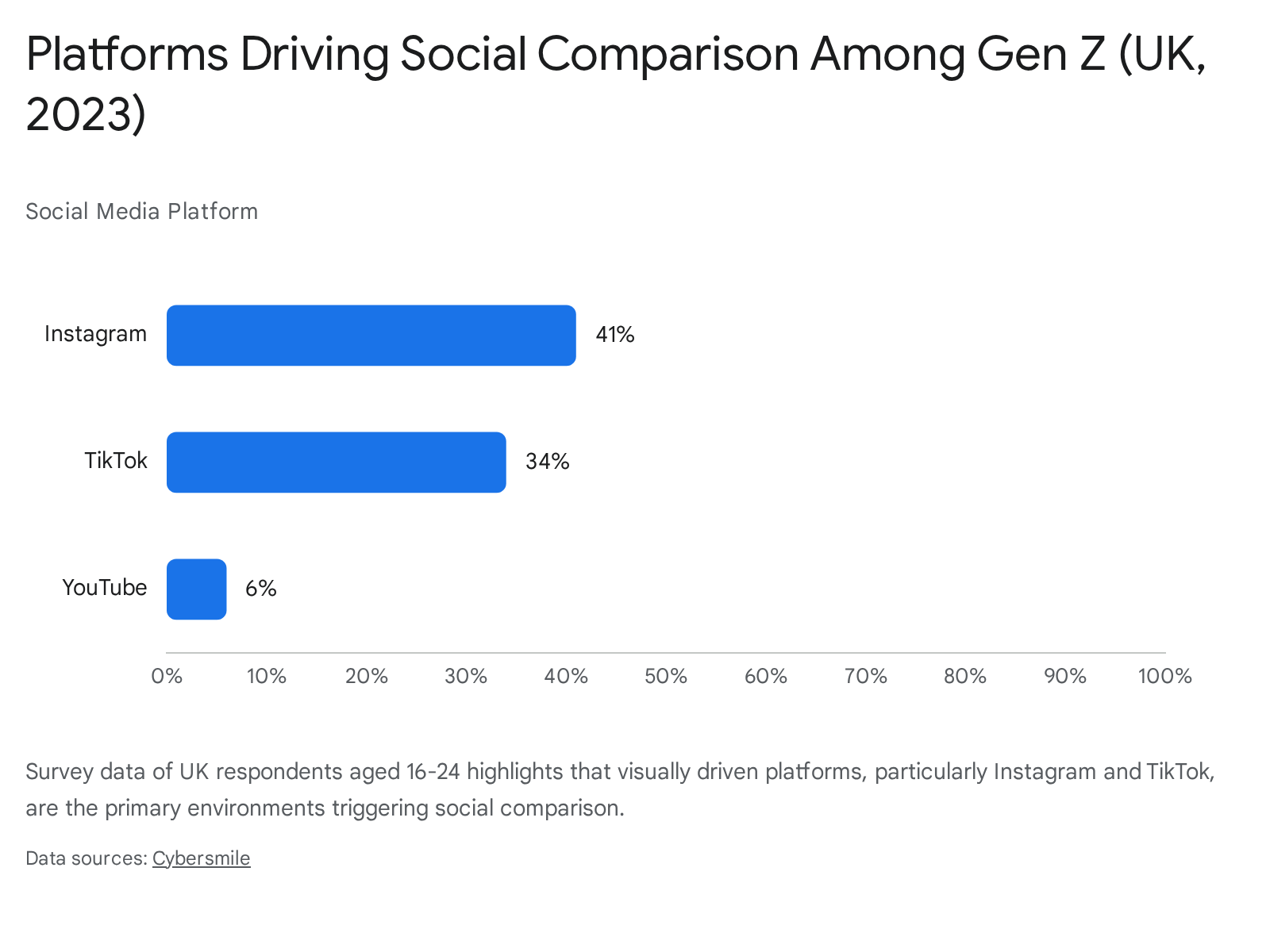
An expansive cross-sectional study analyzing data from 6,104 participants assessed platform-specific differences in psychological outcomes. The findings revealed that users of highly visual, continuous-scroll platforms exhibited the highest levels of distress. Snapchat users reported the highest mean anxiety scores ($16.39 \pm 2.50$), followed closely by users of Instagram and TikTok 31. Additionally, YouTube users experienced the highest levels of perceived stress ($2.27 \pm 1.23$). In stark contrast, platforms prioritizing personal relationships, community text dialogue, or professional networking were linked to significantly lower levels of psychological distress. Facebook users within the same study exhibited the lowest anxiety levels ($13.71 \pm 4.17$) and the lowest stress levels ($1.76 \pm 1.26$) 31. These statistically significant variances underscore that platforms fundamentally designed around visual appearance and rapid algorithmic content delivery uniquely exacerbate the frequency and severity of upward social comparison.
Demographic and Personality Vulnerabilities
Adolescent and Generation Z Susceptibility
The psychological impacts of digital social comparison are heavily stratified by age and developmental stage. Adolescents (ages 13 to 18) and young adults (ages 19 to 24) constitute the demographic most acutely vulnerable to adverse outcomes 32. This vulnerability is grounded in the developmental psychology of identity formation; during these critical years, youth rely heavily on peer evaluation to construct self-concept and establish social belonging 6113237.
Survey data illustrates the pervasive nature of this exposure among Generation Z. A 2023 UK-based study encompassing 1,000 participants aged 16 - 24 revealed that 93% of respondents actively engage in social comparison on social media platforms 38. The consequences within this cohort are severe: 23% reported experiencing social isolation as a direct result of online comparison, 17% noted relationship problems, and a highly concerning 14% reported experiencing suicidal thoughts resulting from comparing themselves to others online 38.
A parallel latent class growth analysis (LCGA) categorized adolescent users into distinct behavioral profiles based on psychological factors and usage intensity. The data indicated that approximately 25.56% of participants fell into a "most vulnerable group" characterized by profound social media addiction, averaging five hours daily on TikTok and three hours on Instagram. Membership in this impaired functioning profile was highly predicted by low offline social support and a high propensity for online social comparison 39.
Personality Traits: Neuroticism and Baseline Self-Esteem
Individual psychological traits significantly moderate the intensity of social media comparison. Baseline global self-esteem acts as a primary buffer; individuals with high, stable self-worth process upward comparisons without experiencing severe psychological distress, as their self-concept is not wholly dependent on external validation 1926. Conversely, individuals with low or unstable self-esteem demonstrate a higher orientation toward social comparison and are highly susceptible to interpreting upward comparisons as confirmations of inherent inadequacy 19262940.
Neuroticism serves as a major negative predictor of outcomes. Individuals scoring high in neuroticism - predisposed to emotional instability and negative affect - experience severe detrimental effects from passive Instagram consumption. A survey of 625 Brazilians assessed the predictive power of Instagram use intensity, social comparison, and the "Big Five" personality traits on self-esteem 4041. The results identified neuroticism and social comparison regarding abilities as the strongest negative predictors of self-esteem. Furthermore, for female participants in the study, higher intensity of Instagram use correlated directly with lower self-esteem, an association entirely mediated by the frequency of social comparison (a suppression effect) 4041.
Gender Variances in Comparison Processing
Empirical data suggests measurable gender variances in the processing and impact of digital comparison. While adolescent males experience significant social comparison pressures - often related to muscularity, athletic achievement, and perceived wealth - the statistical impact on global self-esteem tends to be more acute and pervasive among adolescent girls and young women 30404243.
This discrepancy is largely attributed to societal conditioning regarding beauty norms and the specific algorithmic delivery of appearance-focused content. A Pew Research study conducted in late 2024 involving roughly 1,400 U.S. teens highlighted this divide: female respondents were significantly more likely than male peers to report that social media negatively affected their sleep, productivity, self-confidence, and mental health, citing immense pressure to post attractive content and engage with media that triggers self-doubt 43. Furthermore, studies utilizing problematic use surveys demonstrate that female students report a much stronger internalization of thinness ideals and greater perceived media pressure, whereas male comparison distress was more strongly correlated solely with family-related appearance pressure 30.
Cross-Cultural Variances in Social Comparison
The behavioral manifestations and psychological impact of social comparison on Instagram are deeply influenced by the macro-cultural dimensions of the user's society. Applying Geert Hofstede's Cultural Dimensions theory - specifically the individualism versus collectivism spectrum - research reveals stark contrasts in how different global populations utilize the platform 4445.
In highly individualistic cultures, such as the United States and the United Kingdom, Instagram operates primarily as an engine for self-promotion, the documentation of personal achievements, and the assertion of individual autonomy 444554. Research analyzing user motives demonstrates that individuals in these regions are highly "me-focused." A cross-cultural semiotic analysis of 147 posts from fitness mega-influencers in the USA and Brazil found that in individualistic cultures, endorsement content explicitly highlights the informational competence and self-promotion of the individual 4446. Consequently, social comparison in these societies is fiercely upward, metrics-driven, and competitive. Users maintain relaxed privacy boundaries to maximize audience reach and personal branding, frequently resulting in high levels of malicious envy as they benchmark their singular success against the highly curated triumphs of global peers 455447.
Conversely, in collectivist cultures - such as Indonesia, Croatia, Lebanon, and Brazil - Instagram functions distinctly differently. Users in these societies approach the platform primarily to foster social interaction, emphasize group activities, and maintain relational closeness ("we-focused" behavior) 44544648. Posts typically reflect an interdependent self-construction, highlighting family orientation, social harmony, and emotional warmth 4448. The parameters of social comparison shift accordingly; self-evaluation is based less on individual dominance and more on inclusion within social networks and adherence to group norms 48.
To preserve this social equilibrium, users in collectivist cultures engage in different privacy management strategies. A descriptive content analysis comparing Indonesian and U.S. college students utilizing Communication Privacy Management (CPM) Theory revealed that Indonesian users apply strict privacy settings and rely on indirect self-disclosure to avoid disrupting group harmony, in stark contrast to the explicit personal branding of their U.S. counterparts 45. While upward comparison remains prevalent, the cultural emphasis on emotional competence and shared communal experiences alters the affective response, though the pressure to conform to group expectations introduces unique psychological stressors 4446.
| Cultural Dimension | Primary Platform Utility | Focus of Content & Self-Presentation | Privacy & Disclosure Habits | Nature of Social Comparison |
|---|---|---|---|---|
| Individualistic (e.g., USA, UK) | Self-promotion, personal branding, documentation of achievements. | "Me-focused"; independence, personal autonomy, informational competence 4454. | Relaxed privacy; direct and explicit self-disclosure to maximize reach 45. | Highly competitive; frequent extreme upward comparison; heavily driven by engagement metrics 4454. |
| Collectivist (e.g., Indonesia, Lebanon, Brazil) | Social interaction, maintaining group harmony, relational closeness. | "We-focused"; interdependence, emotional warmth, family orientation 4448. | Strict privacy; indirect self-disclosure utilized to maintain social balance 45. | Relational comparison; evaluated based on group inclusion and adherence to social norms 4648. |
Conclusions
The synthesis of contemporary psychological and sociological research indicates that the architecture of visual social media platforms fundamentally exploits and exacerbates human neurobiology. While the innate drive for self-evaluation identified by Festinger remains an evolutionary constant, the digital environment in which it now operates is unprecedented in human history. The transition from physical, realistic peer groups to an infinite, algorithmic stream of hyper-curated "distant others" guarantees that users are subjected to a relentless barrage of extreme upward comparison 101242.
The empirical evidence strongly suggests that the psychological toll of this phenomenon is worsening. The shift toward rapid-scroll algorithmic video delivery via features like Instagram Reels limits cognitive processing time, forcing vulnerable demographics - particularly adolescents, individuals with high neuroticism, and young women - into vicious cycles of malicious envy, body dysmorphia, and psychological distress 16173240. Furthermore, longitudinal data indicates that the traditional "twin peaks" of social comparison, historically confined to adolescence and pre-retirement, are now chronically sustained throughout an individual's life by the constant presence of the digital scoreboard 37. Neither passive observation nor active engagement appears to offer a definitive shield against these effects, as both have been linked to longitudinal increases in loneliness and social anxiety 23.
Addressing this escalating public health concern requires moving beyond correlational studies of screen time. Future psychological research and policy development must focus on targeted digital resilience frameworks, algorithmic transparency, and the potential regulation of platform designs that prioritize dopaminergic validation loops over user well-being.