
Cultural History and Psychology of Productivity Optimization
The Historical Evolution of Time and Labor Management
The contemporary psychological fixation on productivity is not an innate feature of human cognition, but a historically contingent phenomenon that developed alongside industrial capitalism. To comprehend why modern workers seek to optimize their daily routines with software, analytical frameworks, and rigid schedules, it is necessary to examine the foundational transformation of human time perception.
The Transition from Task-Oriented Work to Clock-Time
Prior to the Industrial Revolution, the measurement of time for the majority of the agrarian and artisan populations was a vague, environmental concept dictated by the sun, the seasons, and agricultural cycles 123. Human labor was fundamentally "task-oriented," meaning work rhythms emerged organically from the requirements of the tasks themselves, such as harvesting crops or tending to livestock 12. In this pre-industrial paradigm, the boundaries between labor and social intercourse were highly porous. Individuals did not experience the modern anxieties of "busyness" or "boredom" as strictly scheduled phenomena, nor was time viewed as an abstract resource to be hoarded or maximized 24.
The advent of the factory system in the mid-18th century necessitated a radical reorganization of human behavior. British historian E.P. Thompson, in his seminal 1967 work Time, Work-Discipline, and Industrial Capitalism, detailed how the deployment of mechanical clocks fundamentally altered the human apprehension of time 235. The synchronization of labor across large, unskilled workforces required strict time discipline, transforming time from an expansive medium that simply "passed" into an abstract commodity that was "spent" 147. With the introduction of hourly waged labor, employers purchased a worker's time rather than their specific output, creating an imperative to ensure that purchased time was not wasted 34.
This economic shift required significant behavioral conditioning. Early factory owners, such as Mr. Crowley of the Crowley Iron Works, instituted strict codes to prevent workers from cheating them of purchased time 3. Workers were initially reluctant to accept this discipline, frequently maintaining traditions like "Saint Monday," a weekly practice of absenteeism 3. Over decades, however, time became synonymous with currency. The clock and the pocket watch emerged not only as tools of synchronization but as cultural status symbols, presaging the modern relationship between technology, time-tracking, and social prestige 234.
Scientific Management and the Measurement of Bodies
The drive to extract maximum value from purchased labor time culminated in the late 19th and early 20th centuries with the implementation of Scientific Management. The foundational theories of productivity optimization can be traced back to Adam Smith's 1776 Wealth of Nations, which delineated "productive" labor (that which adds material value) from "unproductive" labor, and Benjamin Franklin's early formulation of the daily task list 85. However, it was Frederick Winslow Taylor who systematized these concepts into a rigorous, industrialized framework.
Taylorism sought to eliminate inefficiencies by studying and standardizing the physical movements of workers, a practice designed to combat what Taylor referred to in 1912 as "soldiering" - the deliberate restriction of output by employees 67. Under this model, the human body was treated as a mechanical instrument of production 6. Productivity was measured entirely by physical output and tangible goods, and optimization focused on motion studies, rest intervals, and the preservation of physical vitality to maximize efficiency 612. This period also witnessed the severe abuse of labor in the name of productivity; innovations like the cotton gin exponentially increased output but were built upon the brutal exploitation of enslaved and low-wage workers 8.
The Institutionalization of Goal-Setting Frameworks
While Taylorism established the foundation for physical workplace optimization, the post-World War II era introduced new frameworks designed to manage an increasingly complex, white-collar workforce. The shift from manufacturing to knowledge work required new mechanisms of control.
Management by Objectives and Outcome Focus
In 1954, management theorist Peter Drucker introduced "Management by Objectives" (MBO), fundamentally shifting the focus from micro-managing physical tasks to aligning employee outputs with broader corporate goals 13815. Drucker recognized that managers were increasingly caught in an "activity trap," focusing on daily tasks rather than long-term strategy 13. MBO represented a transition from strict process control to outcome-based management, operating on the principle that setting mutual objectives between managers and workers would increase organizational performance 138.
Despite its innovations, MBO possessed significant structural weaknesses. It often relied on rigid, annual targets that failed to account for changing organizational needs and tied goals directly to compensation, which incentivized workers to take shortcuts or compromise quality to meet static quotas 1315. Furthermore, it operated on a rigid hierarchy where managers dictated strategy and workers merely executed it, stifling autonomy 8.
Objectives and Key Results in the Knowledge Economy
By the 1970s, the limitations of annual MBOs led to the development of more agile frameworks suited for rapid technological development. Andy Grove, during his tenure as CEO of Intel, refined Drucker's concepts into Objectives and Key Results (OKRs), a system later popularized globally after John Doerr introduced it to Google in 1999 13815.
| Framework Characteristic | Management by Objectives (MBO) | Objectives and Key Results (OKR) |
|---|---|---|
| Origin Era and Pioneer | 1954 (Peter Drucker) | 1970s (Andy Grove at Intel) |
| Review Cadence | Typically annual | Typically quarterly or monthly |
| Goal Characteristics | Safe, achievable, directly tied to compensation | Aspirational, ambitious, decoupled from direct compensation |
| Directionality | Top-down, hierarchical cascading | Bi-directional, emphasizing team autonomy and cross-functional alignment |
| Primary Metric Focus | Individual performance evaluation | Agile progress tracking and organizational focus |
The progression from Taylor's stopwatch to Grove's OKRs illustrates a continuous historical trajectory. As the nature of work shifted from the physical assembly line to the corporate office, the mechanisms of optimization evolved from tracking bodily movements to structuring cognitive focus.
Neoliberal Restructuring and the Psychological Contract
The contemporary obsession with productivity cannot be fully explained by technological or managerial shifts alone; it is deeply rooted in the macroeconomic transformations of the late 20th century. During the post-war era of Keynesian welfare state capitalism (roughly 1945 to the 1970s), employment was largely characterized by standardized hours, relative job security, and collective bargaining power that ensured wages tracked alongside productivity gains 910.
The Erasure of Job Security
Following structural economic crises in the 1970s, the global north experienced a shift toward neoliberal economic policies. This era was characterized by the deregulation of financial markets, the privatization of state assets, and the deliberate weakening of trade unions under administrations such as Margaret Thatcher in the UK and Ronald Reagan in the US 91112. This macro-level restructuring fundamentally altered the psychological contract between employers and employees.
Neoliberal ideologies aimed to replace political compromises regarding job entitlements and seniority rights with market-determined wages and precarious, contract-based employment 1112. Traditional job security was subsequently replaced by the concept of "employability" - the burden placed on the individual worker to constantly update their skills, optimize their output, and market themselves across a "boundary-less career" 11. The abandonment of full employment policies created a "reserve army of labor," awarding managers unprecedented leverage to demand higher output and enforce unrealistic targets through the persistent threat of job loss 9. Because real wages stagnated for the working and middle classes from the 1980s onward, employees were increasingly compelled to work longer hours simply to maintain their standard of living 1220.
The Internalization of Surveillance and Auto-Exploitation
The psychological impact of neoliberal labor dynamics is profound. Sociological and philosophical critiques argue that neoliberalism shifted the mechanisms of power from external coercion to internal compulsion. Building upon Michel Foucault's concepts of biopolitics, contemporary theorists like Byung-Chul Han suggest that the modern worker functions as a "neoliberal achievement subject" 13. Under this regime, individuals willingly engage in "auto-exploitation," treating themselves as continuous business projects requiring perpetual optimization 13.
This internalization of productivity demands obscures the extractive nature of the labor relationship. When individuals interpret self-optimization as an exercise of freedom rather than a submission to economic imperatives, burnout and exhaustion are internalized as personal failures rather than structural inevitabilities 1013. The pressure to optimize extends beyond the workplace, commodifying physical fitness, leisure, and personal relationships as avenues for self-improvement and status signaling 13. The belief that there is no alternative to the current political economy - a concept termed "capitalist realism" - serves an ideological function by naturalizing targets and overwork, eliciting resignation and compliance from employees 9.
The Psychology of Optimization and Finitude
As the structural demands of the modern economy enforce continuous output, workers increasingly turn to personal productivity systems and technological tools to manage their cognitive load. However, psychological research and cultural analysis reveal fundamental flaws in the premise that better time management leads to a state of completion or peace.
The Efficiency Trap
Author Oliver Burkeman, in his analysis of time management philosophy, identifies a paradoxical phenomenon known as the "efficiency trap" 422. The efficiency trap dictates that efforts to become more productive generally lead to feeling busier and more overwhelmed 4. When a worker utilizes productivity hacks to complete tasks faster, they merely increase their capacity to take on more demands. For instance, answering emails more rapidly simply generates faster replies, resulting in an endless, escalating loop of communication 2223.
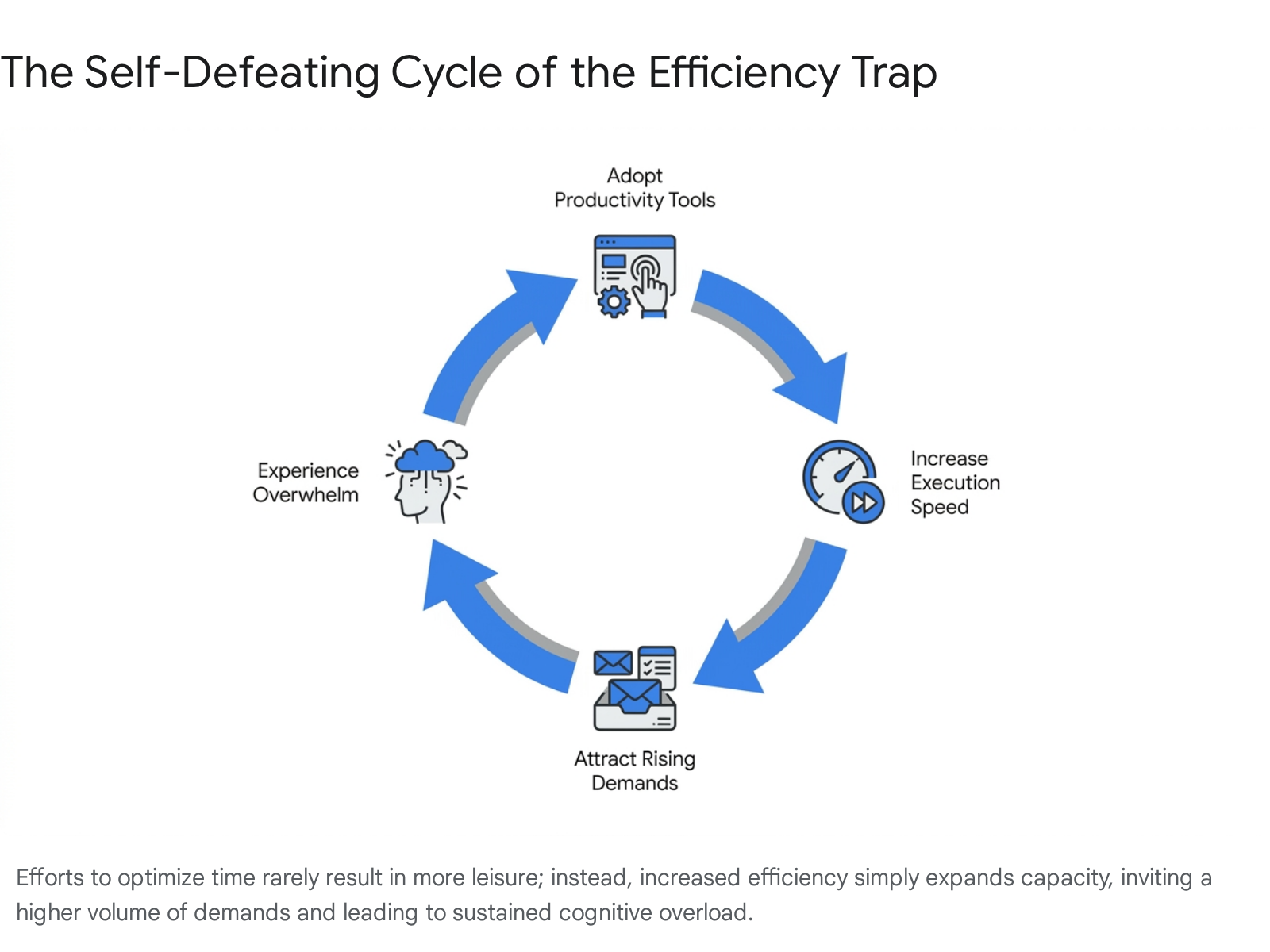
This trap is fundamentally rooted in a psychological refusal to accept human finitude. Productivity culture relies on the illusion of control - the belief that with the right combination of software and discipline, an individual can master time and satisfy infinite societal and professional demands 1423. Burkeman suggests that this pursuit is a futile battle against existential limits, and that true prioritization requires the conscious acceptance that time is a finite, fixed-volume resource 123. To counteract this, philosophers like Kieran Setiya advocate for engaging in "atelic activities" - pursuits whose value is not derived from an ultimate aim or productive output, thereby reclaiming time from the strict logic of optimization 1.
Deep Work versus Pseudo-Productivity
The psychological toll of optimization is exacerbated by the nature of contemporary knowledge work. Unlike the industrial era, where productivity could be easily quantified by the number of physical goods produced, knowledge work deals in intangible ideas, strategies, and communications 12. The absence of clear, objective success indicators has led organizations to rely on "pseudo-productivity" - the use of visible, performative activity as a proxy for actual productive effort 122425.
Computer science professor Cal Newport defines pseudo-productivity as the rapid-fire response to emails, incessant Slack messaging, and attendance at endless meetings 1224. Statistical analyses confirm the pervasiveness of this phenomenon; a McKinsey study found that the average knowledge worker spends 28% of their day managing email, and workers frequently switch tasks every three minutes 2614. Consequently, knowledge workers spend only an estimated 39% of their workday engaging in their core job functions, with the remainder consumed by performative coordination 14.
This performative busyness actively undermines what Newport terms "Deep Work": professional activities performed in a state of distraction-free concentration that push cognitive capabilities to their limits 26. Decades of neuroscience and cognitive psychology research confirm that task switching imposes substantial cognitive costs 26. Psychologist Sophie Leroy identified the phenomenon of "attention residue" - where part of the brain's attention remains stuck on a previous task after switching to a new one - which degrades performance and exhausts executive control systems 26. Consequently, the modern obsession with hyper-connectivity ensures that workers feel highly active while producing work of lower quality, driving both burnout and a sense of meaninglessness 122414.
Algorithmic Surveillance and the Digital Knowledge Economy
As the global economy transitioned from the industrial manufacturing model of the 20th century to the digital knowledge economy of the 21st, the mechanisms of labor control evolved accordingly. The modern paradigm, sometimes referred to as "Cyberism," replaces the physical optimization of Taylorism with the algorithmic and cognitive optimization of the digital sphere 6.
From Physical Strain to Cognitive Exhaustion
The transition from Taylorism to Cyberism represents a fundamental shift in the nature of occupational hazards. Under Taylorism, the primary human costs were muscular exhaustion and physical injuries resulting from repetitive manual labor 6. The digital knowledge economy has largely eliminated this physical exertion, replacing it with heightened cognitive demands, sedentary health risks, and severe decision fatigue 6.
| Dimension of Work | Taylorism (Industrial Model) | Cyberism (Digital Knowledge Economy) |
|---|---|---|
| Primary Output | Physical goods and standardized units | Intangible data, code, strategies, and communications |
| Method of Control | Direct managerial observation, motion studies, physical pace | Algorithmic tracking, data analytics, software surveillance |
| Primary Human Cost | Muscular exhaustion, repetitive physical strain | Cognitive overload, decision fatigue, emotional burnout |
| Boundary Separation | Distinct separation between factory floor and home | Blurred work-life boundaries due to constant digital connectivity |
The Architecture of Bossware
The drive to measure and optimize invisible cognitive labor has led to a massive expansion of workplace surveillance. Often dubbed "bossware," employee monitoring software has surged in use, particularly following the mainstream adoption of remote and hybrid work models 281516. The global employee monitoring software market, valued at $1.12 billion in 2021, is projected to reach $2.10 billion by 2030 28. These tools track keystrokes, monitor idle time, take periodic screenshots, and analyze communication patterns to generate productivity scores 281617.
While proponents argue that monitoring provides real-time insights into inefficiencies and boosts output by preventing distraction - with some data suggesting appropriate monitoring can boost output by 22% 171833 - extensive research points to severe negative externalities. Constant algorithmic surveillance degrades human dignity by reducing complex human creativity and problem-solving to mere data points 16. It fundamentally alters the employer-employee relationship, replacing trust and autonomy with coercion and micromanagement 281617.
Furthermore, studies indicate that surveillance frequently backfires as a productivity tool. The Harvard Business Review noted that excessively strict monitoring can actually cause productivity to drop by 9% to 10% annually 17. Employees subjected to intrusive tracking often redirect their cognitive effort away from meaningful work and toward "gaming" the system - utilizing mouse-jigglers, VPNs, or engaging in performative digital activity simply to simulate productivity and reclaim a sense of autonomy 281517. Algorithmic surveillance also functions as a chilling mechanism against collective action, deterring unionization and suppressing freedom of expression 16.
The Artificial Intelligence Productivity Paradox
The latest frontier in the pursuit of workplace optimization is the integration of generative Artificial Intelligence (AI) and coding assistants, such as GitHub Copilot and ChatGPT. Early empirical data from randomized controlled trials demonstrates significant execution speed gains.
Measured Gains in Execution Speed
Recent studies confirm that AI tools substantially accelerate specific tasks. A joint study involving Microsoft, Accenture, and Fortune 100 developers found that software engineers using GitHub Copilot completed tasks between 26.08% and 55.8% faster than control groups, with less experienced developers experiencing the greatest productivity gains 1920. Similarly, a study of Boston Consulting Group (BCG) consultants utilizing generative AI found that participants finished 12.2% more tasks, completed them 25.1% quicker, and produced 40% higher quality results compared to those without AI assistance 21.
However, these tools also introduce the risk of "falling asleep at the wheel." Research indicates that when AI produces high-quality outputs, human operators often become careless, relying entirely on the algorithm and missing critical errors or nuances - a phenomenon that can ultimately hurt long-term human skill development 2122.
Cognitive Offloading and Cognitive Debt
Despite measured increases in raw output, qualitative reports from heavy AI users point to a burgeoning "AI productivity paradox" 2324. Automation historically fails to reduce total work hours; instead, it lowers the cost of production, leading organizations to demand exponentially more output 2324. As AI makes generating text, code, and data analysis nearly frictionless, the volume of output scales far faster than a human's capacity to properly supervise and verify it 23.
This dynamic shifts the worker's role from a creator to a manager of algorithmic output. While AI enables "cognitive offloading" - delegating mental tasks to external resources to conserve energy - it simultaneously introduces new forms of cognitive overload 2526. Reviewing, fact-checking, and editing multiple AI-generated drafts requires intense critical thinking and constant micro-decisions 24. Over time, educational and psychological experts warn of "cognitive debt": the permanent erosion of independent critical thinking, memory retention, and creative problem-solving capabilities caused by excessive reliance on AI as a cognitive crutch 2226.
Decision Fatigue and the Illusion of Effortless Output
The cognitive overhead of managing AI output can paradoxically exceed the effort required to perform the work manually, especially for tasks requiring nuance or original voice 24. Because workers are making rapid decisions on content they did not organically generate and may not fully trust, they experience severe decision fatigue 2224.
This creates an emotional dimension to AI fatigue known as the "guilt loop" 24. Workers expect AI to complete tasks in minutes, and when heavy editing requires hours, they internalize the delay as a personal failure or a lack of proficiency in "prompting" 24. Ultimately, AI tools remove the intrinsic motivation and satisfaction loop associated with mastering a difficult skill, replacing meaningful creation with endless, exhausting curation 24.
The Global Epidemiology of Burnout
The relentless demand for optimization, combined with precarious economic conditions and constant digital connectivity, has fueled a global mental health crisis. Burnout is no longer a colloquial term but a systemic occupational hazard.
Historical Origins and Clinical Definitions
Burnout first gained scientific legitimacy in the mid-1970s. Herbert Freudenberger, a psychologist operating a private practice in New York while volunteering extended hours at the St. Mark's Free Clinic, observed severe physical and emotional exhaustion in himself and his colleagues . Concurrently, researcher Christina Maslach was investigating similar phenomena, eventually publishing the Maslach Burnout Inventory (MBI) in 1981, which established the syndrome's defining components: emotional exhaustion, depersonalization (cynicism), and a profound sense of professional inefficacy 27.
Today, the World Health Organization officially defines burnout as a syndrome resulting from chronic workplace stress that has not been successfully managed 4428. However, controversies remain within the clinical community. Recent longitudinal meta-analyses indicate that while job stressors do predict burnout, the correlation is modest, and burnout is frequently indistinguishable from broader depressive conditions 2728. Furthermore, despite its origins as a label to safely communicate job distress without psychiatric stigma, modern research shows that employees with a history of burnout face significant professional penalties, including a reduced likelihood of promotion regardless of current performance 28.
Regional Manifestations in the Global South
Recent occupational health data underscores the severity of the crisis globally, extending far beyond Western corporate environments. A 2022 public health assessment of 4,338 full-time working adults across Southeast Asia revealed an aggregate burnout prevalence of 62.91% 462930.
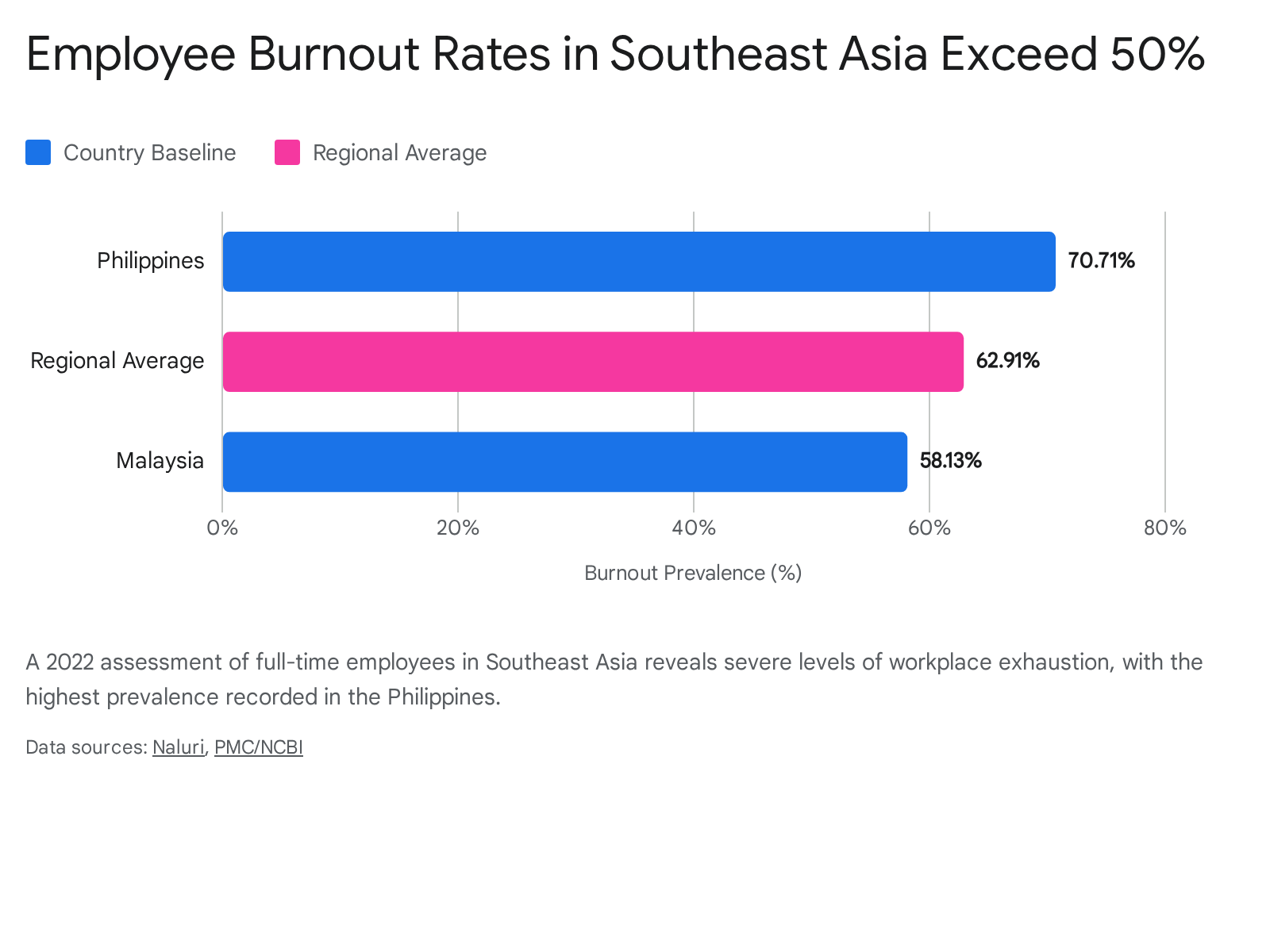
This exhaustion was closely linked to severe depression, anxiety, job dissatisfaction, and working more than 50 hours per week 2930. Similarly, longitudinal bibliometric studies tracking literature from 1963 to 2026 in Latin America show a sharp intensification of research related to psychosocial risks, workplace violence, and clinical exhaustion over the last decade, pointing to the structural challenges faced by workers navigating socioeconomic transformations in developing markets 31.
Survival Mechanics and Hustle Culture
In regions facing acute economic instability, the pursuit of maximum productivity is not driven by self-actualization, but takes on a mandatory survivalist dimension. In Nigeria and Kenya, "hustle culture" is deeply entrenched among youth and young professionals 3233.
Economic Precarity in Developing Nations
Facing high unemployment, rapid inflation, and minimal government safety nets, holding multiple side-gigs and working night shifts is a basic requirement for financial survival 323352. This systemic pressure is heavily reinforced by social media and pop culture, including popular Afrobeats songs that glorify the grind and present rest as an unaffordable luxury 32. The normalization of overwork is compounded by toxic work environments, grueling daily commutes (often 4-6 hours in cities like Lagos), and cultural stigmas against discussing mental health 335234.
The Physiological Toll of the Hustle
Consequently, the physiological costs are severe. Recent surveys in the region indicate that 54% of individuals view hustle culture as a direct cause of their burnout, resulting in an overwhelming prevalence of anxiety, poor sleep, emotional numbness, and chronic stress 323354. When economic realities strip workers of job security, hustle culture functions as a psychological coping mechanism, attempting to reframe involuntary overexploitation as ambition, resilience, and personal drive 333454.
Macroeconomic Shifts and Labor Resistance
The unsustainable trajectory of infinite productivity demands has sparked significant cultural and labor market pushback in the 2020s. Workers are increasingly rejecting the psychological contract of neoliberal auto-exploitation through both individual behavioral changes and collective systemic challenges.
The Great Resignation and Labor Reallocation
The post-pandemic economic recovery witnessed a phenomenon widely dubbed the "Great Resignation," a term coined in 2021 by management professor Anthony Klotz to describe the record numbers of American workers voluntarily leaving their jobs 353637. By November 2021, over 4.5 million people had voluntarily resigned in a single month 36.
Rather than a mass exit from the workforce, economic data indicates this was primarily a "Great Reallocation" . Workers leveraged a tight labor market to abandon low-paying, highly stressful service and retail positions in favor of jobs offering better wages, benefits, and flexibility 3537. This surge in job-to-job mobility had macroeconomic ripple effects; the heightened rate of employed workers searching for new jobs forced employers into intense wage competition to retain staff, contributing up to 1.1 percentage points to the rate of inflation during the period 36.
Work-to-Rule and Quiet Quitting
Simultaneously, the concept of "Quiet Quitting" gained massive cultural prominence. While portrayed in contemporary media as a novel phenomenon driven by social media, labor sociologists recognize it as a modern iteration of historical union tactics such as "work-to-rule" or "soldiering" 7. In 1956, sociologist Reinhard Bendix described this as a "withdrawal of efficiency," where workers deliberately withhold discretionary effort, adhering strictly to the letter of their job descriptions to protect themselves from unpaid overwork 7.
This trend aligns with long-term data on employee disengagement. Gallup tracking from 2013 to 2022 consistently shows that roughly 51% to 52% of the American workforce falls into the "disengaged" category, arriving at work simply to collect a paycheck without emotional investment - meaning at least half the workforce has effectively been "quiet quitting" for over a decade 7.
Historical Work Stoppages and Union Density
The shift toward individualized forms of resistance like Quiet Quitting correlates directly with the historical decline in collective bargaining power. Since the 1970s, the frequency of major labor strikes has plummeted, mirroring the drop in union density.
| Metric | 1970s / 1980s | 2020s (Recent Data) |
|---|---|---|
| Average Major Work Stoppages per Year | 289 (1970s average) | 18.3 (Annual average over last decade); 31 in 2024 |
| Workers Involved in Stoppages | ~2.5 million (1970) | 271,500 (2024) |
| Union Membership Rate (US) | 20% (17.7 million in 1983) | 10% (14.3 million in 2024) |
Table 3: The decline of collective labor resistance and union density in the United States over the last fifty years. 38
With the mechanisms for collective, formal pushback severely diminished, workers increasingly resort to individual boundary-setting, job-hopping, and cultural movements to resist the demands of hyper-productivity.
Cultural Rebellions and Structural Alternatives
Beyond individual workplace actions, distinct cultural rebellions and structural pilot programs have emerged to challenge the fundamental logic of continuous optimization.
The Soft Life Movement
A prominent cultural rebellion against optimization has emerged under the banner of the "Soft Life" movement. Originating within the Nigerian influencer community as a reaction against local hustle culture, the concept was popularized globally by Gen Z 60613940. The soft life represents an ideological rejection of the grind, performative burnout, and toxic productivity 606139.
The movement advocates for intentional living, prioritizing mental health, peace, and strict work-life boundaries over the traditional corporate markers of success 603940. It acts as a direct critique of the 2010s "Girlboss" era, which encouraged marginalized groups to achieve empowerment by emulating highly stressful, patriarchal corporate structures 60. However, sociologists note a critical limitation: accessing the "soft life" frequently requires a baseline of socioeconomic privilege 606141. For precarious workers in the gig economy or those facing acute financial instability, opting out of the hustle remains structurally impossible, leading some critics to view the movement as overly consumerist or exclusionary 606141.
The Swedish Six-Hour Workday Experiments
While cultural movements seek to change individual behavior, some institutional experiments have attempted to formally restructure the measurement of productivity. In Sweden, various municipalities and private companies have piloted a six-hour workday with no reduction in pay 424344.
These experiments rely on Parkinson's Law, which posits that work expands to fill the time allotted for its completion 42. By restricting hours, workers ostensibly maintain focus and output while eliminating pseudo-productive distractions. Private sector implementation has seen notable success; for example, the Toyota service center in Gothenburg transitioned to a six-hour workday 13 years ago, reporting lower turnover, happier staff, and a 25% rise in profits due to more efficient use of machinery across dual shifts 44.
Productivity and Financial Trade-offs
Public sector trials present a more complicated picture. A prominent two-year trial at the Svartedalens care home in Gothenburg showed dramatic improvements in worker health: a 15% reduction in sick leave, massive increases in employee energy, and a 60% increase in activities organized for patients 4345.
However, the trial was discontinued due to financial limitations. To cover the reduced hours in a continuous-care setting, the municipality had to hire 17 additional staff members, increasing operating costs by 22% (approximately $738,000) 45. While proponents argued that extending the trial might have proven that reduced sick pay and lower unemployment costs offset the hiring expenses, the Swedish experiments highlight a critical tension 45. Reducing work hours definitively improves human health and hourly efficiency, but implementing it in service and care sectors requires substantial upfront financial investment that governments and corporations remain hesitant to authorize 45.
Strategic Conclusions on Productivity and Human Capital
The modern obsession with productivity is a complex amalgamation of industrial history, economic ideology, and psychological conditioning. It originated in the factory system's commodification of time, accelerated through the neoliberal shift toward precarious, individualistic labor, and reached its zenith in the digital era of algorithmic surveillance and AI-driven cognitive offloading.
The psychological mandate to constantly optimize essentially treats the human worker as a limitless resource. However, as evidenced by the global burnout epidemic, the physiological and cognitive limits of human beings remain inflexible. The efficiency trap ensures that technological advancements, rather than delivering leisure, merely elevate the baseline expectations for output. Consequently, phenomena ranging from Quiet Quitting to the Soft Life movement are not symptoms of generational laziness, but rather rational, protective responses to a labor paradigm that demands infinite extraction from finite subjects. Meaningful alleviation of the modern productivity crisis requires moving beyond personal time-management hacks, necessitating structural interventions that re-establish firm boundaries between human identity and economic utility.