
Should Brands Invest in Podcasting in 2026
In 2026, the global podcast audience has surged past 600 million regular consumers, driving global advertising spend above the $5 billion threshold. Fueled by the massive adoption of video-first formats and highly effective host-read endorsements, podcast advertising currently delivers a return on investment that consistently outperforms both social media and traditional radio. However, to safely capture these returns in a rapidly maturing ecosystem, brands must strategically balance premium host integrations against the escalating risks of AI-powered programmatic ad fraud.
The New Scale of Global Podcasting
Podcasting is no longer an emerging medium or a niche hobby reserved for early tech adopters and daily commuters. It has firmly established itself as a mass-media staple that competes directly with traditional television, streaming services, and social media for share of attention. The global listener base has essentially tripled since 2019, fundamentally reshaping how audiences consume spoken-word content 1.
Estimating the exact size of the global audience in 2026 requires navigating slightly varying methodologies among major research institutions. Baseline estimates from platforms like eMarketer and Demand Sage place the global monthly listenership between 584 million and 619 million 21.
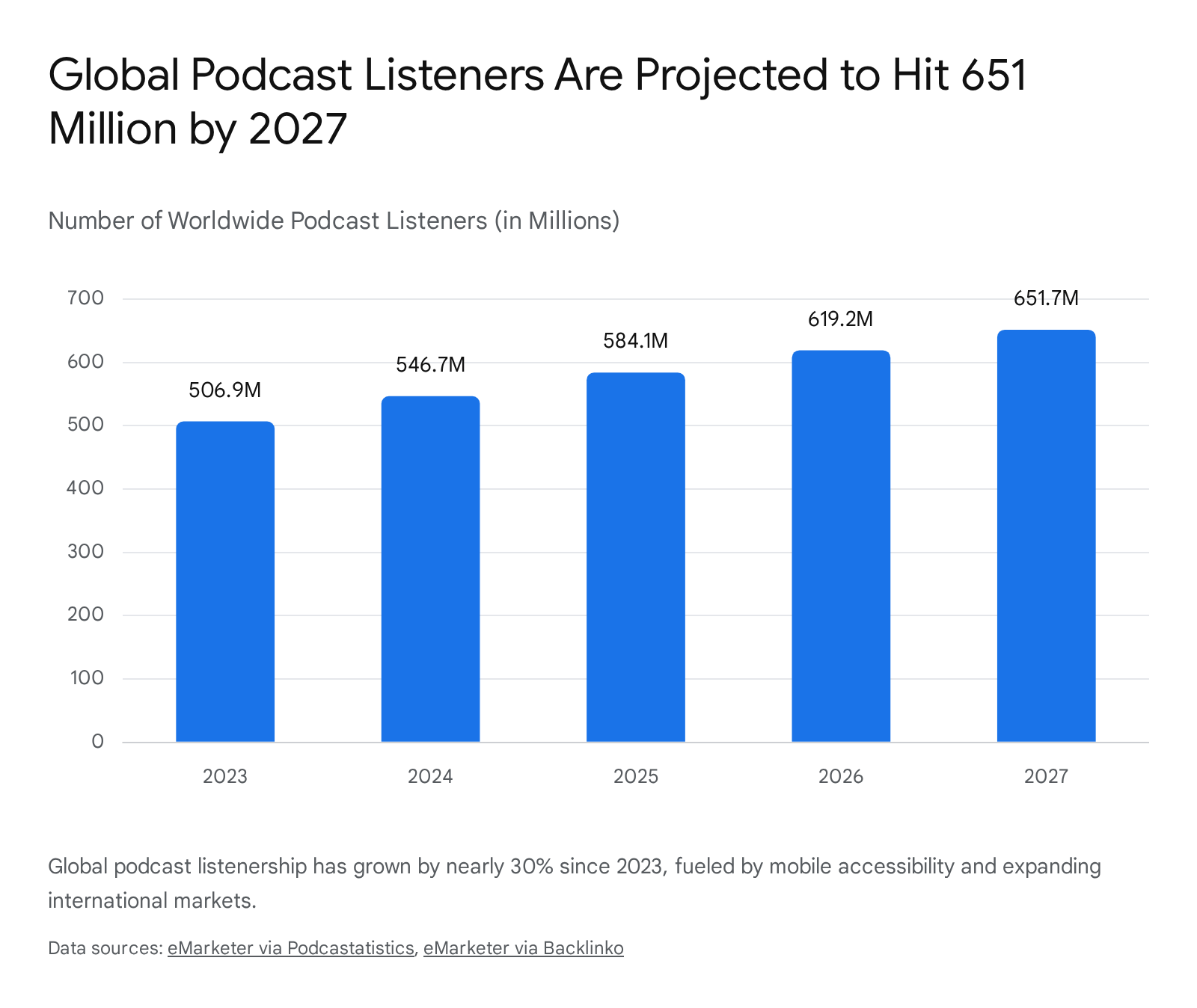
However, broader definitions of podcast "consumption" - which account for audiences watching podcast clips on social media and connected televisions - suggest the true global reach has crossed 672 million monthly listeners 1. Regardless of the specific metric, the medium is experiencing a robust compound annual growth rate, projected to push the industry toward a $131 billion market valuation by 2030 22.
Demographic Maturation in the United States
The United States remains the single largest and most lucrative podcast market, accounting for approximately 158 million to 165 million monthly listeners 236. This means that 55 percent of the entire US population over the age of twelve now tunes into podcasts on a monthly basis, with 40 to 42 percent engaging weekly 23.
Historically, podcasting skewed heavily toward younger, male audiences. While men still maintain a slight edge (57 percent versus 52 percent of women), the gender gap has largely closed, and female listeners now drive substantial growth in highly profitable categories like true crime, health, and wellness 24. Age demographics have also broadened. Approximately 66 percent of Americans aged 12 to 34 listen monthly, forming the core of the audience 2. However, the medium is making significant inroads with older demographics, with regular listenership expanding rapidly among adults over the age of 55 2. Because the average podcast listener tends to be employed, educated, and affluent, advertisers are highly motivated to reach this captive audience 85.
The Expansion of Emerging Markets
While the US market approaches maturity, the primary volume growth in 2026 is originating from emerging international markets. Declining mobile data costs, increasing smartphone penetration, and the aggressive expansion of local-language content libraries have unlocked hundreds of millions of prospective listeners across Latin America, Asia, and Africa 10.
| Global Region | 2026 Monthly Listeners | Year-over-Year Growth | Key Market Dynamics |
|---|---|---|---|
| North America | 198 million | +6.2% | The largest market by ad revenue, shifting heavily toward video and algorithmic discovery. |
| Europe | 142 million | +9.1% | Experiencing rapid catch-up growth; markets like the Netherlands (+28%) and France (+18%) are surging. |
| Asia Pacific | 126 million | +16.8% | Hyper-growth region led by India (+34%) and Indonesia (+29%); mobile-first consumption dominates. |
| Latin America | 58 million | +18.4% | The highest regional growth rate, with Brazil reaching an exceptional 68% monthly penetration. |
| Middle East & Africa | 26 million | +21.2% | The fastest percentage growth globally, led by strong adoption in Saudi Arabia and South Africa. |
Data synthesized from global 2026 audience reports 1366.
South Korea currently holds the highest global penetration rate, with 73 percent of internet users consuming podcasts monthly 1. Brazil follows closely at 68 percent, driven by an explosion of Portuguese-language content 1. For multinational brands, podcasting is no longer just a North American strategy; it is a global marketing channel capable of reaching highly engaged, localized audiences in their native languages.
The Video Podcast (Vodcast) Revolution
Perhaps the most transformative industry trend of 2026 is the mainstreaming of the video podcast, frequently referred to as a "vodcast." If a brand still treats podcasting as a purely audio medium, it is missing nearly half of the available audience. By early 2026, over 50 percent of the US population had watched a video podcast, and 27 percent of consumers actively view vodcasts on a weekly basis 12137.
The shift toward visual consumption is rewriting the rules of audience engagement. While audio podcasts have historically served as background media for driving, working out, or doing household chores, video podcasts command primary screen attention. Viewers who watch podcasts consume 1.5 times more content than audio-only listeners 137. Crucially, 44 percent of vodcast watchers report that they never multitask while viewing, compared to only 29 percent of audio-only listeners 13. This focused attention translates directly to higher subscriber retention, increased brand recall, and deeper parasocial relationships between the host and the audience.
Platform Consolidation and the YouTube Factor
The pivot to video has forced a major realignment among podcast distribution platforms. YouTube has emerged as the undisputed leader in podcast discovery and consumption, capturing between 33 and 39 percent of the US podcast audience and boasting over 1 billion monthly active viewers of podcast-related content 221213. The platform's powerful recommendation algorithm helps new listeners discover shows they would otherwise never find via traditional RSS search.
To counter YouTube's dominance, Spotify has invested billions into its video infrastructure. As of 2026, over 60 percent of Spotify's most popular shows offer a video component, and the platform hosts over 300,000 video podcast titles 715. Even Apple Podcasts, the historical pioneer of the audio RSS feed, updated its platform in 2026 to support advanced video hosting, effectively signaling that video is now a mandatory feature for tier-one podcast distribution 128. For brands, this multi-platform, multi-format distribution means that a single podcast campaign can now generate audio impressions in cars, video views on mobile devices, and short-form viral clips on social media reels.
Monetization: Navigating the Ad Ecosystem
The surge in audience size and engagement has catalyzed a massive influx of advertising capital. Global ad revenues for the podcast industry have crossed the $5 billion mark in 2026, growing at a robust rate of roughly 12 to 20 percent year-over-year 3121317. In the United States alone, podcast ad spend is projected to exceed $3 billion, heavily outpacing the growth rates of traditional digital advertising and connected television 3.
Brands entering the space must choose between two distinct mechanisms for ad delivery: host-read sponsorships and programmatic dynamic ad insertion. Understanding the difference is critical for optimizing return on investment.
Host-Read Sponsorships: The Trust Premium
Host-read ads are exactly what they sound like: the podcast host directly reads the promotional copy or shares a personal endorsement of the product. This format accounts for approximately 58 percent of all podcast ad spend in 2026 3.
The primary advantage of a host-read ad is the psychological trust factor. Listeners form deep, long-term parasocial relationships with podcast hosts, often spending hundreds of hours listening to their perspectives. When a trusted host recommends a product, it bypasses the traditional skepticism consumers apply to standard banner ads. Research shows that 80 percent of listeners prefer host-read advertisements, and these placements achieve a staggering 71 to 88 percent brand recall rate 171819.
However, this authenticity comes at a premium. Host-read Cost Per Mille (CPM, or cost per thousand listens) ranges from $25 to $50 for mid-tier shows, and can easily escalate to between $60 and $120 for the top 100 most popular podcasts 3. Furthermore, host-read ads are historically "baked in" to the audio file, meaning they lack the advanced geographic targeting capabilities of modern digital media.
Programmatic Dynamic Ad Insertion (DAI)
To solve the scalability and targeting limitations of host-read ads, the industry has rapidly adopted programmatic Dynamic Ad Insertion (DAI). DAI now commands roughly 29 to 35 percent of all podcast ad spend 317.
Rather than baking an ad permanently into a file, DAI relies on server-side software to stitch pre-produced audio advertisements into an episode at the exact millisecond the user downloads or streams it 2021. This allows brands to run sophisticated programmatic campaigns across thousands of different podcasts simultaneously. Advertisers can target listeners based on their physical location, behavioral segments, and device types, ensuring that a listener in New York hears a different ad than a listener in London downloading the exact same episode 22. Programmatic DAI is highly cost-effective, with CPMs generally holding steady between $15 and $25 317. It is an ideal solution for top-of-funnel brand awareness and rapid scalability, though it generally yields lower conversion rates than authentic host endorsements.
Does Podcast Advertising Actually Work?
For brands weighing whether to allocate marketing budget to the space, the empirical evidence is overwhelmingly positive. Podcast advertising has evolved from an experimental line item into a highly measurable, performance-driven channel that frequently outperforms other digital media.
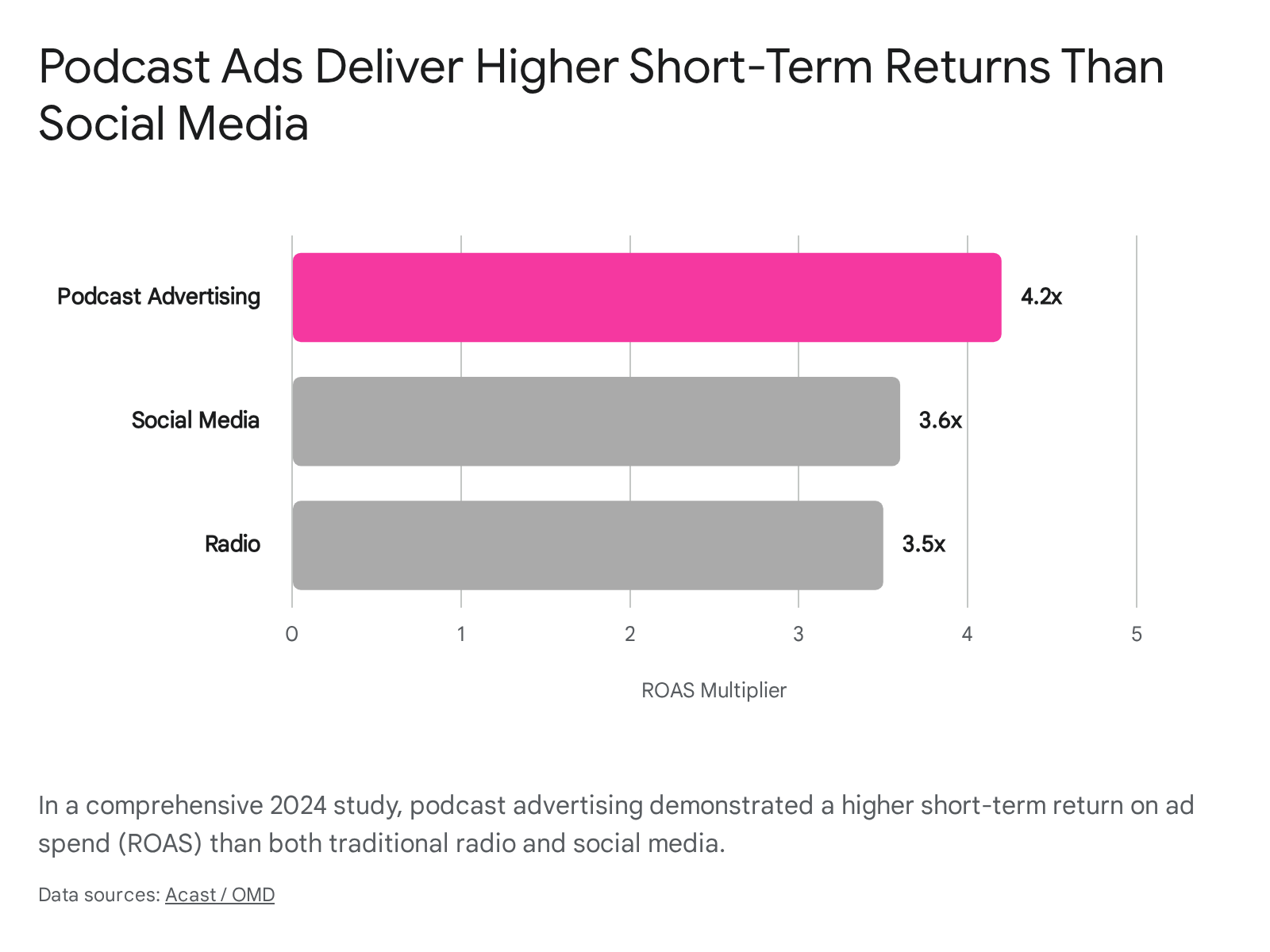
A comprehensive 2024 study conducted by Acast and the media agency OMD analyzed two billion SEK in ad spend across various industries to determine the true efficacy of the medium. The results showed that podcast advertising delivers an exceptional 4.9x long-term Return on Investment (ROI), meaning every dollar spent generates nearly five dollars in long-term sales 9.
When measuring short-term Return on Ad Spend (ROAS), podcasts scored a 4.2, easily surpassing social media (3.6) and traditional radio (3.5) 9.
Furthermore, podcast ads are exceptionally sticky. Studies indicate that 86 percent of engaged listeners recall podcast ads within a one-week period, giving the format a slower reach decay and higher recall rate than virtually any other digital platform 2425.
The medium also drives high purchase intent. Over 60 percent of podcast consumers report purchasing a product specifically because it was discussed or recommended by a host, and roughly half state that podcast ads improve their overall opinion of a brand 1718. Because the audience actively chooses to consume long-form content, they are far more receptive to complex branded storytelling than they are to disruptive, skippable pre-roll videos on standard social feeds.
Navigating the Risks: AI Fraud and Brand Safety
Despite the compelling return metrics, the podcast advertising ecosystem in 2026 is not without significant risks. As vast sums of money pour into programmatic audio channels, sophisticated criminals have followed, bringing advanced technological threats that require immediate advertiser attention.
Agentic AI and Programmatic Ad Fraud
Digital ad fraud is a staggering problem, projected to cost advertisers over $100 billion globally across all media channels in 2026 2627. In the podcasting space, the threat comes primarily through the abuse of the Dynamic Ad Insertion infrastructure.
Fraudsters are no longer using rudimentary scripts to fake clicks. In 2026, the primary threat is "Agentic AI" - highly autonomous botnets capable of simulating complex human behaviors. These bots can request podcast audio streams, fake active listening times, and even fill out lead-generation forms using stolen personal data to trick smart-bidding algorithms into validating the traffic 27. Industry benchmarks suggest that roughly 20.6 percent of all programmatic traffic exhibits signs of invalid or fraudulent activity 2728.
When brands optimize their podcast campaigns based solely on raw download numbers or programmatic dashboard metrics, they risk optimizing toward "ghost audiences" that drain budgets without ever generating real human awareness 28. To combat this, leading advertisers must demand real-time data validation and utilize behavioral fingerprinting tools that analyze the intent behind the traffic, rather than just trusting the IP address.
The Threat of Synthetic Voices and Deepfakes
A secondary, but highly damaging, risk in 2026 involves brand safety and synthetic media. Criminals are increasingly utilizing generative AI to clone the voices of popular podcast hosts and public figures 2910.
These unauthorized audio deepfakes are then used to generate programmatic ads that appear to feature genuine host endorsements for scams, dubious financial products, or counterfeit goods 11. If a legitimate brand inadvertently buys programmatic inventory on a podcast that has been hijacked by deepfake content, or if a cloned host voice is used in an ad placed next to a brand's legitimate product, the reputational damage can be severe. Financial institutions and wealth managers are particularly vulnerable to these voice-imitation schemes, pushing compliance departments to mandate strict, context-aware verification tools like DoubleVerify or Oracle MOAT before approving programmatic podcast campaigns 2910.
The Creator Imbalance and the Push for Intent
As the industry grapples with scale and fraud, the creator landscape itself is shifting. There are now over 4.7 million podcasts available globally, publishing an average of 85,000 new episodes every single week 12.
This sheer volume of content has created a stark imbalance. While elite, top-tier shows enjoy lucrative brand partnerships and access to advanced video production teams, the vast majority of creators face severe burnout trying to maintain multi-platform video and audio distribution without adequate resources 32. Because programmatic ad buying favors massive scale, mid-tier and niche podcasters frequently struggle to monetize their highly engaged, but numerically smaller, audiences 32.
For brands, this imbalance presents a strategic opportunity. Rather than chasing massive, generalized reach, savvy marketers in 2026 are shifting toward intentional, community-led podcasting. By sponsoring B2B podcasts, regional shows, or highly specific hobbyist networks, brands can bypass the inflated CPMs of blockbuster entertainment shows 3312. In this refined approach, the goal is not to maximize impressions, but to secure the deep trust and "narrative influence" of a host who speaks directly to an advertiser's exact target customer profile 35.
Bottom line
The podcasting industry in 2026 represents a maturing, multi-billion dollar media channel capable of delivering exceptional returns through high-trust, video-enhanced storytelling. Brands should confidently invest in the space, prioritizing authentic host-read integrations and targeted niche communities to maximize brand recall and purchase intent. However, as programmatic buying expands, advertisers must remain vigilant, deploying robust verification tools to protect their budgets from the escalating threats of AI-driven ad fraud and synthetic deepfakes.