
Meta Threads Algorithm and Brand Investment Analysis 2026
Platform Evolution and Market Context
The microblogging and real-time text-based social media landscape has undergone a fundamental structural shift over the past three years. Launched initially in July 2023 as a rapidly deployed alternative to X (formerly Twitter), Meta's Threads has matured from an experimental derivative of Instagram into an independent, highly integrated communication ecosystem. The inception of the platform was characterized by a volatile growth cycle, capturing 100 million user sign-ups within its first five days - a period defined largely by exploratory adoption driven by external market turbulence surrounding X's ownership transition 12. Following this initial surge, the platform experienced well-documented short-term retention challenges as early adopters found a minimalist interface lacking parity with established microblogging competitors.
However, by the second quarter of 2026, Threads has definitively transcended its initial hype-crash cycle. It now grows steadily on its own merits, backed by Meta's massive infrastructure, the inherent user base of Instagram, and a deliberate strategy of prioritizing conversational content over broadcast messaging 2. The competitive dynamics between Threads and X have reached a pivotal moment in 2026, culminating in a critical milestone: Threads has surpassed X in mobile daily active users (DAUs) 234. This transition is underpinned by an algorithmic architecture that diverges sharply from legacy models, optimizing for community engagement and reply depth rather than outrage-driven virality 5. Concurrent with massive API expansions in early 2026, the global rollout of native Meta Ads Manager integration, and progressive integration with the decentralized ActivityPub protocol (the Fediverse), Threads presents a highly mature environment for corporate communication, brand marketing, and audience development 367.
This report provides an exhaustive analysis of the Threads platform in 2026, detailing its algorithmic mechanics, developer infrastructure, European regulatory compliance constraints, decentralized networking architecture, and strategic viability for enterprise brands.
Audience Architecture and Demographic Shifts
The user base trajectory of Threads demonstrates sustained, compound growth heavily localized in high-value global markets. By early to mid-2026, the platform crossed 450 million monthly active users (MAUs), effectively establishing itself as a dominant force in the text-based social networking sector 25. The composition of this audience, their device preferences, and their geographic distribution provide crucial context for digital marketing strategies.
Mobile Dominance Versus Desktop Utilization
The overtaking of X in mobile DAUs - 141.5 million for Threads versus 125 million for X - is not merely a statistical footnote; it represents a fundamental changing of the guard in daily habitual digital behavior 2.
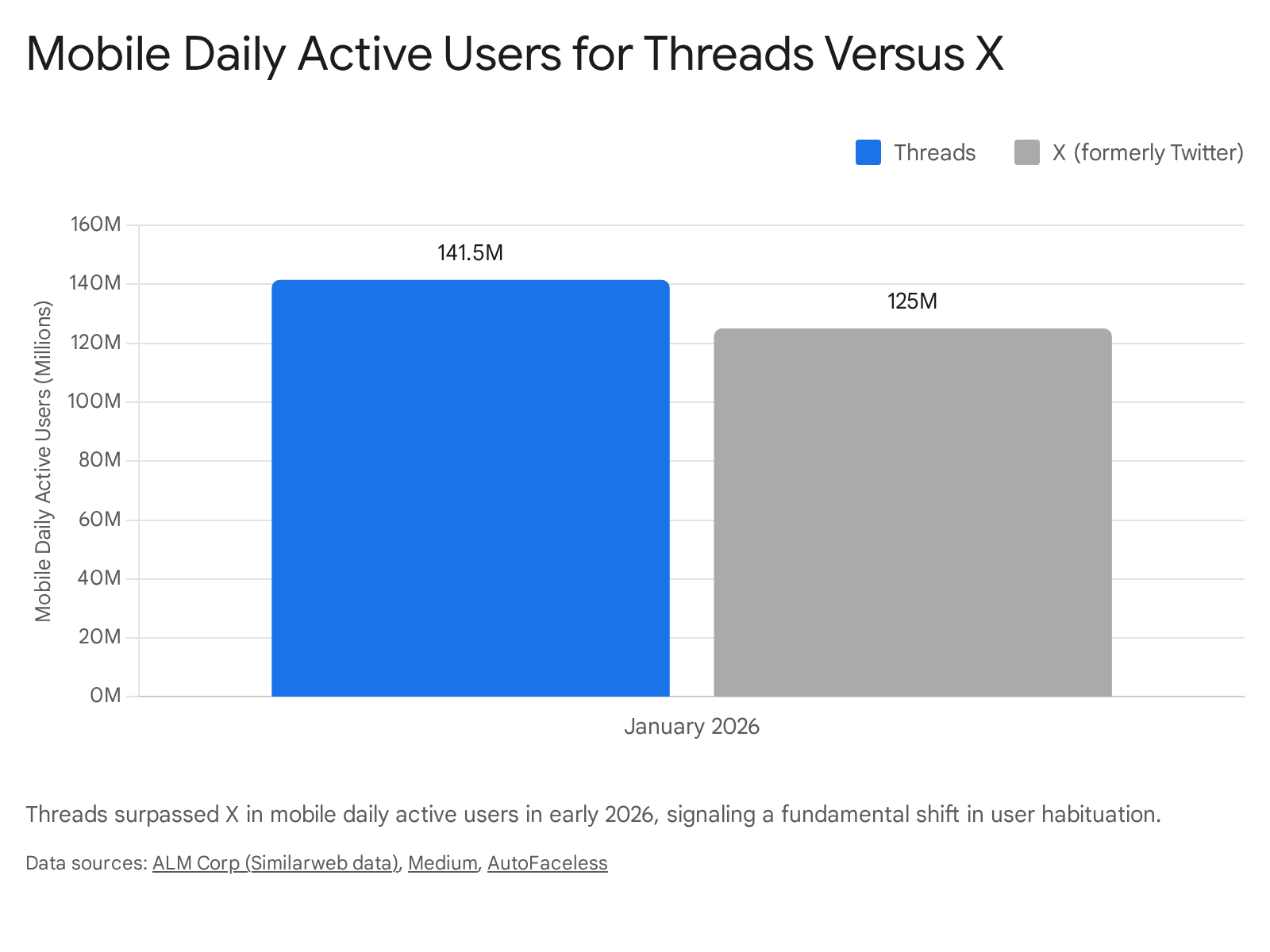
The mobile application market is where users spend the highest quality of attention, making this demographic cross-over highly attractive to advertisers. In the United States application market specifically, Threads commands 15.3 million daily mobile users, trailing X's 22.9 million, though overall domestic MAUs for Threads are projected to reach 60.5 million by the end of 2026, surpassing X's 50 million 7.
Conversely, X continues to maintain a substantial and heavily fortified lead in desktop and web traffic. Industry data indicates X processes roughly 145.8 million daily web visits, dwarfing Threads' approximate 6.9 million daily web visits 7. This discrepancy highlights differing foundational usage environments. Threads remains deeply tethered to mobile-first consumer habits inherited from its parent application, Instagram. X retains its historical utility as a professional desktop tool for real-time monitoring, financial analysis, and journalism 78.
Recognizing this critical gap in professional utility, Meta prioritized web parity throughout early 2026. In May 2026, Meta's Head of Threads, Connor Hayes, announced the rollout of Direct Messaging (DMs) to the Threads desktop interface 910. The introduction of a dedicated "Messages" tab on the web, supporting one-on-one and eventually group chats of up to 50 individuals, directly targets power users and enterprise communicators who operate primarily from desktop environments and rely on "sidebar" conversations outside the public feed 911.
Geographic Penetration and Demographics
Platform adoption varies significantly across global regions, driven by localized marketing efforts and regulatory environments. India currently constitutes the largest user market with an estimated 54.2 million users, followed closely by Brazil with 36.4 million active users 2. The platform supports 31 languages and maintains a presence in over 100 countries 17. The European Union represents a highly complex demographic due to staggered regulatory rollouts mandated by digital privacy laws, but active adoption has accelerated steadily since the platform's official, compliant EU launch in December 2023 1.
Demographically, the platform exhibits a pronounced gender skew. Data from mid-2025 indicated that 68% of Threads users are male, highlighting a strong male dominance in the platform's user base, compared to a 32% female demographic share 7. Furthermore, the platform heavily over-indexes with younger cohorts; an estimated 35.8% of United States Instagram users belonging to Generation Z are active on Threads by 2026, solidifying it as a crucial channel for reaching emerging consumer demographics 12.
| Metric Category | Threads (2026 Estimates) | X / Twitter (2026 Estimates) |
|---|---|---|
| Monthly Active Users (MAU) | ~450 Million 25 | ~561 - 600 Million 414 |
| Mobile Daily Active Users (DAU) | 141.5 Million 234 | 125 Million 234 |
| Daily Web Visits | ~6.9 Million 7 | 145.8 Million 7 |
| Projected Annual Revenue | $11.3 Billion 212 | Declining / Undisclosed 1213 |
| U.S. Market MAU (End of 2026) | 60.5 Million 7 | 50 Million 7 |
Algorithmic Architecture and Feed Distribution
Understanding content distribution on Threads requires completely decoupling strategic assumptions based on legacy text platforms like X. Threads does not optimize for chronological velocity, nor does it rely heavily on friction-based virality - such as outrage amplification or quote-post arguments 58. Instead, it utilizes an interest-graph model heavily seeded by existing behavioral data drawn from the broader Meta ecosystem, specifically the Instagram content graph.
The Instagram Content Graph Synergy
Threads operates separate recommendation algorithms from Instagram, yet the two are structurally and functionally symbiotic. A user's behavioral history on Instagram directly serves as a foundational input signal for the Threads AI ranking engine 5. The algorithm treats the two platforms as distinct surfaces operating on a shared behavioral profile. Viewing an author's Instagram profile, saving their content, or sharing their media via direct messages to non-followers signals high qualitative intent to the underlying algorithm 514. Consequently, the Threads algorithm will subsequently elevate that same author's text posts in the user's Threads "For You" feed.
This interoperability creates a compounding network effect. Accounts active on both platforms experience approximately 15% faster audience growth on Threads 5. For enterprise startups and legacy brands that already possess a mature Instagram presence, Threads provides a text-based channel to reach the exact same audience without the prohibitive friction of building an entirely new social graph from zero 14. This is a structural advantage that independent platforms simply cannot match.
Hierarchical Ranking Factors and Reply Depth
The Threads content ranking system evaluates behavioral signals in a carefully weighted hierarchy.
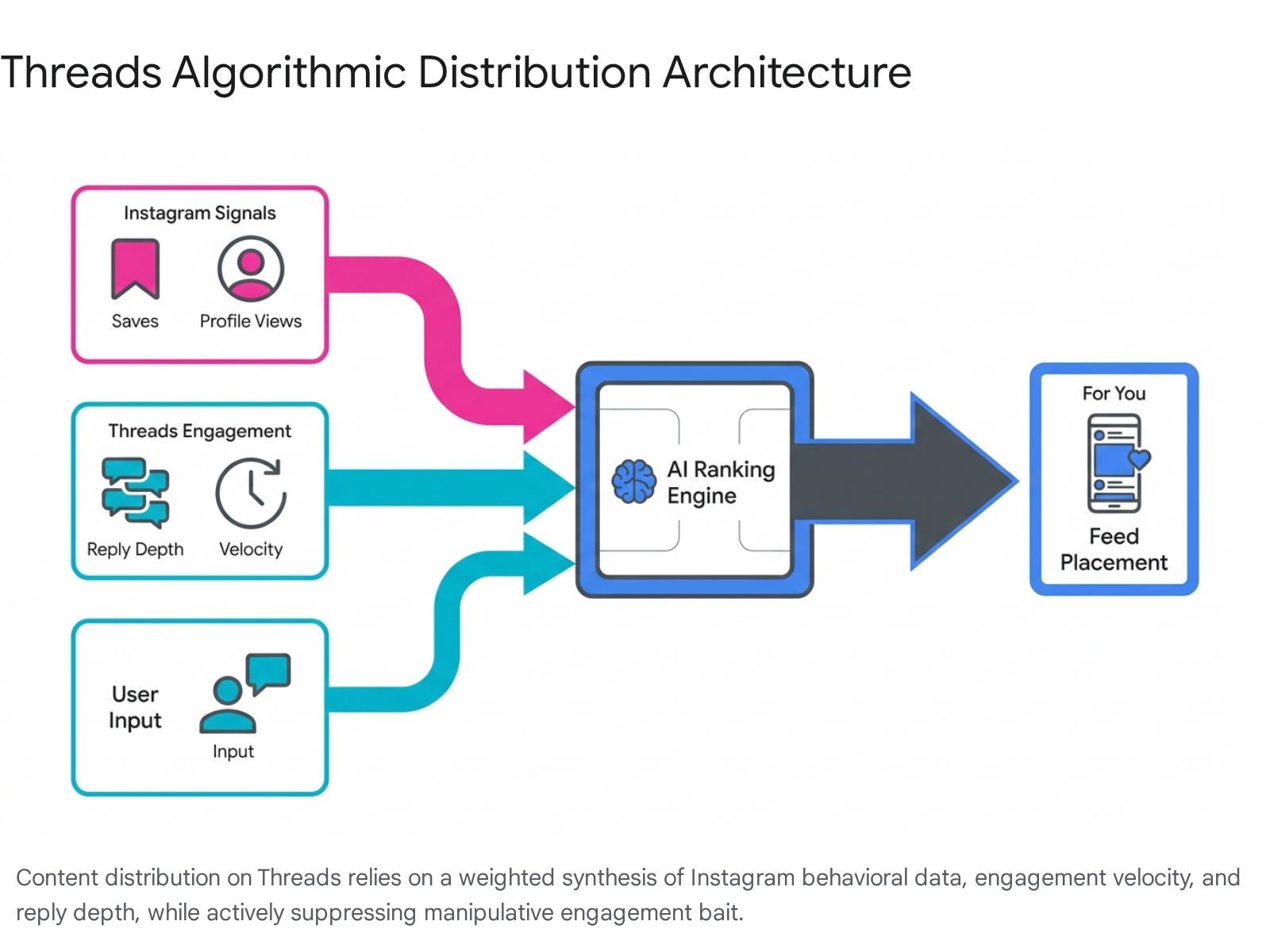
Adam Mosseri, Head of Instagram and Threads, has confirmed through multiple transparency updates that the platform prioritizes metrics indicating prolonged attention and positive community building over passive consumption 514. The primary factors determining feed distribution in 2026 include:
Firstly, engagement velocity plays a critical role. This metric measures the speed at which a post accrues positive interactions relative to its time of publication. The algorithm heavily favors early momentum; accumulating 50 likes within the first 30 minutes of a post's life yields a vastly higher algorithmic distribution multiplier than securing 100 likes distributed evenly over a 24-hour period 58. Both Threads and X reward quick early engagement, but Threads is significantly more forgiving to smaller accounts, whereas X increasingly restricts algorithmic amplification to paid Premium accounts 8.
Secondly, and perhaps most importantly, is reply depth. Threads actively ranks posts that initiate sustained, back-and-forth conversations significantly higher than those generating high volumes of passive likes. Substantive comment chains - defined internally as replies containing more than five words - trigger a "high social relevance" tag 514. This algorithmic flag subsequently opens the original post to widespread non-follower distribution via the "For You" feed. The platform's core design philosophy seeks to emulate a conversational ecosystem rather than a broadcasting megaphone.
Finally, the platform applies a strict algorithmic penalty for engagement bait. While legacy platforms often reward manipulative tactics, Meta actively demotes content designed to artificially inflate metrics. Posts explicitly demanding that users like, follow, or share content are algorithmically penalized and suppressed. This aggressive moderation maintains a cleaner signal-to-noise ratio than competing networks, fostering an environment that feels safer and less contentious for general consumers 514.
User-Directed Modulation: The "Dear Algo" Feature
A significant algorithmic evolution rolled out in February 2026 is the introduction of the user-directed "Dear Algo" feature. This AI-powered tool allows users to explicitly dictate short-term content preferences by publishing a public prompt (e.g., "Dear Algo, show me more posts about corporate sustainability practices") 1718. The system processes the natural language prompt and overrides general behavioral profiling for approximately three days, actively surfacing niche content matching the explicit request 1718.
For brands and social media managers, this heightens the importance of precise semantic keyword inclusion in post text. During these user-directed algorithmic windows, exact semantic matching temporarily supersedes traditional engagement metrics. A highly relevant post with low initial engagement may suddenly receive massive distribution if it precisely matches an influx of "Dear Algo" user requests 1719.
Content Formats and Publishing Strategy
Despite its foundational positioning as a "text-first" application and a direct competitor to microblogging incumbents, empirical data regarding content formats on Threads reveals a distinct visual bias. The platform's origin as a derivative of Instagram has fundamentally shaped user expectations regarding media consumption.
The Visual Performance Anomaly
Analysis of over 10 million posts indicates that visual media vastly outperforms pure text. Image and video posts secure an average of 60% higher engagement rates than text-only updates 5. Specifically, native video posts secure a median engagement rate of 5.55%, images reach 4.55%, while text-only posts lag significantly at 2.79% 15. Link posts perform the poorest, resting at 2.34%, indicating a strong algorithmic suppression of content that directs users off-platform 15. This metric anomaly demands that brands approach Threads not merely as a text-broadcasting tool, but as a hybrid multimedia channel where visual assets anchor conversational text.
Long-Form Native Auto-Threading
Recognizing the desire for deeper, structured commentary, Meta updated the Threads composer in May 2026 to automatically handle long-form text 716. When users paste text exceeding the standard 500-character limit into the mobile composer, the platform now automatically segments that text into multiple, sequentially linked native posts, complete with animated indicators demonstrating character length and division 716.
This automation transforms user behavior. By turning pasted text into natively linked posts rather than forcing users to upload screenshots of text applications or rely on clunky external links, Threads keeps longer commentary directly inside the feed. It encourages structured social commentary, making the platform increasingly viable for creators, journalists, and brands aiming to publish in-depth thought leadership that is too extensive for a single caption but too conversational to bury in a newsletter 16.
Trending Topics and Live Event Integration
To capture the real-time event commentary market - a historical stronghold for X - Threads has aggressively expanded its discovery features. In early 2024, the platform launched AI-generated trending topic summaries in the United States, subsequently expanding to regions including Japan, Vietnam, Taiwan, and Brazil by May 2026 17. These topic summaries utilize artificial intelligence to synthesize the main themes of real-time discussion, applying human oversight to curate high-velocity conversations without amplifying terms that violate community guidelines 17.
Furthermore, Threads introduced "Live Chats" in April 2026. Initially piloted within highly active sports communities, such as the NBA discussions, this feature centralizes event-specific dialogue into real-time public chat interfaces 123. For brands involved in live event sponsorships, product launches, or real-time crisis management, Live Chats provide a dedicated, highly visible surface to engage with actively participating audiences.
Organic Engagement and Analytical Benchmarks
When evaluating platform viability and allocating marketing budgets, engagement rate data presents a compelling argument for resource reallocation toward Threads. However, marketing professionals must navigate significant variances in how third-party analytics firms calculate these critical metrics.
Methodological Discrepancies in Industry Data
Engagement rates are commonly cited without methodological context, leading to widespread misinterpretation. Data providers like Hootsuite typically calculate engagement as a percentage of impressions or reach (average engagement per post divided by total post reach) 18. Conversely, firms like Rival IQ calculate engagement by dividing the median number of interactions by the account's total follower count 18. When applied to identical datasets, the Hootsuite methodology yields percentages that are consistently six to fourteen times higher than the Rival IQ methodology 18. Consequently, cross-platform comparisons are only valid when utilizing internally consistent methodologies.
The True Reach Advantage
Using standardized median calculations across massive data samples, Threads consistently demonstrates an order-of-magnitude engagement advantage over its competitors. In early 2026, the median engagement rate for a Threads post was recorded at 6.25%, compared to X at 3.6% 2319. By comparison, Instagram's overall engagement rate rests at approximately 0.48% 19. While algorithmic maturation and the introduction of native advertising may cause these figures to taper slightly - conservative estimates from late 2025 placed Threads at roughly 3.6% - the platform still consistently delivers nearly double the baseline engagement of X 15.
This discrepancy is primarily a function of supply and demand within the user feed. The Threads feed is drastically less saturated with automated news feeds, repetitive link spam, and political combat compared to X, resulting in a significantly cleaner signal-to-noise ratio 14.
The practical implications for brands are profound when analyzing distribution percentiles. According to data tracking software performance, a Threads post resting in the 25th percentile of performance (effectively an "underperforming" post) still reaches roughly 172 users natively 19. A similarly underperforming post on Instagram reaches only 39 users 19. Because content production for Threads is frictionless - taking an estimated 3 to 10 minutes per post compared to 30 minutes to 2 hours for a polished Instagram Reel - the return on invested time is vastly superior 19. For brands and enterprise startups, this translates to an exceptionally low cost of acquisition for audience attention and high baseline visibility for organic community-building initiatives 14.
| Platform | Median Engagement Rate (2026 Estimates) | Content Formats Ranked by Efficacy |
|---|---|---|
| Threads | ~3.6% - 6.25% 1519 | Video (5.55%), Image (4.55%), Text (2.79%) 15 |
| X (Twitter) | ~2.5% - 3.6% 1519 | Text, Image, Long-form Video 14 |
| ~0.48% 19 | Reels, Carousels, Static Images 18 | |
| ~3.40% 18 | Carousels (21.77%), Text, Video 15 |
Developer Ecosystem and API Infrastructure
The strategic viability of any social media network for enterprise brands is intrinsically linked to its Application Programming Interface (API) infrastructure. Brands rely on third-party management tools, social listening dashboards, and automated analytics pipelines. In this arena, Meta has aggressively positioned the Threads API to capitalize on the highly restrictive developer environment instituted by X.
The X API Pricing Paradigm
Following its acquisition in late 2022, X restructured its API to exact prohibitive costs, effectively dismantling its indie developer ecosystem and pricing out small-to-medium enterprise tools. As of 2026, the X API pay-per-use and tiered structures are highly restrictive 2021. The Free tier is write-only, allowing 1,500 posts per month but zero read access, rendering it useless for analytics or conversational bots 20. The Basic tier ($200 per month) provides 3,000 posts but lacks built-in scheduling capabilities 20. Practical commercial access requires the Pro tier at a flat rate of $5,000 per month, which caps reads at 1 million per month, while Enterprise access requires custom contracts starting at approximately $42,000 per month 2021. Furthermore, X applies a severe URL penalty in its pay-per-use structure; creating a standard text post costs $0.015, but publishing a post containing any hyperlink costs $0.20 per request - a more than 13x markup designed to penalize publishers directing traffic off-platform 22.
Threads API Expansion and Capabilities
In stark contrast, Meta officially launched and subsequently expanded the Threads API throughout early 2026, offering expansive read, write, and analytic capabilities completely free within generous rate limits 2324. This enables widespread integration with social media management platforms such as Sendible, Hootsuite, and Buffer, as well as data aggregation tools like Data365 and Netrows 242526.
In April 2026, Meta instituted a major API update designed to embed Threads deeper into external corporate workflows 6727. Key endpoints and capabilities include:
- Richer Publishing Formats: The API fully supports complex formatting. Developers can programmatically attach long-form text (up to 10,000 characters) to posts, integrate GIFs natively via GIPHY, and utilize spoiler tags for text, images, and videos 67. Additionally, brands can deploy "ghost posts" - ephemeral, text-only updates that automatically archive after 24 hours 6.
- Cross-Platform Integration: Developers can programmatically trigger the cross-sharing of Threads posts directly to connected Instagram Stories, driving immediate cross-platform traffic 67.
- Tokenless oEmbed Architecture: A highly anticipated feature enabling developers, journalists, and publishers to natively embed public Threads content onto websites and external applications without the friction of providing an API access token or navigating complex Meta App Review processes 6.
- Advanced Moderation and Webhooks: For enterprise community management, the API features real-time webhooks for publish and delete events. Furthermore, a new "reply approvals" endpoint allows brands to programmatically filter pending replies, manually approving or ignoring inbound comments before they appear publicly on a thread 6727.
Rate Limits and Operational Constraints
To maintain infrastructure stability, the official Threads API implements strict, yet accommodating, volumetric quotas based on a rolling 24-hour window 2428.
An individual Threads profile is limited to publishing 250 posts per 24 hours via the API 2835. Notably, publishing a multi-image carousel counts as a single post toward this limit 28. For conversational management, profiles are capped at 1,000 programmatic replies within the same 24-hour moving period 2428. Furthermore, the API restricts location tagging searches to 500 per day, and post deletions to 100 per day 28. These limits generally accommodate all standard corporate communication, automated scheduling, and customer service operations, restricting only the highest-volume automated aggregation scrapers.
Advertising Infrastructure and Monetization
For the first eighteen months of its existence, Threads remained devoid of native advertising, a strategy designed to prioritize user acquisition and habituation over immediate monetization. Following rigorous, limited testing phases through late 2025, Meta officially launched global advertising capabilities on Threads in January 2026, representing a massive new revenue vector projected to generate $11.3 billion for the company 2312.
Integration with Meta Ads Manager
The rollout of Threads advertising avoids the friction of a bespoke platform; it leverages Meta's globally ubiquitous existing infrastructure. Advertisers simply access Threads' 450 million monthly active users through the standard Meta Ads Manager 3. Once a brand links its business Instagram account to a Threads profile, campaigns can be deployed simultaneously across Facebook, Instagram, WhatsApp, and Threads from a unified interface 3.
All standard Meta ad objectives are fully functional for Threads placements. This includes brand awareness, website traffic generation, post engagement, lead capture forms, and mobile app promotion 3. Early cost-per-mille (CPM) metrics observed during the alpha testing phases ranged between $2.00 and $8.00, presenting a substantial financial arbitrage opportunity for early-adopting brands 12. Industry analysts project these rates will inevitably normalize to between $12.00 and $25.00 as inventory demand increases and algorithmic targeting refines through Q3 and Q4 of 2026 12.
Brand Safety and Content Moderation
The defining competitive advantage Threads holds for enterprise advertisers is its rigorous commitment to brand safety. Over the past three years, X has experienced sustained, highly publicized advertiser attrition primarily due to its proximity to controversial content, lack of reliable content moderation, and volatile policy changes implemented by executive leadership 31229. Large corporations are increasingly unwilling to risk reputational damage by having their media placed adjacent to unmoderated hostility or illegal deepfakes 3.
Threads inherently mitigates this risk by leveraging Meta's vast, established moderation infrastructure, which strictly enforces standardized community guidelines. Crucially, Threads advertising operates with integrated third-party verification. Meta extended verification capabilities previously restricted to Facebook and Instagram directly into the Threads feed through strategic partnerships with leading providers including DoubleVerify, Integral Ad Science (IAS), Scope3, and Zefr 3. These independent partners actively verify brand safety and suitability, ensuring corporate advertisements appear only within appropriate contextual boundaries. Furthermore, Meta secured Media Rating Council (MRC) accreditation for these placement methodologies, satisfying the stringent compliance requirements of global advertising agencies and reducing risk for media buyers 3.
European Union Compliance and the Digital Markets Act
The global rollout, feature availability, and underlying data architecture of Threads have been profoundly shaped by the European Union's regulatory environment. Specifically, the Digital Markets Act (DMA) - a sweeping legislative framework aimed at curbing the monopolistic tendencies of major technology corporations - has dictated Meta's operational strategy in Europe 3031.
The Gatekeeper Data Segregation Mandate
When Threads initially launched to historic numbers in July 2023 across 100 countries, Meta explicitly withheld the application from the EU market 1330. This omission was rooted directly in the compliance ambiguities surrounding the DMA, which officially designated Meta as a "gatekeeper" entity 3032.
Article 5(2) of the DMA explicitly prohibits designated gatekeepers from unilaterally combining personal data across different core platform services, or automatically signing users into external services to aggregate advertising profiles without explicit, granular user consent 3033. Because the foundational architecture of Threads required an Instagram login to function - effectively merging social graphs, user identity, health tracking, and browsing history into a singular advertising profile - launching the application unaltered in the EU risked catastrophic regulatory action 133032. This caution was heavily influenced by precedent; only months prior, in May 2023, the Irish Data Protection Commission (acting on behalf of the EU) fined Meta a record €1.2 billion for breaching General Data Protection Regulation (GDPR) rules regarding transatlantic data transfers 133034.
Threads ultimately launched in the European Union in December 2023, following a five-month delay, after Meta engineered a bifurcated account structure 1. To comply with the DMA's data segregation mandates, Meta allows EU citizens to browse the Threads platform completely anonymously without creating an integrated profile. However, active participation - such as publishing posts, replying, or liking content - still requires a connected Instagram account governed by newly implemented, DMA-compliant consent frameworks 1.
Hardware Interoperability and the DMA
The DMA's broader influence extends beyond software profiling to the hardware level, indirectly affecting how users interact with applications like Threads. By May 2026, the European Commission mandated strict device-level interoperability for the Apple and Google mobile operating systems 4235.
To comply, Apple's iOS 26.5 update introduced specific interoperability features exclusive to EU iPhone users 42. Third-party wearables (smartwatches, earbuds) gained proximity pairing identical to Apple AirPods, and, crucially, full interactive notification forwarding 42. Prior to this, third-party accessories could only display read-only alerts. Under the DMA, users can now view and directly react to iOS notifications - including Threads direct messages and post alerts - from competitor smartwatches 42. For developers interacting with the Threads API, this regulatory environment ensures that notification endpoints and wearable app integrations in the EU are no longer artificially bottlenecked by the underlying operating system. Furthermore, Google Android is facing similar mandates to allow third-party AI assistants to utilize voice "wake words" and access screen-locked devices seamlessly, opening new vectors for voice-activated social media interaction 35.
The Fediverse and Decentralized Social Networking
Beyond centralized algorithmic feeds and regulatory compliance, Meta's strategic decision to integrate Threads with ActivityPub represents a paradigm shift for corporate social media infrastructure 3637. ActivityPub is an open, decentralized social networking protocol developed by the World Wide Web Consortium (W3C) 3637. It serves as the technological foundation for the "Fediverse" - a constellation of interconnected, independent servers (such as Mastodon, WordPress, and PixelFed) that allow seamless cross-platform communication 3839.
Mechanics of Interoperability
The integration of Threads into the Fediverse breaks down the traditional "walled garden" approach historically favored by Meta. Following an initial beta phase launched in March 2024 for users in the US, Canada, and Japan, Meta expanded the interoperability feature to over 100 countries in June 2024 140.
The integration operates on an opt-in basis for users aged 18 and older with public profiles 3840. Once a user turns on "Fediverse sharing" in their account settings, their published posts become visible and searchable on independent, third-party servers compliant with ActivityPub 3840. Users on platforms like Mastodon can follow the Threads account, like its posts, and issue replies without ever creating a Meta profile 140. These external replies and aggregated like counts subsequently flow back into the native Threads application, appearing on the user's original post 3640.
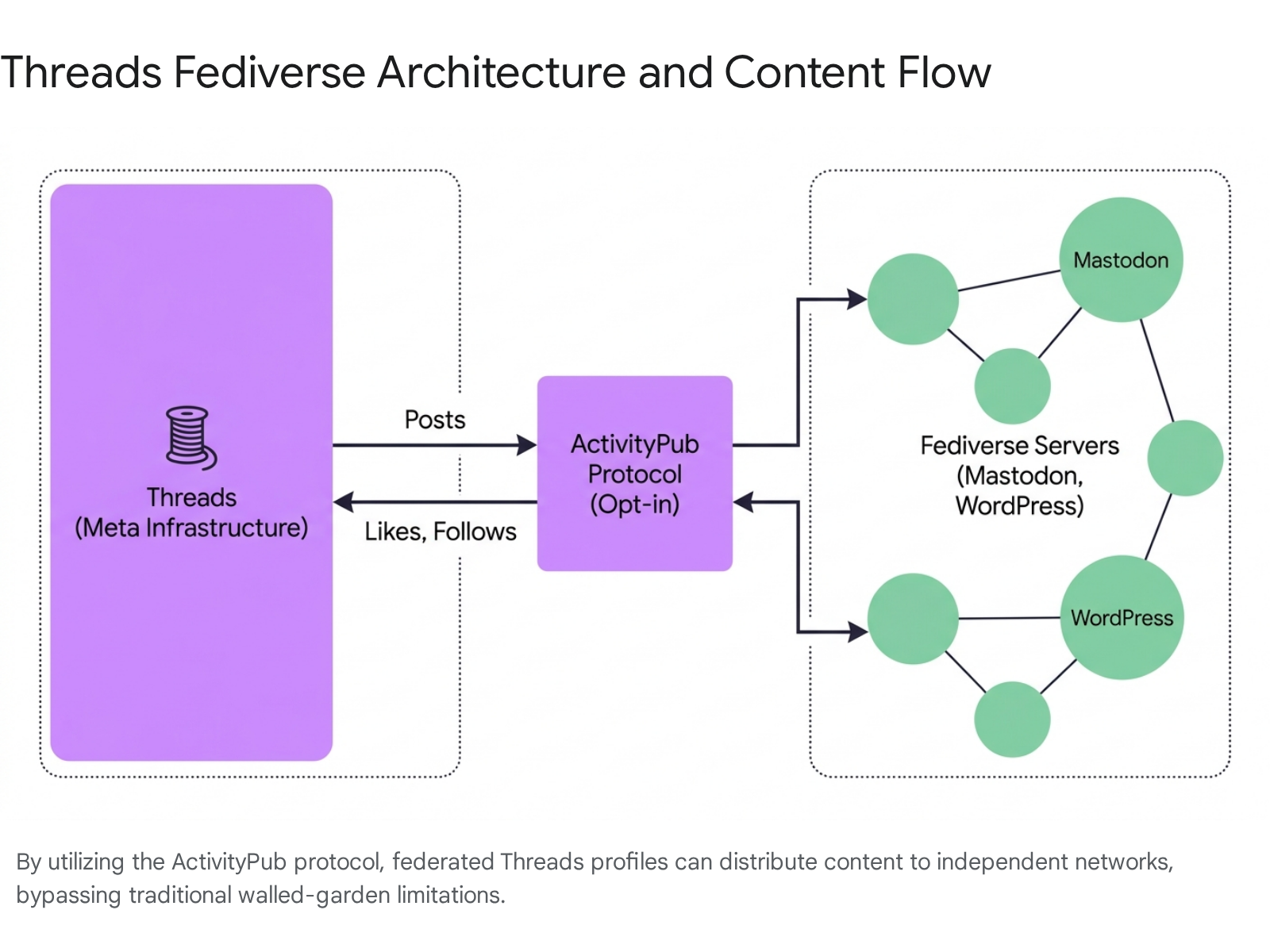
Technical limitations do apply based on protocol constraints. Certain rich-media interactions, including posts with restricted reply settings, interactive polls, quote posts, and re-posts of non-federated content, cannot currently be amplified into the Fediverse 40.
The Brand Safety and Moderation Paradox
For enterprise brands and corporate entities, Fediverse integration presents a profound risk-reward paradox. The primary advantage is guaranteed data portability and wider content distribution that remains entirely independent of Meta's internal algorithmic constraints 37. However, this decentralized reach comes at the explicit cost of moderation control.
Once a brand's post enters the Fediverse, the data physically resides on independent servers governed by varied, highly localized sets of rules 41. Meta explicitly states in its documentation that it cannot enforce community standards, execute retroactive content deletions, or guarantee the removal of copyrighted material on third-party servers 38. If a federated reply to a brand's post originates from an external server with lax moderation regarding hate speech or explicit content, Meta's centralized safety tools are powerless to sanitize the external environment.
Furthermore, federated distribution is not guaranteed. A growing movement known as the "Fedipact" - a pledge signed by numerous administrators of independent Fediverse instances - actively blocks all inbound and outbound traffic communicating with Meta servers 142. Driven by ideological opposition to corporate surveillance, data harvesting, and Meta's historical privacy controversies, these server administrators use their localized authority to arbitrarily sever connections to Threads 3742. Consequently, a brand attempting to leverage the Fediverse may find its content proactively blocked by large swaths of the decentralized network. Due to this severe lack of jurisdictional control over brand adjacencies and copyright enforcement, highly regulated brands generally advise maintaining an unfederated, closed-loop presence on Threads.
Strategic Conclusions for Enterprise Investment
An objective analysis of the 2026 social media landscape yields a definitive conclusion regarding platform viability. Brands maintaining an active, text-based corporate communication strategy can no longer treat Threads as a secondary experiment or a mere hedge against X. It has established structural dominance in the mobile sphere, secured a massive user base, and implemented the necessary developer and advertising frameworks to support enterprise-scale operations.
To capitalize on the current state of the platform, brands must adapt to its specific algorithmic and cultural realities:
- Algorithmic Strategy and Conversational Publishing: Brands must pivot away from traditional, link-heavy broadcast marketing. Because the underlying algorithm disproportionately rewards reply depth and engagement velocity, content must be explicitly designed to solicit ongoing answers, debate, or continuous commentary. Furthermore, due to the synergy with the Instagram Content Graph, brands must actively funnel their existing, highly engaged visual audiences toward their text-based Threads presence to trigger algorithmic seeding and accelerate early account growth.
- API Utilization and Infrastructure Efficiency: The prohibitive pricing, strict read-caps, and URL-penalties embedded in the X API make large-scale automation, sophisticated social listening, and scheduled corporate publishing highly cost-inefficient for many organizations. The free-to-use nature of the expanded Threads API, combined with powerful 2026 updates including tokenless embeds, long-form text attachments, and programmatic reply moderation, supports sophisticated social infrastructure at a fraction of the historical cost.
- Advertising Investment and CPM Arbitrage: As Meta aggressively scales the global rollout of native Threads advertising through its unified Ads Manager, the current CPM environment offers a temporarily underpriced attention arbitrage. Brands should actively reallocate testing budgets toward Threads, relying on the platform's superior brand safety commitments, cleaner signal-to-noise ratio, and independent third-party verification protocols (DoubleVerify, IAS, Scope3) to protect brand equity.
- Fediverse Restraint: While technologically innovative, corporate entities with strict brand safety guidelines and compliance requirements should actively disable Fediverse integration. The marginal benefits of decentralized reach do not currently outweigh the profound inability to moderate adjacent content, retract public errors, or control advertising adjacencies once corporate data propagates to independent, unverified servers.
By systematically out-scaling competing networks in mobile daily active users and finalizing a robust, brand-safe advertising and API infrastructure, Meta has successfully cemented Threads as the definitive, dominant venue for real-time, public discourse in 2026.