
The Science of Why Music Gives You Chills
Musical frisson is a profound psychophysiological response triggered when an acoustic stimulus violates and subsequently resolves the brain's subconscious auditory predictions, flooding the mesolimbic reward pathway with dopamine. Essentially, the human brain functions as an advanced prediction machine, and it rewards itself with neurochemical chills - and physiological arousal such as goosebumps - when its expectations are skillfully subverted.
Picture the visceral reaction to a sudden, earth-shaking beat drop in a crowded electronic dance music (EDM) club, or the shiver that runs down the spine when a singer unleashes a soaring, triumphant vocal crescendo. These moments are not merely abstract emotional reactions; they are highly structured neurobiological events. Known scientifically as frisson (a French term translating to a brief emotional thrill), aesthetic chills, or even "skin orgasms," this phenomenon temporarily merges ancient evolutionary survival mechanisms with profound aesthetic pleasure 1124. During frisson, the autonomic nervous system triggers piloerection - the contraction of tiny muscles at the base of hair follicles - a mechanism that originally evolved in furry mammals to puff up their coats in response to cold or adrenaline-inducing threats 1. In modern humans, this ancient defense mechanism has been co-opted by the brain's reward circuitry to process extreme aesthetic beauty and emotional intensity 15. To fully comprehend how organized sound waves can induce such potent physical sensations, we must explore the cognitive mechanisms of prediction, the intricate neuroanatomy of the reward pathway, cross-cultural acoustic triggers, and the emerging therapeutic applications of sound.
Why Do Certain Sounds Give Us Goosebumps?
The Brain as a Prediction Machine
At its cognitive core, the human brain operates as an unrelenting prediction machine, a complex neural network that continuously scans its environment to anticipate future events based on statistical regularities 2348. This survival mechanism allows humans to navigate a chaotic world by forming subconscious models of what is likely to happen next. When applied to music, this predictive processing occurs at lightning speed. As a listener is exposed to a melody, a rhythmic pattern, or a harmonic progression, the auditory cortex rapidly extracts statistical data and forms a predictive model of the subsequent notes or beats 23.
This phenomenon of statistical learning occurs implicitly; an individual does not need formal conservatory training to instinctively internalize the syntactic rules, scales, and modal frameworks of the music of their culture 38. The renowned musicologist Leonard Meyer famously argued that music's capacity to evoke emotion stems directly from its ability to meet, delay, or entirely break these learned expectations 1. When a piece of music introduces an unexpected harmony, executes a sudden dynamic shift from quiet to loud, or delays a heavily anticipated resolution, it creates a state of acute cognitive tension 128. The brain registers this anomaly as a "prediction error."
However, because this violation occurs within the safe, structured confines of an aesthetic experience, the brain does not trigger a full panic response. Instead, it enters a state of heightened alertness and anticipation, characterized by David Huron as the "Prediction Response" and the "Imagination Response" 5. When the music eventually resolves back into a recognizable or deeply satisfying pattern, the cognitive uncertainty is extinguished 24. This sudden satiation of auditory curiosity acts as a potent psychological reward, triggering a massive release of neurotransmitters that the central nervous system interprets as a sudden thrill or wave of chills 4. In essence, composers and producers are acoustic engineers who manipulate tension and release to hack the brain's evolutionary reward systems 85.
Environmental Context and Cognitive Load
The brain's predictive capacity is not isolated from its broader environmental and social context. Recent computational social science studies tracking lyric and structural complexity over the past five decades demonstrate that societal shocks heavily influence how music is consumed and processed 6. For instance, longitudinal data indicates a significant increase in stress-related language and a decrease in lyric compressibility and complexity in popular music, mirroring rising global rates of anxiety and corresponding drops in cognitive bandwidth 6. During times of intense societal upheaval - such as the COVID-19 pandemic - listeners naturally gravitate toward music that either reflects their internal stress or provides highly predictable, low-complexity acoustic structures to avoid overloading their already burdened predictive processing systems 6. This indicates that the threshold for experiencing frisson - which requires the cognitive energy to process surprise - may be influenced by the listener's baseline cognitive load and external environmental stressors.
What Is the Neurological Pathway of Musical Frisson?
The Mesocorticolimbic Reward System
The subjective euphoria and the physical tingling associated with musical frisson are mediated directly by the brain's dopaminergic reward system, specifically the mesocorticolimbic pathway 4712. This neural circuitry is biologically ancient, having evolved over a billion years ago to reinforce behaviors imperative for survival, such as consuming calorie-dense foods, engaging in sexual reproduction, and forming vital social bonds 8910. The fact that an abstract sequence of pitches and rhythms can hijack this ancient survival circuitry remains one of the most fascinating anomalies in evolutionary neuroscience 810.
When a listener encounters a musically thrilling moment - the climax of an aria or a monumental drop in an electronic track - the physiological cascade begins deep within the midbrain at the ventral tegmental area (VTA) 7916. The VTA serves as a primary hub for dopaminergic neurons. Upon recognizing the aesthetic reward (the resolution of the prediction error), the VTA fires, projecting dopamine along the mesolimbic tract into the ventral striatum, with a specific focus on the nucleus accumbens (NAc) 7128. Positron Emission Tomography (PET) scans and functional Magnetic Resonance Imaging (fMRI) studies consistently demonstrate that the release of dopamine in the dorsal and ventral striatum correlates precisely with the peak emotional arousal and intense pleasure reported during musical chills 4716.
Concurrently, dopamine travels via the mesocortical pathway from the VTA to the prefrontal cortex (PFC), specifically engaging the orbitofrontal cortex and the ventromedial prefrontal cortex 7128.
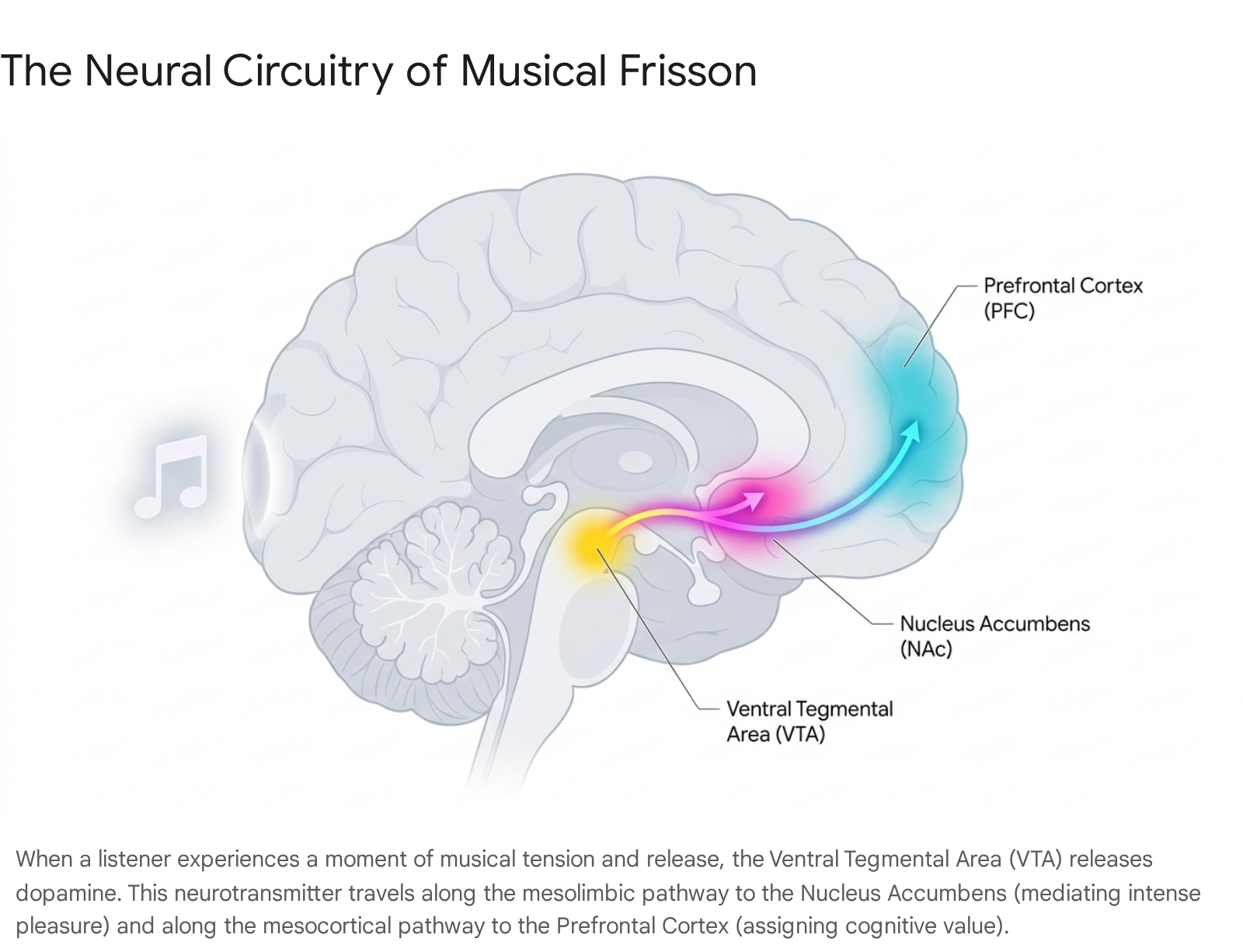
These higher-order cortical regions are responsible for assigning cognitive value, interpreting the emotional significance of the sound, and integrating the experience with autobiographical memory 1216.
As dopamine cascades through these centers, functional imaging reveals a simultaneous deactivation in the amygdala, the brain's primary center for fear and negative emotional processing, as well as deactivation in the hippocampus 410. This interplay suggests that the profound euphoria of frisson is achieved through a dual mechanism: the aggressive stimulation of pleasure centers combined with the active inhibition of regions mediating negative affective states, allowing the listener to surrender entirely to the aesthetic moment 10.
The physical sensation of chills - the goosebumps and the tingling paresthesia traversing the spine and limbs - is subsequently executed by the sympathetic nervous system 1. The anterior insular cortex, a region critical for interoception (the conscious perception of internal bodily states), acts as a bridge, integrating the cognitive appreciation of the music with the physiological arousal to produce the conscious, felt reality of the shiver 1411. This neurophysiological event is so deeply ingrained that a team of neuroscientists even compiled a 712-track, 66-hour playlist of songs proven to consistently trigger this exact pathway, ranging from Mozart to Kanye West 412.
The Opioid Debate and Baseline Physiology
While dopamine has long been heralded as the exclusive architect of musical pleasure, cutting-edge research from 2024 and 2025 has introduced critical nuances. A highly publicized study conducted by the Turku PET Centre, featured in Scientific American, demonstrated that listening to favorite, highly pleasurable music also triggers a significant release of endogenous opioids 13. Because the opioid signaling pathway is inherently linked to pain relief and profound, numbing euphoria, this finding provides a clearer mechanism for music's well-documented analgesic properties 13.
Neuroscientists now hypothesize a division of labor within the reward system: dopamine drives the anticipation and the intense craving of the reward (the agonizing buildup to the chorus), whereas the endogenous opioid system mediates the actual consumption and euphoric satiation of the pleasure (the wash of the chill itself) 71314. However, pharmacological studies utilizing opioid antagonists, such as Naltrexone, have yielded mixed results; some studies show a decrease in physiological arousal during peak pleasure, while others indicate no change in subjective self-reported enjoyment, suggesting that musical reward relies on a highly redundant and complex interplay of multiple neuromodulatory systems 7.
Furthermore, an individual's susceptibility to frisson may be predetermined by their resting autonomic state. A 2026 study published in bioRxiv investigating the overlap between musical frisson and Autonomous Sensory Meridian Response (ASMR) found that individuals with higher resting Heart Rate Variability (HRV) - a marker of robust parasympathetic flexibility - reported significantly more intense aesthetic chills 21. This indicates that a listener's baseline physiological configuration heavily influences their capacity to experience these transcendent psychophysiological moments 21.
Neural Resonance Theory (NRT)
For decades, the cognitive sciences relied on the "predictive coding" model to explain musical enjoyment 15. However, a paradigm-shifting 2025 paper published in Nature Reviews Neuroscience introduced Neural Resonance Theory (NRT), fundamentally reframing how the human body interacts with acoustic stimuli 151617.
Authored by Edward W. Large and Caroline Palmer, NRT proposes that humans do not merely process or predict music abstractly; rather, our biological structures physically resonate with it 1517. Drawing upon the physics of nonlinear oscillators, NRT posits that neural circuits in the brain, alongside structures spanning from the auditory cortex down to the spinal cord, possess inherent oscillatory rhythms (such as alpha, beta, and gamma brainwaves) 151617. When exposed to external rhythmic and harmonic frequencies, these neural networks physically synchronize - a process known as entrainment - to the acoustic signal 1516.
Under NRT, musical pulse and harmony are not merely arbitrary cultural inventions; they reflect stable, universal resonant patterns rooted in human biology 1617. When the brain physically entrains to a heavy bassline or a sweeping orchestral melody, the music literally alters the physical oscillatory state of the neural architecture. This theory elegantly explains the irresistible, involuntary instinct to tap one's foot or sway to a beat, confirming that embodiment - the physical vibration of neural pathways syncing to sound - is a primary driver of musical emotion and, consequently, frisson 15.
What Are the Specific Acoustic Triggers for Chills?
While the mesolimbic reward pathways are universal across the human species, the specific acoustic stimuli required to unlock them rely on highly engineered properties of sound. Acoustic researchers and musicologists have isolated several distinct musical features that reliably induce aesthetic chills by leveraging acoustic surprise, dynamic intensity, and spectral density 1851819.
In contemporary music production, particularly within Electronic Dance Music (EDM), these triggers are weaponized to maximize emotional intensity on the dancefloor. The classic EDM "build-up" employs extensive use of "uplifters" (synthesized sweeping sounds that continuously rise in pitch), the "drum roll effect" (exponentially increasing rhythmic density), and the deliberate, agonizing removal of low-frequency sub-bass 5. As the frequency spectrum narrows and the tempo of the snare roll doubles, the clubber's anticipatory tension reaches a fever pitch 5. The subsequent "drop" - where the kick drum and heavy bass are violently reintroduced alongside a massive widening of the stereo field - creates an overwhelming violation of expectancy 85. This sudden, seismic shift in acoustic energy reliably triggers a dopamine spike, resulting in collective piloerection and peak emotional experiences among the audience 5.
Similarly, in vocal-driven genres like pop, rock, and musical theater, the technique of "belting" serves as a primary catalyst for frisson. Belting is a high-intensity vocalization characterized physiologically by an elevated laryngeal position, extreme subglottal pressure, pharyngeal narrowing, and a closed quotient of the vocal folds exceeding 50% 20. Acoustically, belters achieve a piercing, brilliant timbre by tuning their first vocal tract formant to match the second harmonic of the pitch they are singing 20. When a vocalist abruptly transitions from a soft, breathy, intimate tone into a full-chested, soaring belt during a climactic chorus, the resulting surge in both loudness and acoustic roughness acts as an inescapable trigger for the autonomic nervous system 82021.
Recent 2024 and 2025 studies manipulating pitch, tempo, and timbre in popular instrumental music demonstrate that tempo is the strongest acoustic predictor of physiological arousal, while sudden changes in pitch and timbre heavily influence emotional valence (the perceived positivity or negativity of the sound) 21. These elements are deliberately mapped by composers to guide the listener's internal state.
The following table synthesizes the primary acoustic elements that serve as triggers for musical chills, detailing their measurable characteristics and the underlying psychological mechanisms they exploit:
| Acoustic Trigger | Description & Measurement | Psychological / Cognitive Mechanism |
|---|---|---|
| Dynamic Shifts (Loudness) | Sudden peaks in the amplitude envelope; abrupt transitions from a quiet passage (piano) to a loud, explosive passage (forte), or vice versa 81819. | Directly triggers the brainstem's acoustic startle reflex, heightening autonomic sympathetic arousal. The brain perceives this as a sudden surge in emotional intensity or a massive release of built-up tension 12. |
| Acoustic Roughness (Sensory Dissonance) | Measured by rapidly fluctuating amplitude modulation. Occurs when multiple frequencies clash within a critical bandwidth, stimulating neighboring hair cells in the cochlea 1822. | Engages evolutionary threat-detection and pain systems. When this roughness is contextually resolved within a safe musical framework, the stark contrast exponentially heightens the subsequent reward response (the "safe threat" hypothesis) 422. |
| Spectral Brightness | Measured by an increase in the spectral centroid, reflecting a sudden, higher proportion of high-frequency energy present in the sound spectrum 1819. | Evokes heightened alertness and perceptual clarity. Often associated with the piercing entrance of a soaring soprano voice, a distorted lead guitar, or crashing cymbals, demanding immediate cognitive attention 1821. |
| Harmonic Violations & Appoggiaturas | The use of unprepared harmonies, sudden modulations to distant, unrelated keys, or appoggiaturas (dissonant notes that "lean" heavily into consonant resolutions) 1823. | Directly manipulates the brain's predictive coding. The listener expects a standard diatonic resolution; the harmonic surprise forces a rapid recalculation of expectations, followed by a deeply rewarding resolution 128. |
| Timbral Entrances & Textural Density | The sudden introduction of a new, distinct instrument layer, a raw human voice, or a stark, dramatic change in the overall textural density (e.g., the EDM "breakdown" and "drop") 8521. | Maximizes sensory novelty. The human auditory cortex is highly attuned to changes in "sound color" (timbre); dramatic timbral shifts rapidly escalate emotional arousal and curiosity, driving dopamine release 521. |
Do Non-Western Musical Structures Evoke the Same Responses?
Historically, the fields of music cognition and neuroaesthetics have suffered from a distinct Eurocentric bias, focusing predominantly on Western classical repertoire, the twelve-tone equal temperament tuning system, and standard diatonic harmony 2224. However, modern ethnomusicologists and cognitive neuroscientists have broadened this scope to determine whether the acoustic triggers of frisson are biologically universal or entirely culturally learned. The consensus points to a fascinating intersection: while the physiological mechanisms of the mesolimbic reward system are innately human, the statistical learning required to accurately anticipate - and thus be "surprised" by - music is deeply enculturated 31822.
Cross-cultural acoustic analyses comparing Western classical music to traditional Chinese and Hindustani classical music reveal that sudden peaks in amplitude (loudness), spectral centroid (brightness), and sensory roughness reliably correlate with self-reported chills across all three disparate styles 18. This confirms that the raw acoustic cues for emotional arousal transcend cultural boundaries 18. Yet, the specific modal frameworks and tuning systems utilized to generate these cues vary drastically across the globe.
North Indian Classical Ragas and Tonal Ratios
In North Indian (Hindustani) classical music, the raga serves as the foundational melodic framework. Unlike Western major and minor scales, ragas utilize complex microtonal intervals (śrutis) and stringent ascending and descending rules to evoke highly specific emotional states, known as rasas 2526. Furthermore, Hindustani chordophones (such as the sitar) utilize sympathetic strings (taraf) and wide curved bridges (jawari) to shape a unique, rich timbre that adds immense acoustic roughness and depth to the performance 34.
A groundbreaking 2025 electroencephalography (EEG) study investigated how the minor-to-major (m/M) tonal ratios of various ragas influence cortical activation and emotional response 26. The researchers discovered striking parallels to Western affective responses. Ragas possessing a higher proportion of major intervals, such as Raga Bilawal, elicited overwhelmingly positive emotions like joy, wonder, and calmness, accompanied by widespread cortical activation in areas associated with emotional processing and the Default Mode Network 26. Conversely, ragas featuring an increasing density of minor intervals, such as Raga Todi, induced negative affect (sadness, tension) and demonstrated significantly reduced cortical engagement 26. This indicates that while the microtonal structures and ornaments (gamakas) of Hindustani music are unique, the fundamental psychological impact of interval ratios on the human brain remains remarkably consistent 2526.
Arabic Maqam and the Psychology of Quarter Tones
The Arabic maqam system presents another profound departure from Western tonality, relying heavily on microtonal structures, specifically quarter tones that exist in the acoustic space between the keys of a standard Western piano 25. A maqam dictates not merely the scale, but the precise melodic development, resting notes, and the emotional trajectory of a performance .
Recent 2025 empirical research evaluating Receptive Music Therapy utilizing maqam-based oud improvisations (taqsim) revealed that specific maqamat trigger distinct, measurable psychological and physiological states . For instance, Maqam Rast is strongly associated with emotional stability and mental clarity; Maqam Nahawand reliably evokes deep introspection and melancholy; and Maqam Bayati is linked to spiritual warmth, nostalgia, and profound relaxation, significantly reducing stress markers . For listeners enculturated in the Arab music tradition, the subtle, masterful manipulation of these microtonal steps - and the agonizing tension inherent in quarter-tone dissonance - serve as powerful, direct triggers for frisson, bypassing the need for Western harmonic cadences altogether .
Javanese and Balinese Gamelan
In Southeast Asia, the Indonesian gamelan ensemble - comprising a massive array of bronze percussion, metallophones, and tuned gongs - presents a radically different approach to musical structure and aesthetic tension. Gamelan music utilizes tuning systems (Slendro and Pelog) that are fundamentally incompatible with Western twelve-tone equal temperament 2728. Furthermore, gamelan relies on cyclical, colotomic structures rather than linear harmonic progressions 28.
The aesthetic tension and potential for frisson in gamelan music do not arise from sudden chord changes, but rather from the dense, dynamic, interlocking interaction of the instruments (known as kotekan) built around a fundamental structural unit called the gatra (a four-beat melodic block) 28. A recent ethnomusicological paradigm known as "socio-karawitanology" emphasizes how the immersive auditory environment of the gamelan - its unique timbres, communal performance style, and overlapping resonant frequencies - shapes the sonic experience 2729. In Javanese gamelan, the ultimate moment of resolution and aesthetic thrill often occurs with the strike of the gong ageng (the largest gong) at the exact culmination of a long cyclical phrase (gongan) 28. The immense acoustic weight and low-frequency vibration of the gong provide a profound sense of structural arrival, vibrating the listener physically and triggering emotional release 28. Furthermore, female vocalists in Central Javanese gamelan employ a practice called sindhènan pêmatut, executing context-dependent, improvisational microtonal adjustments to add interpretative tension to the rigid instrumental melody, showcasing how highly localized performance practices engineer sophisticated emotional arousal 27.
Does a Lack of Chills Mean a Lack of Emotional Depth?
A pervasive and damaging misconception in popular culture is the belief that individuals who do not experience goosebumps or chills when listening to music somehow lack emotional depth, empathy, or a true appreciation for the arts 3930. This is demonstrably false. Scientific consensus, backed by decades of psychophysiological testing, indicates that only about 50% to 86% of the general population regularly experiences musical frisson 58. A lack of chills does not denote a psychological or emotional deficit; rather, it reflects natural anatomical variations in neural connectivity, personality traits, and autonomic nervous system baselines 4841.
The Phenomenon of Specific Musical Anhedonia
To fully dismantle this misconception, neuroscientists point to a documented neurological condition known as "specific musical anhedonia," which affects approximately 5% to 10% of the population 3132. Individuals presenting with musical anhedonia possess entirely normal auditory perception 31. They do not suffer from amusia (tone deafness); they can effortlessly recognize melodies, detect dissonant notes, and accurately identify whether a song is universally considered "sad" or "happy" 3132. Crucially, these individuals also possess perfectly healthy, functioning reward systems in all other domains of life. They derive normal physiological pleasure and dopamine release from food, sex, monetary rewards, and even visual art, showing identical skin conductance responses to beautiful paintings as the rest of the population 3144.
What they lack is the specific neurological translation of musical stimuli into a rewarding experience. Functional magnetic resonance imaging (fMRI) studies reveal that individuals with musical anhedonia exhibit significantly reduced functional connectivity between the auditory cortex (the region processing the sound, specifically the right superior temporal gyrus) and the nucleus accumbens (the subcortical region processing the reward) 313245. Because these two critical regions do not communicate efficiently, the brain fails to trigger the autonomic sympathetic response during a musical climax - resulting in no changes in heart rate, no spikes in skin conductance, and no frisson 3132.
Conversely, individuals who experience intense, frequent frisson (a state sometimes referred to as "musical hyper-hedonia") have been shown via Diffusion Tensor Imaging (DTI) to possess an unusually robust volume of white matter tracts connecting the posterior superior temporal gyrus, the anterior insula, and the medial prefrontal cortex 44132.
Beyond pure neuroanatomy, an individual's propensity for frisson is robustly correlated with specific personality traits. Decades of psychometric research confirm that individuals scoring high in "Openness to Experience" - a trait characterized by an active imagination, aesthetic sensitivity, intellectual curiosity, and a preference for variety - are significantly more likely to experience musical chills 1441. The trait of "absorption," the ability to become deeply immersed and cognitively engaged in a stimulus (such as actively predicting where a song's melody will go next), is also a primary predictor of the frisson response 41.
Correcting the Sad Music Misconception
Another common fallacy surrounding musical frisson is that it is primarily, or exclusively, triggered by sad, melancholic, or emotionally devastating music. While sad music can certainly be deeply moving, neurological evidence paints a vastly more complex picture. Functional MRI studies demonstrate that "happy" classical music - typically characterized by major key tonalities, fast, lively tempos, and consonant harmonies - aggressively activates the ventral and dorsal striatum, directly and robustly stimulating the reward pathway and generating profound feelings of joy and a motivation to move 46.
In contrast, listening to strictly "sad" music tends to activate the amygdala and the hippocampus - regions historically associated with threat processing, negative affect, memory formation, and rumination 46. Why, then, do people often report getting chills from sad songs? The answer lies in the "contrast mechanism" outlined by musicologists. If a listener experiences a state of negative affect (such as the sadness induced by a mournful lyric or harsh dissonance) that is subsequently resolved or transformed into an expression of positive aesthetic beauty, the resulting psychological reward is exponentially stronger than if the positive stimulus had occurred in isolation without the preceding tension 4. The brain interprets the safe, aesthetic simulation of sadness as profoundly rewarding, but it is the cognitive resolution and the contrast - not merely the sadness itself - that ultimately triggers the dopamine-induced chill.
Can Music Therapy Clinically Regulate Emotion?
Given the profound neurophysiological impact of music - its demonstrated ability to modulate dopamine, endogenous opioids, cortisol, and the autonomic nervous system - it has naturally been adopted as a widespread clinical intervention. Music therapy is an evidence-based clinical practice utilized across global healthcare systems to treat mood disorders, alleviate chronic pain syndromes, and assist in severe physical and neurological rehabilitation 334834. By stimulating the vagus nerve, calming receptive music therapy activates the parasympathetic nervous system, significantly lowering heart rates, reducing blood pressure, and decreasing stress hormones like cortisol, thereby effectively shifting the brain out of the "fight or flight" survival state governed by an overactive amygdala 4850.
Scientific Uncertainties and Mixed Evidence
However, despite the widespread enthusiasm for music therapy, maintaining scientific rigor requires a clear-eyed acknowledgment of the limitations and uncertainties currently present in the literature. Recent, highly comprehensive systematic reviews and meta-analyses published in 2024 and 2025 highlight a complex, sometimes contradictory clinical landscape.
Regarding clinical depression, a 2025 meta-analysis of randomized controlled trials (RCTs) published in the BJPsych Open found that music therapy was significantly more effective than standard control conditions at reducing depressive symptoms (producing a Standardised Mean Difference [SMD] of -0.97) and noticeably improving sleep quality 353637. However, the researchers explicitly cautioned that the overall "evidence level was very low due to high risk of bias, inconsistency due to high heterogeneity and imprecision" across the analyzed trials 3537. Consequently, the authors concluded that music therapy could only be recommended with "weak strength" for patients with depression, serving strictly as an adjunctive treatment rather than a primary cure 3537.
The clinical evidence regarding anxiety disorders is similarly mixed. A massive 2025 multilevel meta-analysis comprising 51 studies (derived from screening over 10,000 records) revealed a medium overall effect for music therapy in reducing self-reported psychological anxiety 38. However, the same meta-analysis found a "small non-significant effect" regarding objective physiological outcomes, meaning that while patients felt less anxious, their biological markers of anxiety (such as sustained heart rate or galvanic skin response) did not always reflect a statistically significant decrease 38.
Furthermore, some psychological studies report that inappropriate selection of music can be actively detrimental. When patients diagnosed with severe clinical depression isolate themselves and intentionally ruminate on sad, heavy, or aggressive music (a coping strategy known as "discharge"), it can occasionally reinforce negative affect and exacerbate maladaptive behavioral loops 55. This underscores the critical reality that sound is not universally benign; it possesses the power to both alleviate and inadvertently induce severe psychological stress 5539. Ultimately, while the neurobiological foundation for music's healing potential is undeniable, systemic barriers - such as non-standardized clinical methodologies, small experimental sample sizes, and a glaring lack of long-term longitudinal data - prevent it from being universally classified as a standalone psychiatric cure 404159.
How Can Listeners Curate Playlists for Emotional Regulation?
While clinical music therapy requires the guidance of a credentialed professional, individuals can readily harness the neuroscience of music for their own personal emotional regulation. The human brain naturally learns to associate specific acoustic profiles and tempos with desired internal states 50. By deliberately curating personal playlists, listeners can effectively create a "remote control for the nervous system," utilizing the principles of neural entrainment and dopamine release to manage daily stress, counteract burnout, and restore cognitive balance 6061.
Expert health coaches and psychologists recommend moving beyond traditional, genre-based sorting (e.g., creating a "Rock" or "Jazz" playlist) and instead curating music strictly based on neuro-affective goals. A highly effective, science-backed framework from 2025 suggests creating three distinct, functionally oriented playlists 61:
- The "Soothe" Playlist (Neurological Downregulation): Designed specifically for moments of severe overstimulation, anxiety, or cognitive fatigue. This playlist should feature tracks with slow tempos (ranging from 60 to 80 BPM, mimicking a healthy resting heart rate), soft dynamics, minimal acoustic roughness, and predictable, consonant harmonies 5061. Ambient music, classical adagios, and gentle acoustic tracks are ideal. These acoustic features signal safety to the brain, activating the parasympathetic nervous system, lowering cortisol levels, and successfully quieting the threat-detection centers of the amygdala 4850.
- The "Move" Playlist (Physical Stress Release): Curated to break the listener out of mental rumination, physical tension, or lethargy. This playlist should utilize music with heavy rhythmic emphasis, driving basslines, and fast tempos (120+ BPM). Moving physically to a strong rhythm forces the brain to release endorphins and heavily engages the motor cortex, physically shaking off accumulated stress and providing a necessary physiological outlet for built-up tension 5061.
- The "Lift" Playlist (Neurological Upregulation): Targeted for moments of emotional flatness, depressive moods, or a severe lack of motivation. This playlist should lean heavily on tracks that the listener finds deeply, personally meaningful and nostalgic, specifically prioritizing songs that have historically triggered musical frisson. Songs featuring soaring vocal belting, bright spectral centroids, and triumphant dynamic shifts actively stimulate the mesolimbic reward pathway. This triggers the release of dopamine (and endogenous opioids), restoring a sense of energy, determination, and cognitive clarity 6061.
Furthermore, recent 2026 research indicates that integrating specific auditory technologies into these playlists can enhance their efficacy. Studies show that embedding monaural beats in the delta-theta frequency range (0-7 Hz) harmonically beneath standard music can significantly enhance the anxiolytic (anxiety-reducing) properties of the playlist, effectively providing targeted auditory neuromodulation without diminishing the aesthetic enjoyment of the underlying song 42.
Bottom Line Summary
The sensation of musical frisson - the sudden, electrifying chills and goosebumps elicited by a soaring vocal crescendo or a massive EDM beat drop - is a profound neurobiological event driven by the brain's predictive mechanisms and the mesocorticolimbic reward system. When music safely violates and resolves our auditory expectations, it triggers a flood of dopamine (and potentially endogenous opioids), hijacking evolutionary defense mechanisms to produce immense aesthetic pleasure. While the specific acoustic triggers, such as dynamic shifts and timbral changes, are biologically universal, their expression varies magnificently across global traditions, from the complex minor-to-major ratios of Indian ragas to the interlocking cyclical structures of Javanese gamelan. Crucially, not everyone experiences these chills; this variance is linked to neural white-matter connectivity (musical anhedonia) rather than a lack of emotional depth. Furthermore, cutting-edge research, such as Neural Resonance Theory, reveals that our neural circuits physically synchronize with acoustic frequencies, highlighting music's profound potential as a clinical therapeutic tool and a personal mechanism for emotional regulation, even as researchers work to resolve the methodological uncertainties in current clinical trials. Ultimately, music is not merely a passive auditory input; it is a physical and neurochemical resonance that briefly allows us to feel the intricate machinery of our own consciousness.