
The Science Behind Why Music Gives You Chills
Music gives us chills - a sensation scientifically known as frisson - by triggering the brain's ancient reward and survival pathways. When a piece of music surprises us with an unexpected harmonic shift or a sudden crescendo, our predictive neural circuits are momentarily violated, prompting the brain to release a rush of dopamine. This deeply physical reaction is influenced by individual personality traits, the structural wiring of our brains, and an evolutionary history that relied on sound to foster large-scale social bonding.
What Is Musical Frisson?
For many people, the soaring crescendo of a symphony, the sudden entrance of a choir, or a particularly soulful vocal run triggers a distinct, physical reaction. The skin tingles, the heart rate accelerates, and a wave of goosebumps spreads across the arms, shoulders, and the back of the neck. In psychological and neuroscientific literature, this peak aesthetic experience is called frisson (French for "shiver"), aesthetic chills, or psychogenic shivers 12.
Unlike the autonomous shivering triggered by cold temperatures or acute fear, musical frisson is an intensely pleasurable, positively-valenced affective state 1. It represents a moment where an abstract, cognitive stimulus - a sequence of sound waves with no inherent biological survival value - crosses over into a profound physiological response.
Frisson is a widespread phenomenon, but it is not entirely universal. Empirical research estimates that between 55% and 70% of the general population experiences musical chills at least occasionally, characterized by significant individual variations in threshold, frequency, and intensity 2. The physiological mechanics of frisson involve the sympathetic nervous system 13. When triggered, the autonomic nervous system commands the tiny muscles attached to the base of each hair follicle to contract, resulting in piloerection (goosebumps) and transient paresthesia (skin tingling) 14. This physical manifestation is closely tied to pupil dilation, changes in respiration, and increased electrodermal activity (skin conductance) 15.
Differentiating the Types of Chills
It is important to note that not all chills are created equal. Researchers studying the embodied sensations of aesthetic experience have identified distinct categories of physiological shivering. Maruskin and colleagues introduced a framework distinguishing between "goosetingles" and "coldshivers" 6.
"Coldshivers" correspond to negative emotions, avoidance-related constructs, and a sense of vulnerability - akin to the feeling one gets when hearing a sudden, terrifying sound or walking through a dark alley. Conversely, "goosetingles" are associated with positive feelings, approach-related constructs, and awe. Music is uniquely powerful because it almost exclusively induces goosetingles, acting as a stable and reliable trigger for this positive physiological arousal 6.
The Neurobiology of a Musical Chill
The primary reason music can induce a physical thrill is that it taps directly into the brain's mesocorticolimbic reward system. This is the exact same ancient neural circuitry that processes survival-driven rewards such as food, sex, and socially reinforcing stimuli, as well as the euphoric highs associated with drugs of abuse 2667.
The Anticipation and the Peak
A landmark study conducted at the Montreal Neurological Institute at McGill University provided definitive neurochemical evidence for this phenomenon. Using a combination of Positron Emission Tomography (PET) and functional Magnetic Resonance Imaging (fMRI), researchers tracked dopamine release in real-time as participants listened to music that reliably gave them chills 78. Dopamine is a critical neurotransmitter responsible for signaling reward, motivation, and pleasure 59.
By combining the neurochemical specificity of PET (using a radioligand called raclopride that binds competitively with dopamine receptors) and the temporal, second-by-second resolution of fMRI, the McGill researchers discovered a fascinating, two-part temporal dynamic to the brain's dopaminergic response 910.
| Reward Phase | Brain Region Activated | Cognitive and Emotional Function |
|---|---|---|
| Anticipatory Phase | Caudate Nucleus (Dorsal Striatum) | Triggered in the moments leading up to the chill. The brain recognizes patterns and predicts a musical climax. Generates motivational tension, craving, and expectation 3912. |
| Consummatory Phase | Nucleus Accumbens (Ventral Striatum) | Triggered at the exact moment the chill strikes. Represents the apex of the reward pathway. Marks the resolution of musical tension and delivers a profound sense of euphoria 312. |
This segregation of dopamine activity into distinct anticipatory and consummatory phases is typically reserved for biologically adaptive behaviors 9.
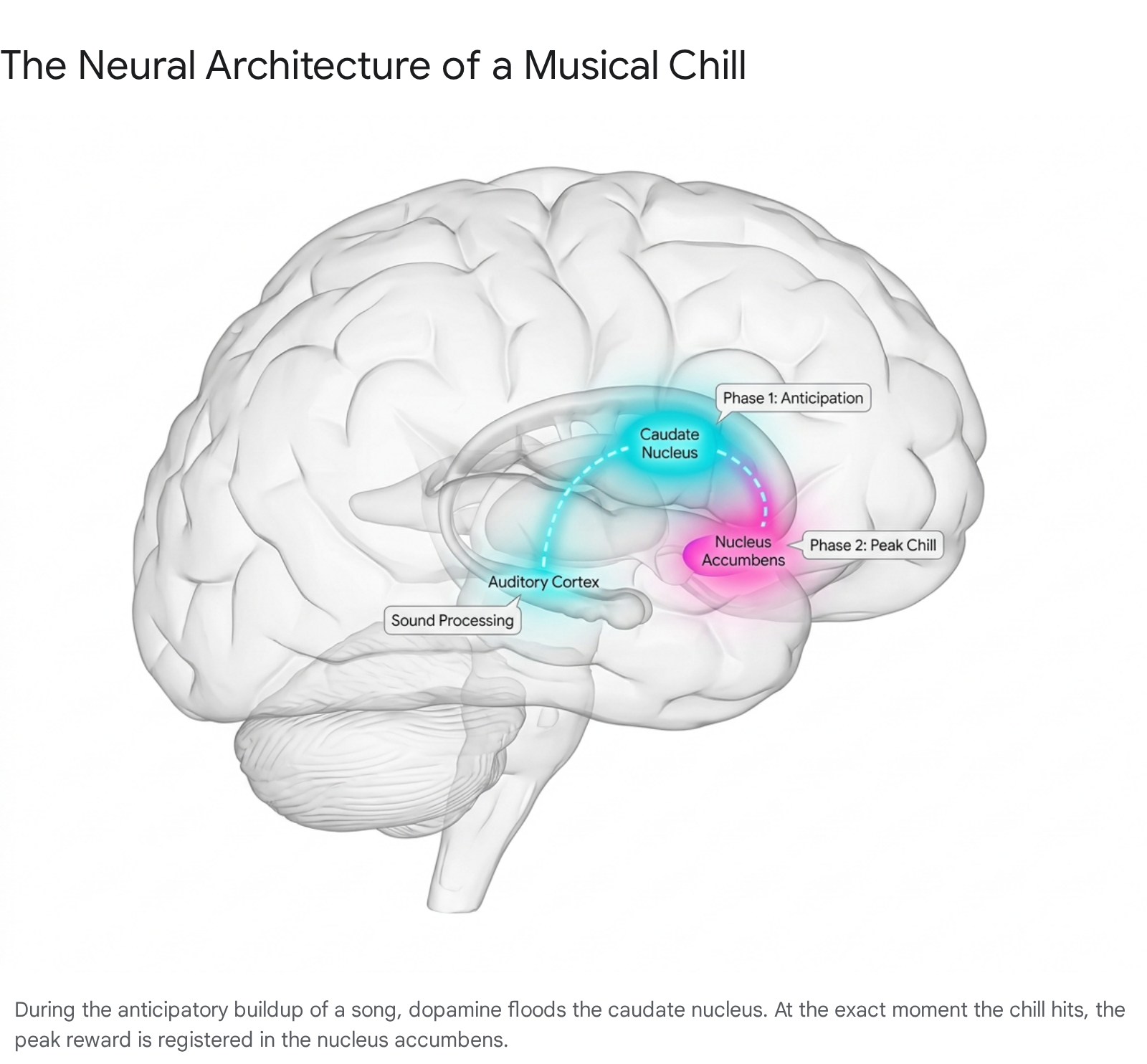
The fact that an abstract cognitive pattern like music can trigger this exact sequence highlights how deeply acoustic processing is woven into our emotional architecture.
A Widespread Network of Emotion
Frisson is not isolated to the striatum; it is a whole-brain phenomenon. When individuals experience musical chills, cerebral blood flow increases in the orbitofrontal cortex (OFC), the midbrain, and the supplementary motor area (SMA), while simultaneously decreasing in the amygdala and the ventromedial prefrontal cortex (vmPFC) 6612.
The deactivation of the amygdala - the brain's fear and threat-detection center - suggests that frisson involves a form of emotional safety and release. Simultaneously, the orbitofrontal cortex and the right temporal lobe (vital for auditory processing and musical appreciation) synchronize via low-frequency electrical signals known as "theta activity" 1211. This network integration transforms raw acoustic data into an emotionally resonant experience.
Furthermore, neuropharmacological studies have tested the boundaries of this reward system. By administering a dopamine precursor (levodopa) or a dopamine receptor inhibitor (risperidone), researchers found they could artificially enhance or impair a listener's ability to experience musical pleasure 12. Interestingly, tests using opioid antagonists like naltrexone have yielded mixed results; some studies show it decreases physiological reactions to positive music, while others show it only dampens pupil response without affecting self-reported pleasure 12. This suggests that while endogenous opioids play a role in physiological arousal, dopamine remains the primary engine of the musical chill.
White Matter Connectivity and Musical Anhedonia
Why do some people experience this intense neurochemical cascade while others feel nothing at all? The answer may lie in the brain's physical wiring.
Research using diffusion tensor imaging (DTI) - an MRI technique that maps the diffusion of water molecules to visualize white matter tracts in the brain - has shown that people who regularly get the chills from music possess a higher volume of white matter fibers connecting the auditory cortex to regions associated with emotional processing 1314. A robust bundle of white matter means these regions communicate more efficiently. Specifically, researchers measured axial diffusivity (AD) in the tracts connecting the right superior temporal gyrus (STG), the orbitofrontal cortex (OFC), and the nucleus accumbens (NAcc), finding a direct correlation between tract efficiency and musical reward sensitivity 15.
Conversely, researchers investigating "specific musical anhedonia" - a condition where healthy individuals with normal hearing and normal responses to other rewards (like food or money) derive absolutely zero pleasure from music - found the exact opposite. Individuals with musical anhedonia exhibit significantly decreased functional and structural connectivity between perceptual brain areas and the reward centers 1516. The degree to which we can extract pleasure from a song is literally tethered to how robustly our perceptual and emotional brain centers are cabled together.
Acoustic Triggers: How Sound Hacks the Brain
If the brain is structurally capable of experiencing frisson, the music itself must provide the spark. Studies into the acoustic properties of frisson-inducing music point to one primary mechanism: the violation of musical expectations 1319.
The Psychology of Expectancy Violation
The human brain is fundamentally a prediction engine. As we listen to a piece of music, our auditory cortex constantly calculates and forecasts the next note, chord, or rhythmic downbeat based on our internalized knowledge of musical scales, statistical probabilities, and cultural patterns 2017. Music theorist David Huron describes this process as an intricate game of tension and release, formalizing it in his ITPRA theory of expectation 422.
In the wild, a sudden, unexpected sound is usually a sign of danger, triggering a brainstem reflex and a rapid fight-or-flight response 422. Music effectively hijacks this ancient circuitry. When a composer inserts a sudden pause, an unexpected harmonic modulation, or a dramatic crescendo, it violates our brain's subconscious acoustic prediction 11819. The autonomic nervous system briefly registers this surprise via an arousal spike. However, the higher cognitive centers appraise the situation in milliseconds, recognizing that the "surprise" is harmless and aesthetically pleasing. The brain resolves the cognitive tension, releasing a massive wave of dopamine as a reward for updating its predictive model 35.
Specific Musical Features That Cause Frisson
While expectations are subjective, researchers have identified several consistent acoustic and structural features that tend to evoke chills across large populations. These moments act as distinct "frisson triggers":
| Acoustic Trigger | Description & Mechanism | Typical Emotional Result |
|---|---|---|
| Sudden Dynamic Swells (Crescendos) | A rapid increase in volume or sonic density. Overloads the auditory system's prediction, simulating an approaching object. | Awe, power, and overwhelming physical tingles 192021. |
| Harmonic Shifts & Modulations | Changing the key of the song or introducing unexpected chords. Violates tonal expectations, forcing the brain to recalculate the tonal center. | Surprise, emotional elevation, tension, and dopamine release 1218. |
| Solo Voice / Instrument Entry | The sudden introduction of a human voice or a piercing solo instrument emerging from a dense orchestral or synthetic background. | Deep empathy, social connection, and parasympathetic resonance 222. |
| Appoggiaturas | A dissonant "grace note" that briefly clashes with the underlying chord before resolving to a consonant note. | Yearning, mild distress, followed by intense relief and pleasure 118. |
| Acoustic Roughness | Sounds with high-frequency energy or a narrow bandwidth. Mimics the acoustic signature of animal distress calls or human screams. | Heightened alertness, negative-valenced chills, and tension 232425. |
These triggers confirm that frisson is essentially an emotional payoff for cognitive surprise. If a song is entirely predictable, it may be soothing, but it will rarely induce chills. If it is entirely chaotic, it becomes unparseable noise. Frisson lives in the delicate balance of structure and surprise 319.
Detailed psychoacoustic analyses have further confirmed that parameters like the spectral centroid (related to the perceptual brightness of a sound) and bandwidth play major roles. Interestingly, studies using continuous self-reporting and physiological monitoring have shown that the peak correlation between a sudden acoustic change and the physical manifestation of frisson occurs with a slight time lag - roughly two seconds after the acoustic feature changes 24.
Individual Differences: Who Gets the Chills?
While the white matter of the brain and the structure of the music are critical, psychologists have also discovered that personality is a powerful predictor of who experiences musical frisson.
Using the NEO-PI-R (a measure of the Big Five personality traits), multiple studies have found a strong, positive correlation between the frequency of musical chills and the trait known as Openness to Experience 23126. Individuals who score high in Openness are typically characterized by an active imagination, aesthetic sensitivity, an appreciation for variety, and intellectual curiosity.
The Role of Fantasy over Feeling
However, researchers digging deeper into the sub-facets of Openness made a surprising discovery. It is not merely an emotional appreciation for beauty that predicts frisson; it is a highly cognitive trait. Mitchell Colver and Amani El-Alayli tested participants with measures of physiological arousal (galvanic skin response) while they listened to chill-inducing music. They found that the Fantasy sub-facet - defined as a receptivity to the inner world of imagination and cognitive attentiveness - was the strongest unique predictor of frisson 3126.
This suggests that individuals who actively and intellectually immerse themselves in music - predicting where the melody will go, visualizing the narrative of the song, and engaging deep cognitive resources - are much more likely to trigger the expectation-violation sequence that results in chills 122627. Passive listeners, who use music merely as background noise, are less likely to generate the robust neural predictions required to trigger the dopaminergic reward of a chill 31.
Can We Habituate to Musical Chills?
If the core trigger of frisson is the element of surprise and the violation of expectations, a logical question arises: Does a song stop giving you chills once you have memorized every note?
Interestingly, while the strict "novelty" of a song does wear off, the frisson response is remarkably resilient. Studies on the test-retest reliability of musical chills show that listeners can experience chills from the exact same passage of music repeatedly over time 2428. In some instances, familiar music is more likely to cause chills than novel music. This paradox occurs because as we learn a piece of music, we attach episodic memories, personal nostalgia, and cultural weight to it 1917. The brain's predictive coding shifts; instead of being surprised by the notes themselves, the listener enters a state of deep, dopaminergic anticipation of the beloved climax. Memory amplifies the physiological kick 17.
Cross-Cultural Universality of Musical Emotion
Because music relies heavily on cultural conditioning - what sounds like a "surprising" chord to a jazz musician might sound entirely normal to someone raised on Western classical music - researchers have long debated whether musical chills are a universal human trait or a culturally learned response.
Recent massive cross-cultural studies suggest a biological universality to how we physically process musical emotion. In a 2024 study published in the Proceedings of the National Academy of Sciences (PNAS), researchers from the Turku PET Centre in Finland tested over 1,500 participants from Western and East Asian backgrounds 3529. Using a topographical tool where participants colored in human silhouettes to show where they felt physiological changes, researchers mapped "Bodily Sensation Maps" (BSMs) for different musical emotions.
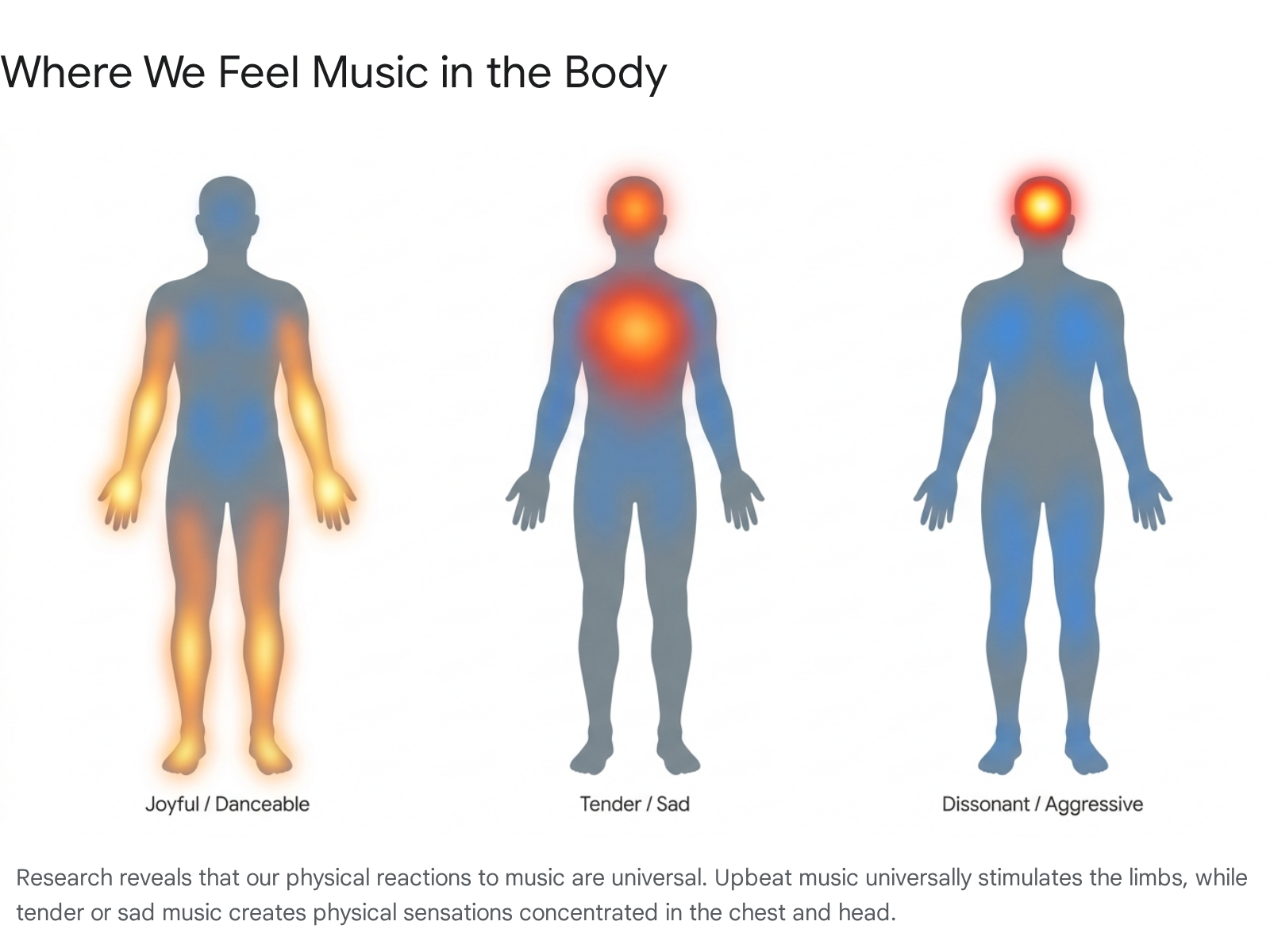
The results were astonishingly consistent regardless of the listener's cultural background or their familiarity with the music 2930. Across both cultures, the somatic representation of musical emotion clustered in highly predictable topographies: * Joyful and danceable music reliably activated the arms, legs, and head. * Sad and tender music resonated deeply in the chest and head regions. * Aggressive, dissonant music localized tension strictly in the head 2931.
Microtones and the Math of Emotion
Further evidence of a biological basis for musical emotion comes from the study of non-Western musical structures. North Indian Classical Music (Hindustani music) relies heavily on ragas - melodic frameworks specifically designed to evoke specific emotional states, sometimes corresponding to particular times of day or seasons 2132.
Neuroscientists analyzing the acoustic properties of ragas found that the specific mathematical ratios of the notes heavily determine the physical and emotional response. Ragas built predominantly on major intervals (shuddh swaras) reliably elicited widespread cortical activation and positive, joyful feelings 3233. Conversely, as researchers increased the proportion of minor intervals (komal swaras, specifically the minor second), participants reported a corresponding increase in sadness, tension, and a drop in overall cortical arousal 3233. The fact that minor intervals and high dissonance reliably induce negative-valenced chills or tension across global populations strongly suggests that human neurobiology is universally tuned to specific mathematical ratios in sound frequencies.
Performers vs. Listeners: The Other Side of the Stage
Historically, nearly all research into musical frisson has focused on the passive listener. However, recent developments in music psychology have begun examining the individuals producing the sounds.
A 2025 study conducted by researchers at the University of Leeds surveyed over 200 musicians and found that performers frequently experience profound musical chills while actively playing their instruments 22. Out of the sample, 176 participants reported experiencing chills during performances - ranging from solo recitals to massive orchestral symphonies 22.
For performers, the triggers for frisson overlap with those of listeners (e.g., harmonic resolution, climactic passages), but they are fundamentally contextualized by active physical involvement. Achieving a difficult musical passage, sensing a deep non-verbal synchronization with co-performers, or feeling the reciprocal emotional resonance from an audience adds layers of social and physical reward 22. The performers described these moments not merely as aesthetic appreciation, but as entering an intense "flow state" or transcendent immersion, acting as an embodied feedback loop of success, emotional fulfillment, and profound social connection 22.
Frisson vs. ASMR: What's the Difference?
Because frisson involves a tingling sensation that can spread across the scalp and down the spine, it is frequently confused with another popular sensory phenomenon: Autonomous Sensory Meridian Response (ASMR). While both involve pleasant bodily tingles triggered by external stimuli, they rely on different acoustic parameters and evoke different emotional states.
| Feature | Musical Frisson | ASMR (Autonomous Sensory Meridian Response) |
|---|---|---|
| Primary Triggers | Loudness swells, harmonic shifts, musical expectation violations, vocal entries 118. | Whispering, tapping, personal attention roleplay, crisp sounds 34. |
| Pacing and Duration | Sudden, intense, and short-lived (lasting only a few seconds during a musical peak) 134. | Slower, sustained, and prolonged over many minutes 34. |
| Emotional State | High arousal, awe, euphoria, sadness, intense emotional peaks 1927. | Low arousal, calmness, extreme relaxation, sleepiness 1234. |
| Neural Mechanics | Mesolimbic reward system (Caudate & NAcc), massive dopamine release, sympathetic nervous system arousal 112. | Overlapping regions with frisson, but strongly linked to parasympathetic down-regulation and stress reduction 1234. |
Though fMRI studies have demonstrated that ASMR and frisson activate some overlapping brain regions, they are qualitatively different experiences 12. Frisson is the brain's response to a highly arousing emotional climax, while ASMR functions more like a soothing, meditative state 1234.
The Evolutionary Purpose of Musical Chills
If music triggers the exact same reward circuitry as food and sex, we must ask: why? Charles Darwin famously considered human musicality a profound evolutionary puzzle, noting that the capacity to produce and enjoy musical notes appeared to have "no least use to man in reference to his daily habits of life" 3536. Evolutionary psychologist Steven Pinker later famously dubbed music "auditory cheesecake" - a biologically useless byproduct that happens to tickle the sensitive pleasure centers our brains evolved for language and environmental awareness 35.
However, modern neurobiological and anthropological evidence suggests a much deeper, adaptive function. The prevailing evolutionary theory explaining the physical power of music is the Music and Social Bonding (MSB) hypothesis 3544.
From Grooming to Group Cohesion
In ancestral primate societies, social cohesion and alliance-building were maintained primarily through physical grooming - a slow, one-on-one process that triggers the release of endorphins and oxytocin 35. However, as human ancestors evolved to live in much larger groups, one-on-one grooming became a mathematical impossibility for maintaining large-scale group cohesion 2335.
Music and rhythmic synchronization are theorized to have emerged as a form of "vocal grooming" 2335. Singing, chanting, and drumming together allowed dozens or hundreds of early humans to synchronize their physiological states, heart rates, and breathing, triggering mass releases of bonding hormones simultaneously 3537.
In this context, the frisson response - characterized by a sudden surge of physical sensation, alertness, and deep, overwhelming emotion - is not merely an aesthetic luxury. It is the vestigial echo of an ancient survival mechanism. It is a neurochemical signal telling the brain that we belong to a unified, synchronized social group, capable of acting as a cohesive unit 2337. Evolutionarily speaking, humans who felt deep physiological rewards from musical participation were more likely to bond tightly with their tribes, increasing their chances of collective survival.
Therapeutic Implications for the Future
Understanding the neural mechanics of musical frisson holds significant promise for the future of clinical therapy. Because music provides non-pharmacological access to the brain's deepest dopaminergic reward pathways, it is being increasingly utilized in neuro-rehabilitation and psychological care 1212.
For example, researchers have observed that stroke patients with severe damage to the insula still experience chills in response to auditory stimuli at a frequency similar to healthy populations, offering a unique pathway to stimulate emotional arousal even when other brain regions are compromised 5. Furthermore, music therapy is currently being applied to conditions characterized by reward deficiency or anhedonia, such as severe depression, trauma, and Alzheimer's disease 1212. By mapping which acoustic features trigger the strongest dopamine responses, clinicians could eventually curate highly personalized, frisson-inducing playlists designed to artificially stimulate the reward system, combat stress, and improve overall psychological well-being 1238.
Bottom line
Musical chills occur when an acoustic surprise - such as a key change or dynamic swell - momentarily violates our brain's predictive models, triggering an intense, dopaminergic reward sequence spanning the caudate nucleus and nucleus accumbens. This highly physiological response is most frequently experienced by individuals with high cognitive attentiveness and active imaginations, and it relies heavily on the volume of white matter physically wiring the auditory cortex to the brain's emotional centers. Ultimately, this euphoric shiver is not a biological accident; it is a profound evolutionary adaptation that utilizes the mathematics of sound to foster emotional connection and large-scale social bonding across the human species.