
Why Do We Get Goosebumps
The human body is an exquisite, living archive of evolutionary history, harboring reflexes and anatomical structures that were once an absolute necessity for the survival of early hominids. Among the most enigmatic and universally experienced of these physiological phenomena is piloerection - colloquially known as "goosebumps." At its most fundamental level, piloerection is a straightforward, involuntary physiological reflex triggered by cold environments or perceived physical threats. Yet, it also manifests during moments of profound aesthetic beauty, such as listening to a sweeping orchestral crescendo, watching a moving film, or witnessing an act of immense altruism. This presents a compelling physiological puzzle for modern science: Why do freezing temperatures, visceral fear, and beautiful music trigger the exact same biological reflex?
For decades, the prevailing scientific consensus dismissed human goosebumps as a vestigial trait - a useless holdover from our heavily furred ancestors that offered no modern utility. However, contemporary research at the intersection of affective neuroscience, evolutionary biology, and dermatology has radically rewritten this narrative. Far from being a mere biological relic, the pilomotor reflex operates at the center of a highly sophisticated network involving the autonomic nervous system, the dopaminergic reward pathway, and complex tissue regeneration mechanisms. This exhaustive report delves into the core physiological mechanisms of piloerection, explores its evolutionary repurposing from thermoregulation to social bonding, examines breakthrough discoveries linking the reflex to hair follicle stem cell activation, and deconstructs the neurobiology of "aesthetic chills" or frisson.
What is the Core Physiological Mechanism Behind a Goosebump?
To understand the multifarious triggers of goosebumps, one must first examine the microanatomy of the integumentary system. The fundamental physiological mechanism of piloerection relies on a specialized structure located within the dermal layer of the skin, consisting of the hair follicle, the arrector pili muscle (APM), and the sympathetic nervous system 12.
The arrector pili muscles are microscopic, ribbon-like bands of smooth muscle fibers that attach to the base of mammalian hair follicles 3. The proximal end of the APM anchors to the follicular bulge - the permanent, vital portion of the hair follicle that houses essential stem cell populations - while the distal end exhibits an arborized, "C"-shaped morphology that ascends and connects to the dermal-epidermal junction 34. Because the APM is composed of smooth muscle rather than skeletal muscle, its contraction is entirely involuntary, governed exclusively by the autonomic nervous system 15.
Specifically, the APM is innervated by postganglionic sympathetic nerve fibers 1. The sympathetic nervous system is the branch of the autonomic nervous system responsible for "fight-or-flight" hyperarousal and acute stress responses 5. These specific nerve fibers operate via the release of the neurotransmitter norepinephrine (also known as noradrenaline), which binds to alpha-1 adrenergic receptors located directly on the muscle tissue 37.
When an environmental or psychological stimulus activates the sympathetic nervous system, a neural cascade originates in the brain, traveling down the spinal cord and prompting peripheral sympathetic nerves to flood the synaptic cleft with norepinephrine 35. The binding of norepinephrine to the alpha-1 receptors initiates a rapid intracellular signaling cascade that culminates in the contraction of the smooth muscle fibers 3. As the arrector pili muscle shortens, it exerts a mechanical force that pulls the hair follicle upright, causing the hair shaft to stand erect perpendicular to the skin surface. Simultaneously, the contraction pulls the surrounding skin downward, producing the visible dimpling and bumps characteristic of the pilomotor reflex 13.
While the peripheral mechanics of muscle contraction are uniform across all instances of goosebumps, the central neural pathways that initiate this sympathetic discharge vary dramatically depending on the nature of the stimulus. When the body encounters a sudden drop in ambient temperature, peripheral thermoreceptors in the skin transmit signals to the median preoptic nucleus (MnPO) and the dorsomedial hypothalamus (DMH) - the brain's primary thermoregulatory centers 67. These hypothalamic regions subsequently orchestrate a sympathetic response to generate and conserve heat 67. Conversely, an acutely terrifying visual or auditory stimulus largely bypasses the hypothalamus during its initial processing; it is routed to the amygdala, the brain's threat-detection center, which then signals the lateral hypothalamus and brainstem to activate a massive systemic sympathetic cascade 5811.
Do Goosebumps Still Keep Modern Humans Warm? The Cat Analogy and Evolution
To trace the evolutionary origins and primary functions of piloerection, evolutionary biologists frequently employ comparative anatomy, looking to non-human mammals and avian species. In the animal kingdom, piloerection serves two highly functional, survival-oriented purposes: thermoregulation and threat display 3910.
In heavily furred mammals and feathered birds, the contraction of the arrector pili muscles fluffs the coat or plumage outward 139. This creates an expanded, stagnant layer of air trapped immediately against the skin. Because air is a poor conductor of heat, this trapped layer acts as highly effective thermal insulation, preventing the loss of vital body heat to the colder external environment 139.
A common myth persists in popular science that goosebumps serve the exact same insulating function in modern humans. This misconception often relies on the "cat analogy" - the everyday observation that a cold cat will puff up its fur to stay warm, leading to the assumption that human goosebumps are an attempt to do the same. However, this analogy fails when applied to the modern human integumentary system. Over the course of hominid evolution, humans shed their thick, dense coats of body fur 914. This evolutionary trade-off favored the development of enhanced eccrine sweat glands to facilitate superior heat dissipation, allowing early humans to engage in persistence hunting and endurance running on the hot African savanna.
Because modern humans possess only sparse, miniaturized vellus hairs over most of their bodies, the pilomotor reflex completely fails to trap a sufficient boundary layer of air 1914. The contraction of the APM in humans does not provide meaningful thermal insulation. The physiological hardware - the muscle, the nerve, and the follicle - remains intact, but the insulative software - a thick coat of fur - has been evolutionarily deleted. Therefore, while goosebumps are indeed a relic of the thermoregulatory response of our furred ancestors, they do not successfully keep modern humans warm 914.
Why Do Cold, Fear, and Music Trigger the Exact Same Reflex?
If goosebumps fail to insulate us, why do we experience them when we are frightened, or more perplexingly, when we listen to a beautiful piece of music? The answer lies in the deeply interconnected architecture of the brain's emotional and autonomic networks, and the evolutionary repurposing of ancient survival circuits.
Threat Displays and the Amygdala
The second primary evolutionary function of piloerection in non-human animals is to alter the organism's physical silhouette during moments of intense fear, aggression, or territorial dispute. In states of anger, anxiety, or in response to a predator, animals experience a massive surge of sympathetic arousal orchestrated by the amygdala 31111. The central nucleus of the amygdala projects to the lateral hypothalamus and periaqueductal gray, triggering a hormonal and neural fight-or-flight cascade that includes rapid heart rate, pupillary dilation, the secretion of catecholamines like epinephrine, and widespread piloerection 5111112.
By erecting the hair on the back and shoulders (commonly referred to as raising the "hackles"), an animal artificially increases its apparent physical size 1314. A dog confronting an intruder, a chimpanzee charging a rival, or a cat cornered by a predator utilizes piloerection to appear larger, more dominant, and more intimidating 35914. Once again, because modern humans lack a dense coat of fur, an angry or terrified human experiencing goosebumps does not actually appear physically larger to an opponent. Yet, the neurological wiring connecting the amygdala's threat detection to the sympathetic nervous system's pilomotor response remains tightly coupled 111713.
The Separation Call Hypothesis and Social Bonding
If the thermoregulatory and threat-display functions of piloerection are largely obsolete in modern humans, why did evolution preserve the reflex so meticulously in emotional contexts? The sympathetic nervous system cannot easily differentiate between the physiological requirement to retain heat, the survival imperative to flee a predator, and the overwhelming emotional arousal induced by profound social interactions. All three states demand a state of heightened physiological readiness, resulting in the indiscriminate deployment of the pilomotor reflex.
However, some affective neuroscientists suggest that the reflex was functionally repurposed to facilitate social cohesion and emotional communication. The neuroscientist Jaak Panksepp proposed the highly influential "separation call hypothesis," which directly links the physiological reflex of piloerection to feelings of sadness, social isolation, and the subjective sensation of coldness 39.
In studies of juvenile macaques and other non-human primates, physical separation from the mother induces severe psychological distress. This distress is characterized by vocalized crying (separation calls), measurable drops in core body temperature, and intense piloerection 3. Panksepp argued that the physiological sensation of being socially separated is neurologically intertwined with the physical sensation of being cold 9. Therefore, the pilomotor reflex was co-opted by the brain's mammalian social attachment systems. When early humans experienced the profound sadness of social loss, or conversely, the intense relief of social reunion, the ancient "cold" and "fear" circuits were triggered, resulting in emotional goosebumps 39.
This theory provides a crucial evolutionary bridge between basic physical survival and complex human emotions. It suggests that emotional piloerection evolved into a valuable interpersonal indicator - a visible, physiological signal to the social group that an individual is in a state of high emotional vulnerability, indicating that they are deeply moved, touched, or socially bonded 39.
Is There a Modern Biological Purpose for the Arrector Pili Muscle? The Stem Cell Connection
Do goosebumps serve a modern biological purpose beyond emotional expression? Until very recently, the scientific community would have answered no, classifying the arrector pili entirely as a vestigial structure. However, between 2020 and 2025, groundbreaking research in developmental biology and dermatology completely revolutionized the understanding of the arrector pili muscle and the sympathetic nervous system, revealing that the goosebump reflex plays a vital, active role in human tissue regeneration 1914.
The Dual-Component Niche
Researchers investigating the micro-architecture of the skin discovered that the arrector pili muscle does much more than simply pull the hair shaft upright; it serves as a crucial physical anchor for sympathetic nerve fibers 2721. These sympathetic nerves wrap intricately around the muscle and descend directly to the follicular bulge, the specific anatomical niche where hair follicle stem cells (HFSCs) reside 221.
Through high-resolution imaging, scientists observed that the sympathetic nerves form direct, synapse-like connections with the stem cells 71914. During normal periods of homeostasis, the sympathetic nerves maintain a low-level, baseline release of norepinephrine. This neurotransmitter acts directly on the HFSCs, keeping them in a primed state of "deep quiescence" by up-regulating specific genetic quiescence regulators, notably Foxp1 and Fgf18, and down-regulating cell cycle machinery and mitochondrial metabolism 71914.
The revelation occurred when researchers examined the effects of prolonged cold exposure on this system. When the body is subjected to persistent cold, the sympathetic nervous system fires rapidly to induce goosebumps. However, this exact same burst of concentrated norepinephrine signaling does not merely contract the APM; it hyper-activates the hair follicle stem cells 1414. The sudden influx of norepinephrine causes the stem cells to quickly exit their dormant state, proliferate, and initiate a new cycle of hair growth (known as the anagen phase) 1415.
This mechanism demonstrates an exceptionally elegant evolutionary adaptation: cold weather triggers a rapid, short-term response (goosebumps) while simultaneously signaling the stem cells to initiate a slow, long-term response (growing a thicker coat of hair to combat the persistent cold) 1414.
Furthermore, this relationship is reciprocal during human development. As a hair follicle develops, the progeny of the stem cells secrete a signaling protein known as Sonic Hedgehog (SHH). This SHH secretion physically directs the formation of the arrector pili muscle and guides the sympathetic nerves to their proper location 191415. Therefore, the APM, the sympathetic nerves, and the stem cells form a highly interdependent "tri-lineage unit" or dual-component niche 214.

Without the APM to anchor the nerves, the sympathetic innervation to the stem cells is lost, and the capacity for hair regeneration ceases 1414.
Clinical Translations: Regenerative Therapies for Alopecia
This profound biological mechanism has not remained confined to laboratory models; it has rapidly translated into human clinical applications, particularly for the treatment of androgenetic alopecia (pattern baldness). In androgenetic alopecia, the arrector pili muscle often degenerates, miniaturizes, or detaches from the primary hair follicle. This structural collapse leads to a loss of sympathetic innervation, depriving the stem cells of norepinephrine and resulting in irreversible stem cell dormancy and hair loss 4714.
By 2024 and 2025, clinical trials began successfully leveraging this exact neuro-epithelial mechanism. Pelage Pharmaceuticals, a clinical-stage regenerative medicine company, developed PP405, a novel topical small molecule designed to pharmacologically mimic the metabolic triggers that reactivate dormant hair follicle stem cells 232425. In a Phase 2a randomized controlled trial completed in 2025 involving 78 men and women with androgenetic alopecia, patients applying PP405 demonstrated remarkable, rapid results 232627. At week eight - just four weeks after completing the once-daily topical treatment - 31% of men with advanced hair loss exhibited a greater than 20% increase in hair density, compared to 0% in the placebo group 2326. The treatment proved safe with no systemic absorption, providing the first clinical validation of direct stem-cell reactivation 232627.
Simultaneously, surgical interventions utilizing autologous Hair Follicle Mesenchymal Stem Cells (HF-MSCs) have shown significant efficacy. Clinical trials involving the extraction of healthy stem cells from the occipital scalp (where APM attachments remain robust) and their subsequent injection into balding regions have successfully restarted the anagen phase, dramatically increasing hair shaft diameter and terminal hair counts in patients after just a few months 161730. Therefore, the biological machinery that produces goosebumps is no longer viewed as an evolutionary dead end, but rather as the master regulator of stem cell behavior and the primary target for modern regenerative dermatology.
How Does a Sequence of Sound Waves Induce a Physical Shiver? The Neuroscience of Frisson
While the physiological execution of piloerection is rooted entirely in the peripheral autonomic nervous system, the psychological phenomenon of experiencing goosebumps in response to art - known formally as frisson, "aesthetic chills," or psychogenic shivers - is a highly complex cognitive process mediated by the central nervous system's deepest reward circuitry 181933.
Music is, at its physical core, merely an abstract sequence of acoustic frequencies and pressure waves. It provides no caloric value, offers no physical shelter, and does not directly aid in reproduction. Yet, human societies universally revere it, and the human body reacts to it with intense physiological arousal. The capacity of music to induce frisson is intrinsically linked to the brain's predictive coding mechanisms and the ancient dopaminergic reward system 182021.
Hijacking the Reward Circuit
Neuroimaging studies utilizing sophisticated functional Magnetic Resonance Imaging (fMRI) and Positron Emission Tomography (PET) scanning have demonstrated that listening to music capable of eliciting chills activates the exact same neural pathways responsible for processing biologically imperative rewards like food, sex, and drugs of abuse 2036.
When an individual listens to a piece of music, the auditory cortex continuously analyzes the rhythmic, harmonic, and melodic patterns. Based on the listener's cultural conditioning, memory, and prior musical exposure, the brain builds an internal model of expectation, constantly predicting which note, chord, or rhythmic downbeat will come next 1922. When the music perfectly fulfills, tantalizingly delays, or dramatically violates these expectations - such as through an unexpected modulation, a sudden dynamic shift in volume, or a sweeping appoggiatura - the brain registers a "prediction error" 1819.
This resolution of auditory uncertainty triggers the Ventral Tegmental Area (VTA) in the midbrain to synthesize and release dopamine 1823. The dopamine is dispatched across the mesocorticolimbic system, flooding the striatum and signaling a profound sense of reward and pleasure 1822. Furthermore, research has shown that administering a dopamine precursor (levodopa) increases the incidence of music-induced chills, while dopamine antagonists (risperidone) suppress the response, proving dopamine's causal role in the phenomenon 1821.
The Temporal Dynamics of Dopamine: Anticipation vs. Consummation
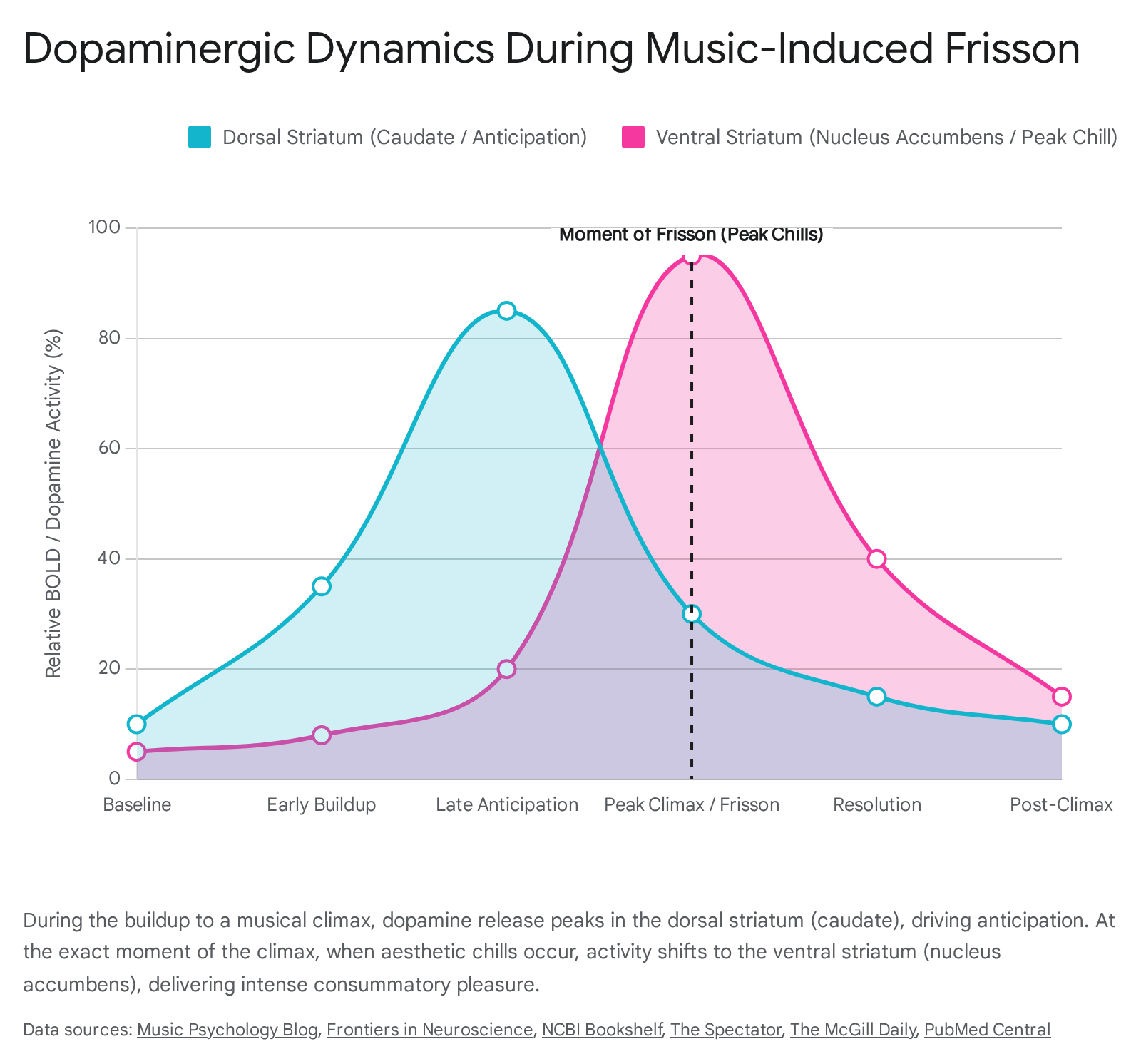
Pioneering research conducted at the Montreal Neurological Institute has revealed an elegant temporal dissociation in how the brain processes musical pleasure, dividing the neurochemical experience of frisson into two distinct neuroanatomical phases 36242541.
- The Anticipatory Phase (Dorsal Striatum): In the seconds leading up to the emotional climax of a song - as a chord progression builds tension, or a crescendo swells - dopamine is released primarily in the dorsal striatum, specifically the caudate nucleus 24254142. This anticipatory phase correlates with the psychological state of "wanting" or craving the resolution of the musical tension, activating cognitive and motor systems to predict the impending reward 2036.
- The Consummatory Phase (Ventral Striatum): At the exact moment the musical climax occurs and the listener experiences the physical chill of frisson, dopamine release abruptly shifts to the ventral striatum, specifically the nucleus accumbens (NAcc) 24254142. The NAcc is densely interconnected with the limbic system (including the amygdala, hippocampus, and ventromedial prefrontal cortex) and is responsible for the intense, immediate rush of peak hedonic pleasure, or "liking" 182225.
The magnitude of white matter structural connectivity between the superior temporal gyrus (which processes complex auditory information) and the anterior insula and prefrontal cortex ultimately determines an individual's neurobiological sensitivity to musical reward 18192627. The anterior insula, in particular, plays a vital role in interoception - the brain's ability to monitor and perceive the body's internal visceral state 18. When a musical prediction error triggers dopamine release, the insula integrates this sudden emotional arousal with autonomic bodily feedback, seamlessly translating an abstract cognitive pleasure into the highly physical, sympathetic rush of a shiver moving up the spine 181923.
Does the Propensity for Aesthetic Chills Correlate with Psychological Traits?
Why do only some people experience aesthetic chills, while others feel nothing at all during the exact same symphony? Research indicates that the capacity to experience frisson is not universally distributed with equal intensity. Rather, it is heavily modulated by individual differences in personality, emotional regulation, and neuroanatomy 182645.
The most consistent and robust psychological predictor of experiencing frequent aesthetic chills is the personality trait "Openness to Experience," which is one of the core dimensions of the widely utilized Five-Factor Model of personality (assessed via instruments like the NEO-PI-R) 181933454628. Individuals scoring highly in Openness are typically characterized by highly active imaginations, deep aesthetic sensitivity, intellectual curiosity, an appreciation for art, and a preference for novelty over routine 334548.
Empirical studies consistently demonstrate that high scores in specific sub-facets of Openness - such as Fantasy, Aesthetics, Feelings, Ideas, and Values - correlate strongly with both the self-reported frequency and the physiologically measured intensity of music-induced goosebumps 45. These individuals are more likely to exhibit deeper cognitive attentiveness to music, fully immersing themselves in the structural complexities of the sonic landscape rather than processing it passively as background noise. This deep, active listening allows musical prediction errors to strike with greater cognitive force, thereby triggering a more robust autonomic and dopaminergic response 454950. Conversely, those lacking Openness process the music less attentively, resulting in a muted neural response that fails to cross the threshold required to initiate piloerection.
The Role of Empathy and "Being Moved"
The relationship between frisson and trait empathy has been the subject of extensive study, though the historical evidence has been highly nuanced and occasionally conflicting. Some researchers have hypothesized a direct link between the capacity for empathic concern and the susceptibility to goosebumps, arguing that feeling deeply for a piece of music, a film, or a poignant speech requires an empathetic projection into the emotional state of the composer, performer, or character 262930.
To resolve conflicting data, recent advanced methodologies have categorized aesthetic chills into distinct phenomenological subtypes, proving that "frisson" is not a monolith 3329. 1. Warm Chills ("Goosetingles"): These are associated with high positive valence, feeling relaxed, euphoric, and cognitively stimulated. They are most often triggered by upbeat, highly rewarding music or themes of social communion and love 334629. 2. Cold Chills ("Coldshivers"): These are associated with negative valence, frowning, tension, and sadness. They are often triggered by highly dissonant audio, horror films, or stimuli portraying entities in severe distress 334629. 3. Moving Chills: These are characterized by profound feelings of awe, feeling a lump in the throat, tears, and overwhelming tenderness. It is specifically this category of "moving chills" that correlates most strongly with self-reported trait empathy 3329.
Therefore, while the overall frequency of aesthetic chills is driven primarily by reward-system dynamics and Openness to Experience, the specific experience of being profoundly "moved" to the point of piloerection relies heavily on social cognition networks and empathic resonance 29. Interestingly, studies aiming to artificially induce the physical sensation of a chill using wearable thermotactile technology have shown that manually triggering the somatic marker of frisson can actually drive downstream cognitive effects, temporarily heightening a subject's feelings of pleasure and empathy 1831.
Do Diverse Populations Feel Music the Same Way? Cross-Cultural Consonance
The neurological mechanisms of frisson highlight how the brain processes and anticipates musical syntax. However, musical syntax itself is often a culturally constructed language. This raises a fundamental anthropological question: Is the physical sensation of music universal and biologically hardwired, or is it conditioned entirely by the culture in which one is raised?
A landmark 2024 study published in the Proceedings of the National Academy of Sciences (PNAS) investigated this exact premise by comprehensively mapping the bodily sensations of 1,500 Western and East Asian participants as they listened to a variety of culturally diverse music 323356. The researchers utilized the 'emBODY' mapping tool, having participants color in human silhouettes to indicate exactly where they felt physical activation, tension, or warmth 57.
The results were striking: the bodily maps of musical sensations were remarkably consistent across both Western and Asian cultures 325634. Happy, danceable songs with clear beats uniformly energized the arms, legs, and head, while tender or sad songs resonated deeply in the chest area, completely regardless of the listener's cultural background 32565735. Furthermore, the study demonstrated that specific, low-level acoustic features universally drove these physical sensations 3256. Music with a clear, driving rhythm consistently produced feelings of happiness and bodily arousal, whereas highly dissonant music or tracks featuring acoustic "roughness" universally triggered feelings associated with aggression, tension, or anxiety across all demographics 325634.
Familiarity vs. Acoustic Universality
While the physical resonance of basic acoustic features (like tempo, loudness, and roughness) appears universally hardwired into the human central nervous system, the emotional interpretation of more complex musical structures (like major and minor keys) is heavily dependent on cultural familiarity and learned stereotypes 33363738.
Extensive cross-cultural field research involving remote populations unexposed to Western media - such as the Kalash and Khow tribes residing in the valleys of Northwest Pakistan - has demonstrated that the deeply entrenched Western association of "Major chords equal happy" and "Minor chords equal sad" is absolutely not a universal biological law 3839. The Kalash and Khow listeners, whose traditional ritual and honorary music frequently utilizes minor modalities for positive and celebratory functions, perceived isolated minor chords as pleasant and positive, in direct contrast to Western listeners 3839.
However, one critical element remained universally consistent across both Western populations and the remote Pakistani tribes: the profound psychological aversion to acoustic roughness (highly jarring, atonal, and dissonant sounds) 3839. The perception of acoustic roughness stems from a biologically determined cause involving interference within the inner ear, triggering bottom-up sensory pathways that universally signal alarm, high arousal, or negative valence 3839.
Therefore, while the baseline physiological capacity for music to induce somatic markers like frisson is a universal human trait built upon inherited biological mechanisms, the specific musical triggers that successfully elicit those chills represent a complex interplay of universally recognized acoustic cues and culturally conditioned emotional expectations 4932363738.
Comparative Synthesis of Piloerection Triggers
To successfully synthesize the diverse, seemingly contradictory mechanisms behind goosebumps, it is necessary to categorize the triggers based on their stimulus type, biological utility, and underlying neuroanatomy. While the peripheral physiological endpoint - the contraction of the arrector pili muscle via sympathetic innervation - is identical across all manifestations, the central nervous system pathways initiating the cascade differ fundamentally based on whether the trigger is physical, threatening, or aesthetic.
| Trigger Category | Primary Stimulus | Evolutionary / Biological Purpose | Primary Neurological Pathway | Associated Physiological / Psychological State |
|---|---|---|---|---|
| Thermoregulatory | Ambient temperature drop (Cold environment) | Generate and retain heat (via trapped air in furred ancestors); Stimulate Hair Follicle Stem Cells for tissue regeneration. | Peripheral thermoreceptors → Median Preoptic Nucleus (MnPO) and Dorsomedial Hypothalamus (DMH) → Sympathetic Nervous System. | Shivering, vasoconstriction, stem cell proliferation (anagen phase initiation). |
| Threat / Aversive | Predators, immediate danger, hostile social interactions, jarring acoustic roughness. | Threat display (appearing physically larger to intimidate rivals); immediate fight-or-flight readiness. | Sensory Cortices / Thalamus → Amygdala → Lateral Hypothalamus & Periaqueductal Gray → Sympathetic Nervous System. | High arousal, negative valence, tachycardia, acute stress, "Coldshivers". |
| Aesthetic / Emotional | Music, awe-inspiring vistas, profound narratives, social reunion. | Facilitate social bonding, indicate profound social connection; neurological byproduct of reward prediction mechanisms. | Auditory/Visual Cortex → Ventral Tegmental Area (VTA) → Striatum (Caudate & Nucleus Accumbens) → Anterior Insula → Sympathetic Nervous System. | High arousal, positive/mixed valence, dopamine release, peak hedonic pleasure, "Goosetingles". |
Conclusion
The phenomenon of piloerection is a physiological masterpiece of evolutionary repurposing. What began as a rudimentary, pragmatic mechanism for thermoregulation and threat display in early mammalian ancestors has been exquisitely preserved, modified, and integrated into the most advanced networks of the human brain and skin.
On a microscopic level, the architectural unit that governs the goosebump reflex serves as a critical bridge between the nervous system and tissue regeneration. The sympathetic nerve fibers, physically anchored by the arrector pili muscle, not only command the skin to dimple in the cold but actively orchestrate the awakening of dormant stem cells, driving hair growth to meet environmental demands. This profound biological interplay has catalyzed an entirely new era of regenerative medicine, offering highly tangible solutions and clinical trials for hair loss therapies that target the stem cell niche directly.
Simultaneously, on a psychological and cognitive level, the pilomotor reflex serves as the physical manifestation of our deepest emotional and aesthetic capacities. Through the dense, intricate interconnectivity of the dopaminergic reward system, the interoceptive anterior insula, and the autonomic nervous system, the brain flawlessly translates the abstract beauty of a musical crescendo or the profound impact of an empathetic connection into a visceral, bodily thrill. Whether shivering against a cold wind, recoiling in momentary fear, or weeping at the resolution of a symphony, the appearance of goosebumps signifies a moment of profound physiological unity - a reminder that we are complex creatures whose highest emotional and aesthetic experiences remain inextricably bound to the ancient, survival-driven biology of our ancestors.