
The Science of Why Cats Purr
Cats purr to communicate contentment, solicit attention, and self-soothe during moments of stress, severe illness, or injury. Recent biomechanical research reveals this low-frequency rumble relies on specialized vocal pads and perfectly mimics the exact frequencies used in clinical human therapies to stimulate bone growth, repair muscle, and reduce localized inflammation.
The Biomechanics of the Feline Purr
For decades, the physical mechanism behind the domestic cat's purr was one of biology's most enduring mysteries. While a dog's bark or a human's voice is relatively straightforward to explain through standard aerodynamics, the feline purr operates on an entirely different set of physiological rules.
The Century-Old Debate: Active Muscle Contraction
Until very recently, the overwhelming scientific consensus held that domestic cats produced their signature purr through a mechanism known as the Active Muscle Contraction (AMC) hypothesis 123. First proposed in the 1970s, the AMC theory suggested that a repetitive neural oscillator deep within the feline brain continuously fired signals to the laryngeal muscles (the voice box) 122.
According to this model, these rapid-fire neurological signals caused the vocal cords to twitch violently, forcing the glottis to constrict and dilate roughly 20 to 30 times per second 133. Because this twitching occurred during both inhalation and exhalation, it produced the continuous, rhythmic rumble we recognize as a purr 36. Under the AMC hypothesis, purring was considered an active, biologically expensive process that required a constant stream of intentional neural input from the brain 12.
The 2023 Breakthrough: Aerodynamics and Purring Pads
A landmark 2023 study published in the journal Current Biology fundamentally upended the AMC hypothesis. An international team of voice scientists, led by Christian T. Herbst at the University of Vienna, discovered that the feline larynx can produce purring frequencies entirely on autopilot, without any active neural input or cyclic muscle contractions whatsoever 45610.
The researchers conducted a controlled laboratory experiment using the excised larynges of eight deceased domestic cats that had been humanely euthanized due to terminal illnesses 1257. By pinching the vocal cords together and pushing warm, humidified air through them to simulate breathing, the scientists successfully produced self-sustained oscillations at frequencies between 25 and 30 Hertz (Hz) 125.
The anatomical secret behind this ability lies in connective tissue masses embedded directly within the cat's vocal folds. Histological analysis revealed specialized "purring pads" measuring up to 4 millimeters in diameter 15. These pads are packed with collagen and elastin fibers, which add crucial mass and density to the vocal cords 56.
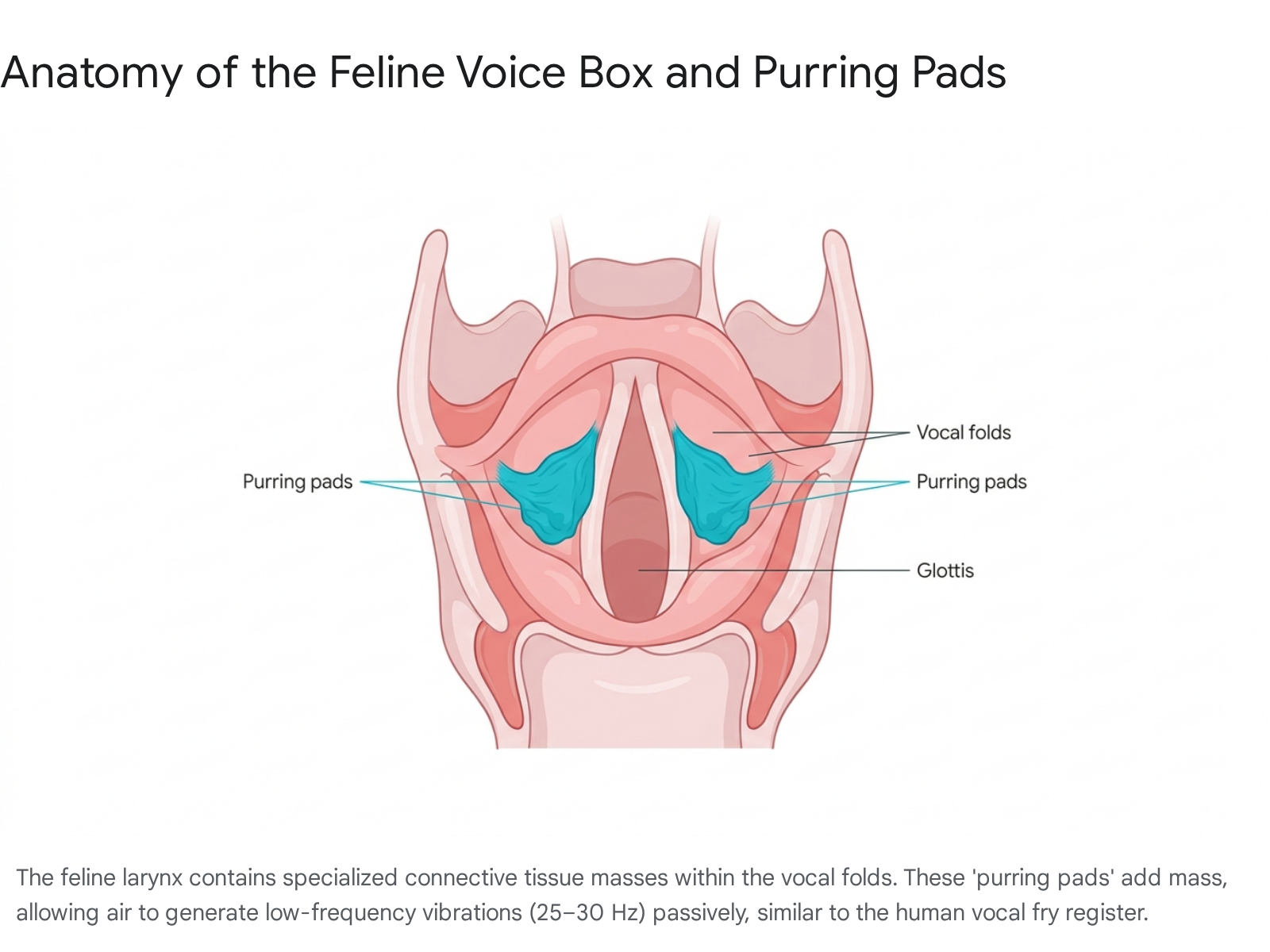
This added weight forces the cords to vibrate at unusually low frequencies for an animal that weighs only a few kilograms 56. The researchers concluded that cats utilize the myoelastic-aerodynamic (MEAD) principle 2410. This is the exact same passive aerodynamic behavior responsible for the human "vocal fry" register - the creaky, low-pitched, gravelly phonation often used in speech and pop-rock singing 256.
Ultimately, while the feline brain still initiates the behavior by bringing the vocal cords together, the physical vibration is sustained aerodynamically by the breath. This means a cat does not expend massive amounts of muscular energy to maintain a continuous purr 25.
Decoding the Feline Language: Why Cats Purr
Because the MEAD mechanism operates so seamlessly in the background, cats have evolved to utilize purring as a multi-channel broadcast, communicating a wide variety of physical and emotional states.
The most common misconception regarding feline behavior is that a purring cat is universally a happy cat 31289. While contentment is indeed a primary trigger, cats also purr when they are severely stressed, highly fearful, critically injured, or even actively dying 391011. To accurately decode the meaning behind a cat's purr, researchers and veterinary behaviorists emphasize that one must observe the specific acoustic pitch of the rumble, the environmental context, and the animal's surrounding body language 91017.
The Contentment Purr
The classic contentment purr is the sound most humans are familiar with. It is a steady, rhythmic, low-frequency rumble that occurs during periods of deep relaxation, petting, or environmental security 681018.
This vocalization is almost always accompanied by loose, soft body postures. A content cat will display half-closed, almond-shaped eyes, and may engage in slow blinking - a feline gesture of ultimate trust 10121314. Their ears will generally point upward and forward, and they may stretch their limbs out completely or expose their bellies 1215. It is a broadcast signal that the animal feels entirely safe in its current territory 1823.
The Solicitation Purr and Acoustic Manipulation
While adult cats rarely meow at one another - reserving meows almost entirely for humans - they have evolved a highly specific purr to prompt their human caregivers for food or attention 162526. Known as the "solicitation purr," this sound represents one of the most sophisticated examples of acoustic manipulation in the animal kingdom 3101617.
A groundbreaking study led by behavioral ecologist Dr. Karen McComb at the University of Sussex revealed that cats embed a high-frequency, cry-like element deep within this specific purr 16261728. While a standard purr rumbles at a low frequency (around 20-30 Hz), the hidden acoustic element in the solicitation purr peaks between 220 and 520 Hz, averaging around 380 Hz 1816.
This 380 Hz pitch is no coincidence. It precisely matches the fundamental frequency range of a human infant's distress cry 16252618. Human neurology is evolutionarily hardwired to respond urgently to the sound of a crying baby. When humans hear this frequency, it triggers an innate nurturing response and causes a spike in the brain hormone oxytocin 262830. The solicitation purr effectively hacks the human nervous system, compelling the owner to feed or tend to the cat - often without the human realizing they are being biologically manipulated 161728.
In blind listening tests, human subjects consistently rate solicitation purrs as significantly more urgent, demanding, and less pleasant than standard contentment purrs, even if the listener has never owned a cat 1618.
The Stress, Pain, and Self-Soothing Purr
Felines frequently utilize purring as a powerful self-soothing mechanism in highly stressful environments, such as during a frightening ride in a carrier, a veterinary examination, amidst loud noises, or when experiencing physical trauma 12917181423.
Much like a human nervously humming, rocking back and forth, or a child sucking their thumb, the internal vibration of the purr serves to calm the cat's autonomic nervous system 891014. It acts as a biological pacifier. An anxious or pain-induced purr is often quieter, slightly more irregular, or higher in pitch than a contentment purr 6810.
Assuming a cat is fine simply because it is purring in a medical setting is a dangerous error that can lead caregivers to overlook serious signs of illness 9. A stressed or injured cat will often engage in displacement behaviors - normal grooming or lip-licking performed out of context - and will actively try to make itself look smaller 1214.
The Social and Greeting Purr
Purring also plays a critical role in early feline development and social bonding. Newborn kittens are completely blind and deaf for the first ten days of their lives 92318. However, their tactile sensory systems are fully functional. Mother cats purr continuously to create a vibratory beacon, allowing her vulnerable kittens to feel the vibrations and navigate toward her for warmth and nursing 92318.
Because the purr is a low-frequency, close-range sound, it carries the evolutionary benefit of allowing the mother to communicate with her litter without alerting nearby predators to their location 1819. As kittens grow, they learn to purr back, establishing a vibratory feedback loop that strengthens social bonds 1023.
Cat Body Language: Contextualizing the Purr
Because the acoustic differences between purr types can be incredibly subtle, veterinary behaviorists rely heavily on visual body language cues to determine exactly what a purring cat is experiencing 121320. A cat's posture, eyes, ears, and tail provide the necessary context to decode the vibration 91214.
Deciphering Ear and Eye Movements
A cat's eyes and ears act as barometers for their internal state. When a cat is happy and purring contentedly, their eyes may be round or partially closed, with pupils narrowed into slits in bright light 91214. Soft, sleepy eyes and slow blinking indicate deep trust 9121420. Their ears will be upright and facing forward, signaling relaxed alertness 121415.
Conversely, if a cat is purring due to stress or pain, their pupils will often become widely dilated, making the eyes look black and glassy, indicating high physiological arousal or fear 12141520. Their ears may flatten tightly against their head or rotate sideways into a posture commonly referred to as "airplane ears" 91214. A cat purring with wide, dark eyes and flattened ears is actively trying to comfort itself in a terrifying situation.
Posture and Tail Positioning
A confident, happy cat moves with a loose, fluid posture. They may stretch out fully, exposing their belly (though this is a sign of comfort, not always an invitation for physical contact) 121415. A friendly greeting is often accompanied by an upright tail with a gentle curl at the tip, resembling a question mark 121314. If the purr is a solicitation for food, the tail may be held high while the cat rubs its body against its owner's legs 61017.
A stressed or injured cat will exhibit the opposite behaviors. They will adopt a tight, crouched posture, attempting to make themselves look as small as possible to avoid drawing attention 131420. The tail will be held rigidly, tucked tightly against or underneath the body 9131415. A twitching or thrashing tail, even while the cat is purring, indicates intense annoyance or overstimulation, signaling that the human should back away immediately 121520.
The following matrix summarizes the distinct differences between a contentment purr and a stress purr based on body language cues:
| Physical Feature | The Happy / Contentment Purr | The Stress / Pain Purr |
|---|---|---|
| Eyes | Almond-shaped, half-closed, slow blinking. Pupils are narrow slits. 121420 | Wide open, glassy, or tightly squinted. Pupils are widely dilated. 9121415 |
| Ears | Upright, relaxed, pointing slightly forward. 121415 | Pinned backward, flattened, or rotated sideways ("airplane ears"). 9121415 |
| Tail Position | Upright with a relaxed curl at the tip, or loosely resting. 12131415 | Rigid, tucked tightly underneath the body, or thrashing side-to-side. 12131415 |
| Body Posture | Loose muscles, fully stretched out, side-lying, or exposing the belly. 121415 | Tense, tightly crouched to the ground, seeking a hiding space. 131415 |
| Additional Actions | Rhythmic kneading of soft surfaces, rubbing against humans. 91214 | Displacement grooming, lip-licking, panting, or freezing in place. 121420 |
The Medical Marvel: Do Purrs Actually Heal?
The observation that cats reliably purr when they are severely injured, frightened, or resting has led biologists, veterinary researchers, and acoustic scientists to investigate whether the physical vibration provides tangible physiological benefits. The prevailing scientific consensus suggests that purring is not merely a method of communication, but a highly effective, internal evolutionary healing mechanism 9112122.
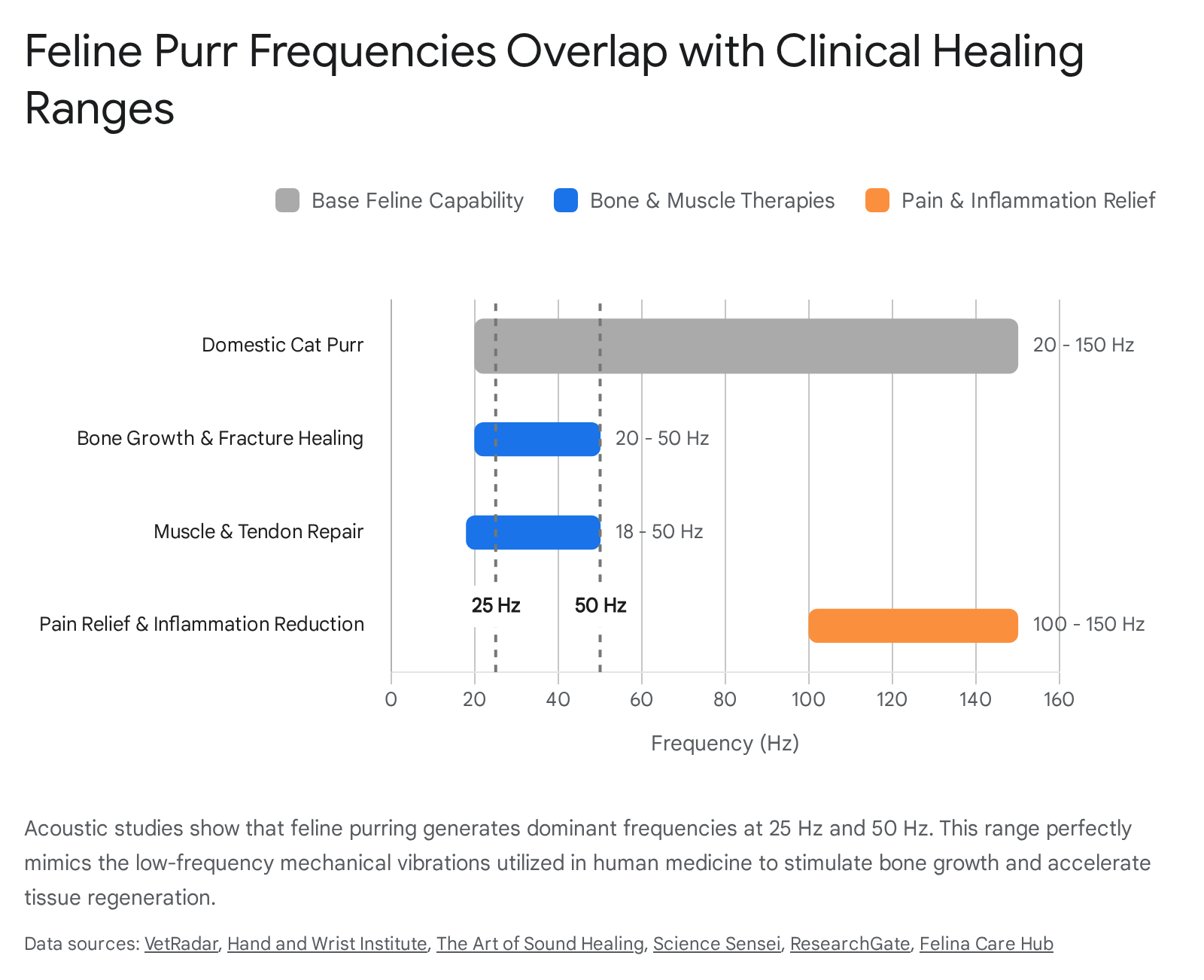
Acoustic analyses across dozens of feline species demonstrate that a domestic cat's purr generally falls within the frequency range of 20 to 150 Hz 3681117. More specifically, researchers have found that almost every purring cat species generates dominant, powerful frequencies at exactly 25 Hz and 50 Hz 1122.
This discovery fascinated the medical community because these exact frequencies are not random. In the field of human regenerative medicine and physical therapy, researchers utilize clinical vibration therapy within this specific 20 to 50 Hz range to stimulate tissue repair, harden bone, and accelerate healing 3212237.
The Science of Mechanotransduction
The therapeutic overlap between feline vocalizations and human medical therapy relies on a fundamental biological process known as mechanotransduction 3839. This is the biochemical mechanism by which cells convert mechanical stimuli - such as low-frequency fluid flow, physical pressure, or acoustic vibration - into cellular activity and tissue regeneration 3839.
When human or animal bones and tissues are exposed to specific low-frequency vibrations, the mechanical pressure stimulates the cellular production of growth factors 83740. Notably, research conducted by Dr. Clinton Rubin and his team demonstrated this effect by exposing the bones of older sheep to vibrational frequencies of 30 Hz for just 20 minutes a day. The exposure initiated measurable signs of bone repair and density improvement 40.
Extensive studies evaluating whole-body vibration therapy in the 25 to 50 Hz range demonstrate that it successfully improves bone density, builds bone strength, accelerates fracture healing, and aids in the repair of injured muscles and tendons 213740. Furthermore, vibrational frequencies at the higher end of the purr spectrum, specifically around 100 Hz to 150 Hz, have been linked to significant reductions in tissue inflammation, edema, and localized pain, as well as providing relief from breathlessness (dyspnea) 112122.
The Feline Evolutionary Advantage
From an evolutionary standpoint, the development of this built-in vibrational therapy makes perfect sense. Cats are apex predators that rely on explosive bursts of speed and agility to hunt 1223. To conserve energy for these intense sprints, cats spend a massive portion of their day sleeping or resting 1121.
However, prolonged periods of being completely sedentary normally lead to decreased bone density and muscle atrophy. Researchers, including Dr. Leslie A. Lyons at the University of California, hypothesize that purring evolved as an incredibly low-energy mechanism to stimulate muscles and bones without the cat needing to engage in physical activity 11182122.
By utilizing the aerodynamic MEAD principle, which requires very little caloric expenditure, an injured or resting cat can theoretically prevent bone loss, maintain joint flexibility, and accelerate tissue repair from the inside out 91122. This internal physical therapy may explain why cats exhibit fewer muscle and bone abnormalities than domestic dogs, and why feline fractures typically heal much faster than canine fractures 2122.
Implications for Human Health
The benefits of the feline purr appear to extend well beyond the cat itself, bleeding over into human health. Studies indicate that physical exposure to a cat's purr can have a profound parasympathetic effect on the human nervous system.
The act of petting a purring cat triggers the release of endorphins, which act as natural mood elevators and painkillers 17. The calming, low-frequency sound combined with the tactile vibration has been shown to lower human blood pressure, reduce cortisol (the stress hormone), and decrease the overall risk of heart disease 1211212443. Remarkably, epidemiological data suggests that cat owners have a roughly 40% lower risk of suffering a fatal heart attack or stroke compared to those who do not live with felines 1121. While some of this is attributed to the general stress-reduction of pet ownership, the specific vibratory frequencies of the purr are believed to play a compounding therapeutic role .
The Roar vs. Purr Divide in Wild Cats
If purring is such an advantageous biological and medical tool, it raises the obvious question: why can't massive apex predators like lions and tigers purr to heal their own wounds? The answer lies deep within feline throat anatomy, specifically the architecture of the hyoid bone, a small structure that supports the larynx and tongue 32325.
The biological family Felidae is broadly divided by a strict acoustic and anatomical rule: a cat can either roar or it can purr, but no species possesses the physiological hardware to do both 32627.
The Roaring Cats (Panthera)
The "roaring cats" - which encompass lions, tigers, jaguars, and leopards - belong to the Panthera genus 37232627. These massive felines possess an incompletely ossified hyoid bone 323. Instead of rigid, solid bone all the way to the skull, a significant portion of their hyoid structure consists of a flexible, highly elastic cartilage ligament 7192527. Furthermore, the vocal cords of roaring cats are anatomically distinct, featuring flat, square-shaped folds rather than the typical triangular folds found in smaller cats 27.
This flexible throat architecture is an evolutionary adaptation for long-distance communication. The elastic ligament can stretch under intense lung pressure, allowing the animal to emit a deep, terrifying roar 2627. A male lion's roar can reach a staggering 114 decibels - a volume comparable to a jet airplane at takeoff, nearing the human threshold for physical ear pain - and can be heard up to five miles away 192627.
However, this immense power comes at a cost. The flexible cartilage that allows the roar completely prevents the high-speed, steady resonance required for true purring 71923. While a lion may make gurgling or grunting sounds when content, the cartilage cannot sustain the continuous, rhythmic vibration on both the inhale and the exhale that defines a true biological purr 725.
The Purring Cats (Felinae)
Conversely, cats in the Felinae subfamily - including domestic cats, bobcats, ocelots, lynxes, and pumas (mountain lions) - have a completely ossified, hardened, and rigid hyoid bone 319232526.
When the larynx operates, this solid bony structure acts as a perfect resonating chamber 72527. It allows the cat to maintain the rapid, aerodynamic vibrations necessary to purr continuously on both the inhalation and exhalation phases of breathing 7232627. However, because their throats are rigidly structured and lack the elastic ligament, they physically cannot stretch their vocal tracts to produce a roar 26.
The cheetah, placed in its own unique genus (Acinonyx), is biologically recognized as the largest of the purring cats 192527. Cheetahs have fully ossified hyoid bones and regularly purr in a variety of contexts, including while nursing cubs, resting, grooming, or when recovering from periods of intense stress or injury 32325. Acoustic studies show that cheetahs utilize the exact same therapeutic frequencies (between 20 and 150 Hz) as their smaller domestic cousins, though they are also known for producing high-pitched bird-like chirps to communicate 311192223.
The Snow Leopard Exception
The snow leopard occupies a unique and somewhat confusing taxonomic position within the feline family. While it is classified as a big cat within the Panthera genus and possesses an incompletely ossified hyoid bone, it is the only member of the genus that cannot produce a true roar 32327.
Because of its solitary nature and the rugged, high-altitude mountainous environments it inhabits, loud roaring is not an advantageous evolutionary trait 23. Instead, snow leopards rely on softer, close-range vocalizations like "chuffing." While chuffing sounds remarkably similar to a purr and signals non-aggression, acoustic biologists note that it lacks the continuous, unbroken dual-phase (inhalation/exhalation) cycle required to be classified as a true biological purr 32327.
The anatomical divisions regarding vocalization capabilities across the Felidae family are outlined below:
| Feline Category | Representative Species | Hyoid Bone Anatomy | Primary Deep Vocalization | Vocalization Capabilities |
|---|---|---|---|---|
| Big Cats (Panthera) | Lions, Tigers, Leopards, Jaguars | Incompletely ossified; features a flexible, elastic cartilage ligament. 3232627 | Roar (up to 114 decibels). 192627 | Cannot purr. 192325 |
| Small Cats (Felinae) | Domestic Cats, Bobcats, Ocelots, Lynxes | Completely ossified; rigid bone structure extending to the skull. 37192526 | Purr (continuous vibration on inhale and exhale). 7192327 | Cannot roar. 2627 |
| Pumas & Cheetahs | Pumas (Mountain Lions), Cheetahs | Completely ossified; rigid bone structure. 31923 | Purr (often loudly while resting or nursing cubs). 3192325 | Cannot roar. 192547 |
Bottom line
The feline purr is a complex biological marvel that extends far beyond a simple expression of happiness. Driven by specialized fibrous pads in the vocal folds acting as a passive aerodynamic oscillator, purring is an incredibly efficient, low-energy survival tool. Cats utilize it to communicate contentment, hack human nurturing instincts via hidden high-frequency pitches, and self-soothe in terrifying situations. Most remarkably, the specific acoustic frequencies generated by a purring cat perfectly match those used in clinical human therapies to stimulate bone growth and tissue regeneration, strongly suggesting that a cat's rumble is a built-in mechanism for physical healing.