
The Science of Why Dogs Wag Their Tails
Dogs wag their tails primarily to communicate their level of emotional arousal and specific intentions, not necessarily just to show happiness. The exact height, speed, and direction of the wag convey distinct social messages, ranging from a friendly approach to fearful withdrawal or an aggressive warning. Recent evolutionary research suggests this behavior became exaggerated in domestic dogs either as a genetic by-product of humans selectively breeding for tameness, or because human brains possess a subconscious, hardwired preference for rhythmic movements.
The core myth: Wagging does not always mean "happy"
Among all the animal behaviors that humans experience in everyday life, domestic dog (Canis familiaris) tail wagging is one of the most common and universally recognized 123. For generations, the conventional wisdom among pet owners and the general public has been wonderfully simple: a wagging tail equals a happy dog. However, modern ethology, comparative bioacoustics, and veterinary behaviorism have comprehensively dismantled this oversimplification 2446.
Tail wagging is, at its core, an emotionally stimulated response that serves as a visual barometer of a dog's general arousal 7567. While dogs certainly do wag their tails when they are joyful or excitedly anticipating a reunion with their owner, they also exhibit the exact same mechanical motion when they are highly anxious, intensely focused, feeling threatened, or actively preparing to act aggressively 475812. To a dog, the tail acts as a vital emotional billboard broadcasting their inner state and intentions to both conspecifics (other dogs) and humans 679.
Furthermore, tail wagging is highly context-specific. While dogs prioritize visual methods of communication - resorting to vocalizations like barking or whining secondarily to emphasize a message - they do not only wag at living things 510. Dogs have been observed wagging their tails in response to non-social stimuli, such as food, fans, and plastic bags 8915. In these scenarios, the wagging is thought to indicate high arousal, curiosity, or positive anticipation rather than a social greeting 81511.
Interestingly, aggressive dogs have sometimes been recorded wagging their tails more frequently (and exhibiting lower serotonin levels) than docile dogs during certain encounters - a finding that directly contradicts the human assumption linking tail wagging exclusively to positive emotional valence 89. To truly decipher what a dog is saying, one must look past the mere presence of a wag and analyze the nuanced biomechanics of the movement.
Decoding the wag: Height, speed, and stiffness
Animal behaviorists and trainers focus on three primary dimensions of the tail to decode a dog's true emotional state: height (also known as carriage), speed, and stiffness 761213.
The height at which a dog carries its tail operates as a reliable emotional thermometer 7. A tail held high in the air generally indicates a high level of arousal, confidence, alertness, or the potential assertion of dominance 761314. Conversely, a tail tucked tightly between the hind legs or pressed against the stomach is a clear sign of extreme fear, anxiety, or submission 71015. By tucking the tail, the dog is attempting to reduce its apparent body size and signal appeasement to a perceived threat 71015. A neutral tail - carried level with the spine or at the dog's natural resting position - signals a relaxed, comfortable state 1213.
Speed and stiffness provide the crucial context needed to interpret the height. A fast, loose, sweeping wag that engages the dog's entire rear end (often referred to as a "full-body wiggle") is a genuine sign of sociability, friendliness, and positive excitement 7712. In stark contrast, a slow, stiff wag with minimal side-to-side movement indicates uncertainty, tension, or discomfort 767. If a dog's tail is held high and vibrating with rapid, rigid stiffness, it is often a warning sign of high agitation and potential offensive aggression, especially if the dog's body weight is leaning forward and the eyes are hard 751212.
Summary of tail signaling parameters
The table below summarizes the general consensus in applied animal behavior regarding tail signals and how humans should safely respond to them.
| Tail Position & Carriage | Wag Speed & Stiffness | Emotional Meaning & Intent | Safe Human Response |
|---|---|---|---|
| Mid-level / Neutral | Loose, wide, sweeping (full rear-end movement) | Genuine happiness, sociability, relaxed friendliness. | Safe to approach and interact. Reciprocate affection gently. |
| High / Upright | Stiff, rapid, vibrating at the tip | High arousal, extreme tension, potential offensive aggression or warning. | Do not approach. Create distance, avoid direct eye contact, monitor closely. |
| High / Upright | Slow, rigid | Alertness, uncertainty, evaluating a potential threat or asserting dominance. | Respect boundaries. Do not force interaction until the dog relaxes. |
| Low / Tucked | Fast, small, tight movements | Appeasement, submissive fear, extreme anxiety ("Please don't hurt me"). | Give the dog space. Do not force comforting; allow them to approach when safe. |
| Low / Mid-level | Slow, tentative | Insecurity, confusion, deciding whether a situation is safe. | Use calm, slow movements. Speak softly and wait for the dog to resolve their uncertainty. |
| Straight out | Slight, rapid wag | Intense curiosity, exploration, or predatory focus (often accompanied by a stare). | Allow the dog to investigate the stimulus. Avoid sudden startling movements. |
It is critical to note that tail baselines vary dramatically by breed due to their morphology. A Greyhound naturally carries its tail very low, a Beagle holds its tail nearly upright, and a Pug's tail naturally curls tightly over its back 7. Therefore, an accurate reading of body language requires knowing the individual dog's neutral baseline before assessing changes in height or speed 7.
Brain lateralization: The tale of two hemispheres
Perhaps the most fascinating discovery in canine ethology over the last decade is that dog tail wagging is an asymmetric behavior. Dogs do not wag their tails perfectly evenly; rather, they exhibit a distinct side bias that corresponds directly to the emotional valence of the stimulus they are facing 91116.
In a landmark 2013 study published in the journal Current Biology, neuroscientists uncovered that when dogs experience positive emotions - such as seeing their owner or a familiar, friendly person - they tend to wag their tails with a distinct bias toward the right side of their body 5111617. Conversely, when they experience negative emotions that elicit a desire to withdraw - such as confronting an unfamiliar, dominant, or aggressive dog - their tails wag with a bias toward the left side 111617.
This directional wagging phenomenon is deeply tied to the asymmetrical organization of the dog's brain, a concept known as brain lateralization 918. Just like humans, a dog's brain is physically divided into two hemispheres that process different types of information and govern distinct behavioral outputs 241920.
In basic terms, left-hemisphere brain activation is associated with positive emotions, "approach" behaviors, and calm sociability. Because of the way the vertebrate nervous system is wired, the left hemisphere controls the right side of the body, resulting in a right-biased tail wag 9161718. Right-hemisphere brain activation is associated with negative emotions, "withdrawal" behaviors, fear, aggression, and the fight-or-flight stress response, resulting in a left-biased wag 9171824.
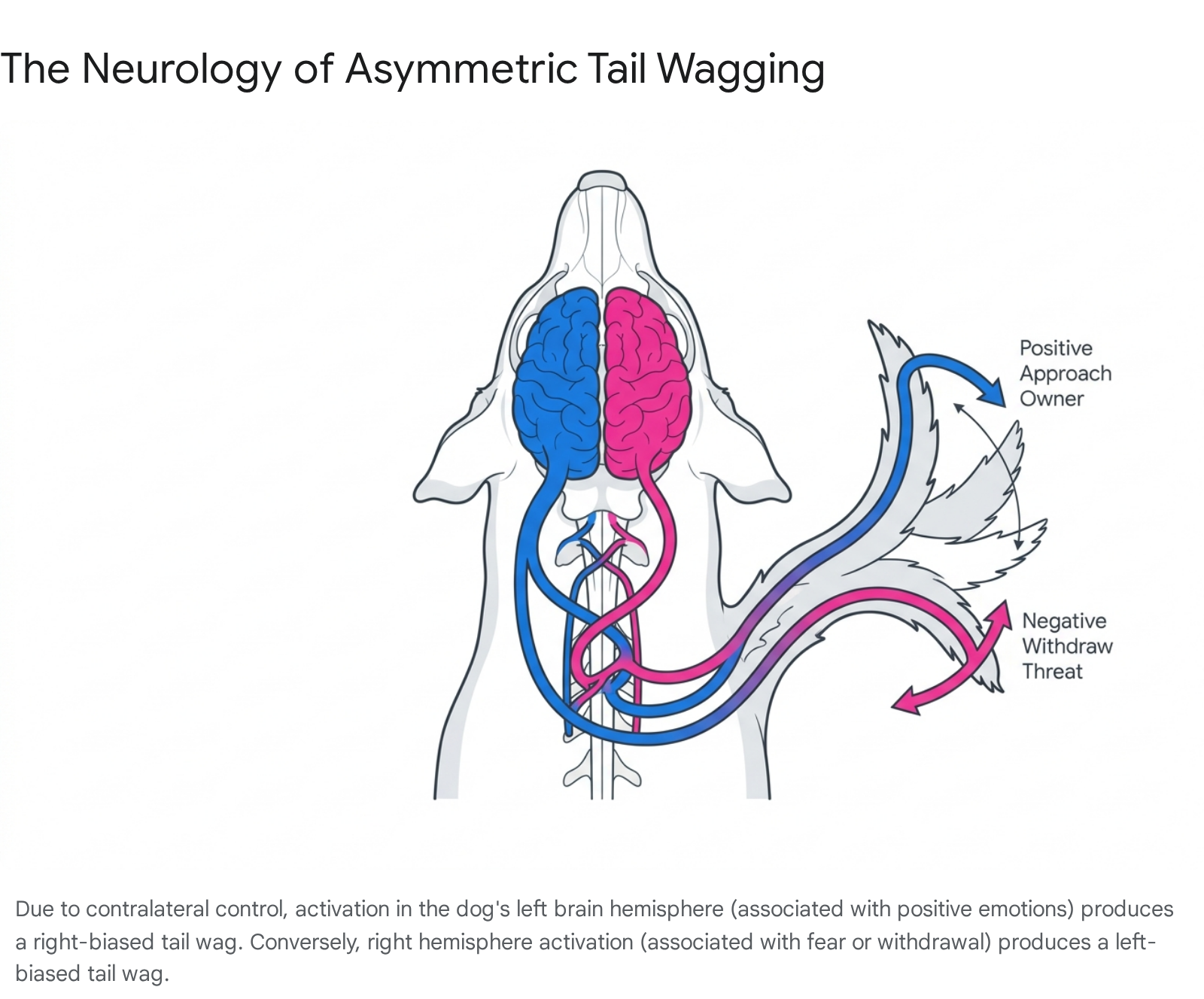
These biased wags are not necessarily deliberate, conscious forms of communication. Researchers believe they are largely automatic, biomechanical by-products of the differential activation occurring in the two halves of the brain 1821. In recent studies utilizing deep-learning-based motion-tracking software, scientists found that dogs exhibit individualized, attractor-like dynamics in their wags - meaning the kinematic features of the tail movement serve almost like a distinct physiological fingerprint for each dog, gradually shifting to a stronger right-side bias over several days as the dog becomes more familiar and comfortable with a human handler 2122.
Do dogs actually notice the directional difference?
While human observers generally require high-speed cameras or very careful attention to notice whether a dog's tail is wagging slightly more to the left or the right, other dogs read these signals instantly.
To test whether dogs actually perceive the lateralized wags of their peers, researchers outfitted 43 pet dogs of various breeds with small vests that monitored their heart rates 17. The observer dogs were then shown life-sized video projections of other dogs, as well as edited digital silhouettes where all physical features were obscured except for the wagging tail 1117.
The results were striking. When the observer dogs saw a tail wagging to the right (indicating a relaxed, friendly conspecific), they remained perfectly relaxed, and their heart rates stayed normal 1117. Some even attempted to approach the screen to initiate a greeting. However, when the dogs viewed a tail wagging to the left, their heart rates spiked significantly, and they began displaying anxious, stressed behaviors, such as lowering their body posture or lifting a paw in apprehension 111617.
This elegant experiment demonstrates that domestic dogs possess an incredibly sophisticated visual vocabulary. They can detect the internal neurological state of another dog solely based on micro-asymmetries in the swing of their tail, allowing them to anticipate friendly interactions or prepare for potential conflict long before any physical contact occurs 11. Dogs have even been shown to accurately read these wagging asymmetries when looking at mechanized robot dogs 9.
The evolutionary mystery of contralateral control
The phenomenon of the left brain controlling the right body (and vice versa) is not unique to dogs; it is a fundamental architectural feature of the central nervous system in all vertebrates, including humans 293031. This structural arrangement is known as contralateral control 202923. The physical crossing of these motor and sensory nerve tracts from one side of the body to the other occurs primarily in the brainstem (specifically in an area called the medulla oblongata) and is known anatomically as decussation 292425.
From an evolutionary perspective, contralateral control presents a profound puzzle. Why would nature design a seemingly counterintuitive system where billions of nerve fibers have to cross the midline, creating a vulnerable bottleneck in the brainstem? While there is no single, universally agreed-upon answer, evolutionary biologists and neuroscientists have proposed several compelling hypotheses to explain why animals - and by extension, the wagging tails of dogs - are wired this way.
The Somatic Twist Hypothesis
One leading morphological theory, known as the "somatic twist" hypothesis, suggests that this cross-wiring is an ancient historical artifact of our earliest marine ancestors. The theory posits that hundreds of millions of years ago, early marine invertebrates evolved a genetic mutation that caused them to flip their body orientation 180 degrees (ventral to dorsal) 253536.
To align their anterior sensory organs (which were migrating to the new "top" of the animal) with their existing body plan, the entire neuraxis essentially underwent a "twist" 2535. This resulted in the brain being wired backward relative to the body's new orientation. Because this twist occurred so early in the evolutionary tree before the divergence of modern vertebrates, all subsequent species - from flounders to wolves to humans - inherited this locked, crisscrossed anatomical pattern 253626.
The Protective Mechanism (Reserve Capacity) Hypothesis
Other biophysicists approach the puzzle by looking for a mathematical survival advantage. The Protective Mechanism hypothesis argues that contralateral wiring offers a distinct evolutionary benefit in the face of physical trauma 2739.
If an animal sustains a severe, unilateral injury to one side of its body (e.g., an animal is attacked from the left), the injury could easily damage both the left limbs and the left side of the head 2739. If the brain were wired ipsilaterally (same side), the animal would lose all functional control on that side and likely die. By cross-wiring the system, damage to the left body and the left brain ensures that the right brain remains intact and can still exert some motor control over the surviving left-side body parts, or vice versa. This provides a critical "reserve capacity" that allows a wounded animal a slightly higher statistical chance to fight back or flee, driving natural selection toward the contralateral model over millions of years 302739.
Early Sensorimotor Coordination
A third theory suggests that early in the evolution of visual systems, processing stimuli from one side of the environment directly into the opposite hemisphere improved reflex speeds. If a threat appeared in the left visual field, processing it in the right hemisphere allowed the organism to rapidly coordinate the complex, multi-limb movements required to turn quickly toward prey or flee from predators 302436.
Regardless of its true evolutionary origins, this ancient neurological decussation is the direct biological mechanism behind the left and right tail wags that dictate the social politics of the modern dog park.
Why did dogs evolve to wag so much? Two theories
While the neurological mechanics of a wagging tail are relatively well understood, the ultimate evolutionary reason why dogs wag their tails so frequently remains a highly debated topic among animal behaviorists.
A critical piece of comparative ethology is that domestic dogs wag their tails far more than any other canine species. In a massive observational study tracking over 40 distinct species over a four-year span, the domestic dog was found to be the species that wags its tail the absolute most 6.
When comparing domestic dogs to wolves - their direct evolutionary ancestors - researchers note a stark behavioral divergence 2829. Even when wolf pups and domestic dog puppies are hand-raised by humans in the exact same environment and treated identically, dog puppies will begin wagging their tails enthusiastically by three to five weeks of age when presented with a positive stimulus 2842. The wolf pups, by contrast, almost never wag their tails in those same contexts 2842.
To wild wolves, the tail is primarily a tool for physical balance, locomotion, and occasional, subdued social signaling (such as a tucked tail for submission or a raised tail to indicate alpha status) 6142943. Somewhere along the timeline of human-canine co-evolution - which began approximately 35,000 years ago during the Stone Age - the domestic dog's tail was biologically repurposed into a hypertrophied (exaggerated) instrument of constant communication 41015.
In a comprehensive 2024 review published in the Royal Society's journal Biology Letters, researchers Silvia Leonetti and colleagues summarized the global scientific literature and proposed two primary evolutionary hypotheses for the explosive prevalence of the canine tail wag: the Domestication Syndrome Hypothesis and the Domesticated Rhythmic Wagging Hypothesis 134930.
Theory 1: The Domestication Syndrome Hypothesis
The first hypothesis posits that tail wagging was never intentionally selected for by early humans. Instead, it emerged as an accidental genetic tagalong - an unintended by-product of humans breeding dogs for an entirely different, highly desirable trait: tameness 14689.
This phenomenon is known widely in evolutionary biology as "domestication syndrome" 1142831. When humans began domesticating wild mammals, they overwhelmingly selected for docility, reduced flight distance, and a lack of aggressive fear responses toward humans 82831. Selecting for tameness fundamentally alters the animal's early developmental biology, specifically the behavior and migration of neural crest cells in the growing embryo 11431.
These highly versatile embryonic stem cells are responsible for developing the adrenal glands (which control the fear and stress response), but they also contribute to the development of facial musculature, ear cartilage, pigmentation, jaw size, and tail anatomy 11431. By inadvertently altering the migration paths of neural crest cells to produce calmer animals, early humans triggered a cascade of unintended physical and behavioral changes. This is why so many vastly different domesticated animals - from dogs and pigs to cows and sheep - share similar physical traits: floppy ears, shorter snouts, patches of white fur (piebaldism), smaller teeth, and curly tails 31.
The most robust support for this hypothesis comes from a famous, decades-long experiment initiated in 1959 by Soviet geneticist Dmitri Belyaev 892831. Belyaev selectively bred captive silver foxes (Vulpes vulpes) using only one strict criterion: tameability. He only allowed the absolute calmest, least aggressive foxes to breed 31.
After just 12 to 40 generations, the foxes began to exhibit the full suite of domestication syndrome traits 92831. Even though tail wagging was never actively selected for, the tame foxes developed more curled tails and began exhibiting explicitly dog-like tail wagging behavior when approached by human handlers 892831. Under the Domestication Syndrome theory, the exuberant tail wagging of the modern dog is simply the physiological and anatomical side effect of thousands of years of human preference for a friendly disposition 12831.
Theory 2: The Domesticated Rhythmic Wagging Hypothesis
The second hypothesis proposed by Leonetti et al. (2024) flips the script entirely. It suggests that tail wagging was not a genetic accident, but rather a direct, functional target of the domestication process, driven by the subconscious evolutionary preferences of the human brain 189.
Multidisciplinary evidence across cognitive neuroscience reveals that humans possess a remarkable, intrinsic affinity for perceiving and producing rhythmic sequences - particularly isochronous patterns, where events are evenly spaced in time (like the steady beat of a drum or a ticking clock) 68932. Human brains have a natural, hardwired preference for rhythmic stimuli; when we perceive a steady rhythm, it actively engages neural networks that are directly tied to our brain's reward system, triggering the release of dopamine and eliciting pleasurable emotional responses 3691532.
A dog's tail wag is a highly conspicuous, cyclical, and uniquely rhythmic visual display 9. The Domesticated Rhythmic Wagging Hypothesis suggests that early humans consciously or unconsciously found the rhythmic motion of a wagging tail endearing, appealing, and neurologically rewarding 4815284333. Consequently, humans favored, fed, protected, and selectively bred the ancient dogs that wagged their tails the most frequently and the most rhythmically 182832. Over millennia, this human neurobiological quirk acted as a powerful selective pressure, cultivating the tireless, rhythmic tail thumping we see in modern domestic dogs.
While both hypotheses carry deep logical weight, distinguishing between them definitively will require future neuroimaging and large-scale genetic studies 6. It is also entirely possible that both forces were simultaneously at play: the behavior initially emerged as a genetic by-product of tameness, and humans subsequently reinforced and exaggerated it through selective breeding because they found the rhythmic visual feedback pleasing 815.
How breed morphology impacts canine communication
If the tail is the dog's primary tool for sophisticated visual communication, what happens when humans breed dogs with physical shapes that compromise this very tool?
The evolutionary divergence from ancient wolves to modern domestic dogs has resulted in over 400 distinct canine breeds with vastly different physical morphologies 34. However, human aesthetic preferences have not always prioritized communicative function. Research strongly indicates that severe physical alterations significantly constrain a dog's ability to communicate effectively with both humans and other dogs 293449.
The loss of facial expressions
Wolves utilize a highly complex matrix of facial expressions, ear positions, and subtle body postures to navigate their intense social hierarchies 3449. Domestication, however, has profoundly altered the facial musculature, eye shape, and skull proportions of dogs 142949.
A comprehensive 2024 study comparing wolves and domestic dogs demonstrated that dogs - particularly those with non-wolf-like morphologies - have lost much of the physical ability to produce the nuanced, affective facial expressions that their wild ancestors use to convey emotions like anger, anxiety, or friendliness 2949. The researchers found that domestic dogs suffer from "confusion" among positive and negative facial states due to their altered anatomy 49.
To compensate for their diminished capacity for nuanced facial signaling, domestic dogs are forced to lean heavily on their tails and their voices. The same study found that domestic dogs vocalize (bark, whine, yelp) significantly more often during social interactions than wolves do (40% of the time for dogs compared to 25% for wolves) 2949.
| Communication Trait | Wild Wolves | Domestic Dogs |
|---|---|---|
| Facial Expressions | Highly complex, nuanced, primary tool for conveying affective states. | Constrained by breed morphology; heavily reliant on specific muscle developments (e.g., puppy dog eyes). |
| Tail Wagging | Infrequent; used primarily for balance, locomotion, or static status signaling (alpha vs submissive). | Highly frequent, rhythmic, exaggerated; serves as the primary visual barometer of arousal and intent. |
| Vocalizations | Less frequent in close social interactions (25%); howling used for long-distance pack cohesion. | Highly frequent (40%); barking hypertrophied as a compensatory mechanism for lost facial nuance. |
| Gaze Behavior | Avoid direct, prolonged eye contact (often viewed as a threat). | Spontaneous tendency to gaze into human eyes to seek information or initiate communication. |
The consequences of docked and curly tails
When human breeding targets the tail itself, the communication breakdown becomes even more severe. Breeds with naturally bobbed tails, tightly curled tails (such as Pugs or the Japanese Spitz), or tails subjected to cosmetic docking face a massive communicative handicap 763435. A dog without a visible, freely moving tail struggles to broadcast its intentions - whether friendly, playful, or fearful - to other dogs across a distance 634. When other canines cannot read the visual cues of a docked or short-snouted dog, social miscommunications and unwarranted conflicts frequently occur.
This communicative impairment has real-world, measurable consequences. A comprehensive study by researchers at the University of São Paulo (USP) in Brazil analyzed the behavioral profiles of 665 pet dogs and found significant correlations between a dog's physical morphology and its level of aggression 513637. The USP researchers discovered that shorter, lighter, and specifically brachycephalic (short-snouted) dogs - like Pugs, Bulldogs, and Shih Tzus - exhibited more behavioral problems and higher rates of aggression toward strangers and unfamiliar objects than medium- or long-snouted dogs 513637.
While genetics, living environment, and owner behavior always play massive roles in a dog's temperament, ethologists suggest that part of this aggression profile stems from defensive compensation 5136. Because physically altered dogs cannot effectively signal appeasement or mild anxiety using standard canine body language (such as a tucked tail or flattened ears), their subtle warnings are often ignored by humans and other dogs 4937. Consequently, they are forced to escalate straight to severe aggressive behaviors - such as growling, snapping, or biting - to communicate their discomfort and create necessary physical distance 4937.
Furthermore, tail wagging behavior is not uniform across all domestic breeds, as centuries of selective breeding for specific geographic or working tasks have left varying behavioral imprints. For instance, ethological studies on phylogenetic trees have noted significant behavioral differences between indigenous Japanese breeds (like the Shiba Inu or Kai Ken, which trace their lineage back to the Jomon period) and standard European breeds 3855. Some preservation societies note that certain ancient Japanese hunting breeds remain highly cautious and will not easily wag their tails at non-family members, retaining a more reserved, wolf-like vigilance compared to a gregarious European Golden Retriever 55. Similarly, working hunting breeds generally wag their tails more frequently and with different physical characteristics than herding dogs, indicating that the selective pressures of human utility continually shaped the exact mechanics of the wag 932.
Bottom line
The domestic dog's wagging tail is a highly sophisticated, deeply evolved communication tool that broadcasts a dog's level of emotional arousal, not simply a baseline state of happiness. Whether the tail is vibrating high and stiff in aggressive warning, or sweeping rhythmically to the right to signal a positive, friendly approach, it is a visual language born from the ancient, contralateral cross-wiring of the vertebrate brain. While researchers continue to debate whether this prolific behavior emerged as an accidental genetic by-product of tameness or because human brains are hardwired to reward rhythmic motion, one absolute fact remains clear: understanding the complex nuance of the wag is essential for safely and compassionately interpreting the needs of our oldest animal companions.