
Science of audience attention management in public speaking
The management of audience attention in public speaking is governed by a complex intersection of cognitive psychology, neurobiology, and physiological reflex mechanisms. For decades, instructional design and public speaking pedagogy have relied on anecdotal assumptions about human attention spans and audience engagement 11. However, contemporary research leveraging neuroimaging, psychophysiological measurement, and cognitive load modeling provides a rigorous empirical foundation for understanding how human beings process spoken information 234. This research demonstrates that audience engagement is not a static resource that simply drains exponentially over time. Instead, it is a highly dynamic state driven by neural synchronization, physiological orienting responses, and the continuous allocation of limited cognitive resources 56. Skilled speakers navigate these neurobiological constraints by utilizing structural pattern interrupts, pacing, and emotional salience to actively manage the cognitive load and predictive models of their listeners 789.
Cognitive Processing Architecture
Understanding how audiences process presentations requires acknowledging the fundamental limitations of the human brain's working memory. Cognitive mechanisms dictate how much information can be held, processed, and encoded at any given time. Two primary theoretical frameworks define these constraints: Cognitive Load Theory (CLT) and the Limited Capacity Model of Motivated Mediated Message Processing (LC4MP).
Working Memory and Cognitive Load Theory
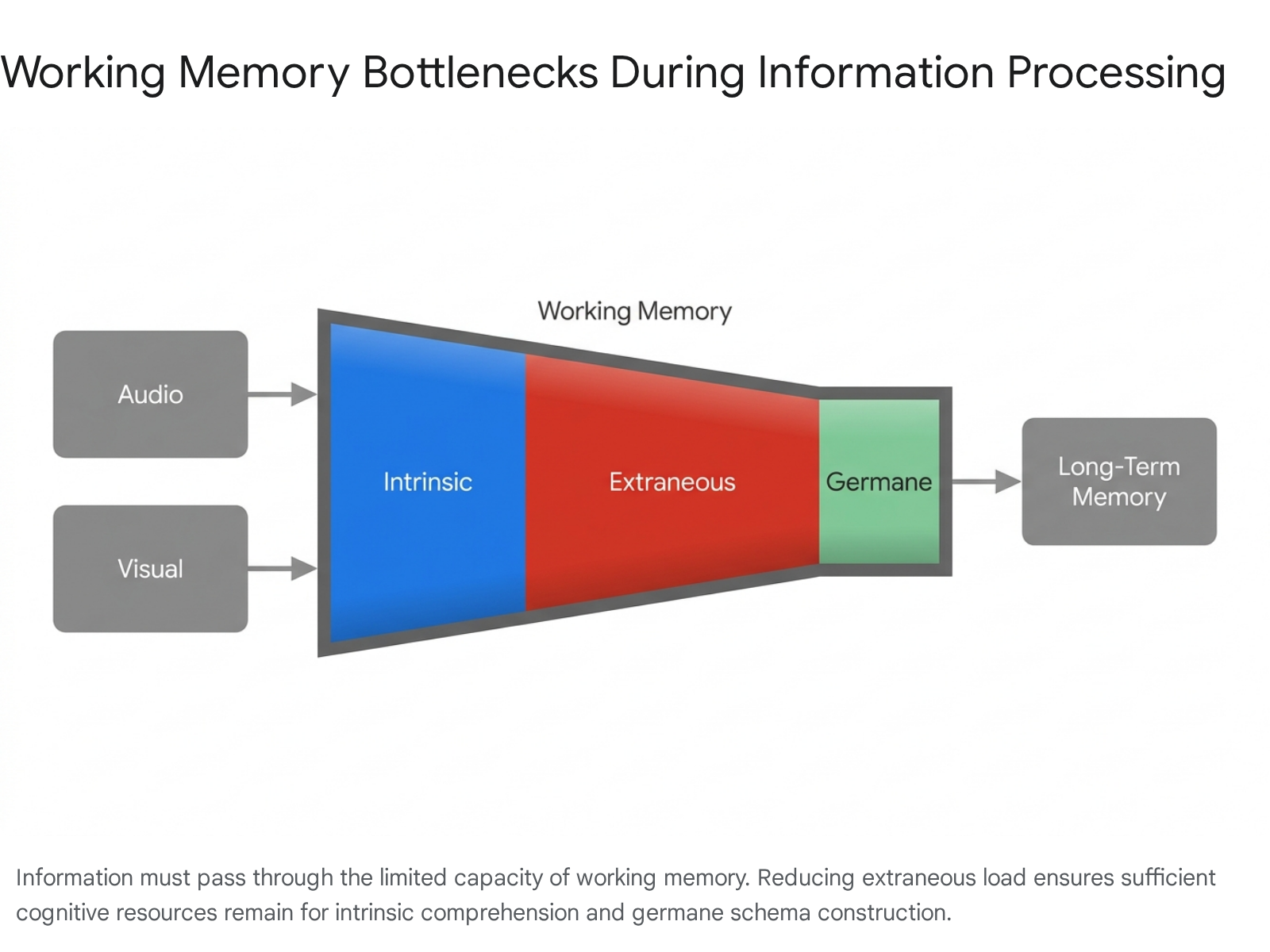
Developed by John Sweller, Cognitive Load Theory postulates that learning and comprehension are fundamentally constrained by the limited capacity of working memory, which can typically process and hold only five to nine chunks of information simultaneously 410. Sensory memory first filters environmental stimuli, passing select information into working memory for processing. If the demands placed on working memory exceed its finite capacity, individuals experience cognitive overload, leading to a precipitous decline in engagement, comprehension, and information retention 41112. Sweller's framework categorizes cognitive load into three distinct but additive types: intrinsic, extraneous, and germane 10131415.
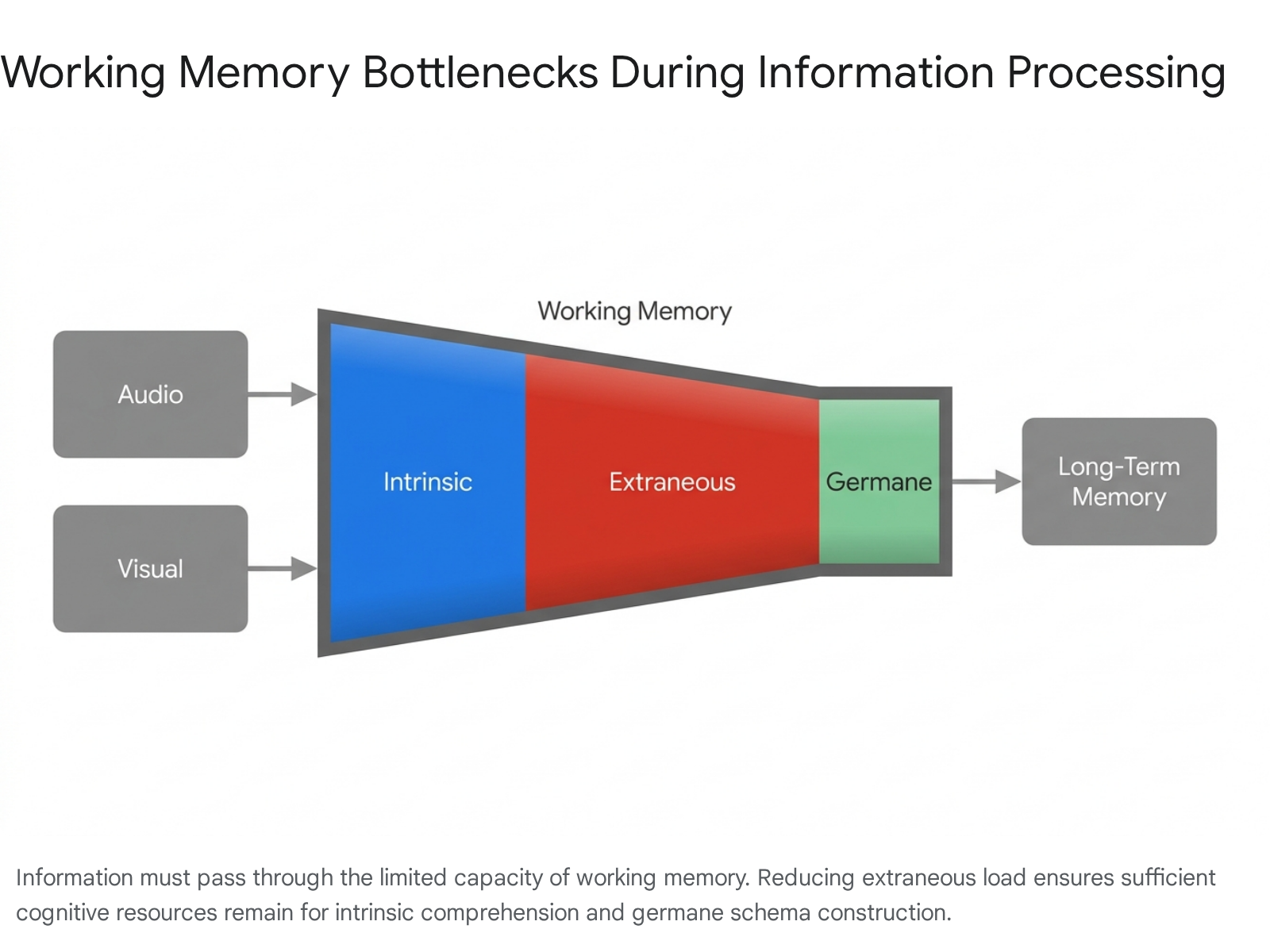
Intrinsic load refers to the inherent complexity of the information being presented relative to the learner's prior knowledge 101316. It is determined by the subject matter itself and the element interactivity within the concepts. A highly technical engineering concept carries a high intrinsic load for a lay audience but a lower intrinsic load for domain experts 14. While speakers cannot easily eliminate intrinsic load without oversimplifying their material, they must actively manage it by sequencing information logically, breaking complex ideas into digestible segments, and assessing the baseline knowledge of the audience to minimize the "problem space" 412.
Extraneous load is the unnecessary cognitive burden imposed by the method and format of presentation 101417. In public speaking and instructional design, extraneous load is generated by poor formatting, such as dense, text-heavy slides, confusing visual layouts, or competing auditory stimuli 1112. A pervasive example of extraneous load in presentations is the split-attention effect or redundancy effect, which occurs when a speaker presents dense on-screen text and simultaneously reads it aloud or provides competing explanations 1218. This splits the audience's visual and auditory attention channels, forcing working memory to reconcile two competing streams of information, thereby increasing cognitive fatigue and impeding learning 18. Minimizing extraneous load is paramount; it allows audiences to dedicate their limited mental resources to understanding the core message. Researchers emphasize "weeding" - eliminating all non-essential content that embellishes the learning environment but promotes irrelevant incidental processing 11.
Germane load is the productive cognitive effort required to process information, construct mental models, and integrate new knowledge into long-term memory 1314. Germane load facilitates the creation and automation of "schemas," which are frameworks the brain uses to organize and retrieve information 417. Speakers can optimize germane load by using clear analogies, providing worked examples, utilizing generative strategies, and employing clear visual diagrams that support the spoken narrative 111718. Empirical studies indicate that when extraneous cognitive load is reduced, total cognitive load decreases, freeing up working memory resources to be devoted to germane processing 14.
| Cognitive Load Category | Definition in Presentation Context | Impact on Audience Processing | Mitigation and Optimization Strategies |
|---|---|---|---|
| Intrinsic Load | The inherent difficulty or novelty of the presented subject matter based on element interactivity. | High intrinsic load can overwhelm working memory if the audience lacks foundational schemas. | Segment complex information into sequential, digestible parts; assess audience baseline knowledge. |
| Extraneous Load | Unnecessary cognitive friction caused by poor instructional design or conflicting delivery methods. | Drains limited cognitive resources, leading to rapid disengagement, frustration, and fatigue. | Remove redundant text, avoid split-attention visuals, clarify navigation, and maximize the signal-to-noise ratio. |
| Germane Load | Productive mental effort dedicated to integrating, making sense of, and storing new information. | Builds robust memory schemas and facilitates long-term retention and retrieval of the core message. | Use illustrative analogies, worked examples, scaffolding strategies, and purposeful visual diagrams. |
Limited Capacity Model of Motivated Mediated Message Processing
While Cognitive Load Theory addresses the structural difficulty of information, the Limited Capacity Model of Motivated Mediated Message Processing (LC4MP), formalized by Annie Lang, provides a highly dynamic, data-driven biological explanation of how and why individuals allocate their attention 192021. Like CLT, the LC4MP assumes humans are biological organisms with a finite pool of cognitive resources available for attending to mediated content 2022. However, it specifically models how these cognitive resources are continuously and automatically allocated to three concurrent information processing sub-processes: encoding, storage, and retrieval 52021.
Encoding involves selecting components of the message and creating mental representations of environmental stimuli; storage involves linking this newly encoded information to existing neural networks in long-term memory; and retrieval brings previously stored information back into working memory to interpret new inputs 521. Because the overall resource pool is limited, these sub-processes exist in constant competition 5. If an audience is dedicating excessive resources to retrieving background knowledge to comprehend a dense, unfamiliar point, they may lack the remaining resources required to encode the subsequent sentence the speaker delivers 5.
Crucially, the LC4MP introduces the biological role of motivation. The human brain contains two underlying motivational systems: the appetitive system (which responds to positive, rewarding, or goal-oriented stimuli) and the aversive system (which responds to negative, threatening, or unpleasant stimuli) 519. Emotionally arousing content automatically activates these systems, driving involuntary, reflexive resource allocation toward the message 192122. Empirical studies using LC4MP show an interaction between consumers' emotions and visual attention, conceptualizing emotion on a two-dimensional space of arousal (calming to exciting) and valence (highly positive to highly negative) 22.
At low to moderate levels of motivational activation, negative messages command more immediate resource allocation to encoding and storage than positive ones, a phenomenon rooted in evolutionary survival mechanisms designed to process potential threats 1921. Conversely, under the "positivity offset" hypothesis, when overall arousal is very low, more resources may be allocated to positive or coactive messages 21. Skilled speakers who introduce emotional narratives or specific stakes (either urgent pain points or promises of reward) actively manipulate these motivational systems. This forces the audience's brain to allocate resources to the encoding phase, combating the natural decay of controlled attention 2325.
Environmental Interference and Cognitive Drain
The constraints of working memory outlined by CLT and LC4MP are significantly exacerbated in modern speaking environments by the persistent presence of digital devices. Recent cognitive research highlights the "brain drain" hypothesis, which posits that the mere physical presence of a smartphone - even when turned off or placed face down - occupies limited-capacity cognitive resources, thereby leaving fewer resources available for focal tasks 2425262728.
Smartphones are highly salient environmental cues strongly associated with social connection, entertainment, and rewards. Consequently, the brain must actively expend cognitive control to inhibit the automatic, habitual response to check them 2425. This inhibition process consumes the exact same finite pool of attentional resources required for encoding a speaker's message 25. Experimental results indicate that working memory capacity and fluid intelligence scores significantly decrease when a participant's smartphone is present in the room compared to when it is absent, even if participants successfully resist the temptation to check their devices and self-report remaining focused 252728.
This effect is moderated by individual differences, with cognitive costs being highest for individuals reporting high smartphone dependence or a high Fear of Missing Out (FoMO) 2428. The Load Theory of Attention and Cognitive Control explains this discrepancy, noting that the extent to which people can focus in the face of irrelevant distractions depends entirely on their available cognitive load capacity 27. For public speakers, this implies that modern audiences are inherently operating with a degraded baseline of cognitive capacity. Consequently, the application of extraneous cognitive load reduction and the use of explicit attention-grabbing pattern interrupts are more critical for successful knowledge transfer than in previous eras.
Attention Dynamics and Temporal Fluctuation
A pervasive paradigm in public speaking pedagogy, instructional design, and corporate communication asserts that audience attention naturally peaks at the beginning of a presentation, plummets sharply after 10 to 15 minutes, and remains low until a slight recovery near the conclusion 1129. This paradigm has heavily influenced the design of university lectures and highly popular presentation formats, such as TED Talks, which strictly cap presentations at 18 minutes under the assumption that audiences cannot maintain focus beyond this threshold 1. However, empirical scrutiny of the underlying literature reveals that this fixed, exponential decay curve is scientifically unfounded.
The Ten-Minute Attention Decay Myth
The historical basis for the 10-15 minute attention span limit relies heavily on a limited set of observational studies from the 1970s, primarily evaluating student note-taking behaviors. Researchers such as Hartley, Davies, Maddox, and Hoole observed a decline in the volume of notes taken after the first ten to twenty minutes of a lecture 130. Furthermore, early work by Trenaman found that students listening to a 15-minute recorded broadcast retained 41% of the material, whereas those listening for 40 minutes retained only 20% 1.
However, subsequent meta-analyses and rigorous physiological reviews, such as those conducted by Neil Bradbury and the research team of Wilson and Korn, have demonstrated that the decline in note-taking was a reflection of the instructor's pacing and a drop in the density of information being presented, rather than an exhaustion of the students' mental capacities 16. Maddox and Hoole specifically noted that the decline in note-taking at the end of the lecture was not caused by mental exhaustion, but rather reflected a drop in actual lecture content during the waning minutes 1. There is scant primary data to support the concept of a strict 10-to-15-minute biological attention limit 129.
Empirical Measurements of Attention Fluctuation
Empirical measurements of continuous attention - gathered via subjective self-reporting, behavioral monitoring (such as fidgeting), and continuous physiological tracking - indicate that attention does not drop off a cliff after ten minutes. Rather, it fluctuates in alternating cycles of engagement and non-engagement 631. While long-term attention decay does occur over the course of a 50-minute session, the decline is slow, gradual, and punctuated by peaks that correspond directly to the speaker's actions and pedagogical shifts 1.
Studies asking students to self-report their attentiveness at 5-minute intervals during a 40-minute lecture video demonstrate that while overall attention slowly wanes as a function of time on task, it does not disappear 32. Behavioral indicators, such as fidgeting, are negatively correlated with attention and memory retention; fidgeting increases during blocks associated with reduced attentiveness, and retention for material presented during those specific blocks decreases accordingly 32. Crucially, the greatest variability in student attention arises from differences between teachers and instructional formats, not from the passage of time itself 129.
Arousal Stimuli as Attention Resets
Attention is highly malleable, and the introduction of active learning components, narrative suspense, or unexpected stimuli can effectively "reset" the attention clock 63135. In a large-scale experimental study involving 846 college students, researchers assigned participants to either an arousal group or a no-arousal control group prior to a 30-minute lecture 33. The experimental group was exposed to a topic-relevant, 90-second external stimulus designed to elevate arousal and focus attention (e.g., a puzzle or game), while the control group listened to the instructor take roll 33.
The results demonstrated a statistically significant difference in information retention. Students exposed to the brief arousal stimulus prior to the lecture scored significantly higher on a subsequent retention exam (p < .001) compared to the control group 33. This suggests that exogenous arousal mechanisms can temporarily override the natural tendency toward habituation and attention decay 33. Therefore, while a gradual decay of attention is a natural physiological tendency in a passive viewing environment, it is not an inevitability. Skilled speakers actively hack this curve by segmenting their presentations into smaller modular units, essentially creating multiple "beginnings" to cheat the attention curve and maintain elevated engagement 131.
| Attention Model Theory | Core Premise | Empirical Validity | Practical Implication for Public Speakers |
|---|---|---|---|
| The 10-Minute Myth | Attention drops steeply and permanently after 10-15 minutes of continuous speaking. | Low. Based on conflated historical data regarding note-taking volume, not true cognitive focus. | Led to arbitrary presentation time limits; falsely assumes audiences cannot process long-form content. |
| The Fluctuation Model | Attention waxes and wanes in shortening cycles, driven by content structure, delivery, and arousal. | High. Supported by modern continuous self-reporting data and behavioral engagement cycles. | Requires speakers to proactively design presentations with periodic pedagogical shifts and interactive elements. |
| The Attention Decay Model | Baseline attention naturally and slowly degrades over long periods if uninterrupted, but can be reset. | High. Aligns with cognitive fatigue, habituation mechanisms, and neurophysiological tracking. | Necessitates the strategic use of pattern interrupts to repeatedly return audience attention to baseline levels. |
Neural Synchronization and Intersubject Correlation
To understand exactly when and why audiences pay attention, neuroscientists have moved beyond behavioral observation, utilizing naturalistic neuroimaging techniques to map audience engagement directly within the brain. The primary methodological metric for this is Inter-Subject Correlation (ISC) 2373435.
Intersubject Correlation Methodologies
Traditional functional magnetic resonance imaging (fMRI) studies rely on highly controlled general linear model (GLM) paradigms to measure responses to isolated stimuli. ISC, conversely, is a data-driven, model-free analysis method used to examine highly complex fMRI or electroencephalography (EEG) data acquired in natural, continuous audiovisual environments - such as watching a movie or listening to a 20-minute public speech 373637.
ISC computes the voxel-wise (in fMRI) or channel-wise (in EEG) correlation between the time series of neural activity across multiple individuals exposed to the exact same time-locked stimulus 37353638. The premise of ISC is that when a stimulus is highly engaging and salient, it overrides spontaneous, idiosyncratic brain activity, forcing the brains of the audience members to process the information in a synchronized, time-locked manner 234353940. High ISC serves as a reliable neural marker for attentional engagement, shared perceptual processing, and cognitive resonance 235.
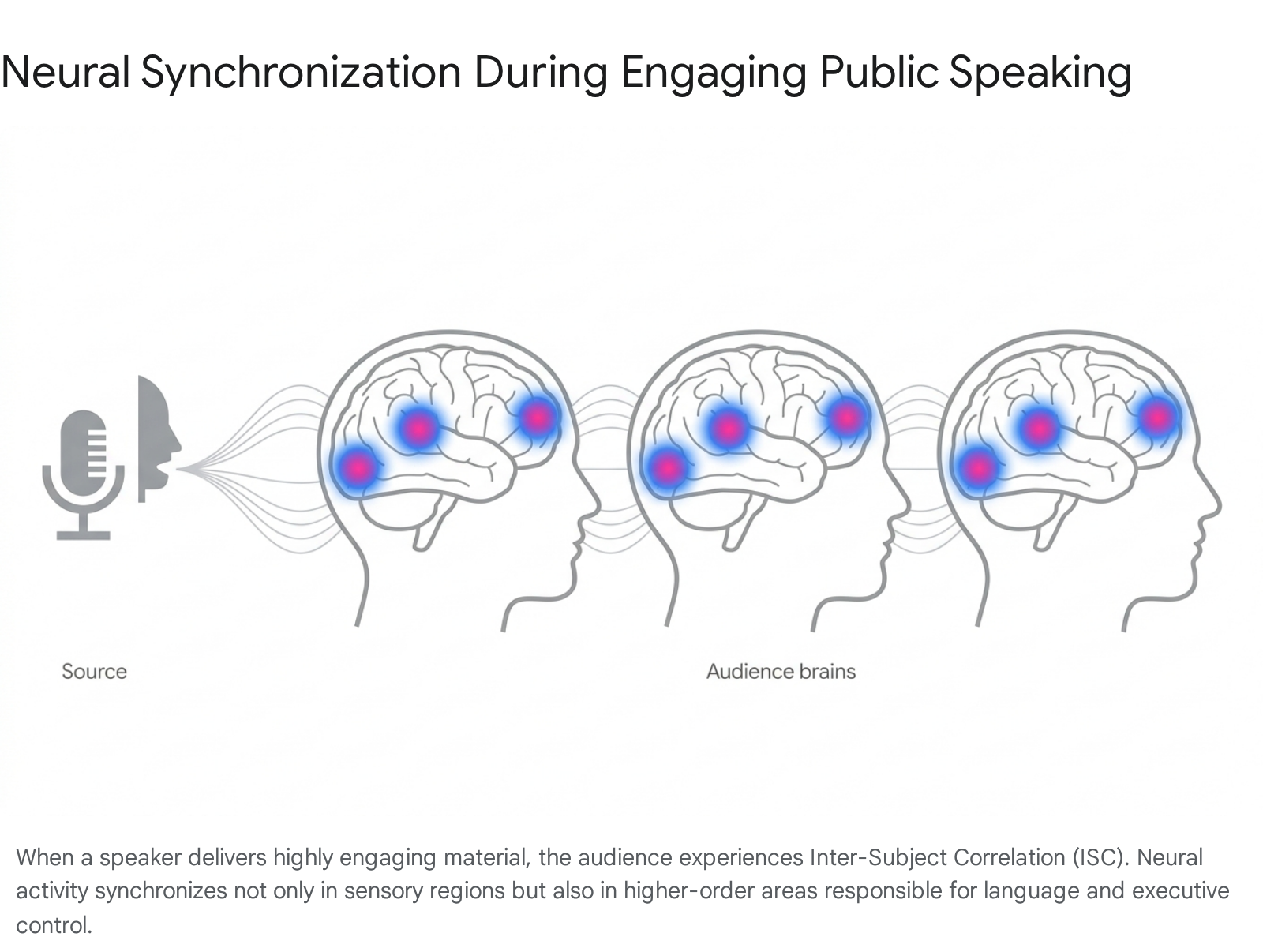
A meta-analysis of 14 studies confirmed a significant positive correlation (r = 0.65, p < 0.001) between ISC and measured attentional engagement 35.
Narrative Drivers of Neural Alignment
Studies utilizing fMRI and EEG show that highly effective and engaging speeches evoke widespread ISC across the human information-processing hierarchy 23741. Synchronization occurs not only in primary visual and auditory sensory cortices but extends deep into higher-order brain regions, including the superior temporal sulcus (associated with language processing), the posterior medial cortex (PMC), the dorsolateral and dorsomedial prefrontal cortex (associated with executive control and sustained attention), and the insula 2414243.
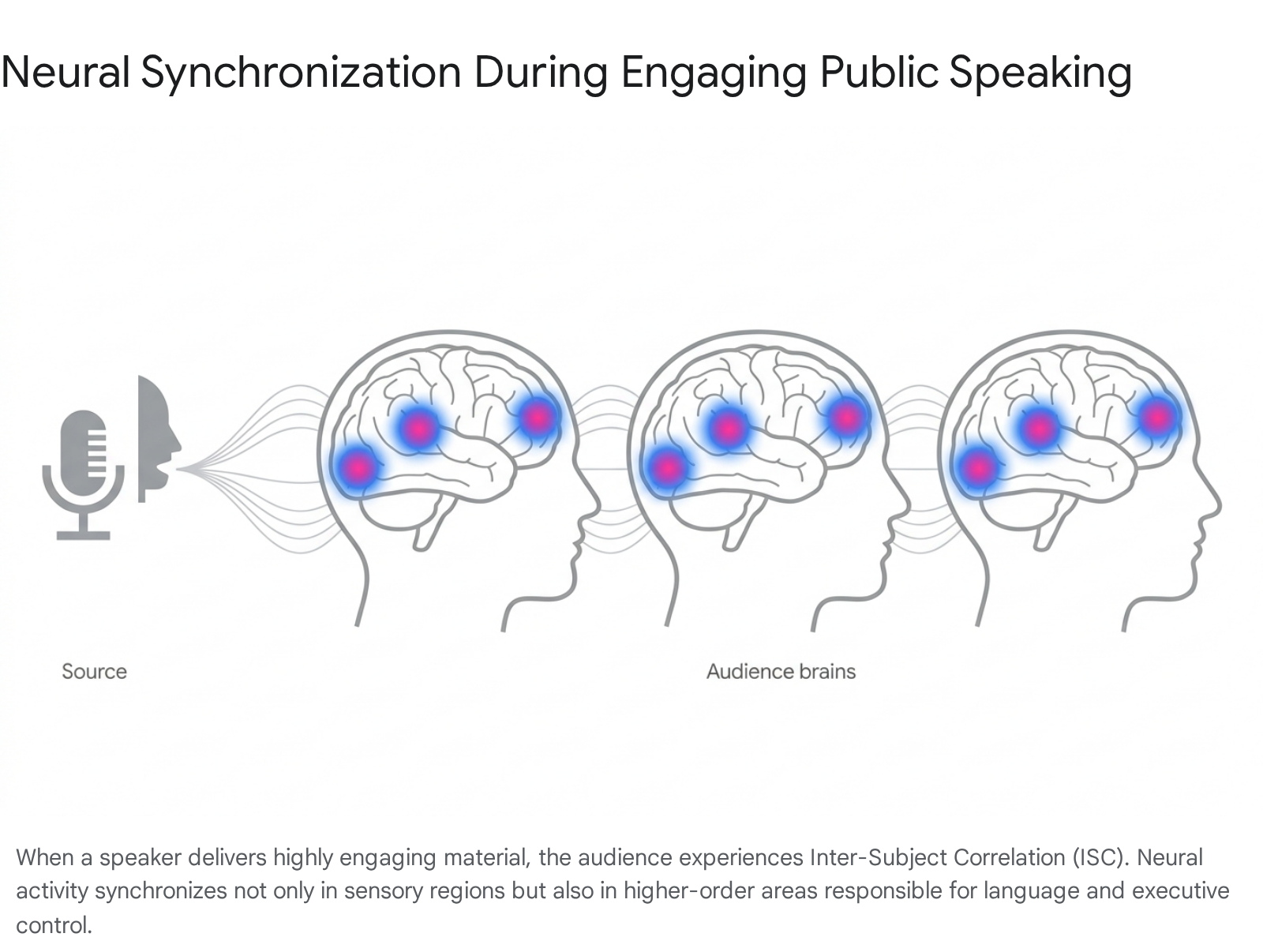
The structural cohesiveness of the content heavily modulates this neural coupling. In studies where students listened to an intact lecture versus a temporally scrambled version of the same lecture, the intact lesson generated widespread teacher-student neural coupling in higher-level areas, whereas the scrambled version disrupted alignment and decreased learning outcomes 41. Furthermore, narrative arc directly influences ISC. EEG-based dynamic intersubject correlation (dISC) studies indicate that neural synchronization aligns closely with the dramatic arc and self-reported suspense levels of a narrative 4044.
Modality also plays a critical role in synchronization. Audiovisual narratives generate significantly stronger ISC than audio-only narratives, reinforcing the importance of multimodal delivery in holding audience attention and capitalizing on the brain's enhanced processing of multisensory integration 343940. When an audience loses interest, or when a presentation lacks a compelling narrative arc, their neural responses decouple, reverting to intrinsic resting-state networks, and ISC drops significantly 3441.
Predictive Validity of Intersubject Correlation
Remarkably, the synchronization measured in small laboratory cohorts can predict the behavior of massive populations. Research by Dmochowski and colleagues demonstrated that the level of ISC in evoked EEG responses of a small sample of viewers robustly predicted the preferences and behaviors of large audiences 4245. By correlating neural reliability with Nielsen ratings and social media metrics (such as the frequency of tweets associated with specific scenes of a broadcast), researchers found that moments of high ISC in the lab sample perfectly time-locked with massive human entrainment online 42454647.
During political debates, for example, tweet rates mentioning candidates surge within 5 to 10 seconds of well-known remarks or sudden interruptions, peaking at one minute before slowly decaying 4647. This long-term attention decay confirms that while large-scale entrainment can be triggered rapidly by a salient event, general interest is subject to bursts and decays, requiring continuous stimulation to remain elevated 46.
Orienting Responses to Auditory Stimuli
To actively manage the fluctuations in audience attention and maintain high levels of neural synchronization, skilled public speakers utilize techniques rooted in physiological reflexes. The most critical of these is the Orienting Response (OR).
Autonomic Markers of the Orienting Response
The orienting response is a primitive, automatic physiological reflex designed to keep biological organisms alert to novel or motivationally significant changes in their environment 523. In the context of media and public speaking, when an individual perceives a structural or content-based change in a stimulus, their autonomic nervous system reacts instantly 34849.
The primary psychophysiological marker of the orienting response to media is a rapid, temporary deceleration in heart rate, often accompanied by changes in skin conductance 34950. According to the LC4MP, this cardiac deceleration indicates that the brain has temporarily suspended other internal processing tasks and automatically reallocated cognitive resources toward encoding the novel stimulus 52351.
When an audience member's attention has drifted to internal thoughts, their heart rate is steady, and their cognitive resources are directed inward. An orienting response forces their attention outward, pulling them back into the present moment. Crucially, empirical testing demonstrates that recognition memory for information presented immediately following an orienting-eliciting structural feature is statistically higher than memory for information presented immediately before it 234950.
Electrophysiological Correlates
Beyond autonomic markers, the orienting response is visible in the electrophysiological activity of the brain. EEG studies utilizing novelty oddball paradigms demonstrate that unexpected or novel stimuli elicit a pronounced P300 (specifically P3a) wave amplitude 5253. The P3a component is closely linked to attention reallocation driven by selection-driven stimuli, particularly novelty 52.
While early sensory processing (indicated by the N1 amplitude) remains stable regardless of whether the audience is processing correct or erroneous trials, the subsequent P3 amplitude reflects active memory updating and cognitive resource reallocation 52. However, this response diminishes with stimulus repetition. Unfamiliar sounds elicit a greater processing load on the first presentation, but as exposure continues and a mental representation is formed, the novelty P3 amplitude is significantly reduced, demonstrating habituation 53.
Structural Audio Features
Extensive psychophysiological research, notably conducted by communication scientist Robert Potter, has identified specific auditory structural features that reliably elicit the orienting response in listeners. By analyzing radio and audio messages, researchers found that systematically introducing auditory structural complexity forces the brain to allocate resources to encoding 34950.
Features that consistently trigger cardiac deceleration and subsequent memory improvement include: * Voice Changes: Transitioning from one speaker to another, or the speaker adopting a drastically different vocal characterization 4849. * Production and Sound Effects: The sudden onset of an auditory effect, structural edit, or music track 34950. * Semantic Novelty and Emotional Words: The sudden use of highly positive, negative, or taboo words (e.g., unexpected cursing or emotionally charged language) activates the motivational systems 2358. Positive emotional target words, in particular, elicit significant cardiac orienting responses and correspondingly high recognition memory scores compared to neutral words 23. Emotional words also elicit measurable facial muscle reactions, specifically in the zygomatic muscles 23.
| Auditory Structural Feature | Description | Physiological Response | Memory Impact |
|---|---|---|---|
| Voice Change | A shift from one speaker to another, or a drastic change in vocal characterization. | Cardiac deceleration (Orienting Response). | Increased recognition memory for subsequent information. |
| Sound / Production Effects | Sudden inclusion of external audio, music onset, or abrupt edits. | Cardiac deceleration and increased skin conductance. | Enhanced encoding of immediately following content. |
| Pitch Range Variation (HL) | Modulating intonation from High pitch to Low pitch within a declarative sentence. | Increased arousal and attention allocation. | Highest rate of immediate recall and recognition compared to flat speech. |
| Emotional Target Words | Insertion of highly positive, negative, or taboo vocabulary. | Cardiac OR, increased zygomatic muscle response. | Significant boost in recognition memory, specifically for positive words. |
Pitch Modulation and Intonation Patterns
Beyond structural edits, the inherent prosody of a speaker's voice acts as an attention management tool. Research into announcer intonation strategies reveals that pitch range variations significantly enhance both attention and memory 2259.
In forced-choice recognition memory tests, dynamic intonation strategies - specifically moving from a high pitch to a low pitch (HL pattern) - attained the highest level of recognition memory (M=21.48 recalled words) compared to monotonous high-high (HH) or low-low (LL) patterns 59. High pitch operates initially to attract the listener's attention, while the descending contour and low pitch are used to convey the core data 59. The contrastive effect of pitch variation serves as a dual mode of meaning, signaling to the brain which data is accessory and which is central, simplifying the encoding process and freeing up resources for storage 59.
Pattern Interruption Mechanisms
In the realm of applied public speaking, sales, and behavioral coaching, the deliberate triggering of an orienting response is commonly referred to as a "pattern interrupt" 7546155. Human brains are highly efficient prediction engines that thrive on routines to save energy 7. When listening to a presentation, the brain quickly habituates to the speaker's cadence, tone, and slide format, placing itself on a "cognitive autopilot" 75556.
Prediction Error and the Locus Coeruleus
A pattern interrupt is a conscious, atypical action that violates the brain's subconscious predictions, disrupting this habitual flow and jarring the audience out of autopilot 76155. Neurobiologically, this expectation mismatch is mediated by the locus coeruleus-norepinephrine (LC-NE) system 85758.
The locus coeruleus is a tiny brainstem nucleus with diffuse projections across the entire neocortex 57. According to predictive coding theory, the brain constantly compares incoming sensory input against expected models. When a discrepancy occurs - a "prediction error" - the mismatch between excitation and inhibition in the prediction-error circuits triggers the locus coeruleus to fire 5758. This firing releases a global surge of norepinephrine (noradrenaline) into the cortex 858.
Norepinephrine acts as an emergency brake on runaway cognition 59. It boosts overall cortical arousal, heightens sensory perception, and signals the dopamine system to prepare for learning and memory updating 8. The pattern interrupt creates a sudden gap of acute awareness, halting negative thought spirals or passive disengagement and forcing the brain to orient toward the new stimulus 76159.
Application in Public Speaking and Pedagogy
Skilled speakers engineer prediction errors to command system-2 (analytical) cognitive processing and combat the natural degradation of focus. Data from sales call analytics reveals that utilizing pattern interrupts in cold outreach increases audience engagement by 29% compared to standard, predictable openings 56. This is because it actively disrupts cognitive biases, such as status quo bias and confirmation bias, which cause audiences to quickly dismiss familiar formats 5556.
Speakers execute pattern interrupts through several modalities: 1. Provocative Openings: Foregoing traditional, predictable agenda slides in favor of a counter-intuitive statistic, a bold claim, or a highly relevant pain-point 960. This creates an immediate "curiosity gap," violating expectations and forcing the audience to lean in to close the information gap 60. 2. Strategic Silence and Pacing: Pausing for several seconds before a critical point acts as a structural anomaly. If a speaker has maintained a steady pace of 150 words per minute, an abrupt silence violates the auditory prediction model, triggering an orienting response and heightening anticipation 253561. 3. Multimedia and Physical Shifts: Transitioning from speaking to showing a brief video, utilizing a physical prop, or physically moving across the stage provides novel visual stimuli. These format changes reset the baseline attention level, keeping the audience engaged long after a static 10-minute span would have expired 3562. 4. Confusion Techniques: In hypnotherapy and advanced behavioral modification, confusion techniques (such as counting backwards in an odd sequence while the speaker counts in evens) overload working memory temporarily. This mild shock or confusion state interrupts the prior pattern, making the subject highly receptive to immediate, clarifying instructions 63.
Efficacy and Calibration of Interrupts
While the LC-NE system's arousal is powerful, it is inherently transient 957. A pattern interrupt only opens a brief neurological window of heightened attention. Neurologically based presentation windows are time-sensitive; effective speakers provide a pattern interrupt to grab attention, an emotional activation within 30 seconds, and clear social relevance shortly thereafter 61.
The speaker must immediately capitalize on this window by delivering high-value, germane information. If a speaker utilizes a pattern interrupt simply as a theatrical stunt without following up with substantive insight, the brain will quickly classify the interrupt as irrelevant noise, habituate to the new pattern, and attention will decay even faster 9.
Furthermore, over-amplification of key stimuli can lead to distraction. While moderate novelty facilitates an orienting response that aids memory, excessive novelty or disjointed interruptions draw attention away from task-related processes, depleting the limited resources required for discourse comprehension 51. Therefore, the science of audience attention management is an exercise in precise calibration - balancing the reduction of extraneous cognitive load with the strategic, biologically driven injection of arousal to sustain optimal neural synchronization.