
Impact of eye contact on audience trust and speaker competence
Introduction
In the domain of public speaking and interpersonal communication, the deployment of visual attention constitutes a foundational mechanism for establishing social connection, projecting competence, and modulating audience trust. Historically, communication frameworks and pedagogical models have operated on the simplified, culturally specific heuristic that maximizing direct eye contact equates to maximal audience engagement and speaker credibility. Ancient adages, such as the French poet Guillaume de Salluste du Bartas's assertion that the eyes are the "windows of the soul," reflect a long-standing human intuition regarding the power of gaze 1. Modern communication theorists often estimate that non-verbal cues account for approximately 65% of all communication, positioning eye contact as a primary metric for evaluating honesty, candor, and authority 12.
However, contemporary behavioral science, neurobiology, and sophisticated eye-tracking research reveal a highly complex, non-linear dynamic. Eye contact is not a universal metric of honesty or competence. Rather, its efficacy is contingent upon precise temporal durations, the preexisting baseline agreement between the speaker and the listener, the neurological profile of the individuals involved, and rigid cultural frameworks that govern the interpretation of gaze. The processing of social gaze involves sophisticated neurobiological pathways that simultaneously govern affective arousal and manage cognitive load.
When an individual engages in mutual gaze, it triggers a cascade of physiological responses, ranging from vagus nerve activation - which regulates the parasympathetic nervous system - to subcortical arousal controlled by the amygdala. Consequently, gaze behavior acts as a bidirectional channel, simultaneously transmitting signals of intentionality and reflecting the internal cognitive and emotional state of the speaker. This report provides an exhaustive, evidence-based analysis of the science of eye contact in public speaking. It examines the specific neurobiological mechanisms that process mutual gaze, the temporal metrics that dictate the line between trust and discomfort, the paradoxical effects of eye contact on persuasion, cross-cultural variances in visual engagement, and the critical shift toward neurodiversity-affirming communication standards. Furthermore, it explores the emerging complexities of simulated eye contact in synthetic environments, extended reality systems, and the resulting uncanny valley effect.
Neurobiological Mechanisms of Gaze Processing
The interpretation and generation of eye contact rely on a distributed neural architecture that processes social cues, intentionality, and physiological arousal. The cognitive mechanisms underlying gaze can be divided into systems that manage autonomic arousal and systems that process mentalizing, commonly referred to as Theory of Mind. Understanding these mechanisms is critical for speakers aiming to leverage physiological responses to foster audience trust.
Autonomic Arousal and Physiological Responses
Theoretical models of social cognition, such as the affective arousal model and the fast-track modulator model, postulate that eye contact involves a subcortical processing route centered on the amygdala, which elicits immediate autonomic arousal 3. The amygdala plays a central role in processing emotional stimuli and potential threats, meaning that direct gaze is inherently stimulating to the human nervous system. This arousal is quantifiable through physiological indices such as pupil dilation and skin conductance. Research utilizing high-resolution pupillometry indicates that mutual gaze triggers subtle pupillary changes that reflect the sympathetic nervous system's response to social stimuli. Specifically, individuals who tolerate or prefer longer durations of mutual eye contact exhibit faster increases in pupil size when viewing another person, suggesting that pupil dilation serves as an autonomic index of physiological arousal beyond volitional control 45.
In the context of public speaking, the autonomic response to eye contact can act as a regulatory mechanism for performance anxiety. Sustained, soft-focused eye contact activates the social engagement system, a physiological network mediated heavily by the vagus nerve. When activated, the vagus nerve functions as a biological brake on the sympathetic nervous system, actively down-regulating the "fight or flight" response 6. For a speaker experiencing the acute stress of public performance - characterized by a racing heart, shallow breathing, and excess adrenaline - establishing non-threatening eye contact with individual audience members can immediately reduce circulating adrenaline and slow the heart rate 67. This biological dampening of stress enables the speaker to project greater competence and authority, while simultaneously signaling safety to the audience, thereby increasing the audience's willingness to absorb new information 6.
Intentionality Networks and the Prefrontal Cortex
Beyond raw physiological arousal, eye contact during verbal communication engages complex cortical regions associated with processing human intentionality. Functional magnetic resonance imaging (fMRI) studies designed to simulate face-to-face verbal interactions reveal that mutual gaze activates specific visual cortical regions, including the cuneus and the calcarine sulcus, alongside regions associated with processing intentionality, such as the temporoparietal junction (TPJ), the posterior superior temporal sulcus (pSTS), and the medial prefrontal cortex (mPFC) 38. These areas are foundational to the Theory of Mind network, which allows individuals to attribute mental states, beliefs, and intentions to others.
Furthermore, dynamic fMRI analyses demonstrate that the dorsolateral prefrontal cortex (dlPFC) shows increased effective connectivity with the pSTS and mPFC during instances of mutual gaze 38. This heightened connectivity suggests that the dlPFC actively modulates the intentionality network based on the specific context of the communication taking place. When a speaker makes deliberate eye contact, the audience's brain actively computes the speaker's communicative intent. This neurocognitive engagement explains why information delivered with appropriate eye contact acts as an associative glue for perception, memory, and decision-making; listeners are significantly more likely to recall structural information and specific data points when the speaker maintains engaging eye contact 69.
Cognitive Load and Visual Aversion
While establishing eye contact requires active cognitive processing, breaking eye contact serves an equally vital neurobiological function: the management of cognitive load. In both dyadic conversations and large-scale public speaking scenarios, individuals frequently avert their gaze when formulating complex thoughts, retrieving specific information from memory, or attempting to articulate nuanced concepts. This behavior is supported by the cognitive load hypothesis, which posits that looking away is a biological strategy employed to reduce mental and visual interference when encoding or providing verbal input 10.
Research analyzing communication roles indicates a distinct, systematic modulation of eye gaze depending on whether an individual is speaking or listening. In controlled referential communication tasks, listeners maintain significantly longer visual fixations on speakers, gazing at the speaker's eyes approximately 55.8% of the time. In contrast, speakers only maintain mutual gaze toward listeners roughly 37.1% of the time, opting instead for quick, intermittent glances 10. Public speakers who attempt to override this biological mandate by constantly scanning their audience or locking eyes without ever averting their gaze risk cognitive overload. This overload can degrade the fluency, lexical diversity, and structural coherence of their speech. Consequently, intermittent gaze aversion is not inherently a signal of deception, lack of confidence, or unpreparedness, but rather a functional neurocognitive requirement for effective verbal expression.
Temporal Thresholds and Perceptual Curves
A primary fallacy in traditional public speaking pedagogy is the assumption that increased eye contact yields a linear increase in perceived trust, emotional connection, and competence. Empirical evidence derived from extensive global eye-tracking and behavioral studies indicates that the relationship between gaze duration and positive audience perception is best represented by an inverted U-shaped curve, where both extremes yield negative psychological outcomes.
The Optimum Window for Sustained Gaze
Determining what constitutes a normative or optimal duration of eye contact has been the subject of rigorous psychophysiological research. A comprehensive 2016 study published in Royal Society Open Science investigated preferred gaze duration (PGD) across 56 nations. Researchers recruited nearly 500 participants, ranging in age from 11 to 79 years, to view a series of video clips featuring actors making direct eye contact for varying durations between 100 milliseconds and 10.3 seconds 45. During the observation, participants' pupil dilation was recorded, and they were subsequently asked to rate their comfort levels regarding the length of the gaze.
The study concluded that the average preferred gaze duration across a wide range of ages, cultures, and personality types is approximately 3.3 seconds 5. The distribution of preferences overwhelmingly fell within a narrow temporal window of two to five seconds, with virtually no participants preferring eye contact durations of less than a second or longer than nine seconds 5.
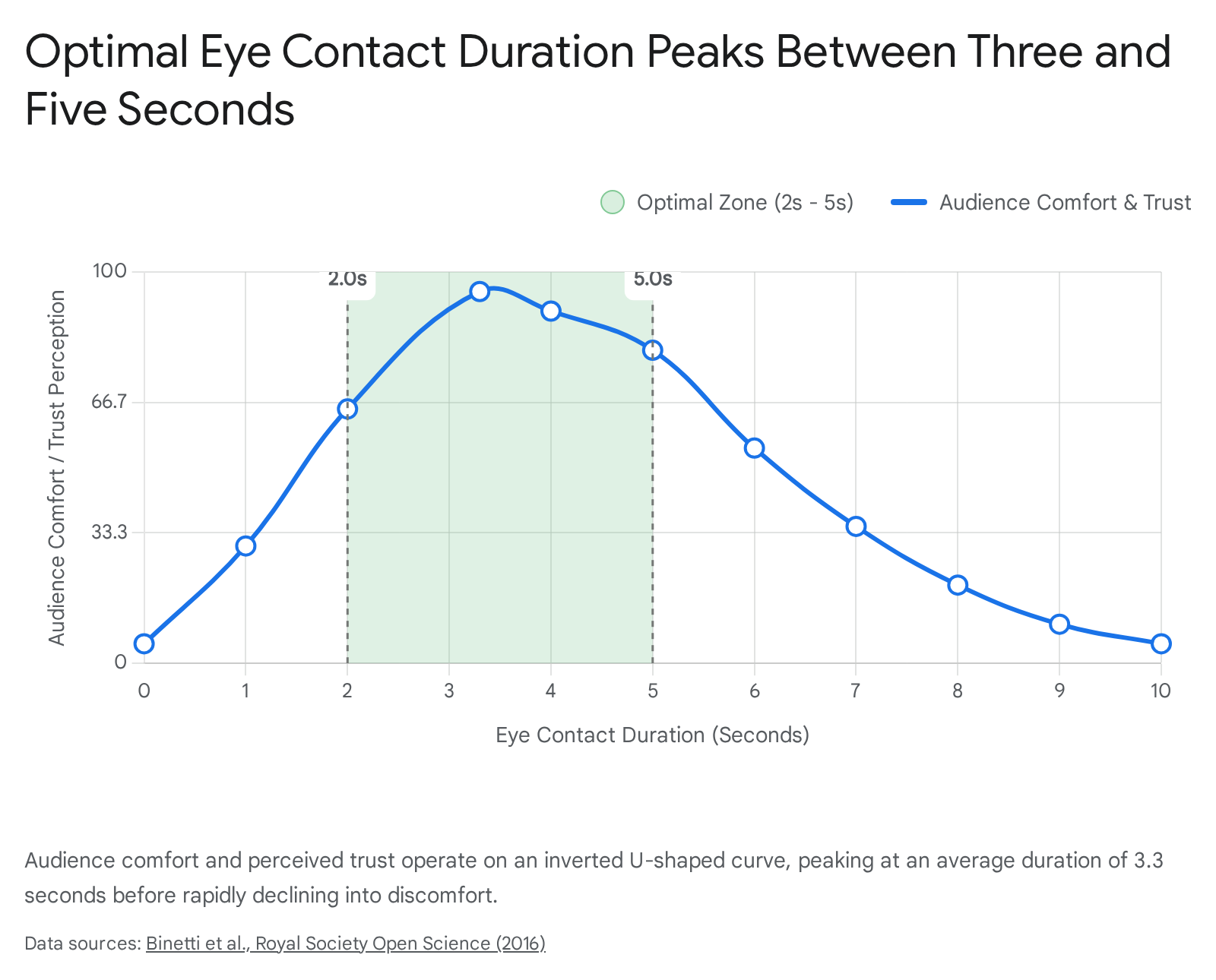
When a speaker holds an audience member's gaze for fewer than two seconds, the interaction is processed subcortically as fleeting or evasive. This rapid aversion can undermine the speaker's perceived sincerity, making them appear shifty or untrustworthy 511. Conversely, when eye contact exceeds the five-second threshold and approaches the ten-second mark, the psychological perception shifts dramatically toward the negative. Prolonged, unbroken eye contact deviates from normative conversational rhythms and triggers primitive threat-detection circuitry within the brain. In both non-human primates and humans, a sustained, unblinking stare is interpreted as a dominance display or a sign of physical aggression, leading the receiver to feel heavily scrutinized, highly uncomfortable, or overtly threatened 411. Therefore, public speakers are advised to sustain eye contact long enough to complete a distinct thought - typically taking three to five seconds - before fluidly transitioning their gaze to another sector of the audience, ensuring that the connection remains affiliative rather than adversarial 1112.
Scarcity of Real-World Mutual Gaze
Despite the intense pedagogical emphasis on maintaining constant eye contact, extensive mobile eye-tracking studies of real-world dyadic interactions reveal that true mutual gaze is surprisingly scarce in natural human communication. Researchers from McGill University and Université du Québec à Montréal (UQAM) conducted a study involving unacquainted individuals paired together to solve an imaginary survival scenario task while wearing mobile eye-tracking glasses 13.
The researchers discovered that participants spent only about 12% of the total conversation time in "interactive looking," defined as gazing simultaneously at each other's faces 13. Even more striking was the revelation that precise mutual eye-to-eye contact occurred for a mere 3.5% of the total interaction duration 13. During the vast majority of the communication, participants directed their gaze away from their partner's face entirely or fixated on the mouth region to aid in speech comprehension and lip-reading 1315.
However, despite its scarcity, the brief periods of direct eye-to-eye contact were highly predictive of subsequent positive social dynamics. Dyads that engaged in mutual gaze were significantly more likely to exhibit subsequent gaze-following behavior, indicating a deep establishment of trust, social synchrony, and mutual attention 13. For public speakers, this evidence suggests that the qualitative impact and strategic timing of mutual gaze are exponentially more critical than attempting to maximize the total quantity of eye contact maintained during a presentation.
Hostile Attribution Bias and Attention Allocation
The perception of eye contact is also heavily influenced by the pre-existing psychological disposition of the receiver, particularly regarding aggression and hostility. Research utilizing the Buss-Perry Aggression Questionnaire (AQ) alongside eye-tracking technology demonstrates that individuals with high aggressive tendencies or hostile attribution bias - the propensity to over-interpret ambiguous behavior as a threat - process eye contact fundamentally differently than individuals with low aggressive tendencies 1114.
Eye-tracking data indicates that highly aggressive individuals tend to avert their gaze from angry or hostile faces, minimizing direct eye contact in confrontational scenarios. Conversely, these individuals allocate disproportionately longer fixation durations to non-hostile cues or neutral stimuli within a scene, yet still attribute hostile intent to the situation overall 1114. This suggests a "schema-inconsistency" hypothesis, where the aggressive individual's internal expectation of hostility overrides the visual data they are processing 14.
Furthermore, recent studies published in Violence and Gender reveal that gender stereotypes deeply affect automatic visual attention during aggressive scenarios. Observers look faster and fixate longer on female aggressors compared to male aggressors, an automatic bottom-up process driven by the novelty of behavior that conflicts with expected social norms 15. In an audience setting, a speaker attempting to use aggressive, prolonged eye contact to command authority may inadvertently trigger intense negative emotional responses, hostility, or feelings of social exclusion in certain audience members, particularly if the speaker is defying gendered expectations of passivity.
The Persuasion Paradox and Audience Disagreement
A cornerstone of traditional public speaking instruction is the belief that eye contact functions as an unequivocal tool for persuasion. The assumption is that by looking an audience directly in the eye, a speaker enhances their credibility, perceived sincerity, and ability to alter deeply held opinions 16. However, experimental psychology reveals a critical caveat to this rule: the efficacy of eye contact in persuasion is almost entirely dependent on the audience's prior alignment with the speaker's message.
Concordant Versus Discordant Audiences
In a highly publicized study conducted by researchers at the University of Freiburg and the University of British Columbia, participants listened to persuasive arguments regarding sociopolitical issues while their eye contact with the speaker was tracked 16. The impact of the eye contact diverged sharply based on the listener's initial stance on the issue. When a listener already agreed with the speaker's viewpoint (a concordant audience), increased eye contact correlated with heightened receptiveness and stronger ultimate persuasion 16. In this context, mutual gaze reinforced a sense of shared values, empathy, and affiliative bonding.
Conversely, when the listener initially disagreed with the speaker's argument (a discordant audience), increased eye contact completely backfired. The more time the dissenting participant spent looking into the speaker's eyes, the less persuaded they were by the argument 16. In a context of pre-existing disagreement, sustained eye contact is not processed by the brain as an invitation to connect; rather, it is perceived as an aggressive attempt to dominate, coerce, or intimidate. This triggers psychological reactance, causing the listener to entrench themselves further in their original opposing view, viewing the speaker as threatening rather than credible 16.
Strategies for Skeptical Audiences
For public speakers navigating hostile, highly skeptical, or ideologically opposed audiences, the strategic reduction of direct eye contact may actually facilitate a more receptive communication environment. Lowering the intensity of the visual engagement removes the implicit dominance display, allowing the skeptical listener to evaluate the logical merits of the argument without feeling socially or biologically threatened. Speakers facing opposition are better served by directing their gaze toward neutral spaces, utilizing visual aids, or engaging in broad, sweeping scans of the room rather than attempting to lock eyes to force submission to an idea.
Cross-Cultural Variances in Gaze Perception
The interpretation of non-verbal communication, particularly the duration and intensity of eye contact, is inextricably linked to cultural frameworks. What is considered a hallmark of professional competence, honesty, and engagement in one region may be perceived as an aggressive affront, a challenge to authority, or a breach of modesty in another. Public speakers operating in global, multinational, or highly diverse environments must rigidly calibrate their gaze behavior to align with the normative expectations of their specific demographic 172018.
Western Frameworks of Competence
In Western cultures - predominantly North America, Northern Europe, and Australia - direct and sustained eye contact is highly valued. It operates as the primary indicator of honesty, transparency, self-confidence, and active listening 172018. Western pedagogical models explicitly train communicators to maintain steady eye contact to project authority and trustworthiness. Consequently, the failure to maintain eye contact in these cultures is frequently misconstrued as evasiveness, severe insecurity, or deceitfulness 1720.
East Asian Hierarchical Frameworks
In stark contrast, many East Asian cultures - including Japan, China, and South Korea - operate on deeply ingrained hierarchical structures where indirect eye contact is utilized as a fundamental mechanism of respect. In these societies, maintaining prolonged, direct eye contact with an elder, a superior, or a teacher is considered highly confrontational, inappropriate, and profoundly disrespectful 17192320. Individuals are culturally conditioned from childhood to lower their gaze or fixate on the speaker's neck or tie to demonstrate deference, humility, and politeness 2019.
Cross-cultural physiological studies reveal the depth of this conditioning. In a study comparing autonomic responses, Japanese participants and Western European (Finnish) participants both exhibited heart rate deceleration when subjected to direct eye contact, indicating universal attentional orienting 19. However, the psychological interpretation of that physiological arousal differed wildly. Japanese participants consistently rated faces making direct eye contact as significantly angrier, less approachable, and more unpleasant compared to the Finnish participants, who interpreted the identical gaze as neutral or engaging 1921.
Latin American and Mediterranean Dynamics
The dynamics of eye contact in Latin America and Southern Europe are characterized by high affiliative expressiveness. In countries such as Brazil, Mexico, Argentina, and Italy, robust, sustained eye contact is actively utilized to convey warmth, friendliness, emotional connection, and active engagement 21726. However, this expressiveness carries distinct boundaries. While affiliative gazing is encouraged to build rapport, overly prolonged staring - especially across gender or status lines - can be rapidly interpreted as an aggressive challenge or an overt expression of romantic and sexual interest 226.
Middle Eastern and Sub-Saharan Norms
In the Middle East and certain regions of North Africa, normative eye contact behaviors are heavily dictated by a complex intersection of hierarchical status and strict gender norms. Within interactions of the same gender, Arab cultural communication patterns often involve sustained, highly intense eye contact as a demonstration of absolute sincerity and straightforwardness 227. However, direct eye contact between unrelated men and women is strictly governed by religious and social conventions of modesty and propriety. In many contexts, such as in Saudi Arabia or rural Egypt, cross-gender eye contact is avoided entirely in public or professional spheres to prevent allegations of flirtation or impropriety 2232027.
Similarly, in many Sub-Saharan African societies, children and subordinates are taught to lower their gaze when speaking to elders or figures of authority as a mandatory sign of respect, mirroring East Asian hierarchical norms. A failure to avert gaze in these contexts is viewed as rebellious and arrogant 22027.
The following table summarizes the macro-regional variations in normative eye contact behaviors, highlighting the distinct interpretations of gaze direction across global cultures.
| Cultural Region | Dominant Eye Contact Norms | Interpretation of Direct Gaze | Interpretation of Averted Gaze |
|---|---|---|---|
| North America & Northern Europe | Medium to High Contact. Steady gaze expected during both speaking and listening. | Honesty, confidence, attentiveness, and professional competence. | Evasiveness, insecurity, lack of interest, or deceitfulness. |
| East Asia (Japan, China, Korea) | Low Contact. Indirect gaze preferred, especially across hierarchical boundaries. | Confrontational, aggressive, disrespectful, or overly dominant. | Respect, deference, humility, and acknowledgment of authority. |
| Latin America & Southern Europe | High Contact. Expressive, sustained gaze used to build rapport. | Warmth, friendliness, emotional connection, or romantic interest. | Aloofness, lack of confidence, or lack of emotional investment. |
| Middle East | Variable. Intense within same-gender; highly restricted across genders. | (Same-gender): Truthfulness, sincerity. (Cross-gender): Inappropriate, flirtatious. | (Cross-gender): Modesty, propriety, religious adherence, and politeness. |
| Sub-Saharan Africa | Variable. Often context and hierarchy dependent. | Can be seen as aggressive or confrontational if directed at elders. | Respect for authority and elders; adherence to social hierarchy. |
Table 1: Comparative analysis of normative eye contact behaviors and their cultural interpretations 2172018232027.
Neurodiversity and Inclusive Communication Standards
A critical and paradigm-shifting evolution in the study of public speaking and communication dynamics is the rapid integration of the neurodiversity paradigm. Historically, public speaking standards, workplace evaluations, and therapeutic interventions were rigidly rooted in a medical model of pathology. This model viewed deviations from neurotypical behavior - such as the active avoidance of eye contact or the presence of self-stimulatory behaviors - as deficits requiring behavioral correction. By 2025 and 2026, global academic guidelines, educational policies, and professional organizations have largely transitioned toward neurodiversity-affirming frameworks, recognizing neurological differences as natural human variations rather than diseases requiring a cure 222324.
The Impact of Autistic Traits on Mutual Gaze
For an estimated 10% to 20% of the global population identifying as neurodivergent - particularly those on the autism spectrum - direct eye contact is not merely a mild social discomfort, but a source of profound physiological distress and neurological overload 25. Self-reported data from autistic populations consistently indicates that mutual gaze triggers intense sensory overload, overwhelming the brain's processing capacity and inducing severe anxiety 10.
Clinical research utilizing the Autism-Spectrum Quotient (AQ) corroborates this lived experience with empirical data. Studies show a highly significant inverse relationship between AQ scores and the proportion of eye gaze maintained during social communication. In tasks where an individual is required to formulate and describe concepts (the speaker role), every one-point increase in an individual's AQ score corresponds to an approximately 2.3% decrease in gaze directed at the communication partner's eyes 10. This reduction in eye contact is not an act of defiance or a lack of social desire; it is a vital, adaptive mechanism. By averting their gaze, autistic individuals actively manage their cognitive load, reducing the overwhelming sensory input required to simultaneously process dynamic facial micro-expressions and complex linguistic data. Averting gaze enables them to dedicate neural resources to linguistic formulation and emotional regulation 10.
The Harms of Compliance-Based Metrics
The recognition of these neurobiological realities has prompted a systematic dismantling of compliance-based communication standards. In the past, behavioral interventions, such as traditional Applied Behavior Analysis (ABA), frequently forced autistic children and adults to maintain eye contact to appear "normal" and compliant 3233. This practice, known as masking or camouflaging, requires immense, continuous cognitive effort. It has been empirically linked to severe long-term mental health consequences, including chronic anxiety, deep depression, autistic burnout, complex trauma, and drastically increased suicidality in autistic adults 32. Furthermore, forcing an overwhelmed neurodivergent individual to maintain eye contact can lead to situational mutism, where the sensory demand entirely shuts down their ability to speak 23.
Neurodiversity-affirming guidelines established by organizations such as the Australian Psychological Society (APS) and the Therapist Neurodiversity Collective now explicitly reject the mandate of eye contact as a metric of attention, respect, or competence 2532332627. Inclusive public speaking environments, workplaces, and educational settings - such as those highlighted in the UK's 2026 Special Educational Needs and Disabilities (SEND) reform white paper "Every Child Achieving and Thriving" - now prioritize psychological safety and functional, individualized communication over normative physical posturing 3628.
Neurodiversity-Affirming Practices in Public Settings
For public speakers, event organizers, and corporate leaders, adopting a neuro-inclusive approach requires a fundamental shift in audience assessment. A speaker can no longer accurately assess audience comprehension, respect, or engagement solely through the metric of sustained visual contact. A listener who is looking at the floor, sketching, or engaging in physical stimming behaviors may be processing the speaker's information far more effectively than if they were expending all their cognitive energy attempting to maintain unbroken, neurotypical eye contact 3227.
Conferences and public speaking events in 2025 and 2026 are increasingly required to provide neuro-inclusive accommodations. This includes providing clear, plain-language communications, offering quiet spaces for sensory decompression, utilizing visual supports and transcripts, and explicitly training staff to recognize that a lack of eye contact from an attendee is a natural variation in communication style, not a sign of disrespect or inattention 22253839.
Eye Contact in Synthetic and Digital Environments
As public speaking, therapy, and professional communication increasingly migrate to digital platforms, extended reality (XR), and interactions with artificial intelligence, the science of eye contact has expanded to encompass the human-computer interface. The replication of human gaze in virtual avatars, AI-driven conversational agents (CAs), and hyper-realistic humanoid robots presents unique psychological challenges, primarily centered around trust erosion and the phenomenon of the uncanny valley.
The Uncanny Valley Effect in AI Gaze
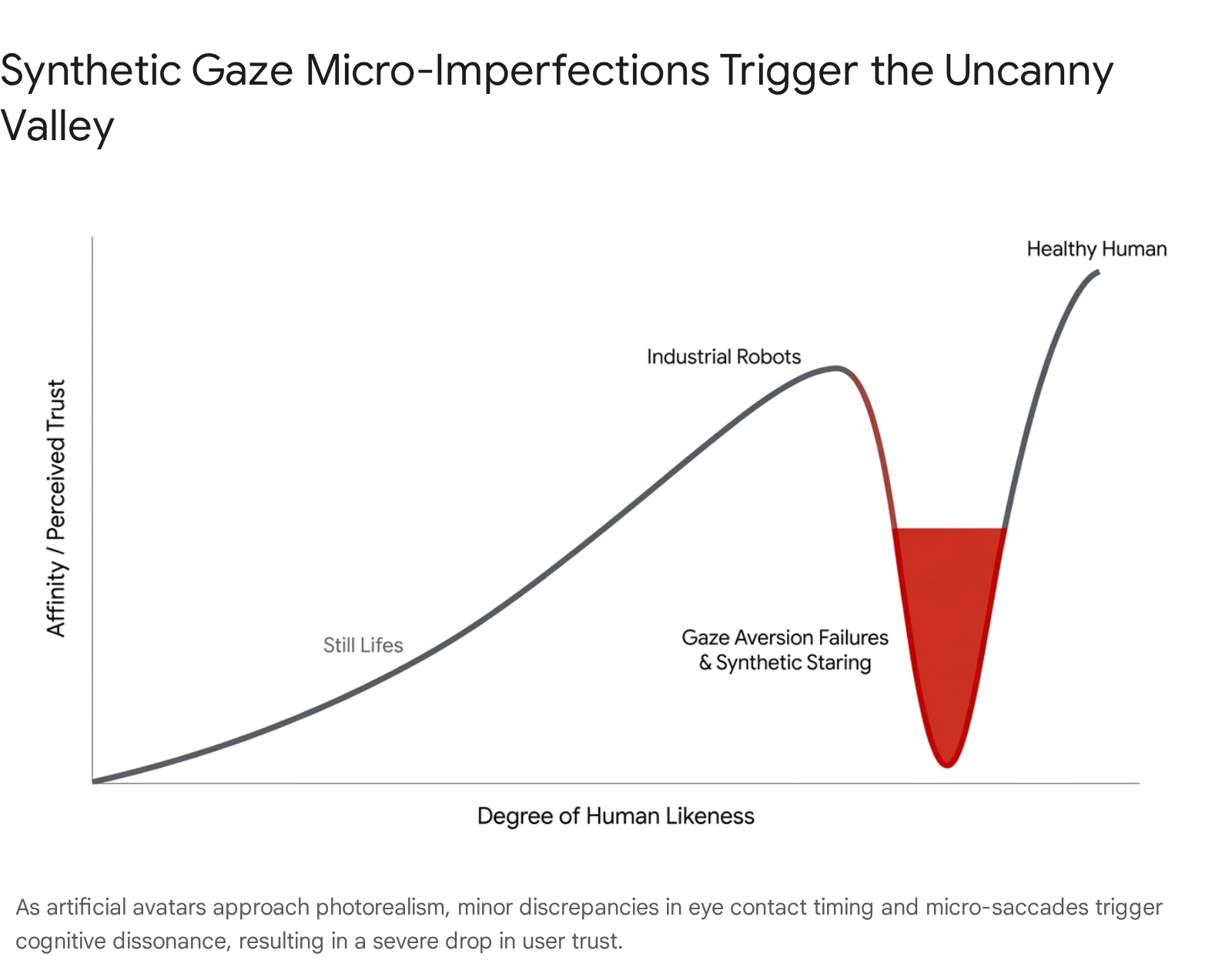
The Uncanny Valley hypothesis, originally proposed by roboticist Masahiro Mori in 1970, dictates that as an artificial entity becomes more human-like in appearance and behavior, human affinity toward it increases - until a critical threshold of near-realism is reached. At this point, slight, almost imperceptible imperfections in behavior or appearance trigger massive cognitive dissonance, causing the entity to evoke feelings of eeriness, severe discomfort, or revulsion rather than empathy and trust 293031.
Eye contact is a critical, highly sensitive failure point within the uncanny valley. Because human neurobiology is highly attuned to the micro-dynamics of gaze - including autonomic pupillary responses, micro-saccades, and the exact timing of gaze aversion for cognitive load management - artificial entities that fail to perfectly replicate these subtle mechanics elicit immediate subconscious discomfort 3132. Eye-tracking studies of humans interacting with hyper-realistic robots demonstrate that visual processing of these entities remains relatively normal until the human fixates on the artificial eyes 29. Once the artificial nature of the gaze is detected, users experience a sharp, immediate decline in perceived trustworthiness, likeability, and willingness to collaborate 293133.
Furthermore, as conversational agents become more cognitively sophisticated via Large Language Models (LLMs), a secondary psychological phenomenon known as the "Uncanny Valley of Mind" has emerged 3435. If a humanoid AI agent maintains perfect, unwavering eye contact while discussing complex emotional topics or executing difficult cognitive tasks, it violates the biological rule of cognitive load management. A real human naturally averts their gaze when recalling emotional memories or processing difficult concepts 10. An AI that maintains a dead, unbroken stare while generating text simulates the aggressive dominance displays associated with predatory or hostile behavior, fundamentally eroding user trust and triggering the autonomic nervous system's threat response 113336.
Disruption of Perceptual Search Strategies
The integration of artificial intelligence into visual fields also has profound impacts on human gaze behavior and competence. A March 2026 prospective eye-tracking study investigated how AI-assisted interpretation influences gaze patterns, specifically analyzing radiologists examining chest radiographs. Utilizing a 7x7 grid and normalized Levenshtein distance metrics to quantify viewing systematicity, researchers found that the introduction of AI algorithms severely disrupted the systematic visual search behavior of novice residents 37. The novices experienced cognitive offloading, allowing the AI to dictate their gaze, which eroded their foundational perceptual search strategies. In contrast, expert cardiothoracic radiologists maintained stable, highly systematic viewing patterns regardless of AI input, successfully integrating the data without allowing it to hijack their visual attention 37. This demonstrates that expertise and pre-existing competence act as a buffer against the visual disruptions introduced by automated systems.
Gaze Tracking and Cognitive Security
To mitigate the issues of trust erosion and to understand human attention in remote interactions, researchers and software engineers utilize sophisticated eye-tracking metrics. Key metrics deployed in both human-to-human video conferences and human-AI interactions include Fixation Duration, Time to First Fixation (TTFF), and Attention Switching Frequency 385039. High fixation durations can signal intense interest, but in synthetic interactions, they often indicate difficulty with comprehension or the cognitive processing of uncanny features 3850.
In modern extended reality (XR) systems, the physical latency between a user's head movement and the digital rendering of mutual eye contact creates severe cognitive security risks. At the 2025 MobiHoc symposium, researchers highlighted that when latency distorts raw gaze signals, users experience manipulation of their attention patterns, degrading trust in the system 40. To combat this, predictive algorithms, such as time-aware Long Short-Term Memory (LSTM) models acting as "human digital twins," are currently being developed. These models predict true gaze targets and correct latency distortions in real-time, ensuring that synthetic eye contact occurs at the precise temporal cadence required to maintain user trust without slipping into the uncanny valley 4041.
Conclusion
The science of eye contact in public speaking and interpersonal communication extends far beyond the traditional, simplistic mandate to "look the audience in the eye." It is a delicate, highly complex neurobiological dance mediated by the amygdala's arousal systems, the prefrontal cortex's intentionality networks, and the vagus nerve's ability to down-regulate stress. Efficacy in public speaking is achieved by adhering to the normative three-to-five-second threshold of mutual gaze, balancing the establishment of physiological trust against the acute biological risk of signaling aggression through prolonged staring.
Furthermore, modern speakers must possess a deeply nuanced, intersectional understanding of their environment. They must recognize that eye contact can drastically backfire in hostile persuasion scenarios, triggering reactance rather than agreement. They must navigate the reality that rigid cultural rules govern the interpretation of gaze, meaning a gesture of respect in Tokyo may be viewed as evasive incompetence in New York. Crucially, as the neurodiversity paradigm reshapes societal standards, communicators must accept that a significant portion of their audience processes visual attention in fundamentally different ways, and that a lack of eye contact from a neurodivergent listener is often a mechanism for processing information, not a sign of disrespect. Finally, as human communication continues its rapid expansion into digital, synthetic, and extended reality realms, mastering the temporal and contextual intricacies of gaze remains an essential, evolving competency for fostering authentic emotional connection, maintaining cognitive security, and projecting genuine competence.