
Psychology of Humor and Audience Rapport in Public Speaking
The deployment of humor in public speaking is frequently categorized in informal contexts as a rhetorical embellishment or an elementary icebreaking mechanism. However, an exhaustive analysis encompassing cognitive neuroscience, linguistics, and organizational psychology reveals that humor functions as a highly complex, multidimensional communication strategy. When executed effectively, humor facilitates incongruity resolution within the listener's neural architecture, minimizes cognitive load during dense information transfer, navigates rigid social hierarchies, and builds deep interpersonal rapport. Conversely, when misapplied, humor can trigger cognitive dissonance, violate established social expectancies, and critically erode speaker credibility. This report investigates the psychological and neurological underpinnings of humor in public presentations, examining the precise cognitive timelines of comedic delivery, the strategic deployment of self-deprecation, the socio-psychological constraints of speaker gender and status, and the emerging challenges of generating rapport in cross-cultural and virtual environments.
Neurobiological Mechanisms of Humor Processing
The psychological experience of humor is not a singular event but rather a sophisticated sequence of cognitive appraisals. It relies fundamentally on the brain's capacity to detect semantic and logical ambiguities, suppress literal interpretations, and resolve narrative contradictions in real-time. Research into cognitive humor processing indicates that humor comprehension and humor appreciation are distinct neurological events that occur in a rapid, sequenced cascade 12.
The Four-Stage Cognitive Processing Model
Current neuroscientific literature divides humor processing into a multi-stage model, frequently categorized into four distinct phases: expectation, incongruity detection, incongruity resolution, and elaboration 1334.
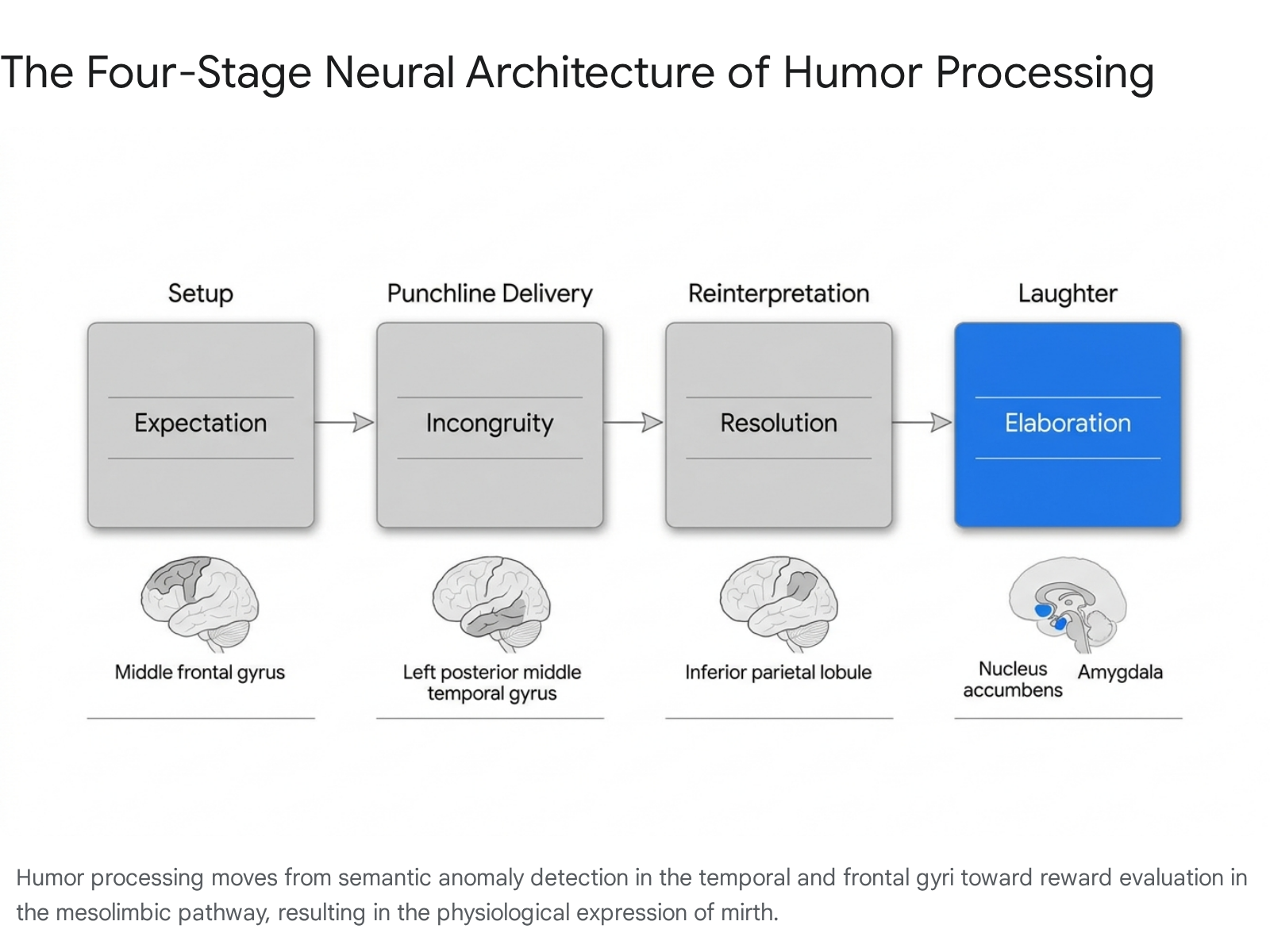
During the initial expectation stage, a speaker establishes a narrative framework or schema. This setup primes the listener's brain to anticipate a specific logical outcome. Functional magnetic resonance imaging (fMRI) studies demonstrate that neural activity during this preparatory phase is concentrated in the posterior insula and the middle frontal gyrus, regions associated with predicting narrative progression 3.
The second stage, incongruity detection, occurs at the exact moment the speaker delivers a punchline that violates the established expectation or schema. This cognitive disparity activates regions associated with semantic processing, phonological processing, and error detection. Primary activation occurs in the left posterior middle temporal gyrus, the left inferior frontal gyrus, and the medial frontal gyrus 1356. The brain recognizes that the literal interpretation of the punchline contradicts the established setup, creating a state of semantic ambiguity 6.
To make sense of this contradiction, the listener's brain immediately enters the incongruity resolution stage. This requires flexible, abstract thinking and perspective-taking to reinterpret the setup in a way that makes the punchline logically coherent 23. Studies show that this cognitive resolution process heavily recruits the inferior frontal gyri, the superior frontal gyrus, and the inferior parietal lobule 23.
Finally, the elaboration (or affective) stage translates the successful cognitive resolution into the physiological and emotional experience of mirth. This stage engages the brain's reward and emotion-processing circuitry, including the ventromedial prefrontal cortex, the bilateral amygdala, and the nucleus accumbens 136. The nucleus accumbens, a critical node in the mesolimbic dopamine pathway traditionally associated with addiction and reward, assesses the pleasure of the "aha!" moment and triggers the release of neurotransmitters, including dopamine, serotonin, and an array of endorphins 3678.
Neuroanatomical Correlates and Expertise
The neurological processing of humor is not uniform across all populations; it varies based on individual cognitive capacities and comedic expertise. Research demonstrates that general intelligence and verbal comprehension skills correlate positively with the ability to swiftly recognize and resolve incongruities 2. Individuals with higher cognitive functioning exhibit stronger neural activity in the striatum during the comprehension and appreciation phases 2.
Furthermore, the physical generation of humor by a speaker involves distinct neuroanatomical pathways compared to passive audience appreciation. An fMRI study comparing professional stand-up comedians to amateur comedians and a control group found that comedic expertise alters brain activation patterns 8. When tasked with generating humorous captions, professional comedians exhibited decreased activation in the medial prefrontal cortex (mPFC) and the striatum compared to controls. Instead, professionals showed significantly increased activation in the temporal association regions 8. This neurological shift indicates that less experienced speakers rely on deliberate, cognitively taxing searches through the mPFC to construct a joke, whereas experts draw instinctively upon spontaneous semantic associations within the temporal lobes 8.
Temporal Signatures of Comprehension
Electroencephalography (EEG) and event-related potential (ERP) studies have provided precise temporal markers for these cognitive events, revealing that humor processing unfolds in a matter of milliseconds. When an audience hears a punchline, the brain registers semantic unexpectedness approximately 400 milliseconds post-stimulus, generating a negative electrical deflection known as the N400 component 91011. The amplitude of the N400 correlates strongly with the degree of linguistic ambiguity or the "cloze probability" of the phrase - meaning the more lexically unexpected the punchline is relative to the preceding context, the larger the N400 spike 10.
Following the N400, incongruity resolution and humor appreciation are marked by late positive and negative components, typically a P600 or a slow negative wave between 600 and 800 milliseconds 91011. The presence of these subsequent waveforms indicates that the listener has successfully reanalyzed the initial semantic anomaly and extracted the humorous intent. If a listener lacks the contextual knowledge or cognitive flexibility to resolve the incongruity, the process halts at the N400 detection stage, resulting in persistent confusion rather than mirth 2.
Event-related spectral perturbation (ERSP) analyses further illustrate these stages. Humorous stimuli evoke significant differences in the Theta-band (3 - 7 Hz) in the anterior cingulate cortex and parietal regions during the 500 - 900 millisecond window, reflecting active memory retrieval and emotional processing 11. Simultaneously, humor triggers distinct Alpha-band and Beta-band activity in the brain's motor regions, signaling the physical onset of laughter and the relaxation response 11.
| Cognitive Stage | Temporal Marker (ERP) | Primary Function | Active Frequency Bands |
|---|---|---|---|
| Incongruity Detection | N400 (~400ms) | Identifies semantic anomalies and unexpected lexical choices based on cloze probability. | N/A |
| Incongruity Resolution | P600 / N600-800 | Reanalyzes the anomaly, resolves the logical paradox, and understands the humorous intent. | Theta-band (memory retrieval, emotion processing) |
| Elaboration / Mirth | N900-1200 | Affective evaluation, pleasure reward, and physiological preparation for laughter. | Alpha-band & Beta-band (motor region activation) |
Cognitive Load Management and Attention Span
Beyond generating momentary amusement, humor serves a critical physiological function in managing the audience's cognitive load and maintaining sustained attention.
The Degradation of Sustained Focus
Longitudinal research into human-computer interaction and cognitive psychology reveals a severe degradation in the average human attention span over the past two decades. In 2004, observational studies utilizing stopwatch methodologies found that individuals averaged approximately 2.5 minutes of sustained focus on a single screen 1213. By 2012, computer logging software recorded a decline to 75 seconds 13. Recent comprehensive studies (2016 - 2024) confirm that the average attention span on a single focal point has plummeted to just 47 seconds, with a median of 40 seconds 131415.
This rapid attention shifting, heavily influenced by the dopamine-driven feedback loops of digital media and the structural design of modern content, induces a state of chronic cognitive fatigue 131416. When an audience is forced to constantly reorient their attention - a phenomenon known as "switch cost" - they experience measurable spikes in stress markers, including elevated blood pressure and cortisol levels 121718. Consequently, a public speaker delivering a dense, uninterrupted monologue is actively fighting against an exhausted audience's neurological limits.
Neurochemical Resets and Humor as Rote Attention
The human brain cannot maintain continuous, high-effort focus; attention naturally operates in peaks and valleys 1819. Cognitive scientists differentiate between "focused" attention (which taxes mental resources) and "rote" attention (which is engaging but requires minimal cognitive effort) 1819.
Humor operates as a highly effective form of rote attention. When a speaker introduces a humorous anecdote or visual, it provides the audience with a necessary cognitive break, allowing executive functioning networks to temporarily disengage and replenish 1420. Furthermore, the physiological act of laughter acts as a rapid stress reliever. Laughter reduces cortisol and adrenaline - hormones that drive the "fight or flight" response and impair memory - by up to 37% 722. Simultaneously, the release of dopamine triggered by a successful punchline actively enhances neural plasticity, improving verbal fluency, creative problem-solving, and the retention of the substantive information that follows the joke 7.
Instructional Humor Processing Theory
These physiological benefits are formalized in Instructional Humor Processing Theory (IHPT) and related frameworks applying cognitive load theory to pedagogy and public speaking 52122. IHPT posits that appropriate, content-related humor reduces students' and audiences' intrinsic cognitive load and lowers "affective filtering" - the emotional barriers, such as anxiety or boredom, that prevent the absorption of new information 2123.
Experimental evidence in educational settings demonstrates that humor significantly enhances motivation, classroom engagement, and listening comprehension 212324. However, IHPT emphasizes that the humor must be contextually relevant to the material. Extraneous or highly distracting humor may actually impede knowledge acquisition by competing for the audience's limited working memory 522.
Delivery Mechanics and Humor Frequency
The efficacy of a humorous remark depends heavily on the speaker's acoustic delivery, physical kinesics, and the structural spacing of the narrative. A cognitively flawless joke will fail if the prosody and pacing do not align with the audience's processing speeds.
Frequency and Placement Parameters
The density of humor throughout a presentation is a strong predictor of audience engagement. An exhaustive quantitative analysis of popular versus unpopular TED Talks isolated the frequency and temporal placement of humor within 15 to 20-minute presentations 5.
The data revealed a highly statistically significant difference (p < 0.001) in humor frequency. Highly rated, popular talks averaged 12.92 instances of humor per presentation, with some exceptionally engaging talks utilizing humor up to 69 times 5. Conversely, unpopular talks averaged only 3.92 instances 5.
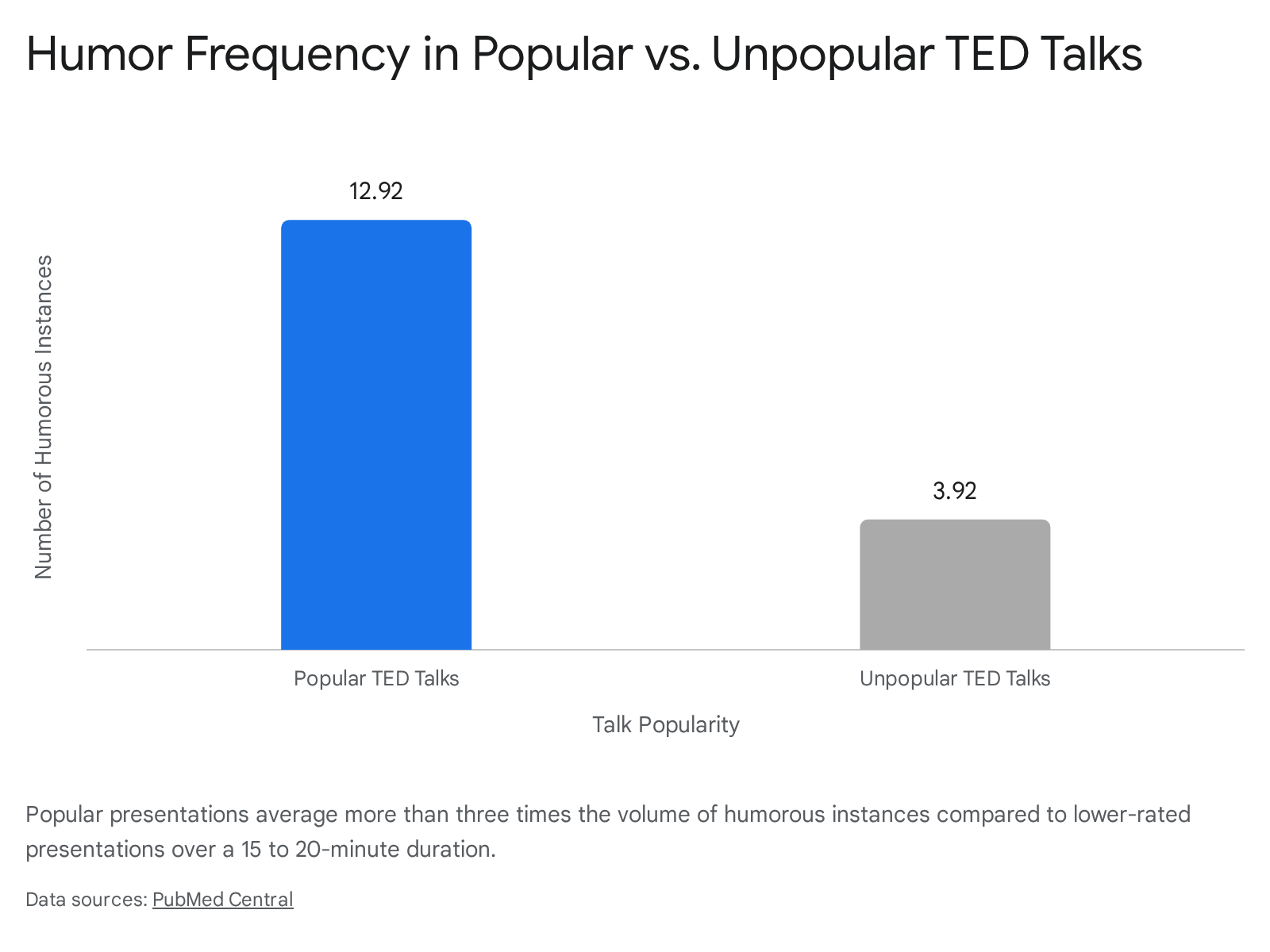
Furthermore, out of the 50 unpopular talks analyzed, 26% contained zero instances of humor, compared to only 4% of the popular talks 5.
Despite differences in absolute volume, the chronological placement of humor followed a consistent pattern across all presentations regardless of popularity. Speakers heavily front-loaded their humor, deploying jokes most frequently during the introduction and the first third of the presentation to capture immediate attention and establish rapport. Humor instances gradually tapered off as the presentations moved into their dense, substantive arguments, remaining largely absent during the concluding segments 5.
Kinesic Dynamics and Physical Stillness
Contrary to the assumption that humor requires a rapid, hyperactive physical delivery, kinesic analyses demonstrate that comedic timing relies heavily on physical restraint. A 2026 multimodal study of stand-up comedy, utilizing the "TIC-TALK" database (Text, Audio, Laughter, Kinesics), analyzed over 5,400 temporally aligned segments across 90 professional comedy specials 2725. Utilizing raw keypoint extraction algorithms to track skeletal coordinates (arm spread, trunk lean, kinetic energy), researchers quantified the exact physical movements preceding audience laughter.
The data revealed a strong negative correlation (r = -0.75) between a speaker's kinetic energy and the audience's laughter rate 2725. This statistically supports a "stillness-before-punchline" pattern. Professional speakers physically freeze or significantly slow their body movements immediately prior to delivering the incongruous element of a joke, drawing acute visual focus to the verbal delivery.
Prosodic Markers and the Pre-Punchline Pause
Acoustic analyses of public speeches corroborate this pattern of restraint in vocal delivery. Prosody - the rhythm, pitch, and volume of speech - is a critical non-verbal channel that guides audience emotion 26.
Linguistic studies measuring the precise rate of speech, vocal pitch, and volume variations during joke delivery show that speakers do not generally speed up or slow down their actual word rate during a punchline 2728. Some experimental manipulations of satirical news delivery even suggest that altering vocal pitch and speech rate does not significantly impact how humorous a joke is perceived to be 29.
Instead, the defining prosodic characteristic of comedic timing is the insertion of a deliberate, sustained pause immediately before the punchline 2728. This micro-pause serves a critical dual cognitive function: it allows the "expectation" schema to fully solidify in the listener's working memory, and it creates a moment of high tension, maximizing the impact of the subsequent semantic violation 102728.
Laughter Latency and Turn-Taking Constraints
Just as the speaker's timing is critical, the temporal latency of the audience's laughter carries significant social and psychological weight. In standard human interaction, conversational turn-taking occurs rapidly, with temporal gaps between speakers averaging 200 milliseconds, and the vast majority of transitions falling within a 100 to 500-millisecond window 3031.
Conversation analysis demonstrates that laughter adhering to this rapid latency window - meaning the audience responds within 500 milliseconds of the punchline - is perceived as genuine, affiliative, and spontaneous 303132. Immediate laughter validates the speaker's intent and frequently triggers "humour-laughter-humour" chains, an upward spiral of group emotion that Broaden-and-Build theory associates with enhanced collaboration and openness to new ideas 223334.
Conversely, delayed laughs - those occurring after 700 milliseconds - are instinctively processed by the human brain as dispreferred responses 303132. Delayed laughter is reliably rated by observers as significantly less genuine, forced, and highly sarcastic 303132. Thus, an effective public speaker relies entirely on immediate auditory feedback to gauge the success of an incongruity resolution.
Interpersonal Dynamics and Status Parameters
The neurological mechanisms of humor do not operate in a sterile vacuum. Audience reception is heavily filtered through the speaker's demographic identity, organizational status, and the specific style of humor employed.
Self-Deprecation and Perceived Competence
Self-deprecating (or self-defeating) humor involves the speaker intentionally lowering their own perceived status by making themselves the target of the joke. Psychologically, this serves as a potent tool for interpersonal connection. By voluntarily revealing flaws and vulnerabilities, the speaker signals approachability, humility, and self-awareness, which can endear them to the audience and foster a safe, egalitarian environment 35394036.
However, the efficacy of self-deprecation is highly contingent upon the speaker's baseline level of competence. When a speaker is already perceived as high-status, successful, or highly competent, self-deprecation humanizes them and reduces perceived threat or arrogance 3940. Conversely, if a speaker's competence is unknown or already in question, excessive self-deprecation can reinforce feelings of inadequacy and validate negative audience judgments 394037.
Experimental research into health communication highlights the contrasting effects of self-deprecating versus other-deprecating humor. In a study assessing anti-binge drinking messages, other-deprecating humor (mocking the binge drinkers) successfully lowered the audience's behavioral intentions to drink but simultaneously risked offending the audience by disrespecting them 35. Self-deprecating humor, however, acts as a critical face-saving mechanism. It allows a speaker to introduce controversial advice, critique a behavior, or diffuse frustration without directly attacking the audience, thereby protecting the social images of both the speaker and the listener 3537.
Gender Stereotypes and Organizational Latitude
The reception of humor in professional settings is profoundly moderated by gender stereotypes and social role expectations. Because traditional gender roles afford men greater behavioral latitude to display both agentic (assertive) and communal (sensitive) traits, men are generally rewarded for utilizing humor at work. Research consistently demonstrates that male managers using humor receive higher ratings for status, overall performance, and leadership capability than non-humorous male managers 3839.
Women, however, face rigid communal prescriptions and significantly narrower social latitude 38. Studies examining the intersection of organizational status and humor reveal complex double standards based on Expectancy Violation Theory 3839. When low-status women use aggressive humor, they are rated as significantly more foolish and are socially penalized compared to low-status men utilizing the exact same script 3840.
The dynamics shift depending on the target of the humor and the relative status of the speaker. High-status women who use affiliative (inclusive, positive) humor directed at low-status men are perceived highly favorably, as this represents a "positive counterstereotypical" behavior that violates traditional expectations in a beneficial way 3841. However, if that same high-status woman uses affiliative humor directed at a low-status woman, she does not receive the same leadership boost 38.
The following table summarizes the divergent audience perceptions of workplace humor based on speaker gender, status, and humor type, derived from recent experimental organizational studies 38394041.
| Speaker Profile | Humor Style | Target of Humor | Audience Perception / Status Penalty |
|---|---|---|---|
| Male (High/Low Status) | Aggressive | Low-Status Female | Rewarded; perceived positively with higher leadership capability. No status penalty. |
| Female (Low Status) | Aggressive | Low-Status Female | Penalized heavily; rated as highly foolish and behavior viewed as disruptive. |
| Female (High Status) | Aggressive | Low-Status Female | Penalized less than low-status women; aligns with stereotypes of harsh female leadership. |
| Female (High Status) | Affiliative | Low-Status Male | Rewarded; viewed as highly effective (Positive Counterstereotypical behavior). |
| Female (High Status) | Affiliative | Low-Status Female | Neutral to negative; viewed as less effective than when targeting male subordinates. |
Ultimately, parallel-constraint-satisfaction theory suggests that audiences implicitly rely on gender stereotypes to interpret the ambiguous nature of humor. Male humor is often assumed to be functional and supportive of the core message, whereas female humor - particularly aggressive or sarcastic forms - is frequently perceived as a distraction or a violation of expected professional decorum 3941.
Psychometric Limitations of the Humor Styles Questionnaire
For nearly two decades, the psychological study of humor has relied heavily on Martin's Humor Styles Questionnaire (HSQ). The HSQ categorizes humor into a 2x2 matrix of four styles: Affiliative (enhancing relationships), Self-enhancing (internal coping), Aggressive (enhancing self at the expense of others), and Self-defeating (enhancing relationships at the expense of self) 4243444546.
However, recent psychometric critiques emerging between 2023 and 2025 argue that the HSQ suffers from significant construct validity issues. Critics highlight that the psychological outcomes measured by the HSQ are heavily driven by the non-humorous social contexts embedded in the questionnaire items, rather than the intrinsic nature of the humor itself 424445. When researchers controlled for these non-humorous contexts, the correlations between specific humor styles and the Big Five personality traits or subjective well-being largely vanished 4445.
Furthermore, behavioral studies reveal that individuals do not strictly adhere to one "adaptive" or "maladaptive" style. For example, individuals scoring high in affiliative, aggressive, and self-defeating humor all frequently utilize "face-saving sarcasm" to diffuse tension and manage social images 37. This indicates that humor styles are not mutually exclusive or inherently healthy/unhealthy; rather, speakers fluidly mix styles - even within a single presentation or interaction - based on their relational goals, the physical context, and real-time audience feedback 424647.
Environmental Contexts and Communication Modalities
The psychological mechanisms of humor are severely tested when public speaking crosses cultural boundaries or transitions from physical stages to digital platforms.
High-Context and Low-Context Cultural Variations
The effectiveness of a speaker's humor depends entirely on the audience's cultural communication framework, conceptualized by anthropologist Edward T. Hall as high-context versus low-context orientations 48495550515859.
Low-Context Cultures (e.g., the United States, Germany, Scandinavia) prioritize explicit, direct, and verbal communication 48555058. In these environments, the meaning of a joke is contained primarily within the words themselves. Humor in low-context settings is highly individualistic, egalitarian, and designed to elicit an immediate, overt reaction, such as loud laughter 555952. Speakers can safely use direct punchlines, aggressive sarcasm, and authority-challenging humor because the audience relies on the explicit setup-punchline structure to derive meaning without requiring deep background context 505952.
High-Context Cultures (e.g., Japan, Arab nations, Latin America) rely heavily on implicit communication, shared historical experiences, nonverbal cues, and relationship dynamics 48515852. In these settings, the explicit words are secondary to the overall atmosphere and social harmony. Humor is utilized primarily as a subtle tool for relationship-building, diffusing conflict, and reinforcing group solidarity 555152. Because high-context communication values respect and hierarchy, a direct, low-context punchline delivered in a high-context culture may easily be perceived as aggressive, disruptive to group harmony, or overly simplistic 5551.
The following table contrasts the humor paradigms of these two cultural frameworks:
| Feature | Low-Context Humor (e.g., US, Northern Europe) | High-Context Humor (e.g., Japan, Middle East) |
|---|---|---|
| Primary Goal | Elicit immediate laughter; entertain; express individuality. | Build consensus; maintain harmony; diffuse tension. |
| Delivery Style | Explicit, direct, relies on verbal setups and clear punchlines. | Implicit, subtle, relies on shared history and nonverbal cues. |
| Social Function | Can challenge authority; egalitarian; individualistic. | Reinforces group solidarity; respects hierarchies and in-group boundaries. |
| Risk of Miscommunication | Viewed by high-context audiences as aggressive, childish, or untrustworthy. | Viewed by low-context audiences as vague, confusing, or unfunny. |
Degradation of Cross-Brain Synchrony in Virtual Environments
The mass transition to virtual presentations has fundamentally disrupted the physiological feedback loop required for successful humor. In-person public speaking allows for continuous, subconscious neurological alignment between the speaker and the audience. Research utilizing functional near-infrared spectroscopy (fNIRS) and EEG demonstrates that face-to-face interaction generates "cross-brain synchrony" - where the neural activity of the speaker and listener physically align - facilitating rich facial processing, empathy, and social engagement 53.
Virtual environments (such as Zoom or Microsoft Teams) severely degrade this synchrony. The loss of subtle nonverbal cues, peripheral vision, eye contact, and spatial co-presence heightens communication ambiguity. This forces the brain into a state of "solitary socializing," wherein individuals feel physically isolated despite being digitally connected, leading to evaluations of the interaction as less satisfying and more exhausting 5455.
Solitary Socializing and Audience Disengagement
For humor, the virtual modality is particularly treacherous due to the technological disruption of latency. Because spontaneous laughter is a critical social signal validating a joke, a speaker must hear it within the expected 100 to 500-millisecond conversational window 30. In virtual settings, muted microphones, internet latency, and the absence of a shared acoustic space eliminate this immediate auditory feedback 3356.
Speakers are forced to deliver punchlines into silence, which frequently results in the phenomenon of "failed humor." Failed humor not only falls flat but can actively induce anxiety in the speaker and undermine professional relationships, as the audience's silence is instinctively processed by the brain as a dispreferred, sarcastic, or rejecting response 31323357.
Furthermore, virtual audiences exhibit severe disengagement behaviors. Survey data of virtual meetings reveals massive levels of detachment: 68% of participants admit to texting friends, 28% leave the room entirely, and 21% report sleeping during virtual presentations 58. Conference data also underscores this deficit; while virtual and in-person modalities perform similarly for basic task-oriented team formation, virtual settings are only half as effective as in-person events at building community and fostering informal, rapport-driven relationships 5960.
Consequently, researchers advise that speakers in virtual environments must exert significantly higher intentionality, rely more heavily on visual humor (such as well-placed slides or polls), and psychologically brace for unreciprocated comedic timing, recognizing that the medium fundamentally strips away the evolutionary and neurochemical rewards of shared, synchronous mirth 335661.