
Psychological impact of scarcity and urgency tactics in marketing
Introduction to Scarcity and Conversion Optimization
The Fear of Missing Out (FOMO) represents a pervasive psychological state defined by the persistent anxiety that others are experiencing rewarding events, acquiring valuable goods, or achieving status from which an individual is absent. While originally identified in the context of interpersonal social relationships, the operationalization of FOMO has become a foundational pillar of modern digital marketing and consumer psychology. Within the e-commerce ecosystem, FOMO is systematically engineered through scarcity and urgency tactics - strategic interventions designed to artificially constrain the perceived availability of a product, service, or promotional offer 123.
The primary objective driving the application of these psychological tactics is Conversion Rate Optimization (CRO). In the digital marketplace, driving organic or paid traffic is highly resource-intensive, making the conversion of existing traffic the highest point of financial leverage 4. According to industry benchmark data, the average baseline website conversion rate across all industries hovers around 2.35%, while the top 25% of websites achieve conversion rates of 5.31% or higher 5. In specific sectors, such as finance, rates can reach 15.6%, whereas standard e-commerce transaction rates typically run between 1% and 4% 45. To elevate these metrics, marketers utilize limited-time offers (LTOs), flash sales, expiring discount codes, and low-stock alerts to propel consumers from a state of passive browsing into immediate transactional action.
These cues are deeply rooted in behavioral economics. They operate on the fundamental premise that the psychological pain associated with losing a perceived opportunity is significantly more intense than the pleasure derived from acquiring it - a foundational concept known as loss aversion 167. However, the efficacy of these tactics is not absolute or permanently sustainable. As the contemporary consumer ecosystem becomes increasingly saturated with artificial pressure, shoppers frequently develop "urgency blindness," experience severe decision fatigue, and exhibit psychological reactance 897. Consequently, understanding the underlying cognitive mechanisms, demographic vulnerabilities, and the precise psychological threshold at which persuasion devolves into perceived manipulation is a critical requirement for sustainable market strategy.
Cognitive Mechanisms of the Scarcity Effect
At its core, the efficacy of scarcity and urgency in marketing relies on systematically bypassing deliberative, analytical thought processes (System 2 cognition) in favor of fast, intuitive, and emotionally driven cognitive shortcuts (System 1 cognition) 8. When consumers are presented with a time-limited or quantity-limited cue, the environmental constraint immediately triggers a state of emotional arousal that alters standard decision-making logic.
The Scarcity Heuristic and Loss Aversion
The "scarcity heuristic" operates as a subconscious mental shortcut in which individuals automatically assume that items in limited supply possess higher intrinsic quality or greater financial value 127. From an evolutionary psychology perspective, human beings are hardwired to rapidly acquire scarce resources. In a retail environment, this heuristic is engaged by visual or textual cues suggesting abnormally high demand or heavily restricted supply. When this scarcity is compounded by urgency - a strict temporal restriction on the consumer's ability to act - the cognitive bias is dramatically amplified.
Loss aversion dictates that the fear of missing out on a valuable opportunity heavily outweighs the anticipated utility of the product itself 1. The prospect of imminent loss forces consumers to involuntarily narrow their cognitive bandwidth. They focus entirely on the immediate acquisition of the item while temporarily ignoring broader financial context, budgetary constraints, or alternative product options 16. Research indicates that externally applied time pressure causes individuals to make rapid, heuristic-based buying decisions without sufficient deliberation, ultimately reducing standard price sensitivity and generating a measurable spike in impulsive purchasing behaviors 26.
The Competitive Arousal Model
The competitive arousal theory provides further explanation for why these triggers succeed. This theory posits that scarcity cues generate an adrenaline-driven psychological state by creating an environment of perceived competition 9. A countdown timer or a visual badge displaying "only 2 items left in stock" signals to the consumer that they are in direct competition with an unseen cohort of rival buyers. This perceived competition elevates the consumer's emotional engagement with the trigger, pushing them into a state of heightened physiological and psychological arousal where the desire to "win" the product supersedes the rational evaluation of its actual necessity 29. Emotional arousal acts as the primary mediating variable that converts a standard promotional message into a catalyst for an impulsive transaction 26.
The relationship between high-arousal marketing tactics and conversion rates is not linear; rather, it follows an inverted U-curve 7. As the intensity of scarcity and urgency cues increases from a low to moderate level, consumer competitive arousal rises, optimally driving short-term conversions. However, once this intensity surpasses a specific cognitive tolerance threshold, it triggers profound psychological reactance, resulting in a sharp decline in consumer engagement, trust, and sales 7. Therefore, maintaining consumer arousal within the optimal zone without crossing into psychological exhaustion is the primary challenge of modern conversion optimization.
Typologies of Urgency and Scarcity
Marketing cues generally fall into specific typologies: economic scarcity (restricted supply or excessive demand), taxonomic scarcity (limited variety), and urgency scarcity (limitations of time or quantity) 10. Historically, marketing literature debated whether limited-time offers (LTOs) or limited-quantity offers (LQOs) were more effective at driving consumer intent.
Earlier independent research suggested a divergence in psychological impact: limited-quantity cues were thought to create a sharper sense of interpersonal competition and aggression, while limited-time cues generated broader intent among less conspicuous, value-driven buyers 10. However, a comprehensive 2023 meta-analysis by Ladeira et al. synthesized decades of empirical data and found no statistically significant difference in the aggregate effectiveness of limited-time versus limited-quantity cues on ultimate purchase decisions 10. The meta-regression estimates yielded a p-value of 0.1126, failing to support the hypothesis that the specific type of urgency cue inherently moderates the conversion outcome 10.
Both cues effectively exploit the scarcity heuristic, producing roughly equivalent standard mean differences (SMD = 0.287 for limited quantity, SMD = 0.3952 for limited time) in consumer intent 10. Consequently, modern conversion rate optimization dictates that marketing managers should deploy whichever urgency cue is most cost-effective and logistically authentic to their specific operational capabilities 10.
| Typology of Scarcity | Mechanism of Action | Primary Psychological Trigger | Optimal Retail Application |
|---|---|---|---|
| Limited-Quantity (LQO) | Constrains the total physical or digital inventory available (e.g., "Only 3 left in stock"). | High competitive arousal, social proof validation, fear of exclusion. | Physical goods, exclusive apparel drops, luxury items, and event seating 101112. |
| Limited-Time (LTO) | Constrains the temporal window for action (e.g., "Flash sale ends in 04:59"). | Decision truncation, loss aversion, immediate heuristic reliance. | Digital services, SaaS subscriptions, holiday flash sales, and digital ticketing 613. |
| Algorithmic Scarcity | Dynamically personalizes supply constraints based on mathematical protocols or user behavior algorithms. | Gamification, tier-based status signaling, programmatic deflation. | Cryptocurrencies (e.g., Bitcoin halving), digital access passes, algorithmic loyalty apps 1217. |
Algorithmic and Structural Scarcity
Beyond traditional retail, a new typology has emerged in the form of "algorithmic scarcity." This is most prominently observed in digital asset markets and blockchain protocols. Unlike retail scarcity, which is often manipulated by the vendor, algorithmic scarcity is structurally enforced by immutable code 1714. For example, the Bitcoin protocol enforces a hard cap of 21 million coins, with a programmatic "halving" mechanism that reduces the issuance rate by 50% approximately every four years 1719.
This creates a verifiable, transparent scarcity state that continuously alters the Stock-to-Flow (S2F) ratio of the asset. In traditional markets, high demand leads to increased production, which eventually suppresses prices. In algorithmic scarcity, the supply valve is permanently locked; increased demand cannot trigger increased supply 17. This structural limitation is highly effective at weaponizing FOMO during bull market cycles, where retail investors frantically chase highs driven by the psychological certainty that the asset cannot be inflated by a central authority 1719.
Contextual Efficacy in Retail Environments
While scarcity is a universally recognized psychological lever, its efficacy is highly dependent on the environment in which it is deployed. Recent empirical studies have demonstrated a striking divergence in how consumers process urgency in physical brick-and-mortar stores compared to digital storefronts.
Offline Versus Online Dynamics
A pivotal 2023 study published in the Journal of Marketing Research by Hmurovic, Lamberton, and Goldsmith revealed that the positive effects of time-scarcity promotions frequently fail to translate from offline to online settings 131516. Identical limited-time offers that successfully drove willingness-to-pay (WTP) and sales in physical retail environments resulted in decreased effectiveness, and sometimes negative engagement, when deployed via e-commerce 16.
This discrepancy is attributed to the accelerated activation of "persuasion knowledge" in digital consumers 1316. Persuasion knowledge refers to a consumer's metacognitive awareness that they are being actively marketed to, which triggers a defensive, analytical, and skeptical cognitive stance. In a physical store, scarcity is tangible; a nearly empty shelf provides verifiable, physical proof of high demand. In contrast, online shoppers inherently understand that digital inventory constraints and countdown timers are often artificially engineered by software 1315. Consequently, when online shoppers encounter a standard countdown timer, they immediately recognize the manipulative intent behind the interface. This recognition dampens their emotional arousal, neutralizes the FOMO effect, and often results in cart abandonment 1315.
To circumvent this skepticism, researchers found that online urgency is only effective when the time constraint features an exogenous justification - a verifiable reason for the deadline that exists entirely outside of the retailer's direct control 131516. For example, a sale strictly tied to a national holiday, a change of season, or a consumer's specific birthday is perceived as authentic and acceptable 1516. Conversely, arbitrary countdown timers that reset daily activate high persuasion knowledge, resulting in immediate suspicion 15.
The Shift from Linear to Non-Linear Journeys
The application of urgency is further complicated by the increasingly non-linear nature of modern consumer journeys. In B2B and high-consideration B2C environments, the path to purchase involves hundreds of discrete touchpoints, extensive comparative research, and delayed decision-making loops 172324. Applying urgency uniformly across all visitors is highly inefficient.
Advanced conversion rate optimization now relies on machine learning models to calculate a "Likelihood to Purchase" score based on non-linear behavioral signals (e.g., review engagement, time-of-day preferences, comparative cart additions) 25. These models reveal that within retargeting audiences, conversion probability varies drastically: the top 6% of visitors exhibit a >50% purchase probability and drive 43% of total conversions, while the bottom 62% hold a <10% purchase probability 25. Applying high-pressure FOMO tactics to the bottom 62% often backfires, increasing psychological reactance, whereas applying contextual "speed to lead" urgency to the top 6% is highly effective 1725.
The Discomfort Threshold and Psychological Reactance
The reliance on urgency cues in e-commerce has led to a saturation of high-arousal stimuli across the digital landscape. When consumers are perpetually subjected to high-pressure marketing, the strategy passes a definitive tipping point, evolving from a persuasive trigger into a source of profound psychological friction 718.
The Discomfort Threshold Assessment and Measurement Framework
The failure of overused scarcity tactics and hyper-personalization is best understood through the Discomfort Threshold Assessment & Measurement (DTAM) framework.
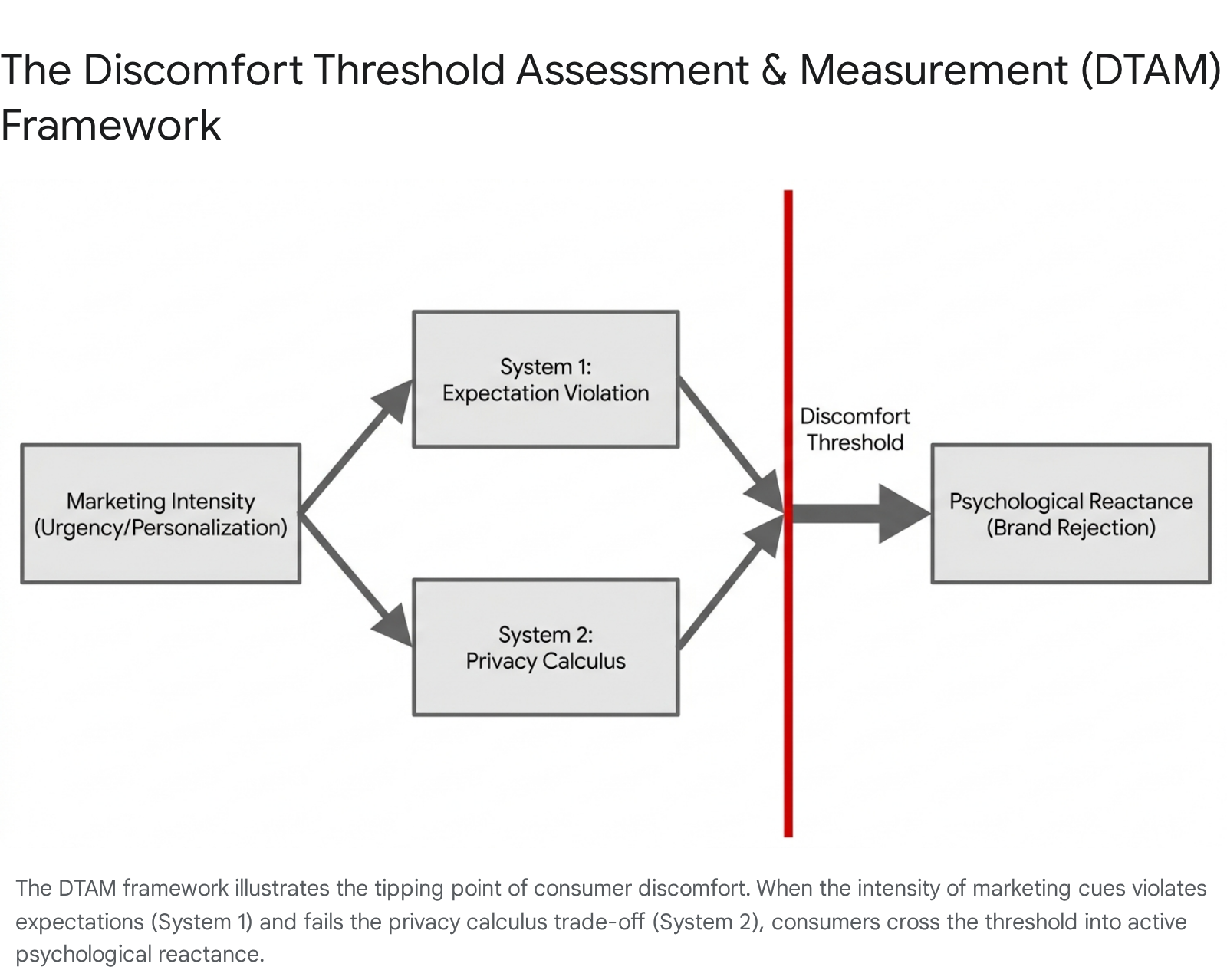
This conceptual model theorizes the exact threshold where personalization and urgency transform from helpful to deeply intrusive 8.
According to the DTAM framework, marketing discomfort occurs across two distinct cognitive systems, integrating Dual Process Theory with distinct psychological responses: 1. System 1 Discomfort (Affective Reactance): Grounded in Expectation Violation Theory (EVT). When a personalization or urgency cue deviates from established social norms - such as a countdown timer that aggressively resets upon page refresh, or an ad that leverages overly intimate personal data - it triggers immediate, intuitive pushback. This manifests as anxiety, a feeling of being surveilled, and an instinctive loss of authenticity 8. Neurophysiological measures, such as EEG and eye-tracking, indicate that this triggers a real-time affective stress response 8. 2. System 2 Discomfort (Cognitive Reactance): Grounded in Privacy Calculus Theory (PCT). This represents a slower, reflective judgment where the consumer explicitly weighs the benefits of the promotional discount against the risks of data exposure and manipulation. When the perceived loss of control, autonomy, and transparency outweighs the value of the deal, System 2 discomfort emerges 8.
The framework defines the tipping point as the specific inflection moment when the combined effects of expectation violations and privacy trade-off failures exceed the consumer's tolerance, transitioning them from a compliant buyer into an active resister 8.
Urgency Blindness and Consumer Burnout
When the DTAM threshold is repeatedly breached, consumers develop an active resistance. Just as early internet users developed "banner blindness" to subconsciously filter out display advertising, modern consumers have developed "urgency blindness." Eye-tracking studies reveal that digital shoppers now actively avoid looking at countdown timers or red urgency banners, categorizing them as visual noise rather than actionable information 9.
Furthermore, the sophistication gap between merchants and consumers is narrowing rapidly. Shoppers routinely employ defensive countermeasures, such as the "incognito window test," where they open a private browser session to verify whether a "personalized" or "limited-time" offer is universally applied and permanent 9. A 2023 study by Tuncer et al. analyzed the impact of dark patterns on user experience, finding that participants overwhelmingly associated limited-time cues with a lack of benevolence and opportunistic behavior from online vendors 11. The mere presence of these cues harmed the trust relationship, significantly lowering the pragmatic and hedonic quality of the user experience, while triggering measurable frustration and stress 11.
The overuse of urgency leads to profound consumer burnout. While a brand may secure a short-term spike in impulsive sales, the hidden organizational costs accumulate rapidly. These include increased return rates driven by post-purchase regret, plummeting customer lifetime value (CLV) as alienated buyers refuse to return, and the accumulation of negative reviews 19. Market forecasts indicate that by 2026, 75% of consumers will refuse engagement with personalization efforts they view as invasive, proving that bad personalization and fake scarcity erode relationships much faster than a total absence of personalization 8.
Demographic Vulnerabilities to Fear of Missing Out
The susceptibility to FOMO, and consequently to scarcity marketing, is not uniform across the consumer base. Deep empirical research indicates profound differences in both the statistical prevalence and the fundamental psychological nature of FOMO across distinct age cohorts.
Generation Z and Financial Anxiety
Unsurprisingly, digital-native generations report the highest baseline levels of FOMO. Approximately 70% of Generation Z and 57% of Millennials report experiencing FOMO regularly, compared to a global average of roughly 50-60% among active smartphone users 31928. Among younger cohorts, FOMO is heavily mediated by social media consumption. Platforms like Instagram, TikTok, and Snapchat expose users to a continuous, algorithmic stream of curated peer achievements, triggering acute social comparison and peer validation anxiety 320.
Crucially, this psychological pressure has recently evolved into acute "financial FOMO." More than half of Americans admit that observing the purchases or investments of others on social media directly motivates them to spend money 19. For Gen Z, this financial FOMO frequently manifests as impulsive spending on lifestyle experiences (dining, travel, concerts) or high-risk digital investments (cryptocurrency, meme stocks) 1928. Nearly 69% of millennials and Gen Z admit to actively overspending specifically to avoid feeling left behind by their social circle 328. Furthermore, Gen Z users frequently develop one-sided parasocial relationships with influencers; while engaging with these influencers can temporarily reduce anxiety, it simultaneously drives them to purchase products they do not need, exacerbating financial strain 320.
Older Adults and the Crisis of Social Isolation
While younger demographics command the bulk of commercial marketing attention, emerging gerontological and psychological research has highlighted the severe, often hidden implications of FOMO among older adults (typically defined as individuals aged 60 and above). Despite popular assumptions linking FOMO exclusively to youth culture, older demographics report FOMO levels that are structurally similar to the general population 2122. A study of 690 older adults in Argentina confirmed that FoMO levels in the 60-90 age bracket align with general population means, though the psychological drivers differ significantly 2122.
For adolescents, FOMO is tied to social status and identity formation. For older adults, FOMO is deeply intertwined with the fundamental human need for relatedness - the innate psychological desire to feel socially connected, integrated, and supported 23. As older adults face inevitable life transitions such as retirement, physical health deterioration, widowhood, and the fragmentation of traditional family structures, they become highly vulnerable to social isolation 2324.
A 2024 national poll by the University of Michigan revealed that 33% of older adults report feeling lonely, and 29% report feeling socially isolated 25. When these socially isolated individuals engage with social media to maintain connections, the perception of missing out on family gatherings or community events triggers profound psychological distress 26. Worrying about the consequences of missing group activities heightens anxiety about future exclusion, driving compulsive checking behaviors 27.
The consequences of FOMO and social isolation in older adults extend far beyond financial overspending; they are empirically linked to severe health outcomes. A six-year longitudinal study from the University of Waterloo demonstrated that the combination of social isolation and loneliness leads to the greatest accelerated decline in memory and cognitive function among aging populations 28. Furthermore, FOMO in older populations is positively correlated with clinical depression, heightened anxiety, compromised immune function, and a significant decrease in overall life satisfaction 21222930. Consequently, when digital marketers blindly deploy aggressive scarcity and social proof tactics that prey on the fear of exclusion, they are inadvertently exploiting deep-seated psychological vulnerabilities in a highly at-risk demographic.
| Demographic Cohort | Prevalence of FOMO | Primary Psychological Driver | Key Behavioral Outcome |
|---|---|---|---|
| Generation Z (Under 25) | Very High (~70%) 1928 | Social comparison, identity formation, influencer parasocial relationships 320. | Overspending, "financial FOMO," anxiety, excessive platform checking 319. |
| Millennials (26-41) | High (~57-69%) 1928 | Lifestyle comparison, milestone anxiety (homeownership, travel) 1920. | Impulse purchasing, susceptibility to algorithmic scarcity 3. |
| Older Adults (60+) | Moderate (~28-34%) 1925 | Need for relatedness, fear of exclusion, social isolation, widowhood 2324. | Depressive symptoms, loneliness, cognitive decline, health anxiety 282930. |
Artificial Intelligence and Synthetic Social Proof
The digital marketing landscape is currently undergoing a systemic paradigm shift driven by the rapid commercialization of Generative Artificial Intelligence (GenAI). While scarcity tactics previously relied on hard-coded countdown timers or simple inventory badges, GenAI has enabled the industrial-scale manufacturing of what researchers term "synthetic social proof" 313242.
The Illusion of Consensus and Synthetic Ambience
Social proof relies on a powerful psychological heuristic: in moments of uncertainty, human beings look to the behavior of the crowd to determine the correct action or belief 3334. If a product page displays thousands of positive reviews, the consumer assumes the product is highly valuable. GenAI fundamentally fractures this heuristic mechanism.
AI agents and Large Language Models (LLMs) can now generate linguistically fluent, highly persuasive fake reviews, deepfake testimonials, and synthetic social media engagement at an unprecedented scale, significantly lowering the cost of producing platform-native deception 313235. This capability creates a phenomenon known as "synthetic ambience" - an information stream massively polluted by bots that mimics human consensus, generating an artificial sense of demand, outrage, or urgency 36.
Furthermore, bad actors deploy automated, multi-agent swarms to manufacture high-velocity engagement. This tactic is used to trick not only human consumers but also platform moderation algorithms into believing a manufactured trend is legitimate, exploiting the algorithms' reliance on volume and velocity as proxies for authenticity 4234. Even in legitimate B2B research contexts, reliance on AI-generated "synthetic users" has been shown to produce severe bias; an Emporia Research study found that 98% of synthetic personas reported being "strongly satisfied" with variables where only 47% of real humans agreed, demonstrating AI's tendency toward "herd-mentality" positivity 37.
Consumer Detection Failure and Cue Inversion
The proliferation of synthetic social proof poses a severe threat to market integrity because consumers are largely incapable of detecting the deception. A rigorous 2025 quantitative-qualitative study published at the Hawaii International Conference on System Sciences (HICSS), involving 151 consumers and 906 review classifications, tested humans' ability to distinguish between genuine human-made reviews and AI-generated fake reviews 38.
The empirical findings were alarming: humans could only identify AI-generated reviews with a 53.2% accuracy rate - statistically indistinguishable from random guessing 38. Crucially, the study noted that consumers were especially poor at detecting negative AI-generated fake reviews 38. This phenomenon - academically termed "cue inversion" - means the traditional heuristics consumers rely on to detect scams (such as poor grammar, repetitive phrasing, or unnatural syntax) are completely obsolete against fluent LLMs 32.
Because human perception is a failing sensor in the GenAI era, trust in the e-commerce ecosystem is structurally vulnerable, and the scarcity heuristic is routinely hijacked by synthetic signals 3242. To combat this, the concept of "review integrity" must shift away from text-based detection toward a layered system governance model. Platforms must analyze behavioral metadata, user provenance, and network-level signals to secure environments against synthetic swarms, rather than relying on human intuition to spot AI deception 32.
Regulatory Interventions and Consumer Protection
In direct response to the widespread exploitation of cognitive biases, the proliferation of dark patterns, and the weaponization of deceptive urgency, regulatory bodies across the globe have initiated aggressive countermeasures aimed at protecting consumer autonomy and enforcing market transparency.
United States Pricing Regulations
In the United States, the Federal Trade Commission (FTC) has systematically targeted deceptive pricing structures that rely on manufactured urgency. The culmination of this effort is the FTC's Rule on Unfair or Deceptive Fees (commonly known as the Junk Fees Rule), which was finalized in December 2024 and becomes fully effective for enforcement in 2025 and 2026 495051.
The rule directly addresses the intersection of urgency and deception, specifically targeting a tactic known as "drip pricing." Historically, online travel agencies (OTAs), hotel chains, and live-event ticketing platforms would use countdown timers or "only 1 room left" badges to force a rapid consumer decision 5051. Once the consumer initiated the checkout process, the platform would reveal mandatory resort fees, convenience fees, or cleaning charges at the final confirmation screen 5051. Because the consumer was already in a state of high emotional arousal and decision commitment, they were highly likely to absorb the hidden cost rather than abandon the transaction and start over 51. Major class-action lawsuits, such as Vianu v. AT&T and Cox v. Spirit Airlines, previously penalized corporations millions of dollars for these bait-and-switch tactics 51. The new FTC regulation codifies this protection universally, mandating that the total, all-inclusive price must be displayed upfront whenever prices are advertised, effectively dismantling the psychological trap of drip pricing 50.
European Union Enforcement Sweeps
In the European Union, the Consumer Protection Cooperation (CPC) Network, coordinated by the European Commission, has taken a rigorous and highly publicized stance against manipulative digital interfaces under the Unfair Commercial Practices Directive (UCPD) and the Digital Services Act (DSA) 3940.
The CPC Network conducts regular, coordinated investigative "sweeps" of the digital marketplace to identify widespread infringements of consumer law. In a comprehensive sweep of 399 major retail websites, authorities found that 37% of the sites were actively using "dark patterns" designed to manipulate consumer behavior 4142. Notably, investigators discovered 42 websites utilizing blatantly fake countdown timers - timers that simply reset upon expiration or page refresh - constituting a direct, prosecutable violation of EU consumer law 41.
The scope of these enforcement actions spans from massive e-commerce platforms to global tech gatekeepers. In 2024 and 2025, the CPC Network launched coordinated actions against platforms like Temu to investigate pressure-selling tactics and hidden information 3943. Furthermore, under the Digital Markets Act (DMA), the Commission mandated that Booking.com entirely overhaul its interface to comply with transparent pricing laws, and actively notified Apple of unlawful geo-blocking practices within its Media Services 39. These actions signal a distinct regulatory shift: exploiting FOMO through deceptive scarcity is no longer viewed merely as aggressive marketing, but as a severe breach of consumer protection law requiring immediate remediation 4144.
Conclusion
The psychology of the Fear of Missing Out, operationalized through scarcity and urgency, remains one of the most potent mechanisms in the digital marketing arsenal. By leveraging deep-seated cognitive biases such as loss aversion and the scarcity heuristic, marketers can successfully bypass analytical deliberation, triggering competitive arousal and driving immediate transaction conversion. However, decades of empirical evidence unequivocally demonstrate that the relationship between urgency and efficacy is not linear; it operates on a strict inverted U-curve.
When consumers cross the discomfort threshold - a psychological boundary defined by the Discomfort Threshold Assessment & Measurement (DTAM) framework - psychological reactance takes hold. Tactics that once efficiently drove sales now foster profound skepticism, urgency blindness, and a rapid erosion of long-term brand equity. This dynamic is exacerbated in the online environment, where digital consumers possess heightened persuasion knowledge and actively deploy countermeasures against artificial constraints. Furthermore, the societal impact of these tactics is not benign. While Generation Z experiences severe financial anxiety and impulse control issues, older adults face profound emotional distress, with FOMO amplifying feelings of social isolation and contributing to measurable cognitive and physical health decline.
As Generative AI ushers in an era of synthetic social proof - rendering human consumers mathematically incapable of distinguishing genuine consensus from algorithmic manipulation - the ethical deployment of scarcity marketing faces a critical inflection point. With the FTC and EU regulatory bodies aggressively dismantling dark patterns and deceptive pricing structures, the future of conversion rate optimization cannot rely on manufactured panic. Sustainable digital marketing strategy must pivot away from exploiting cognitive vulnerabilities, focusing instead on transparent, authentic, and exogenous value propositions that respect consumer autonomy and foster long-term trust.