
Psychology of waitlists and artificial exclusivity in consumer demand
Introduction: The Paradigm Shift in Exclusivity Marketing
The architecture of consumer desire is fundamentally intertwined with the perception of availability. Historically, the curation of exclusivity was heavily reliant on physical and geographical constraints - limited manufacturing capacities, geographic boundaries, and the inherent friction of high-touch luxury retail environments. However, the contemporary digital economy has decoupled scarcity from physical constraints, engendering a landscape where exclusivity is often entirely artificial and programmatically engineered. This report investigates the structural transition from traditional physical exclusivity - typified by streetwear drops and legacy luxury waitlists - to modern digital exclusivity trends, specifically focusing on gamified waitlists for financial technology (fintech) applications, social networks, and artificial intelligence (AI) tools from 2023 onward.
By explicitly targeting foundational consumer psychology and behavioral economics frameworks - such as Commodity Theory, the Snob and Bandwagon effects, and the economics of Veblen goods - this analysis deconstructs the psychological mechanisms that render Fear of Missing Out (FOMO) and scarcity highly potent marketing catalysts. Furthermore, this report incorporates a rigorous global perspective, analyzing regional variations such as "hunger marketing" within Chinese consumer culture and the strategic deployment of limited technology releases in emerging markets like India.
To maintain the highest standards of analytical rigor, this report establishes strict source-quality tiers. The psychological and behavioral mechanisms are rooted in summaries of paywalled, peer-reviewed consumer psychology and human-computer interaction journals. Conversely, modern conversion data, operational metrics, and contemporary case studies are drawn from established consulting firm reports, including McKinsey & Company, Gartner, and PwC. Ultimately, the analysis addresses critical misconceptions regarding the uniform efficacy of scarcity across different product typologies (utilitarian versus hedonic) and deepens the investigation into the psychological tipping points where consumer anticipation inevitably devolves into resentment, perceived unfairness, and algorithmic fatigue. The ultimate objective is to provide a comprehensive understanding of how digital scarcity operates, where its limitations lie, and how consumer behavior is evolving in response to continuous algorithmic stimulation.
Foundational Consumer Psychology and Behavioral Economics Frameworks
The efficacy of exclusivity marketing is not merely a byproduct of modern advertising; it is deeply rooted in evolutionary psychology, cognitive science, and behavioral economics. Marketers exploit deeply ingrained cognitive biases to manufacture urgency, elevate perceived value, and bypass rational economic deliberation.
Commodity Theory and the Scarcity Heuristic
At the core of exclusivity marketing lies Commodity Theory, which postulates that any entity will be valued to the extent that it is unavailable. The scarcity of an item systematically triggers a "scarcity heuristic," a cognitive shortcut wherein consumers automatically equate rarity with high quality, elevated value, and desirability 1. Because human cognitive resources are finite, individuals rely on this heuristic to make rapid purchasing decisions, bypassing the exhaustive evaluation of an item's intrinsic utility.
This heuristic operates in tandem with several overlapping cognitive biases. Anchoring bias causes consumers to rely disproportionately on initial information regarding an item's limited availability, setting an artificial baseline for its subsequent worth 1. Loss aversion, a fundamental tenet of Prospect Theory, dictates that the psychological pain of missing an opportunity (FOMO) is weighted far more heavily than the psychological pleasure of acquiring the item 1. Consequently, scarcity messaging essentially threatens the consumer with a loss of choice, prompting immediate action to secure the asset before the opportunity dissipates. Furthermore, the mere visualization of possessing a scarce item triggers the endowment effect, increasing the consumer's subjective valuation of the product before the transaction even occurs, cementing emotional attachment 1.
The Veblen, Snob, and Bandwagon Effects
Exclusivity marketing frequently manipulates social identity and status signaling through three interconnected socioeconomic phenomena:
- Veblen Goods: Named after economist Thorstein Veblen, these are goods for which demand paradoxically increases as the price rises. The high price and resulting scarcity serve as an exclusionary barrier, allowing the good to function as a conspicuous signal of wealth, prestige, and social status.
- The Snob Effect: This effect occurs when the demand for a product is inversely correlated with its market penetration. Consumers driven by the Snob effect seek to differentiate themselves from the macroeconomic mainstream. As a product becomes more accessible or popular, its subjective value to the "snob" consumer plummets 12. Gamified invite codes and closed-beta software releases target this exact psychological profile by offering consumers the prestige of being an "early adopter" or a privileged "insider."
- The Bandwagon Effect: Conversely, the Bandwagon effect describes the phenomenon where demand for a product accelerates simply because others are consuming it. This mechanism is heavily reliant on social proof and the human evolutionary drive for conformity 12.
Modern digital exclusivity campaigns often execute a sequential psychological maneuver to maximize adoption. They initially weaponize the Snob effect by launching a product or service to a highly restricted, curated cohort (e.g., an invite-only waitlist for a new app). Once a critical mass of aspirational desire and social media visibility is generated, the strategy pivots to weaponize the Bandwagon effect, leveraging the manufactured FOMO to drive mass adoption as the access gates are selectively widened 12.
The Misconception of Uniform Efficacy: Hedonic vs. Utilitarian Goods
A pervasive fallacy in contemporary marketing strategy is the assumption that artificial scarcity works uniformly across all product categories. A synthesis of paywalled academic literature, including a comprehensive meta-analysis of 416 effect sizes drawn from 131 peer-reviewed studies, firmly refutes this notion 3. The research demonstrates that the success of scarcity tactics is heavily contingent upon the underlying nature of the product - specifically, whether it is utilitarian (functional, practical) or hedonic (status-driven, experiential, pleasure-seeking).
The meta-analysis reveals distinct optimal conditions dictating strategy success: * Utilitarian Products: Demand-based scarcity (e.g., messaging that states, "Only 3 items left because 500 people bought them today") is most effective for utilitarian goods. For functional items, high demand acts as a proxy for reliability and superior quality, effectively crowdsourcing the quality assurance process for the consumer 3. However, attempts to use pure "hunger marketing" - artificially restricting the supply of a basic functional good - often fail to enhance its perceived reliability. Because consumers evaluating functional goods operate with a more rational, cognitive mindset, artificial supply constraints on necessities generally trigger irritation rather than desire 3. * Hedonic and Status-Driven Products: Supply-based scarcity (e.g., "Limited edition of 500 units globally") is exceptionally effective for hedonic products and experiential services. Here, the value is explicitly derived from the product's uniqueness and its ability to construct and communicate the consumer's social identity 13. * High-Involvement Products: Time-based scarcity (e.g., "Flash sale ends in 2 hours") yields the highest purchase intentions for high-involvement products. This mechanism forces consumers to truncate their normally prolonged, analytical decision-making processes to avoid the psychological pain of loss aversion 3.
However, the efficacy of time-scarcity is highly contextual. When digital marketers apply aggressive time-scarcity to digital products devoid of physical limitations, modern consumers rapidly activate "persuasion knowledge" - the cognitive realization that they are being manipulated 4. A rigorous 2023 comparative study demonstrated that while identical limited-time offers succeeded in increasing offline retail willingness-to-pay, they entirely failed in online environments. Digital shoppers recognized the ubiquitous, artificial nature of the constraint, highlighting a growing desensitization to digital urgency tactics 4.
The Evolution of Exclusivity: From Physical Drops to Digital Waitlists
The mechanics of exclusivity have undergone a profound evolution over the last decade. In the 2010s, exclusivity was physically manifested through the "drop" model pioneered by streetwear brands and the protracted, opaque waitlists of legacy luxury fashion houses. These traditional models relied on genuine supply chain limitations, specialized manufacturing capabilities, and the highly visible social proof of physical queues winding outside retail storefronts.
By 2023 and 2024, as the volume of digital product transactions increased by nearly 70% globally and digital transformation budgets surged, exclusivity firmly transitioned into the digital realm 5. Because software, digital content, and platform access have near-zero marginal costs of replication, digital scarcity is entirely synthetic. Technology companies now engineer "drops" through sophisticated, gamified access control systems.
Gamified Waitlists in Fintech
In the fintech sector, where customer acquisition costs (CAC) are notoriously high and trust is paramount, waitlists are utilized to build highly qualified lead pools before a product launch or market expansion. In markets like the United Kingdom, the average cost-per-tap for finance apps in Apple Ads reaches $7.15, making organic, hype-driven acquisition an economic necessity 6.
Gamification is introduced by allowing users to elevate their position on the waitlist by successfully referring peers to the platform. This effectively outsources top-of-funnel marketing to the consumer base, transforming potential customers into brand evangelists driven by the Snob effect and the desire for early access privileges. However, the success of this model requires rapid progression; prolonged waiting fundamentally destroys conversion pathways.
Algorithmic Exclusivity and Community Gating in AI Tools
The explosion of generative AI in 2023 and 2024 saw unprecedented enterprise and consumer adoption. McKinsey reported that 63% of high-growth companies adopted generative AI tools within a 15-month period, predicting the technology could unlock $1.4 trillion in incremental revenue by 2030 7. AI companies utilized unique forms of digital exclusivity to manage astronomical demand, mitigate immense server compute costs, and cultivate prestige.
A primary example is Midjourney's deployment strategy. Rather than launching an open web application, Midjourney initially launched exclusively within a Discord server environment. This strategy placed a technical barrier to entry, ensuring only highly motivated, tech-adjacent users gained access. This fostered a highly engaged, cult-like community layer where artists and creators shared outputs in real-time. This dynamic functioned as a continuous loop of social proof and collaborative exclusivity, differentiating it from OpenAI's more accessible, mass-market DALL-E 3 integration within ChatGPT 89. While Midjourney prioritized aesthetic complexity and community gating, DALL-E 3 captured the segment prioritizing workflow efficiency and immediate accessibility 1011.
Furthermore, leading Large Language Model (LLM) providers like OpenAI (ChatGPT Plus) and Anthropic (Claude Pro) utilize dynamic waitlists to gate premium models during periods of high computational strain. By temporarily pausing new subscriptions and placing eager users on a waitlist, these platforms inadvertently triggered intense FOMO. This algorithmic gating cemented the perception of their models as scarce, high-value Veblen goods within the developer and enterprise ecosystems, driving immense pent-up demand when the gates reopened 1213.
Global Perspectives: Regional Variations in Exclusivity Marketing
The application and reception of artificial scarcity are not culturally agnostic. Global technology brands must navigate distinct regional psychological profiles and macroeconomic conditions, leading to fascinating strategic variations across international markets.
"Hunger Marketing" in Chinese Consumer Culture
In China, the strategy of artificially restricting supply to drive unprecedented demand is formally recognized as "hunger marketing" (饥饿营销) 56. This strategy exploits the intense density of Chinese digital social networks and the profound cultural emphasis on social face (mianzi), where owning a difficult-to-acquire product instantly elevates social standing and prestige among peers.
The seminal case study for hunger marketing in the technology sector is Xiaomi. At its inception, Xiaomi released its smartphones in highly restricted batches exclusively through online flash sales, entirely circumventing traditional, expensive retail distribution networks 1617. Because the devices featured flagship-level hardware at near-cost pricing, the artificial scarcity created a market frenzy. Initial flash sales famously sold out hundreds of thousands of units within seconds on platforms like Flipkart and their native site, fostering a fiercely loyal, cult-like community known as "Mi-Fans" 1618. This precise control of supply and hype propelled Xiaomi to execute a massive IPO, eventually reaching a valuation exceeding $50 billion and allowing them to expand into electric vehicles, delivering over 100,000 units of their SU7 EV model by late 2024 161718.
Similarly, the Chinese beverage brand Heytea utilized hunger marketing by weaponizing the physical queue. At its peak, consumers waited upwards of three hours for a cup of tea, with these highly visible queues functioning as aggressive social proof amplified by social media sharing 7. However, the Heytea case also highlights the severe limitations of this model; as wait times extended beyond the psychological threshold of acceptability, the brand began losing massive cohorts of potential consumers to competitors. Facing a revenue slump to 4.7 billion yuan in 2022, the company was forced to pivot toward digital pre-ordering, aggressive lower-tier city store expansion, and an Environmental, Social, and Governance (ESG) marketing focus to stabilize operations and recover market share 7.
Limited Tech Releases in Emerging Markets
India, currently the world's second-largest smartphone market, presents a unique landscape where deep aspirational consumption collides with acute price sensitivity 16. Technology brands have used exclusivity to position "flagship killers" within the premium mid-range segment, capturing consumers who desire luxury design language without the exorbitant flagship costs.
To penetrate the fiercely competitive Indian market against established incumbents like Samsung and Apple without a multi-million dollar marketing budget, OnePlus launched its inaugural device utilizing a strict, invite-only system 208. Consumers could only purchase the device if they received an invite from a previous buyer or won one through forum participation. * The Business Utility: Operationally, this was a masterstroke. By manufacturing phones only after an invite was claimed, OnePlus entirely bypassed the crippling upfront capital costs and risks associated with massive inventory holding, executing a flawless just-in-time manufacturing model 8. * The Psychological Utility: The system transformed every early adopter into a gatekeeper, heavily leveraging the Snob effect. However, it also sparked severe backlash. The infamous "Smash the Past" campaign, which asked users to film themselves destroying their old phones for a chance to buy the OnePlus One for $1, generated significant negative public relations and consumer outrage, forcing the company to rapidly revise the campaign rules 20822.
Led by OnePlus co-founder Carl Pei, Nothing Technology replicated and refined this playbook in 2022. By leveraging a cryptic, invite-only event for the Nothing Phone (1), the brand engineered viral hype, racking up over 200,000 pre-order waitlist sign-ups prior to the full product reveal 239. Targeting the premium mid-range market (the ₹40,000 to ₹60,000 segment in India), Nothing utilized distinctive transparent hardware and selective, community-led drops to appeal to design-conscious Millennials and Gen Z consumers seeking explicit differentiation from mainstream tech hegemony. This strategy proved highly effective, allowing the startup to ship over 4 million units by early 2025 despite manufacturing costs hovering around $360 per unit 232526.
The Data Reality: Waitlist Dynamics and Conversion Efficacy
Evaluating the actual efficacy of digital exclusivity requires a rigorous separation between top-of-funnel engagement and bottom-of-funnel revenue realization. Modern conversion data from leading marketing and consulting reports exposes a significant dichotomy between initial hype and sustainable business growth.
According to McKinsey, brands deploying FOMO-based marketing experience a 30% higher initial engagement rate, and by leveraging limited-time offers and exclusive promotions, they achieve an impressive 29% to 35% surge in short-term sales 2710. This is particularly salient in live-streaming commerce, where time-scarcity triggers immediate impulse buying, primarily among Gen Z and Millennial demographics. However, when analyzing digital transformation initiatives broadly, Gartner notes that only 48% of enterprise-wide digital initiatives meet or exceed their business outcome targets 11. This statistic underscores that while artificial exclusivity can generate initial hype, it cannot compensate for a lack of genuine product-market fit or a poor post-launch user experience.
Waitlist efficacy is deeply fragmented by industry, a phenomenon commonly referred to by growth marketers as the "benchmark mirage" 12.
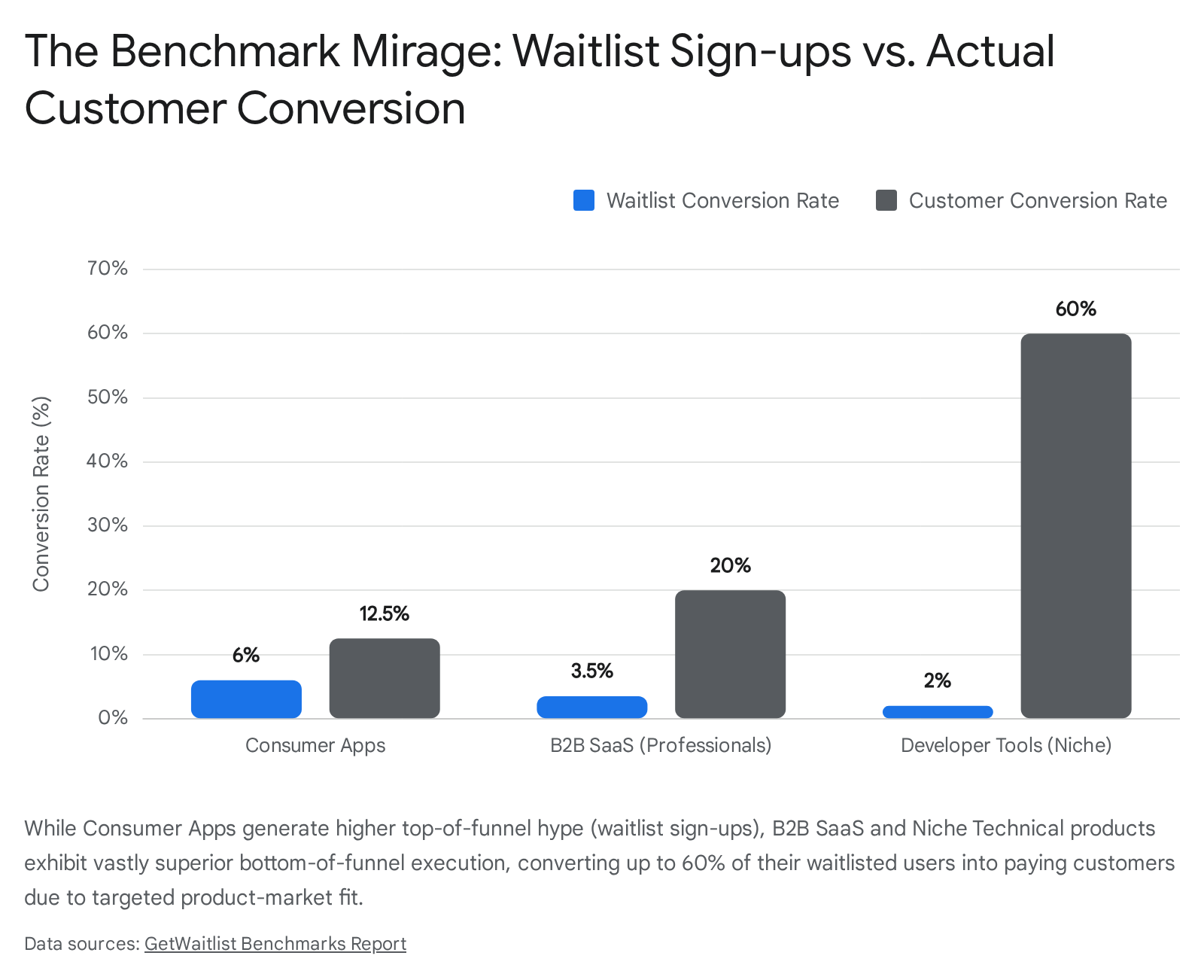
| Product Sector | Average Waitlist Conversion (Top-of-Funnel) | Ultimate Customer Conversion (Bottom-of-Funnel) | Core Conversion Driver |
|---|---|---|---|
| B2B SaaS / Developer Tools | 1% - 3% (Cold Traffic) | 60%+ | High intent, workflow necessity, deep product-market fit 12. |
| Consumer Apps / Gaming | 4% - 8% | 10% - 15% | Viral loops, social proof, low initial commitment 12. |
| Fintech Applications | 2% - 5% | 21% (within first week) | Regulatory trust, complex onboarding friction, high acquisition cost 313213. |
The fintech sector specifically reveals the vulnerability of the waitlist model. While organic App Store conversion metrics for finance apps can reach up to 34% in optimized scenarios, actual activation remains a severe hurdle 32. CleverTap's industry benchmark report reveals that only 21% of users who install a fintech app complete the sign-up process within the first week 13. Crucially, the velocity of access dictates success: if a user is kept on a waitlist without access for beyond three months, their likelihood of conversion plummets below 20%, representing a total loss of expensive acquisition capital 34.
In the AI sector, true retention is dictated by professional workflow integration rather than scarcity. ChatGPT Plus achieves a staggering 71% six-month retention rate, outperforming Claude Pro (62%) and Gemini Advanced (60%) 35. Business-to-business (B2B) AI platforms maintain a remarkably low 3.5% monthly churn rate compared to 4.04% for consumer-facing services, proving that while waitlists build initial subscriber bases, long-term economic viability is determined by daily utility and ecosystem lock-in, not exclusivity 35.
The Psychological Tipping Point: From Anticipation to Resentment
The strategic application of scarcity is a precarious balancing act. There exists a definitive psychological threshold where the friction of exclusivity ceases to signal premium value and begins to signal exploitation. When this tipping point is breached, consumer anticipation violently converts into resentment, psychological reactance, and long-term brand hate.
The Psychology of Waiting and the Threshold of Resentment
Waiting inherently carries both economic costs (lost productivity, opportunity costs) and psychological costs (boredom, anxiety, frustration) 1415. Peer-reviewed studies on consumer waiting times reveal a complex dynamic rooted in mental accounting. Initially, a moderate wait can paradoxically increase purchase volumes; consumers unconsciously seek to offset the "sunk cost" of their wait by purchasing more upon reaching the front of the queue, attempting to make the frustration and time expenditure feel economically "worthwhile" 1415.
However, this dynamic is highly fragile. The psychological tipping point occurs when wait times are perceived as uncertain, unmanaged, or fundamentally unfair. If consumers believe a waitlist is being artificially manipulated solely for corporate benefit, or if they observe opaque mechanisms allowing "VIPs" to bypass the queue, the wait is no longer attributed to high demand (a positive quality signal) but to corporate arrogance and manipulation (a negative signal) 1617. This realization triggers customer rage, a psychological state of intense anger accompanied by expressions of negative behavioral intent 16. As documented in systematic reviews of brand hate literature, this unmet expectation and culmination of dissatisfaction results in active brand avoidance, retaliatory negative word-of-mouth, and public boycotts 18. Crucially, Harvard Business Review data indicates that up to 45% of impulse purchases driven by aggressive FOMO marketing ultimately result in buyer's remorse, permanently fracturing brand trust and ensuring the customer never returns 10.
Algorithmic Fatigue and the Personalization Paradox
In the modern digital landscape, the constant barrage of hyper-personalized content, app notifications, and tailored scarcity claims has generated a new, pervasive psychological phenomenon: algorithmic fatigue 19. Users are increasingly mentally exhausted by the relentless algorithmic curation designed to maximize their screen time and engagement metrics.
A synthesis of peer-reviewed structural equation modeling (PLS-SEM) research reveals the intricate mechanics of this fatigue. Interestingly, Perceived Ad Fatigue (PAF) has no direct effect on a consumer's resistance to persuasion 19.
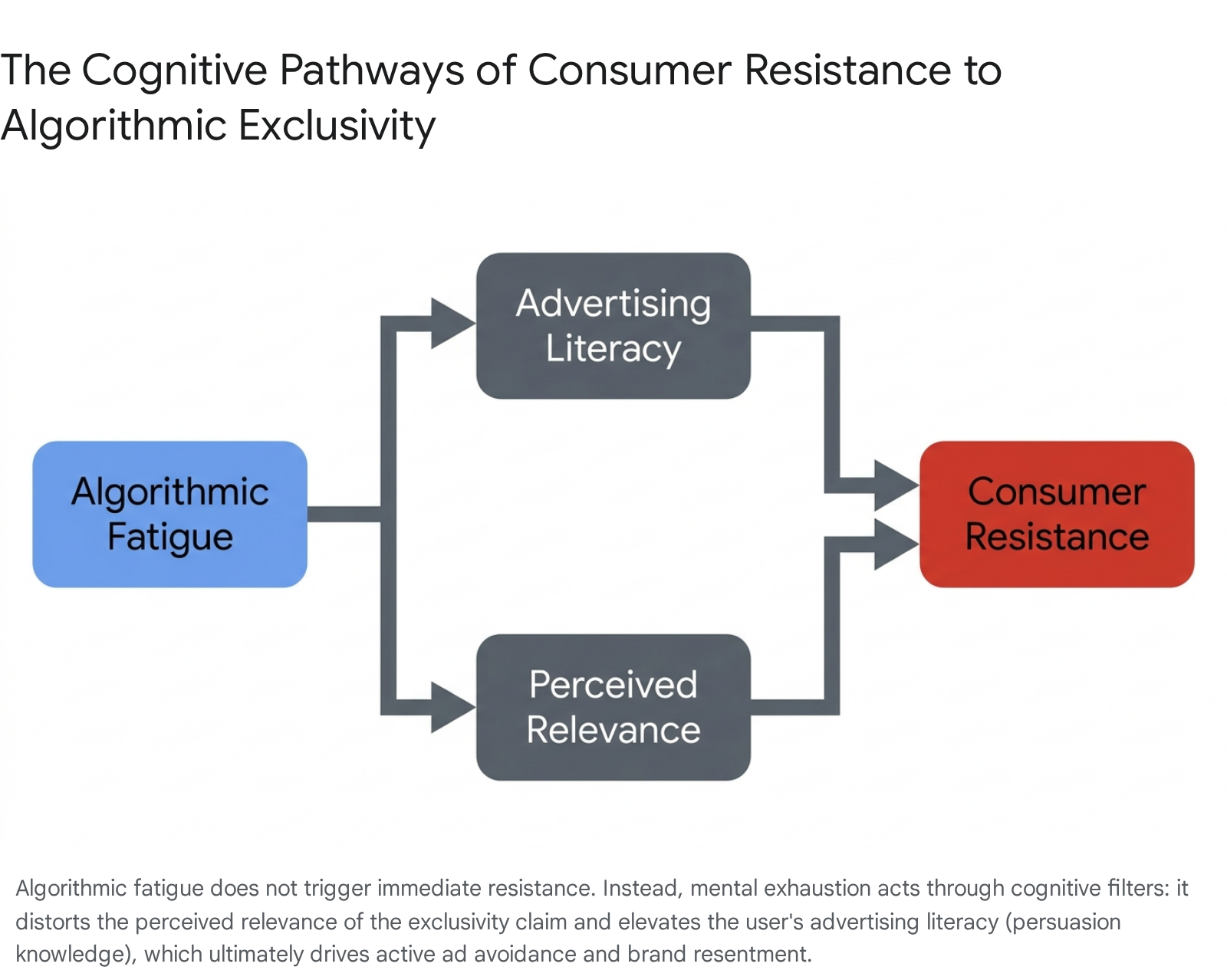
Instead, fatigue operates indirectly, fully mediated by two critical cognitive and perceptual filters: 1. Advertising Literacy (Persuasion Knowledge): As fatigue sets in, users develop heightened analytical defenses. They begin to view personalized exclusivity claims not as genuine, serendipitous opportunities, but as programmatic, manipulative tactics. This increased literacy empowers them to interpret fatigue as a sign of persuasive saturation, triggering defensive cognitive judgments 19. 2. Perceived Relevance and the Personalization Paradox: Chronic exposure distorts how users evaluate relevance. Over-personalization leads to the "personalization paradox," where targeted ads are deemed overly invasive or creepy, sparking deep privacy concerns and psychological reactance 1920.
Consequently, exhausted users deploy coping mechanisms ranging from passive "banner blindness" - where they subconsciously ignore anything resembling a marketing promotion - to active ad-blocker installation and social media account deletion 19.
The implications of this fatigue extend beyond marketing inefficiency into public health. In algorithms designed purely for engagement, platforms often amplify high-arousal, provocative, or anger-inducing content to retain fatigued users. Studies indicate that algorithmic engagement feeds present political tweets expressing anger at a significantly higher rate (62%) than chronological timelines (52%), driving societal polarization 21. Furthermore, psychiatric evaluations warn that constant algorithm-driven exposure to high-arousal content reshapes emotional reactivity, leading to emotional numbing and behavioral dysregulation, a concern echoed in the US Surgeon General's 2023 Advisory on Social Media and Youth Mental Health 22.
In response to this hyper-stimulation, a macro-cultural shift from "impulse to intention" is materializing. While 89% of Americans report making impulse purchases, spending an average of $151 monthly, 73% of shoppers now state that experience and personalized relevance influence their purchasing decisions far more than price or manufactured urgency alone 45. This shift is evidenced by the explosive growth of the secondhand apparel resale market - projected to reach $73 billion by 2028 - and the rise of the "underconsumption core" movement, signaling a mass rejection of chaotic, scarcity-driven consumption in favor of mindful curation 45.
Comparative Analysis of Exclusivity Mechanics
To navigate the delicate balance between generating desire and avoiding consumer resentment, modern marketers deploy various mechanics of exclusivity. The table below synthesizes these tactical implementations, mapping them against their primary psychological triggers, historical conversion efficacy, and the inherent risks of consumer backlash based on the preceding analysis.
| Exclusivity Mechanic | Primary Psychological Trigger(s) | Historical Conversion Efficacy | Backlash & Resentment Risk |
|---|---|---|---|
| Invite Codes (Peer-to-Peer) | Snob Effect, Social Proof, Endowment Effect. | High B2B Customer Conversion (up to 60%). High viral coefficient but lower overall scale 12. | High: "Gatekeeping" accusations. As seen with early OnePlus models, strict limitations can spawn secondary black markets and alienate users without connected networks, leading to public relations crises 208. |
| Gamified / Ranked Waitlists | Bandwagon Effect, FOMO, Sunk Cost Fallacy (time investment). | High Top-of-Funnel Signups (4-8% conversion for consumer apps). Drops sharply if wait exceeds 3 months 1234. | Medium to High: High risk of algorithmic fatigue. Users resent "pay-to-skip" mechanics or required social sharing, perceiving it as exploitative free labor for corporate growth 1519. |
| Time-Limited Drops (Flash Sales) | Time Scarcity, Loss Aversion, Urgency. | Generates 29-35% short-term sales surge. Highly effective for high-involvement and hedonic goods offline 327. | High: Drives impulse buys resulting in 45% buyer's remorse 10. Frequent use online desensitizes consumers, activating persuasion knowledge and complete "banner blindness" 4. |
| Platform/Ecosystem Exclusivity | Veblen Effect (barrier to entry), Status Signaling. | Varies. Highly effective for building deep, insular community loyalty (e.g., Midjourney on Discord) 9. | Medium: Alienates mass-market users unfamiliar with the host platform due to high onboarding friction. Over time, professional users demand open APIs or web interfaces for true workflow utility 810. |
| Lotteries / Raffles | Random Reward, Scarcity Heuristic. | Moderate. Excellent for dampening server loads and preventing immediate bot-scalping on high-heat items. | Low to Medium: Perceived as more egalitarian than ranked waitlists or peer invites. However, persistent, repeated losses lead to "lottery fatigue" and long-term psychological disengagement from the brand. |
Conclusion
The transition from physical queues to programmatic digital waitlists has fundamentally altered the economics and implementation of exclusivity marketing. While the digital landscape allows for the frictionless scaling of artificial scarcity across global markets, it simultaneously amplifies the speed at which consumers achieve psychological saturation and fatigue.
Foundational behavioral economics proves that the scarcity heuristic and phenomena like the Snob and Bandwagon effects remain as potent in a B2B SaaS waitlist as they do for a luxury handbag. However, as comprehensive meta-analyses demonstrate, this efficacy is deeply conditional. Applying artificial scarcity to utilitarian digital products invites rational scrutiny and irritation, whereas it successfully elevates the perceived status of hedonic and experiential goods. The global variations, from Xiaomi's hunger marketing in China to Nothing Technology's community-led drops in India, further illustrate that exclusivity must be precisely calibrated to regional cultural dynamics and macroeconomic sensitivities.
Furthermore, the data explicitly highlights a "benchmark mirage" in digital conversion. While gamified FOMO marketing can temporarily boost top-of-funnel engagement by 30%, it carries a severe hidden cost: 45% buyer's remorse, plummeting activation rates if wait times exceed a financial quarter, and the rapid activation of algorithmic fatigue. Modern consumers are no longer passive recipients of urgency marketing; equipped with heightened advertising literacy and suffering from digital exhaustion, they rapidly filter out artificial constraints.
To achieve sustainable growth in the modern technological ecosystem, brands must evolve beyond the mere fabrication of scarcity. Exclusivity must transition from a superficial barrier to entry into a genuine signal of curated value, community engagement, and operational necessity. Failing to respect the psychological tipping point will inevitably turn highly sought-after brand anticipation into irreversible consumer resentment.