
Psychology of artificial scarcity and limited edition products
Introduction to Behavioral Economics and Market Perception
Traditional neoclassical economic theory rests on the foundational assumption that consumers are rational actors who navigate markets by carefully calculating costs, benefits, and the functional utility of goods and services 1. Under this framework, a product's value is intrinsically linked to its objective utility and the tangible resources required for its production. However, the integration of psychology and cognitive science into the study of market behavior - culminating in the discipline of behavioral economics - has systematically dismantled the myth of the perfectly rational consumer 12. Human decision-making is heavily mediated by cognitive biases, heuristics, and emotional states that frequently lead to seemingly irrational, yet highly predictable, market behaviors 1.
At the forefront of these psychological mechanisms is the principle of scarcity. In its simplest evolutionary form, the scarcity heuristic dictates that humans automatically assign greater subjective value to items, experiences, or opportunities that are perceived to be rare, fleeting, or in short supply 13. Artificial scarcity is the deliberate commercial manipulation of this heuristic. By engineering limitations on product availability - either by restricting production quantities, limiting the time window of a sale, or establishing exclusive distribution channels - brands manufacture an illusion of rarity 34. This strategy intentionally shifts the consumer's focus away from a rational evaluation of price and functional utility toward an emotionally charged urgency to acquire the item before it disappears 1.
Artificial scarcity does not merely act as a promotional tool; it structurally alters the consumer's psychological state. The mere perception of limitation triggers a cascade of cognitive responses, primarily centered around the fear of missing out (FOMO), competitive arousal, and anticipated regret 123. The contemporary deployment of limited editions, seasonal drops, and algorithmic flash sales leverages these deeply ingrained psychological responses, transforming mundane purchasing events into high-stakes behavioral episodes.
Theoretical Architecture of Scarcity
To understand why manufactured urgency dictates modern consumption, it is necessary to examine the core psychological theories that govern human responses to limited resources.
Commodity Theory and Value Perception
Introduced by Timothy Brock in 1968, Commodity Theory provides the foundational psychological explanation for why scarcity enhances desirability. The theory's central tenet is that any commodity will be valued to the extent that it is unavailable 45. This increased valuation operates independently of the product's functional utility. According to this framework, unavailability restricts a consumer's access to a desired object, which in turn causes the consumer to exert greater cognitive effort to obtain it. This increased cognitive and behavioral effort retroactively justifies a higher valuation of the object in the mind of the consumer 5.
Commodity Theory suggests that marketers can artificially inflate the psychological value of an item simply by altering its perceived availability. This explains why tactics such as limiting production runs, enforcing strict per-customer purchase limits, and utilizing exclusive distribution outlets consistently result in heightened consumer interest and a willingness to pay premium prices 56. The object becomes an extension of the self, and possession of a scarce commodity serves to reinforce an individual's distinct identity 5.
Psychological Reactance and Freedom of Choice
Closely intertwined with Commodity Theory is Psychological Reactance Theory, originally formulated by Jack Brehm in 1966 11. Reactance theory posits that human beings possess a fundamental psychological need to preserve their behavioral freedom and autonomy. When a consumer perceives that their freedom to choose or acquire a product is threatened - such as when a limited edition item is rapidly selling out or a flash sale timer is counting down - they experience psychological reactance 117.
This reactance manifests as an intense, reflexive desire to reclaim the threatened freedom. The most direct method to restore this autonomy is to aggressively pursue the restricted item 118. In the context of retail and digital commerce, a sold-out sign or a "limited stock" warning functions not merely as an inventory update, but as an active psychological threat. Consumers interpret these algorithmic signals as a restriction on their choices, prompting impulsive and urgent buying behaviors to reassert control 11.
Compensatory Control and Status Signaling
The appeal of artificial scarcity is further illuminated by Compensatory Control Theory. Economic uncertainty, political volatility, and social fragmentation often heighten consumer sensitivity to loss and unpredictability 9. Recent research indicates that during periods of economic downturn or perceived personal resource scarcity, individuals experience psychological distress due to a lack of control 10. To mitigate this distress, consumers often pivot toward purchasing high-status luxury goods or limited-edition items as a means to restore a sense of psychological balance 10.
This mediation reveals that consumers turn to exclusive items not merely due to external constraints, but as an internal mechanism to reassert control over their circumstances. Acquiring a rare product serves as a conspicuous social signal of competence, wealth, and cultural relevance, counteracting feelings of vulnerability 10. Consequently, scarcity resonates deeply because it allows the consumer to reclaim a distinct sense of agency in an otherwise unpredictable socio-economic landscape 9.
The Bandwagon and Snob Effects
Scarcity does not operate uniformly across all demographics; it interacts dynamically with an individual's social goals, leading to two distinct, and often opposing, behavioral outcomes known as the bandwagon effect and the snob effect 11.
The bandwagon effect is heavily triggered by demand-induced scarcity. When a product is scarce because an overwhelming number of other people are buying it, the scarcity acts as a heuristic for high quality and social validation. Consumers with a high need for conformity are particularly susceptible to this route, as they view rapidly depleting stock as social proof that the item is desirable and culturally necessary 411.
Conversely, the snob effect is triggered by supply-induced scarcity, where the manufacturer deliberately restricts production from the outset. This form of scarcity appeals directly to consumers with a high Need for Uniqueness (NFU) 411. For these consumers, the utility of the product lies explicitly in its exclusivity. Owning the item distinguishes them from the broader population 68. If a limited-edition product becomes too popular, or if the brand expands the supply to meet mass demand, these uniqueness-seeking consumers experience a dilution of exclusivity, which actively decreases their intention to purchase 6.
Typologies of Engineered Scarcity
To effectively navigate the psychology of artificial scarcity, behavioral researchers classify scarcity cues into distinct taxonomies. The primary division exists between quantity-related scarcity, which limits volume, and time-related scarcity, which limits temporal opportunity 61213.
Quantity-Based Scarcity Constraints
Quantity scarcity refers to a physical or numerical restriction on the number of available units. This can be parsed into two distinct market mechanisms:
- Supply-Induced Scarcity (Limited Editions): This occurs when a brand intentionally limits the production of a product to a specific, unalterable number (e.g., a release of only 500 designer sneakers worldwide). This approach explicitly signals exclusivity and prestige, triggering the snob effect 61214. The psychological efficacy of limited editions relies heavily on the permanence of the scarcity. If a brand re-releases the item or restocks heavily, the psychological contract of exclusivity is violated, alienating early adopters who purchased the item for its rarity 115.
- Demand-Induced Scarcity (Inventory Depletion): This occurs when high consumer demand rapidly depletes available stock. E-commerce platforms frequently weaponize this by displaying low-stock warnings, such as "Only 3 items left at this price" 116. This triggers the bandwagon effect, utilizing social proof as a heuristic. The consumer infers that if an item is almost sold out, it must possess exceptional quality or high cultural value, thereby intensifying the desire to purchase 611.
Time-Based Scarcity and Manufactured Urgency
While quantity scarcity restricts physical inventory, time-based scarcity restricts the temporal window in which a consumer is permitted to act 112. Time scarcity is typically operationalized through flash sales, seasonal product releases, or expiring discount codes, often accompanied by visual countdown timers 1217.
Urgency appeals leverage the consumer's desire for immediate gratification and their intense aversion to potential regret 118. Under strict time pressure, consumers experience an increase in cognitive load, which rapidly degrades their ability to evaluate the purchase rationally. The brain defaults to heuristic processing, prioritizing speed over deliberation. This significantly reduces the decision-making cycle and drastically increases the likelihood of an impulsive purchase 1920.
However, emerging research reveals that the efficacy of time-based scarcity diverges sharply based on the retail environment. While highly effective in physical, brick-and-mortar stores, time-scarcity promotions demonstrate diminished returns in online environments 172122. The proliferation of continuous online sales and aggressive digital marketing has induced a state of skepticism among shoppers. Consumers online exhibit heightened "persuasion knowledge" - an acute awareness that a countdown timer is a marketing manipulation designed to coerce them, rather than a genuine logistical constraint 172022. To counteract this persuasion knowledge, researchers note that online time scarcity is only consistently effective when the deadline is externally justified and outside the retailer's direct control, such as a holiday, a seasonal shift, or a consumer's birthday 1722.
Taxonomic Scarcity
Beyond volume and time, researchers also identify taxonomic scarcity, which manipulates the categorization of products. Taxonomic scarcity involves releasing items that are either restricted in variety (e.g., a specific colorway of a shoe that is rare) or restricted by category (e.g., an entirely new, temporary product line) 13. Meta-analyses of purchase behavior indicate that consumers are highly responsive to scarcity based on variety, as specific, distinct attributes within a broader product line offer an accessible way to express individualism without entirely abandoning established brand loyalty 1323.
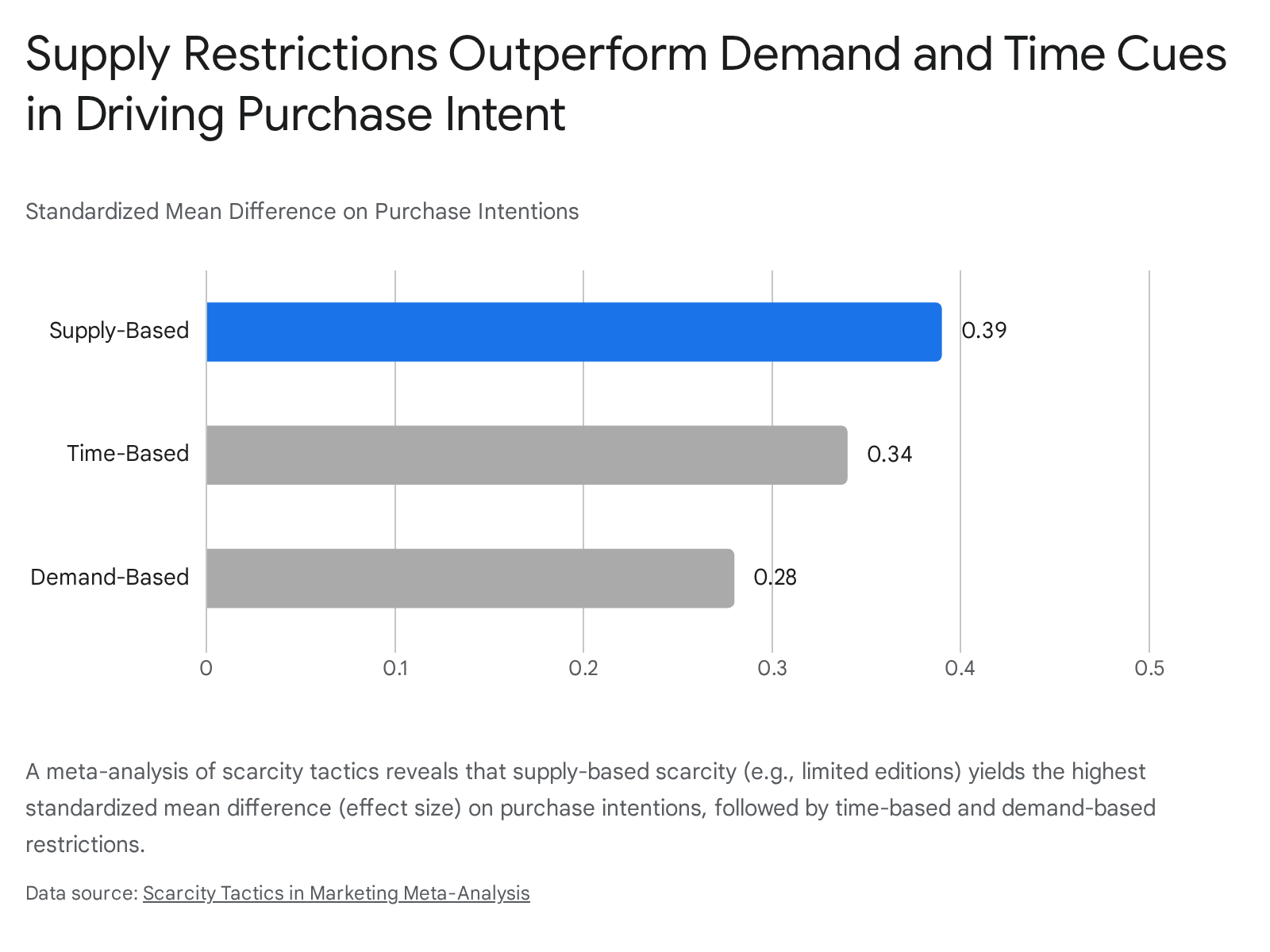
Comparative Analysis of Scarcity Typologies
| Scarcity Type | Core Mechanism | Primary Psychological Trigger | Theoretical Basis | Common Market Application |
|---|---|---|---|---|
| Supply-Induced (Quantity) | Deliberate restriction of production numbers prior to launch. | Need for Uniqueness (NFU), Status Signaling, Exclusivity. | Commodity Theory; Snob Effect | Limited-edition streetwear drops, capsule collections, numbered watches 4611. |
| Demand-Induced (Quantity) | Rapid depletion of stock due to aggregate consumer interest. | Social Proof, FOMO, Competitive Arousal. | Conformity Theory; Bandwagon Effect | Low-stock e-commerce warnings, empty physical retail shelves 61116. |
| Time-Related (Urgency) | Strict temporal deadline placed on product availability or pricing. | Anticipated Regret, Heuristic Processing, Immediate Gratification. | Reactance Theory | 24-hour flash sales, seasonal menu items, algorithmic countdown timers 11217. |
Behavioral Journey Mapping and the Purchase Sequence
The interaction between a consumer and an artificially scarce product is not a momentary event; it is an episodic psychological journey spanning pre-purchase anticipation, the immediate point of sale, and post-purchase reflection. Modern behavioral journey mapping focuses on tracking the emotional fluctuations, cognitive barriers, and decision heuristics at each of these stages to understand how scarcity structures behavior 243031.
Pre-Purchase: Anticipation and Downward Regret
In contemporary consumer culture, scarcity no longer arrives as a surprise; it is actively expected and ritualized 9. The "drop model," a strategy pioneered by niche streetwear brands and subsequently adopted by legacy luxury houses, relies entirely on structured anticipation. Consumers are informed of a limited release weeks in advance, allowing desire to compound over time 32.
During this pre-purchase phase, the dominant psychological force driving the consumer is anticipated regret 925. Consumers engage in counterfactual thinking, visualizing a future in which they failed to act and subsequently missed out on the product 25. Research categorizes this as "downward anticipated regret" - the expectation that a future state of non-ownership will be emotionally worse than the current state 25. This imagined future generates profound psychological discomfort. To alleviate this anxiety, the consumer forms a rigid intention to buy, frequently ignoring the objective functional value or price of the item 9.
Furthermore, the hyper-competitive nature of product drops generates intense competitive arousal. Consumers recognize they are not merely purchasing a product; they are competing against other shoppers and automated bots. This transforms the transaction into an adrenaline-fueled hunt, reframing the acquisition of a material good as a personal victory and a validation of status 114.
Point of Sale: Stimulus-Organism-Response (S-O-R)
At the exact moment a limited edition drop or flash sale commences, the consumer enters an environment meticulously engineered to induce cognitive overload 2627. The Stimulus-Organism-Response (S-O-R) paradigm - often augmented by the Pleasure-Arousal-Dominance (PAD) framework - models this interaction accurately 26. External digital stimuli, such as aggressive UX design, red notification text, and ticking timers, function as the initial stimulus. These immediately trigger physiological arousal and anxiety within the organism 2628.
This elevated state of arousal significantly weakens the consumer's self-control mechanisms. In digital sales rooms, choice architecture explicitly nudges the consumer toward instantaneous action, capitalizing on the reduction in rational deliberation 16. The consumer is conditioned to believe that hesitation carries a severe punitive consequence - the total forfeiture of the item 9. Consequently, the behavioral response is an impulsive, near-automatic execution of the transaction 2628.
Post-Purchase Assessment: Regret and Dissonance
While artificial scarcity excels at driving rapid acquisition, its impact on long-term satisfaction is fraught with complications. Scarcity-driven consumption is fundamentally episodic. The emotional peak of the transaction occurs at the exact moment of acquisition, fueled primarily by the relief of avoiding regret 9. However, once the item is secured and the manufactured urgency dissipates, the consumer must evaluate the product in an environment devoid of the flash sale's reality distortion field 9.
Because the purchase was driven by heuristic processing and loss aversion rather than genuine preference, post-purchase cognitive dissonance is incredibly common 925. When desire is perpetually rushed by marketing deadlines, the resulting consumption is frequently hollow, conditioning a relentless cycle of rapid acquisition followed by swift dissatisfaction 9.
The Post-Purchase Reality: Analyzing Consumer Regret
Empirical data reveals a growing crisis of buyer's remorse directly tied to urgency marketing. A comprehensive 2025 financial sentiment study highlighted stark generational divides in how consumers process and regret impulse purchases 29.
Younger demographics, who operate extensively within digital environments saturated with algorithmic scarcity and social media FOMO, report disproportionately high levels of financial regret 29. According to the data, 48% of Millennials and 42% of Generation Z consumers reported experiencing significant financial regret over purchases made within the previous twelve months 29. Conversely, older demographics, who are generally less exposed to algorithmic drops and possess different financial heuristics, reported far lower rates of regret, with only 17% of consumers over the age of 60 expressing similar remorse 29.
Generational Breakdown of Post-Purchase Financial Regret (2025)
| Demographic Cohort | Percentage Reporting Recent Financial Regret | Primary Cited Causes for Regret |
|---|---|---|
| Generation Z | 42% | Impulse spending, algorithm-driven social media purchases, FOMO 2930. |
| Millennials | 48% | Unplanned expenses, stress-induced retail therapy, pressure to act quickly 2931. |
| Generation X | 29% | General budget overruns, unexpected maintenance costs 2931. |
| Baby Boomers (60+) | 17% | Rarely experience regret; attribute behavior to conscious financial planning 29. |
The primary driver of this regret is impulse buying fueled by digital scarcity. Approximately 62% of surveyed consumers admit to regretting an impulse purchase, with over a third noting that the artificially induced urgency led to tangible financial stress 32. The speed at which transactions occur exacerbates the issue; studies indicate that 77% of impulse buyers complete their transaction within a week of discovering a product, and 15% check out on the exact same day, entirely bypassing the rational deliberation phase 32. Furthermore, 80.2% of consumers admit they have been influenced to avoid future purchases from specific platforms after realizing they were manipulated by aggressive, unreliable urgency cues or misleading product representations 3033.
The Gamification of Scarcity: Gacha and Blind Boxes
The psychological manipulation of scarcity reaches its zenith in the gamified "blind box" economy, a retail phenomenon pioneered in Asian markets and now aggressively expanding globally 3435. Blind boxes synthesize the urgency of limited-edition physical goods with the addictive, probability-based mechanics of digital games.
The POP MART Phenomenon
Brands like POP MART sell physical vinyl art toys packaged in identical, sealed boxes. While consumers know which thematic series they are purchasing from, the specific character inside remains concealed until the moment of unboxing 4436. The psychological hook relies heavily on engineered mathematical probability. Within any given series, standard figures are distributed evenly, but the collection invariably contains a "hidden" or "secret" chase figure. The production ratio of these hidden figures is deliberately constricted, often to odds as low as 1 in 144 boxes 44.
This combination of uncertainty and extreme rarity is a potent commercial force. The uncertainty generates a prolonged dopamine-driven anticipation phase that standard, transparent retail simply cannot match 3437. Furthermore, because the items are physical collectibles, acquiring a hidden figure profoundly satisfies the snob effect, elevating the consumer's social status within the dedicated collector community 37. The Theory of Planned Behavior illustrates that this pursuit of social status, amplified by digital marketing and celebrity endorsements, heavily dictates the purchase intentions of younger consumers engaged in this space 238.
Variable-Ratio Reinforcement and the Zeigarnik Effect
Beneath the aesthetic appeal of blind boxes lies a highly sophisticated behavioral conditioning framework known as "gacha" mechanics. Originating from Japanese capsule toy machines, gacha systems operate on B.F. Skinner's variable-ratio reinforcement schedule 3940.
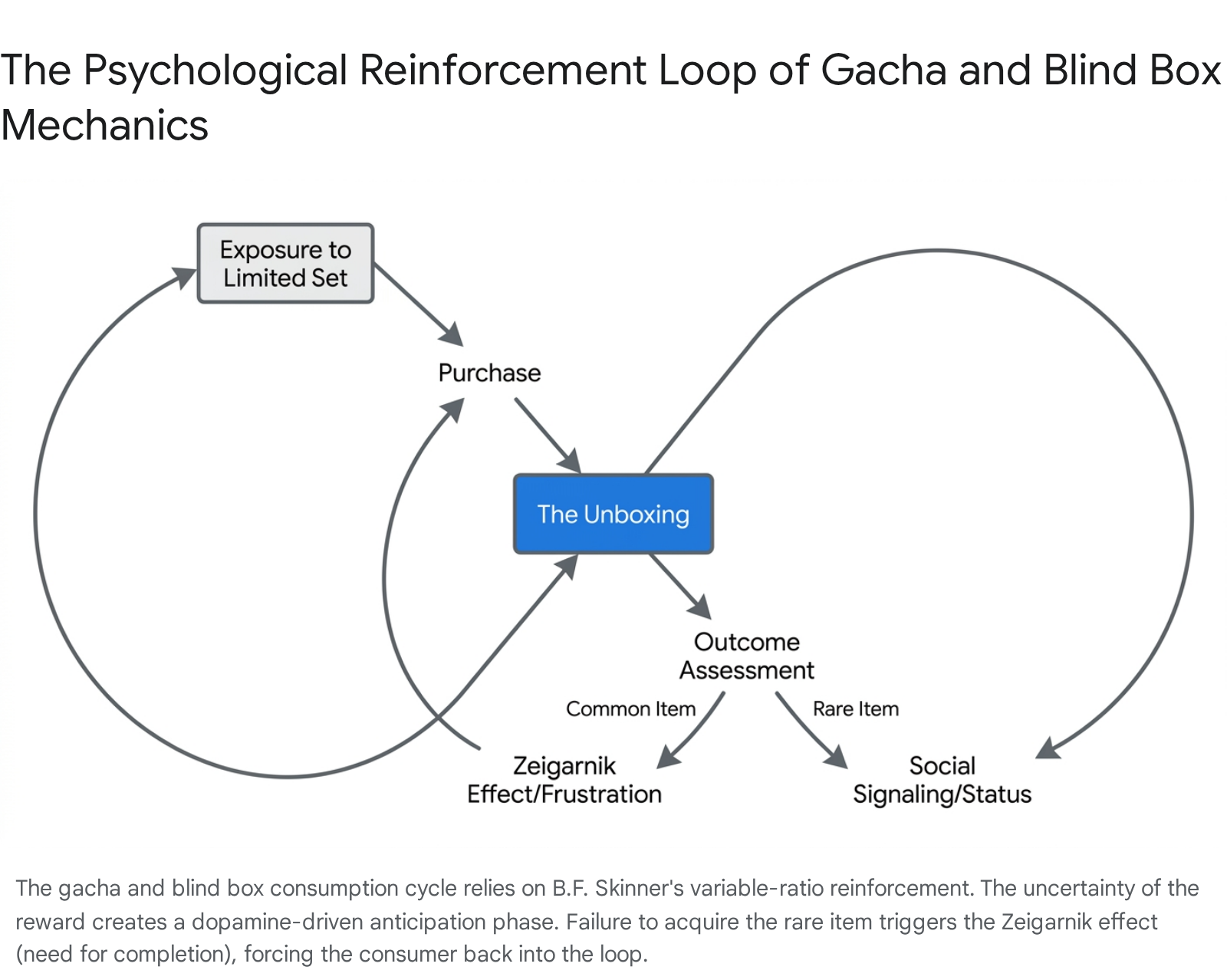
In this framework, rewards (the desired rare items) are delivered after an unpredictable, varying number of responses (purchases). This is the exact psychological mechanism utilized by casino slot machines, known to foster persistent anticipation and a severe resistance to behavioral extinction 3940.
This model actively preys on cognitive dissonance and the sunk cost fallacy. When a consumer opens a box and receives a duplicate or an undesired common figure, the resulting disappointment frequently drives them to purchase another box immediately. The drive to resolve the tension of an incomplete collection invokes the Zeigarnik effect - the psychological tendency for the human brain to fixate on uncompleted tasks while easily forgetting completed ones 39.
The success of these mechanics has birthed the massive "Guzi" (goods) and emotional economy. In 2024, the market scale for China's emotional economy reached 2.3 trillion yuan (approximately $317 billion USD), with consumers explicitly utilizing blind boxes and character merchandise to alleviate life stress 41. The philosophy of "self-pleasing" prioritizes fleeting spiritual and emotional highs over traditional functional utility, illustrating that the psychological desire for unpredictable surprise transcends conventional economic rationale 41.
Digital Goods, Skins, and Virtual Exclusivity
As commerce increasingly migrates to digital environments, the implementation of artificial scarcity has evolved. Physical limitations regarding raw materials, manufacturing capacity, or shipping logistics no longer apply to digital goods. Consequently, scarcity in the digital realm is entirely engineered by code, presenting novel psychological dynamics 8.
In-Game Cosmetic Items and Psychological Ownership
One of the most robust and financially lucrative applications of digital scarcity is found within the video game industry, specifically regarding in-game cosmetic items, colloquially known as "skins." These items offer no objective gameplay advantage; their value is entirely aesthetic, social, and psychological 5142.
The demand for virtual skins is driven by a deep sense of psychological ownership. Research indicates that when players actively customize their avatars - choosing distinct visual elements rather than relying on pre-made templates - they experience the "IKEA effect." This small exertion of effort acts as an emotional adhesive, establishing strong psychological ownership over the digital asset 51. This customization leads to "avatar embodiment," a cognitive blurring of the lines between the physical self and the digital representation. Once this connection is established, the avatar's appearance becomes a vital vehicle for self-expression and social signaling 51.
In digital environments, rare skins from past seasonal events or limited-time battle passes function as digital badges of honor. They communicate dedication, historical presence, and status to the broader gaming community, satisfying the fundamental human need for social recognition 5143. The financial implications of this manufactured digital rarity are staggering. A 2025 analysis of the secondary trading market for skins in the competitive game Counter-Strike revealed that diversified portfolios of these digital assets generated an average annual return of up to 66.9% over a ten-year period, significantly outperforming traditional stock market indices 4445. However, this hyper-financialization of virtual scarcity carries immense volatility, as the value is entirely dependent on the developer's willingness to maintain artificial supply caps 44.
Virtual Fashion and Metaverse Economics
The principles of digital scarcity are also aggressively infiltrating the broader fashion industry via the metaverse. The virtual fashion market, projected to reach $6.61 billion by the end of 2025 and upwards of $12.26 billion by 2030, relies on selling digital garments for avatars or augmented reality filters 564647. Proponents argue these items address urgent environmental concerns by eliminating textile waste and carbon-heavy supply chains 464849.
However, digital clothing faces a significant psychological hurdle: the absence of tactile stimuli. Traditional fashion consumption relies heavily on a consumer's need for touch to assess quality and fit 4849. To overcome this sensory deficit, digital fashion houses rely almost entirely on the psychology of scarcity and rarity to manufacture value. Studies investigating consumer attitudes in metaverse retailing reveal a paradoxical interaction: high product availability typically decreases purchase likelihood, but when a virtual item is explicitly branded as highly "rare" (often backed by blockchain NFTs), high visibility actually increases the consumer's Need for Uniqueness and drives sales 50.
Consequently, digital fashion houses like The Fabricant and legacy luxury brands like Adidas utilize smart contracts to enforce strict production limits on virtual garments. By issuing limited digital collectibles and "phygital" twins (digital counterparts to physical items), brands ensure their digital assets retain their prestige as social currency, projecting that digital fashion could represent 10% of luxury brand revenues by the end of 2025 564651.
Algorithmic Scarcity and Digital Waiting Rooms
Beyond the products themselves, the digital infrastructure of modern commerce has become a tool for manufacturing urgency. Platform-engineered scarcity utilizes algorithms to control the flow of consumer access, transforming the baseline act of purchasing into a stressful competitive event.
The Ticketmaster Virtual Queue Phenomenon
The most prominent example of algorithmic scarcity is the digital waiting room, notoriously utilized by ticketing monopolies like Ticketmaster. Nominally designed to pace server traffic and mitigate automated bot interference, the virtual queue acts as an intense psychological pressure cooker 6364. Consumers are sequestered in a holding area, observing their numerical place in line without any guarantee of eventual success or price stability.
This digital environment perfectly weaponizes both quantity and time scarcity simultaneously. The consumer is acutely aware that a finite number of seats exist and that hundreds of thousands of other users are competing for them in real-time 63. The interface provides continuous, tension-building updates. When a user finally clears the queue, the relief and adrenaline are immense, effectively paralyzing their ability to rationally evaluate dynamic pricing surges, dynamic seating maps, or auxiliary service fees.
The psychological toll of these algorithmic systems reached a breaking point during high-demand events, most notably the 2022 Taylor Swift Eras Tour presale. Millions of fans were trapped in stalling queues, leading to a profound shift in consumer sentiment. Researchers tracking the crisis noted that public discourse rapidly escalated from baseline technical frustration to severe moral condemnation 52. Consumers perceived the opaque algorithmic queue not as a fair line, but as an exploitative abuse of market power designed to force desperate purchasing decisions 52. This distrust was reignited and further exacerbated in early 2026 when Ticketmaster leadership admitted that queue placements were not entirely randomized, fueling widespread consumer theories that the algorithm secretly favored specific account behaviors - such as frequent transferring or reselling - leaving genuine fans at a systematic disadvantage 5354.
Market Saturation, Fatigue, and Consumer Skepticism
While artificial scarcity is a highly potent stimulant, the consumer psyche is not immune to tolerance. Continuous exposure to manufactured urgency and restrictive availability inevitably leads to psychological exhaustion, manifesting in the market as scarcity fatigue and luxury lethargy.
Luxury Lethargy and the Dilution of Exclusivity
The luxury fashion sector historically relies on maintaining strict supply-side scarcity to uphold the prestige and aspirational appeal of its goods 455. However, recent aggressive expansion strategies have critically undermined this foundation. In pursuit of rapid volume growth, legacy brands have multiplied their retail touchpoints, embraced omnichannel distribution, and flooded the market with accessible entry-level product lines 56. This ubiquity directly contradicts the fundamental premise of luxury: relative inaccessibility 56.
The dilution of exclusivity, combined with rapid post-pandemic price inflation disconnected from any corresponding increase in creativity or craftsmanship, has alienated the core consumer base 5657. Market projections for 2025 indicate a 5% contraction in the personal luxury goods market, with the sector shedding an estimated 50 million global customers since 2022 57. Surveys of affluent demographics reveal profound emotional detachment; consumers are increasingly skeptical of paying inflated prices for ubiquitous items that no longer confer genuine social status or signal elite belonging 57. When a heritage brand like Gucci expands to over 520 global stores, the resulting hyper-availability nullifies the snob effect, effectively stripping the product of its primary psychological utility 56.
Persuasion Knowledge and the Rejection of Manipulation
Scarcity fatigue is equally prevalent in digital environments, where consumers are constantly bombarded with urgency cues. As previously noted, modern consumers - particularly digital-native Millennials and Generation Z - possess high levels of persuasion knowledge 1720. When they encounter a "limited time offer" or an arbitrary "almost sold out" notification on an e-commerce site, they increasingly recognize it as an algorithmic manipulation designed to coerce them, rather than a reflection of genuine market dynamics.
When consumers detect manipulative intent, the psychological reactance that typically drives a purchase flips in the opposite direction. Instead of acting urgently to secure the product, they react negatively against the brand itself, leading to immediate cart abandonment, decreased brand trust, and punitive word-of-mouth 11220. Therefore, the rampant overuse of scarcity tactics without authentic, verifiable justification structurally damages a brand's long-term relationship with its audience, transforming marketing effectiveness into brand liability.
Ethical and Environmental Dimensions
The mechanics of artificial scarcity pose severe ethical and socioeconomic questions that extend far beyond market dynamics. The most glaring consequence is the acceleration of environmental degradation. The fast fashion and streetwear drop models explicitly encourage hyper-consumption, training consumers to buy impulsively and discard items rapidly as new, artificially scarce drops replace them in the cultural consciousness 34849.
More disturbingly, to maintain the illusion of supply-side scarcity and protect the psychological integrity of the snob effect, legacy luxury brands routinely engage in the systematic destruction of unsold inventory. Famously, in a single fiscal year, Burberry incinerated $36.8 million worth of its own perfectly viable products 4. This practice intentionally limits secondary market availability to uphold premium pricing, resulting in immense carbon emissions, habitat destruction, and egregious resource waste 4.
Socio-economically, artificial scarcity systematically worsens inequality. By deliberately pricing and restricting goods to cater exclusively to wealthy demographics, brands consciously widen socioeconomic gaps and foster an exclusionary culture driven by conspicuous consumption 34. In digital spheres, dynamic pricing algorithms and opaque algorithmic waiting rooms exploit behavioral biases, disproportionately affecting consumers with lower financial literacy or diminished impulse control, leveraging psychological vulnerability for corporate gain 258.
Conclusion
The psychology of limited edition and seasonal products operates at the complex intersection of evolutionary behavior and engineered digital commerce. Artificial scarcity manufactures urgency by deliberately triggering deep-seated cognitive mechanisms - namely Commodity Theory's association of rarity with value, and Reactance Theory's defense of threatened behavioral freedom. Whether deployed through physical streetwear drops, countdown timers on digital storefronts, algorithmic ticketing queues, or randomized gacha mechanics, the primary objective remains identical: to bypass rational evaluation and provoke an immediate, emotionally driven transaction.
However, the long-term efficacy of this strategy is highly volatile. The contemporary consumer landscape is increasingly defined by the tension between the effectiveness of these psychological triggers and the rising tide of consumer skepticism. As evidenced by escalating rates of post-purchase financial regret, the widespread activation of persuasion knowledge, and the contraction of the hyper-exposed luxury sector, the relentless overuse of manufactured urgency breeds profound consumer fatigue. To operate sustainably in the modern market, brands must balance the mechanics of scarcity with genuine authenticity, transparent practices, and a recognition of the severe ethical and psychological implications inherent in manipulating human desire.