
Loss Aversion in Digital Retail Pricing and Promotions
1. The Shifting Landscape of Modern Digital Retail
The global retail sector has undergone a profound transformation, moving rapidly from traditional physical storefronts to sophisticated, data-driven digital ecosystems. In the contemporary marketplace of 2025 and beyond, consumer behavior is increasingly characterized by complex, sometimes paradoxical, purchasing patterns. Macroeconomic pressures, such as persistent inflation, tariff uncertainties, and rising living costs, have forced consumers to make unexpected trade-offs 21. Retailers observe consumers cutting back on non-discretionary essential categories while simultaneously planning splurges on discretionary items that offer tangible comfort or emotional reassurance 2. According to McKinsey's 2025 State of the Consumer report, more than one-third of surveyed consumers have traded down in one area while planning to splurge in another, a pattern that renders traditional linear forecasting models obsolete 2.
Within this volatile environment, the battleground for consumer attention and wallet share has shifted entirely to the digital user interface (UI) and user experience (UX), where retailers deploy advanced psychological triggers to influence decision-making 23. Modern consumers navigate an omnichannel reality, engaging in "zigzag" journeys where they might discover a product via social commerce, research it using generative AI, and complete the purchase through a mobile application 26. The proliferation of artificial intelligence has further complicated this landscape; in early 2026, 68% of surveyed US consumers reported using AI tools, with nearly a fifth utilizing these platforms specifically to discover or decide on brands and products .
At the core of this digital persuasion architecture lies behavioral economics, a discipline that bridges psychology and microeconomics to explain how and why individuals frequently deviate from rational choice models 4. Foundational literature in this field, most notably the work of Daniel Kahneman and Amos Tversky on Prospect Theory (1979), established that human beings do not evaluate decisions based purely on absolute outcomes or Expected Utility Theory (EUT) 956. Instead, decisions are evaluated relative to a reference point, and the psychological pain of losing something is experienced roughly twice as intensely as the pleasure of an equivalent gain 41213. This phenomenon, known as loss aversion, has become a cornerstone of modern digital marketing, underpinning strategies ranging from exit-intent pop-ups and countdown timers to dynamic pricing algorithms and subscription models 7158.
However, the application of these behavioral principles in modern e-commerce is no longer a blunt instrument. Retailers are leveraging machine learning, predictive analytics, and hyper-personalization to deploy loss-aversion tactics with unprecedented precision 91011. Yet, as the sophistication of these tactics has grown, so too has the risk of consumer fatigue, psychological reactance, and the severe erosion of brand trust 1120. The pursuit of short-term conversion metrics through manipulative architectures frequently jeopardizes long-term customer lifetime value (LTV) 2021.
2. Theoretical Boundaries: Distinguishing Loss Aversion from Risk Aversion and Scarcity
A pervasive error in contemporary marketing discourse is the conflation of distinct behavioral principles - specifically loss aversion, risk aversion, and the scarcity heuristic. While these concepts frequently interact within digital retail environments, they operate on entirely different psychological mechanisms and trigger distinct consumer responses. Precision in understanding these boundaries is critical for optimizing digital strategies without alienating the consumer base.
The Foundational Principle of Loss Aversion
Loss aversion is strictly defined as the psychological asymmetry in evaluating gains and losses. It dictates that individuals are far more motivated to avoid a loss than they are to acquire a comparable gain 62212. Crucially, loss aversion requires a reference point - a baseline state of possession, expectation, or entitlement 5. When a digital retailer frames a promotion as "Stop losing $50 a month on bad trades" rather than "Make $50 a month more," they are artificially shifting the consumer's reference point, implying that the consumer already possesses the $50 and will forfeit it through inaction 132413. Evolutionary psychology suggests this developed as a survival mechanism, as avoiding immediate threats (losses) was historically more critical for survival than acquiring surplus resources 714. The pain of this imagined forfeiture is the engine of loss aversion, activating fear-based reactions in the brain's amygdala 14.
Divergence from Simple Risk Aversion
Risk aversion, by contrast, concerns an individual's general preference for certainty over uncertainty in decision-making contexts 27. A risk-averse consumer will typically choose a guaranteed, albeit smaller, positive outcome over a gamble with a potentially higher payoff but a chance of failure. While loss aversion can drive risk-averse behavior (e.g., choosing a familiar, reliable brand over a new entrant to avoid the "loss" of a substandard experience), the two concepts are not synonymous 927.
In fact, Prospect Theory demonstrates a critical inversion: while individuals are generally risk-averse when evaluating potential gains, they reliably become risk-seeking when evaluating potential losses 515. If a consumer faces a certain loss, they may take significant, mathematically irrational risks to avoid it. In a retail context, this explains why consumers might impulsively purchase an expensive extended warranty; the certain, small financial loss (the premium) is accepted to eliminate the risk of a massive, uncertain loss (product failure) 14. In online shopping, a consumer might engage in risky purchasing behavior (e.g., buying from an unverified third-party seller) if it is the only way to avoid the loss of an expired discount.
The Distinction from Basic Scarcity
Scarcity bias operates on the fundamental economic principle of supply and demand: items perceived as rare, limited, or difficult to obtain are automatically assigned higher cognitive value 122212. The human brain assigns greater worth to scarce items even if their intrinsic utility remains entirely unchanged 12.
While scarcity often triggers loss aversion - because the limited supply introduces the imminent threat of missing out - scarcity itself is an assessment of availability, whereas loss aversion is an emotional response to deprivation 722. For example, a digital tag stating "Only 2 items left in stock" utilizes scarcity to signal high demand and exclusivity 712. This environmental signal of scarcity subsequently activates the consumer's loss aversion: the deep-seated fear of losing the opportunity to acquire the item 78. Understanding this sequential mechanism - that scarcity is the environmental condition and loss aversion is the psychological reaction - allows retailers to calibrate their messaging more effectively without crossing into deceptive practices 8.
3. Deepening Specific Mechanisms: The Endowment Effect in Modern Commerce
The endowment effect is a direct corollary of loss aversion. It describes the phenomenon wherein individuals intrinsically assign greater value to an object simply because they own it, or feel they own it 221617. Once ownership - or even pseudo-ownership - is established, parting with the object is coded by the brain as a loss, triggering intense loss-aversive resistance 2717. Modern digital retail has aggressively weaponized the endowment effect through structural innovations designed to establish a sense of psychological ownership long before a final, irreversible financial commitment is made.
The Psychology of "Buy Now, Pay Later" (BNPL)
The explosive proliferation of Buy Now, Pay Later (BNPL) platforms represents one of the most significant applications of the endowment effect in contemporary consumer finance 1618. Traditional purchasing requires a simultaneous and painful exchange: the acquisition of the good (a gain) and the immediate depletion of capital (a loss). BNPL fundamentally decouples consumption from payment, radically altering the consumer's mental accounting 1618.
When a consumer selects a BNPL option at a digital checkout, they receive the physical or digital item immediately. Psychological ownership is established instantly, and the item seamlessly enters the consumer's "endowment" 16. Because the financial pain of payment is deferred and broken into smaller, seemingly manageable fractions (e.g., four interest-free payments of $25 rather than a $100 lump sum), the immediate cognitive registration of the cost is severely dampened, a phenomenon often referred to as the reduction of the "pain of paying" 1618.
If the consumer later considers returning the item to avoid the remaining installment payments, the endowment effect activates powerfully: they are no longer rationally evaluating whether to spend money to acquire a new good, but rather whether to suffer the emotional loss of a good they already possess and use 1617. Furthermore, data from 2024 and 2025 indicates that consumers who utilize BNPL frequently view the deferred liquidity as part of their total available funds, leading to a false perception of increased purchasing power and higher overall average order values 1617.
Extended Free Trials and Forced Continuity
Digital subscriptions, Software-as-a-Service (SaaS) platforms, and premium retail memberships heavily rely on extended free trials to exploit the endowment effect 221332. By offering 30 or 60 days of unrestricted access, the service provider allows the consumer to deeply integrate the product into their daily workflow or entertainment routine. The service transitions from a novelty to the baseline status quo 13.
When the trial period nears expiration, the decision architecture shifts entirely. The consumer is not asked to "buy" a new service; rather, they are forced to confront the loss of a service they have grown accustomed to 32. Conversion copywriting in retention campaigns frequently amplifies this dynamic by framing expiration notices strictly as losses: "Your premium access ends tomorrow" rather than "Renew to keep your benefits" 137. The friction of the cancellation process, combined with the psychological pain of losing access to accumulated data, personalized algorithms, or premium shipping benefits, significantly reduces churn rates and drives forced continuity 4.
Frictionless Return Policies
Counterintuitively, highly permissive and frictionless return policies are not merely customer service mechanisms designed to build goodwill; they are profound drivers of the endowment effect 14. By guaranteeing an easy, no-cost return process, retailers dramatically lower the perceived risk of the initial transaction, encouraging hesitant shoppers to treat the purchase as a risk-free "trial" 13.
However, once the product arrives in the consumer's home, the endowment effect takes hold. The physical possession of the item, combined with the minor hassles associated with repackaging, printing labels, and shipping (known behaviorally as hassle factors), creates a powerful inertia 19. The item has shifted from a potential acquisition to a current possession, and returning it now feels psychologically akin to a loss. Retailers willingly accept the logistical costs of generous return policies because the behavioral friction generated by the endowment effect ensures that the vast majority of items are kept, ultimately driving higher net revenues 13.
4. Broadening to Modern Digital Retail: UI/UX Applications
Beyond structural financial models like BNPL, the principles of loss aversion are embedded directly into the micro-interactions of digital UI/UX design. The architecture of a modern e-commerce website or mobile application is meticulously curated to guide the consumer toward conversion by systematically highlighting the pain of inaction.
Cart Abandonment and Exit-Intent Architecture
Cart abandonment remains a critical friction point in e-commerce, often occurring when consumers use the shopping cart as a secondary wish list or balk at unexpected shipping costs presented at checkout 20. To combat this, modern platforms utilize sophisticated push notifications and exit-intent pop-ups that leverage precise loss framing.
Research utilizing a stimulus-organism-response (SOR) framework demonstrates that personalized push notifications utilizing gain-loss framing significantly impact purchase intent, particularly for utilitarian products 20. When an exit-intent pop-up states, "Don't lose the items in your cart - your 15% discount expires in 10 minutes," it introduces a dual-threat of loss: the loss of the curated items and the loss of the financial discount. This loss-framed messaging capitalizes on the fear of missing out (FOMO) and creates an artificial urgency that overrides the consumer's initial hesitation, forcing a faster, more impulsive transition from System 2 (deliberative, analytical) thinking to System 1 (automatic, emotional) thinking 7820.
Countdown Timers and Artificial Urgency
The implementation of countdown timers on product display pages (PDPs) and checkout flows represents the most visceral visualization of impending loss 15. A ticking clock captures human attention within 0.5 seconds due to evolutionary wiring prioritizing the detection of motion 15. More importantly, the timer provides an external structure to decision-making, effectively solving the "paradox of choice" by enforcing a rigid, unyielding deadline 15.
The efficacy of countdown timers is rooted entirely in loss aversion. The timer visually represents the approaching loss of a deal, discount, or product availability 1512. Studies indicate that genuine decision deadlines can increase immediate purchase likelihood by 8% to 14% 15. Generational analyses reveal that Millennials and Generation Z, cohorts heavily conditioned by the ephemeral nature of social media and rapid digital consumption, are particularly susceptible to these FOMO-inducing urgency tactics, responding strongly to phrases like "Trending now: Only a few left!" when combined with ticking visual elements 12.
Defaults and Choice Architecture
The strategic use of default options is another highly effective, yet subtle, application of loss aversion. When a platform pre-selects a specific tier of shipping, an auto-renewal toggle for a subscription, or a premium feature package during onboarding, it establishes that specific option as the baseline reality 4. To deselect the option requires active cognitive effort and forces the consumer to actively "give up" a perceived benefit 4. In SaaS and digital retail, pre-selected upgrades have been shown to increase adoption by 12% to 22%, as consumers exhibit strong default bias to avoid the cognitive load of decision-making and the potential regret of making a sub-optimal choice 411.
5. Quantitative Analysis: Gain-Framed vs. Loss-Framed Messaging
The theoretical assertions surrounding loss aversion are heavily supported by empirical A/B testing data within the digital marketing sector. The direct comparison between "Gain-Framed" messaging (emphasizing what the consumer will acquire) and "Loss-Framed" messaging (emphasizing what the consumer will forfeit) consistently demonstrates the superior conversion power of loss-based semantics.
In a comprehensive analysis of e-commerce experiments, the data reveals significant variations in efficacy across different stages of the funnel and different messaging styles. While the average e-commerce conversion rate hovers around 2.5%, top performers who systematically deploy behavioral testing achieve rates closer to 5.5% 35. The execution of these tests often relies on prioritization frameworks like PIE (Potential, Importance, Ease) to avoid wasting testing cycles on low-impact elements 35. Furthermore, advanced retail teams increasingly favor Bayesian A/B testing over traditional Frequentist approaches, as Bayesian models provide the continuous probability of a variant's superiority, allowing for faster, more actionable decisions on low-traffic pages without waiting months to reach arbitrary significance thresholds 35.
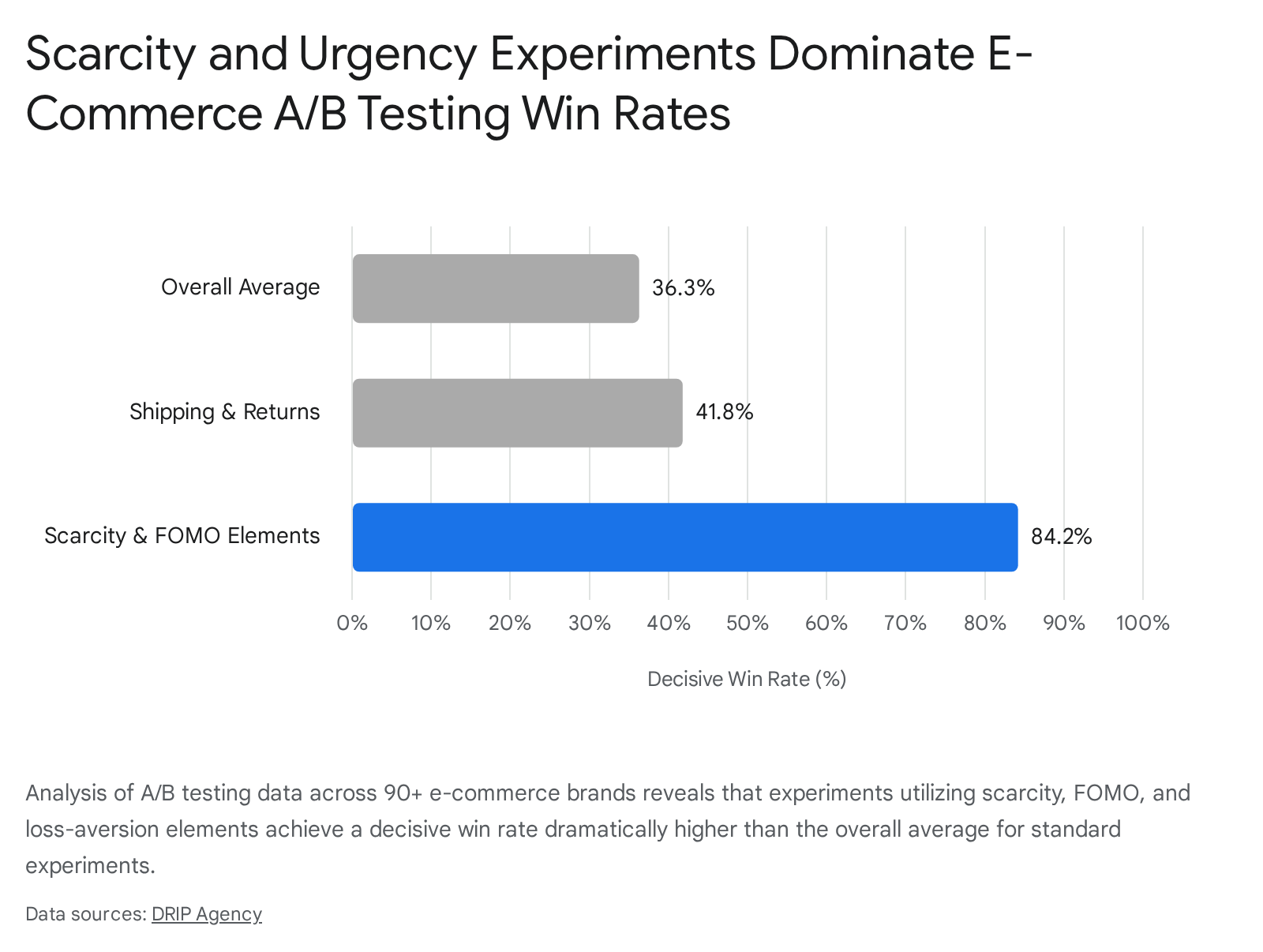
A proprietary database of over thousands of A/B tests across 90+ European e-commerce brands indicated an average win rate for experiments at 36.3%, with 41.6% producing inconclusive results 36. Successful tests delivered a median conversion rate uplift of 1.88% and a Revenue Per Visitor (RPV) uplift of 2.77% 36. The testing surface matters immensely: Product Display Pages (PDPs) dominate testing volume (47%) with a high win rate of 37.6% and a low loss rate of 20.3%, making them the highest expected-value testing surface 36. Conversely, checkout experiments are high-stakes, presenting a 36.1% win rate but a massive 28.9% loss rate, meaning a failed test directly damages revenue 36.
Crucially, tests involving scarcity, FOMO, and loss aversion dramatically outperform neutral or purely functional tests, achieving an 84.2% decisive win rate when inconclusive results are removed 36.
Further controlled experiments consistently validate this asymmetry. For instance, in lead generation and Google Ads (PPC) environments, loss-framed advertisements ("Stop Losing 50% of Your Potential Visitors") routinely generate click-through rates up to 24% higher and form submission rates 18% higher than mathematically identical gain-framed variants ("Boost Your Website Traffic by 50%") 24. Similarly, subscription retention campaigns demonstrate that emails emphasizing lost benefits achieve a 30% higher retention rate than those emphasizing continuous gains 7.
The table below synthesizes structured data comparing the impact of Gain-Framed versus Loss-Framed messaging across various core e-commerce applications.
| E-Commerce Application | Gain-Framed Messaging Example | Loss-Framed Messaging Example | Conversion/Performance Metric Comparison | Source Evidence |
|---|---|---|---|---|
| Subscription Retention | "Keep enjoying exclusive content" | "Don't lose access to exclusive content" | Loss-frame achieved a 30% higher customer retention rate. | 7 |
| PPC Ad Copy / Lead Gen | "Boost Your Website Traffic by 50%" | "Stop Losing 50% of Your Potential Visitors" | Loss-frame generated 24% higher CTR and 18% more form submissions. | 24 |
| B2C Flash Sales | "Get 20% off today" | "Don't lose 20% off today" | Loss-frame produced significantly stronger purchase intentions for short-term transactional products. | 21 |
| General E-commerce Promos | Highlight standard discount value. | Emphasize "Only 2 left in stock" | Loss/Scarcity frame increased checkout conversion rates by 35%. | 7 |
| Checkout/Cart Abandonment | "Gain free shipping with this order" | "You are about to lose free shipping" | Loss-aversion variations yielded the highest mean scores for maximizing conversions and page views. | 27 |
These structured comparisons highlight that while gain-framed messages are perceived as positive and encouraging, loss-framed messages create an undeniable psychological friction that demands immediate resolution, driving the superior conversion metrics seen across modern retail platforms 2722.
6. Cross-Cultural Consumer Behavior: Geographically Diverse Markets
While loss aversion is generally considered a universal human cognitive trait rooted in deep evolutionary survival mechanisms, its manifestation and efficacy in consumer behavior vary significantly across different geographic and cultural contexts. The application of framing effects cannot be treated as a monolith; global retail brands must carefully calibrate their UX strategies based on established cultural dimensions, particularly the spectrum of individualism versus collectivism and high-context versus low-context communication 232425.
Western Markets: Individualism and Direct Framing
In Western, developed economies such as the United States, United Kingdom, and Germany, consumer culture is heavily skewed toward individualism and low-context communication 24. Consumers in these markets tend to prioritize personal achievement, individual rights, and direct, explicit messaging. Consequently, digital retail strategies in these regions often succeed using highly direct, aggressive loss-framing and scarcity tactics 8. Countdowns, flash sales, and explicit warnings about missed individual opportunities resonate strongly, as the threat of loss is perceived as a direct threat to personal utility or status 13.
However, nuanced research indicates that pure gain-framed messages can sometimes resonate better with American consumers when promoting concepts tied to positive individual identity or morality, such as fair-trade or sustainable consumption 2627. For instance, a 2023 study comparing Vietnamese and American consumers found that Americans responded more favorably to gain-framed messages highlighting the positive outcomes of fair-trade for farmers, whereas Vietnamese consumers were more persuaded by loss-framed messages 26.
Southeast Asia and the GCC: Collectivism and High-Context Communication
In contrast, markets in Southeast Asia (SEA) and the Gulf Cooperation Council (GCC) are predominantly characterized by collectivist orientations and high-context communication styles 2428. In these cultures, the individual is deeply embedded in the social fabric, and meaning is often derived from implicit cues, relationship dynamics, and maintaining social harmony 2425.
Cross-cultural advertising analyses from 2019 to 2024 reveal that standardized global content utilizing aggressive, Western-style loss framing often underperforms in SEA 2425. Instead, mobile-first campaigns that integrate local languages, community values, and visual storytelling achieve significantly higher engagement 24. In collectivist cultures, loss aversion is frequently triggered not merely by the fear of losing an individual financial discount, but by the fear of social exclusion or the loss of group status 23. Thus, framing that emphasizes social proof alongside loss aversion (e.g., "Don't be the only one in your community to miss this") is exceptionally potent 28. In the GCC, consumers demonstrate a high susceptibility to heuristic biases; surveys indicate that 68% are heavily influenced by price anchoring, and 74% rely on social proof and influencer endorsements to validate quality before engaging with a loss-framed promotion 28.
Latin America: Economic Hybridity and Consumer Ethnocentrism
The Latin American market presents a complex hybrid of cultural patterns and economic realities 129. The region experiences high digital connectivity but also significant economic volatility, inflation, and tariff uncertainties, making consumers highly price-sensitive and focused on securing essentials 129. While there is a strong cultural identity and theoretical potential for consumer ethnocentrism (preferring local brands), actual purchasing data reveals a stark disconnection: only 9% to 14% of consumers actively prefer local brands in practice, with the vast majority prioritizing affordability and perceived tangible value over cultural loyalty 29.
In these hybrid markets, loss aversion is intimately tied to immediate economic security. Digital retailers operating in Brazil or Mexico find that consumers are highly responsive to loss-framed promotions because the baseline economic environment is already perceived as risky and volatile. However, manufactured urgency or manipulative dynamic pricing are met with profound skepticism 1. Strategies in Latin America must blend the urgency of loss aversion with strong signals of brand reliability, emphasizing that a purchase protects the consumer's limited capital from inflation or inferior product quality 29.
The Bicultural Consumer and Frame Switching
Global digitalization and migration have also created the "bicultural consumer" - individuals who navigate multiple cultural identities depending on the context and environment 23. Marketers can utilize a "Cultural Nudging Framework," employing specific linguistic cues in digital UI to trigger either an individualist or collectivist mindset before presenting a framed offer 23. By deliberately activating a specific cultural frame, the retailer alters what the consumer perceives as the "real loss" (e.g., a financial penalty versus a familial disgrace), dramatically amplifying the persuasiveness of the message and creating highly responsive micro-segments 23.
7. The Dark Side of Persuasion: Limitations, Fatigue, and Backfire Effects
While the short-term conversion metrics of loss-aversion strategies are overwhelmingly positive, a structural overreliance on these tactics poses severe long-term risks to brand equity. The modern digital consumer is becoming increasingly digitally literate, leading to phenomena such as consumer fatigue, psychological reactance, and heightened awareness of deceptive design.
Consumer Fatigue and Psychological Reactance
The pervasive use of urgency cues, countdown timers, scarcity alerts, and hyper-personalized recommendations across the digital ecosystem has led to widespread consumer fatigue 81130. When every retailer claims that an offer is "ending soon" or that there are "only 2 left," the signal loses its potency. This relentless barrage induces emotional fatigue, a state of annoyance, defensiveness, and indifference, particularly among younger, digitally native demographics who quickly recognize manufactured urgency 1130. This state of hyper-engagement creates a psychological burden, reducing users' ability to focus and increasing decision fatigue 11.
When consumers perceive that their autonomy is being undermined by algorithms, they exhibit psychological reactance - a motivational state directed toward re-establishing threatened freedom 831. In the context of e-commerce, reactance manifests as immediate cart abandonment, negative brand perception, and an active refusal to engage with the promotion. Studies on dynamic pricing, for example, show that while transparent, personalized discounts can increase repeat purchases, demand-based surge pricing perceived as exploitative results in a 20% drop in repeat purchase intentions due to perceived unfairness 48.
The Rise of Dark Patterns
The aggressive optimization of behavioral heuristics frequently crosses the line into "dark patterns" - manipulative UI/UX designs that coerce users into taking actions they did not intend, such as forced subscriptions, hidden costs, or extreme difficulty in canceling services 202132. These interfaces intentionally exploit cognitive biases and System 1 thinking to subvert user autonomy 2033.
A comprehensive 2024 global review by the FTC, ICPEN, and GPEN of 642 subscription-based websites and apps worldwide found that an alarming 76% employed at least one dark pattern, and 67% used multiple deceptive tactics concurrently 20. The fashion e-commerce sector is particularly egregious; a quantitative study found dark patterns present on 78.4% of fashion websites, heavily utilizing "Nagging" and "Limited-time Messages," with a positive correlation between the number of dark patterns and overall website popularity 3435. Furthermore, a Cambridge University empirical design found strong evidence that individuals across all demographic groups (regardless of income, age, or educational attainment) are susceptible to dark patterns, refuting the idea that only "vulnerable" populations are affected 33.
8. Trust Erosion and the Regulatory Horizon
The business impact of deploying manipulative dark patterns represents a stark trade-off between short-term metric inflation and the catastrophic destruction of long-term Customer Lifetime Value (LTV) 202136. While mild dark patterns can double immediate subscription rates, and aggressive tactics can nearly quadruple them, the resultant damage to brand trust is often irreparable 20.
A 2023 Dovetail study revealed that 56% of respondents lost trust in a platform due to manipulative design, and over 43% permanently ceased purchasing from a retailer after experiencing dark patterns, leading to financial consequences and long-term resentment 20. When a consumer feels cheated by a fake countdown timer or trapped by a complex cancellation process, they not only churn but actively engage in negative word-of-mouth 152036. The psychology reverses: the loss aversion is redirected from "losing the deal" to "losing trust in the store" 15. Data confirms that authentic timers based on real inventory or firm deadlines outperform fake timers by 2x to 3x in long-term metrics precisely because they preserve this vital trust 15.
The erosion of trust is mathematically ruinous in modern retail. Customer acquisition costs (CAC) continue to rise rapidly, making retention and LTV the primary drivers of profitability 2154.
Ethical Considerations and Regulatory Scrutiny
The exploitation of cognitive biases has moved beyond academic debate and industry whitepapers directly into the crosshairs of global regulators. Lawmakers increasingly view extreme loss-aversion framing and dark patterns as forms of digital manipulation that require legislative intervention 33.
In the European Union, regulations such as the Digital Services Act and updated consumer protection directives place stringent restrictions on manipulative choice architectures, aiming to protect all consumer groups from exploitative UI 1633. Regulators are mandating transparency and "frictionless" opt-outs that mirror the ease of opt-ins, directly combating the forced continuity tactics that rely on the endowment effect and default bias. Furthermore, emerging privacy regulations in the United States, such as the Opt Me Out Act (effective 2027) and browser-level signals like Global Privacy Control (GPC), are actively combating "consent fatigue" by requiring websites to honor universal opt-out signals programmatically, stripping retailers of the ability to use nagging dark patterns to extract data 54.
For corporate executives and retail brands, the opportunity cost of regulatory enforcement is massive. Responding to compliance actions drains hundreds to thousands of executive hours, delays strategic product launches, and can result in 20% to 50% spikes in cyber liability insurance premiums 54. Ethical UX design, grounded in transparency, honesty, and authentic value exchange, is rapidly transitioning from a moral preference to a hard competitive advantage 20.
9. Conclusion
The deep integration of behavioral economics into modern digital retail has fundamentally altered the mechanics of digital commerce. By expertly leveraging cognitive heuristics - specifically the profound human aversion to loss, the paradox of choice, and the subsequent endowment effect - retailers have engineered digital environments that systematically reduce decision friction and accelerate immediate conversions. Tactics such as Buy Now, Pay Later models, artificial scarcity alerts, and loss-framed cart abandonment strategies demonstrably outperform traditional, gain-focused marketing approaches in short-term quantitative A/B testing environments.
However, the efficacy of these strategies is neither infinite nor universally applicable. The research clearly indicates that the uncalibrated application of loss aversion - particularly when it devolves into deceptive dark patterns or mathematically fake urgency - triggers severe backfire effects that cripple retention. The modern consumer landscape is characterized by high digital literacy, the rapid onset of marketing fatigue, and deep psychological reactance to perceived manipulation. Furthermore, in geographically diverse markets, from the collectivist cultures of Southeast Asia to the economically volatile environments of Latin America, standardized Western tactics frequently fail unless rigorously adapted to local cultural dimensions, high-context communication styles, and economic realities.
As global regulatory bodies systematically tighten the legal parameters of acceptable digital persuasion, the strategic imperative for retail executives must shift. The singular, myopic focus on optimizing immediate transaction conversion rates via psychological pressure must be balanced against the preservation of long-term Customer Lifetime Value, brand equity, and regulatory compliance. Sustainable competitive advantage in the coming decade will belong to retailers who utilize behavioral science not as a tool for digital coercion, but as a framework for building transparent, personalized, and genuinely valuable user experiences that align with both the consumer's rational goals and emotional needs.