
Psychology of Urgency Cues and E-Commerce Conversion Rates
The integration of urgency and scarcity cues into digital retail environments represents a sophisticated application of behavioral economics and consumer psychology. Time-limited offers, such as countdown timers, and quantity-limited signals, such as low-stock alerts, are engineered to compress the consumer decision-making timeline. By manipulating the perceived availability of a product or the duration of an economic incentive, digital retailers routinely alter the cognitive processing routes of their users. This manipulation actively shifts consumer behavior from deliberative, rational evaluation to heuristic, impulse-driven action 112.
While the efficacy of these cues in driving immediate transaction volume is well-documented within digital marketing literature, the psychological mechanisms underlying these outcomes dictate a complex web of secondary effects. Urgency cues do not merely convey logistical information about supply chain inventory; they actively alter physiological arousal, cognitive load, and the baseline perception of product value 1434. Consequently, the strategic application of urgency in e-commerce produces a wide spectrum of behavioral outcomes. These range from accelerated purchasing and increased short-term conversion rates to adverse psychological responses such as decision paralysis, post-purchase regret, and brand fatigue 567. Furthermore, as the prevalence of synthetic or "fake" urgency cues increases, regulatory bodies and consumers alike are developing mechanisms to detect and penalize deceptive design, fundamentally altering the long-term utility of scarcity as a promotional tactic 8910.
Cognitive Mechanisms of Urgency
The psychological potency of urgency cues is rooted in their ability to stimulate specific neurological and physiological responses that prioritize immediate action over sustained deliberation.
Stimulus-Organism-Response and Dual-Process Theory
The Stimulus-Organism-Response (S-O-R) paradigm provides a foundational framework for understanding how digital scarcity operates. This model posits that external digital stimuli - such as flash sales or visual countdowns - alter the internal organismic state, specifically regarding emotional arousal and cognitive load, which subsequently dictates the behavioral response, be it rapid purchase or cart abandonment 21112.
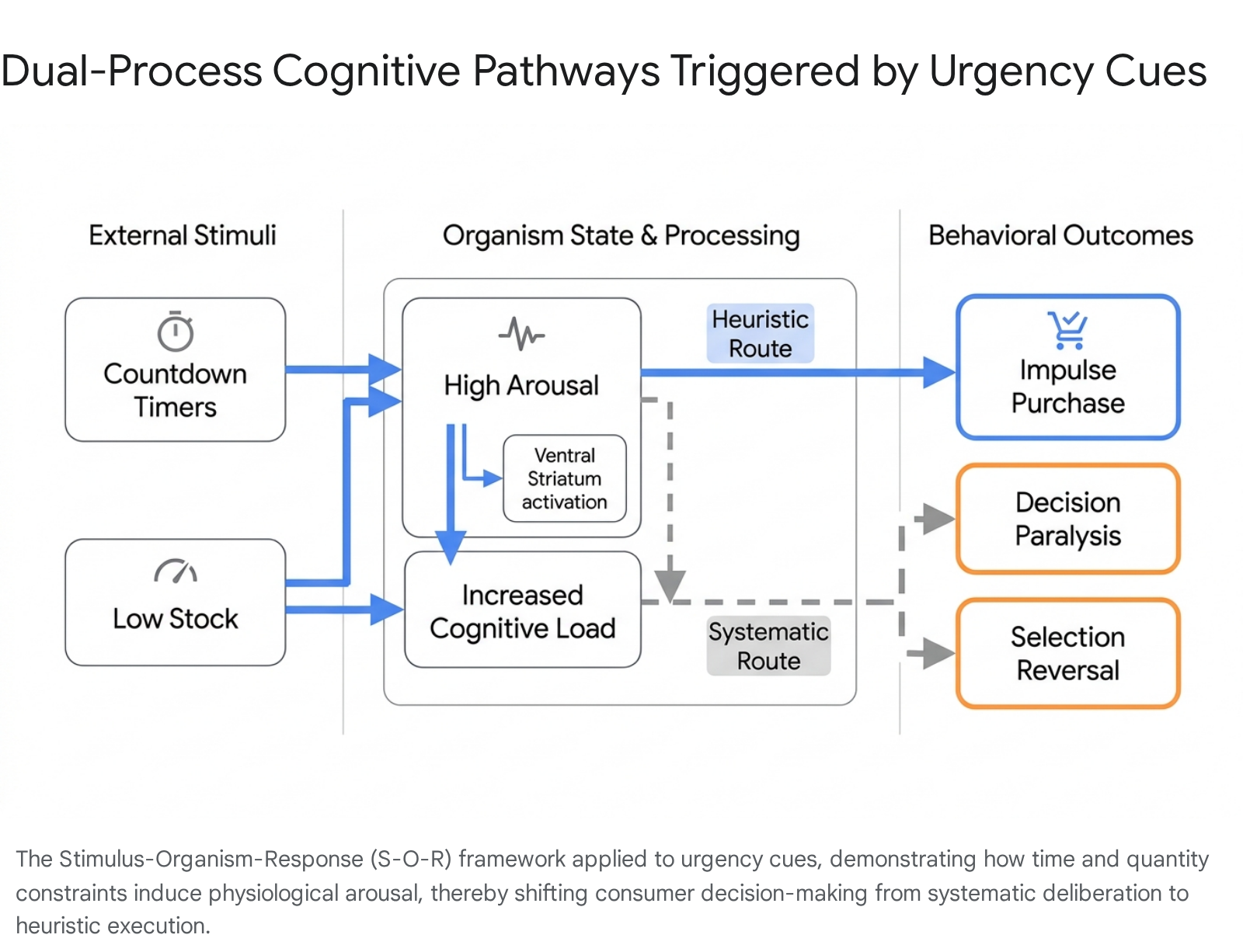
Within this framework, consumer decision-making operates along a continuum described by dual-process theory, delineating two distinct cognitive pathways. The systematic, deliberative route is associated with cognitive control and the prefrontal cortex, whereas the heuristic, affect-driven route is associated with rapid intuitive responses and the amygdala 1213. In a standard e-commerce environment devoid of time pressure, consumers are more likely to engage in systematic processing, evaluating product attributes, comparing alternatives, and assessing long-term utility 12.
The introduction of an urgency cue actively suppresses this systematic processing. Time pressure imposes strict cognitive constraints, drastically reducing the temporal bandwidth required for thorough evaluation 14. Under such constraints, the human brain defaults to heuristic rules - mental shortcuts that rely on common sense, peripheral cues, or past experiences to expedite a choice 1. Rather than rationally calculating the functional value of an item, the consumer substitutes the complexity of evaluation with a simpler heuristic assumption: if the item is scarce, it must be inherently valuable and desirable 141715.
This heuristic shift is intimately linked to processing fluency, defined as the subjective experience of ease or difficulty when processing information 1916. Scarcity signals, when clearly presented, can temporarily enhance decision-making speed by removing the cognitive burden of extended comparison 1917. However, if urgency cues contradict other on-page information, or if multiple scarcity signals compete for attention simultaneously, processing fluency degrades. This increases cognitive strain, meaning the consumer is more likely to experience frustration rather than a seamless path to purchase 1918.
Physiological Arousal and Neurological Impact
The transition from deliberative to heuristic processing is biologically catalyzed by physiological arousal. From a clinical and neurological perspective, moments of induced urgency are characterized not merely by focused psychological attention, but by tangible autonomic nervous system activation 4319. Experimental psychology demonstrates that exposure to strict time constraints or diminishing resources triggers an adrenaline response, elevating the heart rate and blood pressure - a state of physiological arousal akin to a mild fight-or-flight response 4320.
This arousal state is deeply tied to the brain's reward processing centers. The ventral striatum evaluates potential positive outcomes, while the amygdala processes emotional urgency and potential threats 1321. In a retail context, consumers often interpret this arousal not as fear, but as excitement or competitive drive 41522. The arousal acts as an "affect-as-information" signal, indicating to the consumer that the current decision is of high importance and requires immediate resolution 23.
However, the relationship between arousal and optimal decision-making follows a U-shaped curve. Moderate arousal facilitates faster, highly engaged decision-making. Conversely, hyper-arousal degrades the functionality of the brain's decision-making circuits. When physiological stress exceeds a certain threshold, neural pathways may reconfigure to prioritize tracking internal interoceptive states - such as heart rate and respiration - rather than external tasks like evaluating a shopping cart 31920.
Urgency-Gating and Information Processing
The exact mechanism by which time pressure alters information evaluation can be modeled quantitatively. According to the LATER (Linear Approach to Threshold with Ergodic Rate) model of decision-making, instructing an individual to respond hastily effectively alters the internal threshold at which a decision signal triggers an actionable response 4.
Furthermore, digital commerce often involves dynamic information environments where product details or peer reviews appear intermittently with temporal gaps. In these scenarios, the brain utilizes an "urgency-gating" mechanism. Evidence is not merely accumulated sequentially; instead, it is low-pass filtered and combined with an internal urgency signal that grows continuously over time 2824. Traditional accumulation models fail to capture this dynamic, indicating that under the influence of an artificial countdown timer, the later a piece of information is presented in the decision window, the differently it is weighted due to the compounding internal urgency signal 2824.
Effects on Conversion Rates and Decision Dynamics
The deployment of urgency cues yields multifaceted outcomes that extend beyond binary, immediate conversion metrics. While the primary objective of these psychological triggers is to optimize transactional velocity, their influence permeates the entire lifecycle of the decision, affecting pre-purchase hesitation, the scale of choice overload, and post-purchase satisfaction.
Short-Term Conversion Optimization
In the short term, the strategic application of scarcity and urgency operates as a highly effective conversion lever. Empirical data consistently demonstrates that authentic urgency cues lift click-through rates and finalize purchase conversions. For instance, incorporating time-sensitive language into email marketing subject lines has been shown to increase open rates by up to 22%, and scarcity messages can elevate click-through rates by up to 50% 25.
The presence of a countdown timer or a limited-stock indicator creates an artificial deadline that forces the consumer out of a passive browsing state and into an active buying state 426. By limiting the temporal window for action, retailers successfully prevent choice deferral 2227. In an environment where global cart abandonment rates hover around 70-74%, minimizing the time a consumer has to second-guess a purchase is a central objective of conversion rate optimization 1928. Scarcity signals achieve this by establishing a clear opportunity cost for inaction 134.
Accelerating this initial conversion has profound macroeconomic implications for digital storefronts. Data analyzing customer lifetime value (LTV) demonstrates that individuals who make an initial purchase within the first three days of interacting with a brand's website exhibit a six-month LTV of $178, compared to an LTV of just $14 for those who do not convert within that initial window - a difference of over 12X 29.
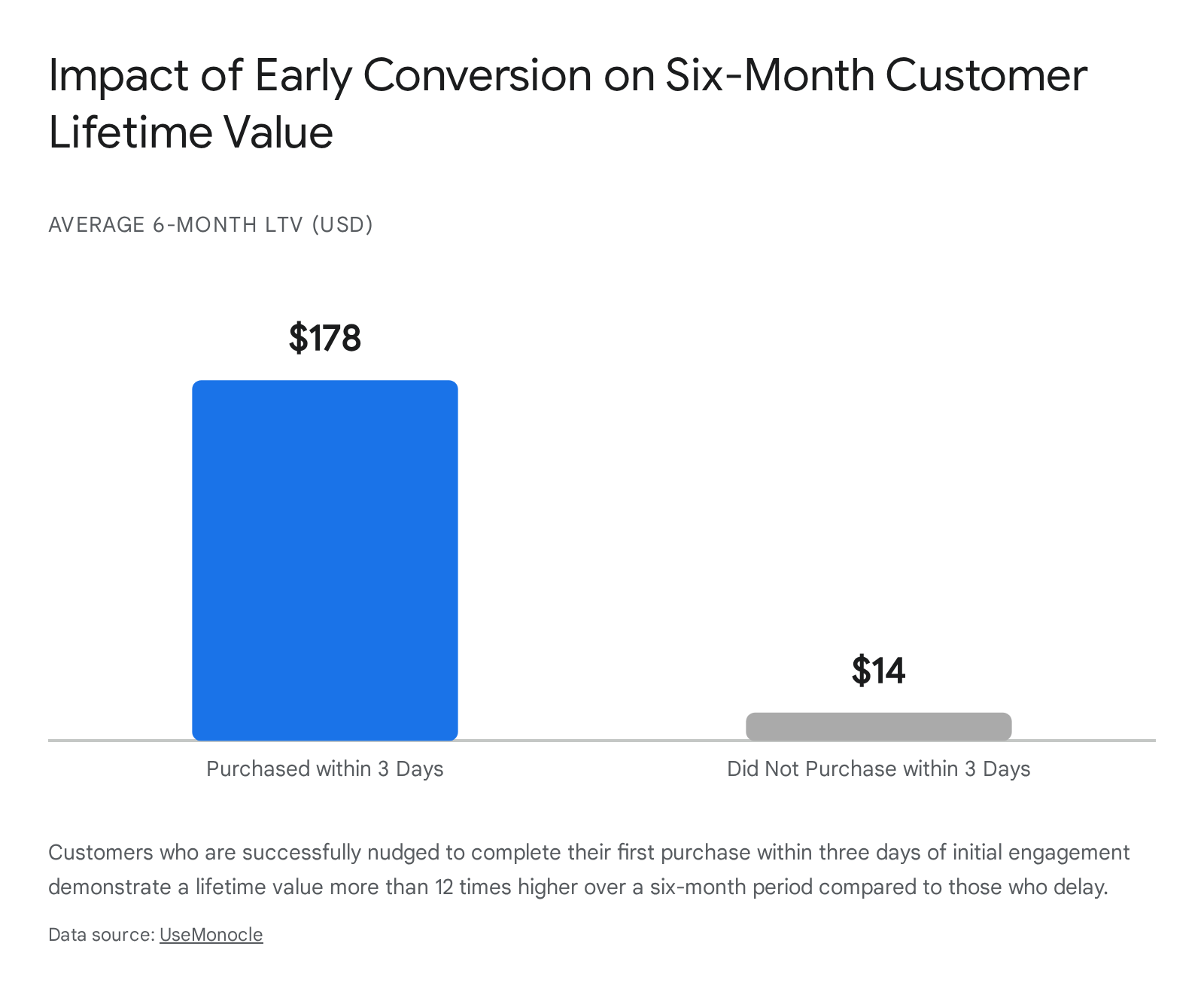
For those early converters, the first purchase accounts for nearly 74% of their total six-month value 29. Consequently, urgency cues are heavily utilized not just to secure a single cart, but to lock consumers into a high-yield LTV trajectory.
Decision Paralysis and Choice Overload
Despite the proven efficacy of urgency in driving isolated conversions, the aggressive or simultaneous use of multiple urgency cues can backfire, resulting in decision paralysis. The digital marketplace is characterized by an inherently high degree of information overload, where consumers face vast assortments of products, competing reviews, and complex filtering mechanisms 283031.
According to the paradox of choice, while an abundance of options initially attracts consumers, it ultimately demands excessive cognitive effort, leading to anxiety, decision fatigue, and abandonment 73432. Search costs and search fatigue drain a consumer's cognitive energy over the duration of a browsing session 28. In e-commerce studies, up to 74% of respondents report abandoning online shopping carts because they felt overwhelmed by choice and frustrated by the effort required to make a final decision 28.
Decision paralysis occurs precisely when the cognitive effort required to analyze options outweighs the perceived benefits gained from the decision 7303334. When severe temporal constraints - such as a rapidly depleting countdown timer - are superimposed onto this complex decision matrix, the physiological arousal curve shifts from optimal engagement to detrimental stress 335. Experiencing acute choice overload coupled with extreme urgency, consumers frequently terminate the session entirely, leaving items in their carts to escape the uncomfortable cognitive and emotional strain 72830.
Corrective Behaviors and Selection Reversals
The heuristic processing triggered by urgency cues inherently bypasses rational evaluation, introducing significant risks to post-purchase satisfaction. Decisions made under intense time pressure are highly susceptible to cognitive bias and a misalignment with the consumer's actual utility needs 636. The "urge to buy impulsively" - an intense emotional response - is distinct from the actual "impulse buying behavior" 11. Urgency cues maximize the probability that the urge converts into behavior, but they do not guarantee long-term satisfaction.
As the physiological arousal of the shopping environment subsides post-checkout, consumers re-engage their systematic processing pathways, allowing for a rational review of the transaction 137. If the purchased item fails to provide genuine value, the consumer experiences post-purchase cognitive dissonance, frequently resulting in corrective behaviors 5638.
Experimental analyses of consumer behavior under varying degrees of time pressure reveal a high incidence of "selection reversals" - actions taken to undo an impulsive choice, such as order cancellations, high return rates, or removing items from a cart immediately after adding them 52438. High emotional reactivity makes specific consumer segments particularly prone to these reversals, as the initial urgency easily overrides their baseline preferences, leading to immediate regret once the artificial pressure is lifted 536. Therefore, while scarcity appeals may inflate gross transaction metrics, net revenue is often severely impacted by the logistical and financial costs associated with these corrective returns 3538.
Moderators of Urgency Cue Efficacy
The psychological impact of scarcity and urgency is not uniform across all contexts; it is heavily moderated by intrinsic consumer traits, cultural backgrounds, and the specific nature of the product being marketed. Recognizing these boundary conditions is critical for understanding when urgency cues optimize conversions and when they degrade the user experience 323940.
Product Attributes and Promotional Design
Scarcity cues generally fall into two primary categories, each engaging different cognitive heuristics: Limited-Quantity Scarcity (LQS) and Limited-Time Scarcity (LTS). Furthermore, the fundamental nature of the product - whether it is hedonic or utilitarian - determines how receptive a consumer will be to these signals.
| Scarcity Type | Common Implementations | Primary Psychological Driver | Behavioral Outcome |
|---|---|---|---|
| Limited-Quantity Scarcity (LQS) | "Only 3 left in stock", Store-exclusive releases, Small-batch runs. | Competitive arousal, perceived exclusivity, uniqueness-seeking, and threat to freedom of choice 154142. | Increases willingness to pay a premium; drives immediate acquisition to prevent loss of the item to a rival consumer 154344. |
| Limited-Time Scarcity (LTS) | Countdown timers, "Flash Sale Ends at Midnight", Seasonal offers. | Temporal pressure, anticipated regret of missing a financial advantage or discount 364145. | Accelerates decision speed and compresses information search time; heavily relies on heuristic processing 11745. |
Urgency and scarcity cues naturally align with hedonic products (experiential, luxury, pleasure-driven goods) 16. Scarcity inherently signals exclusivity, which amplifies the aesthetic and symbolic value of luxury items 1444. When consumers evaluate hedonic items, their primary motivation is emotional gratification. Introducing an LQS cue heightens emotional arousal, seamlessly accelerating the impulse to buy by validating the item's desirability 61416.
Conversely, applying urgency to utilitarian goods (functional, practical, need-driven items) requires distinct strategic framing. Utilitarian purchases are typically driven by functional necessity and price sensitivity, causing consumers to default to systematic, cognitive processing 1316. A scarcity cue attached to a utilitarian product is generally most effective when framed as a prevention mechanism (e.g., avoiding an impending price increase) rather than a promotion mechanism (e.g., gaining an exclusive item) 16.
Furthermore, the timing of the cue within the customer journey serves as a boundary condition. Field experiments indicate that costless scarcity nudges are highly effective in the early stages of browsing, before a user has initiated a digital cart 46. However, once a consumer has reached the late shopping stage and populated their cart, scarcity messages become less effective than direct price incentives, as the consumer's focus has shifted from product discovery to cost evaluation 46.
Cultural Dimensions and Consumer Mindset
Cross-cultural psychology, particularly frameworks relying on Hofstede's cultural dimensions, demonstrates that foundational cultural values dictate how consumers interpret and respond to scarcity signals 22455347.
Consumers in highly individualistic societies (e.g., the United States, United Kingdom, Australia) prioritize personal distinctiveness, self-reliance, and autonomy 534748. For these consumers, limited-quantity scarcity is highly effective because it directly appeals to their "Need for Uniqueness" 49. Owning a scarce product signals status and individuality, separating them from the broader collective and validating personal achievement 2749.
Conversely, consumers in collectivistic societies (e.g., China, Indonesia, Japan) value group harmony, social conformity, and peer influence 534748. In these contexts, urgency cues are interpreted through the lens of social proof. A low-stock alert is effective not because it provides uniqueness, but because it indicates mass popularity and social validation. This triggers a Fear of Missing Out (FOMO) based on social exclusion and the bandwagon effect, rather than personal deprivation 4550.
The cultural tolerance for ambiguity - measured as Uncertainty Avoidance (UA) - also significantly moderates the effect of time-limited cues. Consumers in cultures with high uncertainty avoidance experience heightened anxiety when faced with the ambiguity of a disappearing offer or an expiring countdown timer 224550. Consequently, they demonstrate a more intense psychological reaction to temporal pressure, resulting in rapid, risk-averse purchasing to eliminate the stress of uncertainty 2245.
At an individual level, mindset further dictates the reception of urgency tactics. Consumers possessing a "growth mindset" tend to respond more favorably to limited-quantity scarcity, viewing the acquisition of a rare item as a personal achievement. In contrast, those with a "fixed mindset" derive greater perceived value from established heritage cues and brand stability, frequently viewing aggressive, ephemeral scarcity tactics with skepticism 44.
Live Commerce and Synchronous Environments
The emergence of live-streaming e-commerce introduces a synchronous dimension to urgency cues, fundamentally altering traditional digital boundaries. Unlike static web pages, live commerce transforms consumption into a performative, socially validated experience where scarcity is staged in real-time alongside peer commentary 1537.
In this environment, Limited-Time (LT) and Limited-Quantity (LQ) promotions drive perceived value through distinct dimensions of social presence. LT promotions create "Collective Synchronicity" - a shared temporal urgency among viewers that forces a rapid evaluation of a product's functional value to avoid the regret of inaction 15. Conversely, LQ promotions trigger "Interactive Control Perception," heightening competitive arousal among the audience and driving social value, particularly for consumers who are highly sensitive to social cues 15.
The psychological distance between the consumer and the product is also drastically reduced in live commerce. The host's nonverbal cues - such as gesture intensity, nodding frequency, and postural movement - guide consumer attention and increase emotional immersion 151. This intense parasocial interaction, combined with real-time algorithmic signals, accelerates information consumption and bypasses cognitive defenses, making the urgency feel immediate and intensely personal 1251.
Consumer Adaptation and Persuasion Knowledge
Consumers are not passive, static recipients of digital stimuli; they adapt to their environments. As e-commerce platforms increasingly saturate interfaces with countdown timers, low-stock badges, and real-time purchase notifications, consumers develop complex cognitive schemas to identify and resist manipulation.
The Persuasion Knowledge Model
The Persuasion Knowledge Model (PKM) provides a framework for understanding this consumer adaptation. It posits that individuals develop specific knowledge structures - topic knowledge, agent knowledge, and persuasion knowledge - to evaluate and cope with marketing tactics 105253.
When a modern consumer encounters a countdown timer, their persuasion knowledge is immediately activated 10. If the consumer deduces that the timer is baseless (e.g., they reload the page and the clock resets) or that the scarcity is synthetically generated by an algorithm rather than true supply constraints, the intended psychological effect inverses 10525455. Rather than experiencing arousal and processing fluency, the consumer experiences suspicion, psychological reactance, and anger 61055.
While suspicion of manipulation does not always completely halt a purchase if the product's underlying utility is exceptionally high, it severely degrades long-term brand trust and perceived benevolence 185355. Consumers with low persuasion knowledge remain susceptible to these tactics, but as digital literacy increases, a growing segment of the population utilizes this knowledge to deploy ad avoidance behaviors, protecting themselves from compulsive buying triggers 56.
Urgency Fatigue and Coping Strategies
The continuous overuse of FOMO triggers and artificial scarcity inevitably leads to "urgency fatigue" 6255758. This phenomenon occurs when repeated exposure to hyper-stimulating cues desensitizes the consumer, rendering the tactics inert and causing widespread advertising burnout 61725.
The cognitive overload associated with constant pressure forces consumers to develop active coping strategies. Faced with relentless, low-fidelity urgency, consumers deploy passive avoidance mechanisms, install ad-blockers, abandon carts prematurely, or consciously choose to purchase from competitors who utilize transparent, pressure-free pricing 25375967.
The fallout from urgency fatigue extends to physical retail experiments as well; data tracking over 3,400 pop-up shop activations indicates that while 7-day pop-ups generate highly effective urgency, extending the activation past 14 days results in a 19% drop in daily foot traffic explicitly due to urgency fatigue 58. Consequently, brands that over-leverage fake urgency sacrifice long-term consumer trust and Customer Lifetime Value (LTV) for negligible, diminishing short-term gains 617252660.
Regulatory Scrutiny of Artificial Scarcity
The recognition that artificial urgency manipulates cognitive architecture and exploits cognitive biases has shifted the phenomenon from a matter of marketing ethics to a pressing issue of legal compliance. Regulatory agencies globally are classifying synthetic scarcity and baseless countdown timers as "dark patterns" - user interface design choices that intentionally deceive, coerce, or materially distort a consumer's ability to make free and informed autonomous decisions 896162.
Federal Trade Commission Enforcement
In the United States, the Federal Trade Commission (FTC) has adopted a highly aggressive enforcement posture against deceptive digital design. Operating under the authority of the FTC Act, the agency explicitly identifies fake urgency cues as manipulative practices that induce false consumer beliefs 87172.
The FTC's regulatory logic focuses heavily on the "net impression" conveyed by a website's user interface 8. If a design element bypasses a consumer's rational consideration and forces an economic decision through artificial pressure - such as employing a countdown timer on an offer that is not genuinely time-limited, or falsely claiming an item is almost sold out when ample supply exists - it is deemed an unfair trade practice 8. Recent high-profile enforcement actions, including multimillion-dollar lawsuits against major technology and e-commerce conglomerates for trapping consumers via deceptive interfaces, signal that regulators are moving beyond policing traditional false advertising text to policing the behavioral architecture of the digital interfaces themselves 61717263.
European Union Regulatory Frameworks
The European Union has formalized the prohibition of dark patterns into comprehensive, binding digital regulatory frameworks. The Digital Services Act (DSA), fully enforceable as of early 2024, explicitly prohibits large online platforms from designing, organizing, or operating interfaces that deceive, manipulate, or materially impair users' ability to make free choices 96465.
Under the DSA and related directives, visual or structural elements that simulate fake urgency - such as resetting countdown clocks or baseless "confirmshaming" - are strictly illegal 96466. The penalties for violating the DSA are severe, allowing for fines up to 6% of a company's global annual turnover 64.
EU consumer protection authorities are actively enforcing these standards. The Netherlands Authority for Consumers and Markets (ACM), for example, recently conducted automated sweeps of thousands of e-commerce sites, issuing direct cessation orders to merchants found utilizing resetting timers and false low-stock claims 61. Looking forward, the impending Digital Fairness Act aims to further curb unethical algorithmic profiling and deceptive design, targeting AI-driven personalization engines that weaponize real-time consumer vulnerabilities - such as emotional states or economic scarcity - to push impulse purchases 6667.
| Regulatory Framework / Agency | Jurisdiction | Focus Regarding Urgency Cues & Dark Patterns |
|---|---|---|
| Federal Trade Commission (FTC) | United States | Regulates "net impression" of interfaces; targets baseless timers and false scarcity under the FTC Act and ROSCA as unfair/deceptive practices 872. |
| Digital Services Act (DSA) | European Union | Explicitly bans manipulative interfaces that distort user autonomy; imposes fines up to 6% of global turnover for deceptive design 96465. |
| Digital Markets Act (DMA) | European Union | Prevents tech "gatekeepers" from using behavioral techniques or interface design to circumvent obligations or lock users into ecosystems 965. |
| Digital Fairness Act (Proposed) | European Union | Aims to tackle unethical commercial practices, specifically targeting AI-driven deceptive marketing and the exploitation of consumer vulnerabilities 6667. |
The global regulatory consensus is increasingly uniform: while authentic scarcity based on true inventory or genuine promotional windows remains a legal and viable marketing strategy, the algorithmic simulation of urgency intended to hijack a consumer's cognitive processing is recognized as a punishable offense 6165. Sustainable e-commerce growth therefore requires a strategic recalibration, moving away from short-term coercion toward transparent, trust-building user experiences that respect consumer autonomy.