
SAT vs ACT: Which Test Should You Take
The SAT and ACT are universally accepted and equitably valued by undergraduate admissions committees across the United States, with the primary distinction residing in their structural mechanics and pacing demands. The Digital SAT operates as a shorter, stage-adaptive assessment focused on complex reasoning puzzles with generous time allowances, whereas the Enhanced ACT remains a linear, fast-paced sprint requiring rapid data processing across a higher volume of questions. By leveraging official diagnostic exams and statistical concordance tables, applicants can efficiently identify their optimal testing format, thereby minimizing preparation time, maximizing scoring potential, and significantly reducing the anxiety inherent to the college admissions process.
The Stress of College Admissions and the Shifting Test-Optional Landscape
The contemporary college admissions landscape is characterized by intense competition, rapidly shifting institutional policies, and profound anxiety for prospective applicants. Over the past several years, standardized testing has undergone unprecedented disruption. During the onset of the COVID-19 pandemic, thousands of higher education institutions adopted temporary test-optional or test-blind policies to accommodate logistical testing failures 1. This policy shift fundamentally altered application strategies, leading many students to believe that standardized assessments were permanently declining in relevance. However, the higher education sector is currently experiencing a massive structural reversal regarding testing mandates.
For the 2025 - 2026 admissions cycle, a critical mass of highly selective institutions has reinstated standardized testing requirements. This cohort includes Harvard University, Yale University, Brown University, Dartmouth College, the Massachusetts Institute of Technology (MIT), the California Institute of Technology (Caltech), Purdue University, and the University of Texas at Austin 231567. Furthermore, entire public university systems, most notably within Florida and Georgia, strictly mandate test scores for all first-year applicants 3.
The rationale driving this return to test-required policies is rooted in internal institutional data. Universities such as Dartmouth and Brown conducted exhaustive research concluding that standardized test scores remain one of the most robust predictors of early collegiate academic success 1. Counterintuitively to some public narratives, these institutional studies revealed that standardized testing actually assists admissions officers in identifying high-achieving applicants from under-resourced high schools - students who might otherwise be overlooked in a holistic review process that relies heavily on localized grade point averages or subjective extracurricular profiles 1. While more than 2,000 four-year institutions, including the University of California system, maintain test-optional or test-blind frameworks 782, the empirical reality for students targeting elite universities or highly competitive merit-based scholarships is that a strong SAT or ACT score remains a vital application asset.
Amidst these shifting admission requirements, the testing agencies themselves - the College Board and ACT, Inc. - have completely overhauled their flagship assessments to address test-taker fatigue, modernize delivery, and compete for market share. The SAT transitioned to a fully digital, stage-adaptive format in the United States in Spring 2024, significantly reducing its overall testing time 34. In direct response, ACT announced the "Enhanced ACT," a shorter digital and paper exam format rolling out sequentially throughout 2025 and 2026 513.
For high school students and their families, navigating these structural overhauls induces considerable stress. Preparing for both exams simultaneously is a highly inefficient use of cognitive resources. By understanding the distinct mechanical differences between the Digital SAT and the Enhanced ACT, students can make an informed, data-driven testing decision early in their high school trajectories, recovering valuable time for academic coursework and mitigating preparation anxiety.
What is the new Digital SAT like?
In March 2024, the College Board officially retired the legacy paper-and-pencil SAT in the United States, replacing it with the Digital SAT (DSAT) administered via the proprietary Bluebook application 34. This transition represents a fundamental redesign of the exam's architecture, moving away from a static, linear format to a multistage adaptive testing (MST) model 615.
The Stage-Adaptive Architecture
The Digital SAT is engineered to measure the same core literacy, rhetorical, and mathematical skills as its predecessor but accomplishes this in just 2 hours and 14 minutes of total testing time - nearly an hour shorter than the previous paper iteration 36. This operational efficiency is achieved exclusively through its adaptive routing mechanics. The exam is divided into two distinct sections: Reading and Writing (RW) and Math 3. Each section is further subdivided into two separately timed modules.
When a student begins the Reading and Writing section, they are presented with Module 1, which contains a carefully calibrated, broad mix of easy, medium, and hard questions 7. As the student completes this initial stage, the Bluebook software algorithmically evaluates their performance in real-time to determine the difficulty profile of the questions presented in Module 2 717. If a student performs exceedingly well on the first module, the software routes them to a more challenging second module. Reaching this higher-difficulty tier provides the student with mathematical access to the highest possible scoring ceiling 17. Conversely, a lower performance on Module 1 routes the student to an easier Module 2. While this easier routing caps the maximum achievable score, it allows the assessment to gauge the student's actual ability level more precisely without subjecting them to demoralizing, overly difficult questions 17. This identical adaptive routing process is subsequently repeated for the Math section.
Structure and Question Counts
The Digital SAT contains a total of 98 questions, scored on the traditional 400 - 1600 scale 3.
| Section | Modules | Total Questions | Total Time | Time Per Question | Score Range |
|---|---|---|---|---|---|
| Reading & Writing | 2 (32 min each) | 54 | 64 minutes | ~71.1 seconds | 200 - 800 |
| Math | 2 (35 min each) | 44 | 70 minutes | ~95.4 seconds | 200 - 800 |
Data derived from official College Board Digital SAT Specifications 36.
Embedded seamlessly within these modules are a small number of unscored "pretest" questions (specifically, two per module). The College Board utilizes these indistinguishable items to gather statistical data for the development of future exam forms 36. Because test-takers cannot identify which questions are unscored, they must treat every prompt with equal analytical effort.
Content and Stylistic Shifts
Beyond the delivery mechanism, the Digital SAT features significantly altered content presentation. In the Reading and Writing section, the long, 750-word reading passages of the legacy test have been entirely eliminated. Instead, students read brief micro-passages ranging from 25 to 150 words, with exactly one discrete question attached to each passage 81920. The subject matter spans literature, historical documents, humanities, and the sciences, assessing a student's command of textual evidence, rhetorical synthesis, and standard English conventions 6.
The Math section also introduces a major structural benefit for modern test-takers: calculators are now permitted for the entire duration of the mathematics assessment 320. A built-in Desmos graphing calculator is embedded directly into the testing interface, allowing students to graph linear and non-linear equations seamlessly, though students may still bring their own approved physical calculators 37. The mathematical content focuses heavily on algebra, advanced mathematics, problem-solving, data analysis, and trigonometry 2122. Furthermore, the exam retains student-produced response questions - often referred to as "grid-ins" - where students must calculate and type their own numerical answers without the benefit of multiple-choice options 723.
What is the new Enhanced ACT like?
Recognizing that the 3-hour, 215-question legacy ACT was losing significant market share to the shorter, highly accessible Digital SAT 59, ACT, Inc. announced a sweeping redesign known as the "Enhanced ACT." This new format represents the most dramatic alteration to the exam in decades, fundamentally shifting its length, pacing allowances, and scoring structure 2510.
The Rollout Timeline
The transition to the Enhanced ACT is heavily phased to ensure systemic stability. In April 2025, the format underwent a soft launch strictly for students taking the online national test during weekend administrations in the United States 511. In September 2025, the Enhanced format becomes the universal standard for all weekend national test dates, regardless of whether a student chooses the digital interface or the traditional paper-and-pencil booklet 5131112. International test centers, which already administer the ACT exclusively in a digital format, also fully transition to the Enhanced version in September 2025 132513. Finally, state and district school-day testing programs - which often operate on delayed contractual cycles - will adopt the new format in Spring 2026 51312.
Structural Streamlining and Time Allotments
The core philosophy driving the Enhanced ACT is the provision of more time per question to accurately assess student knowledge, thereby reducing the extreme, often prohibitive time pressure that characterized the legacy exam 1114. The core required test - consisting of English, Math, and Reading - has been truncated from 195 minutes to just 125 minutes of total testing time 1331. The aggregate question count across the core battery has dropped by 44 items, moving from 215 to 131 questions 5.
To demonstrate the magnitude of these pacing changes, the following table compares the legacy format to the new Enhanced ACT:
| Section | Legacy ACT Questions | Legacy ACT Time | Enhanced ACT Questions | Enhanced ACT Time | Enhanced Pacing |
|---|---|---|---|---|---|
| English | 75 | 45 minutes | 50 | 35 minutes | ~42 seconds/question |
| Math | 60 | 60 minutes | 45 | 50 minutes | ~67 seconds/question |
| Reading | 40 | 35 minutes | 36 | 40 minutes | ~67 seconds/question |
| Science | 40 | 35 minutes | 40 (Optional) | 40 minutes | ~60 seconds/question |
Data derived from official ACT, Inc. Enhanced Specifications 10121332.
Beyond the macro-level timing changes, the internal mechanics of the sections have been modernized. The English section now features explicit question stems (e.g., "Which choice is least redundant in context?") rather than relying solely on ambiguous underlined portions of text 1310. Crucially, the Math section has reduced its multiple-choice options from five to four, aligning with the SAT and mathematically increasing a student's probability of guessing correctly when eliminating incorrect variables 10113115. Reading passages remain long but are now accompanied by fewer questions, and the time limit for the section was actually increased, granting a massive 27% increase in time per reading question 1011.
Unlike the Digital SAT, the Enhanced ACT remains a strictly linear assessment 41115. It is not computer-adaptive; every student taking a specific form of the exam experiences the exact same questions in the exact same sequence, regardless of their performance on earlier sections 1115. Furthermore, ACT maintains the option for students within the United States to take the exam on paper if they prefer a tactile, offline testing experience 515914. Unscored experimental questions, which previously comprised an entire "5th test" at the end of the exam, are now seamlessly embedded within the primary subject sections 131012.
The Optional Science Section and Scoring Methodology
Perhaps the most structurally significant change to the Enhanced ACT is the relegation of the Science section to an entirely optional status 593134. The traditional ACT Composite score - still reported on the classic 1 - 36 scale - is now calculated as the rounded average of only three sections: English, Math, and Reading 15101315.
If a student elects to take the optional Science section by paying a small supplemental fee during registration, the Science score is reported as a standalone metric and does not mathematically impact the primary Composite score 103536. However, taking the Science section commands the generation of a specialized "STEM Score," calculated as the average of the student's Math and Science performances, which provides highly technical programs with a focused metric of quantitative readiness 103136.
The Side-by-Side Structural Comparison
To comprehend how these distinct architectures translate into the actual testing environment, it is imperative to view their current metrics side-by-side.
| Feature | Digital SAT (2024 - Present) | Enhanced ACT Core (Fall 2025 - Present) |
|---|---|---|
| Delivery Mechanism | Fully digital, stage-adaptive | Digital or Paper (US), linear |
| Total Test Time | 2 hours 14 minutes | 2 hours 5 minutes (Core only) |
| Optional Sections | None | Science (+40 mins), Writing (+40 mins) |
| Total Questions | 98 | 131 (Core only) |
| Primary Scoring Scale | 400 - 1600 (Sum of 2 sections) | 1 - 36 (Average of 3 core sections) |
| Math Answer Choices | Four choices, plus grid-ins | Four choices (reduced from legacy five) |
| Reading Architecture | Micro-passages (25 - 150 words), 1 question each | Macro-passages, 5 - 10 questions each |
Sources: Official College Board Specifications 36; Official ACT Enhanced Specifications 13101213.
The Real-World Analogy: The Puzzle vs. The Fast-Paced Sprint
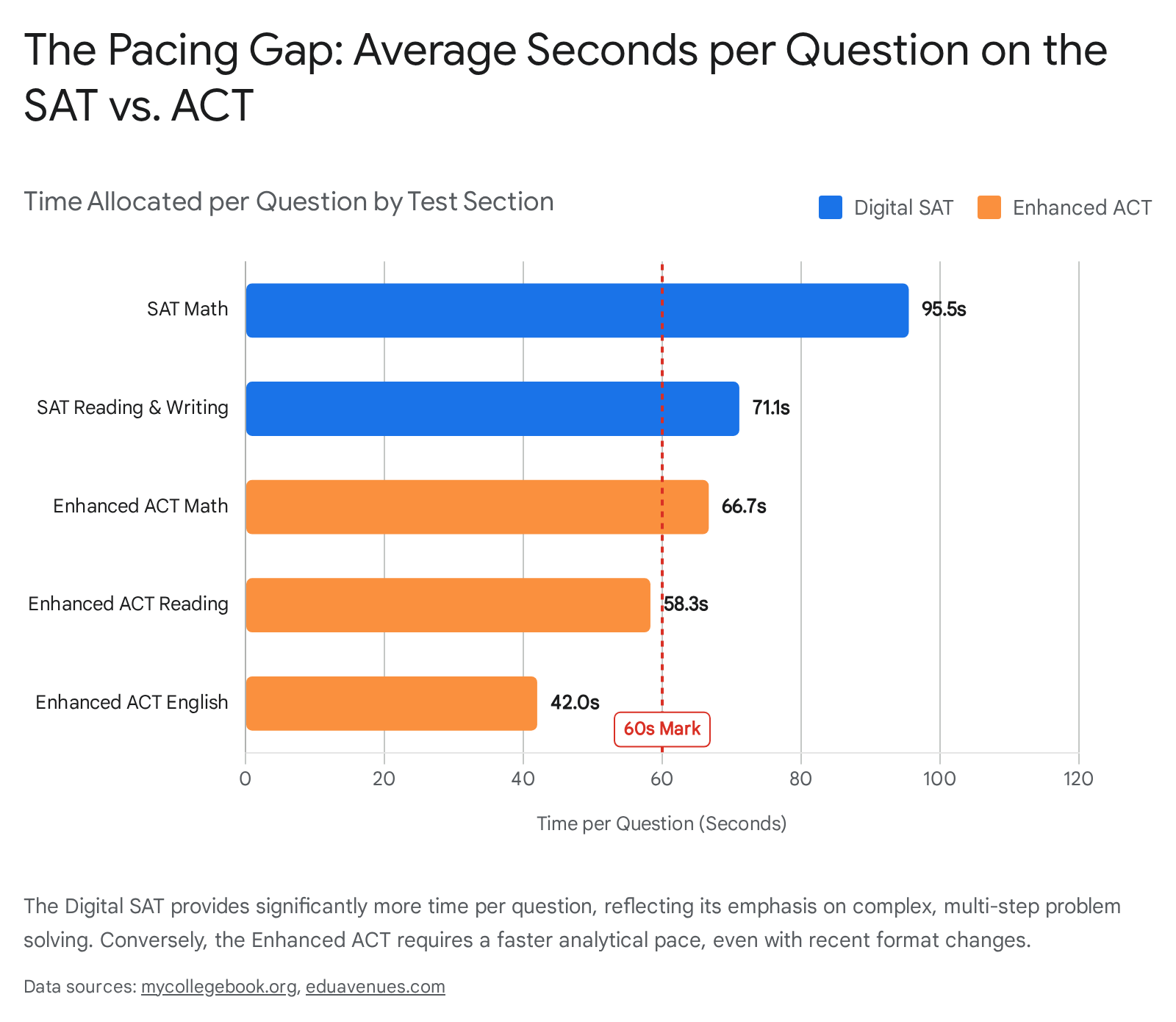
To properly conceptualize the mechanical divergence between the two exams, educational analysts frequently rely on a specific cognitive analogy: The SAT operates as a complex reasoning puzzle, while the ACT functions as a fast-paced analytical sprint.
The Digital SAT requires deep, analytical deconstruction. With up to 95 seconds available for a single mathematical inquiry 36, the test-makers have meticulously designed problems that frequently feature multiple logical steps, distractors, and layers of mathematical abstraction 2223. The reading section demands intense, sentence-level comprehension to parse archaic vocabulary, evaluate logical arguments, or infer the precise rhetorical purpose of a single micro-text. It is fundamentally a test of analytical depth.
Conversely, the Enhanced ACT - even with its recent pacing adjustments granting more time per item - remains an assessment of speed, cognitive stamina, and rapid data ingestion 816. Students must tear through an English section at a blistering rate of 42 seconds per question 1232, identifying grammatical errors, syntactical flaws, and rhetorical flows almost by instinctual pattern recognition. The reading section requires students to digest long, multi-paragraph narratives and rapidly locate specific textual details hidden within hundreds of words. The ACT is less about solving complex riddles and more about maintaining a high velocity of accurate decision-making over an extended duration.
Which test is better for slow readers?
When determining which assessment mathematically aligns with a student's cognitive profile, baseline reading speed and working memory capacity are frequently the deciding variables.
Historically, the ACT has heavily penalized deliberate, slow readers. The legacy format required students to read four lengthy passages and answer 40 questions in a highly restrictive 35 minutes 1016. While the Enhanced ACT has improved this specific metric by allowing 40 minutes for 36 questions 1012, it still fundamentally requires test-takers to process vast amounts of continuous text. For questions inquiring about minor details, a student must retain the structural map of a multi-paragraph essay within their working memory or spend precious seconds scanning backward through the text to locate the specific line, as the ACT does not always provide line-number references for localized detail questions 16. If a student struggles with sustained visual tracking, loses focus during extended reading blocks, or reads at a slower natural cadence, the ACT Reading and English sections can quickly compound into major statistical liabilities.
The Digital SAT mitigates these sustained reading issues almost entirely. By fracturing the Reading and Writing section into 54 discrete micro-passages (often the length of a single short paragraph or a social media post), the test effectively prevents cumulative "reading fatigue" 31920. If a student misunderstands a dense historical passage on the SAT, they only forfeit the points for that single attached question; they can mentally reset and approach a completely fresh, unrelated topic on the very next screen 8. Conversely, misunderstanding a core narrative theme in a long ACT passage could jeopardize an entire block of five to ten subsequent questions tied to that exact same text 816.
For students who read slowly but process deeply, or those who struggle with executive function and focus over long durations, the Digital SAT's generous pacing and modular, bite-sized text format present a clear, quantifiable strategic advantage 32016.
Does the ACT Science section require advanced chemistry or biology?
A pervasive and damaging myth surrounding the ACT is that the Science section operates as a rigorous assessment of advanced, high-school-level scientific memorization. This misconception routinely drives capable applicants away from the test unnecessarily.
According to official ACT content parameters, the Science section is absolutely not a test of rote biology, chemistry, earth science, or physics memorization 171819. Rather, it functions as a highly specialized reading comprehension and data interpretation assessment wrapped in a scientific veneer 1820. The vast majority of the requisite answers are explicitly provided within the charts, scatterplots, graphs, and experimental summaries printed directly on the page 1819.
The assessment is categorically broken down into measuring three specific cognitive skills: * Interpretation of Data (38 - 50%): Manipulating and analyzing scientific data presented in tables and graphs 1718. * Scientific Investigation (18 - 32%): Understanding experimental tools, identifying controls and variables, and predicting results of modified experiments 1718. * Evaluation of Models (25 - 35%): Judging the validity of scientific information and comparing conflicting scientific viewpoints 171819.
While a rudimentary understanding of basic scientific terminology (e.g., pH levels, gravity, the function of a nucleus) can expedite comprehension, advanced AP-level course prerequisites are entirely unnecessary to achieve a perfect score 351718.
The Strategic Dilemma: Should applicants opt into the ACT Science section?
With the Enhanced ACT officially migrating the Science section to an optional status in 2025, students face a critical strategic divergence regarding whether to invest the extra 40 minutes and supplemental registration fees to take it.
This decision must be dictated entirely by the applicant's prospective college list and intended academic major. Certain highly selective institutions and specific programmatic tracks actively require the submission of the Science section to benchmark historical applicant data. For instance, Georgetown University, Boston University, Pomona College, and the U.S. Military Academies have explicitly stated they require the submission of all four ACT sections, making the Science module mandatory for their applicants 53536. Furthermore, universities renowned for their STEM programs - such as Caltech, Duke, Johns Hopkins, and Carnegie Mellon - strongly recommend the Science section to thoroughly evaluate technical and quantitative readiness 353642.
For students applying exclusively to liberal arts colleges, or those intending to major in the humanities and social sciences at test-optional universities, skipping the Science section is a highly strategic maneuver that reduces testing fatigue and limits potential score liabilities 3443. However, for undecided students, or those aiming for elite engineering, computer science, and pre-medical tracks, capturing a strong STEM score by taking the Science section remains highly advantageous to application competitiveness 344344.
Calculator Policies and Mathematical Assessments
The policies governing computational aids serve as another distinct separator between the two assessments, directly impacting mathematical strategy.
The Digital SAT provides universal calculator access. Students are permitted to use a calculator on every single question within the Math section 320. To ensure systemic equity, the College Board integrated a full version of the Desmos graphing calculator directly into the Bluebook testing interface 37. This powerful tool allows students to visually map complex linear equations, locate intercepts, and solve algebraic systems efficiently without manual computation. Students who prefer their own hardware are still permitted to bring an approved physical graphing calculator to the testing center 37.
The Enhanced ACT maintains a slightly more restrictive protocol. Calculator usage is strictly limited to the Math section; students are expressly forbidden from using calculators during the Science section, requiring them to utilize mental math for data interpolations 174521. Like the Digital SAT, the online version of the ACT now integrates the Desmos graphing calculator directly into the testing platform 2147. However, students bringing physical hardware must navigate strict ACT prohibitions: calculators featuring Computer Algebra System (CAS) functionality, QWERTY-style letter keyboards, paper tape mechanisms, or capabilities to hold unapproved downloaded documents are strictly banned and can result in immediate dismissal from the testing center 474849.
Do colleges prefer the SAT or ACT?
The standardized testing ecosystem is rife with misinformation that routinely causes students to misallocate their preparation time and resources. It is imperative to explicitly debunk the most pervasive myths circulating within the college admissions landscape.
Myth 1: Elite Ivy League colleges inherently prefer the SAT. This is unequivocally false. Every four-year university in the United States that requires standardized testing treats the SAT and ACT with absolute parity 2350. Admissions officers do not view a high SAT score as intrinsically more rigorous, academic, or prestigious than a high ACT score. To ensure a fair, normalized evaluation process, enrollment management teams utilize official statistical concordance tables to translate the scores into equivalent metrics, ensuring an "apples-to-apples" comparison across diverse applicant pools 2252. A 34 on the ACT holds the exact same institutional and statistical weight as a 1500 on the SAT 23.
Myth 2: You need to take both exams to be a highly competitive applicant. Attempting to master both the SAT and the ACT is a massive strategic error that yields diminishing returns. Because the tests assess similar baseline academic constructs but utilize vastly divergent pacing mechanisms and formatting styles, studying for both simultaneously splits a student's cognitive focus and severely dilutes their preparation efforts 32. Colleges only require the submission of one test format. Students achieve the highest statistical score trajectories by identifying the single test that naturally aligns with their cognitive strengths and committing 100% of their preparation bandwidth to mastering the specific nuances of that format 2332.
Myth 3: The ACT is only for students in the Midwest, and the SAT is for the Coasts. While there are historical geographic concentrations rooted in regional state-mandated testing contracts, university admissions offices possess absolutely no regional bias regarding the exams. A student applying from a New York preparatory academy to UCLA will not be penalized for submitting an ACT score, nor will a student from rural Ohio be penalized for submitting an SAT score to an Ivy League institution.
How Admissions Committees Compare the SAT and ACT
Because universities receive hundreds of thousands of applications featuring disparate SAT and ACT scores, admissions committees rely exclusively on official Concordance Tables to evaluate candidates equitably.
The College Board and ACT, Inc. periodically conduct joint, large-scale concordance studies to mathematically map the statistical relationship between their respective scoring scales 222324. The most recent official concordance tables were established and published in 2018 22. Despite the recent technological transition to the Digital SAT in 2024 and the Enhanced ACT in 2025, these 2018 concordance tables remain the official, valid standard used by universities 52. This validity holds because the underlying psychometric constructs of the score scales - the 400 - 1600 scale for the SAT and the 1 - 36 scale for the ACT - have been strictly maintained, and both testing agencies actively engineered their new digital formats to align with historical percentile distributions to avoid disrupting university admissions modeling 5255.
| ACT Composite Score | Equivalent SAT Total Score |
|---|---|
| 36 | 1590 - 1600 |
| 35 | 1530 - 1580 |
| 34 | 1490 - 1520 |
| 33 | 1450 - 1480 |
| 30 | 1360 - 1380 |
| 27 | 1260 - 1290 |
| 24 | 1160 - 1190 |
| 20 | 1030 - 1050 |
Data sample derived from the official 2018 ACT/SAT Concordance Tables 2325.
Concordance tables allow an admissions officer to immediately recognize that an ACT Composite of 27 is statistically equivalent to an SAT total of 1260 - 1290 2325. Understanding concordance is not just crucial for admissions officers; it is the fundamental tool students must use when attempting to decide which test to pursue.
Regional and Systemic Context: State Mandates and International Availability
Testing decisions are rarely made in a vacuum; they are often heavily influenced by systemic, financial, and regional factors, particularly for students attending public high schools in the United States or applicants residing abroad.
State-Mandated School Day Testing
In the United States, dozens of state educational agencies maintain exclusive, multi-million-dollar contracts with either the College Board or ACT, Inc. to administer their respective exam for free during the school day. These exams are often utilized as standardized metrics for federal accountability monitoring or as strict high school graduation requirements 5758.
- SAT Mandates: States such as Connecticut, Delaware, Indiana, Michigan, New Hampshire, New Mexico, Rhode Island, West Virginia, Colorado, and Illinois (which transitioned its long-standing contract to the SAT starting in 2025) officially mandate the SAT for their public school juniors 5758.
- ACT Mandates: States including Alabama, Arizona, Arkansas, Hawaii, Kansas, Louisiana, Mississippi, Montana, Nebraska, Nevada, North Carolina, South Dakota, Utah, Wisconsin, and Wyoming officially mandate the ACT 58.
- Choice States: A smaller subset of states, such as Florida, Ohio, Oklahoma, and Tennessee, allow individual school districts to select which of the two exams they will administer to fulfill graduation mandates 58.
For students residing in states with definitive mandates, the path of least resistance is often to prepare extensively for the test their high school is already financing and administering during regular academic hours 59. However, if a student naturally excels at the alternative exam format, they are entirely free to register independently for weekend national test dates.
International Testing Differences
For international applicants seeking entry into American universities, the testing landscape presents unique logistical challenges and distinct timelines.
The SAT is available globally and is exclusively administered via the digital Bluebook application; paper testing has been completely eradicated worldwide 3460. The ACT is also heavily administered internationally, but unlike the United States - which retains a paper-and-pencil option for weekend testing - the international ACT has been strictly a computer-based exam since 2018 606162.
The Enhanced ACT format, featuring the shorter timeline and the optional science section, will be implemented at all international testing centers starting in September 2025 132513. International students must also be acutely aware that registration fees for both the SAT and ACT are significantly higher outside the United States, and test dates occasionally differ from the domestic schedule, requiring meticulous calendar management during the fall application season 606263.
What this means for you action plan
Choosing between the SAT and ACT should never be a decision based on anecdotal advice, generalized peer pressure, or assumptions about intellectual rigor. It requires an empirical, data-driven methodology. Students and their families are advised to execute the following four-step strategic action plan:
1. Take Official Diagnostic Exams Under Simulated Conditions. During the sophomore year or the summer preceding junior year, students should sit for a full-length, strictly timed practice exam for both the Digital SAT and the Enhanced ACT 5233264. Free official practice tests for the SAT are readily available via the College Board's Bluebook application 36, and official ACT practice tests can be procured directly from the ACT website 1313. It is absolutely critical to adhere strictly to the time limits to accurately gauge the physiological and cognitive impact of the ACT's faster pacing versus the SAT's deeper reasoning requirements.
2. Convert and Compare the Percentiles. Once both diagnostics are completed and scored, students must utilize the official College Board/ACT Concordance Tables (or automated conversion widgets provided by reputable admissions organizations like Compass Education Group) to normalize the results onto a single scale 235525. If a student scores a 1160 on the SAT and a 27 on the ACT, the concordance table immediately reveals that a 27 ACT is roughly equivalent to a 1260 SAT 23. In this empirical scenario, the student demonstrates a clear, quantifiable natural aptitude for the ACT.
3. Evaluate Qualitative Preferences. If the concorded scores are identical or fall within a marginal "judgment call" bandwidth (e.g., within 10 - 20 points of each other on the SAT scale) 5525, the decision should default to qualitative comfort. Did the student feel completely overwhelmed by the rapid pacing of the ACT Math section? Did the micro-passages on the Digital SAT feel disjointed and contextually confusing? Does the student rely heavily on an advanced physical graphing calculator, or are they comfortable manipulating the built-in Desmos tool? Identifying which format induces less fatigue and anxiety is crucial for long-term preparation endurance.
4. Commit and Prepare Exclusively. Once the empirical data and qualitative experiences clearly point to one exam, the student must commit entirely to that singular path 32. By abandoning the secondary test, the student frees up dozens of hours that can be channeled into targeted, high-yield preparation, allowing them to master the specific quirks, recurring question archetypes, and optimal pacing strategies of their chosen assessment.
Bottom line
The massive structural shifts to the stage-adaptive Digital SAT and the streamlined Enhanced ACT have fundamentally altered the college admissions testing landscape, prioritizing digital fluency and attempting to reduce systemic student burnout. Elite universities view both exams identically, meaning applicants should completely ignore prestige myths and focus solely on maximizing their individual performance metrics. By executing rigorous diagnostic practice tests, leveraging concordance tables to identify natural aptitude, and committing fully to the exam that aligns with their specific reading speed and cognitive style, students can efficiently maximize their scores, enhance their college applications, and significantly reduce the anxiety associated with standardized testing.