
When to Submit SAT or ACT Scores to Test-Optional Colleges
For applicants weighing whether to submit standardized test scores to a test-optional institution, the evidence-based directive relies on a strategic calculation of institutional context, academic benchmarking, and financial goals: submit scores if they fall at or above the college's historical median or if they significantly outpace the average of the applicant's high school. Conversely, applicants should withhold scores that fall into the bottom quartile of a target college's historical range, provided their high school transcript demonstrates rigorous academic excellence that can stand alone.
The modern college application process is defined by an overwhelming paradox of choice, leaving students and their families to navigate an opaque landscape fraught with anxiety. The suspension of mandatory standardized testing, initially a public health necessity during the COVID-19 pandemic, has evolved into a persistent feature for the vast majority of American colleges. However, the resulting lack of rigid requirements has only intensified the pressure on applicants. Without the clear, numerical mandate of an SAT or ACT requirement, applicants are paralyzed by the fear that a misstep - submitting a sub-par score or withholding a potentially competitive one - will result in an application being discarded or tens of thousands of dollars in merit aid being left on the table. The "test-optional" designation, while initially designed to foster equity and reduce stress, has inadvertently introduced a complex game of strategic positioning. This comprehensive report unpacks the data, institutional policy shifts, and strategic considerations necessary to navigate the 2026 college admissions cycle.
What Exactly Does "Test-Optional" Really Mean?
To understand the strategic implications of test submission, it is necessary to first untangle the often-confusing terminology employed by higher education institutions. Admissions policies vary significantly, not just between distinct universities, but sometimes between different academic colleges within the exact same university framework. As of the fall 2025 and 2026 admissions cycles, an overwhelming majority of U.S. four-year colleges and universities - more than 80%, representing over 1,825 bachelor-degree granting institutions - remain test-optional or test-blind 12.
However, the specific operational mechanics of these policies drastically alter how an applicant should approach their submission strategy.
| Admissions Policy Type | Operational Definition | Strategic Implication for Applicants |
|---|---|---|
| Test-Required | Applicants must submit an SAT or ACT score to be considered for admission. No exceptions are made unless explicitly specified by the institution. | Standardized test scores are a mandatory metric; test preparation and testing timelines must be prioritized heavily. |
| Test-Optional | Applicants choose whether to submit scores. If submitted, they are weighed in the holistic review. If withheld, the application is judged on other merits. | Requires a localized, strategic decision based on the college's middle-50% score range and the applicant's specific high school context. |
| Test-Flexible | Applicants must submit standardized testing, but can substitute the traditional SAT/ACT with other exams (e.g., AP scores, IB exams). | Ideal for students who excel in specific, rigorous subject areas but struggle with broad, timed aptitude tests. |
| Test-Blind / Score-Free | The institution will not view or consider SAT or ACT scores under any circumstances, even if the applicant attempts to submit them. | Test scores cannot provide a competitive edge; the applicant's focus must shift entirely to GPA, course rigor, and narrative essays. |
It is critical to recognize that a university's overarching policy might not apply universally. For example, Cornell University operates a bifurcated system during its transitional years, where certain colleges within the university (such as the College of Arts and Sciences) are test-optional, while others (such as the College of Agriculture and Life Sciences) remain strictly score-free or test-blind 315. An applicant must map out the specific policies not just for the campus, but for the exact academic program they intend to pursue.
Do Admissions Officers Assume Failure If Scores Are Withheld?
A pervasive misconception among applicants and families is the belief that withholding a test score acts as a silent admission of failure. The psychological fear is that if a score is not submitted, an admissions officer will automatically assume the student performed terribly, subsequently penalizing the application. However, direct statements from admissions professionals, alongside comprehensive institutional policies, aggressively contradict this assumption.
Admissions officers read applications holistically and are trained to evaluate the evidence provided, rather than penalizing an applicant for data that is absent under an explicitly optional policy. According to a retired college admissions reader who evaluated files for highly selective institutions with single-digit acceptance rates, evaluators are strictly instructed not to note or penalize the absence of a test score 6. Under no circumstances is a student to be penalized for not submitting scores, as the official policy dictates that testing is optional, and it is impossible for an admissions officer to accurately assume the reason for the omission 6. At schools like Indiana University, the focus smoothly shifts to a holistic evaluation of the classes taken, the grades received, extracurricular engagement, and letters of recommendation when a test score is absent 7.
However, applicants must understand the mechanical reality of a holistic review. While officers do not actively penalize a missing score, the absence of a standardized metric means that the remaining elements of the application must carry the entire weight of proving academic readiness 68. High school grade point average (GPA) and the rigor of the coursework become the sole quantitative indicators of an applicant's potential to succeed in college-level work 8. If a transcript reveals inconsistent grades, a downward academic trend, or a lack of advanced coursework, withholding a test score can inadvertently draw much more scrutiny to those academic vulnerabilities 8.
Furthermore, logical scrutiny of the "test-optional" premise reveals a competitive nuance. If an institution claims that students who do not submit scores will not be disadvantaged, it follows logically that students who do submit scores will not be advantaged 9. Yet, this is demonstrably false; if high test scores provided no advantage, no student would take them, and colleges would simply adopt test-blind policies 9. Therefore, while withholding a score does not trigger an assumption of failure, submitting a highly competitive score undeniably provides a distinct, quantifiable advantage in crowded applicant pools.
Why Are Elite Institutions Reinstating Test Requirements?
While the vast majority of institutions maintain test-optional postures, a highly influential cohort of elite universities has sharply reversed course. Beginning in 2023 and cascading aggressively through the 2025 and 2026 admissions cycles, institutions such as the Massachusetts Institute of Technology (MIT), Dartmouth College, Yale University, Brown University, the California Institute of Technology (Caltech), Stanford University, Cornell University, and the University of Texas at Austin have reinstated standardized testing requirements 1172111213.
The rationale behind this reversal is not a regression to antiquated admission models, but rather a response rooted in massive internal data analyses regarding student success, rampant grade inflation, and, counterintuitively, socioeconomic equity.
The Equity Paradox and Dartmouth's Revelations
The original intent of the test-optional movement was to remove barriers for low-income, first-generation, and underrepresented minority students who might lack access to expensive test preparation resources 814. However, researchers at Dartmouth College convened a working group of economists and sociologists to study the impacts of test-optional admissions, leading to the discovery of a profound "equity paradox" 1516.
Under the test-optional policy, Dartmouth found that many high-achieving, less-advantaged applicants chose to withhold their scores because those scores fell slightly below the college's published median averages 1516. What these applicants failed to realize was that admissions officers evaluate scores contextually. A National Bureau of Economic Research study examining Dartmouth's admissions discovered that disadvantaged students with an SAT score above 1400 were more than three times as likely to receive an admissions offer if they submitted their score than if they withheld it 3. By choosing not to submit, these students denied admissions officers the exact data point that would have identified them as exceptional outliers within their specific, under-resourced environments 153. The Dartmouth working group concluded that test-optional policies were inadvertently masking the talent of the exact demographic they were designed to help.
Furthermore, test-optional policies forced admissions officers to place greater weight on other elements of the application, such as boutique extracurricular activities, private letters of recommendation, and advanced coursework like Advanced Placement (AP) or International Baccalaureate (IB) classes 12. Access to these resources is often much more heavily correlated with systemic wealth than standardized testing 12. A student at a well-funded private school may have access to a dozen AP courses and highly specialized extracurriculars, while a student at an under-resourced rural school may have none 12. Standardized tests provided a unified metric that allowed talent to be identified irrespective of a high school's course catalog.
Is High School GPA No Longer a Reliable Indicator?
The return to testing is also fundamentally tied to the degradation of the high school transcript as a reliable differentiator. Over the past decade, grade inflation has become rampant in the United States, with over 89% of high school students receiving A or B grades across all subjects 18. When nearly every applicant to a highly selective university boasts a near-perfect GPA, the transcript ceases to function as a tool for identifying exceptional academic readiness 1519.
A landmark 2024 study by the Opportunity Insights group at Harvard University analyzed data from Ivy-Plus colleges and determined that standardized test scores carry significantly more weight in predicting college outcomes than high school grades 119. The research demonstrated that SAT and ACT scores were nearly four times more predictive of a student's first-year college GPA than their high school grades 19. Specifically, students with top-tier SAT scores earned first-year college GPAs approximately 0.43 points higher than those with modest scores, keeping all other factors equal 15. In stark contrast, a student with a perfect 4.0 high school GPA performed only about 0.1 GPA points better in college than a student with a 3.2 high school GPA, rendering the high school GPA highly limited in its predictive power for elite academic environments 15.
Institutional Case Studies: Yale, Caltech, Stanford, and Cornell
The empirical findings from Opportunity Insights and Dartmouth catalyzed similar internal reviews across the Ivy Plus landscape, resulting in a wave of policy reversals.
Yale University's admissions office conducted a comprehensive four-year analysis and concluded that test scores were the single strongest predictor of a student's performance in Yale courses 15. Consequently, Yale implemented a "test-flexible" policy for the Fall 2025 cycle, requiring standardized testing but allowing applicants to submit AP or IB exam scores in lieu of the SAT or ACT 15421. This approach allows students to showcase their strengths while still providing the university with standardized, objective academic data. Despite operating under a test-optional framework for the previous cycle, Yale reported that 86% of its enrolled students had ultimately chosen to submit test scores, highlighting the de facto necessity of testing at the highest levels of selectivity 22.
Caltech took an even more aggressive stance, ending its test-blind moratorium a full year early 21123. The faculty advisory committee noted that over 95% of their enrolled class had actually taken standardized exams, but the admissions office was blinded to this data during the selection process 2. Because Caltech relies heavily on identifying students with extraordinary mathematical and scientific aptitude, the faculty deemed it critical to use all available, relevant data, noting that in science, one should "never dismiss a variable" 224.
Stanford University announced its return to mandatory testing for the Fall 2026 cycle following a faculty review confirming the strong correlation between standardized testing and academic performance at the university 1325265. Notably, Stanford's reinstatement comes alongside adjustments forced by California Assembly Bill 1780, which bans legacy and donor preferences for institutions receiving state funds 13265. As the landscape of legacy admissions shifts, the reliance on objective academic metrics like the SAT and ACT becomes even more pronounced.
Similarly, Cornell University will require testing for the Fall 2026 application cycle after a multi-year task force found no clear indication that its test-optional policies had actually increased diversity 315. In fact, Cornell's data indicated a slight decrease in diversity along some metrics during the test-optional years, as underrepresented students withheld scores that would have otherwise advantaged them during contextual review 5.
Analyzing Applicant Behavior: The Common App Data
The shifting policies of elite institutions have had a tangible ripple effect on the broader applicant pool. Analyzing the most recent data from the Common Application provides critical insights into how student behavior is adapting to the 2025 and 2026 admissions landscape.
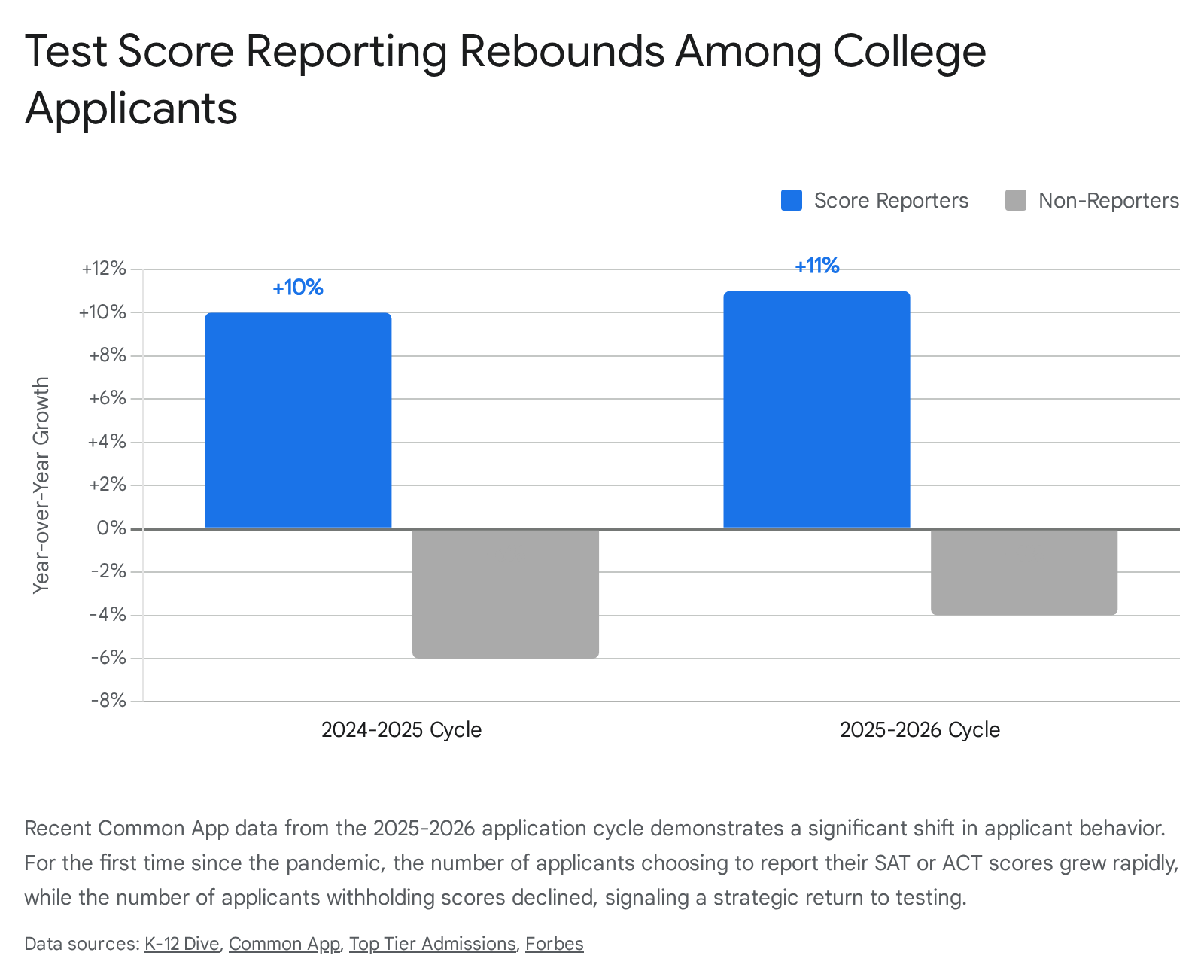
The Common App's Deadline Update for January 2026 reveals a significant turning point in reporting behavior. Through the early stages of the 2025-2026 cycle, the number of applicants reporting a standardized test score increased by 11% compared to the previous year, while the number of applicants opting not to report a score actually decreased by 4% 67. This stands in stark contrast to previous cycles where non-reporters comprised the majority of the overall applicant pool 68.
Interestingly, while overall application volume to returning Common App members rose by 7%, the demographic makeup of those applying continues to evolve 6. Applications from students residing in below-median income ZIP codes increased by 9%, and first-generation applicants saw a 9% increase over the previous year 7. However, despite the overall platform trend moving rapidly toward score submission, these historically underrepresented groups - first-generation students, underrepresented minorities, and low-income applicants eligible for fee waivers - remain significantly less likely to report a standardized test score than their wealthier, continuing-generation peers 8.
This data highlights a critical strategic gap in the admissions ecosystem. While highly resourced students are reading the institutional tea leaves and aggressively submitting scores to validate their GPAs, marginalized students continue to rely heavily on test-optional policies. In highly competitive admissions environments, this divergence can result in the precise "undermatching" phenomenon that researchers at Dartmouth and Yale warned about, where qualified disadvantaged students fail to optimize their applications.
Do Test-Optional Policies Actually Improve Diversity?
While elite institutions found that test-optional policies hindered their ability to identify disadvantaged talent, it is vital to acknowledge that these ultra-selective universities represent only a tiny fraction of the higher education landscape. When examining broader swaths of universities, the academic consensus regarding test-optional policies and diversity becomes highly nuanced.
A 2023 study by Christopher Bennett of Vanderbilt University, which examined nearly 100 private institutions that voluntarily adopted test-optional policies prior to the pandemic, found that these policies were indeed associated with modest diversity gains 3132. Bennett's research indicated a 3% to 4% increase in Pell Grant recipients, a 10% to 12% increase in first-time students from underrepresented racial and ethnic backgrounds, and a 6% to 8% increase in the enrollment of women 3132. A separate report published by the National Association for College Admission Counseling (NACAC) analyzed data from almost one million applicants and found that nearly half (42%) of students who withheld their scores and subsequently enrolled were underrepresented minorities, first-generation, or Pell Grant recipients, compared to only 32% among score submitters 33.
Furthermore, research from RTI International revealed that dropping test score requirements was not linked to any measurable changes in overall student retention or six-year graduation rates across the full spectrum of studied institutions 9. The NACAC study corroborated this, finding that while non-submitters had slightly lower first-year grades, they ended up highly successful and graduated at equivalent - and sometimes slightly higher - rates than their test-submitting peers 33.
However, the impact diverges sharply based on institutional selectivity. The RTI International analysis noted that at institutions with more competitive admissions, the enactment of test-optional policies was actually associated with a 2-percentage-point increase in graduation rates for White students, men, and women 329. Conversely, at less competitive institutions, the policy was associated with a 2-percentage-point decrease in graduation rates for White students 329. Ultimately, the efficacy of test-optional policies as a tool for equity depends heavily on the specific context and selectivity of the institution utilizing them.
How Does the Digital SAT Shift the Strategic Landscape?
Adding a final layer of complexity to the 2025 and 2026 admissions cycles is the permanent transition of the SAT to a fully digital, adaptive format 3536. The traditional three-hour, paper-and-pencil marathon has been universally replaced by a two-hour and fourteen-minute computer-based exam consisting of two primary sections: Reading and Writing, and Math 3536.
From an admissions strategy standpoint, the Digital SAT introduces several key variables that applicants must navigate. The multistage adaptive nature of the test means that a student's performance on the first module of a section dictates the difficulty of the second module 35. This results in a highly personalized assessment that the College Board asserts is vastly more efficient at pinpointing a student's precise aptitude 35. Furthermore, scores are delivered within days rather than weeks, allowing students to make much faster, data-driven decisions about whether to submit their scores as critical application deadlines approach 3536.
Surveys indicate record-high satisfaction rates with the digital format, citing its significantly shorter duration and built-in tools, such as the Desmos graphing calculator, which helps level the playing field for students who may not own expensive physical calculators 3710. The adaptivity of the test is also reported to reduce testing anxiety, offering a more comfortable experience for students, particularly those with learning differences 10. For applicants, the stabilization of the Digital SAT format - with a national average hovering around 1029 - means that scores are once again viewed by admissions committees as a highly reliable, standardized metric 37.
How Do Large Public Universities and Regional Colleges Handle Test Scores?
While the reinstatement of testing at elite institutions garners the vast majority of media attention, these universities operate in a distinct sphere. For the majority of applicants targeting large public university systems and regional colleges, the strategy regarding test scores differs significantly, primarily because these institutions process exponentially larger application volumes.
At many large state universities, test scores serve as a vital mechanism to process massive applicant pools efficiently, even if the institution is officially test-optional. At Michigan State University (MSU), the admissions office received an all-time high of 62,138 applications for the Class of 2028, resulting in an 84.8% acceptance rate 3940. While MSU maintains a test-optional policy and states that there are no minimum requirements for admission, the data reveals that nearly 39% of enrolled students still submitted SAT scores 4011. For those admitted to MSU, the middle-50% SAT range fell between 1100 and 1320, with a median ACT of 28 394011.
Similarly, at James Madison University (JMU) in Virginia, which accepts roughly 71.5% of its 38,000+ applicants, the median SAT score for admitted students is a robust 1250, with the middle 50% ranging from 1170 to 1320 424344. At institutions like MSU and JMU, submitting a score at or above the median acts as an independent verification of a student's high school transcript. When an admissions office is tasked with evaluating 60,000 applicants, a clean, undeniable data point like a 1260 SAT provides immediate validation of an applicant's academic readiness, ensuring a smoother path through the holistic review process.
Will Withholding My Score Cost Me Merit Scholarships?
The most severe, yet frequently overlooked, consequence of utilizing a test-optional policy is the potential loss of merit-based financial aid. Many families operate under the dangerous assumption that "test-optional for admission" seamlessly equates to "test-optional for scholarships." This is a costly misconception that can leave tens of thousands of dollars on the table.
Institutional merit scholarships are heavily reliant on standardized test scores. Because high school GPAs are highly compressed and virtually impossible to compare fairly across different states and grading scales, universities rely heavily on the SAT and ACT to objectively rank students for finite scholarship dollars.
Consider the financial architecture at prominent universities across the country: * The Ohio State University (OSU): OSU explicitly ties its most prestigious financial awards to elite test scores. The President's Ohio Scholarship Program, which provides a full cost of attendance scholarship plus a $5,000 enrichment grant, strictly mandates a perfect 36 on the ACT or a 1600 on the SAT achieved on a single test date 1213. Furthermore, the university scales its other awards based on scores; the Excellence Scholarship requires applicants to meet specific thresholds, explicitly including a 23 ACT or 1070 SAT alongside GPA and class rank metrics, to be eligible for funding 47. * Pepperdine University: While Pepperdine is broadly test-optional for undergraduate admissions, its highly competitive Regents Scholars Program is not. Awarded to only the top 8% to 10% of the admitted class and providing at least $20,000 annually, this program strictly requires the submission of an SAT, ACT, or CLT score for consideration 14491551. A student opting not to test automatically forfeits any chance at this $80,000 total package. * Arizona State University (ASU): ASU utilizes a highly transparent grid to award its New American University (NAmU) merit scholarships, primarily evaluating core GPA, residency, and intended degree programs 16. While test scores are not strictly required for base scholarship eligibility, ASU explicitly warns applicants that providing an ACT or SAT score "may lead to increased scholarship awards" 1617. For international students seeking aid at ASU, the intersection of GPA and English proficiency test scores directly dictates the financial award tiers 54.
Even at public flagship institutions with robust need-based aid programs, such as the University of North Carolina at Chapel Hill, external foundational scholarships intimately linked to the university experience often demand test scores. The highly coveted Morehead-Cain Scholarship, an independent, fully-funded four-year leadership program at UNC, seeks the top academic students in the world; a high standardized test score is a standard feature of a competitive profile for such prestigious awards, even if UNC itself is test-optional for general university admission 55565758.
For middle-class families attempting to balance a strong GPA against a middling test score, the decision to withhold the score might successfully secure an admission letter, but it frequently results in an admission offer entirely devoid of merit discounts. In 2026, a student's application strategy must be fundamentally aligned with their family's financial strategy.
How Should I Weigh a Strong GPA at an Under-Resourced High School Against a Middling Score?
If the SAT and ACT are not purely absolute metrics, how do admissions officers evaluate a score that feels "middling"? The answer lies deeply within the high school profile.
Every high school provides colleges with a comprehensive profile documenting its grading scale, demographic data, the rigor of courses offered (e.g., the number of APs available), and historical standardized testing averages. Admissions officers evaluate a student's test score not just against the national average or the college's overall median, but directly against the student's immediate peers.
This is the essence of the contextual review. Consider an applicant targeting a selective university with an SAT score of 1250. If this student attends a highly resourced, competitive suburban high school where the graduating class averages a 1350 SAT and offers 20 AP classes, a 1250 is viewed as a subpar performance. It indicates that the student, despite having access to immense educational resources and test prep, underperformed relative to their immediate environment. In a test-optional framework, this student would be strongly advised to withhold the 1250, as submitting it would likely damage their academic profile and weaken their otherwise strong transcript 6.
Conversely, consider a student hailing from an under-resourced rural or inner-city public school where the average SAT score is a 950 and only two AP courses are offered. If this student scores a 1250, it is a marker of extraordinary academic vitality. The student has outpaced their local peer group by a massive 300 points. Even if the target college's median SAT is a 1350, this student should absolutely submit the 1250. As demonstrated by the Dartmouth working group data, admissions officers actively search for these "discrepant" scores as proof of high intelligence, resilience, and an ability to maximize limited resources 1559. The score indicates that the student is highly likely to thrive when finally given access to the world-class resources of a top-tier university 15.
How Should Applicants Decide to Submit or Withhold? The Decision Matrix
The decision to report test scores is no longer a blanket, one-size-fits-all policy but rather a highly individualized, school-by-school tactical choice. Applicants must meticulously gather data from the Common Data Set (CDS) for each target institution on their list, specifically reviewing Section C9, which details the exact 25th and 75th percentile scores of enrolled students from the previous cycle 622.
The Submission Decision Matrix
| Applicant Profile | Target College Percentile | Contextual Factors | Strategic Action & Recommendation |
|---|---|---|---|
| The High Achiever | Score is at or above the 75th percentile. | High school GPA is perfectly aligned with the score, indicating consistent excellence. | Submit unconditionally. This reinforces a strong transcript, proves readiness, and maximizes opportunities for highly competitive merit aid and honors college placements. |
| The In-Range Candidate | Score is between the 25th and 50th percentile. | High school average is comparable. Extracurriculars and narrative elements are strong. | Lean strongly towards submitting. Especially if the college relies heavily on test scores for regional merit scholarships or if the score places the student high within their specific high school context. |
| The Discrepant Student (Under-Resourced) | Score is below the 25th percentile of the college, but vastly above the high school's average. | First-generation student or attends an under-resourced school with severely limited AP/IB offerings. | Submit. Contextual review will recognize the score as an indicator of exceptional relative potential and significant outperformance of the local, under-resourced environment 1559. |
| The Discrepant Student (Highly-Resourced) | Score is below the 25th percentile of the college, and falls below the high school's average. | Attends a highly competitive, well-funded high school. Strong, unweighted GPA. | Withhold. Submitting a lower score from a high-achieving environment will negatively impact the holistic review. Rely entirely on the rigorous transcript and qualitative elements. |
| The Scholarship Seeker | Score is below the college's 50th percentile. | Family requires merit aid to afford the institution; the college explicitly ties aid to test score tiers. | Evaluate carefully. If withholding the score means guaranteeing no scholarship money, the student must decide if admission without financial aid is a viable outcome. Consider submitting the score or actively planning to retake the exam. |
When executing this strategy, applicants must be acutely aware that what is considered a "good" score is entirely relative to the institution. A 1480 SAT is an exceptional score at a large state flagship like Michigan State or James Madison, practically guaranteeing admission and triggering top-tier merit money 4043. Yet, that exact same 1480 falls at the very bottom of the 25th percentile at Yale, where the middle 50% of accepted students ranges from 1480 to 1560 2260. A savvy student applying to both institutions would logically submit the score to the state flagships to secure funding while strategically withholding it from Yale, allowing their unweighted 4.0 GPA and rigorous coursework to stand alone in the Ivy League review 22.
Bottom Line
The era of blanket test-optional college admissions is permanently fracturing. While the vast majority of institutions will not strictly require an SAT or ACT for the 2026 admissions cycle, highly selective universities are leading a massive, data-driven return to mandatory testing to combat grade inflation and improve equity. Simultaneously, large public universities and regional colleges continue to heavily utilize standardized scores as gatekeepers for lucrative merit scholarships. A test-optional policy means that while an applicant will not be explicitly penalized for withholding a score, they willingly forfeit a critical data point that could validate their high school GPA, distinguish them within a saturated applicant pool, or secure vital financial aid. The most successful applicants in 2026 will not view "optional" as a convenient excuse to opt out, but rather as an invitation to strategically leverage their scores school-by-school, submitting when the data empirically supports their academic narrative and withholding only when their transcript is robust enough to stand entirely on its own.