
How Test-Optional and Test-Blind Colleges Differ
In 2026, test-optional colleges allow students to decide whether to submit SAT or ACT scores and will actively weigh those scores if provided, whereas test-blind colleges completely redact and ignore standardized test scores even if an applicant submits them. While thousands of universities remain officially test-optional following the pandemic, elite institutions are rapidly returning to mandatory testing. Admissions data now clearly reveals a significant acceptance rate advantage for students who choose to submit strong scores to test-optional schools.
The 2026 Admissions Landscape
The college admissions testing landscape is more fractured today than at any point in recent history. Following the emergency suspension of standardized testing during the COVID-19 pandemic, higher education institutions embarked on a massive, multi-year experiment to determine how best to evaluate academic readiness 12.
By the 2026 admissions cycle, the dust has largely settled, splitting colleges into distinct operational camps based on institutional priorities, faculty research, and legal pressures. While umbrella terms like "test-optional" are thrown around casually in high school counseling offices, how a specific university actually treats an SAT or ACT score varies drastically. To build a successful application strategy, students and families must understand the nuanced differences between the four primary testing paradigms.
Defining the Four Testing Paradigms
Understanding the exact definitions of these policies is the first step in determining an application strategy. The differences dictate whether time and money spent on test preparation will yield an admissions advantage or be entirely wasted.
1. Test-Optional Admissions At a test-optional college, the choice rests entirely with the applicant. You can decide whether or not to include your SAT or ACT scores in your application portfolio 45. If you withhold your scores, the admissions committee will evaluate you based on your high school transcript, the rigor of your coursework, your personal essays, recommendation letters, and extracurricular achievements 37. You will not be formally penalized for missing scores, and your application will be considered complete 3.
However, if you do submit scores, admissions officers will review them. In the context of holistic admissions, a high test score serves as a powerful piece of confirming evidence. It validates a high grade point average (GPA) and reassures the admissions committee of a student's readiness for college-level academics 48. Examples of institutions operating under a test-optional policy in 2026 include the University of Michigan, the University of Chicago, Vanderbilt University, and Wake Forest University 374.
2. Test-Blind (Test-Free) Admissions Test-blind - increasingly rebranded by universities as "test-free" - is an absolute policy. These colleges will not look at your SAT or ACT scores under any circumstances during the admissions evaluation 56.
If an applicant attempts to submit a perfect 1600 SAT score to a test-blind school, the university's application software will automatically redact or suppress the data field before the application ever reaches a human reader 1213. The policy is designed to create a perfectly level playing field where test scores cannot introduce bias or tip the scales for wealthy applicants who can afford test preparation 7. The most prominent example is the entire University of California system (including UC Berkeley and UCLA), alongside private liberal arts institutions like Pitzer College 715.
3. Test-Required Admissions A growing cohort of highly selective universities has officially abandoned pandemic-era flexibility, returning to mandatory testing. These colleges mandate the submission of SAT or ACT scores, and an application without them will be automatically rejected as incomplete. In 2026, this category includes Harvard, Dartmouth, Brown, the University of Texas at Austin, and the California Institute of Technology (Caltech) 161789.
4. Test-Flexible Admissions The test-flexible model is a rarer hybrid approach where a college requires standardized testing to demonstrate academic competence but allows students to submit alternatives to the SAT or ACT. Acceptable alternatives typically include a combination of Advanced Placement (AP) or International Baccalaureate (IB) exam scores 510. However, this model is shrinking; Yale University famously operated a test-flexible policy for a few years before reversing course in late May 2026 to firmly require the SAT or ACT 10.
Comparison of 2026 Institutional Testing Policies
To summarize the current landscape, the following table outlines how different institutions handle standardized test scores as of the 2026 application cycle.
| Policy Type | Who Decides to Submit? | Are Scores Read by Admissions? | Key 2026 Institutional Examples |
|---|---|---|---|
| Test-Required | Mandatory for all applicants | Yes, heavily weighted | Harvard, Brown, Caltech, UT Austin, MIT, Dartmouth 1617921 |
| Test-Optional | The applicant | Yes, if submitted | Univ. of Michigan, Univ. of Chicago, NYU, Vanderbilt, Tufts 37412 |
| Test-Blind | Irrelevant | No, scores are mechanically redacted | UC System (UCLA, Berkeley), Pitzer College, Cal State 5715 |
| Test-Flexible | Mandatory, but format varies | Yes, alternatives allowed | Rare in 2026 (Yale used this prior to May 2026 reversal) 1022 |
Inside the Test-Blind Admissions Process
Test-blind policies represent a fundamental philosophical shift in higher education. Proponents of the test-blind movement argue that standardized tests correlate too closely with family wealth, parental education levels, and access to private tutoring 723. By eliminating the tests entirely, these universities are forced to rely on long-term indicators of student achievement, which advocates believe are more equitable measures of a student's potential 523.
The Mechanics of Score Redaction
A common question from anxious applicants navigating a mixed list of colleges is: "What if I accidentally submit my scores to a test-blind school, or try to sneak them into my essay?"
The process is highly systematized to prevent this. Test-blind colleges utilize their application platforms (such as the Common App and internal university CRM systems) to implement a digital firewall. If an applicant uploads an official score report, the data fields are automatically scrubbed or suppressed 1213. If a student tries to cleverly weave their 35 ACT score into a personal statement, admissions readers are trained to ignore it, and in some highly rigorous systems, the text is physically or digitally blacked out before the admissions committee convenes 13.
At schools like Pitzer College, which extended its test-blind pilot through the 2025-2026 application cycle, the admissions committee evaluates applicants entirely on the rigor of a student's high school transcript, letters of recommendation, work history, and alignment with the college's core values of social responsibility and interdisciplinary learning 111213.
The Great Test-Blind Experiment: The University of California
The University of California (UC) system is the undisputed heavyweight of test-blind admissions, and its policies have dramatically influenced the national testing landscape 14.
The UC system's journey to a test-blind mandate was born out of intense legal and political pressure. Following a 2019 civil rights lawsuit (Kawika Smith v. Regents of the University of California) which argued that standardized tests inherently disadvantaged marginalized, low-income, and disabled students, the UC Board of Regents agreed to a landmark settlement in May 2021 151415. The settlement legally barred all UC campuses from considering SAT or ACT scores in admissions or scholarship decisions through at least the spring of 2025 1516.
Because the UC system is massive - receiving a record-breaking 249,855 applications for the fall 2021 cycle alone - their refusal to accept test scores sent shockwaves through the College Board and the testing industry 1517. For high school students applying exclusively to the UC system or California State universities, testing strategy has been rendered entirely obsolete; they literally do not need to sit for the SAT or ACT, saving families time and money 31.
The 2026 UC Faculty Revolt
However, the long-term viability of the UC test-blind policy is facing unprecedented internal and external challenges in 2026. Internal concerns regarding academic preparedness have triggered massive faculty pushback.
In late May 2026, more than 600 UC faculty members - spearheaded by the mathematics department at UC Berkeley - issued a public open letter to the UC Board of Regents demanding the reinstatement of an SAT or ACT math score requirement for incoming STEM (Science, Technology, Engineering, and Mathematics) majors starting in the 2027-2028 cycle 2232. The faculty cited a steep decline in college-level mathematical readiness among freshmen, arguing that the test-blind policy obscures vital preparation gaps. "It offers the appearance of access while undermining the [educational mission]," the letter noted, suggesting that students are arriving on campus unprepared for the rigor of university calculus and physics 32.
Adding to the complexity, the UC system is facing federal scrutiny. In early 2025, the U.S. Department of Education issued a "Dear Colleague" letter arguing that removing standardized tests for the explicit purpose of promoting racial diversity could violate federal law and recent Supreme Court precedents regarding affirmative action 1517. Subsequently, the Department of Justice launched investigations into admissions policies at UC Berkeley, UCLA, and UC Irvine 17. While the UC system remains officially test-blind for 2026 applicants, the foundation of the policy is deeply contested 1532.
When Test-Blind Fails: The WPI Pivot
The ideological push for test-blind admissions has not succeeded uniformly. Not all test-blind experiments survive contact with enrollment data. Worcester Polytechnic Institute (WPI), a prestigious STEM-focused university in Massachusetts, embarked on an eight-year test-blind pilot in 2021. Their explicit goals were to increase the diversity of the applicant pool while maintaining academic quality and retention rates 218.
By late 2024, WPI leadership abruptly terminated the pilot, opting to return to a standard test-optional policy indefinitely for the Class of 2030 (students starting in Fall 2026) 1819. Internal presentations revealed that the test-blind policy fundamentally failed to achieve its stated goals. The percentage of enrolled BIPOC/ALANA (Black, Indigenous, People of Color/African, Latinx, Asian, Native American) students actually trended downward 1819.
Furthermore, international applications dropped significantly. WPI discovered that international students rely heavily on standardized tests to validate their overseas transcripts to American admissions officers 20. Without the ability to submit an SAT score, many highly qualified international applicants simply opted not to apply 18. Lastly, WPI found itself increasingly viewed by prospective students as "less competitive" and out of sync with peer national engineering universities, prompting a swift return to a policy where students could submit scores "if they want to" 1819.
The Hidden Realities of Test-Optional Policies
For the vast majority of four-year universities in the United States in 2026, "test-optional" remains the official, stated policy 36. But in the highly competitive tiers of college admissions, what is technically optional is rarely optimal.
Admissions experts, guidance counselors, and higher education analysts consistently caution that "test-optional" does not mean "test-irrelevant" 78. If a student submits a score, it becomes a permanent, weighted part of their academic narrative. At selective schools, the absence of a test score removes a critical tool the admissions committee uses to contextualize a student's high school transcript. In a highly competitive applicant pool, skipping the test limits an applicant's strategic leverage 4.
Grade Inflation as the Catalyst
To understand why test-optional schools still heavily favor test scores, one must understand the current state of American high school grading. The primary driver behind the persistent power of the SAT and ACT is widespread grade inflation 821.
High school GPAs have climbed steadily over the past decade. According to educational research, average adjusted high school GPAs increased from 3.17 to 3.39 in English and from 3.02 to 3.32 in math between 2010 and 2022. By recent measures, more than 89% of high school students receive an A or a B in core subjects 21.
When the vast majority of applicants to competitive colleges arrive with flawless or near-flawless 4.0 unweighted GPAs, admissions readers struggle to differentiate candidates based on academic performance alone 8. An 'A' from an elite private prep school does not necessarily represent the same mastery of material as an 'A' from an underfunded public high school. A standardized test score - even from a school with notoriously lenient grading - gives application readers a stabilizing metric, providing an external validation of a student's true academic competence 816.
The Admit Rate Gap for Score Submitters
The most compelling evidence that test scores still heavily influence outcomes lies in institutional admit rates. When admissions data is separated into "submitters" and "non-submitters," a clear and undeniable advantage emerges for those who provide scores 1622.
Across various selective institution types, students who submit SAT or ACT scores to test-optional schools are admitted at substantially higher rates, with the gap typically ranging from 5 to 20 percentage points 1622. For example, at the University of Virginia (UVA), recent data showed that in-state students who submitted test scores achieved an admission rate of 26%, compared to a mere 14% for those who applied without scores 23. Other independent analyses of highly selective universities reveal even starker contrasts, pointing to admit rates of 13.5% for submitters versus just 5.5% for non-submitters 40. This effectively means that applicants who submitted test scores were 2.5 times more likely to be admitted to certain highly selective institutions 40.
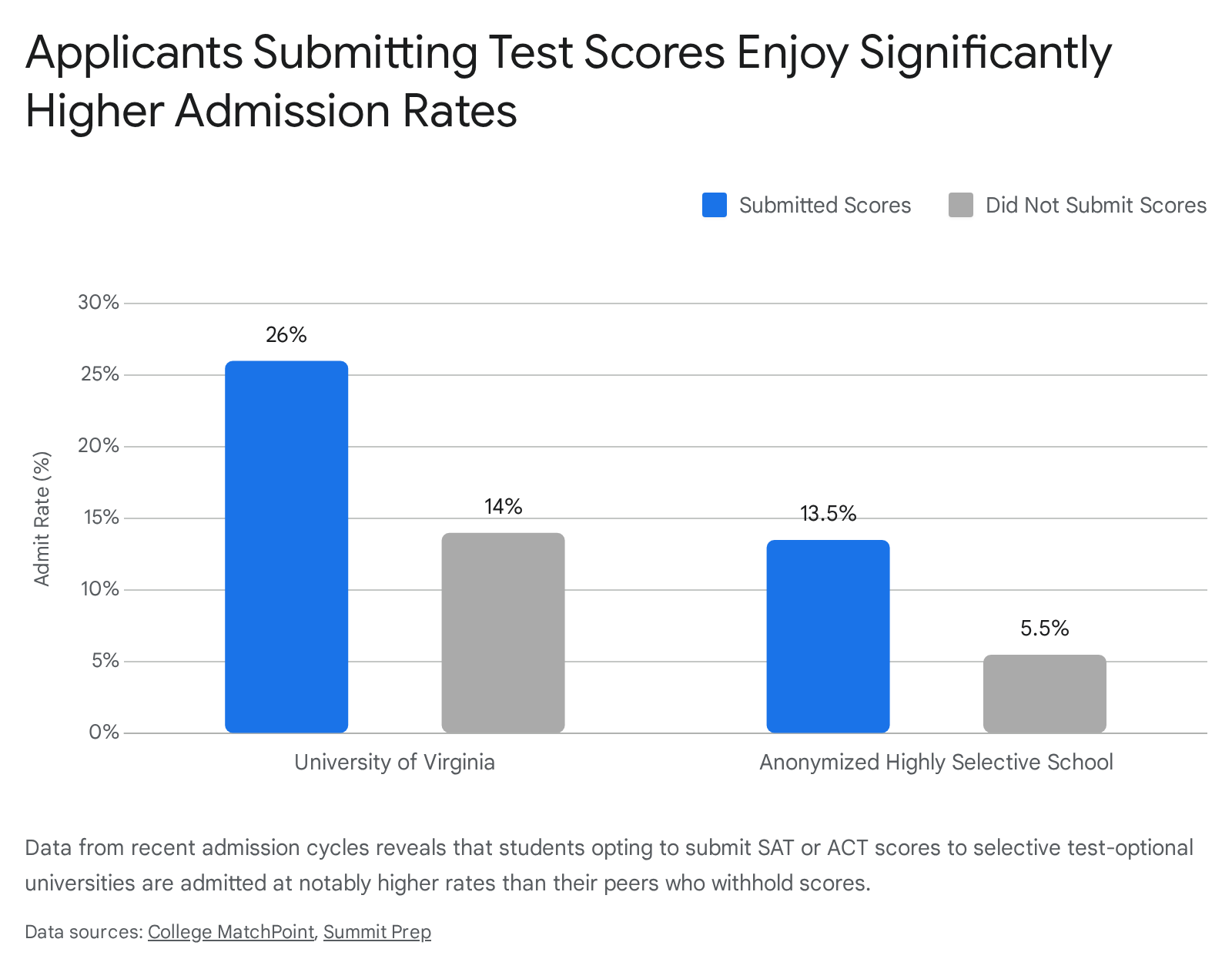
This massive gap does not necessarily imply that university admissions offices are secretly penalizing non-submitters or lying about their test-optional status. Rather, the pool of students who choose to submit scores is, on average, academically stronger, and their high test scores tightly correlate with other outstanding elements of their applications 22. However, when elite universities face applicant pools with single-digit acceptance rates, strong scores quietly serve as a powerful tiebreaker.
Why Score Submissions Are Surging in 2026
Students and high school counselors have recognized this unspoken reality. According to data released by the Common App, the behavior of applicants has shifted dramatically. In the 2025-2026 cycle, the number of applicants reporting test scores surged by 11% year-over-year, while the number of applicants applying without scores declined by 5% 4821.
By late in the application cycle, over 125,000 more students reported test scores on their Common Apps than those who did not 21. Students are submitting scores not because the universities explicitly require them, but because a strong score provides differentiation that a 4.0 GPA no longer automatically guarantees 8. Submitting a test score is rapidly returning to a status of competitive necessity at elite institutions.
The Return of the Test-Required Mandate
While test-optional remains the dominant policy in terms of sheer numbers nationwide, the upper echelons of higher education have aggressively shifted back to mandatory testing. Following internal reviews of student performance, dozens of elite institutions concluded that standardized tests are uniquely predictive of college success, perhaps even more so than high school grades 168.
The Ivy League and Elite Reversals
The return to testing was initially led by the Massachusetts Institute of Technology (MIT), which reinstated its requirement in 2022 after finding that math scores were essential for predicting a student's ability to survive its grueling, highly quantitative core curriculum 1622. MIT explicitly stated that standardized tests actually helped them identify talented students from disadvantaged backgrounds who might otherwise be overlooked due to attending under-resourced high schools 1624.
The Ivy League soon followed. Dartmouth, Brown, and Cornell reinstated testing requirements 162543. Harvard University, which had initially promised to extend its test-optional policy through 2026, abruptly reversed course in April 2024. Harvard announced that students applying for Fall 2025 (the Class of 2029) and beyond must submit an SAT or ACT score 824.
Harvard's decision was heavily influenced by internal data and research from Opportunity Insights (a Harvard-based economic research group), which demonstrated that standardized tests are highly predictive of early college grades. Harvard's Faculty of Arts and Sciences Dean noted that tests offer predictive information that makes the admissions process more meritocratic, arguing that essays and recommendation letters are actually far more prone to bias toward wealthy families who can hire expensive private admissions consultants 824.
Princeton University has similarly announced a return to testing, though it provided a longer runway for high school students to adapt. Princeton will remain test-optional for the 2026 and 2027 application cycles before mandating scores for Fall 2028 enrollment 2645. Columbia University is currently the only Ivy League school to commit to a permanent test-optional admission policy 2225.
Yale's "Test-Flexible" Experiment Ends
Yale University's trajectory is particularly illustrative of the volatile, fast-moving policy environment. In 2024, Yale introduced a novel "test-flexible" policy. This allowed applicants to bypass the SAT and ACT entirely, provided they submitted all of their Advanced Placement (AP) or International Baccalaureate (IB) scores instead 1046. The goal was to provide flexibility while still demanding standardized proof of academic rigor.
However, in late May 2026, Yale's Office of Undergraduate Admissions abruptly scrapped the test-flexible option. Following recommendations from a Presidential Council tasked with reviewing admissions integrity in the wake of the Supreme Court's affirmative action ban, Yale announced that beginning with the very next admissions cycle, all applicants must submit ACT or SAT scores, restoring their pre-pandemic 2020 policy 1022.
The university noted that the test-flexible policy was ultimately redundant; 90% of enrolled first-year students in the prior cycle had already submitted SAT or ACT scores regardless of the flexible AP/IB option 1043. Yale's leadership concluded that SAT and ACT scores remain the single greatest predictor of a student's performance in Yale courses across every statistical model they constructed 1046.
Caltech's Innovative "Bucket" System
The California Institute of Technology (Caltech), historically maintaining one of the most rigorous STEM environments in the world, went completely test-blind during the pandemic, extending the moratorium multiple times 927. However, after extensive faculty research showed that test scores strongly correlated with student grades in first-year physics and calculus, Caltech reinstated the SAT/ACT requirement for Fall 2025 entry 928.
To mitigate student anxiety and the relentless pursuit of a perfect 1600, Caltech introduced a highly innovative "bucket system" for reviewing scores in 2026 2829. Under this policy, admissions officers do not see a student's exact score if it is exceptionally high. Instead, scores are grouped into buckets before they are presented to human readers:
| Caltech Test Score Category | SAT Math or EBRW Score | ACT Individual Subscore | How Admissions Readers See It |
|---|---|---|---|
| Bucket A | 780 - 800 | 35 - 36 | Exact score hidden; shown only as "Bucket A" 28 |
| Bucket B | 750 - 770 | 33 - 34 | Exact score hidden; shown only as "Bucket B" 28 |
| Below Cutoff | Below 750 | Below 33 | The exact individual score is revealed 2829 |
Caltech's institutional research found that the difference in academic performance between a student arriving with a 780 and an 800 was statistically negligible. Hiding the exact number prevents admissions readers from unconsciously splitting hairs over insignificant testing margins, while still ensuring the baseline competency required to survive Caltech's curriculum 2829.
Public Flagships and Nuanced Mandates
It is not just private Ivy League institutions returning to testing. Major public universities are increasingly utilizing scores to manage massive, highly competitive applicant pools.
The University of Texas at Austin fully reinstated its SAT/ACT requirement for Fall 2025 and 2026 entrants 1730. Under Texas state law, UT Austin must automatically admit a massive percentage of its incoming class based purely on high school class rank. In 2026, the automatic admission threshold dropped to the top 5% of a Texas graduating class 1731. Because so many seats are filled by the top 5% rule, the remaining applicants face holistic review for very few spots. UT Austin President Jay Hartzell noted that reinstated test scores are crucial for placing students into highly competitive, mathematically rigorous majors like business, computer science, and engineering 1730.
The University of North Carolina (UNC) system has taken a fascinating hybrid approach based on high school performance. Through Fall 2026, UNC remains test-optional only for students with a high school cumulative, weighted GPA of 2.80 or higher. If a student's weighted GPA falls below 2.80, they are legally required by the state system to submit a minimum score of 17 on the ACT or 930 on the SAT to be eligible for admission 213233.
Meanwhile, the University of Washington (UW) occupies a strange middle ground. Officially, UW is test-optional. However, UW actively discourages students from stressing over the exam, stating that reviewers will fundamentally not see test scores for the vast majority of applicants 34. The only exception is for "a handful of students who may not otherwise be admitted" who submit remarkably high scores (e.g., above 1400 SAT or 31 ACT), leading some college counselors to classify UW as practically test-blind for the average applicant 434.
Crafting a Standardized Testing Strategy for 2026
With testing requirements fragmenting across state lines and institutional tiers, high school students applying to college in 2026 must act strategically. The days of treating "test-optional" as a blanket excuse to skip the SAT without consequence are over 4.
Assess the "Middle 50%" Benchmark
When deciding whether to submit a score to a test-optional college, the golden rule in admissions counseling is the "Middle 50%" metric. Every university publishes the middle 50% SAT and ACT score range of its previously admitted class (the spread between the 25th and 75th percentiles) 3122.
- When to Submit: If your score falls at or above the 50th percentile of a school's historical data, you should submit it. It will actively strengthen your application and serve as a reliable independent verification of your transcript 31.
- When to Withhold: If your score falls below the 25th percentile, do not submit it. Allow your GPA, course rigor, and extracurriculars to carry the academic weight of your application 1655. Sending a score that is significantly lower than a school's average can introduce doubt about your academic readiness 7.
Understand the Major and the Context
Context is critical when making the submission decision. A student applying for a highly quantitative major - like Computer Science or Biomedical Engineering at a test-optional school - is strongly encouraged to submit test scores (specifically a high math subscore) to prove their readiness 4.
Furthermore, standardized tests serve as vital external validation for specific applicant profiles. Homeschooled students, or students from high schools that utilize unfamiliar or unaccredited grading scales, almost always benefit from submitting an SAT or ACT score, as it provides admissions officers with a standardized, nationally recognized data point 16.
Similarly, students aiming for merit scholarships must read the fine print carefully. Many universities that are test-optional for general admission still firmly require test scores for the allocation of institutional financial aid, or for placement into elite honors colleges 163557. A student may gain admission without a test score, but forfeit tens of thousands of dollars in academic scholarships in the process.
Bottom line
In 2026, the distinction between test-optional and test-blind is profound: test-optional schools will evaluate your scores if you provide them, whereas test-blind schools (like the UC system) digitally redact them from the review process entirely. However, as Ivy League institutions, major public flagships, and elite STEM universities reinstate testing mandates, the broader landscape is shifting rapidly back toward standardized metrics. For students applying to competitive test-optional colleges, withholding an SAT or ACT score is becoming increasingly risky; data shows that submitting strong scores yields a massive admission advantage in an era of rampant grade inflation.