
Role of the platform core in expansion into adjacent markets
The trajectory of digital platforms - whether they successfully scale into adjacent markets or stall amid costly operational failures - is fundamentally determined by the architectural and strategic strength of their foundational business models. While traditional pipeline businesses rely on supply-side economies of scale and linear value chains, multi-sided digital platforms operate under the dynamics of network economics. In these environments, the primary theoretical frameworks for understanding market expansion and competitive advantage combine the concept of the "extendable core" with the mechanics of "platform envelopment."
An analysis of historical scaling attempts across the technology sector indicates that platforms succeed when their expansion strategies rely on a highly adaptable, technologically superior core that can be translated seamlessly into new domains. Conversely, when platforms attempt to expand by relying solely on brand recognition, capital expenditure, or existing user volume without a translatable operational advantage, they frequently encounter feature bloat, revenue capture mismatches, and structural rigidity that stalls their growth.
Theoretical Foundations of Platform Strategy
Understanding why digital platforms succeed or fail in adjacent markets requires an integration of disruptive innovation theory and network economics. These disciplines provide the vocabulary necessary to dissect the underlying mechanisms of platform scalability.
The Extendable Core in Disruptive Innovation
The concept of the extendable core was formally introduced in strategic management literature by Wessel and Christensen (2012) as a mechanism for evaluating a disrupter's potential to maintain performance advantages while expanding upmarket or into new industry verticals 122. Disruptive innovation theory historically posits that entrants originate in low-end or new-market footholds, serving less profitable customers that incumbents intentionally ignore in favor of their most demanding tiers 135. However, the critical determinant of whether an entrant can eventually displace the incumbent across the broader market lies in the strength of its extendable core.
The extendable core is defined as the aspect of a business model - whether a technological architecture, an algorithmic engine, or a unique cost structure - that allows a firm to preserve or enhance its inherent advantages as it creeps upmarket to capture more demanding customer segments 224. Crucially, an extendable core differentiates structural disruption from simple price competition. Lowering prices to capture market share is easily replicable if it relies on standard margin compression or short-term subsidies. A true extendable core is built on a foundation that incumbents cannot easily adopt due to their legacy architectures, capability constraints, or vested interests 234.
For example, early Software-as-a-Service (SaaS) companies utilized multi-tenant cloud architectures as their extendable core. This allowed them to deliver basic, low-cost software to underserved small businesses. As these SaaS providers expanded, their architecture allowed them to add complex features to compete with legacy on-premise providers while maintaining intrinsic structural advantages in delivery speed and cost efficiency 54.
The extendable core dictates exactly which types of customers a platform can attract and which it will repel. Identifying the viability of this core requires analyzing the "jobs-to-be-done" by the consumer. If an adjacent market requires a fundamental shift in the primary job the product is hired to perform, the existing core may not extend successfully, leading to stalled growth 245.
Platform Envelopment and Ecosystem Dynamics
In the context of multi-sided digital markets, the extendable core operationalizes a broader strategic maneuver known as "platform envelopment," theorized extensively by Eisenmann, Parker, and Van Alstyne 67. Platform envelopment occurs when a provider in one platform market enters another platform market by bundling its own functionality with that of the target market 89.
This strategy relies heavily on shared user relationships and common technical components 67. By leveraging a massive, existing user base - which is highly valuable due to indirect network effects - an enveloping platform can bypass the traditional barriers to entry that protect incumbents. Envelopers capture market share by foreclosing an incumbent's access to users, effectively harnessing the very network effects that previously served as the incumbent's primary defense 67.
The success of an envelopment attack depends heavily on the functional relationship between the bundled platforms: whether they are complements, weak substitutes, or functionally unrelated 67. When a platform successfully executes platform envelopment, it creates a multi-platform bundle that significantly increases switching costs for the consumer. However, intra-platform envelopment - where a platform owner invades the space of its own complementors - must be managed carefully. While it can generate direct revenue, it risks alienating the third-party developer ecosystem that provides the collective intelligence and boundary resources necessary for the platform's initial growth 91011. When a platform attempts to envelop a market where its core components provide no structural advantage, the expansion inevitably stalls.
Mechanisms of Successful Scaling into Adjacent Markets
Digital platforms that scale successfully do so by ensuring that their foray into adjacent markets directly leverages their extendable core. This minimizes friction, maximizes existing operational infrastructure, and aligns with the proven capabilities of the organization.
Algorithmic Scaling and Shared Logistics Components
The trajectory of Uber's various expansions provides a precise illustration of how the extendable core dictates success or failure within adjacent markets. Uber originated as a ridesharing platform, but its underlying extendable core was not passenger transport; rather, it was a highly sophisticated algorithmic engine for real-time supply-and-demand matching, dynamic surge pricing, and the management of a massive, distributed network of independent drivers 1412.
When Uber launched Uber Eats in 2014, it successfully enveloped the food delivery market because the expansion relied entirely on its existing extendable core. The same drivers could transport food, and the same routing algorithms optimized the delivery paths 121317. Furthermore, Uber Eats capitalized on the existing consumer interface. By integrating food delivery, Uber shifted consumer behavior toward a higher-frequency engagement model. Market data indicates that consumers who used both personal mobility and Uber Eats engaged with the platform for an average of 11.5 trips per month, compared to 4.9 trips for single-offering users 18. This dual-market utilization reduced the customer acquisition costs and improved overall unit economics, allowing the delivery division to scale rapidly and offset losses in the core ridesharing business during macroeconomic downturns 1814.
Similarly, Uber Freight scaled successfully by applying the company's real-time matching algorithms and transparent pricing models to the opaque, heavily intermediated commercial trucking industry 1415. By digitizing the freight brokerage model, Uber Freight reduced delays, optimized load matching, and stripped out middleman costs. This represented a direct, seamless application of its algorithmic extendable core to a business-to-business (B2B) environment, connecting shippers directly with carriers via a mobile interface 1415. Furthermore, projections indicate that incorporating large language models for real-time decision-making within Uber Freight could further optimize routes and reduce labor costs, reinforcing its technological advantage 15.
Super-App Architectures and Consolidated Interfaces
The structural contrast between Chinese and American social media platforms further highlights the mechanics of successful platform envelopment. WeChat, developed by Tencent and launched in 2011, transformed from a standalone messaging application into a comprehensive digital ecosystem boasting over 1.3 billion monthly active users by utilizing "mini-programs" as its extendable core 162217.
Mini-programs are lightweight, third-party applications that function entirely within the WeChat ecosystem. They eliminate the friction of requiring users to download, install, and manage multiple standalone applications on their devices 2425. By maintaining a cohesive, unified interface, WeChat effectively enveloped dozens of adjacent markets, including food delivery, transportation, utility payments, and e-commerce 1624. The extendable core in this instance was the platform's ubiquitous daily active user base and its integrated payment gateway, WeChat Pay. Data suggests that an average user opens a mini-program four times a day, deeply embedding the platform into the daily infrastructure of Chinese society 1725.
In contrast, Western platforms like Meta (formerly Facebook) historically maintained a fragmented approach. Meta created a family of distinct applications - Facebook, Messenger, Instagram, and WhatsApp - encouraging users to navigate between separate standalone entities 1624. While this strategy allowed for focused product development, it resulted in a less integrated ecosystem. Meta's fragmented approach limited its ability to envelop adjacent commerce and utility markets as seamlessly as WeChat, highlighting how architectural design choices define the limits of an extendable core 1617.
Architectural and Operational Pathologies of Stalled Platforms
When platforms fail to scale into adjacent markets, the failure rarely stems from a lack of capital, technical engineering talent, or brand awareness. Instead, it occurs because the platform attempts to expand beyond the fundamental limits of its extendable core. This misalignment leads to feature bloat, brand dilution, revenue capture mismatches, and a failure to address the target market's distinct consumer needs.
Core Rigidity and Misinterpretation of Hardware Ecosystems
The failure of the Amazon Fire Phone in 2014 serves as a premier case study in misjudging the extendable core and abandoning established corporate advantages. Amazon had successfully scaled into consumer electronics previously with the Kindle e-reader, an expansion that directly extended its core dominance in e-commerce and digital book distribution. However, when Amazon attempted to enter the highly competitive smartphone market, it fundamentally misunderstood the boundaries of its extendable core 1827.
Historically, Amazon's extendable core relied on low-margin, high-efficiency logistics and cost-leadership pricing strategies designed to drive retail volume. The Fire Phone, however, launched at a premium price point of $199 with a two-year wireless contract, placing it in direct competition with established, high-end incumbents like the Apple iPhone and Samsung Galaxy 1827. By abandoning its pricing ethos, Amazon failed to provide an incentive for consumers to switch platforms 1819.
Furthermore, the device relied on a proprietary app store that lacked essential third-party applications, most notably the Google suite (Gmail, Google Maps, YouTube), which severely degraded the utility of the device 1819. The phone's defining feature - a 3D "Dynamic Perspective" camera tracking system - was an expensive technological novelty that did not align with Amazon's core competency of providing frictionless retail experiences 2719. When initial sales failed to materialize, Amazon aggressively dropped the price to $0.99 on contract, a move that signaled desperation and further diluted the brand 1819. Ultimately, by failing to leverage its true extendable core, Amazon suffered a $170 million inventory write-down and entirely shuttered its phone division 1827.
Conversely, Amazon Web Services (AWS) succeeded monumentally because it represented a perfect externalization of Amazon's genuine extendable core: its massive, highly efficient internal server infrastructure and computing architecture 20. AWS scaled because it applied Amazon's backend efficiencies directly to an adjacent B2B market.
Feature Bloat and Misalignment with Ideal Customer Profiles
Google's attempt to envelop the social networking market with Google+ illustrates the dangers of forcing ecosystem integration without organic user demand or a distinct functional advantage. Launched in 2011 to combat the rising dominance of Facebook, Google+ attempted to leverage Google's massive search engine and email user base to rapidly scale a social graph 2131.
However, Google+ lacked an extendable core tailored to social interaction. It offered features similar to Facebook but with added complexity, such as the "Circles" feature. While conceptually sound for categorizing real-world relationships, Circles proved confusing and friction-heavy in execution 3132. Furthermore, Google relied on a rank-based algorithm rather than chronological user preference for content discovery, leading to a disjointed user experience 32.
Rather than allowing organic growth, Google forced integration, mandating Google+ accounts for users who wished to comment on YouTube or utilize other Google services 2133. This aggressive, non-organic scaling strategy led to immense feature bloat, alienated the existing user base, and diluted the brand's reputation for seamless utility 2133. The fundamental error was assuming that a utility-based extendable core - built around asynchronous email and data retrieval algorithms - could be seamlessly translated into a platform requiring synchronous social engagement, identity management, and continuous mobile interaction 3134. By 2019, Google officially shuttered the consumer version of the platform 21.
Revenue Capture Mismatches in Adjacent Logistics
Even highly successful platforms experience stalled expansions when the unit economics of the adjacent market do not map effectively to the firm's core operational model. Uber Rush, an on-demand courier service launched by Uber in 2014, failed despite utilizing the exact same driver network that powered the successful Uber Eats platform 22.
The failure of Uber Rush was rooted in a revenue capture mismatch. With Uber Eats, the platform controlled the entire consumer interface. All orders passed through the proprietary application, allowing Uber to capture revenue from both the delivery fee charged to the consumer and a substantial percentage of the total food order charged to the restaurant 22.
With Uber Rush, however, Uber merely provided the backend, white-label logistics for third-party retailers. Consumers placed orders on the retailer's external website, meaning Uber could only collect the flat delivery fee, missing out on the value of the underlying transaction 22. This thin margin structure could not sustain the operational costs of managing the logistics network. Consequently, Uber abandoned the Rush initiative to focus its resources on Eats and Freight, where the extendable core allowed for full-stack revenue capture 22.
Similarly, traditional market expansion failures - such as Walmart's entry into Germany or Starbucks' expansion into Australia - demonstrate that operational scaling stalls when companies assume a business model will automatically transfer to a new demographic without adapting to local consumer behavior and infrastructural realities 3637. Walmart failed to account for Germany's robust public transit and localized shopping habits, while Starbucks failed to recognize Australia's highly developed, independent cafe culture 3637. While these are physical expansions, the underlying pathology mirrors digital platform failure: an overestimation of the extendable core's universal applicability.
Exogenous Constraints on Platform Envelopment
A digital platform's ability to scale is not governed solely by internal architectural decisions or market demand. Exogenous variables - such as rigid regulatory frameworks, institutional friction, and antitrust legislation - frequently act as hard boundaries that prevent even the most robust extendable cores from penetrating specific adjacent markets.
Regulatory Friction and Institutional Boundaries
The collapse of Meta's (Facebook's) cryptocurrency initiative, originally named Libra and later rebranded as Diem, demonstrates the hard limits of platform envelopment when adjacent markets are heavily regulated by sovereign entities. Announced in 2019, Libra was intended to be a global, blockchain-based stablecoin pegged to a basket of fiat currencies and government debt instruments 3823. Meta intended to leverage its massive, global user base of over 2.9 billion people as an extendable core to instantly scale a new financial ecosystem, ostensibly providing frictionless banking services and cross-border payments to unbanked populations 3824.
Despite the theoretical soundness of the underlying distributed ledger technology, which promised high scalability and security, the expansion immediately stalled due to severe regulatory backlash 2325. Governments and central banks viewed the initiative not as a standard technological expansion, but as a direct threat to national monetary sovereignty, capital controls, and macroeconomic stability 3824.
Furthermore, Meta's historical controversies regarding data privacy and content moderation made global regulators fundamentally unwilling to trust the company with systemic financial infrastructure 24. Concerns over anti-money laundering (AML) compliance, consumer protection, and the potential for the platform to supplant weaker national currencies generated insurmountable political headwinds 38. The project quickly suffered high-profile defections from vital institutional partners like Visa, Mastercard, and PayPal, ultimately forcing Meta to wind down the initiative entirely by January 2022 2324. The failure of Diem highlights a critical limitation of digital expansion: a dominant user base cannot bypass institutional requirements. The extendable core of a social network does not inherently transfer the institutional trust required to operate global financial infrastructure.
The Impact of Antitrust Legislation and the Digital Markets Act
Legislative efforts, particularly the European Union's Digital Markets Act (DMA), have begun explicitly targeting the mechanics of platform envelopment to prevent monopolistic consolidation. The DMA, which became fully applicable in 2024, aims to ensure contestable and fair markets by regulating designated "gatekeepers" - large digital platforms that control access to vital digital ecosystems 2627.
The DMA fundamentally restricts how gatekeepers can utilize their extendable core to scale into adjacent markets. For instance, the regulation prohibits gatekeepers from combining personal data across different core platform services without explicit user consent, directly undercutting the data-aggregation advantages that drive successful platform envelopment 2628. Furthermore, it mandates enhanced interoperability, forcing companies like Apple to open their operating systems to third-party app stores and alternative payment systems, and requiring designated messaging platforms to communicate with smaller rivals 2628.
Consequently, major platforms are being forced to restructure their expansion strategies. Apple, for example, has cited the DMA's interoperability requirements and security risks as the reason for delaying the launch of certain generative AI features (Apple Intelligence) and screen-sharing functionalities in the European market 2829. The regulatory environment signifies a major paradigm shift: governing bodies are actively dismantling the algorithmic and data-driven extendable cores of large technology firms to artificially level the playing field, making frictionless adjacent scaling increasingly difficult 2630.
Comparative Analysis of Expansion Outcomes
To synthesize the variables that dictate whether a platform scales or stalls, it is highly instructive to evaluate historical expansions through the analytical framework of the extendable core.
| Platform / Parent Company | Attempted Adjacent Market | Extendable Core Leveraged | Outcome | Primary Cause of Scaling or Stalling |
|---|---|---|---|---|
| Uber Eats (Uber) | Food Delivery | Real-time routing algorithms, driver network, dynamic pricing. | Scaled | Direct translation of core logistics algorithms into a high-frequency, full-revenue-capture market 1218. |
| Uber Rush (Uber) | Retail Courier Logistics | Driver network, logistics API. | Stalled | Revenue capture mismatch; inability to monetize the full transaction value compared to the core rideshare model 22. |
| Amazon Web Services | Enterprise Cloud Infrastructure | Internal server architecture, computing efficiency, API structure. | Scaled | Organic externalization of Amazon's highly efficient backend infrastructure into a scalable B2B service 20. |
| Amazon Fire Phone | Consumer Smartphone Hardware | E-commerce dominance, prime membership. | Stalled | Misalignment with cost-leadership core; high price point, weak app ecosystem, and gimmicky technical features 1827. |
| WeChat (Tencent) | E-commerce, Ride-hailing, Payments | Messaging user base, unified digital identity, WeChat Pay. | Scaled | Super-app "mini-programs" allowed seamless envelopment without requiring users to download external applications 1624. |
| Google+ (Alphabet) | Social Networking | Search and email user base. | Stalled | Feature bloat, lack of differentiation from incumbents, and artificial scaling by forcing integration across unrelated products 3233. |
| Libra / Diem (Meta) | Global Cryptocurrency / Finance | Social network user base, global reach. | Stalled | Extreme regulatory friction; inability of a social extendable core to bypass sovereign monetary policies and institutional trust barriers 38. |
The Future of the Extendable Core: The Shift to Agentic Artificial Intelligence
As the digital landscape evolves rapidly through the mid-2020s, the definition of the extendable core is shifting away from static algorithmic matching and basic user-base aggregation toward dynamic, autonomous workflows. The proliferation of Generative AI, and specifically the transition toward "Agentic AI," represents the next major frontier of platform envelopment.
Agentic AI as a Strategic Orchestration Layer
Industry analysts, including Gartner, have identified "agentic AI" as the primary strategic technology trend for 2025 48.
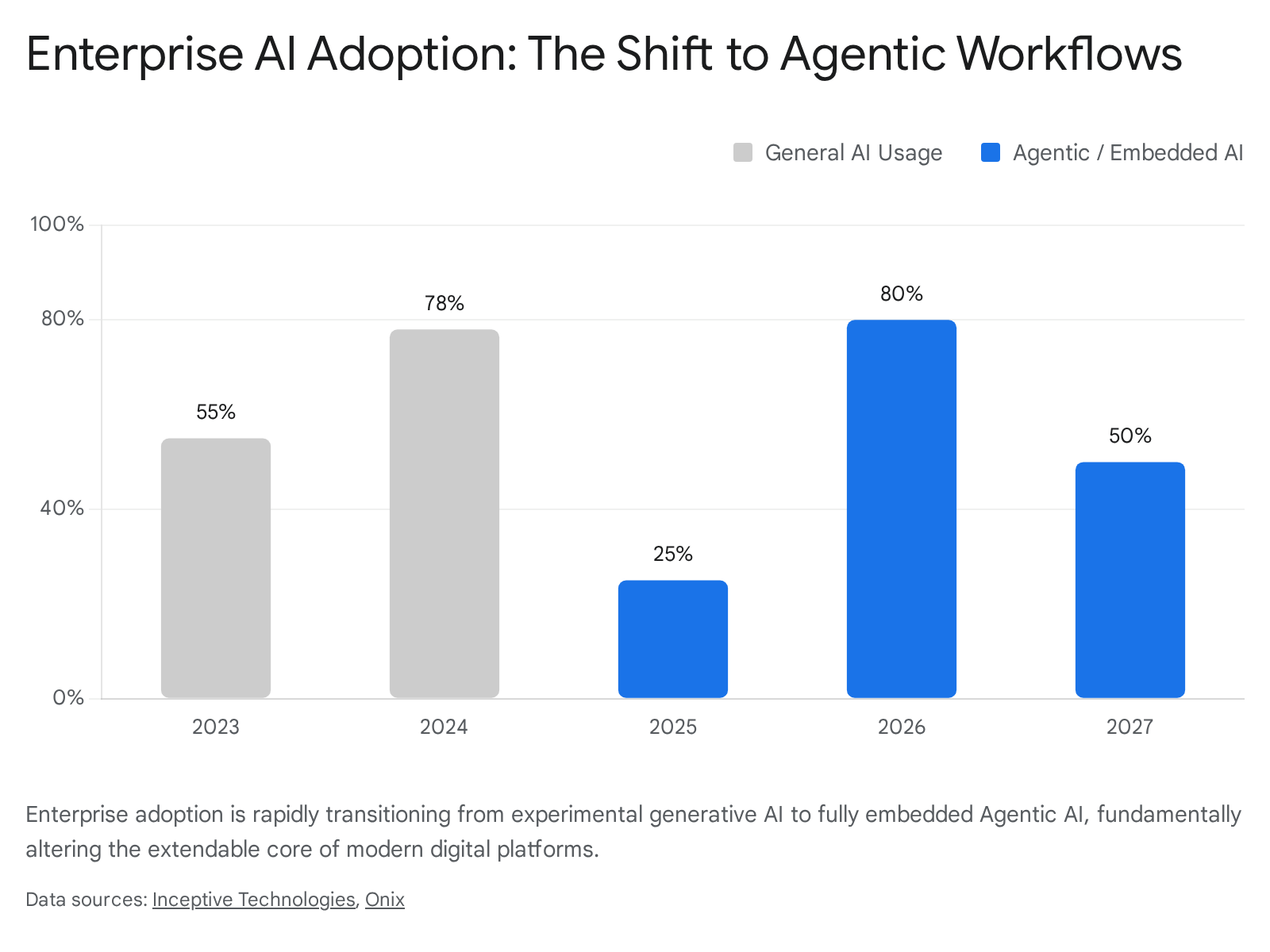
Unlike early generative AI models that functioned as passive chatbots requiring manual human prompting, agentic AI systems operate autonomously. They can reason, set objectives, navigate complex enterprise data environments, and execute multi-step workflows across various software ecosystems without constant human intervention 3150.
From a strategic management perspective, agentic AI is transitioning from a standalone product feature into the foundational orchestration layer of enterprise platforms 3233. This effectively shifts the definition of the extendable core from passive data hosting to active, autonomous workflow execution. Organizations implementing agentic systems report accelerating core business processes by 30% to 50% by eliminating traditional silos in data analysis and decision-making 31. The capacity of a digital platform to deploy secure, governable, and effective AI agents will dictate its ability to scale into new enterprise verticals over the next decade.
Envelopment via AI Integration: Microsoft, AWS, and Google
Major cloud and software providers are currently executing massive envelopment strategies using agentic AI as their primary vehicle, bundling these capabilities deeply into their existing subscriptions to fend off niche competitors.
Microsoft's deployment of Copilot exemplifies this aggressive dynamic. Initially launched as a standalone chat interface, Microsoft has deliberately restructured Copilot to function as the primary user interface across the entire Microsoft 365 ecosystem 53. By embedding Copilot directly into Word, Excel, Teams, and an expanding suite of third-party applications via Copilot Studio, Microsoft is utilizing its monopolistic distribution footprint as an extendable core to dominate the AI productivity market 5455. The transition to multi-agent orchestration - where specialized agents interact with one another to complete complex tasks like human resources onboarding or IT ticketing - further entrenches Microsoft's platform, making it exceedingly difficult for standalone AI startups to compete 5356.
Similarly, Amazon Web Services (AWS) has evolved its Amazon Bedrock offering from a simple model-hosting service into a comprehensive enterprise-grade governance layer known as AgentCore 5734. Enterprises have historically been hesitant to deploy autonomous agents due to severe security risks, compliance mandates, and the potential for AI to "go rogue" within sensitive corporate networks 5057. AWS addresses this structural barrier by making deterministic policy enforcement its new extendable core. Through AgentCore, AWS allows companies to set hard constraints on what an AI agent can access and execute, evaluated outside the reasoning loop of the underlying Large Language Model 5735. By providing the secure infrastructure necessary for trust and compliance, AWS is successfully scaling its historical cloud dominance into the highly lucrative autonomous agent sector 5736.
Google is executing a parallel strategy by integrating its advanced Gemini AI models deeply into Google Workspace and the Chrome browser environment 613738. By eliminating the need for separate AI add-ons and baking capabilities like automated document drafting, cross-tab summarization, and meeting analysis directly into tools used by billions daily, Google significantly lowers the barrier to entry 3738. This increases ecosystem stickiness and fends off user churn to third-party AI providers 3738. Furthermore, Google's introduction of "AI Mode" in Search, powered by the Gemini 2.0 architecture, expands the traditional search engine's extendable core to handle complex, multimodal reasoning and intricate e-commerce comparisons natively, effectively keeping users engaged within the Google ecosystem for longer durations rather than sending them to external domains 39.
Conclusion
The variance in outcomes for digital platforms seeking to scale into adjacent markets is not random, nor is it strictly a function of capital expenditure or marketing prowess. It is fundamentally governed by the structural integrity and operational applicability of the platform's extendable core. When a firm effectively maps its foundational technological, architectural, or algorithmic advantages to the specific "jobs-to-be-done" in a new market, it successfully envelops that market - as evidenced by Uber Eats' application of real-time logistics routing and WeChat's utilization of its integrated mini-program architecture.
Conversely, when platforms attempt to expand by relying solely on brand recognition or existing user volume - without translating a distinct, underlying operational advantage - they inevitably stall. Feature bloat, pricing misalignments, and cultural misunderstandings plague these efforts, as demonstrated by the costly failures of the Amazon Fire Phone and Google+. Furthermore, it is critical to recognize that no technological core exists in a vacuum; regulatory and institutional boundaries, such as the European Union's Digital Markets Act and the sovereign financial regulations that halted the Diem cryptocurrency, serve as formidable, exogenous friction points that can halt even the most sophisticated algorithmic envelopment strategies.
As the enterprise software landscape transitions firmly into the era of agentic artificial intelligence, the fundamental laws of the extendable core remain intact. The platforms that will dominate the coming decade are those capable of evolving their core from static data aggregation and passive software delivery toward dynamic, autonomous orchestration, seamlessly and securely integrating intelligence into the daily workflows of the global economy.