
Network effects and incumbent protection from disruptive innovation
Introduction
The intersection of disruptive innovation theory and the economics of network effects represents a critical frontier in strategic management, industrial organization, and platform economics. Originally formulated to explain the failure of leading firms in the face of technological and market change, the theory of disruptive innovation describes a process by which entrants with fewer resources successfully challenge established incumbent businesses by targeting overlooked market segments. Concurrently, the theory of network effects explains the dynamics of markets where the utility of a product or service increases as more individuals use it, leading to demand-side economies of scale.
Historically, these two theoretical frameworks developed along largely parallel tracks in academic literature. Innovation scholars focused heavily on product performance trajectories, value networks, and the resource allocation dilemmas faced by incumbent management. Economists, meanwhile, mapped the mechanics of two-sided markets, pricing strategies, switching costs, and the structural topologies of interconnected systems. However, in contemporary digital economies, these phenomena are inextricably linked. Digital platforms, software ecosystems, and multi-sided networks dominate the modern competitive landscape, meaning that any rigorous analysis of market disruption must account for the structural properties of the networks defending the incumbents.
This report examines how the theory of disruptive innovation intersects with network effects, identifying the precise economic and structural conditions under which network externalities insulate incumbents from disruptive threats. Furthermore, the analysis delineates the specific vulnerabilities inherent in networked markets - such as negative network effects, multihoming behaviors, network fragmentation, and targeted hub-plucking - that allow asymmetric entrants to bypass traditional network defenses and fundamentally destabilize dominant platforms.
Theoretical Foundations of Disruptive Innovation
To analyze the intersection of these two concepts, it is necessary to establish the independent mechanics that govern disruptive innovation and how it operates in traditional, non-networked industries.
Introduced by Clayton M. Christensen in the late 1990s, the theory of disruptive innovation was designed to explain how great, well-managed firms can fail despite employing optimal management practices, listening to their best customers, and investing heavily in new technologies 122. The theory posits that incumbents naturally focus their resources on sustaining innovations - incremental or radical improvements designed to satisfy the rigorous demands of their most profitable customers 34. Over time, this relentless pursuit of premium margins causes incumbents to overshoot the actual performance requirements of mainstream and low-end customers, creating a strategic vacuum at the bottom of the market 45.
Disruptive innovations systematically exploit this vacuum through two primary trajectories. The first trajectory is low-end disruption. In this scenario, an entrant introduces a product that is objectively inferior by traditional industry performance metrics but is considered "good enough" for overserved customers 678. The product typically features a cheaper, simpler, or more convenient business model, allowing the entrant to achieve profitability at price points that are financially unattractive to the incumbent 210. As the entrant secures a foothold in this low-margin tier, it steadily reinvests and improves its offering along the industry's traditional performance trajectory. Eventually, the entrant moves upmarket, capturing mainstream consumers with a product that now meets their performance needs while retaining its structural cost advantage 34912. Classical examples of low-end disruption include steel minimills unseating integrated steel mills and early online booksellers undercutting traditional retail footprints 710.
The second trajectory is new-market disruption. Here, an entrant targets non-consumers - populations that previously lacked the financial resources, technical expertise, or physical access to consume the incumbent's product. By establishing a completely new value network, the entrant avoids direct competition with the incumbent until its product performance matures sufficiently to pull mainstream customers into the new paradigm 891112. The early personal computer, which initially lacked the processing power to compete with enterprise mainframes but created a massive new market of individual users, exemplifies this trajectory 79.
A critical element of the theory is that disruption is a longitudinal process, not a static product attribute 58. For example, the early mass-market automobile disrupted horse-drawn carriages because it fundamentally altered the transportation value network through affordability and infrastructure, whereas early luxury cars did not 8. Similarly, Netflix disrupted Blockbuster through a low-end foothold, initially offering mail-order DVDs to consumers willing to wait, before leveraging technological advancements to move upmarket via broadband streaming 36912. Conversely, Christensen explicitly categorized ride-hailing services like Uber as sustaining innovations rather than disruptive ones, as they primarily targeted mainstream consumers in established geographic markets with a superior service model, rather than initiating from a foothold of low-end users or non-consumers 4810.
The Dynamics of Network Effects
While disruptive innovation focuses on the supply-side evolution of products and business models, the theory of network effects focuses on demand-side economies of scale. Network effects, or network externalities, occur when the utility a user derives from a good or service depends directly on the number of other users consuming the same good or service 1314. Markets characterized by strong network effects frequently exhibit extreme "winner-takes-all" or "winner-takes-most" dynamics, resulting in high market concentration, durable monopolies or oligopolies, and significant barriers to entry 151617.
The economic literature categorizes network effects into several distinct typologies, each with unique strategic implications for both incumbents and entrants. Direct network effects, also known as same-side effects, occur when an increase in usage leads to a direct increase in value for other users of the exact same type. Telecommunications networks, instant messaging applications, and foundational social media platforms are classic examples; the utility of a telephone or a messaging app is entirely dependent on the presence of one's peers on the same network 14151618.
Indirect network effects, also termed cross-side effects, are prevalent in two-sided or multi-sided platform markets. In these ecosystems, the platform acts as an intermediary, and the presence of one user group significantly increases the value of the platform for a distinct, complementary user group. For example, in operating systems, an abundance of software developers attracts end-users, which in turn attracts more developers. Similar dynamics govern credit card networks, e-commerce marketplaces, and digital employment platforms 1314151618.
In the modern digital economy, data network effects have emerged as a third crucial typology. As a platform aggregates more usage data, its underlying algorithms improve, allowing the firm to offer superior personalization, search accuracy, or operational efficiency. This enhanced product quality attracts more users, generating even more data, thereby closing a virtuous cycle of continuous improvement that is exceedingly difficult for new entrants to replicate 161920.
Finally, network effects are structurally defined by their geographic or topological scope, categorized as either local or global. Global network effects provide utility regardless of the physical geography of the participants, such as a user in Europe interacting seamlessly with a user in Asia on a professional networking site. Local network effects, however, are strictly constrained by physical geography or highly specific social clusters. Ride-hailing applications and food delivery services exhibit local network effects; an oversupply of drivers in London provides absolutely no utility to a rider seeking transportation in New York 161721.
When these various typologies of network effects compound within a single platform, they create formidable defensive moats. The positive feedback loops generated by network externalities manifest as high switching costs for consumers. Even if a new entrant offers a standalone product with superior technological features or a radically lower price point, the rational consumer will not switch if the entrant lacks a comparable, liquid user network 152223. This dynamic inherently suppresses the "good enough" threshold that typically enables disruptive innovation.
The Intersection: When Network Effects Protect Incumbents
When disruptive innovation theory is applied directly to digital platforms and network-driven markets, a profound theoretical tension emerges. Christensen's original model assumes that a cheaper, simpler product will successfully peel away price-sensitive, low-end customers, establishing a beachhead for the entrant 48. However, in a network-mediated market, a disruptive entrant faces a crippling dual deficit: it initially lacks both traditional product performance and essential network utility 2224.
Simulation models and extensive empirical case studies analyzing the interaction of technology development and consumer choice confirm that the strength and scope of an incumbent's network effect dictate the probability of successful disruption.
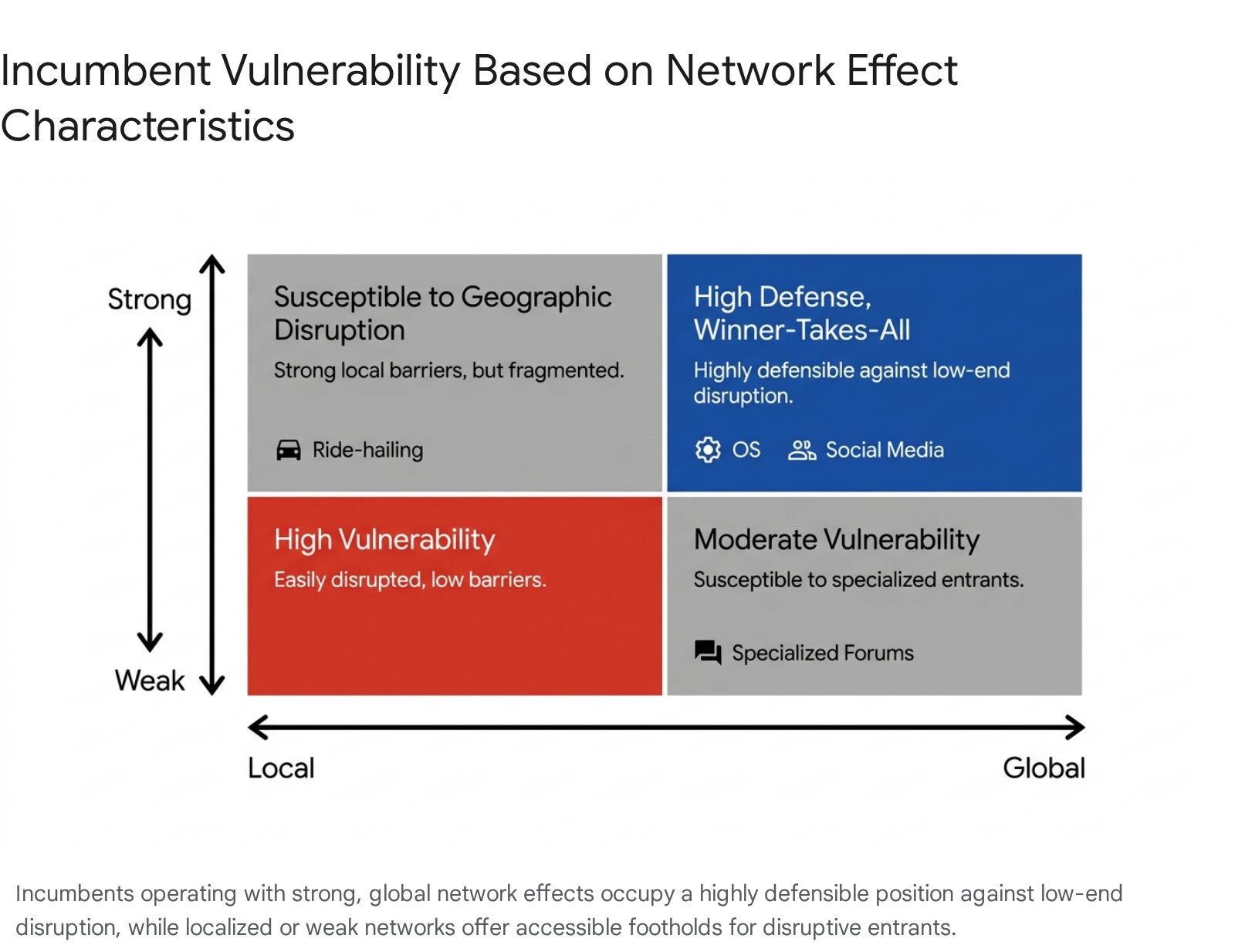
Strong network effects overwhelmingly insulate incumbents against asymmetric entrants, effectively neutralizing the standard low-end disruption mechanism 2325.
If an incumbent benefits from a strong global network effect, the immense value derived from the network significantly outweighs the marginal price or convenience advantages offered by a disruptive entrant 162125. Because low-end customers in a networked market still require the network to derive value - a cheaper social network is functionally useless if an individual's peers are absent - they cannot easily be captured by an entrant offering a standalone low-cost alternative. Consequently, strong network effects compel a winner-takes-all equilibrium. This structural reality locks out disruptors regardless of the underlying heterogeneity in consumer preferences for price, simplicity, or specific features 2325.
Furthermore, the operational architecture of digital platforms provides incumbents with unprecedented visibility into niche market behaviors. In traditional, non-networked industries, incumbents often ignore low-end disruptions because these innovations occur in entirely distinct, less profitable value networks that are disconnected from the incumbent's core operations 15. In multi-sided platform markets, however, user activity, third-party developer trends, and shifting consumer preferences are highly observable through platform analytics. This data superiority allows incumbents to identify nascent threats and shifting consumer behaviors much earlier in the disruption cycle, enabling proactive defensive responses 26.
Platform Envelopment: Disruption via Ecosystem Integration
Because markets protected by strong network effects are resistant to traditional low-end footholds, Schumpeterian innovation - offering a fundamentally superior standalone technology - is rarely sufficient to overcome the incumbent's entrenched switching costs 22. Instead, successful attackers in digital economies frequently rely on an entirely different strategic mechanism known as platform envelopment 22272829.
Formulated extensively by scholars such as Eisenmann, Parker, and Van Alstyne, platform envelopment occurs when a provider operating in one multi-sided market enters a second, distinct target market by bundling its existing functionality with that of the target market 132227. By leveraging an existing, massive shared user base and established data infrastructures, the enveloping platform entirely bypasses the "cold start" or "chicken-and-egg" dilemma that typically dooms standalone, single-product entrants 133031. The attacking platform forecloses the incumbent's access to users, effectively hijacking the very network effects that previously protected the incumbent and repurposing them to subsidize the invasion 222428.
This enveloping mechanism serves dual purposes in the digital economy, functioning both as a devastating offensive attack and a robust incumbent defense mechanism. As an attack, an entrant operating in an adjacent digital sector can use platform envelopment to disrupt a dominant incumbent. Because the enveloper subsidizes the new service using revenue, behavioral data, or user engagement monetized in its origin market, it can afford to offer the new bundled service at a radically lower cost, mimicking the pricing trajectory of a low-end disruption but executing it with the backing of a mature ecosystem 242832. A classic historical instance is Microsoft's envelopment of Netscape; by bundling its Internet Explorer browser with the dominant Windows operating system, Microsoft utilized its massive existing user base to instantly commoditize the standalone browser market 2233.
Conversely, established incumbents utilize envelopment defensively to neutralize nascent disruptive threats. When a digital incumbent identifies an emerging, potentially disruptive platform gaining traction in a niche market, it can expand its own ecosystem to replicate the entrant's specific functionality. By bundling this replicated feature into its core offering, the incumbent denies the entrant the critical mass required to achieve escape velocity and sustain its own independent network 222934. This dynamic explains why competition in the digital sector is heavily shaped by continuous feature cloning and the expansion of massive conglomerates rather than the steady rise of specialized startups 2835.
To clarify the structural differences between traditional disruption and network-based envelopment, the following table summarizes the strategic vectors, constraints, and underlying economic forces.
| Strategic Mechanism | Primary Driver of Value | Barrier to Incumbent Response | Role of Network Effects | Historical Example |
|---|---|---|---|---|
| Traditional Low-End Disruption | Price and operational simplicity | Financial asymmetry; responding requires margin dilution and stranding core assets 589. | Negligible; theory relies heavily on standalone product value 46. | Minimills disrupting integrated steel mills 10. |
| New-Market Disruption | Accessibility and convenience | Lack of incumbent expertise or presence in the newly created value network 7811. | Secondary; network grows organically outside incumbent view 7. | Personal computers disrupting enterprise mainframes 79. |
| Platform Envelopment | Bundled utility and shared user relationships | Economies of scope; inability to match the multi-platform bundle or cross-subsidization 222829. | Primary weapon; attacker weaponizes its own origin network effects to crush the target 2224. | Microsoft bundling Internet Explorer against Netscape 2233. |
Structural Vulnerabilities in Networked Markets
While strong network effects and aggressive envelopment strategies present formidable barriers, they do not guarantee absolute or permanent invulnerability. Market structure, behavioral usage patterns, and topological network features can generate specific structural vulnerabilities that sophisticated disruptive entrants can exploit.
Negative Network Effects and Ecosystem Congestion
A fundamental misconception in platform economics is that network effects scale infinitely without friction. In reality, as platforms grow beyond a certain critical mass, they frequently encounter negative network effects, where the addition of new users actively degrades the value of the platform for existing participants 15173637.
Negative network effects manifest primarily through physical or digital congestion and an overwhelming increase in noise 153638. In social networks and content platforms, an unregulated influx of users can rapidly dilute content quality, increase the prevalence of spam, and erode trust between participants 173739. In two-sided e-commerce marketplaces or freelance gig platforms, an oversupply of sellers can result in massively increased search costs for buyers, while inciting intense, race-to-the-bottom price competition that ultimately drives high-quality, professional producers off the platform entirely 1437.
This degradation of user experience creates a classic "overserved" customer segment - users who are fatigued by the complexity, algorithmic opacity, or noise of the dominant platform. Disruptive entrants can target this specific vulnerability by offering stripped-down, highly curated, or niche-specific networks. By utilizing a low-end or new-market foothold, these entrants capture disillusioned users who seek a return to the platform's original, uncluttered value proposition 1737.
The Threat of Multihoming and Low Switching Costs
The protective power of any network effect is inversely proportional to the rate of multihoming within the ecosystem. Multihoming refers to the practice of users actively participating in multiple competing networks simultaneously 13151617.
If the cost of multihoming - whether measured in financial terms, cognitive effort, or data portability - is low, the incumbent's network moat is remarkably shallow 16. The ride-hailing industry serves as an optimal example; both the supply side (drivers) and the demand side (passengers) can seamlessly operate the applications of Uber, Lyft, and regional competitors simultaneously 1516. Because the switching cost approaches zero, no single incumbent can rely on network lock-in to defend its margins or dictate terms. In such environments, market structures lean heavily toward fragmented oligopolies rather than stable, winner-takes-all monopolies. This reality leaves incumbents highly vulnerable to disruptive entrants that compete aggressively on subsidized pricing, specialized regional services, or localized density 16.
To defend against multihoming disruption, dominant platforms must artificially increase the cost of multihoming for users. This is typically achieved by introducing exclusive platform features, deep data lock-ins, robust loyalty incentives, or algorithmic optimizations that require continuous, single-platform engagement to function effectively 1516. Conversely, regulatory interventions often seek to mandate interoperability to artificially lower switching costs, specifically to induce market fragmentation and allow new entrants to compete 4041.
Network Fragmentation and Hub-Plucking Strategies
Advancements in network science have introduced highly sophisticated frameworks for analyzing platform vulnerability, moving beyond basic economic theory to examine the actual mathematical topology of digital ecosystems. Central to this analysis is the concept of hub-plucking 4243.
The vast majority of digital platforms exhibit scale-free topologies. These networks are characterized by a highly unequal distribution of connections: a very small number of highly connected nodes (hubs) anchor the network, alongside a massive, sprawling number of peripheral nodes with very few connections 4344. While scale-free networks demonstrate remarkable resilience to the random removal or churn of average users, they are structurally fragile if subjected to targeted attacks that remove the central hubs 4445.
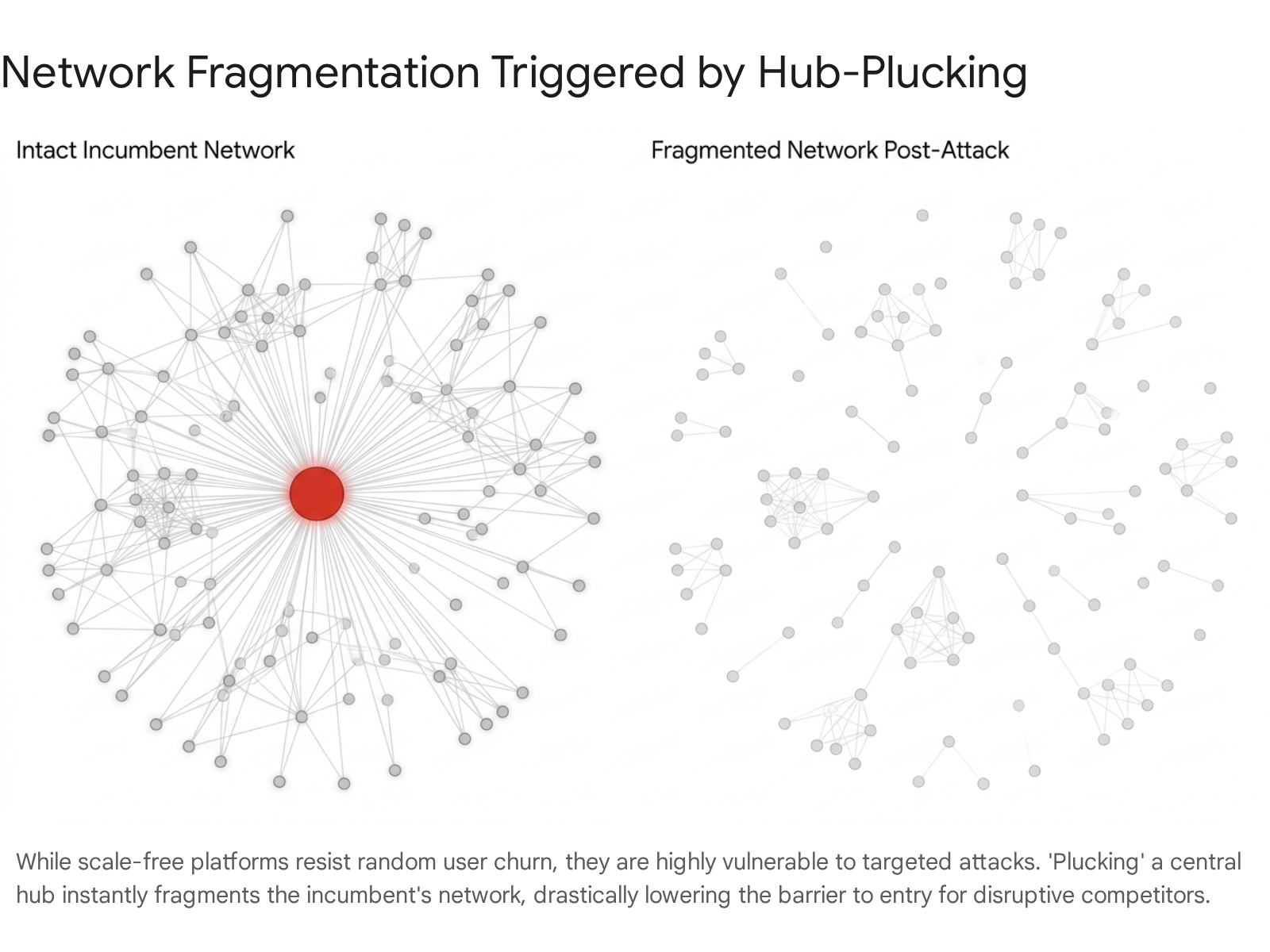
In a commercial platform context, these "hubs" represent power users, super-merchants, highly followed content creators, or high-volume enterprise buyers 4344. Fledgling platforms and disruptive entrants can overcome the network effects of dominant incumbents by executing a precise hub-plucking strategy. This involves aggressively subsidizing, courting, or outright acquiring the incumbent's most connected hubs 4246. Network models demonstrate that removing even a minor percentage of critical hubs - often as low as 5% to 15% - can trigger cascading operational failures and severe network fragmentation across the entire incumbent platform 4244. By systematically plucking hubs, the entrant instantly captures disproportionate market share, degrades the incumbent's value proposition, and shatters the network externalities that previously insulated the incumbent against disruption 42.
Case Studies in Platform Disruption, Defense, and Failure
The theoretical interplay between network effects and disruption is best contextualized through empirical market case studies. In these examples, traditional models of disruption have either succeeded spectacularly, failed completely, or forced fundamental adaptations in corporate strategy.
Failed Disruption and Network Resistance
Not all disruptive technologies succeed in overthrowing incumbents. Theoretical models often highlight cases where network effects or complex supply chains prevented new entrants from achieving escape velocity. The history of the digital music industry provides a stark contrast in disruption strategies. Early file-sharing networks like Napster introduced a highly disruptive digital consumption model but failed to achieve sustainable market dominance. Napster's peer-to-peer network was ultimately dismantled by legal constraints and industry resistance, demonstrating that unregulated, disruptive technology cannot survive if it fails to integrate with the broader legal and commercial network 2. Spotify, in contrast, did not rely on a classic low-end technological disruption. Instead, it leveraged complex multi-sided platform mechanics, securing licensing agreements with record labels while providing an accessible interface for consumers. By utilizing powerful data network effects through algorithmic curation, Spotify restructured the industry's value network and established high switching costs, protecting it from both legacy media incumbents and new entrants 247.
Similarly, hardware industries with complex competence requirements often resist disruption. In the digital photography transition, while Kodak famously struggled, high-end incumbents like Hasselblad survived the initial wave of digital disruption. The stringent performance requirements of the high-end market - combined with specialized professional value networks - prevented low-end digital entrants from immediately moving upmarket and unseating entrenched, premium brands 48.
WeChat and the Super-App Ecosystem Paradigm
Tencent's WeChat represents a premier example of how platform envelopment and compound network effects can serve as an impregnable defense mechanism. Originating as a straightforward instant messaging application, WeChat rapidly accumulated a massive user base in China, generating intense direct network effects 495051. However, rather than remaining a single-sided platform vulnerable to disruption from newer communication protocols, WeChat pursued an aggressive "super-app" strategy.
WeChat integrated digital payments, e-commerce, ride-hailing, food delivery, and third-party "mini-programs" into a singular, unified interface 47505152. This strategy systematically enveloped adjacent industries, fundamentally disrupting traditional telecommunications providers, standalone payment gateways like Alipay, and segmented e-commerce applications 495053. By layering indirect network effects - connecting millions of third-party developers and merchants with consumers - on top of its foundational direct network effects, WeChat achieved a level of ecosystem integration that effectively monopolized user attention 545556. This process of "co-innovation" and "co-adaptation" drastically elevated switching costs. The platform became highly resistant to standard low-end disruption from newer, standalone applications because leaving WeChat meant losing access to vital daily services, not just a messaging tool 5254.
The comparative dynamics of these diverse market disruptions and defenses are structured below, illustrating how the presence or absence of network effects dictates the competitive outcome.
| Entity | Target Market | Incumbent Disrupted | Primary Disruption Strategy | Status of Network Effects | Outcome / Result |
|---|---|---|---|---|---|
| Netflix | Video Rental | Blockbuster | Low-end disruption targeting price and convenience 369. | Negligible; lack of network protection exposed the incumbent 12. | Complete displacement of the physical retail incumbent 36. |
| Spotify | Music Distribution | Physical Retail / Digital Downloads | Multi-sided platform design and business model innovation 247. | Strong data and indirect network effects protect the entrant 2. | Entrant established dominance via an entirely new value network 2. |
| Digital Ecosystem | Telecoms / Standalone Apps | Platform envelopment via Super-App integration and mini-programs 495056. | Compound direct and indirect network effects create lock-in 525456. | Entrant achieves near-monopoly status, highly insulated from future disruption 5052. |
The Impact of Generative Artificial Intelligence
The recent proliferation of Generative Artificial Intelligence (GenAI) and Large Language Models (LLMs) introduces a profound technological vector capable of fundamentally altering the established balance between disruptive innovation and incumbent network defenses. GenAI operates as a general-purpose technology, drastically lowering the marginal cost of knowledge generation, software coding, analytical reasoning, and creative synthesis across the broader digital economy 5758.
Erosion of Traditional Data Moats and Cognitive Sovereignty
Historically, data network effects have served as the ultimate protective moat for digital incumbents. Platforms that aggregate vast amounts of proprietary user data can optimize their algorithms faster than new competitors, driving superior user experiences and further user acquisition in an impenetrable, self-reinforcing feedback loop 16195759.
Generative AI threatens to commoditize these data advantages. Because foundation models are pre-trained on internet-scale datasets, they possess the capacity to synthesize, infer, and generate highly accurate outputs without requiring the platform to possess a continuous, proprietary data feedback loop from its specific user base 5760. Entrants utilizing advanced GenAI APIs can instantly offer highly personalized, intelligent services that previously would have required years of user data aggregation to construct 5961. By effectively circumventing the "cold start" problem, GenAI diminishes the absolute value of traditional data network effects. This technological shift lowers historical barriers to entry, enabling rapid, new-market disruptions across legal, educational, programming, and creative industries 315758.
Furthermore, as GenAI tools evolve into persistent, personalized digital companions, they create new forms of psychological lock-in. Analysts refer to this as "Network Effect 2.0," where a platform achieves a deep "cognitive sovereignty" over the user. The value scales not with the number of other users, but with the depth of personalized memory and contextual understanding the AI assistant possesses, creating a deeply entrenched, individual-level moat that is exceptionally difficult for competing platforms to replicate or port 59.
Complementary Assets and Incumbent Survival
Despite the theoretically disruptive nature of foundation models, the massive physical and financial infrastructure required to train and deploy them suggests that the long-term competitive landscape may still heavily favor existing incumbents 5758.
Innovation economics posits that when a technology is highly disruptive but exceptionally difficult to commercialize independently, control over specialized complementary assets ultimately determines the market victor 5862. In the GenAI sector, the requisite complementary assets - enormous computing power (GPUs), vast cloud infrastructure, massive energy resources, and access to exclusive, licensed, high-quality training datasets - are controlled almost entirely by a small oligopoly of incumbent technology giants 5763.
Consequently, rather than witnessing a wave of traditional low-end disruptions where agile startups overthrow the old guard, the AI landscape is currently characterized by incumbents using massive platform envelopment to protect their domains. By embedding GenAI features deeply into their existing enterprise and consumer software ecosystems, dominant technology firms can immediately enhance their core offerings and reinforce user lock-in, neutralizing standalone AI entrants before they can achieve scale 2758. Furthermore, within corporate environments, the deployment of GenAI actively rewires human-to-human network collaboration. It increases the centrality and output of generalist employees and embeds the AI infrastructure inextricably into the firm's daily operational processes, solidifying the incumbent vendor's position 646566.
Conclusion
The intersection of disruptive innovation and network effects reveals a highly complex, non-linear competitive landscape that defies simplified strategic frameworks. Clayton Christensen's foundational theory of disruption remains robust when applied to linear value networks and traditional manufacturing. In these environments, successful incumbents are reliably blinded by the pursuit of sustaining innovations for their most demanding customers, leaving low-end footholds exposed to cheaper, simpler entrants 578. However, the introduction of network effects into digital platforms systematically distorts this established process.
When network externalities are strong and global in scope, they act as an insurmountable barrier to standard low-end disruption 2325. The inherent switching costs associated with abandoning a thriving, interconnected network routinely outweigh the standalone product superiority or the localized cost advantages offered by an isolated entrant. In these networked environments, market disruption is rarely achieved via standard technological inferiority; instead, it is driven heavily by platform envelopment, where adversaries weaponize adjacent networks and economies of scope to capture users en masse, bypassing the cold start problem entirely 222728.
Nevertheless, incumbents protected by network effects are not immune to decline. Structural vulnerabilities emerge when networks scale recklessly to the point of generating negative externalities, such as severe congestion and noise, thereby creating new pockets of overserved, dissatisfied users ripe for extraction 363738. Furthermore, topological weaknesses - specifically the reliance on highly centralized hubs within scale-free networks - expose dominant platforms to aggressive hub-plucking strategies 424344. By targeting, incentivizing, and extracting a platform's most connected nodes, asymmetric entrants can induce cascading fragmentation, neutralizing the incumbent's network moat entirely and redefining the market structure 4244.
Looking forward, the widespread deployment of Generative AI will serve as the ultimate stress test for these economic paradigms 5758. While AI possesses the theoretical capacity to bypass traditional data network effects and democratize digital production, the staggering scale of computing and capital resources required threatens to consolidate power back into the hands of the very incumbents it was poised to disrupt 575863. Ultimately, the survival of firms in the digital era depends not merely on continuous product innovation, but on the relentless architectural defense and strategic manipulation of the networks upon which they reside.