
Role of anticipated regret in consumer deliberation and satisfaction
Psychological Foundations of Anticipated Regret
Anticipated regret is a future-oriented, cognitively constructed emotion that fundamentally underpins human decision-making and consumer behavior. Unlike experienced regret, which is an affective reaction to an unfavorable outcome that has already materialized, anticipated regret is an emotionally inert expectation or a "virtual emotion" generated before a decision is finalized 123. It originates from counterfactual thinking, specifically the mental simulation of conditional propositions such as "what if" or "if only" regarding the potential negative consequences of a choice 14. This cognitive projection serves an adaptive regulatory function, compelling individuals to evaluate options more prudently to avoid future psychological discomfort and cognitive dissonance 156.
The regulatory power of anticipated regret relies heavily on an individual's assessment of responsibility and self-blame 78. Consumers recognize that their choices may yield suboptimal outcomes and systematically incorporate the anxiety of potential loss into their pre-purchase deliberation 179. Regret management theory posits that individuals are highly motivated to minimize this anticipated psychological penalty, often resulting in altered purchase timing, adjusted risk-taking behavior, and fundamentally modified information processing strategies 256. By actively simulating future emotional states, consumers attempt to shield themselves from the sting of making a verifiable error in judgment.
Cognitive Mechanisms and Regret Regulation Theory
Regret Regulation Theory provides a comprehensive framework for understanding how the anticipation of regret dictates behavioral pathways 56. The theory outlines that consumers deploy specific strategies to manage both experienced and anticipated regret, categorizing these strategies into decision-focused, alternative-focused, and feeling-focused coping mechanisms 5. In the pre-purchase phase, decision-focused regulation is paramount. Consumers attempt to construct choices that are easily justifiable, thereby minimizing the potential for self-blame if the product subsequently fails to deliver the expected utility 57.
The incorporation of anticipated regret into the expected utility calculus alters traditional economic models of consumer choice. When consumers evaluate the subjective utility of an option, they discount the expected benefits by the anticipated psychological cost of regretting the decision 1011. This means that a product with a high potential payoff but an equally high potential for regret (e.g., an unfamiliar, deeply discounted electronic device with no warranty) may be passed over in favor of a mathematically inferior but psychologically safer alternative 1011. The theoretical consensus dictates that the need to avoid regret is frequently a stronger driver of choice than the desire to maximize functional utility.
Temporal Dynamics of Action and Inaction Regret
The influence of anticipated regret bifurcates into two distinct psychological pathways that operate on different temporal horizons: anticipated action regret and anticipated inaction regret.
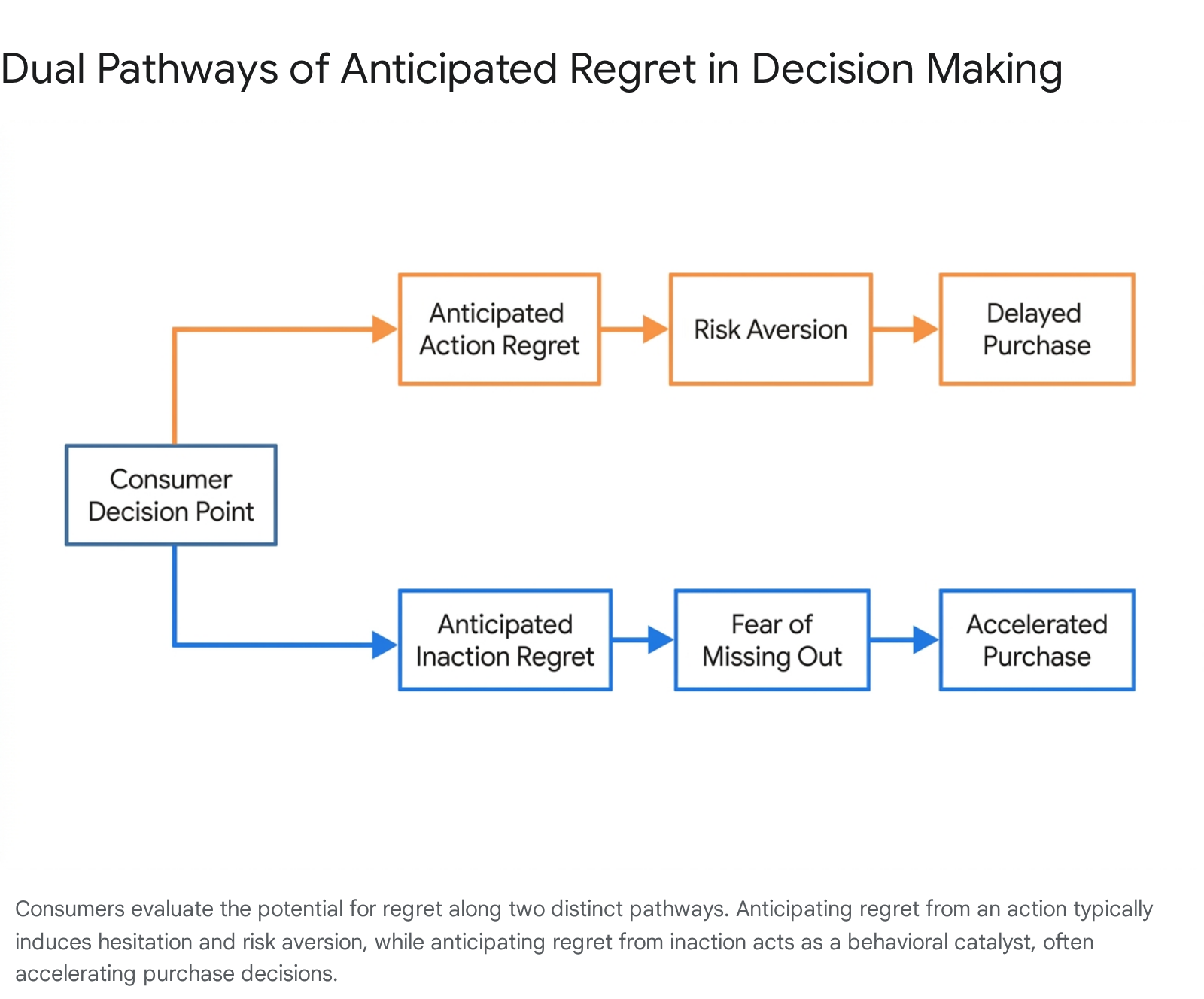
Anticipated action regret involves the anxiety that taking a specific step - such as purchasing a new product, adopting a new technology, or switching from a familiar brand - will result in an inferior outcome compared to maintaining the status quo 2412. This form of regret is typically associated with risk aversion, hesitation, and a rigid preference for default or conventional options. Deviations from the norm that result in failure generate severe self-blame, making action regret a powerful inhibitor of change 2713.
Conversely, anticipated inaction regret involves the fear that failing to act - such as passing up a limited-time discount, delaying a purchase, or failing to invest - will result in a permanent missed opportunity 2412. While action regret acts as a psychological brake, inaction regret serves as a powerful behavioral accelerator 214. Meta-analytic evidence spanning numerous health and consumer behavior contexts indicates that anticipated inaction regret is associated with stronger behavioral intentions (r = 0.52) and a higher likelihood of engaging in the target behavior compared to anticipated action regret (r = -0.45 for intentions) 2.
Furthermore, psychological literature reveals a profound temporal asymmetry in regret experience. In the immediate short term following a decision, individuals experience significantly more intense regret over actions taken (errors of commission) than actions withheld (errors of omission), largely because the immediate consequences and financial costs of action are highly salient 4. However, over the long term, the psychological consequences of regrettable actions tend to be finite, whereas the consequences of regrettable inactions expand indefinitely through imagination, making inaction regret infinitely more cognitively persistent 4.
Anticipated Regret in the Theory of Planned Behavior
The Theory of Planned Behavior (TPB) provides a structural framework demonstrating how anticipated affect modifies behavioral intentions. Traditional TPB models focus heavily on cognitive determinants - attitude, subjective norms, and perceived behavioral control 1015. However, researchers have established that incorporating anticipated regret into TPB models significantly increases their predictive validity 1516. When controlling for past behavior and affective attitudes, anticipated regret independently adds to the variance explained in behavioral intentions 1516.
Crucially, methodological considerations dictate how this is measured. Residual effects of anticipated affect in predicting intentions are most prominent when TPB variables are assessed regarding a specific action, but anticipated regret is measured concerning the alternative behavior (inaction) 10. This intersection proves that anticipated regret operates as an independent evaluative vector, forcing consumers to weigh the emotional cost of the alternative against the cognitive benefits of the primary choice.
Pre-Purchase Deliberation and Information Processing
The anticipation of regret fundamentally alters how consumers process information, search for alternatives, and deliberate over choices. Because regret is perceived as a highly aversive cognitive state, the prospect of experiencing it forces consumers into a highly prudent, deliberate, and resource-intensive mode of information processing 11718.
Central Route Processing and Product Involvement
When anticipated regret is introduced into the decision environment, individuals invest more cognitive effort in evaluating alternatives. This dynamic aligns with dual-process models of persuasion, where heightened regret salience shifts the processing style from peripheral, heuristic-based judgments to central, systematic evaluations 119. In scenarios involving high product involvement, consumers already process information deeply via the central route because they assign high subjective value to the product 117. Consequently, the differential impact of varying directions of anticipated regret (upward versus downward counterfactuals) is less pronounced for high-involvement items 117.
However, in low-involvement scenarios where consumers typically rely on peripheral cues, anticipated regret exerts a disproportionate influence. Specifically, downward anticipated regret - the expectation that a future outcome will be worse if an immediate action is not taken - dramatically increases the likelihood of online impulsive buying behavior 11720. It serves as an emotional heuristic shortcut, bypassing extended deliberation by replacing the question of "Is this product necessary?" with the more urgent question of "Will I suffer if I miss this?" 11721.
Deviation from Default Options and Status Quo Bias
The introduction of anticipated regret has been shown to unfreeze habitual consumer behaviors and overcome status quo bias. Behavioral economics demonstrates that consumers generally favor default options due to the inherent cognitive ease and the implicit assumption that the default represents a safe, normative choice 714. When consumers are prompted to anticipate post-purchase satisfaction, their preferences tend to gravitate even further toward these conventional, default options 14. Anticipating satisfaction focuses the consumer's attention on the positive attributes and security of the safe choice 14.
Conversely, prompting consumers to anticipate regret radically alters their attentional focus. Anticipating regret shifts consumer focus toward the negative aspects of the default option and highlights the positive attributes of the foregone alternate option 14. Because regret arises specifically from counterfactual comparisons between a chosen option and a superior foregone alternative, focusing on regret makes the potential losses associated with the default option highly salient 14. This cognitive shift increases the likelihood that the consumer will deviate from their baseline preference and select the non-default alternative, a finding with significant implications for underdog brands attempting to capture market share from established incumbents 14.
| Cognitive Prompt | Primary Attentional Focus | Evaluation of Default Option | Evaluation of Alternate Option | Behavioral Outcome |
|---|---|---|---|---|
| Anticipating Satisfaction | Positive attributes of the chosen path. | Heightened focus on safety, reliability, and ease. | Diminished attention to alternate benefits. | Reinforces status quo; high preference for default option. |
| Anticipating Regret | Counterfactuals; what might be lost. | Heightened focus on limitations and potential failures. | Heightened focus on unique benefits and missed opportunities. | Breaks status quo bias; shifts preference toward alternate option. |
Risk Aversion and Behavioral Hesitation
The relationship between anticipated regret and risk aversion is robust and observable across varied experimental paradigms. In tasks designed to measure risk-taking, such as the Balloon Analog Risk Task (BART), the presence of anticipated regret significantly increases risk-averse behavior 1322. Consumers who actively anticipate the regret associated with an adverse outcome (e.g., a financial loss or a product failure) exhibit a higher threshold for decision execution and demand more certainty before proceeding 13.
This relationship is further moderated by situational constraints such as time pressure. Under high time pressure, individuals generally default to higher levels of risk aversion, as the cognitive bandwidth required to fully assess outcomes is restricted 1322. However, the specific influence of anticipated regret on risk avoidance is somewhat attenuated in high-pressure conditions, suggesting that deep regret anticipation requires a minimum threshold of cognitive processing time to manifest fully in behavioral hesitation 1322.
The Moderating Role of Product Functionality
The type of product under consideration - specifically whether it serves a hedonic or utilitarian function - acts as a critical moderator for both the intensity of pre-purchase deliberation and the severity of subsequent post-purchase regret. Consumer expectations and the mechanisms of evaluating success fundamentally differ between these product categories, altering the regret trajectory 232425.
Utilitarian Products and Cognitive Evaluation
Utilitarian products are acquired primarily to fulfill practical, functional, or instrumental needs. They are evaluated based on objective criteria such as reliability, efficiency, durability, and functional performance 2324. Because the evaluation metrics for utilitarian products are predominantly cognitive and objective, it is exceedingly difficult for a consumer to psychologically rationalize a product failure 2325.
When a consumer experiences dissatisfaction, service failure, or brand betrayal related to a utilitarian product, the resulting feelings of regret, self-blame, and anger are significantly stronger than those associated with hedonic products 232425. The objective nature of the failure leaves no room for emotional reinterpretation. Consequently, consumers exhibit intense behavioral responses to utilitarian regret, including high levels of brand avoidance, aggressive vindictive complaining, and the dissemination of negative word-of-mouth 232425. Furthermore, if the product failure or brand betrayal is discovered via external sources (e.g., public news or peer reviews) rather than personal experience, the resulting regret and embarrassment are magnified, further intensifying the retaliatory behaviors against the brand 232425.
Hedonic Products and Emotional Buffering
In contrast, hedonic products are consumed for sensory gratification, emotional fulfillment, pleasure, and experiential value. The evaluation of hedonic goods is highly subjective, relying on internal affective states rather than objective functional benchmarks 2325. The inherent emotionality of hedonic consumption appears to possess a built-in psychological buffering effect against regret 2325.
Emotional engagement during the anticipation and use of a hedonic product amplifies a consumer's capacity for cognitive regret-regulation while simultaneously attenuating behavioral regret-coping 2325. Even in the event of a negative outcome or a realization that a better alternative existed, the subjective and affective nature of hedonic goods provides the consumer with greater psychological flexibility. They can easily rationalize the choice by focusing on the intangible joy, the experience of the moment, or the aesthetic appeal, thereby reducing the acute sting of post-purchase regret 2325. Consequently, brand betrayal in the hedonic sector generates significantly weaker feelings of regret and lower instances of vindictive consumer behavior compared to the utilitarian sector 2325.
Cultural Dimensions of Regret Anticipation
The cognitive mechanisms underlying anticipated regret are not universally uniform; they are deeply embedded within, and modulated by, the cultural frameworks of individualism and collectivism. These cultural orientations dictate whether the locus of anticipated regret is primarily personal or social, and determine whether consumers are motivated by promotion strategies (seeking gains) or prevention strategies (avoiding losses) 182627.
Individualism and Promotion-Focused Regret
In individualistic cultures, which prioritize personal autonomy, self-reliance, self-expression, and independence, consumer behavior is driven largely by personal goals and the pursuit of individual achievement 182828. Consumers in these environments are highly attuned to their internal states, value their personal preferences over group consensus, and evaluate anticipated regret primarily based on personal utility and self-actualization 2629.
Research demonstrates that individualistic consumers operate predominantly under a promotion focus, which makes them highly susceptible to anticipated inaction regret 27. Their primary psychological concern is the fear of missing out on personal gains, unique experiences, or opportunities for self-enhancement. Consequently, they are more likely to regret the things they failed to do or the purchases they failed to make, regardless of the specific life domain (social or personal) in question 27. Marketing strategies in individualistic cultures successfully leverage this by framing products as unique opportunities for personal success and emphasizing the regret of missing out 1826.
Collectivism and Prevention-Focused Regret
Conversely, collectivistic cultures place a paramount emphasis on group harmony, social cohesion, and the welfare of the community or family unit over personal desires 182628. In these societies, decision-making relies heavily on consensus, and individuals frequently suppress or adjust their personal preferences to align with the expectations of their in-group 1828.
Because of the high social cost of friction and the presence of clearly defined, rigid social norms, collectivistic consumers exhibit a strong prevention focus, particularly concerning social domains and visible consumption 27. Consequently, they are significantly more likely to experience and anticipate action regret - the fear of doing something that disrupts social harmony, violates group norms, or invites group-based shame and social disapproval 2730. In these cultures, the anticipation of regret serves as a mechanism for social conformity. Products that promote social peace, familial utility, and group identification are favored, as they minimize the risk of action-oriented regret 18.
| Cultural Dimension | Primary Value Orientation | Self-Regulatory Focus | Dominant Regret Vulnerability | Consumer Decision Paradigm |
|---|---|---|---|---|
| Individualistic | Personal autonomy, self-expression, independence. | Promotion-focused (maximizing personal gains). | Anticipated Inaction Regret (fear of missed opportunities). | Emphasizes personal utility; low reliance on group consensus. |
| Collectivistic | Group harmony, social cohesion, familial alignment. | Prevention-focused (avoiding social friction or shame). | Anticipated Action Regret (fear of norm-violating actions). | Emphasizes collective good; high reliance on community opinion. |
Cultural Variations in Social Conformity and Brand Attachment
The intersection of culture, emotion, and regret extends deeply into brand relationships. Because collectivistic cultures place immense pressure on individuals to conform to social emotion norms, deviations from these norms lead to severe drops in life satisfaction 29. However, cultural orientation also dictates how consumers seek to repair emotional deficits. For example, when experiencing social isolation or loneliness, individualistic consumers are highly likely to seek emotional restoration through enhanced attachment to brands (brand love), utilizing the brand as a symbolic proxy for social connection 31. They anticipate regret if they lose this symbolic connection. Collectivistic consumers, however, do not exhibit this compensatory mechanism, as their conceptualization of social groups is strictly interpersonal rather than symbolic; a brand cannot replace the functional role of the in-group 31.
Scarcity Tactics and E-Commerce Implementation
The digital retail environment has aggressively operationalized the psychological principles of anticipated regret. Online platforms heavily utilize time and quantity scarcity tactics - such as flash sales, limited-time offers, countdown timers, and low-stock alerts - to artificially induce anticipated inaction regret at scale 33343233.
Artificial Induction of Inaction Regret
By artificially restricting the availability of an offer, retailers aim to increase the perceived value of the product, trigger the fear of missing out (FOMO), and deliberately bypass the consumer's rational deliberation phase, thereby driving immediate conversion 333437. Research indicates that these scarcity cues can momentarily boost conversion rates by creating acute emotional pressure to act 3433. The presentation of low-stock warnings forces the consumer to immediately calculate the anticipated inaction regret of losing the item to another buyer, a calculation that frequently supersedes price sensitivity or careful product evaluation 3437. Scarcity signals effectively weaponize anticipated regret to accelerate the velocity of the consumer journey.
Persuasion Knowledge and Consumer Backlash
However, the efficacy of these tactics in the modern e-commerce landscape is subject to severe diminishing returns due to the widespread activation of consumer persuasion knowledge. When modern consumers encounter aggressive scarcity cues online, they frequently recognize them as deliberate, algorithmic manipulation attempts by the retailer 32.
This awareness activates cognitive defenses, transforming the intended emotional pressure of scarcity into feelings of profound frustration, stress, and irritation 3734. Studies reveal that online time-scarcity promotions can actually be less effective than identical promotions without time limits because they actively erode perceptions of website benevolence and destroy consumer trust 3237. When consumers feel manipulated into feeling regret, the psychological reactance often causes them to abandon the platform entirely 37.
Structural Mitigation: Exogenous Justifications and Pre-Sale Strategies
To mitigate the backlash of activated persuasion knowledge while still leveraging anticipated regret, research suggests that scarcity limits must be justifiable and structurally exogenous to the retailer. When a time limit is explicitly tied to an external, logical event (such as a seasonal change, a specific holiday, or a consumer's birthday), the activation of persuasion knowledge is significantly reduced. The anticipated regret mechanism functions more effectively because the consumer attributes the scarcity to natural constraints rather than retailer manipulation 32.
Furthermore, retailers optimize anticipated regret through pre-sale mechanisms. Strategies such as deposit expansion (where a small deposit guarantees a future discount but offers post-decision flexibility) consistently attract higher demand than rigid advance discounts 9. Deposit expansion allows the consumer to secure the opportunity (mitigating inaction regret) while preserving the flexibility to back out later (mitigating action regret), effectively neutralizing both psychological barriers 9.
Post-Purchase Dissonance and the Rationalization Paradox
The transition from pre-purchase deliberation to post-purchase evaluation is marked by the potential onset of post-purchase cognitive dissonance. Cognitive dissonance is an aversive state of psychological discomfort that occurs when a consumer's expectations clash with the actual performance, utility, or reality of the purchased product 39404142. This dissonance is the direct precursor to experienced post-purchase regret.
Factors that reliably exacerbate post-purchase dissonance include high financial cost, high product involvement, limited perceived utility, the realization that a rejected alternative might have been superior, and the absence of adequate post-purchase support 39413544. When consumers realize they have made an error, the discrepancy between their self-image as a rational actor and their actual behavior generates acute stress 4145.
Pre-Purchase Regret as a Buffer for Post-Purchase Satisfaction
A highly counterintuitive finding in recent consumer psychology research is that the presence of high anticipated regret prior to a purchase can actually result in higher post-purchase satisfaction, even if the eventual outcome is suboptimal 1322.
This paradox is driven by the profound emotional engagement and cognitive processing required to navigate anticipated regret during the deliberation phase. When consumers anticipate negative outcomes and actively process the risks associated with a choice, they invest significant cognitive effort into justifying their decision pre-purchase 13. Consequently, if the product subsequently underperforms, these consumers engage in robust, pre-formulated post-choice rationalization. Because they deliberately accepted the risk and mentally simulated the potential for regret beforehand, they are less susceptible to the shock of unmet expectations 1322.
The anticipatory emotional processing buffers the post-purchase experience, allowing consumers to maintain a state of cognitive balance, accept the outcome, and report higher overall satisfaction with their choice 1322. Conversely, impulse purchases made rapidly without the prudent processing triggered by anticipated regret often lead to acute post-purchase cognitive dissonance 343545. In impulsive scenarios, the consumer lacks a pre-constructed rationalization framework to justify the act, leaving them highly vulnerable to sudden, intense buyer's remorse 3545.
Behavioral Manifestations: Shopping Cart Abandonment
Shopping cart abandonment serves as a highly quantifiable behavioral manifestation of anticipated regret and perceived risk paralyzing the consumer at the exact point of conversion. Utilizing the Stimulus-Organism-Response (S-O-R) framework, research demonstrates that the complex online shopping environment acts as a stress-inducing stimulus that triggers emotional ambivalence and hesitation (the organism phase), leading directly to abandonment (the response) 3647.
In 2024, the global average cart abandonment rate across retail industries was observed to be approximately 70.19%, with mobile platforms experiencing even higher rates exceeding 75% 364849.
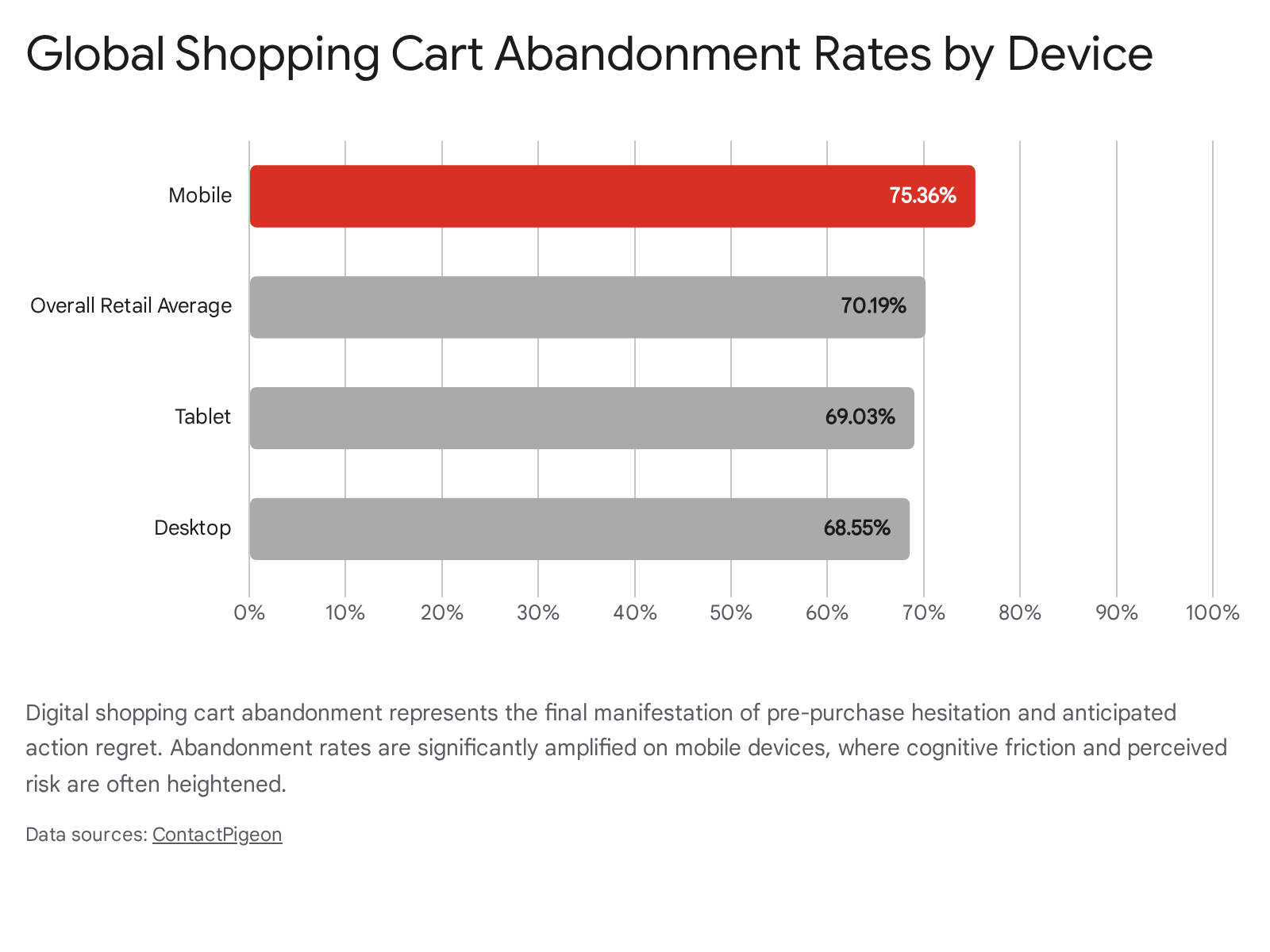
Abandonment represents an evaluation gap between initial purchase intention and transaction completion, heavily influenced by sudden spikes in perceived financial and functional risk 364737. When consumers reach the checkout phase and are confronted with unexpected costs (shipping, taxes), complex processes, or forced account creation, cognitive load sharply increases 48. This friction shifts the consumer's focus to the risks of the transaction, instantly elevating anticipated action regret. If this perceived risk surpasses the consumer's psychological threshold, emotional ambivalence takes over, resulting in the abandonment of the cart as a mechanism to preserve the status quo and avoid potential regret 3647.
Institutional Mitigation Strategies and Expected Utility
To combat the dampening effects of anticipated action regret on sales, retailers deploy institutional risk-reduction strategies. The most prominent of these are lenient return policies, extended warranties, and return freight insurance. These mechanisms are specifically designed to alter the consumer's expected utility calculus by providing a structural psychological safety net 113839.
Lenient Return Policies and the Endowment Effect
By offering a lenient return policy or a seamless warranty claim process, the retailer artificially reduces the consumer's anticipated action regret 423839. The consumer rationalizes that if the product fails to meet expectations, the decision can easily be reversed without financial penalty, effectively neutralizing the self-blame component of regret 56. Consequently, empirical meta-analyses confirm that lenient return policies - specifically those that offer generous time limits and require low effort from the consumer - directly stimulate consumer demand and significantly increase initial purchase rates 3840.
However, this strategic mitigation introduces a highly complex post-purchase dynamic. While lenient return policies slightly increase the overall volume of returns due to the sheer increase in total purchases, they also inadvertently trigger the endowment effect 38. The longer a consumer possesses an item under a lenient return time window, the more psychological ownership they establish over it. Thus, the retailer's leniency successfully bypasses the pre-purchase barrier of anticipated regret, and the subsequent psychological endowment acts as an organic barrier to the physical return of the item, protecting the retailer's bottom line while maintaining consumer trust 3839.
Warranties and Return Freight Insurance
In online environments where physical inspection of a product is impossible, functional and financial risks are severely amplified 4142. To address this, platforms have introduced Return Freight Insurance (RFI), which covers the shipping costs of returning unsatisfactory goods. By shifting the financial burden of the return from the consumer to an insurer, RFI drastically reduces perceived risk and encourages confident purchasing behavior 42.
Game-theoretic models of e-commerce competition demonstrate that when retailers utilize these asymmetric return policies (e.g., offering both full refunds and RFI), they effectively manipulate the consumer's anticipated regret to their advantage 4042. However, retailers must execute these strategies with flawless operational efficiency. If a return process is restrictive, hidden fees are discovered, or customer support is inadequate, the consumer's initial anticipated regret materializes into profound post-purchase dissonance, permanently damaging brand loyalty, inciting negative word-of-mouth, and increasing long-term customer churn 3642.
| Mitigation Strategy | Psychological Mechanism | Effect on Pre-Purchase Deliberation | Effect on Post-Purchase Behavior |
|---|---|---|---|
| Lenient Return Policy (Time) | Triggers the Endowment Effect. | Reduces anticipated action regret; accelerates purchase. | Reduces actual return rates as psychological ownership increases over time. |
| Return Freight Insurance (RFI) | Shifts financial risk to third party. | Eliminates financial hesitation; neutralizes functional risk in e-commerce. | Increases return volume, but preserves brand trust and high satisfaction. |
| Extended Warranties | Provides long-term functional security. | Justifies higher initial price points; reduces anxiety of future failure. | Promotes post-purchase rationalization; buffers against cognitive dissonance. |