
Regulatory Focus Theory and Consumer Segmentation
The evolution of consumer segmentation has progressively shifted away from rigid demographic categorizations toward dynamic, psychographic, and motivational frameworks. Marketers increasingly recognize that predicting consumer behavior requires an understanding not just of what consumers purchase, but of the underlying psychological drivers that motivate their goal pursuit. At the forefront of this theoretical evolution is Regulatory Focus Theory (RFT) and its natural extension, Regulatory Fit Theory. First articulated by E. Tory Higgins in his foundational 1997 work, RFT reconceptualizes the fundamental drivers of human motivation, moving beyond simplistic paradigms of pleasure-seeking and pain-avoidance to uncover the strategic orientations that govern goal pursuit.
As digital environments become increasingly personalized through artificial intelligence, voice commerce, and virtual influencers, understanding the nuances of how consumers regulate their behavior is no longer merely an academic exercise; it is an imperative for predictive modeling and strategic communication. This exhaustive research report revises and expands the research plan for exploring RFT and its impact on consumer segmentation. It grounds the definitions in established foundational literature while integrating a wealth of recent empirical studies published between 2023 and 2026 in top-tier outlets such as the Journal of Consumer Research, Journal of Marketing, and Journal of Consumer Psychology. Furthermore, the analysis broadens the scope to encompass Regulatory Fit Theory and Regulatory Mode Theory, exploring the mechanisms of processing fluency and the metacognitive experience of "feeling right." By detailing cross-cultural nuances, product category alignments, distinct linguistic vocabularies, and emotional sensitivities, this report constructs a multi-dimensional matrix for modern consumer segmentation. Crucially, the investigation systematically dissects the boundary conditions, limitations, and backfire effects of these motivational frameworks, providing a rigorous roadmap for future empirical inquiry and applied marketing strategy.
Theoretical Foundations: E. Tory Higgins (1997) and the Architecture of Motivation
Reconceptualizing the Hedonic Principle: Beyond Approach and Avoidance
For decades, psychological and economic models of consumer behavior were anchored tightly to the basic hedonic principle, which states that individuals are universally motivated to approach pleasure and avoid pain 12. While this principle remains a foundational axiom of human behavior, it is fundamentally incomplete as a predictive tool for complex consumer decisions. The limitation of the basic approach-avoidance model is that it conflates the ultimate goal (achieving pleasure or avoiding pain) with the specific strategic means deployed to achieve that end state.
E. Tory Higgins' (1997) foundational work on Regulatory Focus Theory resolved this theoretical bottleneck by proposing that the hedonic principle operates through two distinct self-regulatory systems: promotion focus and prevention focus 12. RFT posits that individuals can approach pleasure and avoid pain in fundamentally different ways depending on their underlying, evolutionary survival needs 34. Therefore, RFT is not merely a restatement of approach and avoidance; rather, it is a higher-order principle that dictates the strategic inclinations individuals use to navigate the approach and avoidance spectrum 156.
A promotion-focused system regulates behavior toward the attainment of "ideals," which encompass hopes, aspirations, and accomplishments. It is driven by the evolutionary need for nurturance, advancement, and growth 23. Strategically, the promotion system utilizes an eagerness orientation, wherein the individual aims to approach matches to the desired end-state (creating gains) and avoid mismatches (preventing non-gains) 78. Promotion-focused consumers are highly tolerant of risk, accepting errors of commission (trying and failing) as an acceptable cost of maximizing potential gains 789.
Conversely, the prevention-focused system regulates behavior toward the fulfillment of "oughts," which encompass duties, responsibilities, and social or personal obligations. This orientation is deeply rooted in the evolutionary need for safety, security, and protection 23. Strategically, the prevention system employs a vigilance orientation, wherein the individual strives to approach the absence of negative outcomes (securing non-losses) and avoid the presence of negative outcomes (preventing losses) 567. Prevention-focused consumers exhibit low risk tolerance; they prefer conservative choices and prioritize avoiding errors of omission, preferring to miss a potential gain rather than risk a catastrophic loss 89.
The Emotional Sensitivities of Goal Attainment
The distinction between these two regulatory systems extends deeply into the emotional sensitivities consumers experience throughout the consumer journey, particularly upon goal attainment or failure. Because a promotion focus is acutely attuned to the presence or absence of positive outcomes, success in a promotion-oriented task (attaining a gain) elicits cheerfulness-related emotions such as elation, happiness, and joy 51011. Conversely, failure in this domain (experiencing a non-gain) elicits dejection-related emotions such as disappointment, sadness, and discouragement 111213.
In stark contrast, a prevention focus is highly sensitive to the presence or absence of negative outcomes. Success in a prevention-oriented task (successfully maintaining a non-loss or fulfilling a duty) does not elicit elation; rather, it produces quiescence-related emotions such as relief, calmness, and relaxation 51013. Failure in a prevention context (experiencing a loss or failing a duty) triggers agitation-related emotions such as anxiety, fear, and tension 2313. Higgins and colleagues demonstrated that the accessibility and strength of a consumer's ideal or ought self-guides directly dictate the latency and intensity of these emotional responses 101113.
These emotional trajectories are critical for consumer segmentation and brand communication. A marketer targeting a prevention-focused segment with promises of "elation and ecstatic joy" will likely suffer a systemic disconnect, as the target audience is not cognitively primed to seek elation. Instead, a message framed around "peace of mind, reliability, and relief from worry" aligns perfectly with their emotional anticipations and internal self-guides.
Chronic Dispositions Versus Situational Activation
A robust consumer segmentation model must account for the dual nature of regulatory focus as both a stable personality trait and a malleable environmental state. Chronic regulatory focus represents a relatively stable, trait-like disposition developed through early childhood socialization, caretaker interactions, and long-term cultural conditioning 214. This chronic focus acts as a baseline psychological lens through which a consumer evaluates brand value, evaluates risk, and processes information.
Despite these chronic dispositions, regulatory focus can be temporarily induced or primed by immediate environmental cues, specific task framing, or contextual product categories 21516. Recent empirical evidence highlights the power of situational activation in marketing contexts. Experimental studies reveal that situationally induced regulatory focus often produces stronger, more immediate effects on behavioral outcomes than chronic orientations 16. For instance, a classically prevention-focused consumer - who is chronically risk-averse - can be temporarily shifted into a promotion state by exposure to natural environments. Exposure to nature psychologically distances individuals from their daily obligations, lowers their baseline vigilance, and activates aspirational thinking, thereby making promotion-focused advertising significantly more persuasive 17. Therefore, comprehensive marketing strategies must either rely on identifying chronic traits through deep psychographic profiling or deliberately engineer situational states through persuasive framing and user interface design.
Regulatory Fit Theory and Regulatory Mode Fit: The Architecture of "Feeling Right"
Processing Fluency and Value Transfer
Building directly upon the foundations of RFT, Regulatory Fit Theory examines the interaction between a consumer's current regulatory state and the strategic means provided to pursue a specific goal 1718. Regulatory fit occurs when the manner of goal pursuit sustains and structurally aligns with the consumer's current regulatory orientation 6. For example, a promotion-focused consumer experiences regulatory fit when presented with an eager, gain-framed strategy, while a prevention-focused consumer experiences fit when offered a vigilant, loss-avoidance strategy 1619.
When this regulatory fit is successfully achieved, it generates a powerful metacognitive experience of "feeling right" 217. This feeling of rightness acts as an internal heuristic that consumers subconsciously use to evaluate the target object, service, or brand. Crucially, regulatory fit increases processing fluency, which is the cognitive ease with which information is absorbed and processed. This fluency sequentially enhances attitude certainty, message persuasiveness, and ultimately, purchase intention 1720. The positive affect derived from the smooth, aligned goal pursuit is subconsciously transferred to the product or brand itself, a phenomenon identified in the literature as value transfer 1820. Recent literature covering the 2023 - 2025 period confirms that this fit specifically activates perceptions of uniqueness for promotion-focused individuals, while activating perceptions of risk-mitigation efficacy for prevention-focused individuals 1720.
Expanding the Paradigm: Regulatory Mode Theory (Locomotion and Assessment)
While Regulatory Focus Theory predominantly addresses why individuals pursue goals and the outcomes they desire, Regulatory Mode Theory addresses how they move through the actual pursuit process 17. This framework introduces two independent, functionally distinct self-regulatory orientations that govern decision-making processes: locomotion and assessment.
Locomotion mode represents the drive to initiate and sustain forward movement and action. Consumers operating in a high locomotion state function on a psychological "just do it" principle 212223. They are intensely focused on progress, speed, and continuous movement from one state to another, often experiencing positive affective traits like decisiveness, optimism, and self-confidence 212223. In contrast, assessment mode represents the drive to critically evaluate, compare, and deliberate before acting. Consumers in a high assessment state are deeply concerned with "doing things right" 172223. They engage in thorough, exhaustive comparisons of all available alternatives to maximize quality and avoid errors. While highly analytical, this mode can sometimes lead to negative outcomes such as choice deferral, severe post-purchase regret, or excessive cognitive musing 172223.
Recent applications of these theories in the Journal of Consumer Psychology and the Journal of Marketing indicate that Regulatory Mode Fit operates analogously to Regulatory Focus Fit, with profound implications for user experience design and segmentation 1724. For example, assessment-oriented consumers show a strong preference for extensive product assortments, detailed comparison matrices, and thoughtful evaluation tools. Conversely, locomotion-oriented consumers prefer streamlined, frictionless experiences, rapid progress indicators, and curated selections that eliminate decision fatigue 1721.
Furthermore, current research has identified a compounding effect known as "Regulatory Focus - Mode Fit." Studies demonstrate that marketing messages combining a promotion focus with a locomotion orientation (emphasizing eagerness combined with speed), or a prevention focus with an assessment orientation (emphasizing vigilance combined with thorough comparison), significantly reduce consumer variety-seeking behavior. By maximizing attitude certainty and processing fluency, this dual-alignment creates a formidable barrier against competitor messaging and dramatically increases brand loyalty 17. The intersection of these orthogonal theories reveals specific consumer archetypes that marketers can target with high precision.
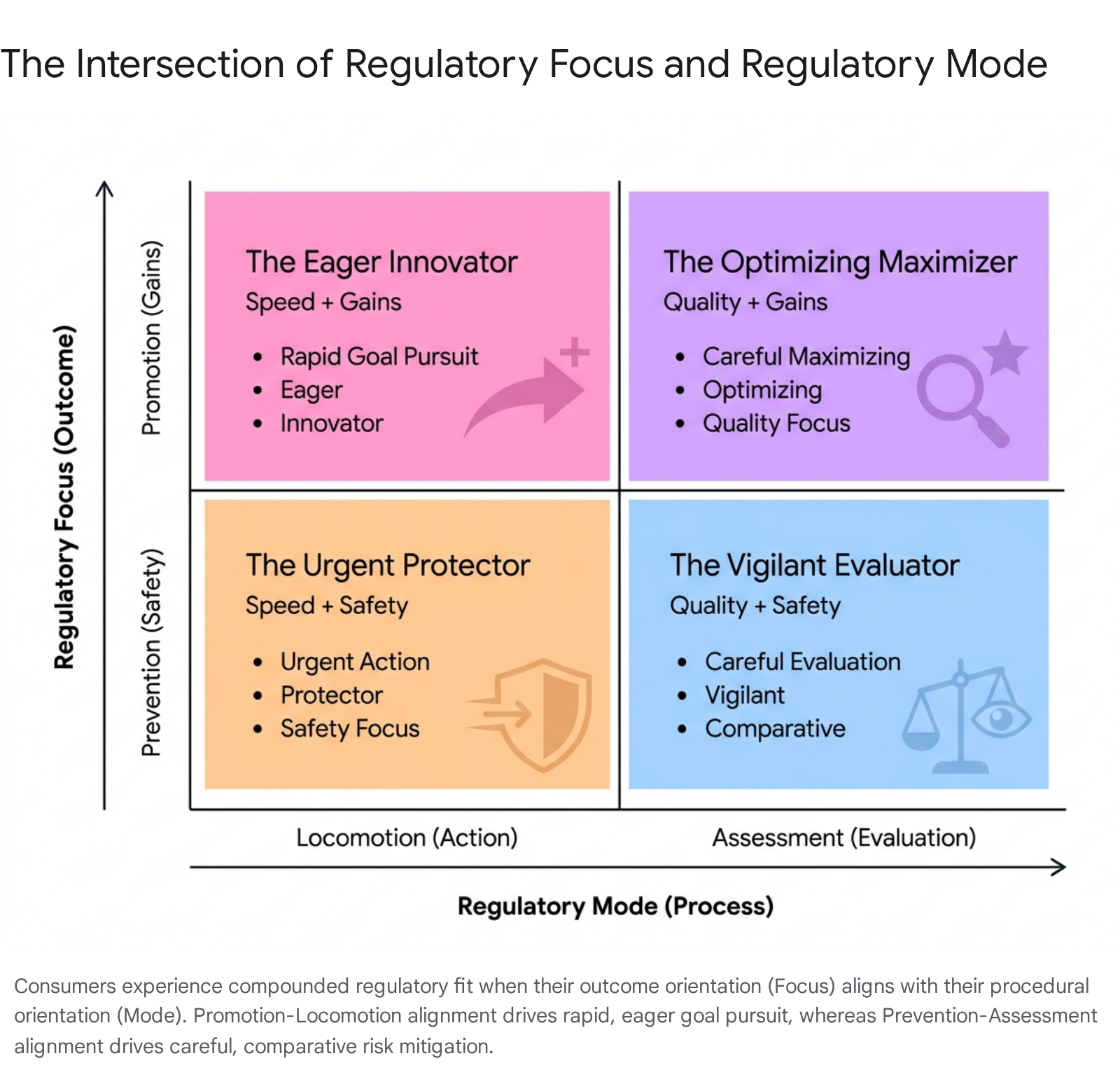
This intersection is particularly relevant in contemporary sustainability marketing. For instance, recent field studies exploring second-hand circular luxury fashion and electric vehicles show that highlighting "circular principles" often alienates consumers if framed incorrectly. However, utilizing a locomotion-predominant language - emphasizing progress, forward movement, and innovativeness - creates a regulatory fit with circularity, successfully driving consumer engagement in sustainable markets by aligning ethical consumption with personal advancement 21.
The Lexicon and Syntax of Motivation: A Comparative Framework
Linguistic analysis provides one of the most powerful diagnostic and execution tools for both identifying a consumer's chronic regulatory focus and strategically priming a situational focus. According to foundational work by Semin et al. (2005) and subsequent advanced computational linguistic studies utilizing tools like LIWC (Linguistic Inquiry and Word Count), a consumer's regulatory orientation leaves highly distinct, measurable linguistic signatures based on how they fundamentally construe information 192526.
Promotion-focused individuals process information globally and abstractly. Because they are focused on aspirational end-states, their natural language relies heavily on interpretive action verbs, abstract state verbs (e.g., hate, love), and broad adjectives that convey overarching intentions 19252627. In contrast, prevention-focused individuals process information locally and concretely, reflecting their need to vigilantly monitor immediate environments for potential threats. Their linguistic signature relies heavily on descriptive action verbs (e.g., walk, throw, measure) and concrete nouns, grounding their communication in verifiable, immediate reality 2526.
The following table synthesizes the core evolutionary needs, emotional sensitivities, cognitive strategies, and specific marketing vocabulary necessary for precise consumer segmentation across both regulatory frames:
| Dimension | Promotion Focus | Prevention Focus |
|---|---|---|
| Evolutionary Root | Need for Nurturance, Advancement, and Growth 23 | Need for Safety, Security, and Protection 23 |
| Self-Guide Alignment | Ideal Self (Hopes, aspirations, potential) 81328 | Ought Self (Duties, responsibilities, obligations) 81328 |
| Strategic Orientation | Eagerness (Insure hits, proactively approach gains) 61928 | Vigilance (Insure against errors, reactively avoid losses) 61928 |
| Emotional Sensitivity (Success) | Cheerfulness, Elation, Joy, Excitement 51011 | Quiescence, Relief, Calmness, Relaxation 51013 |
| Emotional Sensitivity (Failure) | Dejection, Disappointment, Sadness, Depression 101112 | Agitation, Anxiety, Tension, Fear 31013 |
| Cognitive Processing Level | Global, Abstract, Heuristic, Expansive 727 | Local, Concrete, Systematic, Detailed 71927 |
| Tolerance for Risk | High (Accepts errors of commission to maximize gains) 789 | Low (Prefers conservative choices, avoids errors of omission) 89 |
| Review & Evaluation Sensitivity | Driven by online review Valence (Degree of Positivity) 30 | Driven by online review Volume (Consensus indicates safety) 30 |
| Linguistic Syntax Preference | Adjectives, Interpretive action verbs, Abstract state verbs 2526 | Descriptive action verbs, Concrete nouns, Specific metrics 2526 |
| Marketing Lexicon (Keywords) | Advance, Achieve, Aspire, Bonus, Grow, Ideal, Maximize, Progress, Upgrade, Win 1217 | Avoid, Defend, Guarantee, Obligation, Protect, Reliable, Responsible, Safe, Secure 1217 |
Consumer Segmentation Nuances: Context, Culture, and Category
Segmentation based on regulatory focus cannot rely solely on assessing the individual consumer; it must robustly incorporate the inherent regulatory nature of the product, the cultural backdrop, and the specific consumption context.
Product Category Alignments: Hedonic vs. Utilitarian Contexts
Products intrinsically carry regulatory associations that dictate baseline consumer expectations. Hedonic products - such as luxury travel, entertainment, experiential dining, and high-end fashion - are intrinsically tied to pleasure, enjoyment, and personal aspirations. This creates a natural, seamless alignment with a promotion focus 172930. Marketing campaigns for hedonic goods achieve maximum regulatory fit when they utilize abstract imagery, highlight bonus attributes (e.g., "extra features" rather than "discounts"), and employ an eager, enthusiastic tone 1729.
Conversely, utilitarian products - such as health insurance, cleaning supplies, anti-virus software, and basic financial services - are associated with solving practical problems, fulfilling domestic obligations, and preventing negative outcomes. These categories naturally align with a prevention focus 2930. For utilitarian goods, utilizing concrete imagery, providing detailed technical specifications, and employing loss-aversion messaging yields the highest processing fluency and subsequent conversion rates 171929. Attempting to market a highly utilitarian product (e.g., home security) using promotion-focused abstraction and aspiration often results in a profound cognitive disconnect, reducing consumer trust and stalling purchase intention.
Cross-Cultural Dynamics: Western Individualism vs. Eastern Collectivism
Cultural paradigms serve as powerful macrosystemic primers for chronic regulatory focus, shaping goal pursuit from childhood. Traditional academic literature broadly posits that Western, individualistic cultures (e.g., the United States, Western Europe) predominantly foster a promotion focus. These societies emphasize personal autonomy, the pursuit of unique self-goals, and individual advancement 2830. In contrast, Eastern, collectivistic cultures (e.g., East Asia) naturally foster a prevention focus. These societies prioritize social harmony, fulfilling interpersonal duties to the family or corporation, and vigilantly avoiding behaviors that might disrupt the group dynamic or result in a loss of face 2830.
However, nuanced academic inquiries refine this binary perspective, suggesting that simply mapping geography to motivation is insufficient. The theoretical distinction between horizontal and vertical individualism and collectivism provides a much sharper segmentation tool. Vertical individualism, which is highly competitive and status-driven, correlates intensely with a promotion focus. Conversely, horizontal collectivism, which is egalitarian and duty-bound, aligns closely with a prevention focus 28. Furthermore, recent cross-cultural studies indicate that certain highly competitive Asian markets, such as Hong Kong, exhibit strong dual orientations. Consumers in these regions may prioritize prevention strategies in social and interpersonal contexts to maintain harmony, but demonstrate high promotion focus in economic, academic, and achievement contexts 28. International marketers must therefore apply RFT dynamically across regions, tailoring the regulatory focus not just to the country, but to the specific cultural axis and situational context of the target demographic.
Brand Identification and Digital Ecosystems
In digital ecosystems, particularly on social media brand pages, consumers exhibit varying degrees of loyalty based on their identification with the brand versus their identification with other users. Recent empirical studies demonstrate that a consumer's regulatory focus moderates how they build this loyalty. Promotion-focused individuals build loyalty through aspirational alignment with the brand itself, driven by the desire for experiential gains. Prevention-focused individuals, however, are highly risk-averse and build loyalty through identification with the community of other users, relying on consensus to mitigate the perceived risk of the brand experience 30.
Contemporary Empirical Applications in Digital Markets (2023 - 2026)
Recent empirical investigations published between 2023 and 2026 have radically expanded the application of RFT into cutting-edge digital environments, revealing how these fundamental human motivations interact with rapidly emerging technologies and platforms.
Highly Autonomous AI and Subscription Services
In the modern realm of digital marketing, the integration of highly autonomous AI into subscription platforms - such as algorithmic grocery curation or AI-driven fast-fashion styling - is heavily moderated by a user's regulatory focus. Promotion-focused individuals view algorithmic autonomy as a powerful engine for functional congruity, efficiency, and personal growth. They are highly responsive to the convenience and personalized discovery enabled by AI, demonstrating a remarkably high tolerance for the inherent loss of direct control or information asymmetry 931.
Conversely, prevention-focused consumers view autonomous AI through a lens of inherent risk. Delegating decision-making authority to an opaque algorithm threatens their fundamental need for security, frequently triggering psychological reactance - a motivational state of resistance where the user feels their personal agency and freedom are compromised 931. To achieve technology "stickiness" and ensure continuous usage, AI platforms must actively segment users. They must offer promotion-focused users interfaces centered on "discovery and optimization," while simultaneously providing prevention-focused users with transparent "control and oversight" dashboards to mitigate perceived risk and restore a sense of agency 931.
Voice Commerce and Algorithmic Bias
The rapid, global adoption of voice commerce presents unique regulatory challenges that alter traditional e-commerce paradigms. Research from 2024 to 2026 highlights that voice interfaces introduce a severe "top-of-mind" bias. Because voice limits visual comparison, it compresses the traditional evaluation phase and heavily favors dominant, established brands during open-ended voice queries 3233.
This environment profoundly taxes the assessment mode (which requires the careful, visual comparison of multiple alternatives) and artificially enforces a locomotion mode (demanding immediate, frictionless action) 2233. Furthermore, voice commerce radically compresses temporal expectations, resulting in a documented 73% elevation in same-day delivery expectations compared to traditional digital channels 33. Prevention-focused consumers, who rely on extensive visual review of product specifications and volume-based peer reviews to mitigate purchasing risk, often exhibit extreme friction in voice-only commerce. To overcome this, the AI voice assistant must be programmed to use concrete, risk-mitigating language (e.g., proactively stating warranties, return policies, or trusted brand heritage) to satisfy the prevention-focused need for security 3032.
Virtual Influencers and the Uncanny Valley
The deployment of AI-generated virtual influencers (VIs) represents a multi-billion dollar frontier in consumer engagement and brand representation 3435. Recent studies demonstrate that a consumer's regulatory focus moderates their susceptibility to VIs. Promotion-focused consumers are significantly more likely to engage with and organically share content from virtual influencers, driven by the perceived novelty, entertainment value, and aspirational aesthetics of the digital avatars 34.
However, high anthropomorphism (extreme human-likeness) in VIs is not without consequence. It can trigger upward social comparison and Fear of Missing Out (FOMO), leading to a documented reduction in overall consumer well-being, particularly among younger demographics 36. Prevention-focused consumers exhibit much higher baseline skepticism toward VIs. To establish trust with this segment, marketers must ensure explicit source credibility, maintain absolute transparency regarding the AI generation of the influencer, and ensure authentic narrative alignment that focuses on product reliability rather than unattainable digital lifestyles 343738.
Boundary Conditions: When Regulatory Fit Fails or Backfires
The most critical advancement in recent RFT research involves identifying the complex boundary conditions where the widely accepted principle of "regulatory fit" breaks down, fails to persuade, or actively backfires, resulting in negative brand equity and diminished conversion rates.
1. Psychological Reactance and the Personalization-Privacy Paradox
In contemporary digital marketing, achieving perfect regulatory fit often requires extensive data mining to tailor messages to a consumer's exact psychographic state. However, recent Journal of Marketing publications (2024 - 2025) document a profound boundary condition governed by the "personalization-privacy paradox" 39.
Data mapping the degree of data intrusiveness against net conversion intent reveals a distinct inverted-U curve. Initially, as personalization increases, perceived relevance rises linearly, driving up conversion intent as the marketing message aligns with the consumer's regulatory focus. However, at a critical tipping point, privacy reactance - which spikes exponentially at high levels of data intrusiveness - overtakes the relevance benefits. This creates a severe backfire effect where hyper-personalization utilizing personally identifiable information (PII) sharply diminishes net conversion intent, transforming theoretical regulatory fit into active brand avoidance 3940.
When privacy concerns are activated by overly specific targeting, consumers shift immediately from evaluating the utilitarian benefit of the fit to perceiving corporate surveillance. This triggers psychological reactance - a potent motivational state directed at re-establishing threatened freedom and autonomy 394041. Prevention-focused consumers are particularly susceptible to this reactance, immediately engaging in message rejection, ad-blocker installation, and long-term brand distrust when they perceive their digital autonomy has been breached 313942.
This reactance is not limited to digital advertising. In the realm of public policy and system-level changes (e.g., mandates, "buy local" government campaigns), reactance is shown to be a time-dependent phenomenon. Psychological reactance to systemic changes that threaten freedom is significantly higher during the planning and ex-ante implementation phases than after the policy has actually been enforced, illustrating how the anticipation of lost control deeply triggers prevention-oriented resistance 4143.
2. Retail Stockouts and Asymmetrical Resilience
The physical or digital absence of a product - out-of-stock (OOS) situations - reveals an important boundary condition regarding consumer resilience. Eye-tracking and behavioral studies from 2024 to 2026 demonstrate that a consumer's regulatory profile heavily dictates their reaction to stockouts 4445. Promotion-focused consumers exhibit remarkable psychological resilience; because their primary goal is advancement, they simply re-orient their eagerness toward an alternative product, maintaining stable purchase intentions for the retailer. Prevention-focused consumers, however, demonstrate severe negative reactions. Eye-tracking data reveals that they physically fixate on the empty shelf spaces, interpreting the stockout as a systemic failure of reliability and a localized loss, which dramatically increases store abandonment rates 4445.
3. Corporate Social Responsibility (CSR), Storytelling, and Self-Brand Connection
Regulatory fit logic generally dictates that emotionally resonant storytelling enhances persuasion and processing fluency. However, 2024 - 2025 research identifies narrative formats as a major boundary condition in Corporate Social Responsibility (CSR) communications, particularly following brand transgressions. When brands engage in ethical failures, they often deploy CSR storytelling to mitigate reputational damage. For consumers with a high self-brand connection (SBC), this strategy works as a buffer; motivated reasoning allows them to view the CSR story as counterfactual evidence of the brand's underlying morality, reinforcing their loyalty 46.
However, for consumers with a low SBC, storytelling actively backfires. The emotional narrative format activates persuasion knowledge, heightening the consumer's perception of manipulative intent and extrinsic attribution 4650. Rather than increasing processing fluency, the story format feels like calculated, strategic corporate rhetoric, making low-SBC consumers highly cynical. This results in significantly reduced brand loyalty and purchase intent 50. In these low-connection boundary conditions, expository, factual messaging - devoid of narrative flourish and emotional manipulation - is necessary to prevent the backfire effect.
4. Synthetic Content, Deepfakes, and the Disclosure Threshold
The rapid proliferation of AI-Generated Content (AIGC) introduces a novel boundary condition regarding truth, emotional sensitivity, and transparency. Generative AI allows for the creation of high-quality deepfakes that possess immense perceptual realism. These audio-visual, multimodal elements easily manipulate cognitive biases, transcending the limitations of text-based disinformation and enhancing persuasion 4748.
While marketers might logically assume that seamless, undisclosed synthetic content generates the highest cognitive fluency and fit, empirical research indicates the exact opposite due to a growing public distrust of AI. Uncanny or poorly disclosed deepfakes evoke primary appraisals of anxiety and eeriness (the uncanny valley effect), entirely destroying regulatory fit 49. Surprisingly, explicit disclosure of high-quality deepfakes does not break the immersive experience or ruin the fit. Rather, proactive disclosure aligns with modern consumer preferences for honesty, transparency, and ethical compliance (such as the impending European AI Act), leading to more positive brand appraisals than undisclosed synthetic content 4950.
5. Inauthentic Emotional Displays in Service Environments
In service marketing, the emotional labor of frontline employees is crucial. Integrating RFT with emotion as social information (EASI) theory, recent studies demonstrate that the authenticity of an employee's emotional display (e.g., a smile) interacts heavily with the customer's regulatory focus. Inauthentic emotional displays trigger a strong backfire effect, severely damaging service performance evaluations, specifically for prevention-focused customers. Because prevention-focused individuals are highly vigilant regarding social threats, they interpret an inauthentic smile as a signal of inferred deception, whereas promotion-focused customers are generally more forgiving or oblivious to the subtle lack of authenticity 51.
6. The Strategic Power of Regulatory Non-Fit
Finally, while decades of psychological research champion the absolute necessity of regulatory fit, emerging empirical evidence (2025) demonstrates that regulatory non-fit can occasionally be leveraged as a deliberate strategic asset. When consumers process information that purposefully breaks their regulatory expectations (e.g., presenting a highly utilitarian product using a chaotic, abstract, promotion-focused campaign), the resulting cognitive friction generates surprise 17. If the consumer has sufficient cognitive resources to resolve this deliberate incongruity, the element of surprise captures attention, increases physiological arousal, and can lead to more favorable, memorable product evaluations than a perfectly matched, but highly predictable and boring, fit condition 1752.
Strategic Research Agenda and Conclusion
Regulatory Focus Theory, powerfully expanded by Regulatory Fit and Regulatory Mode Theories, provides a profound, multi-dimensional matrix for modern consumer segmentation. By moving beyond basic demographic profiling and standard hedonic approach/avoidance models, marketers can map the deep psychological architecture of their audience - segmenting not merely by what consumers want to purchase, but by how they psychologically pursue it. The distinction between eager, promotion-focused advancement and vigilant, prevention-focused security dictates the optimal deployment of vocabulary, emotional framing, interface design, and technological interaction.
However, the future of marketing science requires strict, ongoing attention to the boundary conditions detailed in recent empirical literature. The assumption that regulatory fit universally guarantees persuasion is demonstrably false, particularly in the context of hyper-personalized digital environments. As AI platforms evolve, the line between helpful regulatory alignment and invasive corporate surveillance becomes perilously thin. Small and medium enterprises (SMEs), for instance, note massive variations in conversion rates (e.g., 1.76% for new users versus 7.41% for returning users), highlighting how trust and risk mitigation are paramount before promotion-focused upselling can even occur 53.
Psychological reactance, the personalization-privacy paradox, the varying resilience to stockouts, and the severe backfire effects of inauthentic storytelling or undisclosed deepfakes demand that marketers balance psychological targeting with absolute transparency and respect for consumer autonomy. Moving forward, the most successful brand strategies will not merely automate regulatory fit through algorithms. Instead, they will dynamically calibrate their approach, utilizing the exact lexicon of motivation to build trust, while vigilantly avoiding the precipice where persuasion collapses into reactance.