
Psychology of return policies and consumer risk perception
The exponential growth of global e-commerce has fundamentally altered the retail landscape, elevating the product returns process from a peripheral logistical function to a core determinant of consumer behavior. In the contemporary digital economy, returns represent a massive economic force; retail returns in the United States alone were projected to reach $890 billion in 2024, accounting for approximately 16.9% of annual sales 123. This vast volume of reverse logistics is not merely an operational friction point but the direct result of a complex psychological ecosystem. Return and refund policies serve as critical cognitive heuristics, shaping pre-purchase risk perception, post-purchase dissonance, and long-term brand loyalty. Understanding the psychological mechanisms that govern how consumers interact with return policies is paramount for retailers seeking to balance the stimulation of demand against the severe financial and operational costs of reverse logistics.
Foundational Psychological Mechanisms of Return Policies
The interaction between a consumer and an e-commerce platform is defined by an inherent information asymmetry. Unlike traditional brick-and-mortar retail environments, online shopping deprives consumers of the ability to physically inspect, handle, or test merchandise prior to financial commitment 45. This sensory deficit introduces significant uncertainty into the purchasing process, forcing consumers to rely on proxy indicators to assess product value and mitigate potential negative outcomes. Retailers strategically deploy return policies to bridge this gap, utilizing policy leniency as a psychological lever to lower the barrier to purchase.
Information Asymmetry and Multidimensional Perceived Risk
Purchasing products online exposes consumers to multiple dimensions of perceived risk, which must be overcome for a transaction to occur. The primary barriers are financial risk - the fear of losing money on a suboptimal product or incurring hidden shipping costs - and product performance risk, which involves the anxiety that the physical item will not match its digital representation 678. Secondary risks include convenience risk, involving the time and effort required to return an unwanted item, and social risk, the fear that a purchase will be viewed unfavorably by peers 78.
Academic research indicates that high levels of perceived risk directly hinder the adoption of online shopping channels and suppress purchase intention 89. Furthermore, specific product categories exhibit different risk profiles; for example, apparel carries a high product performance risk due to variable sizing and material quality, whereas digital goods carry different risk metrics 6. In this environment, an explicit, visible return policy functions as a primary risk mitigation tool. By guaranteeing a pathway to reverse the transaction, the retailer effectively neutralizes the financial and product risks, shifting the burden of uncertainty from the consumer to the platform. Studies confirm that consumer confidence in online purchasing negatively correlates with perceived risk, meaning that as trust is established through robust guarantees, the cognitive perception of risk decreases 9.
Quality Signaling and Trust Formation
Beyond mere risk mitigation, return policies operate within the framework of signaling theory. A lenient return policy acts as a costly signal of a retailer's high confidence in the quality of its merchandise 510. From the consumer's perspective, a "hassle-free" or "unconditional" guarantee implies that the retailer fundamentally believes the product will satisfy the customer, thereby anticipating a low rate of return. Conversely, highly restrictive return policies often trigger consumer skepticism, prompting them to question the inherent quality of the goods 11.
When consumers perceive that the logistical and financial friction associated with returning an item is low, their willingness to pay increases, and they are more likely to complete a transaction 12. This dynamic illustrates that return policies are not solely post-purchase mechanisms; they actively influence the pre-purchase decision-making matrix. The availability of a lenient return policy is an expectation for the vast majority of online shoppers, with 76% of consumers identifying free returns as a key determinant in their choice of retailer 23. A transparent and generous policy reduces purchase anxiety, acting as a psychological safety net that encourages consumers to finalize transactions they might otherwise abandon 13.
| Risk Dimension | Consumer Psychological Concern | Return Policy Mitigation Strategy |
|---|---|---|
| Financial Risk | Fear of unrecoverable monetary loss if the product is unsatisfactory. | Full monetary refunds, zero restocking fees, and prepaid return shipping labels 81213. |
| Product Risk | Anxiety that the physical item will not match expectations or specifications. | Extended time leniency allowing for thorough at-home evaluation and trial periods 810. |
| Effort Risk | Dread of the administrative or logistical burden of initiating a return. | Box-free, label-free drop-off networks and immediate refund processing upon scan 315. |
| Social Risk | Concern over peer judgment regarding a specific brand or stylistic choice. | Confidential, no-questions-asked return policies that do not require justification 7. |
Cognitive Theories Driving Consumer Return Behavior
To comprehend why consumers initiate returns - or why they surprisingly choose to keep items despite lenient return options - it is necessary to examine the underlying cognitive theories that govern human decision-making under conditions of uncertainty and delayed gratification.
Cognitive Dissonance and Post-Purchase Evaluation
Consumer behavior is highly susceptible to cognitive dissonance, a psychological phenomenon characterized by the mental discomfort experienced when an individual holds conflicting beliefs or when a decision results in an outcome that misaligns with pre-existing expectations 1415. In the retail context, this is commonly referred to as post-decision dissonance or "buyer's remorse" 1416.
Research within the retail sector delineates post-purchase dissonance into two distinct categories: product dissonance, which arises from dissatisfaction with the functional performance or aesthetic quality of the item, and emotional dissonance, which involves internal anxiety over the act of purchasing itself, such as guilt over spending money or second-guessing the necessity of the item 1516. When consumers experience high levels of cognitive dissonance, they are biologically and psychologically driven to alleviate that discomfort. A lenient return policy provides the most direct behavioral mechanism to "reverse the outcomes of the regretted choice" 16.
Interestingly, the mere existence of a liberal return policy has been shown to proactively reduce the initial onset of both emotional and product dissonance. The knowledge that a purchase is easily reversible lowers the psychological stakes of the decision, preventing the hyper-critical evaluation that typically triggers buyer's remorse 15. However, external factors such as switching barriers and customer opportunism can exacerbate dissonance, increasing the frequency of product returns 16. Retailers must carefully calibrate their policies to provide enough reassurance to prevent initial dissonance without creating an environment so devoid of commitment that it encourages opportunistic returning.
The Endowment Effect and Time Leniency
One of the most profound and counterintuitive applications of behavioral economics in e-commerce involves the "endowment effect." Originating from prospect theory and loss aversion frameworks developed by Kahneman, Knetsch, and Thaler, the endowment effect dictates that human beings place a higher subjective value on objects once they establish ownership over them 171819. According to loss aversion principles, the psychological pain of losing an item is significantly greater than the equivalent pleasure of gaining it 1820.
In the context of retail return policies, the endowment effect directly contradicts classical economic assumptions regarding time leniency. A traditional rational actor model would suggest that extending a return deadline (e.g., from 14 days to 90 days) provides the consumer with more opportunities to discover flaws or find cheaper alternatives, thereby increasing the probability of a return. However, empirical studies repeatedly demonstrate the inverse relationship: longer return deadlines frequently result in lower overall return rates 1321.
This phenomenon occurs because extended return windows allow consumers more time to integrate the product into their daily lives, thereby solidifying psychological ownership. As the duration of physical possession lengthens, the consumer's reference point shifts. The product transitions from being a newly acquired good to a permanent possession. Consequently, the act of returning the item is reframed cognitively from a "refund of cash" to a "loss of property" 1718. Because losses loom larger than gains, consumers become reluctant to part with the item, ultimately deciding to keep merchandise they might have returned had they been forced to decide within a strict, pressured timeframe 1321.
Construal Level Theory in Return Environments
Construal Level Theory (CLT) provides another critical lens through which to view consumer interaction with return policies. CLT posits that psychological distance - measured across temporal, spatial, social, and hypothetical dimensions - fundamentally alters how individuals mentally represent objects and events 2226. Events that are psychologically distant are evaluated abstractly, focusing on core, high-level features (high-level construal). Conversely, events that are psychologically close are evaluated concretely, focusing on immediate, contextual details and logistical feasibility (low-level construal) 26.
This theory explains the discrepancy between how consumers evaluate return policies before a purchase versus when they actually need to execute a return. During the pre-purchase phase, the prospect of a return is a hypothetical, distant event. The consumer processes a "Free Returns" banner using a high-level construal, abstractly interpreting it as "safety," "quality," and "trust" 2623. However, post-purchase, if the product proves unsatisfactory, the psychological distance collapses. The return process is now an immediate, concrete reality evaluated through a low-level construal, focusing on specific logistical hassles: printing a label, finding a box, driving to a courier, and waiting for the refund 526.
If a retailer promises an abstractly "generous" policy but demands high-friction, concrete actions to execute it, the resulting cognitive friction damages the consumer-brand relationship. Therefore, modern return strategies succeed by aligning the concrete execution of the return (e.g., providing QR-code-based, box-free drop-offs) with the abstract, high-level promise of convenience made during the purchase phase 515.
Multidimensional Framework of Return Policy Leniency
To move beyond theoretical abstraction and quantitatively analyze how specific policy mechanisms affect consumer behavior, researchers deconstruct return policies into distinct structural elements. A definitive meta-analysis by Janakiraman, Syrdal, and Freling identified five primary dimensions of return policy leniency that retailers manipulate to balance the stimulation of consumer demand against the volume of reverse logistics 132425.
The Five Dimensions of Leniency
The five dimensions allow researchers and retailers to isolate which aspects of a policy drive purchases and which aspects drive returns. The dimensions are defined as follows:
- Time Leniency: This dimension dictates the duration a consumer has to initiate a return, ranging from strict 14-day windows to indefinite, lifetime guarantees. As established by the endowment effect, time leniency is unique because increasing it often suppresses the final return rate while simultaneously increasing purchase intent 1324.
- Monetary Leniency: This refers to the financial completeness of the refund. A fully lenient monetary policy provides a 100% refund of the purchase price with no deductions for original shipping, return shipping, or restocking fees. Monetary leniency is highly effective at reducing perceived financial risk and stimulating initial purchases, but it simultaneously triggers higher return volumes, as consumers face zero financial penalty for reversing the transaction 1213.
- Effort Leniency: This dimension measures the logistical and administrative friction placed on the consumer. Strict effort policies require the original receipt, unbroken seals, pristine original packaging, and consumer-arranged shipping. Lenient effort policies require no receipts, accept unboxed items, and provide prepaid, printable labels or QR codes. Reducing effort significantly lowers post-purchase dissonance and increases long-term brand loyalty 13.
- Scope Leniency: Scope determines the breadth of products eligible for return. Restrictive scope policies often exclude clearance items, customized goods, intimate apparel, or opened electronics. Lenient scope policies apply universally across the retailer's catalog. Leniency in scope has been found to increase returns, as consumers adopt a trial mindset even for heavily discounted or final-sale items 13.
- Exchange Leniency: This dimension covers the type of compensation provided. A restrictive policy might only offer store credit or exact-item exchanges, keeping the capital within the retail ecosystem. A lenient exchange policy offers unconditional cash refunds to the original payment method. Lenient exchange policies build consumer trust but pose the greatest risk of revenue loss 1324.
Differential Impacts on Purchase and Return Proclivity
The meta-analysis of these dimensions fundamentally challenges the assumption that all forms of leniency yield the same behavioral outcomes. The data demonstrates that return policies generally exhibit a stronger positive effect on purchase decisions than they do on return decisions 1325. However, the specific type of leniency dictates the ultimate operational impact. If a retailer's primary objective is to aggressively stimulate top-line revenue growth, maximizing monetary and effort leniency is the optimal strategy. Conversely, if the objective is to protect margins and curb the volume of returns, retailers are advised to extend time leniency while restricting monetary leniency (e.g., implementing return shipping fees) 1213.
| Leniency Dimension | Primary Effect on Purchase Intention | Primary Effect on Return Volume | Optimal Strategic Application |
|---|---|---|---|
| Time Leniency | Moderate Increase | Decrease (due to endowment effect) | Best for complex or high-value items requiring deliberation 13. |
| Monetary Leniency | High Increase | High Increase | Best for acquiring new customers in highly competitive markets 1224. |
| Effort Leniency | Moderate Increase | Moderate Increase | Best for building long-term customer loyalty and positive brand perception 513. |
| Scope Leniency | Low Increase | High Increase | Generally restricted; used selectively to clear inventory 13. |
| Exchange Leniency | Moderate Increase | High Revenue Loss | Best balanced by incentivizing exchanges over cash refunds to retain capital 1324. |
The E-Commerce Returns Landscape and Consumer Counter-Behaviors
As e-commerce platforms historically engaged in an arms race of policy leniency to acquire market share, they inadvertently habituated consumers to view returns as a fundamental right rather than a situational remedy. This shift has resulted in a staggering economic burden. Total returns for the retail industry reached approximately $890 billion in 2024, with retailers estimating that 16.9% of their annual sales would be returned 23. Within online channels, the return rate is even more pronounced, averaging 21% higher than overall aggregate return rates, and spiking further during the holiday season 326. Within this massive volume, a spectrum of consumer counter-behaviors has emerged, ranging from rational risk mitigation to explicit fraud.
Bracketing as a Risk Mitigation Strategy
A dominant behavioral trend, particularly among Generation Z and Millennial shoppers, is "bracketing." Bracketing involves a consumer intentionally purchasing multiple variations of a single product - such as ordering the same pair of shoes in three different sizes or colors - with the explicit pre-purchase intent of keeping only the item that fits perfectly and returning the rest 272829. Surveys indicate that up to 46% of consumers admit to bracketing their online purchases 27.
From a psychological standpoint, bracketing is a highly rational coping mechanism. Because consumers cannot utilize tactile assessment or fitting rooms, they temporarily transfer the fitting room to their living rooms, leveraging the retailer's free return policy to mitigate product performance risk. Importantly, bracketing is not inherently malicious; the consumer possesses a genuine intent to complete a purchase 2734. Analytics reveal that consumers who bracket frequently exhibit high "keep rates," sometimes exceeding 75% across their transactions 34. While bracketing creates significant operational density and reverse logistics costs for the retailer, it is generally treated as an inevitable consequence of apparel e-commerce, best addressed through enhanced product data, sizing algorithms, and augmented reality tools rather than punitive bans 2728.
Return Fraud and Wardrobing Psychology
In stark contrast to bracketing, "wardrobing" constitutes deliberate retail fraud. Wardrobing - also known as "free renting" - occurs when a consumer purchases an item with the premeditated intent to use it temporarily for a specific event (e.g., a wedding, a job interview, or a social media photoshoot) and subsequently return it for a full refund 273430. The financial impact is severe; in 2024, an estimated $103 billion in losses were tied directly to return and claims fraud, representing approximately 15% of all return volume 2631.
The psychology of wardrobing is complex, often driven by intense social pressure, the influence of social media aesthetics, and economic constraints 3430. Crucially, many consumers who engage in wardrobing compartmentalize their behavior, rationalizing it as "friendly fraud" or a victimless crime committed against faceless corporate entities 2734. Because the behavior does not involve traditional theft, the cognitive dissonance associated with the act is significantly lower.
Criminal Scripting in Return Abuse
Advanced behavioral analysis of return fraud utilizes the concept of "crime scripting" to understand and disrupt abusive patterns. A 2026 report on retail loss emphasizes that return fraud is rarely a spontaneous act; rather, it is a highly repeatable, scripted behavior 32. When consumers successfully execute an abusive return, the psychological reward reinforces the behavior. Data shows that roughly 70% of individuals who successfully complete a problematic return intend to repeat the process 32.
The wardrobing script typically involves a calculated sequence: the bad actor identifies retailers with the most lenient policies, makes several legitimate small purchases to establish a "good customer" profile, initiates the fraudulent return during peak retail periods (such as mid-December) to exploit overwhelmed staff, and utilizes aggressive social engineering or threats of credit card chargebacks to force compliance from customer service representatives 32.
To combat this, loss prevention strategies have shifted away from blanket policy restrictions - which punish the compliant majority - toward psychological deterrents and "targeted friction." Interventions include prominent, non-removable security tags placed in visible areas of garments (which void the return if detached), implementing AI-driven customer scoring to dynamically alter return windows based on individual risk profiles, and training staff to break the social engineering scripts used by fraudsters 272832.
Regional Regulatory Frameworks and Cultural Expectations
The psychology of returns is not a universal constant; consumer expectations are heavily dictated by regional legal frameworks, entrenched cultural norms, and the competitive strategies of dominant local e-commerce platforms.
Statutory Baseline of the European Union
In the European Union, the baseline psychology of online returns is dictated by statutory law rather than competitive retailer strategy. The Consumer Rights Directive 2011/83/EU establishes a mandatory 14-day "cooling-off" period for all distance contracts (online, phone, or mail-order purchases) 38333435. During this period, consumers possess the unequivocal right of withdrawal, allowing them to cancel an order and return the goods for any reason, with no justification required 3833.
Because this 14-day window is a legally enforced minimum, European consumers do not view basic return policies as a generous perk, but rather as an inalienable entitlement. Consequently, retailers operating in the EU cannot effectively use basic time leniency as a competitive differentiator 36. To build trust and influence consumer choice, EU retailers must compete heavily on effort leniency. This involves operationalizing the right of withdrawal seamlessly through advanced digital portals, offering localized carrier options, and ensuring immediate refund timelines, thereby removing the administrative friction from the statutory right 36.
Hyper-Leniency and the Chinese Returnless Refund Model
The e-commerce market in China provides a profound case study on the psychological and economic dangers of hyper-leniency. In 2021, seeking to aggressively capture market share from incumbents like Alibaba, the platform Pinduoduo pioneered a "refund only" (or returnless refund) policy 4344. This mechanism allowed buyers to request and receive full financial refunds without the obligation to ship the physical product back to the merchant 43. Initially designed to streamline logistics for ultra-low-cost goods where reverse shipping costs exceeded the item's value, the policy was rapidly adopted across major platforms, including Taobao, JD.com, Douyin, and Kuaishou, due to intense competitive pressure 4344.
While this ultimate form of monetary and effort leniency eradicated consumer purchase risk, it catastrophically warped consumer behavior. Opportunistic buyers quickly recognized the vulnerability and began systematically exploiting the policy, claiming phantom defects to receive free merchandise 434445. The policy triggered severe financial distress for merchants, with some reporting return rates spiking to 50% or even 90% during promotional periods, destroying profit margins 45.
The psychological contract of trust required for functional e-commerce collapsed. Merchants retaliated by threatening legal action against consumers - with over 500 legal disputes reaching Chinese courts - and deliberately refusing to ship to certain high-risk provinces known for exploiting the rule 4345. Following massive merchant backlash and direct intervention from regulatory authorities decrying "malicious competition," the major platforms officially phased out automatic returnless refunds by mid-2024, shifting the authority back to merchants 4344. This severe market correction highlights that while extreme leniency drives short-term volume, it invites systemic abuse that degrades the entire retail ecosystem.
Competitive Dynamics in Latin America and Southeast Asia
In emerging e-commerce markets, return policies are frequently weaponized in aggressive market share disputes. In Latin America, the long-standing market leader, Mercado Libre, historically maintained a pragmatic, cost-conscious approach to reverse logistics, generally limiting customers to one free return per month due to the region's fragmented infrastructure and high fulfillment costs 4637.
This established baseline was violently disrupted by the arrival of Shopee, a platform owned by Singapore-based Sea Limited. Utilizing a playbook refined in Southeast Asia - where it offers a heavily promoted "15 Days Free Returns, No Questions Asked" guarantee to build trust in developing digital economies - Shopee entered Brazil with aggressive shipping subsidies and highly lenient seller and buyer policies 38394051. Shopee's strategy of absorbing massive logistical costs to foster a risk-free consumer environment proved highly successful with cost-conscious Latin American consumers, propelling the platform to a projected BRL 70 billion GMV in Brazil by 2025 3839.
To defend its dominant position against this psychological and financial offensive, Mercado Libre was forced to adapt, drastically reducing its free-shipping thresholds from BRL 79 to BRL 19 to match Shopee's low-friction environment, demonstrating how a foreign entrant can permanently alter the return policy expectations of an entire continent 39.
| Region | Dominant Policy Framework | Consumer Psychological Baseline | Primary Market Challenge |
|---|---|---|---|
| European Union | Statutory 14-day right of withdrawal 3833. | Returns viewed as a legal entitlement; expectations focus on effort reduction 3536. | Harmonizing digital portals across fragmented member states 36. |
| China | Retreat from hyper-lenient "Returnless Refunds" 4344. | Heightened opportunism leading to systemic policy exploitation 4445. | Rebuilding merchant-consumer trust after severe policy abuse 43. |
| United States | Retailer-defined, heavily competitive leniency 241. | Free returns historically expected; current shock at new fees 34142. | Balancing the $890B cost of returns against the demand for leniency 2. |
| Latin America | Transition from restricted to highly subsidized returns 4638. | Rapidly escalating expectations driven by foreign platform disruption 39. | Overcoming severe geographic and logistical infrastructure costs 3743. |
Strategic Integration of Friction and Evolving Return Models
Faced with the unsustainable financial burden of the reverse logistics ecosystem, the global e-commerce industry has reached a tipping point. The macroeconomic pressures of 2024 and 2025 have driven a massive strategic shift away from the era of unconditional free returns, forcing retailers to deploy sophisticated behavioral economics to protect margins while retaining customer loyalty.
The Shift from Unconditional Free Returns
For over a decade, Western retailers utilized unconditional free returns as a loss leader to habituate consumers to online shopping. However, as e-commerce matured and logistics costs surged, this model became untenable. Industry benchmarking data from Loop Returns reveals a stark transformation: in 2021, approximately 70% of brands offered unconditional free return shipping. By 2024, 65% of merchants had implemented return fees, a figure that surged to 70.2% by 2025 (and 73% in markets like Australia and New Zealand) 4244.
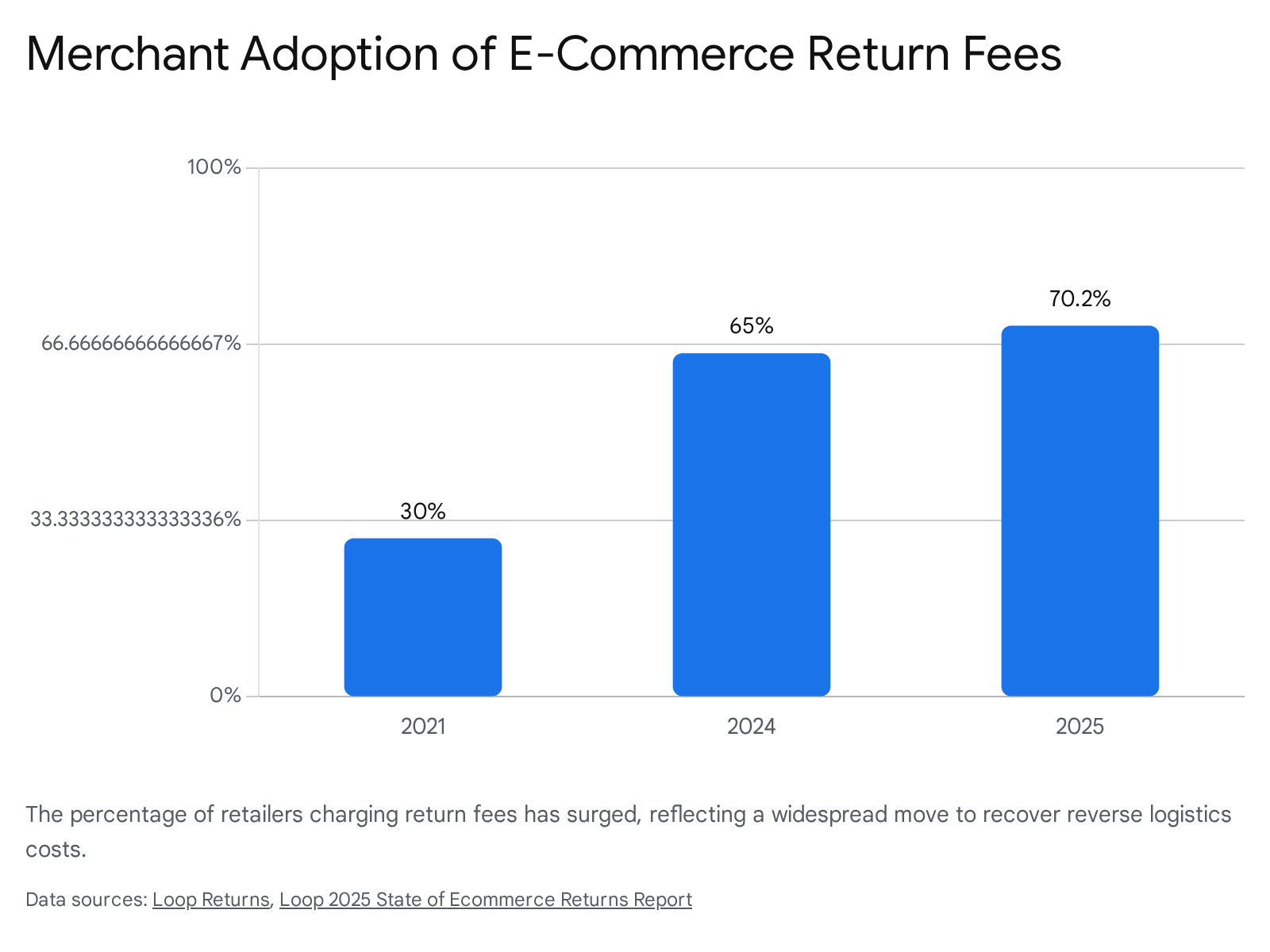
Rather than inducing massive consumer abandonment, this widespread implementation of flat-fee deductions for refunds has successfully reset consumer expectations. Survey data indicates that transparent return fees effectively dissuade casual policy abuse and bracketing, with 37% of respondents stating a fee would deter them from problematic return behaviors 29. Crucially, enterprise brands implementing these fees observed zero negative impact on repeat purchase rates, demonstrating that consumers are willing to accept financial friction if the policy is transparent and the effort leniency remains high 42.
Segmented Friction and Behavioral Nudges
As the blunt instrument of "free returns for all" is retired, retailers are transitioning to highly segmented, data-driven return models. The goal is no longer to eliminate returns entirely, but to implement "proportionate, transparent friction" that deters bad actors without punishing high-value customers 3242.
A primary tactic in this new paradigm is "exchange-first" routing. By utilizing software logic to incentivize exchanges or store credit over direct cash refunds, retailers effectively retain the revenue within their ecosystem. Consumers are often offered bonus store credit to forgo a cash refund, shifting their cognitive focus from wealth recovery to continued consumption 4546. Regions that lag in adopting these strategies suffer severe financial leaks; for instance, the United Kingdom exhibits a massive 78.1% refund ratio and an exchange adoption rate of only 5.8%, resulting in the vast majority of returned value permanently exiting the brand 46.
Additionally, innovative risk-shifting models such as opt-in return coverage have gained traction. In these models, consumers are presented with a micro-fee at checkout to unlock free returns later. Data shows that an average of 70% of shoppers select this option, allowing retailers to proactively subsidize reverse logistics costs while shifting the psychological burden of risk to the consumer at the point of sale 4244. Through dynamic AI monitoring, personalized return windows, and strategic friction, retailers are successfully evolving return policies from a pure cost center into a sophisticated mechanism for revenue retention and lifecycle management 263142.