
The affect heuristic in consumer risk and value judgments
Introduction
The architecture of human decision-making has historically been modeled through a strictly cognitive and rationalist lens, presupposing that individuals exhaustively calculate probabilities, weigh alternatives, and maximize utilities in a deliberative manner. However, decades of psychological, neurobiological, and behavioral economic research have catalyzed a paradigm shift toward "affectivism," acknowledging that affective states - momentary emotions, underlying moods, and visceral feelings - are not mere epiphenomena or irrational biases, but primary, functional drivers of judgment and choice 123. At the epicenter of this affective revolution is the "affect heuristic," a theoretical framework positing that individuals rely on rapid, automatic emotional responses to evaluate the risks and benefits of a given stimulus 245.
As the global consumer landscape transitions into increasingly complex digital ecosystems - characterized by hyper-personalized e-commerce user interfaces, algorithmically driven social media feeds, and highly volatile digital finance markets - the role of the affect heuristic has never been more critical. The modern consumer is inundated with an unprecedented volume of information, operating under chronic cognitive load. In such environments, the brain defaults to the affect heuristic as an adaptive, efficiency-driven shortcut, substituting the arduous analytical question of "What do the objective data and probabilities indicate?" with the computationally simpler, immediate query, "How does this make me feel?" 256.
This comprehensive research report synthesizes foundational psychological theories with cutting-edge, peer-reviewed research spanning from 2023 to 2026 to explore the nuanced mechanics of affective decision-making. It meticulously deconstructs the affect heuristic, moving beyond the simplistic binary of positive versus negative valence to explore the Appraisal-Tendency Framework (ATF), which demonstrates how discrete emotions drive profoundly divergent risk and value judgments 789. Furthermore, this analysis delineates the critical distinction between incidental and integral affect, investigates cross-cultural variations in emotional valuation through the lens of Ideal Affect Theory, and examines the real-world implications of these psychological constructs in contemporary, high-stakes digital environments 10111211. Ultimately, this report dispels the pervasive misconception that emotion-driven decision-making is inherently maladaptive, framing it instead as a highly evolved, albeit exploitable, cognitive filtering mechanism essential for navigating the information density of the twenty-first century 156.
The Foundational Architecture of the Affect Heuristic
Risk-as-Feelings and the Affect Pool
The conceptualization of the affect heuristic is deeply rooted in the pioneering work of Paul Slovic, Norbert Schwarz, and Gerald Clore. Foundational definitions describe "affect" as a specific quality of "goodness" or "badness" that is experienced as a feeling state, occurring rapidly and automatically, with or without conscious awareness, demarcating the positive or negative quality of a stimulus 41213. Slovic introduced the concept of the "affect pool," a mental reservoir containing all the positive and negative affective tags consciously or unconsciously associated with representations of objects and events in the human mind 12. When faced with a judgment or decision, individuals consult this affect pool as a primary cue 121316.
This rapid consultation process relies heavily on the "affect-as-information" hypothesis, wherein subjective feelings provide individuals with immediate feedback regarding their environment, guiding judgment without the need for laborious cognitive processing 114. The greatest empirical utility of the affect heuristic lies in its ability to explain the seemingly irrational alignment of risk and benefit assessments. Logically, risks and benefits are often independent or positively correlated in the real world (e.g., high-yield investments carry high financial risk, and nuclear power provides immense energy benefits despite severe catastrophic risks) 25. However, in the human mind, they are inversely correlated due to affective tagging. If a stimulus evokes a strong positive affective response, the individual experiences an "affective spillover," which simultaneously inflates the perceived benefits of the activity while systematically deflating its perceived risks 25616. Conversely, a negative affective tag correlates high perceived risk with low perceived benefit 2616. When researchers place individuals under severe time pressure, this inverse correlation becomes even stronger, proving that the affect heuristic is faster than analytic processing and serves as the dominant determinant of assessment when systematic analysis is precluded 16.
The Evolutionary Imperative: Efficiency Under Cognitive Load
A pervasive bias within classical economic theory is the categorization of affective decision-making as strictly irrational, maladaptive, or a systemic flaw in human reasoning. Modern cognitive psychology and evolutionary biology firmly reject this notion, reframing the affect heuristic as a sophisticated, adaptive evolutionary strategy designed for rapid survival assessment 151516.
Dual-process theory categorizes human cognition into two distinct systems: System 1 (automatic, fast, intuitive, and emotional) and System 2 (effortful, slow, analytical, and logical) 2456. The affect heuristic operates squarely within System 1. In ancestral environments, the ability to instantly tag a stimulus - such as a complex environmental change or a novel food source - with an emotional valence of "good/approach" or "bad/avoid" provided a distinct selective advantage over slow, deliberative analysis 516.
In contemporary contexts, this adaptive benefit translates to vital cognitive efficiency. Human decision-making is fundamentally constrained by the limited capacity of the working memory 1718. Cognitive Load Theory characterizes mental effort into extraneous load (unnecessary effort), intrinsic load (embedded difficulty), and germane load (effort directed toward learning and processing) 19. When individuals are placed under high cognitive load, extensive multitasking demands, or severe environmental complexity, attempting to engage System 2 processing overwhelms attentional systems, leading to decision fatigue, anxiety, and ultimate paralysis 26171920.
The affect heuristic circumvents this bottleneck by reducing extraneous cognitive load, allowing consumers to make "good enough" or satisficing decisions rapidly 1618. Recent empirical research into bounded rationality highlights that under conditions of cognitive and affective ambivalence - such as low discrimination ability between choices and high informational complexity - an algorithm characterized as "Take the emotionally best" (TTEB) often precedes or optimally blends with cognitive heuristics like "Take the best" 18. The TTEB strategy consists of choosing the alternative that integrally triggers the most positive holistic affective response, thereby bypassing the working memory's constraint of handling a maximum of four to seven information chunks 18.
Furthermore, individual differences in cognitive capacity modulate the reliance on this heuristic. Studies utilizing the Cognitive Reflection Test (CRT) - a metric evaluating the mechanism by which intuitive errors are identified and overridden by System 2 - demonstrate that individuals with higher cognitive reflection are less inclined to exploit the affect heuristic, whereas those with lower CRT scores rely on it heavily as a necessary compensatory mechanism to manage their cognitive load 2. Thus, while the heuristic can lead to systemic errors when misapplied to complex financial or medical data, it is intrinsically a functional, ecologically rational mechanism for managing the overwhelming information density of the modern world 11617.
The Dual-Affect System: Incidental vs. Integral Emotion
To accurately model consumer decision-making, it is imperative to distinguish between the two primary sources of emotion: incidental affect and integral affect. While historically studied in isolation, modern consumer psychology emphasizes their concurrent presence and complex interplay in real-world environments 1102122.
Integral Affect: The Consequential Signal
Integral affect refers to feelings that are normatively and directly related to the judgment or decision at hand, defined clearly by a consequentialist perspective 11022. It is the emotional response elicited by the actual features, implications, or anticipations of the target object. For example, the anxiety a consumer feels when considering a high-stakes, uninsured financial transaction, or the inherent joy experienced when evaluating a highly anticipated luxury vehicle, are integral emotions 1021. Because integral affect is causally linked to the decision, it is generally considered a highly adaptive source of information, alerting the consumer to genuine risks or rewards associated with the choice and serving as an authentic motivational signal 1.
Incidental Affect: Misattribution and Carryover
Conversely, incidental affect involves feelings that are completely unrelated to the decision at hand but carry over to influence it 11022. This affective state can originate from chronic dispositional traits (e.g., trait anxiety or trait anger), momentary physiological moods, or entirely external environmental stimuli (e.g., a frustrating commute, background music in a retail store, or a distressing news article read prior to shopping) 71022. The core mechanism by which incidental affect alters consumer behavior is misattribution; the consumer unconsciously attributes their pre-existing, unrelated emotional state to the target object being evaluated 110.
Dynamic Interplay in Consumer Environments
Contemporary research reveals that integral and incidental affects rarely operate in a vacuum; they co-occur and interact continuously, often sequentially 1102122. A 2022 study analyzing affective value experiences during high-stakes life transitions (such as evaluating and purchasing real estate during a divorce) demonstrated complex intrapersonal interplays between incidental life moods and integral property evaluations 21. The research unveiled mechanisms of spillover, ambivalence, divergence, and convergence, proving that incidental anxiety regarding a life event can fundamentally alter the perceived integral value of a physical asset 21.
Theoretical models suggest that when both forms of affect are present simultaneously, the stronger signal typically dominates. If integral affect is highly salient, it will minimize the misattribution of incidental moods 10. However, if the integral response is weak, ambiguous, or of moderate intensity, and if the incidental affect is particularly intense with a source that remains outside conscious awareness, the incidental emotion can completely hijack the decision-making process 110.
This dynamic is highly visible in online impulse buying behavior. Empirical evaluations utilizing Partial Least Squares Structural Equation Modeling (PLS-SEM) on consumer cohorts demonstrate that unmanaged incidental emotions have a significant negative relationship with rational purchasing, often precipitating spontaneous, unplanned buys that the consumer later regrets 2324. Conversely, appropriately targeted integral emotions - such as genuine excitement about the utility of the product itself - drive positive post-purchase satisfaction 112324. Medical and sequential decision-making models also highlight this danger; the lingering incidental fear from a false positive medical screen can irrationally dictate a consumer's willingness to engage in subsequent, unrelated preventative health purchases 2225.
The Appraisal-Tendency Framework (ATF)
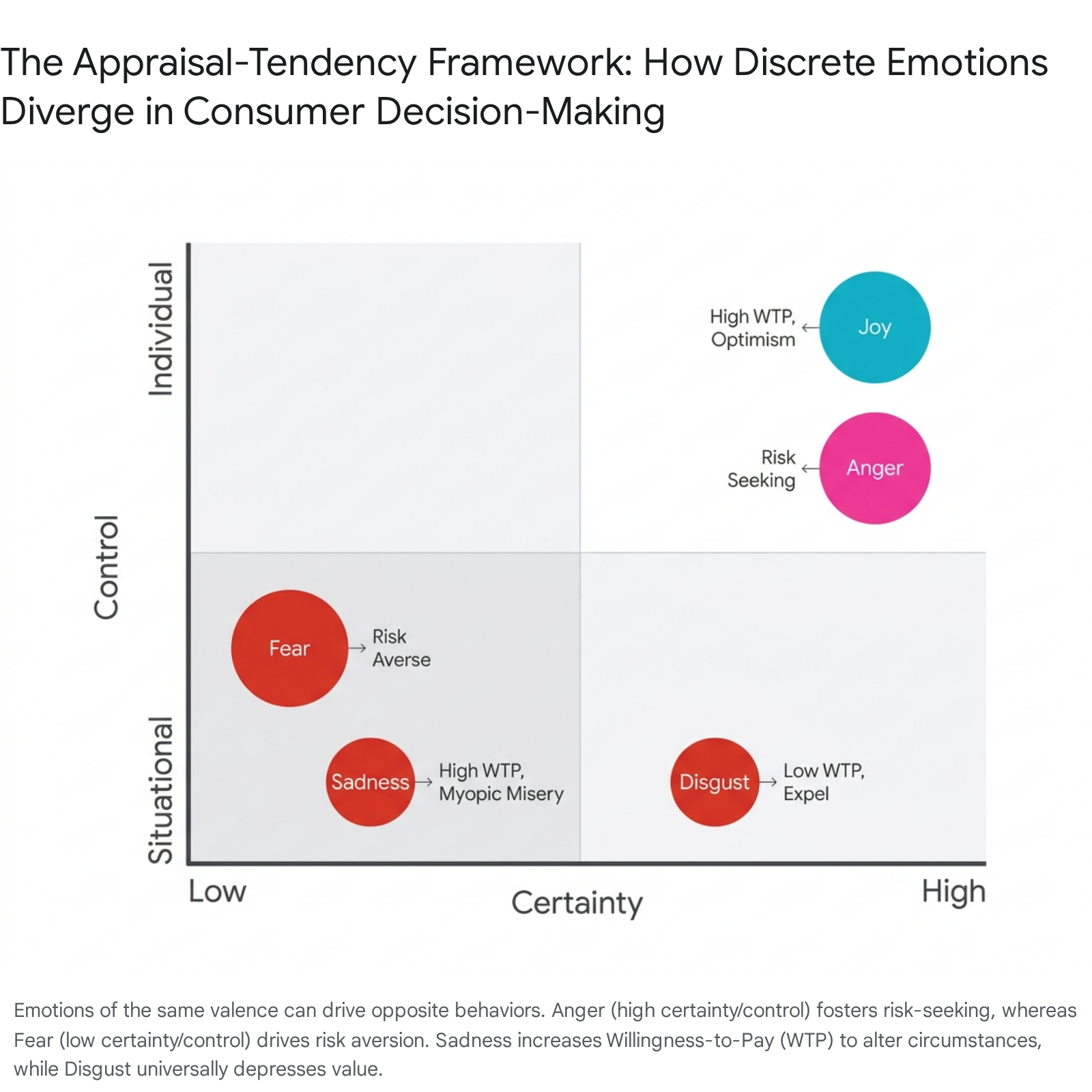
For decades, affective science relied on a valence-based approach, broadly categorizing emotions as either positive (beneficial, approach-oriented) or negative (detrimental, avoidance-oriented), assuming that all emotions within a valence category produced roughly the same cognitive outcomes 79. However, this bipolar paradigm fails to explain why emotions of the exact same valence can produce diametrically opposed consumer behaviors. The Appraisal-Tendency Framework (ATF), pioneered by Jennifer Lerner and Dacher Keltner, revolutionized this understanding by proposing that discrete emotions are associated with distinct cognitive appraisal dimensions - such as certainty, control, responsibility, anticipated effort, and attentional activity 789252926.
According to the ATF, the specific cognitive appraisal that triggers an emotion initially carries over to act as a perceptual lens, coloring subsequent, entirely unrelated judgments without the individual's awareness 825. Thus, discrete emotions shape risk perception, value judgment, and willingness-to-pay (WTP) in highly specific, predictable ways.
Fear vs. Anger: The Divergence of Negative Arousal
Both anger and fear are highly arousing, negative emotions, yet they diverge fundamentally along the cognitive appraisal dimensions of certainty and control 78926. * Fear is triggered by an appraisal of low certainty and situational control (i.e., unpredictable threats governed by external forces) 78. Consequently, the appraisal tendency of fear leads consumers to perceive high "unknown risk" in new situations. This results in highly risk-averse choices, a preference for uncertainty-reducing options (e.g., low-risk, low-reward investments), and consistently pessimistic future estimates 789. * Anger, by contrast, is characterized by appraisals of high certainty and individual control (i.e., a clear understanding of what happened, often involving a grievance caused by a specific, confrontable agent) 78. The appraisal tendency of anger induces a state of "defensive optimism" and an illusion of control. Angry consumers exhibit optimistic risk estimates, systematically de-emphasize the potential impact of negative events on the self, and engage in highly risk-seeking behavior 78926.
A rigorous 2024 replication study of the ATF by Lu and Feldman confirmed that trait anger is positively associated with risk-seeking behavior and optimistic risk estimates, proving conclusively that negative valence does not uniformly equate to risk aversion 9. Interestingly, while the replication confirmed the anger hypothesis, it found that trait fear was negatively associated with optimistic risk assessments but unexpectedly not associated with active risk-seeking avoidance in all contexts, suggesting that further nuance in the study of specific emotions is required 9. Nonetheless, in financial markets, the core divergence holds: an angry investor is more likely to aggressively double down on a volatile asset to regain control, whereas a fearful investor will liquidate and seek safe havens 726.
Sadness, Disgust, and Willingness-to-Pay (WTP)
The ATF also provides profound insights into how discrete negative emotions alter routine economic valuations, specifically Willingness-to-Pay (WTP) and intertemporal discounting. * Sadness revolves around the appraisal theme of irrevocable loss and situational helplessness 8. Its accompanying action tendency is to actively change one's circumstances to seek reward and alleviate the negative internal state 8. In consumer economics, this manifests as "myopic misery" - a state where sadness creates a myopic focus on obtaining gratification immediately, significantly increasing impatience and temporal discounting. Experimental trials reveal that median sad-state participants accepted 13% to 34% less money immediately merely to avoid waiting three months for a larger future payout, with impatient thoughts mediating these effects 2728. Furthermore, because sad individuals possess an implicit goal to change their circumstances, sadness drives up WTP for new consumer goods as a compensatory mechanism to alter the self-concept 828. * Disgust, conversely, revolves around the appraisal of contamination and the evolutionary threat of ingesting offensive or impure objects 81429. Its action tendency is to expel current objects and avoid acquiring anything new 8. Disgust drastically reduces WTP and purchase intentions across the board. This effect is particularly pronounced in food categories and products requiring high trust (the "ick" factor) 81427293031. Disgust can be categorized into contamination-based, structural, and moral disgust 2932. Recent peer-reviewed studies (2024) analyzing sustainable circular packaging and cashback rewards reveal that feelings of moral or physical disgust immediately trigger self-protective avoidance, severely depreciating the perceived value of the product regardless of its objective utility 143132. For example, the offer of a "Cashback Reward for Favorable Comments" (CRFC) elicited self-disgust in communal consumers who value authentic relationship norms, leading directly to lower repurchase and recommendation intentions 31.
Joy and the Positivity Premium
Joy and happiness align with appraisals of high certainty and high individual control, but possess a positive valence 9. The affect-as-information framework posits that happiness signals a benign, safe environment, reducing the perceived need for extensive cognitive scrutiny or defensive posturing 1. In transactional settings, happiness exerts a quantifiable "positivity premium." Empirical field studies evaluating WTP demonstrate that while happy consumers are often offered lower prices by sellers due to interpersonal warmth, the consumers themselves exhibit a higher baseline WTP to acquire goods and services, driven by inherent optimism and a lower perception of financial risk 3334.
To systematically illustrate these dynamics, the following table maps discrete affective states to their corresponding ATF appraisal dimensions and subsequent consumer outcomes.
| Discrete Emotion | Valence | Core Appraisal Dimensions (ATF) | Impact on Risk Perception | Impact on Value Judgment & WTP |
|---|---|---|---|---|
| Fear | Negative | Low Certainty, Situational Control | Pessimistic; High perceived risk. | Promotes safe-haven seeking; lowers WTP for novel/risky assets. |
| Anger | Negative | High Certainty, Individual Control | Optimistic; Low perceived risk. | Drives risk-seeking purchases; aggressive valuation of high-risk assets. |
| Sadness | Negative | Irrevocable Loss, Situational Control | Neutral to pessimistic risk perception. | Myopic Misery; High intertemporal discounting; Increases WTP for new goods to change circumstances. |
| Disgust | Negative | Contamination, Purity Violation | Risk-averse regarding physical/moral exposure. | Expel/Avoid; Drastically reduces WTP; severe devaluation of affected goods (the "ick" factor). |
| Joy / Happiness | Positive | High Certainty, High Control | Optimistic; Low perceived risk. | Increases WTP; lowers price sensitivity; promotes exploration of new products. |
Cross-Cultural Variations in Affective Processing
A critical oversight in early consumer psychology was the assumption that the affect heuristic operated uniformly across all human populations. Contemporary cross-cultural psychology decisively refutes this, demonstrating that cultural frameworks fundamentally dictate which affective states are valued, how they are expressed, and how they subsequently shape economic decision-making 1135363738. The most robust dimensions for analyzing these variations are the dichotomies of Individualism (Independent self-construal) versus Collectivism (Interdependent self-construal), as well as measures of uncertainty avoidance and power distance outlined by Hofstede and Schwartz 35373839444046.
Affect Valuation Theory: Ideal vs. Actual Affect
Developed by Jeanne Tsai, Affect Valuation Theory (AVT) - also known as Ideal Affect Theory - provides a vital lens for cross-cultural analysis. AVT distinguishes between "actual affect" (how people truly feel, which is largely driven by biological temperament and genetics) and "ideal affect" (the emotional states people want to feel, which are almost entirely shaped by cultural values and social exposure) 11414243.
Western, independent cultures (e.g., the United States and Western Europe) heavily prioritize Schwartz's values of self-enhancement, autonomy, achievement, and the expression of distinct individual qualities 353943. Consequently, their ideal affect leans heavily toward High-Arousal Positive (HAP) states, such as excitement, enthusiasm, and elation 414243. American consumer environments - ranging from the energetic facial expressions in children's storybooks to highly stimulating retail layouts and high-octane advertising - are engineered to elicit this maximal stimulation 1143.
Conversely, interdependent, collectivistic cultures (e.g., East Asian nations like China, Japan, and South Korea) emphasize Schwartz's values of conservatism, tradition, conformity, and social harmony 37394043. Their ideal affect revolves around Low-Arousal Positive (LAP) states, such as calmness, peacefulness, and serenity 4143. Because maintaining group harmony hinges on meticulous emotional regulation, collectivist societies tend to control negative emotions strictly and display a preference for subdued, concrete product features over highly arousing, abstract brand personalities 394043. In empirical studies utilizing the Affect Validation Index (AVI), it is clear that imposing a High-Arousal marketing strategy in a Low-Arousal culture generates cognitive dissonance rather than consumer engagement 11. However, globalization introduces nuance; bicultural consumers can readily switch back and forth between independent and interdependent cultural frames in response to primed context (e.g., viewing an individually focused appeal versus an interpersonally focused appeal) 3539.
The WTP Divide: Positivity Bias vs. Negative Avoidance
These culturally dictated ideals directly map onto the mechanics of the affect heuristic in the marketplace, fundamentally altering Willingness-to-Pay. In a comprehensive study quantifying the value of emotions, British (Western) participants demonstrated a robust "positivity bias." They indicated a willingness to pay significantly more to experience positive emotions (such as love and happiness) than to avoid negative ones 44.
In stark contrast, Hong Kong Chinese participants did not display this preference. They were willing to pay significantly less to experience positive emotions, but substantially more to avoid negative emotions 44. This reflects the collectivist mandate where the avoidance of social disruption, embarrassment, or interpersonal friction (negative states) carries a higher functional utility than the pursuit of individual euphoric achievement (positive states) 44.
Navigating the Global South: Collectivism and Digital Adoption
As businesses expand into the Global South and emerging Asian markets, ignoring these cross-cultural affect heuristics leads to profound strategic failures 363746. A 2025 comparative study of consumer behavior in India and South Korea - both culturally rich nations grounded in collectivism - highlights critical sub-cultural nuances. Indian consumers, rooted in high-context communication norms and high power distance, heavily prioritize social influence, familial opinion, and traditional affective cues in their purchase decisions 3746. Korean consumers, while also operating within a collectivist framework, demonstrate stronger digital integration, brand consciousness, and a greater affective openness to trend-driven, innovative products 37. Marketers must recognize that the affect heuristic's activation vectors are distinct across geographies; an appeal to risk avoidance, environmental sustainability, and communal harmony will often yield higher conversion rates in the Global South than an appeal to individual uniqueness 374446.
The Affect Heuristic in Modern Digital Ecosystems
The digitization of the consumer journey has exponentially amplified the speed and power of the affect heuristic. In modern environments - ranging from personalized e-commerce platforms to algorithmically driven social media and decentralized digital finance - technology is explicitly engineered to elicit, manipulate, and capitalize upon emotional arousal, often exploiting the consumer's cognitive load 114546.
E-Commerce UI/UX: The Architecture of Arousal
In the highly competitive realm of e-commerce, user interface (UI) and user experience (UX) design operate as the frontline of affective manipulation. Designers utilize visual cues, color psychology, and information architecture to bypass System 2 logic and strike directly at the consumer's System 1 emotional core 45545556.
The application of "mood congruency" and the Stimulus-Organism-Response (S-O-R) theory dictates that environmental stimuli (the website's UI) elicit an emotional state within the organism (the consumer), which drives a behavioral response (conversion or cart abandonment) 1147. Modern UX features - such as infinite scrolling, one-click checkouts, and hyper-personalized recommendations - drastically reduce cognitive effort, allowing the rapid affect heuristic to dominate the purchasing decision 1148. Urgency-based marketing cues (e.g., flash sales or "Only 2 items left in stock!") leverage the ATF's fear and sadness dimensions, specifically the anticipation of loss, to trigger rapid, myopic decision-making and impulse buying 1149. Conversely, integrating "social presence cues" such as interactive AI chatbots and genuine user-generated reviews increases emotional arousal and trust, serving as potent mediators for unplanned purchasing 47.
Interestingly, the strategic application of UX is not universally focused on eliminating friction. The "Friction Paradox" in fintech and high-value e-commerce dictates that making a process too easy can trigger anxiety and a negative affective tag regarding security 54. For high-stakes transactions, UX designers intentionally introduce friction (e.g., multi-step verifications) and utilize specific color palettes (such as blue, which universally signals LAP states of stability and peace) to manage financial anxiety and build trust 54. In contrast, user testing for speculative fintech apps in 2026 demonstrated that utilizing soft, rounded corners on buttons and vibrant neon colors increased user risk-taking by 30%, as the aesthetic projected an affect of friendliness that bypassed the critical evaluation of financial risk 54.
| UX/UI Element | Targeted Psychological Mechanism | Affective Response & Consumer Outcome |
|---|---|---|
| Urgency Cues / Flash Sales | Anticipation of Loss (ATF Sadness/Fear) | Increases temporal discounting; drives immediate impulse buying. |
| Social Presence Cues (Chatbots, Reviews) | Social Proof / Interpersonal Connection | Elevates emotional arousal and trust; mediates unplanned purchases. |
| Blue Color Palettes in FinTech | Low-Arousal Positive (LAP) Association | Signals stability and peace; reduces anxiety in high-stakes transactions. |
| Neon Colors & Rounded Corners | Gamification / High-Arousal Positive (HAP) | Decreases perception of risk; increases speculative financial risk-taking by up to 30%. |
| Friction Addition (Multi-step verification) | The Friction Paradox | Alleviates security anxiety; reinforces trust in the platform's safety. |
Algorithmically Driven Social Media: Emotional Contagion
Social media platforms represent the most pervasive, global exploitation of the affect heuristic. AI-driven algorithms are optimized relentlessly for a singular metric: engagement and maximized screen time 465061. Because high-arousal emotions - specifically outrage, anger, and fear - generate the highest levels of physiological activation, algorithms disproportionately push this sensational or divisive content to users 466162.
This architecture creates a continuous feedback loop of emotional contagion. When users are exposed to emotionally charged content, their System 2 cognitive processing is suppressed by the sheer velocity of the infinite scroll, leaving the System 1 affect heuristic to process complex social and political information 465051. The result is the formation of algorithmic echo chambers that reinforce severe cognitive distortions, such as catastrophizing, confirmation bias, and black-and-white thinking 616251.
Over time, this constant barrage of negative, high-arousal stimuli rewires dopaminergic pathways, fostering behavioral dependency akin to substance addiction 5061. A recent meta-analysis ascertained a linear dose-response relationship between social media time and depression, noting a 13% increase in the incidence of depression among adolescents for every additional hour spent on social media 50. In extreme cases, such as the 2022 lawsuit against Meta, the algorithm steered users into echo chambers glorifying anorexia and self-harm, utilizing the affect heuristic to foster dangerous addictions 46. In the context of consumer behavior, this heightened emotional reactivity makes users vastly more susceptible to targeted advertising, influencer marketing, and impulsive purchasing, as their capacity for deliberate, rational evaluation is chronically diminished by emotional fatigue 114651.
High-Risk Digital Finance and Cryptocurrency: FOMO, FUD, and Heuristics
Perhaps no contemporary sector exemplifies the extreme manifestations of the affect heuristic better than the cryptocurrency and digital asset markets. Unlike traditional equities, which rely heavily on established valuation models, intrinsic utility metrics, and fundamental analysis (System 2 processes), digital assets operate in a highly volatile, 24/7 environment largely devoid of traditional regulatory or analytical anchors 12525354. In the absence of reliable cognitive data, retail investors substitute complex financial analysis with the affect heuristic, essentially asking: "How do I feel about this token's momentum?" 525556.
The cryptocurrency market is driven overwhelmingly by behavioral finance anomalies, primarily FOMO (Fear Of Missing Out) and FUD (Fear, Uncertainty, and Doubt) 1269. * FOMO functions as a high-arousal, anxiety-driven state laced with anticipatory joy. When retail investors observe a token surging - such as the PENGU token, which soared 480% in July 2025 due to endorsements from online personalities and ecosystem expansion - the resulting positive affect overshadows any perception of actual financial risk 12. This herd behavior and emotional contagion lead to irrational exuberance, prompting investors to buy aggressively at market peaks 12556957. * FUD, conversely, rapidly injects the market with intense negative affect. Guided by the ATF, the sudden onset of fear induces a severe deflation in risk tolerance, leading to cascading panic selling at market bottoms, evidenced by the PENGU token's subsequent 28.5% drop by October 1269.
The gamification of trading apps exacerbates these biases. By integrating social media-style notifications, vibrant UI colors, and real-time community sentiment features, these platforms maintain a state of continuous emotional arousal. According to a 2025 report, the average crypto trader checks market prices 14.5 times per day, displaying signs of compulsive behavior where financial losses feel like deeply personal emotional setbacks 12. This constant engagement ensures that investors rely heavily on cognitive shortcuts - such as the availability bias (relying on readily available social media hype), the gambler's fallacy, and the disposition effect - rather than objective risk assessment 525457.
Empirical studies bridging personality psychology and behavioral finance indicate that the "Big Five" personality traits heavily influence susceptibility to these digital affect heuristics. For instance, investors high in Openness exhibit stronger availability bias due to curiosity, while those high in Neuroticism demonstrate a greater disposition effect, being highly loss-averse and emotionally reactive to market fluctuations 54. While factors like financial literacy can mitigate the severity of these heuristic biases, the sheer velocity of information and the structural design of digital finance platforms ensure that affective emotional contagion remains the dominant market force 1254.
Conclusion
The affect heuristic is not an anomaly of human irrationality; it is a fundamental, structurally integrated component of our cognitive architecture designed to facilitate efficient decision-making under conditions of high cognitive load. As demonstrated by the Appraisal-Tendency Framework, the subtle nuances of discrete emotions - such as the risk-seeking confidence of anger versus the myopic devaluation of sadness and disgust - dictate economic behaviors with profound, predictable precision. Furthermore, the cross-cultural divergence between the pursuit of high-arousal excitement in the independent West and low-arousal harmony in the interdependent East dictates that the global application of affective marketing must be culturally fluent to achieve efficacy.
In the contemporary era, the collision between the ancient, evolutionary affect heuristic and highly optimized digital environments presents a dual-edged sword. While it allows for seamless e-commerce experiences and intuitive user interfaces, it also renders consumers uniquely vulnerable to algorithmic manipulation, emotional exhaustion, and severe financial risk in volatile, gamified markets. For businesses and marketers, mastering the psychological triggers of UI design and affective framing is a potent engine for consumer conversion and brand loyalty. However, policymakers, economists, and ethical technologists must recognize that algorithmically weaponizing the affect heuristic - particularly through the amplification of fear, outrage, and FOMO on social media and speculative financial platforms - poses systemic risks to both individual psychological well-being and broader market stability. Navigating the future of consumer behavior requires an acute awareness of not just what data consumers consume, but precisely how that data is engineered to make them feel.