
Identity signaling and self-concept in consumer brand choice
Introduction
Consumer behavior operates far beyond the utilitarian acquisition of goods and services; it is fundamentally driven by the psychological imperative to define, express, and protect the self-concept. Rather than acting strictly as rational economic agents, consumers frequently utilize brand choices and material acquisitions as symbolic extensions of their identity. The deliberate deployment of these symbols to communicate personal values, wealth, social standing, and group affiliation to observers is known as identity signaling. As global markets evolve through periods of economic volatility, rapid digital transformation, and shifting cultural paradigms, the mechanisms by which individuals signal their identity have grown increasingly complex and multifaceted.
The traditional Veblenian model of conspicuous consumption - which posits that individuals purchase highly visible, premium goods primarily to broadcast wealth to the masses - has fractured into multidimensional behaviors 12. Contemporary consumers navigate a vast spectrum ranging from overt, logo-heavy branding to subtle, code-driven aesthetics. Simultaneously, the underlying psychological motivations for these purchases vary drastically depending on socioeconomic status, market maturity, and self-esteem. While affluent consumers may purchase understated goods to align with elite in-groups, economically disadvantaged individuals often engage in compensatory consumption, utilizing status goods to mitigate psychological deficits such as social exclusion or fear of missing out. The following analysis explores the intricate intersection between self-concept, identity signaling, and consumer brand choice, evaluating the psychological mechanisms, cross-cultural variances, and digital manifestations that define modern consumption.
Self-Concept Clarity and Identity Alignment
The degree to which consumers utilize brands to signal their identity is heavily moderated by self-concept clarity (SCC). SCC is defined as the extent to which an individual's self-beliefs are clearly and confidently defined, internally consistent, and temporally stable 3. Research demonstrates that SCC serves as a critical, measurable predictor of self-congruent product choice and brand affinity.
The Role of Self-Concept Clarity in Purchasing
Individuals exhibiting high SCC possess a robust understanding of their personal preferences, values, and boundaries. Consequently, they display a significantly higher likelihood of purchasing products that are explicitly linked to their established identity. Experimental data evaluating consumer choices indicates that high-SCC individuals score an average of 2.78 on indices measuring the selection of identity-linked products, compared to an average score of 2.04 for low-SCC individuals 3. High-SCC consumers exhibit greater decisiveness in the marketplace, experience less post-purchase regret, and demonstrate a profound affinity for brands that mirror their specific ethnic, cultural, or professional identities 3. Furthermore, high SCC is negatively correlated with materialism and escapist shopping behaviors. This inverse relationship suggests that individuals with high SCC do not rely on brands to construct their identity from scratch, but rather use consumption to reflect an already stable self-concept 3.
Conversely, individuals with low SCC experience persistent uncertainty regarding their self-beliefs. This internal uncertainty translates into avoidance behaviors in the marketplace. Low-SCC consumers actively avoid identity-linked products out of fear of committing to a symbolic representation they are unsure they genuinely embody 3. Instead, they tend to prefer utilitarian or non-identity-linked products, perceiving them as safer investments that do not require a rigid declaration of the self. This reluctance manifests as indecisiveness, characterized by a hesitancy to sign up for or cancel identity-relevant brand subscriptions 3.
Cognitive Dissonance and Post-Purchase Regulation
The alignment - or misalignment - between self-concept and consumption is further illuminated by Higgins' Self-Discrepancy Theory. Consumers frequently experience cognitive dissonance when a purchased product aligns with an idealized digital or social self but fundamentally fails to satisfy the pragmatic or psychological needs of the actual self 4. In such cases, products often remain entirely unused, becoming digital or physical artifacts of an unfulfilled identity projection.
Qualitative studies conducted in the beauty and apparel sectors reveal that when purchases are driven by emotional impulses, mood regulation, or curated social media aesthetics rather than genuine self-congruity, consumers engage in complex post-purchase regulation strategies. To manage the psychological discomfort of a misaligned purchase, consumers utilize strategies such as deliberate avoidance, delayed usage, post-hoc justification, and cognitive reframing 4. These behaviors highlight that identity signaling is not merely an external performance but an internal regulatory process where consumers must reconcile their acquisitions with their authentic self-concept.
Implications for Strategic Marketing
Because self-concept clarity is not entirely fixed and can be temporarily manipulated by external environments, it presents strategic avenues for brand marketing. Experimental studies have shown that SCC can be temporarily elevated or depressed through interventions such as targeted essay prompts that make a person feel either certain or uncertain about their life 3. Marketers can utilize specific word choices, empowering imagery, and affirmative messaging to enhance a consumer's SCC immediately prior to a call to action. This psychological priming is particularly relevant for brands in highly identity-linked industries, such as sports merchandise or ethnic apparel, where capturing the shifting preferences of younger, identity-conscious demographics like Generation Z is critical 3.
Conspicuous and Inconspicuous Consumption Dynamics
The landscape of identity signaling is predominantly shaped by the inherent tension between conspicuous consumption - the overt display of wealth and status - and inconspicuous consumption - the subtle, coded communication of cultural capital. The taxonomy of status signaling, notably conceptualized by researchers Han, Nunes, and Drèze, segments consumers based on their accumulated wealth and their psychological need for status.
The Taxonomy of Status Signaling
The established framework identifies four distinct consumer segments, frequently referred to in the literature as the "Four Ps": Patricians, Parvenus, Poseurs, and Proletarians 5678. This taxonomy clarifies how different demographic groups utilize brand prominence to associate with or dissociate from specific social strata.
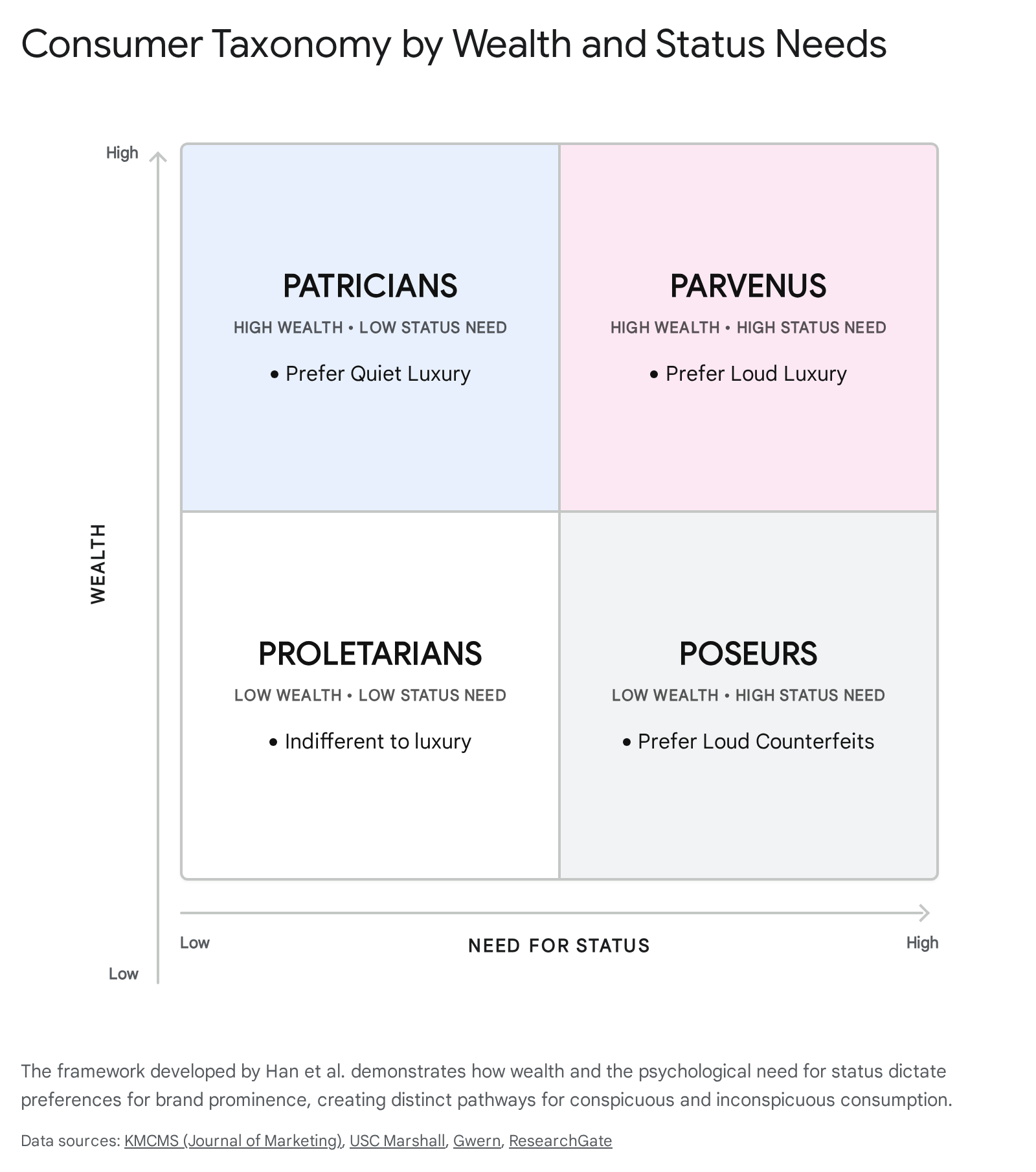
Consumer Taxonomy by Wealth and Need for Status
| Consumer Segment | Wealth Level | Need for Status | Primary Signaling Behavior | Brand Prominence Preference | Target Audience for Signal |
|---|---|---|---|---|---|
| Patricians | High | Low | Horizontal signaling to peers | Quiet / Subtle (Inconspicuous) | Other Patricians |
| Parvenus | High | High | Dissociation from lower classes | Loud / Prominent (Conspicuous) | Patricians and Poseurs |
| Poseurs | Low | High | Emulation of upper classes | Loud / Prominent (Counterfeits) | Parvenus and Proletarians |
| Proletarians | Low | Low | Utilitarian consumption | Indifferent | None |
Patricians possess high financial capital but a remarkably low need for external validation from the general public. They utilize "quiet luxury" - minimally branded, highly crafted goods - to signal horizontally to other elites. Only peers possessing the necessary cultural capital can decode these subtle brand cues, such as specific stitching or hardware 67. Parvenus, while equally wealthy, harbor a high psychological need for status. They rely on "loud luxury," utilizing prominent logos to unequivocally signal their wealth to the masses and actively dissociate themselves from lower socioeconomic tiers 68.
Poseurs lack financial capital but possess a high need for status, frequently turning to highly conspicuous, loud counterfeit goods to mimic the Parvenus and project an illusion of wealth 6. Finally, Proletarians lack both the wealth and the psychological drive for status signaling, viewing goods purely through a utilitarian lens 57.
Market Maturity and Brand Prominence
The preference for prominent versus subtle branding is deeply correlated with both market maturity and the psychological traits of the consumer base. Emerging markets, where wealth generation is relatively recent, tend to favor prominent branding as a tool for immediate status elevation. For instance, experimental studies reveal that Indian consumers with high status consumption tendencies express a significantly higher willingness to purchase prominently branded luxury products than subtly branded ones 9. Conversely, in mature markets like the United States, consumers with lower status consumption tendencies prefer subtly branded luxury, utilizing consumption for personal enjoyment rather than external signaling 9.
Furthermore, the type of narcissism a consumer exhibits dictates their signaling strategy. Overt narcissists, who possess a high degree of self-assurance and prioritize self-expression, hold a value-expressive attitude toward consumption, leading them to prefer quiet luxury 10. Covert narcissists, who suffer from deep-seated insecurities and require continuous external validation, hold a social-adjustive attitude, leading them to prefer loud luxury to ensure their status is recognized by others 10. As the global luxury market shifts - with estimates indicating that 60% of global luxury spending will originate from consumers under the age of 40 by 2026 - understanding these psychological nuances is critical for brand positioning 10.
The Shift Toward Quiet Luxury
In the post-pandemic era spanning 2023 to 2025, there has been a pronounced market shift toward inconspicuous consumption. Quiet luxury generated an estimated $62 billion globally in 2024, growing 28% year-over-year and overtaking logo-driven luxury in several key demographics 11. This shift reframes luxury from a performative declaration of wealth to an alignment with personal values, authenticity, and emotional connection 11.
Experimental research confirms that subtle branding commands higher perceived exclusivity. Discerning consumers associate minimally branded products with superior craftsmanship, elegance, and "insider fluency" 12. Furthermore, there is a negative correlation between product price and logo conspicuity; stealth-branded products frequently command higher retail prices than overtly branded equivalents 612. The "sum of small things" - intangible investments in education, wellness, and understated goods - has replaced overt ostentation as the ultimate symbol of social distinction among the aspirational class, requiring a high degree of knowledge to decode 12.
Interestingly, the intersection of sustainability and brand prominence challenges traditional assumptions regarding conspicuous consumption orientation (CCO). Research indicates that consumers with a high CCO - who traditionally favor loud luxury - actually report higher aesthetic perceptions and valuations of quiet luxury products when those products are explicitly tied to sustainability 13. Empirical evaluations show that the aesthetic rating for quiet, sustainable luxury among high-CCO consumers reached 5.37, compared to a stagnant 2.79 for loud, sustainable luxury 13. This data suggests that sustainability itself functions as a potent form of cultural capital, elevating the status-signaling power of understated goods even for those who typically desire conspicuous displays.
Psychological Deficits and Compensatory Consumption
While elite consumption is often driven by the maintenance of cultural capital and insider fluency, status signaling among lower socioeconomic and socially threatened groups is frequently driven by compensatory consumption. Compensatory consumption refers to the desire for, purchase, and use of products to respond to psychological deficits and self-threats 14.
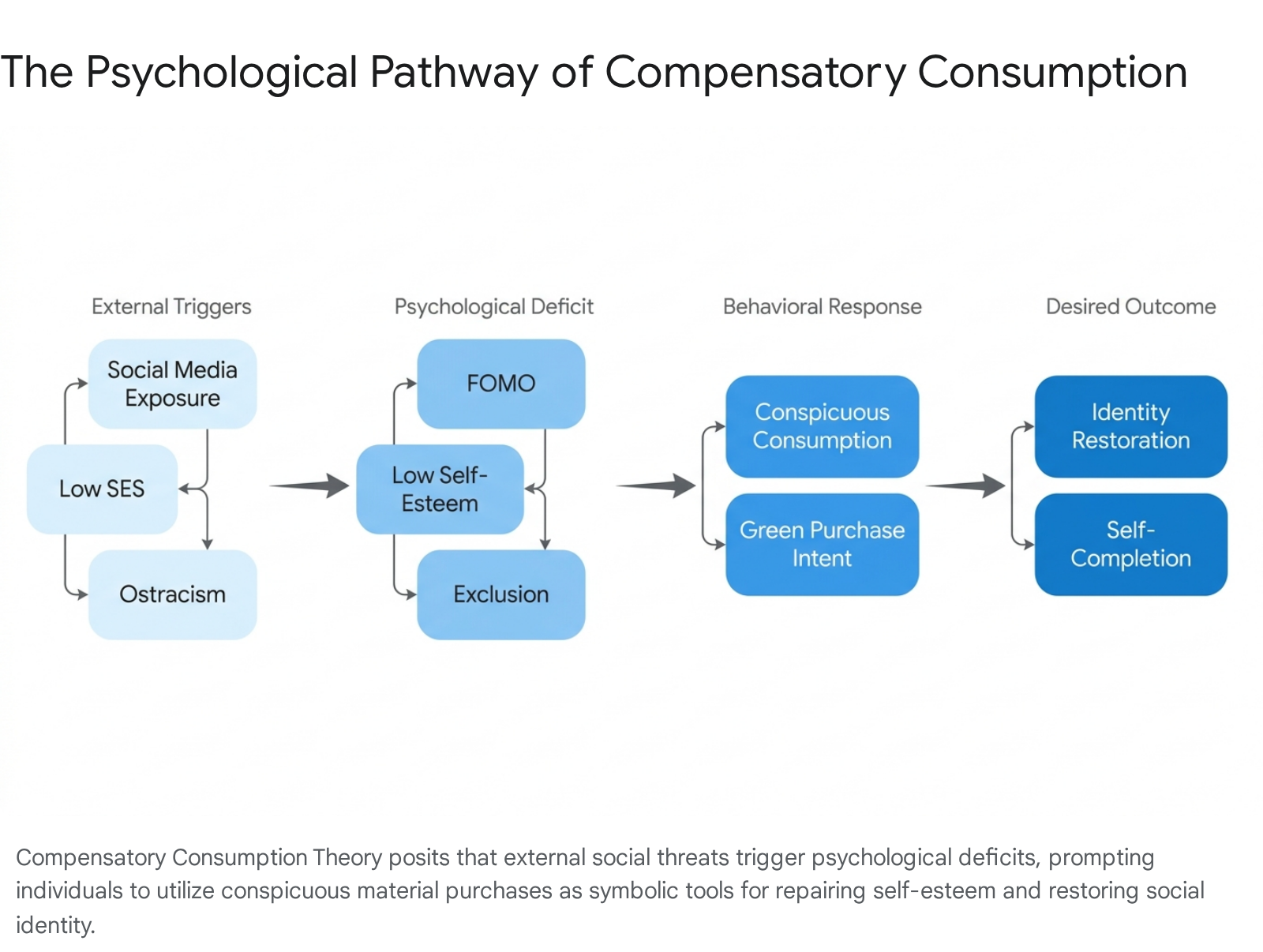
Theoretical Foundations of Compensatory Behavior
Grounded deeply in Symbolic Self-Completion Theory, compensatory behavior involves utilizing the expressive cues of material possessions as bridges to displaced meanings. When individuals experience threats to fundamental self-determination needs - such as autonomy, competence, or relatedness - they engage in substitute behaviors to construct and repair their identities 14. Products are pursued not for their functional utility, but as a tactical effort to offset a threatened self-concept. The development of the Conspicuous Compensatory Consumption Scale confirms that individuals with low self-compassion and high materialism possess significantly higher compensatory tendencies 14.
Socioeconomic Status and Status Discrepancy
Compensatory consumption is heavily influenced by socioeconomic status, particularly childhood SES. Life Course Theory demonstrates that early economic disadvantage shapes adult consumption behaviors through psychological mechanisms 15. Individuals originating from low childhood SES backgrounds exhibit elevated tendencies toward upward social comparison. When these individuals focus on their relative socioeconomic disadvantage compared to peers, it activates negative emotions, a profound sense of deprivation, and systemic insecurity 15.
To alleviate this psychological discomfort, affected individuals emphasize material values and engage in conspicuous consumption. Statistical analyses confirm a chain mediation path: lower childhood SES predicts increased social comparison, which fosters high materialism, ultimately resulting in conspicuous consumption 15. Consequently, low-income consumers frequently allocate a disproportionately high percentage of their disposable income toward products perceived to have high status 1617. This aspirational purchasing temporarily restores feelings of self-integrity and social legitimacy within their reference groups, masking financial vulnerability with an illusion of affluence - a phenomenon sometimes termed "refined poverty" 17. Furthermore, personality traits moderate this behavior; extraverts, who naturally seek sociability and ambition, are significantly more likely to engage in compensatory status purchasing when living on a low income compared to introverts 16.
Social Exclusion, Fear of Missing Out, and Status Goods
Beyond financial deprivation, acute psychological threats such as social exclusion (ostracism) and the Fear of Missing Out (FOMO) serve as powerful catalysts for conspicuous consumption. FOMO - the diffuse anxiety generated by constant exposure to the highlight reels and luxury displays of others on social media - creates a painful perceived gap between an individual's current state and their aspired social identity 1819.
When individuals experience social ostracism or acute FOMO, their baseline self-esteem drops significantly. The Temporal Need-Threat Model of ostracism typically categorizes responses as antisocial, prosocial, or withdrawal; however, recent consumer research demonstrates that compensatory consumption serves as a powerful fourth response 20. To counteract perceived social disconnection, ostracized individuals engage in "make-up" spending, utilizing high-priced status goods to rebuild social bonds, assert their intrinsic value, and command attention 1820. This dynamic exhibits gender-based variations; women, who are often culturally conditioned to utilize social media to foster intimacy, become particularly attuned to social cues and may experience intensified compensatory responses to FOMO 18.
Conspicuous Consumption in Sustainable Markets
Interestingly, the compensatory mechanism extends beyond traditional luxury goods into the realm of sustainability. Research utilizing the Theory of Reasoned Action (TRA) indicates that the relationship between social media exposure and green consumption is heavily mediated by social comparison and conspicuous consumption motives 19.
Consumers experiencing self-threats or FOMO exhibit higher intentions to purchase premium-priced green products, provided those products function as visible signals of both environmental consciousness and high social status 19. The perceived quality of the eco-friendly product acts as a critical moderator; when perceived quality is high, the effect of social comparison on conspicuous consumption intentions is strengthened, as it allows the consumer to broadcast dual signals of elite taste and moral superiority 19. This indicates that ethical consumption is frequently driven not by pure altruism, but by the necessity of identity repair and status acquisition.
Cross-Cultural Variations in Identity Signaling
Identity signaling and brand choice do not occur in a cultural vacuum. The symbols utilized to construct the self-concept vary significantly across global regions, heavily influenced by underlying cultural dimensions such as individualism versus collectivism, and analytic versus holistic cognitive styles.
Western vs. Eastern Market Paradigms
Historically, Western branding tactics align seamlessly with individualistic cultural norms. Consumers in North America and Western Europe typically possess an independent self-construal, utilizing brands primarily for self-expression, asserting their unique identity, and distinguishing themselves from the collective 212322. Western communication is characterized as low-context, direct, and explicit, translating into marketing strategies that emphasize a product's functional and emotional benefits tailored strictly to the individual 212323. Furthermore, Western identity signaling often rewards divergence; consumers may aggressively abandon brand preferences if a product becomes too heavily associated with an undesired out-group or the broader majority, seeking to protect their fundamental need for uniqueness 24.
Conversely, traditional Eastern and Asian branding tactics operate within collectivistic, high-context frameworks shaped by philosophies such as Confucianism 23. In these societies, the self is viewed as interdependent, and branding centers on harmony, group identity, and shared social norms 22. Consumers are significantly more inclined to purchase brands that emphasize family, social responsibility, and collective success 2728. Identity signaling in East Asia is highly context-sensitive. Experimental cognitive studies reveal that East Asians pay significantly more attention to contextual information in visual scenes and social settings compared to the object-focused analytic reasoning of North Americans 2530. Consequently, status is often communicated through implicit, subtle cues rather than explicit divergence from the group 2125.
Luxury Consumption Trajectories in China and India
While the traditional East-West dichotomy holds theoretical value, modern Asian markets - particularly China and India - have evolved into highly complex luxury ecosystems that blend global prestige with local identity, yet follow diverging psychological trajectories.
Comparative Drivers of Luxury Consumption in Asia
| Market Region | Primary Psychological Driver | Preferred Signaling Mechanism | Market Trends (2024-2025) |
|---|---|---|---|
| China | Lifestyle alignment, long-term value | Quiet luxury, experiential consumption | 47% projected UHNWI growth; shift away from overt logos. |
| India | Social elevation, status recognition | Conspicuous consumption, prominent logos | Rapid middle-class expansion; entering luxury to signal wealth. |
| Japan | Refined understatement, tradition | Subtle quality, established brands | Slower adoption of local brands; high baseline for quiet luxury. |
In China, the population of ultra-high-net-worth individuals (UHNWIs) is forecast to increase by a staggering 47% by 2028, driving significant structural shifts in luxury consumption 26. Chinese consumers are rapidly transitioning away from the overt, logo-heavy brand signaling that characterized the market a decade ago. Cautious spending amid domestic economic pressures has led to a preference for long-term traceable value, investment pieces, and quiet luxury 272829. Recent survey data indicates that 88% of Chinese consumers agree with the codes of quiet luxury, prioritizing intrinsic quality and timelessness over seasonal trends 27. Furthermore, there is a booming appetite for local niche brands, with 86% of Chinese consumers indicating that Asian luxury labels now match Western brands in quality and accessibility, allowing them to balance global aspirations with local cultural alignment 2730.
In stark contrast, the Indian luxury market is expanding rapidly, but the psychological drivers mirror earlier stages of market maturity. Emerging consumers in India frequently enter the luxury market specifically to signal social status; a quarter of Indian respondents explicitly cite social recognition as their primary driver for luxury purchases 36. Unlike the mature markets of Europe or the increasingly lifestyle-oriented consumers in China, the Indian market retains a strong appetite for conspicuous consumption, acting as a vital tool for social elevation among new entrants to wealth 1736.
Latin American Consumer Dynamics
Latin America presents a uniquely diverse consumption landscape characterized by what analysts term "progressive polarization" - where market behaviors are heavily influenced by the region's deep social and economic divisions and political volatility 31. Latin American consumers are evolving into highly "intentional shoppers," meticulously balancing their budgets across multiple channels to maximize resources 32.
Persistent inflationary pressures have driven significant growth in private label goods, which saw a 14.2% increase in value, democratizing access to quality basics 39. However, simultaneously, premium brand options advanced by 1.4 percentage points in overall shopping baskets 32. This indicates a bifurcated, highly strategic signaling strategy: Latin American consumers utilize private labels to protect their economic resources in private, while continuing to invest selectively in premium brands for public status signaling and identity expression 32. Brand reputation and social stance are paramount in this region; 30% of Latin American consumers base their purchases specifically on a brand's alignment with their personal social and political ideologies 31.
Digital Environments and Social Media Aesthetics
In the contemporary era, the construction of the self-concept is inextricably linked to digital platforms. Social media networks (e.g., Instagram, TikTok, Xiaohongshu) do not merely host images; they function as "affective infrastructures" that circulate moods, sensory experiences, and curated atmospheres 33. Consumers engage with aesthetic trends not just as fashion choices, but as complex identity signaling mechanisms that govern digital belonging and social capital.
Affective Infrastructures and Curated Atmospheres
Digital aesthetics such as "Dark Academia," "Cottagecore," and "Vanilla Girl" operate beyond visual trends; they are affective modalities that produce distinct emotional environments 33. Users inhabit these atmospheres, utilizing curated visuals and platform affordances to project a specific self-concept. Brands that successfully decode these visual languages and integrate seamlessly into these curated atmospheres are embraced by users seeking self-expansion 3334. Conversely, brands relying on traditional, overt advertising that disrupts the aesthetic cohesion of the user's feed are often rejected as inauthentic 34.
The "Clean Girl" Aesthetic and Aspirational Identity
One of the most prominent digital manifestations of inconspicuous consumption is the "Clean Girl" aesthetic. Popularized across TikTok and Instagram, this aesthetic emphasizes minimalism, natural beauty, health optimization, and hyper-femininity 3335. Visually, it relies on slicked-back hair, glowing skin, neutral palettes, and meticulously tidy environments 36.
Psychologically and sociologically, the Clean Girl aesthetic is a profound exercise in aspirational identity performance and class signaling. It functions essentially as the digital equivalent of quiet luxury 35. While the aesthetic is deliberately branded as "effortless," it requires rigorous discipline, multi-step beauty routines, and significant financial investment in premium skincare 3537. The aesthetic camouflages material abundance as minimalism, utilizing fleeting visual glimpses of high-end products (e.g., Rhode, Gisou) to signal cultural distinction, wellness, and elite status 35. By romanticizing disciplined routines and self-care, young women use this aesthetic to construct an idealized, optimized digital self, seeking continuous validation through the algorithm's feedback loop 35. However, mental health researchers note that this relentless pursuit of curated perfection frequently promotes unrealistic standards, contradicts its own minimalist ideals through overconsumption, and generates significant psychological pressure 36.
Generational Subcultures and Market Penetration
The digital signaling landscape is not monolithic. While minimalism thrives, opposing subcultures reject it entirely. In China, Generation Z utilizes platforms like Xiaohongshu (RedNote) to categorize fashion into rapidly shifting "core" aesthetics. Subcultures such as "Kidcore" (characterized by bright colors and cartoon references) and "Y3K" (futuristic, cyber-inflected styling) offer an intentional rejection of minimalism, embracing emotional excess and maximalism as a form of joyful release in a high-pressure society 38.
Furthermore, digital aesthetics can drive massive brand success even in the absence of traditional market entry. The brand Rhode, founded by Hailey Bieber, capitalized on the "white girl aesthetics" (minimalism, glow, quiet confidence) that went viral on Chinese platforms. Despite having no official launch in China, the brand achieved cult status among Chinese Gen Z consumers through gray-market resellers, proving that an alignment of aesthetic, authenticity, and aspirational power can transcend physical borders 37. Similarly, local Chinese influencers (wanghong) perform intense "emotional labor" on Xiaohongshu, presenting themselves as authentic and relatable to build a sense of community. They negotiate a post-socialist Chinese femininity, utilizing beauty and fashion to counteract the de-feminized ideals of previous eras with a consumerist, expressive identity 39.
Virtual Consumption and Digital Avatars
The digitization of identity extends far beyond curated social media feeds into fully immersive virtual environments. In video games and digital metaverses, virtual goods - specifically cosmetic items known as "skins" - have evolved into a primary medium for conspicuous consumption and identity signaling 4041.
Identity Signaling in Video Games
In modern video games operating primarily on free-to-play models (e.g., Fortnite, VALORANT), platform revenue is driven almost entirely by the sale of these cosmetic alterations, highlighting the immense psychological and financial value placed on digital self-presentation 4041. Research indicates that purchasing behavior in these virtual environments is deeply tied to the offline self-concept. Players who seek higher "identifiability" in the game and those who primarily play alone spend significantly more money on skins 41. For these individuals, skins act as digital social currency, allowing them to signal status, aesthetic taste, and community affiliation without the need for vocal or textual self-disclosure, effectively migrating the "reality-body-skin" relationship into the virtual world 4041.
Psychological Risks and Problem Gaming
However, the psychological dynamics of avatar identification carry substantial risks. Social Identity Theory posits that strong identification with a virtual group leads to profound in-group favoritism and the rapid adoption of the group's specific norms 42. Extreme identity fusion with gaming communities can facilitate deep pro-social bonding, but it also creates vulnerabilities for the internalization of anti-social or exclusionary ideologies present within those subcultures 43.
Furthermore, clinical and neuroimaging studies have established a concerning correlation between poor self-concept clarity in the physical world and excessive avatar identification in the virtual world. Individuals experiencing real-world psychological deficits frequently create idealized, high-status avatars to compensate for perceived inadequacies. Functional MRI (fMRI) studies reveal that problematic gamers exhibit greater brain activity during avatar-reflection tasks and less activity during actual self-reflection compared to healthy controls 44. In this context, virtual consumption functions as the ultimate, albeit potentially pathological, form of compensatory consumption, allowing users to endlessly purchase the identity, mastery, and social standing they feel denied in physical reality 44.