
Personalized marketing effects on consumer autonomy and conversion
Introduction to the Hyper-Personalized Digital Economy
In the contemporary digital marketplace, artificial intelligence (AI) has catalyzed a fundamental paradigm shift in how organizations interact with consumers. The transition from broad demographic segmentation to algorithmic hyper-personalization allows firms to leverage real-time data, predictive analytics, and generative machine learning models to tailor interfaces, product recommendations, and advertising stimuli to the individual user 11. This precision engineering of the consumer journey theoretically maximizes cognitive resonance and behavioral engagement, reducing information overload in an increasingly saturated digital environment 2. However, the assumption that increased personalization unilaterally drives higher conversion and sustained brand loyalty represents a dangerous oversimplification of modern consumer psychology.
As algorithmic marketing systems ingest unprecedented volumes of consumer data - ranging from self-disclosed preferences to covertly tracked behavioral traces, cross-platform interactions, and biometric inferences - they inevitably collide with heightened consumer sensitivities regarding digital privacy, data sovereignty, and psychological autonomy 34. This friction generates an intricate set of behavioral responses, ranging from enthusiastic adoption to acute psychological reactance. Consequently, contemporary marketing science must navigate a complex equilibrium between delivering hyper-relevant utility and triggering the profound psychological discomfort associated with perceived algorithmic surveillance 75.
This comprehensive report provides an exhaustive, evidence-based examination of modern AI-driven hyper-personalization, synthesizing recent empirical research published primarily between 2023 and 2026 across marketing science, consumer psychology, and information systems. It delineates the underlying theoretical frameworks governing consumer data exchange, explicitly debunks the persistent misconception of a linear relationship between personalization intensity and conversion rates, and investigates the "uncanny valley" of marketing where customized engagement mutates into intrusive creepiness. Furthermore, it analyzes how differing global regulatory environments - specifically comparing the European Union, the United States, and the Asia-Pacific region - shape baseline consumer autonomy and structural responses to algorithmic marketing.
1. The Mechanics and Psychology of Data Acquisition: Overt vs. Covert Paradigms
The efficacy and psychological reception of AI-driven marketing campaigns are inextricably linked to the mechanisms by which consumer data is sourced. A critical distinction in the contemporary literature is the dichotomy between overt and covert personalization strategies, which yield profoundly divergent psychological responses, emotional valences, and behavioral acceptance rates among modern consumers 67.
Overt personalization relies on explicitly declared data, wherein the consumer actively and knowingly provides information to the platform. This encompasses profile creation details, self-reported preferences, and active in-platform interactions, such as liking a post, saving a product, or utilizing a search bar 6. Because the consumer initiates these data inputs, the resulting personalization is generally anticipated. In contrast, covert personalization utilizes hidden, inferred, or aggregated data sets. This includes tracking cross-platform browsing histories, triangulating geolocation data without explicit contextual consent, purchasing third-party data broker profiles, or employing predictive machine learning to deduce unstated demographic or psychographic traits 78.
Recent structural equation modeling studies investigating the attitudes of digital natives reveal a hierarchical continuum of consumer acceptance that is heavily skewed toward overt methodologies. Consumers demonstrate the highest tolerance for personalization derived from their explicit actions within a specific, contained digital ecosystem. Acceptance significantly deteriorates as data collection moves toward covert methodologies, with consumers demonstrating acute aversion to external, covertly acquired data 6. This phenomenon is deeply embedded in social contract theory; consumers perceive covert tracking as an opportunistic violation of implicit normative boundaries and a usurpation of user autonomy 6.
The psychological dynamics governing this spectrum of acceptance are effectively captured by the Privacy and Trust Equilibrium (PATE) model. The PATE model identifies three interacting cognitive forces that dictate user response: privacy concern (a "push" factor discouraging acceptance), trust (a "pull" factor encouraging engagement), and privacy fatigue (a "resigning" factor) 6. When organizations rely on overt data, trust functions as a dominant pull factor, easily neutralizing low-level privacy concerns. However, when organizations rely on covert data, they simultaneously activate acute privacy concerns while demanding immense trust, frequently plunging the consumer into a state of cognitive dissonance 6.
For a substantial subset of users, this dissonance is resolved not through genuine acceptance, but through "privacy fatigue" - a psychological state of weary resignation where users surrender to covert tracking simply because they feel powerless to prevent it across opaque digital ecosystems 6. This mechanism of resigned giving-in rarely translates to sustained brand loyalty; rather, it breeds a latent resentment that can trigger rapid platform abandonment if a viable alternative arises.
The structural variance in consumer responses to these strategic approaches is synthesized in Table 1 below, illustrating the contrasting psychological profiles of overt versus covert personalization.
| Psychological Dimension | Overt Personalization (Explicit/Transparent) | Covert Personalization (Inferred/Hidden) |
|---|---|---|
| Primary Data Sources | Profile inputs, direct in-platform activity, voluntarily stated preferences, consented histories 68. | Cross-platform tracking, predictive algorithmic inference, third-party data brokering, ambient surveillance 68. |
| Baseline Acceptance Level | Highest. Users view this as a fair value exchange governed by a reciprocal social contract 6. | Lowest. Strongly correlated with perceptions of boundary violations and intrusive surveillance 6. |
| Trust Dynamics (PATE Model) | Acts as a dominant "pull" factor; high institutional trust easily overrides minimal or expected privacy concerns 6. | Trust is frequently eroded; cognitive dissonance occurs due to competing high-risk perceptions and perceived manipulation 6. |
| Activated Privacy Concern | Minimal to moderate. Consumers retain perceived autonomy and control over their digital footprint 69. | High. Triggers a strong "push" factor, resulting in active ad-avoidance, reactance, and brand devaluation 6. |
| Role of Privacy Fatigue | Negligible. Acceptance is driven by perceived utility, relevance, and active consumer consent 6. | High. Generates "resigned acceptance" where users yield to personalization out of powerlessness rather than brand preference 6. |
| Subsequent Behavioral Intent | Significantly positive correlation with click-through rates; seen as relevant and assistive 6. | Often null or negative. The psychological "creepiness" factor neutralizes the utilitarian benefit of high relevance 68. |
2. Competing Theoretical Frameworks in the AI Era
To accurately predict how consumers will navigate the persistent tension between tailored digital utility and data vulnerability, marketing scientists rely on three foundational frameworks: The Privacy Calculus Model, the Privacy Paradox, and Psychological Reactance Theory. While the former two address the economic and behavioral paradoxes of data exchange, the latter provides the foundational psychological mechanism that explains consumer rebellion against algorithmic overreach.
2.1 The Privacy Calculus Model: Rational Utility Maximization
The Privacy Calculus Model posits that consumers function as rational economic actors when navigating the digital landscape. Before disclosing personal information or engaging with a personalized algorithmic recommendation, individuals perform a subconscious, compensatory cost-benefit analysis 1011. The anticipated benefits are weighed directly against the psychological, social, and practical risks of data exposure 1012.
The benefits side of the calculus encompasses both utilitarian gains - such as reduced search friction, financial discounts, and expedited checkout processes - and hedonic rewards, such as the discovery of highly relevant entertainment or the aesthetic pleasure of a customized interface 1013. The risk side of the calculus involves evaluating the potential for identity theft, discriminatory pricing, unauthorized secondary use of data, and the erosion of personal autonomy 1014.
If the perceived utility outweighs the perceived risk, the consumer opts into the exchange. This model eloquently explains the behavior of "Utility-Maximizers" - a consumer segment that highly prioritizes efficiency and convenience and is therefore the least resistant to data sharing, provided the algorithmic output directly streamlines their digital foraging 1015. However, contemporary empirical evidence suggests that this rational calculus is highly fragile. When platforms rely on algorithmic obscurity, fail to provide clear explainability, or fail to demonstrate tangible, immediate value, the perceived risks rapidly dominate the consumer's mental accounting, leading to immediate system abandonment 24.
2.2 The Privacy Paradox: The Intention-Behavior Gap
While the Privacy Calculus implies a highly deliberative, rational actor, empirical reality consistently demonstrates the phenomenon known as the Privacy Paradox. This paradox describes the stark, persistent disconnect between consumers' stated privacy attitudes and their actual, observable data-sharing behaviors 915. Consumer surveys repeatedly indicate that massive majorities of the public are highly anxious about digital surveillance - with reports indicating over 75% express acute concern about corporate data misuse - yet these same individuals routinely bypass privacy settings, accept invasive tracking cookies, and surrender biometric data to access personalized content 515.
In the era of AI, this phenomenon has evolved into the specific "Personalization-Privacy Paradox." This iteration highlights the inherent tension in AI-driven interfaces, particularly within immersive technologies such as Augmented Reality (AR) or hyper-curated algorithmic social feeds. The very features that create these immersive, hyper-relevant experiences require the most invasive, continuous data access (e.g., precise geolocation, facial mapping, granular social graphs) 16.
Resolving the paradox requires recognizing the temporal discounting inherent in human psychology. Privacy concerns are often treated as an abstract, probabilistic, and long-term threat. In contrast, the reward of instant personalization provides immediate, tangible gratification. Faced with this asymmetric temporal dynamic, the immediate utility of a frictionless, AI-tailored experience frequently overrides abstract concerns regarding systemic surveillance, resulting in paradoxical behavior 316.
2.3 Psychological Reactance Theory: Autonomy and Algorithmic Resistance
To contextualize the outer limits of the Privacy Calculus - the point at which rational exchange breaks down entirely - modern researchers invoke Psychological Reactance Theory. Established as a foundational psychological construct by Jack Brehm in 1966, reactance provides the explanatory mechanism for modern algorithmic resistance. Reactance occurs when an individual perceives that their freedom to choose, or their fundamental personal autonomy, is being threatened, restricted, or eliminated. In response, the individual reacts by actively rebelling against the constraint in a drive to restore their lost freedom 1721.
In the context of AI marketing, algorithmic targeting frequently triggers profound reactance. When an algorithm predicts a consumer's behavior with unnerving accuracy, or restricts their exploratory options by trapping them in a repetitive "information cocoon" or "filter bubble" 1318, the consumer experiences a severe loss of consumer sovereignty 23. If an AI seamlessly pre-populates a shopping cart based on predictive analytics, or tailors an advertisement using intimately covert data, the consumer no longer feels like an independent agent making a free choice. Instead, they feel manipulated, corralled, and surveilled.
This perception of lost autonomy triggers psychological reactance, which manifests in destructive behavioral outcomes for the brand. Consumers may engage in active brand avoidance, install ad-blocking software, deliberately provide false data to "poison" the algorithm, or abandon the platform entirely 717. Reactance is the precise psychological mechanism that transforms high algorithmic accuracy into a catastrophic marketing failure, demonstrating that human consumers will actively reject utility if it costs them their perceived free will.
3. The Myth of Linear Conversion and the Inverted U-Shape Effect
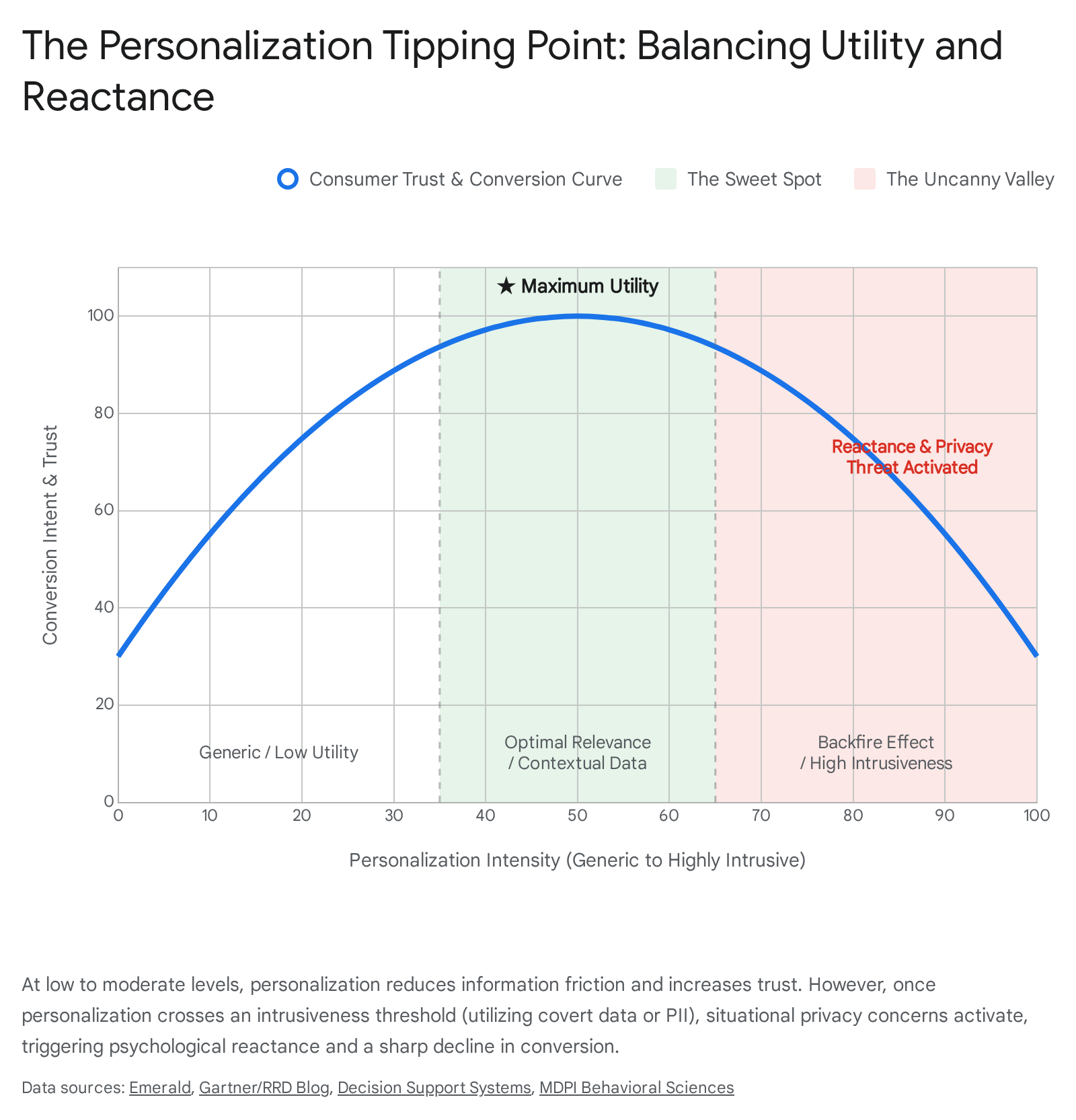
A pervasive and financially costly fallacy in digital marketing strategy assumes a linear correlation between personalization intensity and marketing outcomes. This misconception operates on the assumption that acquiring more granular data, training larger models, and deploying more aggressive algorithmic targeting will universally and indefinitely yield higher conversion rates and customer satisfaction. Recent rigorous econometric modeling and behavioral experiments decisively dismantle this assumption, revealing instead an inverted U-shaped relationship between personalization depth and positive consumer outcomes like trust and conversion 1920.
3.1 The Threshold of Intrusiveness and Cognitive Overload
At low to moderate levels of personalization, algorithms function as highly effective decision-support systems. By utilizing broad contextual cues or overtly provided preferences, they successfully reduce search friction, mitigate information asymmetry, and deliver highly relevant utilitarian value. In this ascending phase of the inverted U-curve, the consumer's willingness to purchase, institutional trust, and brand engagement steadily rise as the platform proves its usefulness 1920.
However, as the personalization intensity continues to deepen - incorporating highly granular personally identifiable information (PII), scraping cross-platform histories, or extending into prolonged, hyper-tailored interaction durations - the psychological effect reaches a critical inflection point. Beyond this threshold, the marginal utility of increased relevance is entirely negated by the sudden activation of situational privacy concerns, cognitive fatigue, and psychological reactance 192122. Consumers begin to suffer from severe information overload, and the intense algorithmic focus shifts their perception from receiving a "helpful recommendation" to facing a "surveillance threat" 1719.
Empirical observations substantiate this non-linear dynamic. For instance, observational data tracking producer-consumer interaction durations in live-commerce environments found a specific turning point around 167.6 seconds; interactions that extended beyond this threshold induced acute social pressure and decision fatigue, directly suppressing conversion rates 19. Similarly, macro-level consumer data from a 2024 Gartner survey revealed that 53% of consumers reported that highly personalized interactions actually had a negative impact on their recent purchasing journey, making these consumers 44% less likely to initiate a repeat purchase with the offending brand 27.
3.2 Situational Privacy Concern: Triggering the Backfire Effect
The descent down the far side of the inverted U-curve is characterized in recent literature as the "backfire effect" 2122. The backfire effect occurs when a highly personalized message performs statistically worse than a completely generic control message. Importantly, this backfire is not a static trait of the consumer, but rather is moderated by situational privacy concern - a momentary, context-dependent psychological state that can be activated by environmental cues, such as reading a news article about a corporate data breach 172123.
In experimental studies utilizing an "intrusiveness ladder" (exposing users to generic, then contextual, then PII-based algorithmic messaging), researchers found that when situational privacy concern was low, consumers tolerated higher personalization 2122. However, when environmental cues elevated their privacy concerns, exposing them to highly intrusive PII-based personalization triggered an immediate backfire effect. Under these heightened conditions, the most aggressive personalization tactics yielded significantly lower purchase intent than moderate, contextual personalization, proving that creeping past the psychological threshold actively destroys marketing ROI 2123.
4. Contextual Moderators: Utilitarian vs. Sensitive Consumption
The precise apex of the inverted U-shape is highly malleable, shaped profoundly by the intrinsic nature of the product or service being algorithmic marketed. A robust consensus in empirical research sharply distinguishes between the effectiveness of AI personalization for utilitarian products versus sensitive or hedonic products 212425.
4.1 Utilitarian Efficacy
For utilitarian products - such as hardware, household appliances, standard business software, or grocery staples - consumers are highly goal-oriented. The primary cognitive driver is efficiency 1324. In these low-risk, practical contexts, consumers tolerate a significantly higher degree of algorithmic targeting because the utility of the recommendation is obvious and non-threatening. AI algorithms that analyze past purchase histories to surface a highly specific utilitarian item serve to drastically reduce cognitive load and search costs. Consequently, for utilitarian goods, the inverted U-curve features a much wider tolerance threshold before triggering privacy reactance 132425.
4.2 Sensitive Products, Identity Threats, and Uniqueness Neglect
Conversely, when algorithms attempt to hyper-personalize the marketing of sensitive products - such as healthcare services, pharmaceuticals, financial planning tools, or inherently embarrassing personal care items - they frequently trigger an immediate and severe backfire effect 212426.
In healthcare and medical AI applications, this resistance is driven by "uniqueness neglect." This refers to a consumer's profound fear that an algorithmic system, relying on generalized statistical models, cannot possibly comprehend the intricate, individual nuances of their personal health or financial status 2427. When an AI attempts to prescribe a highly personalized medical or financial solution, consumers reject it because it feels reductive, lowering their trust in the institution providing it 2427.
Furthermore, when an algorithm accurately infers a sensitive condition - such as a financial distress signal or an undisclosed medical symptom - from covert digital footprints, the perceived privacy violation is catastrophic. Algorithmic recommendations can also inadvertently trigger "social identity threats." If an AI recommends a product by associating the consumer with a highly sensitive or dissociative reference group, the consumer experiences acute psychological discomfort and alienation 28. In these high-stakes, sensitive contexts, marketers must actively suppress their algorithmic capabilities, relying on broad contextual cues rather than granular behavioral profiling to avoid activating psychological reactance and brand revulsion 21.
5. The Uncanny Valley of Marketing: Traversing the Creepiness Tipping Point
The intersection of extreme algorithmic accuracy and human psychological boundaries gives rise to the "Uncanny Valley of Marketing." Originally coined by Masahiro Mori in 1970 to describe the eerie, visceral revulsion humans feel toward robotics that appear almost, but not perfectly, human, the concept has been successfully adapted to digital marketing and AI engagement 17.
In the digital sphere, the uncanny valley occurs when an AI system demonstrates a level of intimate knowledge or conversational mimicry that crosses the boundary from a "helpful digital assistant" to an "omniscient stalker" 129. The tipping point - frequently and colloquially termed the "creepiness factor" - is reached when consumers cannot logically deduce how an algorithm acquired a specific, highly intimate piece of information 721. For example, if a consumer discusses a niche product out loud in a physical space and subsequently sees an advertisement for it on a mobile social feed without having explicitly searched for it, the algorithm is perceived not as predictive, but as an active surveillance apparatus 227.
5.1 Anthropomorphism and Generative AI
This uncanny sensation is significantly compounded by the recent deployment of sophisticated conversational agents, Generative AI avatars, and virtual influencers. Marketing science delineates between functional AI roles (e.g., executing a search query) and relational AI roles (e.g., providing empathetic customer service or companionship) 29. While moderate anthropomorphism - such as a chatbot utilizing a polite, conversational tone - can foster emotional connection, deploying hyper-realistic virtual influencers or AI agents that attempt to simulate deep human empathy in purely transactional or health-related roles evokes profound unease 2930.
Consumers instinctively recognize the emotional hollowness of the interaction, leading to an "authenticity deficit" 31. This is particularly damaging in risk-sensitive contexts; for instance, utilizing virtual influencers to market health supplements routinely backfires, as consumers demand genuine human accountability for health claims 31. Furthermore, when these generative systems make a granular error - such as an AI drafting a highly personalized cold-outreach email that hallucinated a false personal detail about the recipient's career - the illusion shatters completely. This exposes the robotic, formulaic architecture beneath the personalized veneer, plunging the interaction straight into the uncanny valley and permanently eroding brand trust 37. To safely traverse this valley, organizations must deliberately inject friction or restraint into their targeting parameters, avoiding the temptation to appear overly prescient 17.
6. Geographic Divergence: Regulatory Regimes and Cultural Privacy Perceptions
The boundaries of acceptable hyper-personalization are not solely dictated by universal psychological theories; they are strictly mediated by the geopolitical and regulatory environments in which the algorithms operate. A comparative analysis of the European Union (EU), the United States (US), and the Asia-Pacific (APAC) region reveals stark contrasts in structural privacy protections. These diverse legal architectures fundamentally alter baseline consumer autonomy, trust, and expectations across global markets 183239.
6.1 The European Union: The Rights-Based Ecosystem and GDPR
The EU operates under the General Data Protection Regulation (GDPR) and the newly enacted Artificial Intelligence Act (AI Act), establishing the world's most stringent, comprehensive, and rights-based data ecosystem. The European framework is fundamentally characterized by an opt-in consent architecture, demanding explicit, informed, and unambiguous consent prior to the deployment of covert tracking or automated decision-making technologies (ADMT) 1833.
Crucially, under Article 22 of the GDPR, EU citizens possess the unequivocal right to a human review of automated decisions that significantly affect them, as well as the right to a detailed explanation of the underlying algorithmic logic 33. Consequently, the regulatory environment has forced total transparency upon corporate actors. Market research indicates that this overarching regulatory umbrella has a tangible psychological impact: roughly 42% of European consumers report feeling a heightened sense of control over their personal data post-GDPR implementation, with variations ranging up to 63% in nations like Romania 34.
However, this systemic regulation has not resulted in blanket trust. Trust remains highly compartmentalized; while European consumers trust highly regulated, traditional sectors like banking with their data (24%), trust in social media and tech platforms remains critically low (with 43% citing them as the least trustworthy). This enduring skepticism is fueled by the very transparency the GDPR enforces, as citizens are routinely exposed to news of ongoing, high-profile regulatory fines and investigations into tech conglomerates 34.
6.2 The United States: Fragmented, Market-Driven Compliance
In sharp contrast to the EU's centralized approach, the United States relies on a highly fragmented, sector-specific, and state-led patchwork of regulations. This approach is epitomized by the California Consumer Privacy Act (CCPA) and the subsequent California Privacy Rights Act (CPRA) 3233. The U.S. approach is primarily market-driven and innovation-first, functioning largely on an opt-out paradigm 3335.
While the CCPA grants consumers the right to know what data is collected and the right to opt-out of its sale, the default structural assumption permits continuous data scraping, aggregation, and algorithmic profiling until the consumer actively intervenes. Furthermore, unlike the comprehensive protections of the GDPR, the CCPA includes broad legislative carve-outs. These carve-outs allow automated decision-making in high-stakes areas (e.g., fraud prevention, employment screening, educational profiling) without mandatory pathways for human appeal, unless the corporation has completely denied the consumer an opt-out option 33.
As a direct result of navigating this fragmented, opt-out ecosystem, U.S. consumers experience widespread "privacy fatigue." Operating within an environment where the burden of privacy protection falls entirely on the individual, American consumers frequently exhibit higher levels of skepticism and feel overwhelmingly apathetic regarding their practical ability to control their digital footprint compared to their European counterparts 32.
6.3 APAC and Emerging Markets: Cultural Collectivism and the DPDP Act
The Asia-Pacific region, illustrated prominently by India's recent Digital Personal Data Protection (DPDP) Act of 2023, represents an evolving middle ground that blends stringent legal frameworks with unique cultural dynamics 18. While the DPDP Act introduces severe financial penalties for data misuse and enforces corporate accountability resembling Western frameworks, consumer reception of AI in APAC is heavily moderated by distinct cultural orientations.
Sociological research indicates that collectivist cultures, prevalent in many APAC nations, often demonstrate a higher baseline tolerance for algorithmic interventions and institutional data gathering compared to the fiercely individualistic cultures of the US and Western Europe 1836. Nonetheless, even in these highly digitized markets, the personalization-privacy paradox persists. Indian consumers, despite recognizing the immense utilitarian value of predictive algorithms, report feelings of reduced decision-making freedom, describing the experience of being algorithmically curated as being "trapped in a bubble" where the app dictates their choices 18.
Crucially, while digital users in emerging markets may lack technical comprehension of the specific legal mechanisms of the DPDP Act, the mere "symbolic power" of the legislation plays a critical role. Knowing that a robust legal framework exists, and that the government holds corporations accountable, significantly fosters baseline trust and encourages ongoing digital participation, mitigating some of the anxieties associated with rapid AI adoption 18.
7. Strategic Re-alignment: Restoring Consumer Sovereignty
The intersection of the aforementioned psychological paradigms, empirical threshold limitations, and diverging global regulatory regimes dictates a radical recalibration of AI marketing strategies. The prevailing assumption that mere computational power and unchecked data extraction can infinitely scale consumer engagement is fundamentally flawed. As privacy concerns transition from latent to acute, the continued reliance on covert, third-party data pipelines presents catastrophic, existential risks to long-term brand equity 37.
7.1 Explainable AI (XAI) and Transparent Data Governance
To resolve the personalization-privacy paradox, digital platforms must pivot aggressively toward transparency. Mitigating the psychological reactance triggered by the inverted U-shape threshold requires the implementation of Explainable AI (XAI) directly within consumer user interfaces. When an algorithmic recommendation is presented, augmenting the interface with transparent, accessible disclosures (e.g., "We recommended this specific financial product because you searched for X in January") fundamentally shifts the psychological framing.
By demystifying the algorithmic obscurity, XAI satisfies the consumer's inherent need for autonomy and reinforces the rational cost-benefit analysis central to the Privacy Calculus 3738. However, this transparency must be calibrated; studies suggest that combining highly complex counterfactual and local explanations can overwhelm workers and consumers, suggesting that explanations must be clear, concise, and easily digestible 24.
7.2 Information Foraging Autonomy and the Subscription Economy
Furthermore, leading researchers have begun applying the Information Foraging Autonomy Score (IFAS) to quantify the loss of consumer sovereignty. Empirical modeling reveals that hyper-personalization significantly reduces choice autonomy - by up to 30% when daily algorithmic ad exposures exceed a high threshold - leading directly to brand avoidance and privacy distrust 3.
To counter this structural exploration suppression, the literature suggests a strategic transition toward subscription-based models or Zero-Party Data ecosystems. In these models, consumers are incentivized to explicitly declare their preferences and intentions (overt data) in exchange for premium, tailored services 346. By relying on data that the consumer actively and willingly provided, firms bypass the uncanny valley entirely. Because the consumer initiated the data exchange, the resulting hyper-personalization is perceived not as an intrusive surveillance tactic, but as a highly competent, bespoke response 646.
Conclusion
AI-driven hyper-personalization remains one of the most technologically potent instruments in contemporary marketing science, yet its unchecked deployment is psychologically and structurally unsustainable. This exhaustive analysis of modern consumer psychology reveals that digital engagement is not a linear function of data volume; rather, it operates on a delicate, inverted U-shaped curve governed tightly by the Privacy Calculus and Psychological Reactance. While overt, transparent personalization generates robust institutional trust and high utilitarian value, covert algorithmic tracking inevitably pushes consumers past the tipping point of the uncanny valley. At this threshold, relevance mutates into creepiness, and utility devolves into perceived surveillance.
Particularly within sensitive product categories, the empirical "backfire effect" unequivocally demonstrates that algorithmic restraint is frequently more profitable than algorithmic omniscience. As global regulatory environments continue to diverge - with the EU solidifying an opt-in, rights-based landscape, and the US and APAC struggling to balance rapid innovation with emerging consumer protections - the burden falls upon corporate organizations to design algorithmic systems that actively prioritize consumer autonomy. Ultimately, the future of the digital economy relies not on maximizing the volume of behavioral data an AI can covertly extract, but on optimizing the transparency, equity, and mutual value of the data exchange, ensuring that technological sophistication serves to empower, rather than alienate, the human consumer.