
Psychological Reactance and Perceived Autonomy Loss in Consumers
Foundational Mechanics of Reactance Theory
The foundation of human behavioral motivation is intricately linked to the perception of personal agency and autonomy. When this agency is challenged, individuals frequently respond not with compliance, but with active resistance. This phenomenon is formalized in the theory of psychological reactance, initially conceptualized by Jack W. Brehm in 1966 to explain the unpredictable failures of persuasive communication and social influence paradigms 123. Operating primarily within social psychology and consumer behavior, reactance theory posits that individuals maintain a cognitive reservoir of "free behaviors." These behaviors encompass specific actions, choices, attitudes, or thoughts that an individual believes they possess the physical and psychological capacity to execute either immediately or in the near future 23.
When consumers perceive an external threat to these behavioral freedoms, they experience an aversive motivational state designed to restore the threatened autonomy 24. This state, known as psychological reactance, acts as an internal defense mechanism against perceived coercion, providing researchers with a critical tool to analyze resistance across fields ranging from public health campaigns to personalized digital marketing 2. Brehm established that the ultimate goal of the reactive state is always the restoration of freedom, which frequently manifests as an immediate rejection of a restrictive rule or the adoption of a view contrary to what the source of the pressure intended 2.
Core Elements and Theoretical Structure
The architecture of reactance theory is structured around four interconnected elements that describe the psychological process from the initial perception of a threat to the ultimate behavioral response. The first element is perceived freedom, which dictates that in order for someone to experience reactance, they must first possess an awareness of their autonomy and the belief that a specific freedom of action exists 5. Reactance theory suggests that individuals are constantly monitoring their environment for threats to this reservoir of free behaviors 2. The second element is the threat to freedom, which occurs when a consumer perceives an external force attempting to limit or eliminate their choices 56. This threat does not need to be an explicit mandate; it can be implied through the linguistic structure of an advertisement, a paternalistic policy, or an algorithmic recommendation 46.
The third element is the motivational arousal of reactance itself. While not always consciously recognized by the individual, this state encompasses a determined internal drive to reassert control 2. The fourth and final element is the restoration of freedom, comprising the actual behavioral or attitudinal changes undertaken by the individual to neutralize the threat 25. The magnitude of the reactance experienced by a consumer is directly proportional to the perceived severity of the threat, the absolute number of freedoms simultaneously threatened, and the intrinsic importance the individual assigns to the specific freedom in question 236. If an interference is seen as illegitimate, the consumer may assume a broader set of freedoms is now at risk, exponentially increasing the intensity of the reaction 2.
The Intertwined Cognitive-Affective Model
Contemporary consumer psychology relies heavily on the intertwined model proposed by Dillard and Shen, which operationalizes reactance as a complex dual-process mechanism 7. According to this framework, psychological reactance cannot be reduced merely to an isolated emotion or a purely cognitive evaluation. Rather, it is a simultaneous, fused experience of negative cognitions, largely taking the form of counter-arguing the persuasive message, and negative affect, which manifests as anger, hostility, and frustration directed at the source of the message 278.
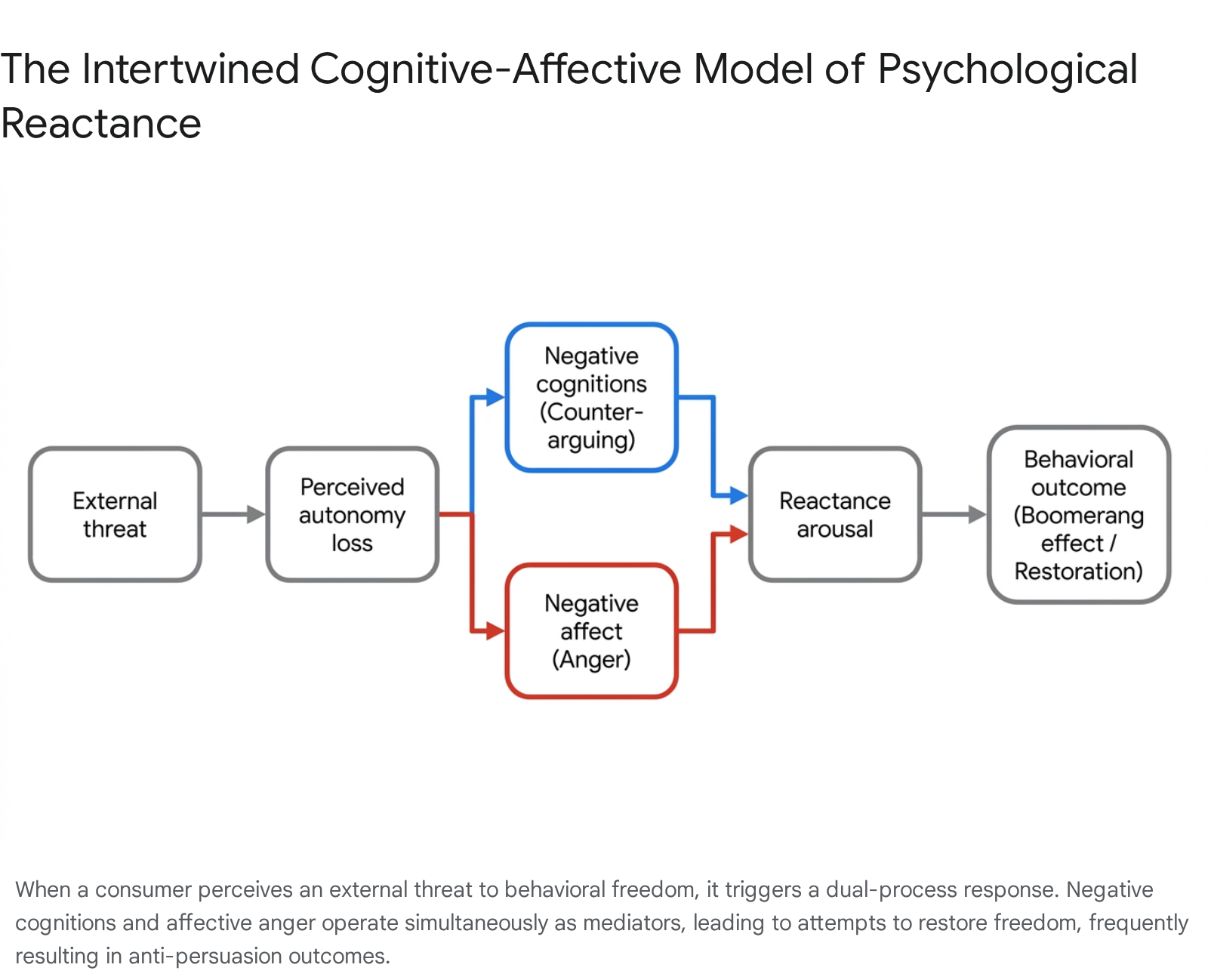
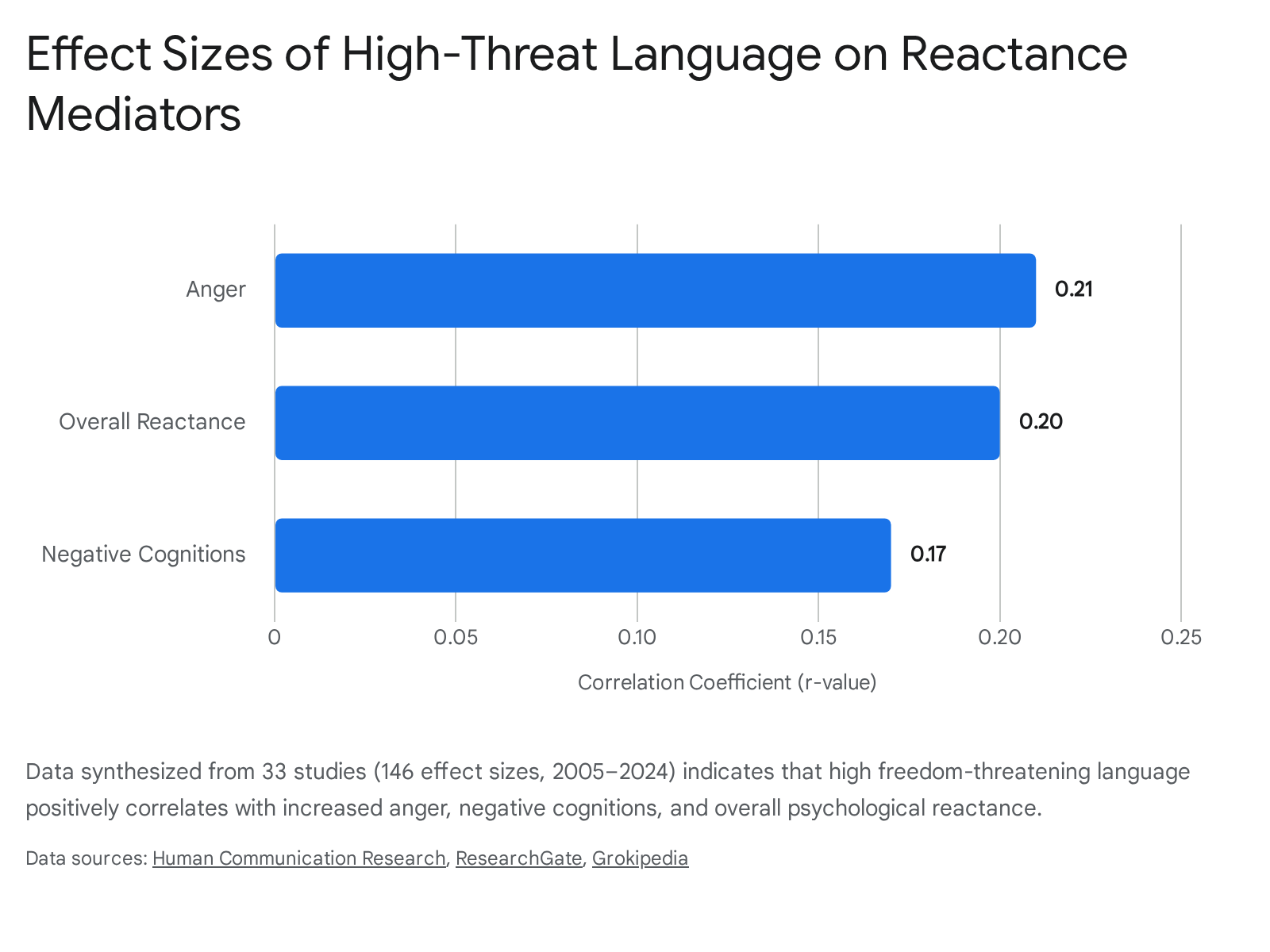
When consumers are confronted with forceful or controlling marketing language, they rapidly generate cognitive counterarguments to dismantle the logic of the persuader 47. Concurrently, the perceived usurpation of their autonomy triggers emotional anger 27. A comprehensive 2025 synthesis of 33 studies encompassing 146 effect sizes confirmed this dual pathway across varied communication contexts 4910. The meta-analysis demonstrated that high freedom-threatening language reliably elicited anger ($r = .21$) and negative cognitions ($r = .17$) 4910.
These intertwined components subsequently act as mediators that systematically reduce persuasion outcomes, shifting consumer attitudes away from the intended message 47.
Trait Reactance Versus State Reactance
The propensity to experience psychological reactance is not uniformly distributed across the consumer population. Researchers differentiate between state reactance, which is a temporary, situation-specific response to an isolated freedom threat, and trait reactance, which reflects a stable individual difference in sensitivity to control 345.
Individuals exhibiting high trait reactance proneness are inherently more sensitive to implied restrictions and are highly motivated to consistently assert their independence 45. This disposition is frequently measured using instruments such as the Hong Psychological Reactance Scale, a validated metric comprising multiple subscales that evaluate perceived threats to freedom, lack of choice, and perceived constraints 41112. Empirical studies relying on the Hong scale confirm that consumers with high trait reactance routinely perceive higher threat levels in standard persuasive messages, exhibiting stronger resistance and attitude polarization compared to consumers with lower trait reactance 412. Understanding this baseline sensitivity is critical for consumer researchers, as a message that safely persuades a low-reactance demographic may severely alienate a highly reactance-prone audience.
The Boomerang Effect and Anti-Persuasion
The most salient behavioral consequence of psychological reactance in consumer contexts is the boomerang effect. This phenomenon describes a severe counterproductive outcome of persuasive communication where recipients actively adopt attitudes or behaviors diametrically opposed to those advocated by the message sender 411. Rather than yielding compliance, the persuasive attempt inadvertently acts as a catalyst for anti-persuasion, strengthening the consumer's initial position through intensified resistance 2410.
The boomerang effect is driven by the intrinsic need for direct restoration of freedom. If an advertisement or public policy explicitly demands a certain behavior, the most definitive way for a consumer to prove that their autonomy remains intact is to deliberately perform the prohibited action or reject the mandated one 35. This results in systemic backlash, translating cognitive counterarguments into observable shifts in consumer choice 4.
Manifestations in Paternalistic and Normative Messaging
Empirical investigations have documented the boomerang effect across diverse domains, observing its prevalence particularly when messaging adopts a paternalistic or highly dogmatic tone 413. In the realm of public health and risk communication, anti-smoking initiatives utilizing paternalistic, high-threat language have occasionally misfired. Instead of promoting cessation, these campaigns inadvertently boosted pro-smoking sentiments among highly reactance-prone audiences who viewed the paternalism as an unacceptable invasion of their autonomy 4.
The boomerang effect is equally prevalent in normative feedback interventions designed to promote sustainable and pro-environmental consumer behaviors 414. A foundational 2007 field experiment conducted by Schultz et al. tested the impact of descriptive social norms on electricity consumption among 290 households in California 414. The households were provided with monthly feedback comparing their personal energy usage to the neighborhood average 4. While households consuming above the average reduced their usage by 5.7%, a distinct boomerang effect emerged among low-consuming, compliant households 4. Upon realizing their energy conservation exceeded the descriptive norm, these households increased their energy consumption by 8.5% in the following month 4. The descriptive norm inadvertently signaled that higher consumption was socially acceptable, pulling low performers upward toward the mean and reversing their previously desirable behavior 414.
The Low-Discount Boomerang Phenomenon in Pricing
Beyond structural messaging, the boomerang effect manifests profoundly in pricing architectures and promotional strategies. Traditional economic logic suggests that price discounts should uniformly correlate with an increase in consumer purchase intent. However, research into the low-discount boomerang effect reveals a paradoxical reversal when discounts are perceived as trivial 415.
For non-essential goods, offering a highly marginal discount can suppress consumer demand to levels significantly below those observed when no discount is offered at all 415. Experimental data derived from online purchasing platforms demonstrates that minimal discounts often trigger negative inferences regarding product quality, temporary scarcity, or merchant sincerity 415. This initiates cognitive reactance; consumers feel their intelligence is being insulted or their autonomy exploited by a trivial financial incentive. Consequently, the correlation between discount rate and purchase volume forms a U-shaped curve 15. Both zero discounts and substantial discounts outperform negligible promotions, indicating that when a marketing strategy is recognized as a manipulative attempt to force a transaction, it initiates restorative behaviors that actively depress conversion rates 415.
Peer Influence and Positive Word-of-Mouth Reversals
The boomerang effect also extends to complex social dynamics, including word-of-mouth (WOM) marketing. While positive WOM generally drives adoption, it can backfire under specific competitive conditions. A 2025 empirical study examining a duopoly in the mobile payment market analyzed switching intentions among 531 respondents 1617.
The researchers hypothesized that positive WOM regarding a competitor would increase switching intentions away from an incumbent provider. Surprisingly, the data revealed a boomerang outcome: positive WOM regarding the alternative service had a nonsignificant effect on its perceived attractiveness but significantly increased the consumers' trust in their incumbent provider 16. Conversely, negative WOM regarding the incumbent, while not directly prompting an immediate switch, significantly enhanced the perceived attractiveness of the alternative 1617. This highlights that psychological resistance mechanisms are highly contextual; overt peer influence promoting an alternative can inadvertently trigger a defensive reinforcement of the consumer's current choices, solidifying brand inertia rather than disrupting it.
Consumer Resistance Taxonomies and Differentiators
To accurately operationalize anti-persuasion, researchers must cleanly delineate psychological reactance from tangentially related, yet mechanistically distinct, consumer resistance states. Resistance in marketing literature is broadly defined as a reaction against the pressure for change 18. However, the psychological origins and behavioral manifestations of this resistance vary significantly.
Psychological reactance is fundamentally characterized by an external threat to behavioral autonomy, leading to an active, energized pushback and intertwined affective anger 218. This must be distinguished from cognitive dissonance, which is internally generated. Dissonance arises when a consumer holds conflicting internal beliefs or engages in actions misaligned with their values, creating psychological discomfort 2. While reactance motivates an individual to oppose an external force to restore control, dissonance motivates the individual to rationalize their internal beliefs or actions to restore psychological harmony 2.
Similarly, reactance differs structurally from consumer skepticism. Skepticism is a vital cognitive defense mechanism utilized to detect false, misleading, or exaggerated advertising claims 1920. It is largely analytical and evaluative; consumers do not question advertising because advertisers necessarily lie, but because consumers operate under the heuristic that advertisers do not have their best interests in mind 19. Skepticism seeks verification, whereas reactance seeks rebellion 519. Ad fatigue and brand apathy present another distinct resistance mode. These occur when consumers become mentally exhausted from repetitive exposure to static visual elements or overwhelming advertising clutter 202122. Fatigue leads to habituation and passive avoidance, such as scrolling past content or utilizing ad-blockers to conserve cognitive energy, differing sharply from the active defiance of reactance 202122.
Finally, the construct of brand hate represents a more severe, retaliatory psychological state. Brand hate encompasses intense negative emotions - specifically disgust, contempt, and severe anger 2324. It is typically triggered by a deep sense of betrayal, severe functional or symbolic self-incongruity, or a negative brand event (such as an ethical scandal or service failure) 2325. While reactance can lead to brand switching, brand hate is a deeper psychological rupture that results in punitive actions, boycotts, and organized counter-attitudinal advocacy 232427.
Taxonomy of Consumer Resistance States
| Resistance Construct | Primary Psychological Trigger | Underlying Mechanism | Dominant Consumer Response |
|---|---|---|---|
| Psychological Reactance | External threat to behavioral autonomy or perceived choice. | Motivational arousal; intertwined anger and counter-arguing. | Active Defiance: Boomerang effect, intentionally adopting contrary behaviors. |
| Consumer Skepticism | Perception of exaggerated, misleading, or insincere marketing claims. | Cognitive defense mechanism; analytical doubt of message veracity. | Verification / Delay: Information seeking, disbelief, rejection of claims. |
| Ad Fatigue / Inertia | Overexposure to repetitive stimuli; cognitive overload and clutter. | Habituation; depletion of cognitive processing resources. | Passive Avoidance: Tuning out, utilizing ad-blockers, maintaining status quo. |
| Brand Hate / Betrayal | Severe self-incongruity, ethical failures, or broken consumer trust. | Deep affective revulsion (disgust, contempt, enduring anger). | Retaliation: Boycotts, vindictive negative word-of-mouth, sabotage. |
| Cognitive Dissonance | Internal inconsistency between personal beliefs, values, and actions. | Psychological discomfort seeking internal harmony. | Rationalization: Altering attitudes to justify past consumer choices. |
Exploitative Architectures and Autonomy Threats
Digital marketing ecosystems frequently deploy specific choice architectures designed to accelerate conversion and reduce the time from product discovery to purchase. However, when these tactical designs cross the threshold from persuasive nudging into coercive exploitation, they severely compromise consumer autonomy, triggering aggressive anti-persuasion responses 26.
False Scarcity and the Manipulation of Urgency
Marketers routinely leverage the psychological principle of scarcity - the perception that an item is rare or limited in availability - to enhance perceived value and invoke a fear of missing out 329. While authentic scarcity based on genuine supply constraints can legitimately inform consumer choices, false scarcity constitutes an exploitative deceptive pattern that routinely backfires 262728.
Tactics such as artificial countdown timers that reset upon page refresh, or fabricated "low stock" indicators generated by commercial plug-ins, are explicitly designed to overwhelm the consumer's nervous system 2628. For example, tools like the Shopify application "Sales & Stock Counter" allow merchants to deploy fake sales figures and artificial low-inventory warnings 28. These dark patterns bypass logical deliberation and manufacture unwarranted urgency 26. Because psychological reactance dictates that individuals will resist when their behavioral freedom is artificially constrained, false scarcity frequently invokes intense hostility once the deception is detected by the consumer 32632. Consumers interpret these constraints not as helpful parameters, but as direct, manipulative attacks on their decision-making sovereignty 326.
The Paradox of Choice and Decision Fatigue
Autonomy theoretically requires the availability of multiple options; however, an excessive volume of choices creates an inverse effect known as the paradox of choice 27. Popularized by psychologist Barry Schwartz in 2004, this phenomenon illustrates that while consumers state a preference for variety, offering too many options demands intense cognitive effort, leading to decision fatigue, elevated expectations, and heightened anxiety about making the correct choice 27.
Paradoxically, in an attempt to retain autonomy when overwhelmed by complex choice arrays, consumers often default to familiar options, select based on non-optimal single criteria, or abandon the purchase entirely as a mechanism of cognitive self-protection 27. This avoidance behavior underscores that an unstructured proliferation of choice is perceived not as absolute freedom, but as an oppressive cognitive burden that ultimately degrades consumer satisfaction and post-purchase confidence 27.
Language Intensity and Imperative Framing
The linguistic structure of marketing communication is a critical determinant of whether an interaction preserves or threatens autonomy. Assertive or imperative framing (e.g., utilizing phrases such as "You must," "Buy now," or "Do not miss out") signals control rather than choice, escalating the perceived magnitude of the freedom threat 4913. Assertive language inherently communicates social agency and demands compliance, which conflicts deeply with the modern consumer's self-concept as an independent, rational actor 813.
By contrast, autonomy-supportive or choice-enhancing language (e.g., "Consider this option," or "You could choose") mitigates threat perception 913. The use of highly dogmatic, controlling language reliably amplifies counter-arguing and anger, particularly in contexts where the requested behavior is highly repetitive, such as sustainable consumption or recurring subscription models 91013. Thus, the semantic framing of an advertisement serves as the primary gateway, determining whether the message functions as an instrument of persuasion or an immediate trigger for the boomerang effect.
Algorithmic Reactance and Artificial Intelligence
As predictive analytics and recommender systems increasingly pervade consumer-firm interactions, the locus of the freedom threat has notably shifted from human marketers to artificial intelligence 2930. Algorithmic marketing offers unprecedented personalization, capable of processing massive datasets to optimize content delivery 2931. However, this shift has birthed a novel psychological phenomenon defined in recent literature as algorithmic reactance 293032.
Algorithmic reactance occurs when consumers perceive AI-driven curation, precision targeting, and automated decision-making not as value-added conveniences, but as an encroachment on their independent agency 62932. The sheer efficiency of machine learning algorithms leaves many consumers feeling that their choices have been preempted, resulting in a profound loss of decision-making autonomy 63334. A recent scoping review of literature published between 2023 and 2025 regarding virtual influencers and AI communicators noted that inhibitory mechanisms - primarily AI skepticism and algorithmic reactance - systematically constrain the effectiveness of artificial agents 32. Transparency cues and standardized AI disclosures often generate confusion regarding the system's ontological status and heighten consumer sensitivity to algorithmic bias, intensifying doubts about the genuineness of the interaction 32.
Algorithmic Surveillance and Autonomy Attrition
The mechanism of algorithmic delivery also independently influences the magnitude of consumer reactance. Behavioral studies indicate that individuals react significantly more adversely to surveillance and data collection when it is conducted autonomously by AI rather than by human agents 35. In empirical experiments examining real-time surveillance, participants monitored by algorithms reported significantly lower perceived autonomy (M = 3.91) compared to those monitored by humans (M = 4.61) 35.
When individuals recognize they are being monitored and analyzed by opaque "black box" algorithms, they experience a profound loss of privacy and agency 632. To restore control, consumers engage in direct resistance behaviors. The aforementioned study found that 11.7% of participants actively criticized and resisted algorithmic surveillance, compared to 0.0% for human surveillance 35. This resistance manifests broadly in digital markets through the utilization of ad-blockers, the intentional provision of false data, or the categorical rejection of overly personalized content 635.
Product Type Moderation in Recommender Systems
The magnitude of algorithmic reactance is also heavily moderated by the nature of the consumer decision. Consumers exhibit distinct preferences for algorithmic versus human recommendation sources depending on whether they are evaluating search products or experience products 36.
Search products require objective, detailed, and fact-based evaluations. Examples include consumer electronics, financial instruments, or standardized hardware 36. In these domains, consumers generally demonstrate higher trust in AI recommendations. They perceive algorithms as possessing superior computational capability to process vast datasets efficiently and transparently, viewing the AI as a tool that enhances rather than replaces their analytical process 36.
Conversely, experience products rely heavily on sensory perceptions, subjective judgment, and emotional resonance. Examples include gourmet dining, spa services, fashion, and entertainment 3637. When AI is utilized to recommend experience products, consumers frequently exhibit algorithm aversion due to a phenomenon termed uniqueness neglect 36. Consumers feel that a mathematical algorithm is inherently incapable of capturing the unique, idiosyncratic nuances of their personal tastes and emotional needs 36. In these subjective contexts, the imposition of an algorithmic choice triggers intense psychological reactance, driving consumers to rely on human experts who are perceived as possessing genuine empathy and subjective understanding 3236.
Recommendation Source Acceptance Matrix
| Decision Domain | AI / Algorithmic Recommendation | Human / Expert Recommendation | Primary Reactance Risk |
|---|---|---|---|
| Search Products (Objective, spec-heavy) | Highly Trusted. Viewed as capable of processing vast data efficiently. | Less preferred. May lack comprehensive data processing capacity. | Low - AI is viewed as an analytical tool enhancing, not restricting, choice. |
| Experience Products (Subjective, sensory) | Algorithm Aversion. Triggers "uniqueness neglect." | Highly Trusted. Seen as possessing empathy and subjective emotional judgment. | High - Algorithmic curation feels restrictive and highly impersonal. |
| Routine / Low-Stakes | Accepted. Reduces cognitive load and mitigates decision fatigue. | Represents unnecessary friction in the purchase journey. | Low - AI assumes a helpful background role, optimizing time. |
| Identity-Sensitive / High-Stakes | High skepticism. Opaque algorithms trigger deep privacy and bias concerns. | Preferred for accountability, transparency, and emotional intelligence. | High - Algorithmic decisions threaten personal agency and core identity. |
Transparency, Explainability, and Shared Agency
To mitigate algorithmic reactance, systems must be architected to support shared responsibility and algorithmic transparency 638. Interventions utilizing Explainable AI (XAI) enhance user trust by providing comprehensible rationales for the algorithm's decisions 63339. When AI systems explicitly communicate the underlying logic behind a recommendation - such as stating "Recommended because you frequently engage with content regarding X" - it demystifies the black box. This shifts the consumer's perception of the AI from a coercive, autonomous controller to an assistive, navigational tool 3334.
Furthermore, research demonstrates that allowing consumers to actively tune algorithms or adjust input preferences preserves their status as the ultimate decision-maker 3839. By keeping the human in the loop, platforms fulfill the psychological need for autonomy and dramatically reduce anti-persuasion responses, maintaining engagement even when the AI assumes a highly prominent role in the consumer journey 3839.
Cross-Cultural Variances in Freedom Threats
While the fundamental psychological drive for freedom is universal, the specific triggers, thresholds, and magnitude of psychological reactance are deeply influenced by overarching cultural paradigms. This is most notably observed along the cultural continuum of Individualism versus Collectivism, as defined by researchers such as Geert Hofstede and Shalom Schwartz 124045414742.
Individualism and the Independent Self-Construal
In individualistic cultures, which dominate Western societies, societal norms place paramount emphasis on personal freedom, self-expression, uniqueness, and the independent self-construal 1245424344. Individualistic cognitive modes favor analytic thinking, focusing on objects and choices perceived as existing independently from their broader social context 42. Consequently, individualistic consumers are highly sensitive to direct restrictions on their personal choices and autonomy 4147.
Marketing messaging that threatens an individualist's ability to act autonomously is swiftly met with elevated levels of anger and cognitive counter-arguing 1245. These consumers are primarily driven by personal utility and market differentiation 4746. If a brand message implies conformity or relies heavily on prescriptive, injunctive social norms (what one "ought" to do), it routinely triggers an autonomy threat 4345. Individualists prioritize making decisions that reflect their unique identities and deeply resent explicit external influence 424345.
Collectivism, Interdependent Norms, and Vicarious Reactance
Conversely, collectivistic cultures emphasize group harmony, social interdependence, and strict adherence to established social norms 1245424344. Collectivist cognitive modes favor holistic thinking, where the perception of self is firmly rooted in interactions with others and the social environment 42.
While collectivists also experience psychological reactance, the catalyst significantly differs. Collectivistic consumers demonstrate a much higher tolerance for behavioral guidelines that align with group consensus or promote communal stability, as their self-concept is deeply intertwined with societal expectations 474345. For example, a cross-cultural study regarding ethical fashion purchase intentions found that consumers in China (a collectivist society) were significantly more influenced by subjective norms and peer behavior than consumers in Spain (an individualistic society) 45. Collectivists utilize social norms as functional heuristics for acceptable choices rather than viewing them as threats to individual autonomy 4345.
However, cross-cultural research utilizing perspective-taking interventions reveals that collectivists exhibit profound vicarious reactance 1241. While they may be more resilient to minor restrictions on their personal freedom for the sake of group harmony, they react with intense hostility when the collective freedoms of their in-group are threatened by an external force 1241.
Cognitive Architectures and the Maximizer Persona
Cultural dynamics also heavily influence localized cognitive shopping architectures, intersecting with reactance via specific decision-making strategies. Demographic research in Southeast Asia provides a compelling example, identifying a highly prevalent consumer persona known as the Maximizer or Rational Shopper 53.
Unlike heuristic Satisficers - who seek merely acceptable, "good enough" outcomes and are willing to outsource decisions to algorithms to save time - Maximizers meticulously deploy resources to extract the absolute best value from the market 53. Quantitative synthesis estimates that approximately 44% of the Southeast Asian shopping population falls into the Maximizer/Optimizer spectrum 53. Maximizers are acutely sensitive to algorithmic reactance 53. When e-commerce platforms push highly personalized recommendations, Maximizers view these algorithmic intrusions with deep skepticism. They inherently prefer to be the active agents of their own choice, frequently bypassing AI recommendations in favor of manual, exhaustive search filters to verify product superiority independently 53. For these consumers, over-automation directly threatens their self-identity as optimal decision-makers.
Exogenous Shocks and Reactance in Emergency Contexts
The dynamics of consumer reactance can be radically altered by sudden, systemic exogenous shocks. The global response to the COVID-19 pandemic provided a real-world stress test of reactance theory, illustrating how consumers behave when confronted with massive, involuntary restrictions on their autonomy.
Pandemic-Induced Autonomy Loss and Post-Crisis Behavior
The unexpected implementation of strict lockdowns and social distancing mandates in 2020 represented an unprecedented external threat to routine behavioral freedoms 474849. In this dramatic context, the fear of contagion and the sudden scarcity of resources triggered profound psychological distress. Consumers, stripped of their usual autonomy, engaged in compensatory control behaviors to mitigate uncertainty 354849.
One of the most immediate manifestations was panic buying, a phenomenon driven by the fear of product scarcity and a desperate attempt to restore a semblance of control over basic survival needs 4849. Furthermore, research indicated an increase in acquisitive consumption, where the act of shopping itself functioned as an emotional coping mechanism for the stress, anxiety, and profound uncertainty caused by widespread autonomy loss 49. As the immediate crisis subsided, post-modern consumption paradigms - previously characterized by hedonistic experiences - shifted back toward simpler lifestyles and an increased focus on the utilitarian value of goods 4757.
Shifts in E-Commerce and Brand Loyalty
The structural loss of physical retail access during the pandemic accelerated a permanent behavioral shift toward digital commerce and fundamentally disrupted historical brand loyalty 474850. Deprived of the freedom to physically evaluate products, consumers exhibited massive brand switching. Data from late 2024 revealed that 81% of Gen Z and Millennial consumers had switched brands within the past year 50. As physical retail behavior was constrained, consumers rapidly abandoned legacy brands in favor of those equipped to service new demands, such as rapid delivery and robust digital interfaces, demonstrating how severe autonomy restrictions can completely reset consumer allegiances 5750.
Interventions to Mitigate Consumer Reactance
The transition from a perceived autonomy threat to active anti-persuasion is not an absolute certainty. Several moderating variables and strategic interventions can amplify, buffer, or entirely extinguish psychological reactance in consumer contexts 45152.
Source Credibility and Brand Trust Dynamics
The credibility of the message source - defined structurally by the dimensions of expertise, trustworthiness, and attractiveness - acts as a critical governor on reactance arousal 615354. Consumers are inherently more willing to accept restrictive guidance, assertive language, or behavioral directives from a source they deem highly credible and benevolent 5354. Research into brand reputation confirms that high levels of brand trust and historical credibility positively influence consumer advocacy, even when confronted with regulatory restrictions or service disruptions 52.
However, when baseline brand trust is low, consumers view assertive messaging or service failures through an immediate lens of deep skepticism, operating under the assumption that the brand is prioritizing corporate gain over consumer welfare 5261. In these low-trust scenarios, even mild persuasive attempts are interpreted as manipulative threats, fueling intense counter-arguing and rapid behavioral shifts to alternative competitors 52. Thus, source credibility acts as a psychological buffer; high credibility neutralizes the assumption of malintent that is required to trigger a full reactance response 54.
Bypassing Strategies and Conversational Frameworks
Contemporary efforts to mitigate reactance have led to the development of sophisticated linguistic and conversational interventions. One of the most effective emergent techniques is the bypassing strategy, conceptualized as a nonconfrontational influence framework 955565758.
Bypassing actively acknowledges and preserves the consumer's autonomy by avoiding direct confrontation, imperative commands, or harsh corrections of false beliefs 58. Instead of dictating a behavior or directly attacking a consumer's stance, bypassing strategies utilize conversational frameworks that invite the consumer to share their perspective or collaboratively explore alternative options 5868. Recent experimental deployments by Calabrese et al. (2026) utilized AI chatbots to address highly sensitive contraceptive misinformation on platforms like Reddit 95155. The researchers found that utilizing a combined bypassing and correction strategy successfully circumvented the psychological defenses of highly reactance-prone users 95155. By engaging the user without threatening their intellectual agency, the AI chatbot was perceived as significantly warmer and more competent, resulting in higher recommendation intentions and a marked reduction in the boomerang effect 5155.
Restoration Scripts and Choice-Enhancing Design
Alongside conversational bypassing, marketers can utilize structural restoration scripts to actively dismantle reactance during the communication process 51. Restoration scripts are explicit textual or verbal reminders of the consumer's behavioral autonomy, utilizing phrases such as "The choice is ultimately yours" or "Feel free to decide what works best for you" 51.
Experimental research evaluating the relative efficacy of these strategies in persuasive health campaigns demonstrates that placing these autonomy reminders either prior to the appeal (preemptive scripts) or immediately following the appeal (restoration postscripts) significantly reduces subsequent anger and cognitive resistance 51. By explicitly validating the consumer's freedom to reject the message, the persuader neutralizes the perceived threat, lowering the consumer's psychological defenses and allowing the substantive merits of the persuasive message to be evaluated objectively, free from the distortions of the boomerang effect.