
Construal Level Theory and Consumer Preferences
Foundations of Construal Level Theory
Construal Level Theory represents a foundational framework in social psychology and consumer behavior that delineates the profound relationship between psychological distance and mental representation. Developed primarily by researchers Nira Liberman and Yaacov Trope, the theory posits that individuals mentally construe objects, events, and concepts differently depending on how psychologically removed those entities are from the individual's immediate, subjective experience - defined conceptually as the "self, here, and now" 123.
The central axiom of Construal Level Theory is that greater psychological distance necessitates a higher level of mental abstraction. When an event or object is perceived as distant, individuals lack direct sensory access to its contextual intricacies. Consequently, they rely on high-level construals, which are abstract, schematic, and decontextualized representations that capture the core "gist" or superordinate features of the object 234. Conversely, when an object is psychologically close, mental representations become low-level. These low-level construals are concrete, highly structured, and deeply contextualized, focusing heavily on subordinate, incidental, or secondary details 56. This cognitive shift dictates that consumers do not evaluate products based solely on objective utility; rather, they evaluate their subjective mental representation of the product at the precise moment of the decision-making process 1.
Dimensions of Psychological Distance
Psychological distance is not an objective metric but a subjective cognitive experience. Within the Construal Level Theory framework, this distance is organized into four primary dimensions.
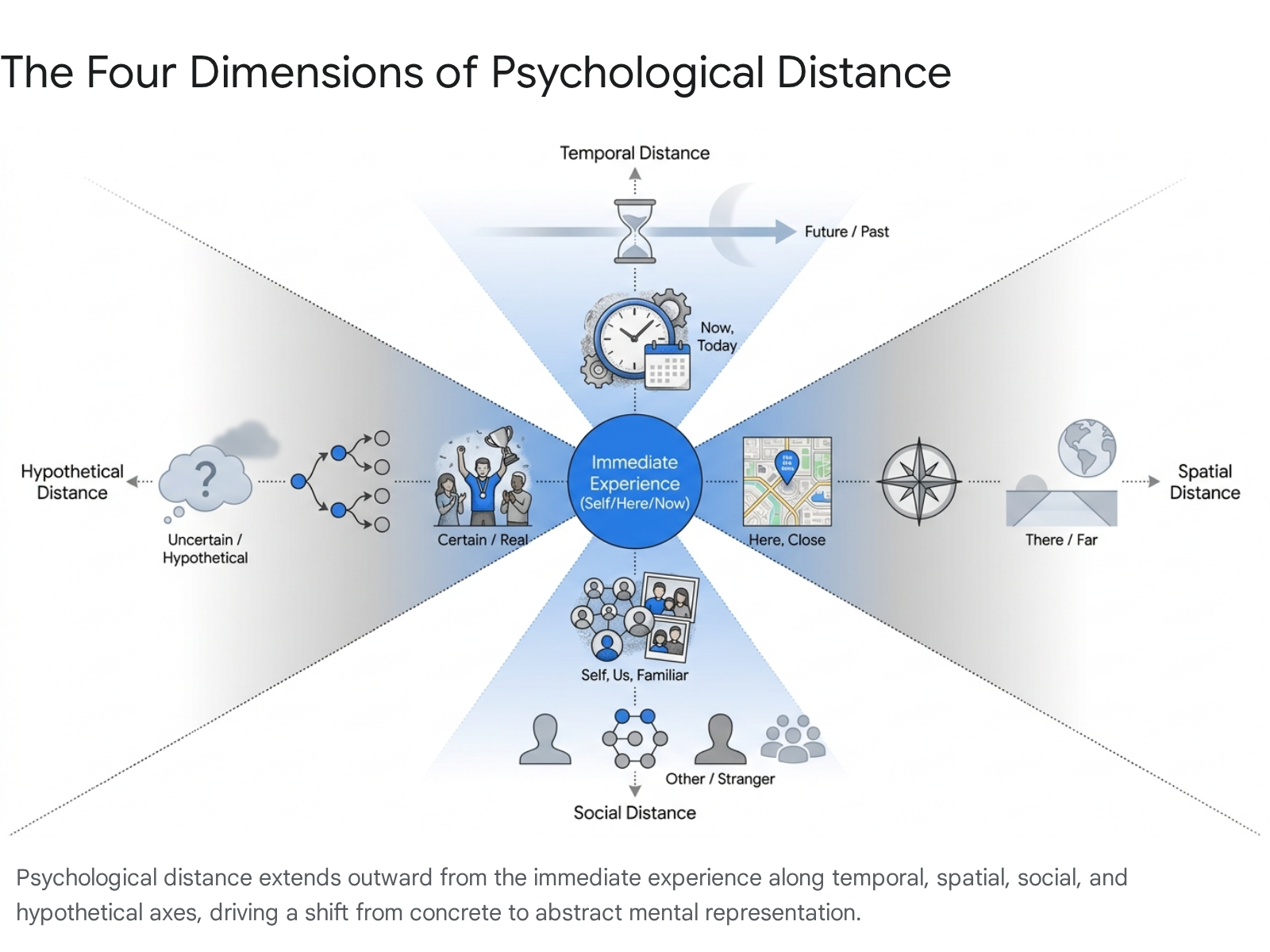
Extensive research demonstrates that these dimensions are cognitively interrelated, operating through the exact same underlying psychological mechanism of mental abstraction 123. Furthermore, the relationship between distance and abstraction is bidirectional: manipulating the distance of an event changes its construal level, but prompting an abstract construal mindset can also alter a consumer's perception of distance, making an event seem further away in time or less likely to occur 34.
The first dimension is temporal distance, which refers to the perception of how far an event resides in the past or the future. Events occurring in the near term, such as planning a vacation for the following weekend, elicit low-level construals focused on concrete details like restaurant reservations and packing lists. Events occurring in the distant future, such as planning a vacation for the following year, elicit high-level construals focused on abstract goals like relaxation and bonding 12. The second dimension is spatial distance, denoting the physical proximity of an event or object. A retail store in a consumer's immediate neighborhood is processed using concrete mental representations, whereas a manufacturing facility located on another continent is processed using abstract, generalized schemas 237.
The third dimension, social distance, measures the degree of perceived similarity, familiarity, or interpersonal closeness between the self and others. Individuals who belong to a consumer's ingroup, close friends, or those with similar demographic backgrounds are perceived as socially close. Outgroups, strangers, individuals with divergent cultural values, or entities with significant power differentials are perceived as socially distant, prompting abstract processing 589. The final dimension is hypotheticality, or probability distance. This dimension reflects the perceived likelihood that an event will materialize. Highly probable events are processed as psychologically near and concrete, whereas improbable, risky, or highly uncertain events are processed as psychologically distant and abstract 235.
The Desirability and Feasibility Trade-off
The most universally applied consequence of Construal Level Theory in consumer psychology is the shifting evaluative weight assigned to desirability versus feasibility considerations. In the context of goal-directed actions, desirability refers to the superordinate "why" of an action. It encompasses the value of the end-state, the central benefits of a product, and the overarching purpose of a transaction 510. Feasibility, conversely, refers to the subordinate "how" of an action. It encompasses the means used to reach the end-state, the practical constraints involved, the ease of use, and the financial or temporal costs required to execute the behavior 510.
As psychological distance increases across any of the four dimensions, desirability concerns systematically outweigh feasibility concerns 5.
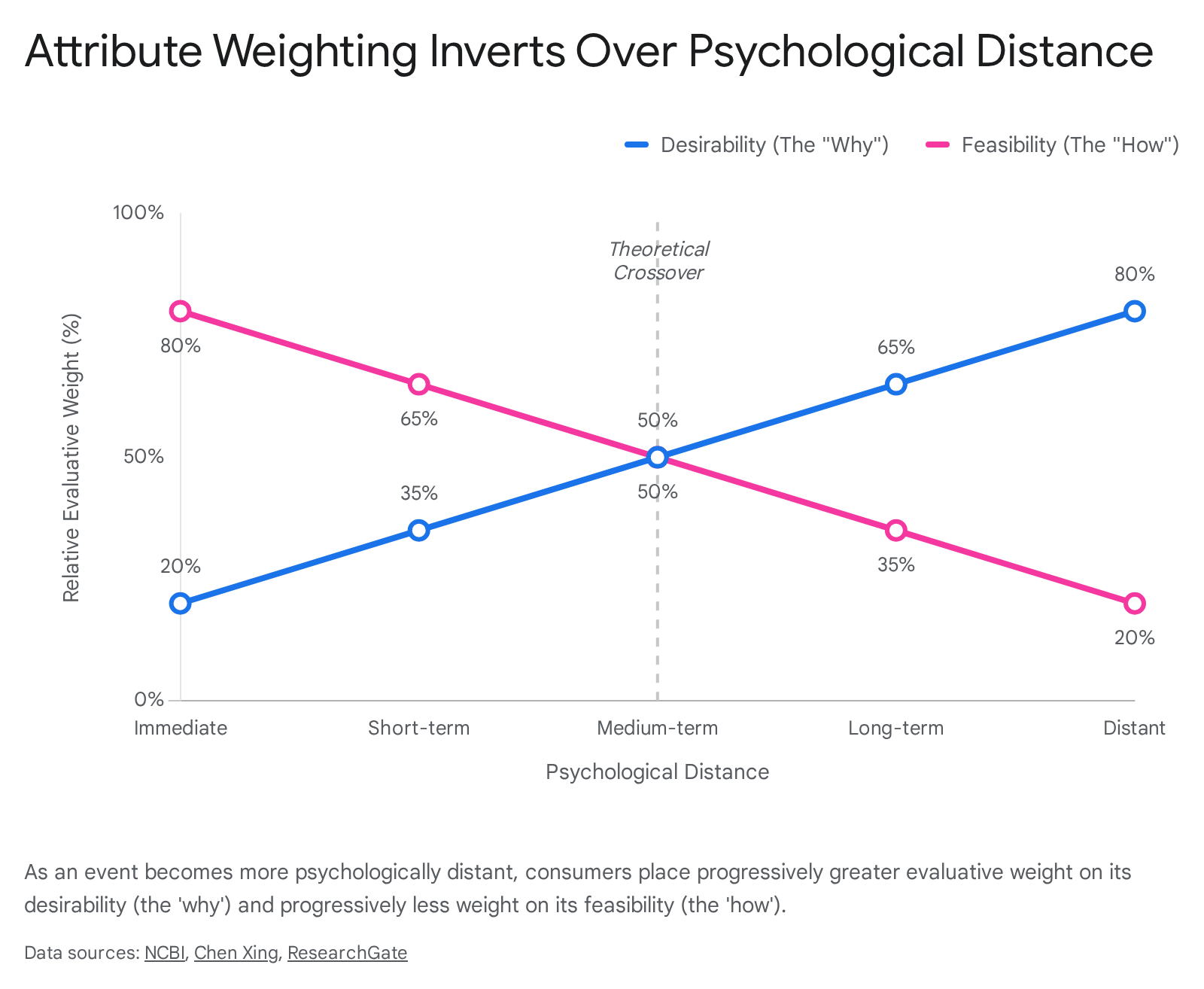
When consumers evaluate a product to be purchased or consumed in the distant future, they rely on high-level construals and weigh the desirability of its primary features heavily, actively discounting the feasibility of acquiring or operating it. However, when the consumption event becomes imminent, the psychological distance collapses. The consumer adopts a low-level construal, and feasibility constraints - such as immediate financial cost, installation time, or operational complexity - disproportionately influence the final purchase intention 35.
This theoretical trade-off extends smoothly to the dimension of probability. Under low probability scenarios, which equate to high psychological distance, consumers consistently prefer options characterized by high desirability and low feasibility. They are willing to accept significant practical hurdles for a highly rewarding but unlikely outcome. Conversely, in high probability scenarios, consumers shift their preference toward high feasibility, low desirability options, prioritizing guaranteed, easily attainable results over complex, idealized goals 5. In the realm of product design and innovation management, this dynamic mirrors frameworks that separate desirability (user need), feasibility (technical practicality), and viability (financial sustainability). Products that index high on desirability but low on feasibility often secure early conceptual support when the launch date is distant, but face severe consumer rejection as the release date approaches and feasibility constraints become salient 111314.
Evaluative Shifts in Product Attributes
A direct corollary to the desirability and feasibility trade-off is the shifting emphasis consumers place on primary versus secondary product features. Primary features are central to the product's identity and function, aligning with high-level construals. Secondary features are peripheral, incidental, or contextual, aligning with low-level construals. In distant-future evaluations, consumers express significantly higher satisfaction with products that possess strong primary features but poor secondary features. For instance, a consumer evaluating an audio system for a purchase next year will favor a unit with exceptional sound quality (primary feature) despite a highly unintuitive clock interface (secondary feature) 35. However, for near-future evaluations, consumers weigh the poor secondary feature far more heavily. The immediate frustration of the unintuitive interface becomes a dominant evaluative criterion, often leading to choice deferral or brand switching 5.
Psychological distance also alters how consumers process the affirmative "pros" and negative "cons" of a decision. Because "pros" represent the primary goal and can stand alone conceptually, while "cons" represent secondary obstacles that only matter if the primary goal is actively pursued, a high-level construal naturally elevates the cognitive salience of pros and diminishes the salience of cons 35. Consequently, consumers generate more arguments in favor of an action when it is temporally or spatially distant. As the distance closes, the ease of retrieving arguments shifts, making it significantly easier for the consumer to generate negative counter-arguments and focus on potential risks or drawbacks 5.
| Cognitive Dimension | Low-Level Construal (Psychologically Near) | High-Level Construal (Psychologically Distant) |
|---|---|---|
| Mental Representation | Concrete, contextualized, detailed, unstructured | Abstract, decontextualized, schematic, "gist" |
| Primary Goal Focus | Feasibility (The "How", ease of use, cost, effort) | Desirability (The "Why", end-state value, core benefit) |
| Feature Weighting | Secondary, peripheral, incidental features | Primary, central, essential features |
| Evaluative Bias | Focus on "Cons" (obstacles, risks, drawbacks) | Focus on "Pros" (benefits, rewards, utility) |
| Attribute Processing | Alignable attributes (easily compared features) | Nonalignable attributes (unique, abstract features) |
| Values Activation | Pragmatic concerns, instrumental rewards | Idealistic values, moral identity, broad principles |
Table 1: A summary of the cognitive and evaluative shifts dictated by Construal Level Theory based on psychological distance 235.
These evaluative shifts have profound implications for cognitive biases, particularly the sunk cost fallacy. Sunk cost bias occurs when consumers persist in an unfavorable endeavor due to prior investments of time or capital. Recent research applying Construal Level Theory demonstrates that inducing a high-level construal mitigates sunk cost persistence 12. By forcing individuals to think abstractly, they are distanced from the immediate, concrete pain of the lost resources. This abstract mindset allows them to evaluate the broader conceptual alternatives and future utility, freeing them from the contextual anchor of the past investment 12.
Psychological Distance in Marketing and Advertising
Marketers leverage the architecture of Construal Level Theory to structure advertising appeals, design product positioning, and time communication strategies based on the anticipated psychological distance of the target consumer. Persuasion is mathematically and cognitively optimized when the level of message abstraction matches the recipient's baseline construal level - a robust phenomenon documented in the literature as the matching effect 61314.
Message Framing and Construal Matching
The format and framing of marketing information act as direct cues for mental construal. Textual information, which inherently requires symbolic decoding and imaginative processing, naturally induces a high-level, abstract construal. Visual information, specifically photography and direct imagery, provides immediate perceptual input and induces a low-level, concrete construal 15.
This visual-verbal dichotomy dictates the efficacy of specific advertising formats depending on the inherent psychological distance of the product category. Durable goods, which are expected to yield utility over a long temporal horizon, are inherently perceived at a higher psychological distance. Consequently, durable goods are evaluated more favorably when advertised using text-heavy formats that match the consumer's abstract expectations 15. Nondurable goods, which are consumed rapidly in the near term, benefit heavily from picture-based advertising that matches the low-level construal of immediate consumption 15.
This matching principle extends to spatial and temporal advertising contexts. Advertisements promoting distant future travel destinations or international tourism are more persuasive when relying on abstract text and wide-angle, panoramic imagery that capture the holistic "gist" of the location. Conversely, promotions for imminent, local vacations benefit from concrete language detailing specific amenities and close-up photography that highlight contextual details 31516. Furthermore, when consumers face mixed emotional appeals - such as advertisements invoking both happiness and sadness - those operating under a high-level construal experience less cognitive discomfort. The abstract mindset allows them to integrate the disparate emotions into a cohesive, superordinate theme, whereas a low-level construal forces them to focus on the conflicting subordinate details, leading to ad rejection .
Numeric Formats and Charity Appeals
Construal Level Theory provides a rigorous framework for understanding donor behavior and optimizing charitable appeals. Prosocial actions, such as donating to international charities, often involve exceptionally high psychological distance: the beneficiaries are socially or spatially distant, and the impacts of the donation are temporally delayed and highly hypothetical 1718.
Research consistently demonstrates that abstract construals make the emotional and moral rewards of prosocial behavior significantly more salient. Individuals primed to think abstractly anticipate greater emotional benefits from volunteering or donating than those primed to think concretely. This occurs because abstract construal emphasizes the central, long-term meaning of the action, activating idealistic values and moral identity, which override the immediate pragmatic concerns regarding the loss of personal time or capital 3519.
The matching effect in charity advertising also extends to the symbolic presentation of numerical data. Verbal numerals (e.g., the word "Five") engage phonetic and ideographic processing, evoking broader, imaginative interpretations. This aligns strictly with high-level construals and "warmth-based" appeals that highlight compassion, social responsibility, and moral identification 14. Arabic numerals (e.g., the digit "5") promote rapid, analytical, and precise processing. This aligns with low-level construals and "competence-based" appeals that emphasize concrete organizational achievements, efficiency metrics, and specific operational capabilities 14. Aligning the numeric format with the psychological appeal type - verbal numerals for warmth, Arabic numerals for competence - significantly enhances perceived message fit and cognitive fluency, structurally increasing the expected value of the action and driving higher donation intentions 14.
Sustainable Consumption and Green Marketing
The application of Construal Level Theory to environmental sustainability highlights a profound psychological paradox. Climate change and ecological degradation are frequently processed as highly distant phenomena - spatially occurring in remote ecosystems, temporally unfolding over geological timeframes, and socially impacting future generations or distant populations. This extreme psychological distance naturally induces abstract construals, which can hinder the urgency required for concrete behavioral change 161820.
To navigate this, green marketing must carefully manipulate construal levels. When attempting to convey the broad necessity of environmental, social, and governance (ESG) initiatives, marketers succeed by using abstract framing that connects long-term sustainability to high-level corporate identity and global preservation goals 1821. However, to drive immediate consumer action - such as recycling, energy conservation, or purchasing premium-priced green products - marketers must forcefully reduce psychological distance. Concrete messaging that highlights local environmental impacts, immediate health consequences, and specific step-by-step actions shifts the consumer into a low-level construal 162223. For example, during public health crises exacerbated by environmental factors, abstract warnings fail to generate compliance, while localized, concrete messaging regarding specific hospital capacities or community infection rates elicits immediate, actionable responses 22.
The Influence of Cultural Orientation
The cognitive perception of psychological distance is not universally uniform across human populations. It is heavily moderated by stable psychological traits and cultural orientations. The most significant moderator in the literature is the cultural spectrum of individualism versus collectivism, which fundamentally alters baseline psychological distance 1724.
Individualism and Collectivism
Cultural background alters how individuals define the "self" in relation to the social environment, which directly shifts baseline social and temporal distance calculations 2425. Collectivist cultures, prevalent in East Asian, Latin American, and African societies, emphasize interdependence, group harmony, and tight, interconnected social networks. This orientation fosters an interdependent self-construal, systematically reducing perceived social distance between individuals. Consequently, consumers from collectivist backgrounds chronically adopt lower-level, concrete construals and perceive future events as temporally closer and more immediate than their individualistic counterparts 2426.
Individualistic cultures, prevalent in Western societies, prioritize autonomy, independence, and personal distinctiveness. This independent self-construal creates a larger psychological boundary between the self and others, fundamentally increasing chronic social distance 2427. As a result, individualists tend to chronically adopt high-level, abstract construals and perceive future events as more temporally distant 24.
These cultural variations dictate the success of specific marketing frames across global regions. Consumers from collectivist cultures respond more favorably to advertising that uses proximal temporal framing and emphasizes feasibility - focusing on concrete, subordinate features, practical utility, and immediate group benefits. Conversely, consumers from individualist cultures are more persuaded by distant temporal framing that highlights desirability - focusing on abstract, end-state benefits, personal achievement, and individual distinction 2426. For instance, in the context of ethical fashion consumption, collectivist consumers show significantly stronger behavioral intentions when subjective social norms are emphasized, as the perceived social distance to community expectations is acutely low 17.
Power Distance and Charitable Behavior
Cultural power distance - the extent to which unequal distribution of power is expected and accepted within a society - also interacts with Construal Level Theory to shape consumer behavior, particularly in charitable giving. High power distance cultures inherently foster greater social distance between different socioeconomic strata 28.
According to Social Distance Theory, individuals operating with a high sense of power perceive greater social distance from those in need, prompting them to adopt higher-level, abstract construals. This abstraction often leads to decreased feelings of personal responsibility and lower rates of charitable giving toward outgroups, unless the appeal is framed around abstract, emotion-driven, attitude-oriented values 1428. Conversely, individuals with a low sense of power, or those in low power distance cultures, perceive closer social distance, operate at lower-level concrete construals, and respond more favorably to detailed, capability-focused messages that emphasize direct community impact 91429. Overcoming the dampening effect of high power distance on charitable giving requires marketers to emphasize uncontrollable needs and communal relationship norms, artificially reducing the social distance between the donor and the beneficiary 28.
Cognitive Depletion and Situational Factors
Beyond stable cultural traits, temporary physiological and situational factors heavily influence the availability of cognitive resources, which in turn dictates the construal level a consumer can achieve.
Diurnal Fluctuations and Processing Capacity
Abstract, high-level construals require significant cognitive effort and executive function (System 2 processing), whereas low-level, concrete construals rely on more automatic, detail-oriented heuristic processing (System 1) 30. Consequently, the ability to adopt a high psychological distance is susceptible to cognitive resource depletion.
Recent research into diurnal changes demonstrates that natural, time-of-day fluctuations in cognitive resources impact consumer information processing strategies. Consumers exhibit higher construal levels during times of peak cognitive capacity (typically morning or early afternoon for chronotypic averages) and revert to lower-level, concrete construals late in the day as cognitive fatigue sets in 31. This suggests that complex marketing messages emphasizing abstract desirability, long-term investments, or sophisticated nonalignable attributes perform better earlier in the day, while evening marketing should pivot toward concrete feasibility, simplicity, and immediate rewards 31.
Choice Set Size and Decision Overload
The structure of the retail environment itself can act as a situational constraint on construal level. In modern e-commerce, consumers are frequently exposed to massive product assortments. Experimental evidence indicates that choosing from a large, overwhelming choice set acts as a cognitive burden that rapidly induces a low-level mental construal.
When forced into this low-level mindset by choice overload, consumers systematically abandon high-level desirability criteria (e.g., sophisticated product design, brand identity) and revert to evaluating options based on strict feasibility attributes (e.g., lowest price, immediate availability) 10. To succeed in environments with high choice density, retailers must emphasize the feasibility and affordability of their offerings, as the consumer lacks the cognitive bandwidth to process abstract desirability 10.
| Variable | Low-Level Construal Contexts | High-Level Construal Contexts |
|---|---|---|
| Cultural Orientation | Collectivism, Interdependent Self | Individualism, Independent Self |
| Power Dynamics | Low Power Distance, Subordinate Status | High Power Distance, Authority Status |
| Cognitive State | Depleted (Evening, Fatigue) | Peak Capacity (Morning, Rested) |
| Retail Environment | Large Choice Sets (Overload) | Small, Curated Choice Sets |
| Payment Mechanism | Cash (Immediate loss) | Mobile/Credit (Abstracted loss) |
Table 2: Cultural, situational, and technological variables that chronically or temporarily dictate consumer construal levels 1024283132.
Construal Level Theory in Digital Environments
The rapid expansion of e-commerce, augmented reality, and mobile payments has fundamentally altered traditional metrics of physical and temporal distance. Construal Level Theory provides a precise mechanism for understanding how digital interfaces artificially manipulate psychological distance to drive consumer behavior.
Augmented Reality and Virtual Try-on
Online shopping intrinsically involves high spatial and hypothetical distance; the consumer cannot physically interact with the product, leaving its fit, texture, or performance highly uncertain. Augmented reality (AR) and virtual try-on technologies function as psychological distance compressors 333435.
By projecting apparel, furniture, or cosmetics onto the user's immediate physical environment through a first-person perspective, AR generates vivid, multimodal sensory inputs. This "modality richness" forcefully induces a highly concrete, low-level construal, effectively eliminating the spatial distance inherent in e-commerce 333435. This reduction in psychological distance mitigates the perceived risk (feasibility constraint) of online purchasing, enhances the sense of psychological ownership, and significantly increases purchase intention. High modality richness in digital interfaces prevents the consumer from relying on abstract, generalized schemas, forcing detail-oriented processing that closely mimics offline, physical consumption 3435.
Subscription Models and Payment Methods
The transition toward subscription-based business models and contactless payment systems can also be analyzed through the lens of temporal and hypothetical distance. Digital subscriptions separate the act of payment from the ongoing consumption of digital goods, manipulating the temporal distance of the financial cost 3236. Consumers evaluating annual billing options are forced to consider the distant future impact of the purchase. This high-level construal makes them more likely to focus on the overall desirability and volume of the subscription's content library. In contrast, monthly billing keeps the financial cost temporally proximate. This maintains a chronic low-level construal that keeps feasibility (continuous cost-benefit analysis) highly salient, which can impact customer retention and increase churn rates if the immediate utility drops 323637.
Similarly, the physical form of payment alters the construal of financial expenditure. Cash payments involve tangible, immediate physical loss, representing low-level construal and a high "pain of paying." Mobile payments, digital wallets, and credit cards abstract the concept of currency 32. By increasing the hypothetical and spatial distance between the buyer and the physical capital, mobile payments induce a high-level construal of the transaction. This abstraction systematically reduces price sensitivity, diminishes the pain of paying, and significantly increases consumers' overall willingness to pay (WTP) compared to cash transactions 32.
Artificial Intelligence and Virtual Influencers
The integration of non-human agents, such as Artificial Intelligence (AI) and computer-generated virtual influencers, introduces new dimensions of social and hypothetical distance. When consumers interact with AI-generated product summaries or travel itineraries, the perceived source of the information affects trust. Consumers under a prevention focus (avoiding negative outcomes) experience higher perceived information overload when reading concrete AI summaries, whereas abstract AI summaries are processed more fluently 38.
Furthermore, the rise of virtual influencers in marketing creates a unique psychological dynamic. Virtual influencers are inherently hypothetical and socially distant from human consumers. Research indicates that this extreme psychological distance can lead to increased moral disengagement. Consumers interacting with non-human virtual agents exhibit a higher likelihood of engaging in unethical consumer behavior or dismissing corporate transgressions, as the abstract nature of the virtual entity dampens concrete empathic responses 39.
Boundary Conditions and Methodological Challenges
While Construal Level Theory has achieved broad consensus and integration within consumer psychology, recent methodological scrutiny has highlighted specific boundary conditions and raised vital concerns regarding the theory's empirical robustness under certain contexts.
Processing Mode as an Intervening Variable
Classical Construal Level Theory models conceptualize a direct, unmediated relationship between psychological distance and construal level 40. However, recent consumer behavior research indicates that "processing mode" - specifically whether an individual relies on visual or verbal processing - acts as a critical intervening variable and a severe boundary condition .
Naturally, proximal events induce visual processing, which yields concrete representations, while distal events require verbal processing to decode abstract concepts 40. However, if a consumer is explicitly forced to use visual processing to evaluate a distant event (e.g., looking at a detailed photograph of a vacation destination planned for next year), the typical CLT effect is overridden. The consumer will form a low-level, concrete construal regardless of the high temporal distance . This indicates that psychological distance only dictates construal level when the processing modality is left unconstrained.
Replication Efforts and Theory Robustness
As the behavioral sciences face broader methodological reckoning, the replicability of core CLT findings has come under intense empirical scrutiny. A prominent 2026 registered report executing a massive multi-lab replication across 27 countries with 11,775 participants attempted to directly replicate foundational CLT studies regarding temporal, spatial, social, and likelihood distances 41.
The findings of this rigorous replication attempt presented a severe challenge to certain aspects of the theory. While temporal distance effects showed some resilience, when controlling for methodological confounds, the predicted effects of social distance on construal level were entirely eliminated (effect size $d = 0.006$) 41. Additional preprints from the Collaborative Levers in Marketing Research (CLIMR) consortium indicated minimal support for standard CLT predictions in specific social distance scenarios, estimating a false-positive rate as high as 31% in published CLT research - vastly exceeding the standard $\alpha$ level of 0.05 42.
These replication failures suggest a need for calibrated uncertainty. While temporal and spatial distance manipulations frequently yield reliable shifts in attribute weighting (desirability versus feasibility) 5, social distance manipulations - such as distinguishing between political ingroups and outgroups - frequently fail to alter the relative weighting of evaluation criteria in applied consumer choice scenarios 4142. Consequently, marketers deploying strategies based on social distance, power dynamics, or hypotheticality must approach application with rigor, recognizing that situational factors, cognitive depletion, and individual regulatory focus heavily constrain the predicted effects 3143.
Construal Level Theory remains a powerful architectural framework for understanding how the subjective perception of distance reorganizes consumer thought. By recognizing both its profound explanatory power in mapping the shift from desirability to feasibility, alongside its newly identified empirical boundaries, researchers and marketers can develop highly calibrated, cognitively congruent strategies that adapt to the fluid nature of consumer preference.