
Psychology of queuing and consumer perception in service industries
The phenomenon of waiting in line is an inescapable facet of modern consumption, representing a critical intersection between service operations management and human psychology. Prior to the COVID-19 pandemic, the study of queuing largely focused on operational efficiency, throughput optimization, and the application of classical queuing theory to minimize systemic delays. However, the post-pandemic era has catalyzed a profound paradigm shift. As consumers emerged from prolonged periods of social distancing, lockdown-induced behavioral modifications, and digital-first interactions, their psychological tolerance for waiting, physical proximity, and environmental uncertainty underwent an irreversible transformation. Businesses and service providers across global markets are no longer merely managing operational flow; they are actively managing cognitive load, psychological friction, and perceived social equity.
This comprehensive research report synthesizes empirical data and theoretical advancements from 2023 through 2026 to explore the nuanced psychology of post-pandemic queuing behaviors. By integrating foundational queuing principles with contemporary data from peer-reviewed consumer behavior journals, behavioral science models, and leading consultancy reports, the analysis unpacks the rise of hybrid queuing, the emerging operational challenge of virtual queue app fatigue, and the intricate cross-cultural dimensions of time perception and personal space. Furthermore, the report systematically dismantles the persistent misconception that shorter absolute wait times inherently yield higher customer satisfaction, demonstrating instead that managed expectations, perceived fairness, and attention restoration are the definitive drivers of a positive waiting experience.
1. The Post-Pandemic Consumer Landscape and Theoretical Shifts
The global disruption caused by the COVID-19 pandemic fundamentally reshaped human behavioral science, prompting scholars to revisit foundational models to understand new consumer realities. Post-pandemic research has heavily utilized the Theory of Planned Behavior (TPB), the Health Belief Model (HBM), Social Cognitive Theory (SCT), and the COM-B model to explain how perceived pathogen threats trigger protective behaviors that alter baseline consumer expectations 1. Under pandemic conditions, standing in a physical queue transformed from a mundane inconvenience into a perceived biological threat, causing chronic uncertainty and rewiring consumer expectations regarding structured environments, safety protocols, and personal autonomy 12.
Interestingly, despite the massive surge in digital commerce during lockdowns and the persistent presence of trait anxiety in the general population, consumer appetite for offline retail and dining rebounded with unprecedented strength 23. By the first half of 2025, physical visitation to retail and dining venues consistently surpassed pre-pandemic 2019 levels 3. However, the consumer who returned to the physical store was fundamentally altered. A comprehensive 2024 global survey of over 15,000 consumers across 18 markets revealed distinct behavioral paradoxes: while middle-income consumers expressed profound economic pessimism, they continued to splurge on experience-based categories like travel and dining 4. Simultaneously, traditional brand loyalty plummeted among older demographics, while young consumers in emerging markets demonstrated a fierce willingness to trade up for premium experiences 4.
These macro-economic behavioral shifts highlight that the modern consumer demands a seamless, high-value experiential interaction. They demonstrate a newly solidified demand for hybrid experiences that blend the frictionless convenience of digital platforms with the tactile benefits of in-person engagement 5. Consequently, customer experience (CX) has become the primary competitive differentiator for 89% of organizations globally, with exceptional past experiences driving a 140% increase in subsequent consumer spending 6. In this heightened experiential landscape, the queue is no longer a precursor to the service; it is the critical first touchpoint that determines the psychological trajectory of the entire consumer journey.
2. The Illusion of Absolute Time and the Transparency Effect
A prevailing and costly misconception in traditional operations management is the belief that reducing absolute wait times is the singular path to higher customer satisfaction. Contemporary behavioral research thoroughly refutes this assumption. Instead, satisfaction in a queuing environment is dictated almost entirely by perceived wait time and the psychological mechanism of expectation confirmation 78.
The negative impact of waiting time on satisfaction is best explained by Expectation Confirmation Theory, which suggests that customers constantly compare their internal expectations for service performance with their real-time perceptions 8. If a customer expects a short wait but encounters an uncommunicated delay, the cognitive dissonance results in intense dissatisfaction, regardless of the objective length of the delay 8. Conversely, customers will readily tolerate objectively longer waiting times if they perceive them as fair, predictable, and justified by the ultimate quality of the service provided 8.
2.1 The Transparency Effect in Modern Queuing
This dynamic gives rise to the "transparency effect." A landmark 2025 study published in the Journal of Service Research revealed that customers who received real-time, proactive updates regarding their queue position perceived their wait time to be 35% shorter than those who received no updates, even when chronological wait times were rigorously controlled and identical 9. Providing accurate, real-time wait estimates effectively extends a customer's abandonment threshold by approximately 35%, while the implementation of SMS notifications reduces wait-related complaints by 40% 9.
This psychological phenomenon highlights that uncertainty - not duration - is the primary driver of queue abandonment. When a business implements digital queue management systems, the actual operational wait time may decrease by 25% to 30% due to better throughput, but the addition of transparency features yields an additional 35% reduction in the psychological burden of the wait 9.
2.2 The Economic Imperative and Industry Thresholds
The financial ramifications of mismanaged queuing psychology are staggering. In 2026, the average customer demonstrated an abandonment threshold of merely 8 minutes before defecting from an unmanaged, opaque queue 9. This microscopic window of tolerance is responsible for an estimated $130 billion in annual lost revenue across the United States alone, with the average mid-sized restaurant losing approximately $46,800 annually specifically from walkouts caused by excessive, unmanaged waits 9.
Different industries operate with varying degrees of operational buffer against this psychological abandonment threshold. Data indicates that while casual dining restaurants maintain a modest buffer before walkouts occur, retail stores and fast-food venues operate within minutes of their customers' maximum psychological tolerance for waiting. The following table illustrates the delicate balance between average actual wait times and the critical psychological abandonment thresholds across various service industries in 2025/2026.
| Industry Sector | Average Wait Time | Psychological Abandonment Threshold | Operational Buffer |
|---|---|---|---|
| Fast Food / Quick Service | 3 - 5 minutes | 8 minutes | 3 - 5 minutes |
| Retail Stores | 8 - 12 minutes | 10 minutes | Zero to Negative Buffer |
| Barbers & Salons | 10 - 20 minutes | 25 minutes | 5 - 15 minutes |
| Healthcare Clinics | 18 - 24 minutes (past appointment) | 20 minutes (past appointment) | Zero to Negative Buffer |
| Restaurants (Walk-in) | 15 - 25 minutes | 30 minutes | 5 - 15 minutes |
| Government Services | 30 - 45 minutes | 60 minutes | 15 - 30 minutes |
Data derived from the 2025/2026 State of Waiting in Line and Service Intelligence Reports 9.
As demonstrated, the retail and healthcare sectors face severe operational risks, possessing virtually zero buffer between average service delivery times and the point of catastrophic customer defection. In these environments, psychological queue management and transparency are not optional enhancements; they are critical survival mechanisms.
3. Mapping the Waiting Lifecycle: From Unoccupied to Occupied Time
To effectively manage a queue, one must understand that a customer's psychological state is not static during a wait; it follows a distinct lifecycle marked by specific cognitive shifts, emotional appraisals, and anxiety spikes.
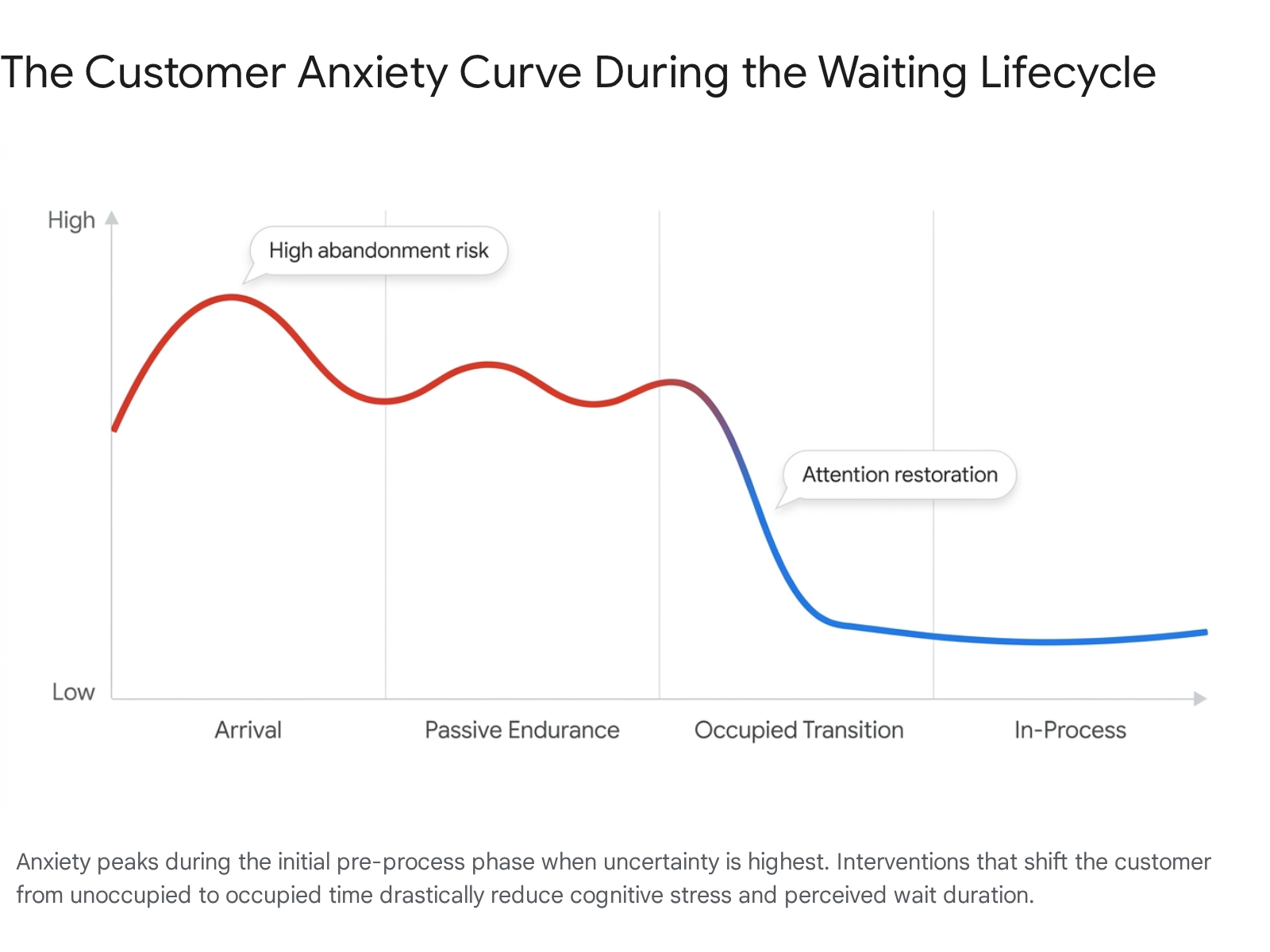
The theoretical foundation of this lifecycle relies heavily on David Maister's seminal 1985 propositions on the psychology of waiting lines, which remain remarkably predictive of consumer behavior in 2026 1213.
3.1 Maister's Propositions in a Modern Context
Maister established several core axioms that govern the subjective experience of time: unoccupied time feels longer than occupied time; pre-process waits feel longer than in-process waits; anxiety makes waits seem longer; and uncertain or unexplained waits feel longer than known, finite ones 12131415.
In a queue, the human brain constantly processes environmental stimuli. When it lacks engaging focal points, it defaults to monitoring the passage of time - a state known as "passive" or "unoccupied" waiting 12. Studies indicate that passive waiting feels roughly 36% longer than active waiting 12. When a customer first joins a queue, they enter the pre-process phase. This is the most psychologically vulnerable stage of the waiting lifecycle. Because the service has not yet officially begun, the customer feels no sense of commitment, sunk cost, or momentum, leading to a profound spike in cognitive anxiety and a heightened propensity to renege 1315.
3.2 The Four Phases of Queue Endurace
The transition through a modern queue can be mapped across four distinct psychological phases, each requiring different managerial interventions:
- The Arrival and Assessment Spike (Pre-Process): As the customer evaluates the line, anxiety peaks immediately due to uncertainty regarding the queue's length, speed, and fairness. If the queue lacks a visible structure, a greeter, or a time estimate, the cognitive load is extreme. Abandonment rates are highest in the first 60 to 120 seconds.
- The Passive Endurance Phase (Unoccupied Time): If the customer commits, they enter a period of unstructured waiting. Without distraction, internal time-tracking mechanisms accelerate. This phase is characterized by growing frustration, hyper-awareness of other customers (monitoring for line-cutters), and physiological tension.
- The Transition to Occupied Time (Distraction/Engagement): Successful queue management systems intervene here by providing structured distractions. By diverting cognitive resources away from time-tracking and toward an engaging activity, the perceived time is effectively compressed 1011.
- The In-Process Resolution: The customer crosses the threshold into the service environment. Anxiety plummets. Because they are now officially "in-process," their psychological tolerance for any remaining wait time increases significantly, as they feel the organization has taken responsibility for their care 141512.
4. The Physical vs. Virtual Paradigm: Psychological Trade-offs
The proliferation of mobile technology has popularized virtual queuing (VQ), allowing customers to secure a spot in line digitally and wait elsewhere, effectively converting unoccupied time into occupied, autonomous time. By 2026, 52% of consumers expressed a strict preference for virtual queues over traditional physical lines, and 67% preferred joining queues via their smartphone rather than interacting with staff or kiosks 911. While the operational benefits of VQs are highly apparent, recent empirical research uncovers fascinating, and sometimes counterintuitive, psychological trade-offs between physical and digital waiting environments regarding consumption intentions and perceived equity.
4.1 The Cognitive Burden of Physical Queues and the "Compensatory Effect"
Physical queues impose a heavy psychological tax. A 2025 study in the Journal of Hospitality and Tourism Management demonstrated that physical queuing inherently involves high perceived waiting costs - comprising chronological uncertainty, opportunity cost, physical fatigue, and the perceived risk of crowding 13. This lack of autonomy, combined with high non-monetary investment (physical effort), creates a profound sense of psychological deprivation.
Crucially, this deprivation triggers a behavioral phenomenon known as the "compensatory effect." Customers who endure the friction of a physical queue often attempt to subconsciously justify their sunk costs by altering their consumption behavior upon finally reaching the point of sale. Research shows that customers in physical lines exhibit a significantly higher intention to order extra items, spend more money, or consume larger quantities as a coping mechanism to compensate for their frustration and validate their prior investment 13. In empirical settings, the mean score for the intention to order more in a physical queue was recorded at 3.43, compared to just 3.10 in a virtual queue 13.
4.2 Attention Restoration and the Paradox of Virtual Queues
Virtual queue apps (VQAs) fundamentally alter this dynamic. By removing the requirement for physical presence, VQAs drastically lower perceived waiting costs and facilitate what environmental psychologists term "attention restoration" 13. In a virtual queue, cognitive fatigue and musculoskeletal tension dissipate, allowing the customer to enter a relaxed, autonomous state. Changing the queue type from physical to virtual has been shown to quantitatively increase perceived waiting equity by 0.17 points on standard psychological scales 13.
Because the customer experiences higher perceived equity and minimal psychological deprivation, the compensatory effect is completely nullified 13. Consequently, customers in a virtual queue are noticeably less likely to impulsively order extra items to self-soothe at the point of sale.
However, this reduction in point-of-sale impulse buying is heavily offset by an entirely different behavioral shift: increased supplementary browsing. The 2024 State of Waiting in Line report revealed that 41% of consumers actively continue shopping or browsing other retail categories while waiting in a virtual queue, an increase from 38% in 2023 11. By transforming "idle time" into "useful time," virtual queues significantly increase overall patience; while only 5% of consumers will wait more than 30 minutes in a physical line, 24% are willing to do so in a virtual queue 11. Thus, the trade-off for businesses is a potential fractional loss of localized impulse buys at the register, exchanged for a massive increase in total customer retention, secondary cross-shopping, and overall brand satisfaction.
5. Virtual Queue App Fatigue and the Rise of Hybrid Systems
Despite broad consumer preference for virtual queuing, the specific mechanism of delivery has become a critical point of friction. Between 2023 and 2025, the service industry witnessed a severe backlash against mandatory native app downloads, a behavioral phenomenon termed "virtual queue app fatigue."
5.1 The Friction of the Download and Digital Resentment
App fatigue occurs when the cognitive load of navigating an app store, downloading proprietary software, creating an account, and learning a new user interface outweighs the perceived benefit of skipping the physical line 2021. For infrequent visitors at experiential venues, theme parks, or quick-service restaurants, this digital commitment is viewed as an unwarranted intrusion and a barrier to entry. As industry experts note, app fatigue ripples through operations, leading to longer physical lines as guests abandon digital onboarding, thereby forcing staff to spend valuable time troubleshooting basic tech requests rather than fulfilling service 20.
Furthermore, poorly designed proprietary apps can generate more anxiety than a physical line. For example, consumer analyses of theme park apps like SeaWorld Orlando revealed rampant complaints regarding inaccurate wait times, map functionality issues, and login problems that persisted even after password resets 21. In one documented instance, an app displayed a 15-minute wait while the actual physical queue was 120 minutes long 21. Such catastrophic failures in expectation confirmation obliterate trust and trigger intense customer resentment. Contrastingly, apps that master virtual queuing see massive operational success. ChargePoint's EV charging app, for instance, utilized a virtual queue system with real-time notifications to reduce average wait times at charging stations by 40% compared to traditional first-come, first-served approaches 22.
5.2 Browser-Based Queuing and the QR Revolution
To combat app fatigue, the service sector has rapidly pivoted toward browser-based, contactless interactions, primarily driven by QR code activation. In 2024, 89 million Americans actively scanned QR codes for service access, with projections reaching 99.5 million by 2025 20. Browser-based smart maps and virtual queues eliminate download friction entirely, allowing instant access to real-time wait times and mobile ordering via a standard smartphone camera, thus respecting the user's digital boundaries and storage space 20. The average time to join a mobile queue via QR code is now under 15 seconds, a stark contrast to the 2 - 3 minutes required for traditional in-person or kiosk check-ins 9.
5.3 The Social Friction of Hybrid Queuing
Concurrently, businesses are increasingly adopting "hybrid queuing" models. These systems, highly prevalent in quick-service restaurants offering "order-ahead" capabilities, blend invisible digital queuing with visible physical fulfillment 1415. Through discrete event simulation, analyses indicate that mobile applications increase the efficiency of the system as a whole; by completing food preparation before the digital customer arrives, the total waiting time for all customers is reduced 14.
However, while hybrid models drastically increase overall system throughput, they introduce perilous new psychological complexities regarding social equity. Walk-in customers who are forced to wait in a physical line frequently feel slighted, experiencing acute social injustice as they watch digital customers arrive and immediately receive service, seemingly bypassing the queue 14. In this scenario, the locus of frustration often shifts; research on multi-actor exchanges demonstrates a "locus-responsibility shift," where consumers transfer blame for service failures or perceived inequities onto the platform or the brand itself, rather than recognizing their own choice to avoid the digital queue 16. Managing the visual optics of hybrid systems - ensuring that physical waiters do not feel actively penalized - is now a central challenge for modern operations managers.
6. Queue Management Strategies vs. Psychological Outcomes
To synthesize the complex operational trade-offs discussed above, the following table compares distinct queue management strategies against their resultant psychological and behavioral outcomes, derived from recent empirical data and psychological models.
| Queue Management Strategy | Core Mechanism | Psychological Burden & Anxiety | Occupied Time & Engagement | Fairness & Equity Perception | Impact on Consumer Spending / Behavior |
|---|---|---|---|---|---|
| Traditional Physical Queue | First-in, first-out (FIFO) physical standing. | High: Spikes during pre-process; high perceived time risk and crowding anxiety 13. | Low: Passive/unoccupied time dominates; time feels 36% longer 12. | High: Transparent FIFO structure feels egalitarian if strictly enforced 72617. | Triggers Compensatory Effect: Higher likelihood to order extra items to justify sunk effort 13. |
| Native App Virtual Queue | Download proprietary app to secure digital spot. | Medium-High: "App fatigue" and digital friction cause initial cognitive load 2021. | High: Customer is free to roam; active time reduces perceived wait duration 10. | Medium: Less transparent; users cannot physically verify their place in line 13. | Less localized impulse buying, but allows for omnichannel engagement and personalized upselling 1121. |
| Browser-Based Virtual Queue (QR) | Scan code for instant, web-based queue tracking. | Low: Zero download friction; provides immediate attention restoration 920. | High: 41% of users actively browse or shop elsewhere while waiting 11. | Medium-High: SMS/web updates provide status transparency, buffering abandonment 9. | High retention; exponentially increases secondary browsing and cross-shopping across the venue 1120. |
| Hybrid Queuing (Order-Ahead) | Digital orders fulfilled alongside walk-in physical orders. | Variable: Low for digital users; high frustration and resentment for walk-ins 1415. | High (Digital): Wait is completely absorbed into travel/transit time 14. | Low (Walk-ins): Walk-ins feel slighted as others "skip" the line, viewing it as unjust 14. | Increases total system throughput and efficiency, raising overall revenue capacity 14. |
| Priority / Paid Skip-the-Line | Tiered access based on financial premium or loyalty. | Low (Priority): Anxiety eliminated for VIPs 18. | N/A: Wait time is essentially bypassed. | Very Low (Standard): Causes severe "queue rage" and feelings of social inequity for standard users 71718. | Highly lucrative direct revenue stream, but risks long-term brand damage among standard users 1018. |
7. Cross-Cultural Dynamics in Queuing Psychology
A critical oversight in traditional, Western-centric operations management is the assumption that queuing behavior is a universal human constant. In reality, the psychological endurance of a wait is inextricably linked to deep cultural programming. The perception of personal space, the measurement of time, and the definition of social fairness vary drastically across global populations, heavily influencing how queues must be designed and managed internationally 26291931.
7.1 Proxemics and the Architecture of Personal Space
Proxemics - the study of how humans use and perceive physical space - dictates the psychological comfort of a physical queue 32. In "low-contact" cultures, such as those in North America, the United Kingdom, Northern Europe, and Japan, personal space boundaries are vast 322034. Individuals in these regions experience acute physiological stress and "crowding anxiety" when forced into close proximity with strangers 2035. Consequently, they favor orderly, linear, and spacious queues 2635.
Conversely, "high-contact" cultures spanning Latin America, the Mediterranean, the Middle East, and parts of India operate with much smaller personal bubbles. These cultures frequently engage in what event organizers term "crowd choreography," where dense, fluid clustering is the norm 32203435. In these environments, the rigid, linear queues of the West may feel unnatural or excessively formal, and close physical proximity does not trigger the same anxiety spikes 263435. Venue operators hosting international audiences must adapt crowd safety protocols accordingly, utilizing strict stanchions and clear signage in low-contact regions, while allowing more organic, communal flow in high-contact settings to avoid cultural friction 35.
7.2 The Cultural Segmentation of Time
The very perception of a "long" wait is culturally relative. Anthropological research, spearheaded by figures like Robert Levine and Edward T. Hall, divides societies into monochronic and polychronic time orientations 2919. * Monochronic Cultures: Western societies view time linearly. Time is a commodified asset ("time is money"), and schedules are rigidly adhered to. Delays are perceived as a breach of contract and a direct financial or opportunity loss, leading to rapid dissatisfaction in unmanaged queues 29. * Polychronic Cultures: Eastern, Latin American, and Middle Eastern societies view time as fluid, event-driven, and circular. Human interaction and relationship-building supersede strict schedules 29. In these cultures, waiting is not inherently offensive; an extended interaction between a service provider and a customer is viewed as appropriate relationship maintenance rather than an irritating delay for those further back in the line 29.
Furthermore, research reveals that cultures cognitively segment time differently. Psychological studies demonstrate that Americans typically package time into precise 5-minute intervals; an arrival 6 minutes late is perceived as a distinct violation 19. Conversely, Arab and North African cultures tend to segment time in broader 15-minute intervals. Consequently, a 10-minute wait in a queue represents two distinct units of psychological distress for an American, but does not even register as a full unit of delay for individuals from broader time-segmenting cultures 19.
7.3 Fairness, Hierarchy, and Social Equity
Queues are not merely lines of people; they are micro-societies governed by fragile social contracts 718. The fundamental rule of First-In, First-Out (FIFO) appeals to Western democratic ideals of egalitarianism 1721. When this implicit rule is violated by line-cutters or opaque priority systems, it triggers profound feelings of social injustice, leading to physical "queue rage" and permanently diminished repurchase intentions 71718. Research into outdoor recreation allocation similarly shows that users deeply prioritize social equity, often viewing lotteries as fairer than queuing when access to public goods is concerned 21.
However, the definition of fairness is not universal. In cultures with steep social hierarchies, the concept of a strict FIFO queue may conflict with ingrained respect for status, age, or authority. In certain Eastern societies, individuals of high social or corporate status may bypass queues without apology, and this behavior is often tolerated by the collective as a reflection of societal structure rather than a breach of etiquette 2629. Understanding these nuances is vital for global service operators; imposing a rigid Western queuing structure in a highly stratified society may inadvertently cause offense.
8. Industry-Specific Applications and Empirical Outcomes
The theoretical principles of queuing psychology manifest distinctly across different sectors. From the high-stakes emotional environments of theme parks to the clinical urgency of healthcare, operators are leveraging advanced strategies to mitigate wait fatigue.
8.1 Experiential Environments: The Theme Park Mastery
No industry has operationalized queue psychology more effectively than experiential entertainment, specifically Disney theme parks. Disney Imagineers are the pioneers of queue psychology, recognizing early on that expanding the concept of the customer experience to include the queue itself pays massive dividends 10. By integrating the queue into the attraction's narrative, they effectively eliminate "unoccupied time." For instance, the queue for Avatar Flight of Passage physically transitions guests through meticulously themed jungles and laboratories, entirely distracting them from the passage of time and building positive psychological anticipation 10.
Furthermore, Disney explicitly manipulates expectation confirmation. By intentionally posting estimated wait times that are slightly longer than the actual calculated wait, Disney ensures that guests experience a sense of relief and delight when they reach the front of the line "early," exceeding expectations 1012.
Recently, Disney has aggressively expanded its use of Virtual Queues (for attractions like TRON Lightcycle / Run and Guardians of the Galaxy: Cosmic Rewind) alongside paid priority access (Lightning Lanes) 103738. While this frees up immense amounts of occupied time for guests to spend money elsewhere in the park, it also creates complex tiered access systems. These systems turn obstacles into revenue streams, but they must be carefully managed to prevent standard standby guests from perceiving deep social inequity as they watch premium users bypass them 1018.
8.2 Healthcare: Wait Time Guarantees and Triage Models
In healthcare, waiting is compounded by acute physical and emotional vulnerability, making uncertainty uniquely distressing 2223. The application of "wait time guarantees" - promises that a patient will be seen within a specific timeframe - yields polarized psychological outcomes. Rooted in Prospect Theory and loss aversion, if a wait time guarantee is met, patient satisfaction increases; however, if the guarantee is violated, the psychological penalty is immense, causing satisfaction to plummet far below what it would have been without a guarantee 24. In Canada's publicly funded system, for example, wait times for specialist treatments surged to 27.4 weeks in 2023, exacerbating patient distress despite federal investments and wait time guarantees 23.
To combat chronic delays, forward-thinking health systems are abandoning traditional "waitlist and triage" models in favor of strategies like STAT (Specific Timely Appointments for Triage) 22. By shifting away from opaque, unmanaged queues toward structured, scheduled intakes, clinics have successfully reduced waiting times to first appointments by up to 33.8% 22. Median waiting times in studied clinics dropped from 42 days to 24 days, significantly lowering patient anxiety and reducing the variability of the wait 22.
8.3 Retail and Quick Service Hospitality: Combating Line Balk
In retail and QSRs, the primary enemy is "line balking" - the immediate abandonment of a queue upon arrival 25. Due to the post-pandemic reliance on convenience, drive-through services face severe bottleneck constraints. Applying the Theory of Constraints (TOC), operations managers identify that a delay at the bottleneck (often the cashier stage) ripples backward, causing a visible buildup of vehicles 25. For example, the average drive-through wait at Chick-fil-A reached 541 seconds (roughly nine minutes) in 2023 25. Because the physical queue of cars is highly visible, the perceived time risk is heavily magnified, leading to high defection rates 25.
To mitigate this, sophisticated QSRs employ queue-busting staff armed with tablets to walk the line, moving the point of transaction upstream. This simple intervention completely disrupts the "pre-process" anxiety phase. By engaging the customer early, the establishment shifts the patron into "in-process" occupied time long before they physically reach the window, drastically reducing perceived wait time and almost eliminating line balking 14151225. Moreover, the integration of service robots to assist frontline employees has been shown to reduce the stress and cognitive workload of human agents, leading to warmer, more efficient interactions that further ease customer anxiety 262728.
8.4 Digital Waiting Rooms and Call Centers
In digital service spaces, the physical queue is replaced by the auditory purgatory of the call center hold line. To combat this, businesses are increasingly replacing traditional hold times with STIR/SHAKEN compliant automated callback services and virtual queueing 46. When wait times exceed a specific threshold (e.g., 60 seconds), the system captures the customer's data via XML, holds their exact place in a virtual queue, and releases the active phone line to reduce per-minute costs 46. This eliminates the psychological torture of unoccupied auditory waiting. A recent study by Bain & Company indicated that simply offering a callback option increases customer satisfaction scores (NPS) by up to 28 points, representing a massive shift in positive brand perception achieved purely by returning autonomy and occupied time to the consumer 46. Similarly, modernizing banking application architecture to microservices has reduced downtime by 90%, preventing digital queues from forming in the first place during high-traffic updates 29.
Conclusion
The post-pandemic landscape has irrevocably altered the psychology of queuing. Consumers, hypersensitized to crowding and highly protective of their time, no longer tolerate opaque, unmanaged waits. As the extensive research synthesized in this report demonstrates, the absolute chronological duration of a wait is merely a secondary metric. The true battleground for customer satisfaction lies in managing the cognitive load of the waiting lifecycle: mitigating pre-process anxiety spikes, shifting customers seamlessly from unoccupied to occupied time, and maintaining strict adherence to cultural norms regarding fairness and proxemics.
While virtual queues offer a powerful mechanism for attention restoration and anxiety reduction, the emergence of app fatigue serves as a stark cautionary tale against introducing digital friction into physical spaces. The compensatory effects observed in physical lines, contrasted with the extended browsing behaviors facilitated by virtual queues, highlight that queue design is ultimately a lever for revenue generation. The future of queue management belongs to frictionless, browser-based hybrid models that provide total transparency without demanding digital commitment. Ultimately, businesses that respect the profound psychological weight of waiting - and design their operations to protect their customers' cognitive and emotional resources - will command the highest levels of loyalty in the modern service economy.