
Psychology of sequential offers in cross-selling and upselling
Theoretical Foundations of Sequential Consumer Behavior
The architecture of digital commerce relies heavily on the strategic sequencing of offers, capitalizing on distinct psychological mechanisms that govern consumer behavior post-initial commitment. The deployment of sequential offers capitalizes on cognitive biases, behavioral momentum, and psychophysical pricing evaluations to maximize consumer lifetime value and average order value.
Differentiating Upselling, Cross-Selling, and Upgrading
While frequently conflated in industry parlance, upselling, cross-selling, and upgrading operate on fundamentally different behavioral and economic principles. Upselling constitutes a vertical modification of an initial purchase intent, persuading the consumer to adopt a superior, more expensive iteration of the target item 1. This mechanism capitalizes on status signaling, perceived quality enhancements, and the minimization of perceived risk associated with premium options 2. Upgrading operates similarly but offers more desirable options at no additional charge, often used as a retention or loyalty mechanic 1.
Conversely, cross-selling represents a horizontal expansion of the purchase basket, introducing supplementary or complementary items that do not alter the primary product but enhance its utility or convenience 34. Cross-selling leverages the consumer's established transactional intent to append items that might not have triggered a standalone purchase sequence. The distinction is critical because consumer motivations differ significantly across segments; business-to-business (B2B) entities respond primarily to cross-sells that enhance operational flow and quantity discounts, whereas business-to-consumer (B2C) buyers are more susceptible to premium upselling driven by instant gratification and emotional connections 5.
The Shopping Momentum Effect and Mindset Shifts
The efficacy of sequential offers is deeply rooted in the "shopping momentum" effect, a phenomenon where an initial purchase provides a psychological impulse that drives the acquisition of subsequent, unrelated products 56. Extensive empirical research establishes that completing an initial transaction reduces the psychological friction associated with subsequent expenditures 78.
The theoretical underpinning of this effect is best explained by the Rubicon model of action phases, developed by Gollwitzer (1990), which distinguishes between deliberative and implemental mindsets 59. During the pre-decisional phase, consumers occupy a deliberative mindset, carefully weighing the pros and cons of an action, assessing utility, and experiencing a psychological barrier to parting with capital 79. The act of making an initial purchase crosses a psychological "Rubicon," transitioning the consumer into an implemental mindset 5. In this state, the cognitive focus shifts from whether to act to how to execute goal-oriented actions 7. This transition evokes feelings of commitment and significantly lowers the barrier to accepting subsequent offers 5.
Hedonic Versus Utilitarian Purchase Drivers
The shopping momentum effect is highly context-dependent and exhibits distinct boundary conditions based on the nature of the primary purchase. Experimental evidence indicates that the nature of the initial driver item - whether utilitarian or hedonic - dictates the strength of the subsequent momentum 10. Utilitarian purchases, which are items acquired for practical and functional purposes, are highly effective at inducing shopping momentum because they fulfill basic functional goals without triggering cognitive dissonance 10.
In contrast, hedonic purchases, which are desired for fun, luxury, or fantasy, often induce latent feelings of guilt 10. This guilt prompts a "justification mindset," shifting the consumer's focus away from the desirability of subsequent options and toward their justifiability 10. This psychological pivot returns the consumer to a deliberative state, effectively halting the momentum effect and reducing the likelihood of cross-sell or upsell acceptance 10. Furthermore, physical or digital environment cues modulate this momentum; consumers interacting with an empty shopping cart remain anchored in a deliberative "whether-to-buy" mindset, whereas the presence of an initial item in the cart primes an implemental "which-to-buy" orientation 11.
Cognitive Depletion and Decision Paralysis
The success of sequential offers relies not only on the generation of positive momentum but also on the systematic depletion of consumer cognitive defenses through prolonged exposure to transactional environments.
Self-Regulatory Resource Depletion in Commerce
The sequential presentation of offers exploits the finite nature of human cognitive resources, a concept modeled through ego depletion theory and the limited strength model of self-control 1213. According to this framework, active decision-making, weighing alternatives, and resisting temptation draw from a shared physiological or cognitive resource 1415. As consumers navigate complex e-commerce environments, comparing specifications, prices, and reviews, this resource is gradually exhausted 1316. When confronted with a subsequent upsell or cross-sell at checkout, the depleted consumer exhibits reduced self-regulatory capacity, defaulting to heuristics or passive acceptance rather than rigorous evaluation 12.
The severity of cognitive depletion is directly proportional to the complexity of the preceding choices. Studies utilizing the "Foot-in-the-Door" (FITD) paradigm demonstrate that more cognitively demanding initial requests produce higher levels of resource depletion, leading to increased compliance with subsequent requests due to impaired deliberative processing 712. This is evidenced by experiments where participants subjected to complex purchasing decisions perform significantly worse on subsequent self-regulation metrics, such as Stroop tasks or arithmetic problem-solving 1213.
While recent expansive meta-analyses have challenged the absolute magnitude of the ego depletion effect in strictly controlled, isolated laboratory environments, the behavioral outcome in cumulative commercial environments remains economically significant 1314. In real-world shopping scenarios, decision fatigue consistently results in increased heuristic reliance, reduced resistance to sequential offers, and higher incidences of impulse buying after prolonged cognitive load 1315.
The Paradox of Choice and Cognitive Overload
While presenting multiple upgrade options might theoretically cater to diverse consumer preferences, psychological evidence points to a strict "paradox of choice" that aggressively curtails conversion when sequential options multiply 1617. Choice paralysis occurs when decision complexity exceeds the brain's mental processing capacity, causing the consumer to freeze, delay the purchase, or abandon the transaction entirely 1719.
When consumers are confronted with an expansive array of sequential offers, the brain struggles to establish clear comparison frameworks, resulting in cognitive overload 1719. This overload triggers the fear of missing out (FOMO) and anticipatory regret regarding the potential of making a suboptimal choice 1620. Empirical testing indicates that reducing choices from 24 to six can multiply overall purchase rates by up to ten times, and 64% of purchase probability declines stem directly from consumers avoiding searches when faced with excessive product recommendations 17.
Consequently, the most effective sequential offer architectures strictly limit choices. Single-action designs - such as emails or checkout pages presenting only one primary upgrade button - generate up to 371% more engagement than multi-option layouts because they eliminate decision fatigue 17. In complex e-commerce ecosystems, mitigating this choice overload relies heavily on guided selling and AI-powered recommendation engines, which currently influence up to 35% of total e-commerce revenue by filtering out overwhelming variables 1619.
Psychophysics and Pricing Optimization
Consumer evaluation of sequential pricing is not an exercise in absolute accounting; rather, it is a relative assessment anchored to the initial transaction. This relational processing of price is governed by established laws of psychophysics.
The Weber-Fechner Law in Price Perception
When consumers evaluate the financial impact of an upsell, their perception is governed by the Weber-Fechner Law, a foundational principle of psychophysics originating from the 19th-century work of Ernst Heinrich Weber and Gustav Theodor Fechner 211819. The law posits that the "just noticeable difference" (JND) between two stimuli is proportional to the magnitude of the initial stimulus, meaning human perception of change scales logarithmically rather than linearly 1820.
In the context of sequential upselling, the Weber-Fechner Law dictates that the perceived financial pain of an upgrade is determined by its percentage relative to the initial anchor price, not its absolute dollar amount. Industry optimization data systematically corroborates this psychological principle. Conversion rates for upsells drop precipitously if the additional cost exceeds 25% of the original purchase price 21. Within this psychophysical boundary, the consumer perceives the supplementary cost as a marginal increment rather than a distinct, standalone financial burden 1921. E-commerce benchmark data reveals that the optimal absolute monetary zone for maximum return on investment sits in the $51 to $100 range, which averages a 16.2% conversion rate and a 31.4% revenue lift, provided the offer respects the proportional constraints of the primary anchor 2122.
Offer Architecture and Presentation Friction
The architectural placement and friction level of a sequential offer dictate its conversion efficacy as strictly as its psychological framing. Digital commerce has evolved highly specific mechanisms for deploying cross-sells and upsells, each generating vastly different conversion benchmarks.
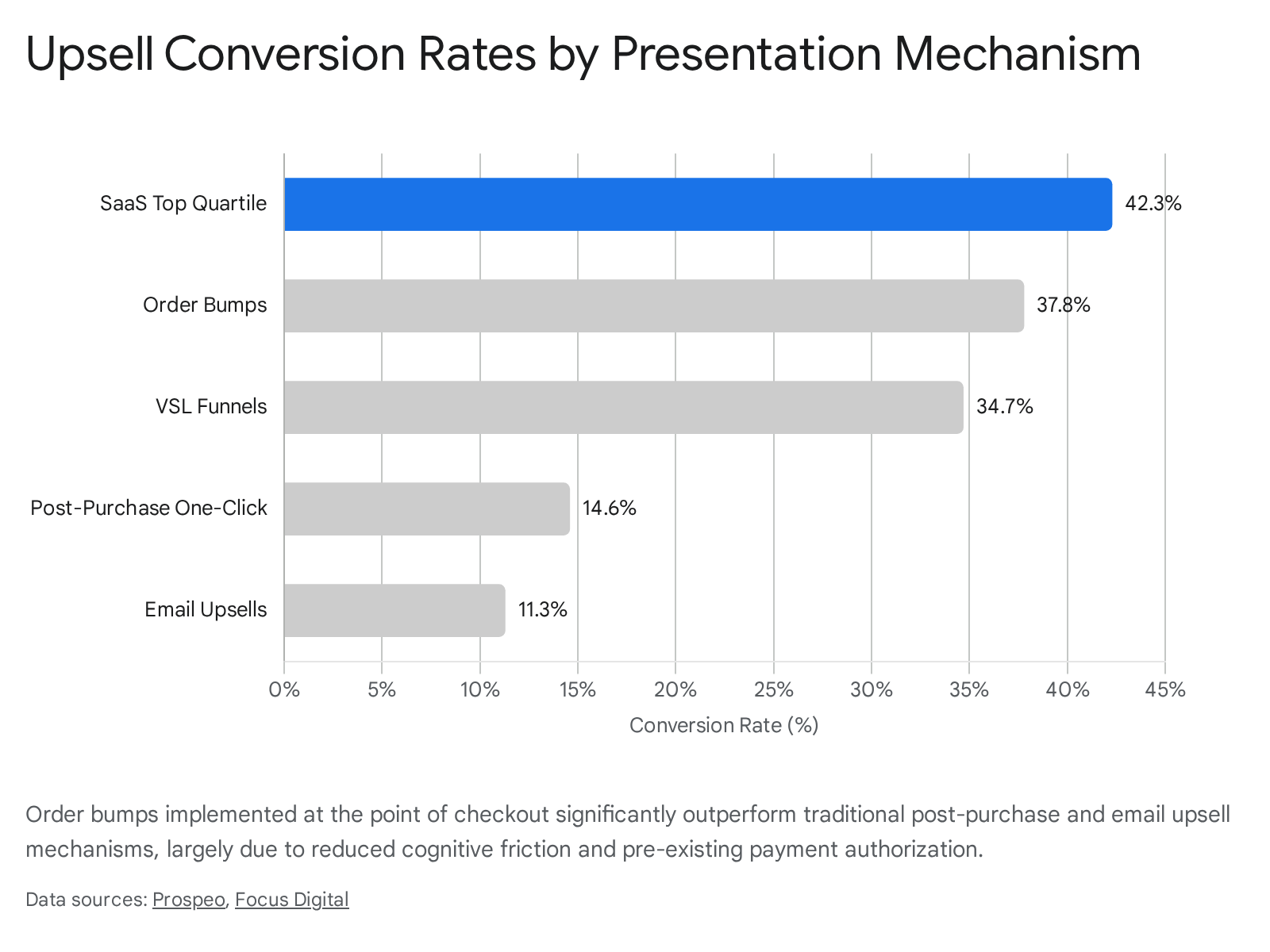
The pre-checkout "order bump" - a single checkbox presented on the checkout page (e.g., "Add priority shipping for $4.99") - represents the zenith of conversion optimization, averaging a 37.8% acceptance rate 2122. This mechanism succeeds by entirely eliminating decision-making friction; it requires no navigation away from the payment flow and leverages the consumer's established implemental mindset 21.
Following closely in post-transactional efficacy are post-purchase one-click offers, which average a 14.6% conversion rate 2122. These offers are presented immediately upon payment completion, utilizing stored payment credentials to allow consumers to add items without re-entering data 2324. Because the primary transaction is already secure, this mechanism carries zero risk of initial cart abandonment, representing pure incremental revenue 212430.
| Sequential Offer Mechanism | Average Conversion Rate | Psychological Driver / Advantage |
|---|---|---|
| Order Bumps (In-Cart) | 37.8% | Zero navigational friction; captures user in peak implemental mindset prior to payment execution 2122. |
| Video Sales Letter (VSL) Funnels | 34.7% | High emotional engagement; utilizes narrative persuasion to justify continuous spending 22. |
| SaaS In-App Upgrades | 27.6% | Contextual relevance; triggered when users hit strict usage limits, creating immediate utilitarian need 2225. |
| Post-Purchase One-Click | 14.6% | Risk elimination; secures primary revenue first, then capitalizes on residual shopping momentum without requiring payment re-entry 2123. |
| Email Upsell Sequences | 11.3% | Relies on reactivation; suffers from the decay of the implemental mindset and requires overcoming inbox friction 21. |
Diminishing Marginal Returns in Offer Sequencing
While upselling and cross-selling are highly profitable - selling to an existing customer yields 5 to 25 times more profit than new customer acquisition - the continuous deployment of sequential offers is subject to the economic law of diminishing marginal returns 526. As the frequency of offers and the marketing expenditure driving them increase, the conversion output cannot continue to scale linearly; eventually, the consumer base and marketing channels reach a strict saturation point 27.
In econometric modeling, this phenomenon is captured via saturation curves (often S-curves or Hill transformations), where the efficiency of marketing efforts declines exponentially according to power functions 2728.
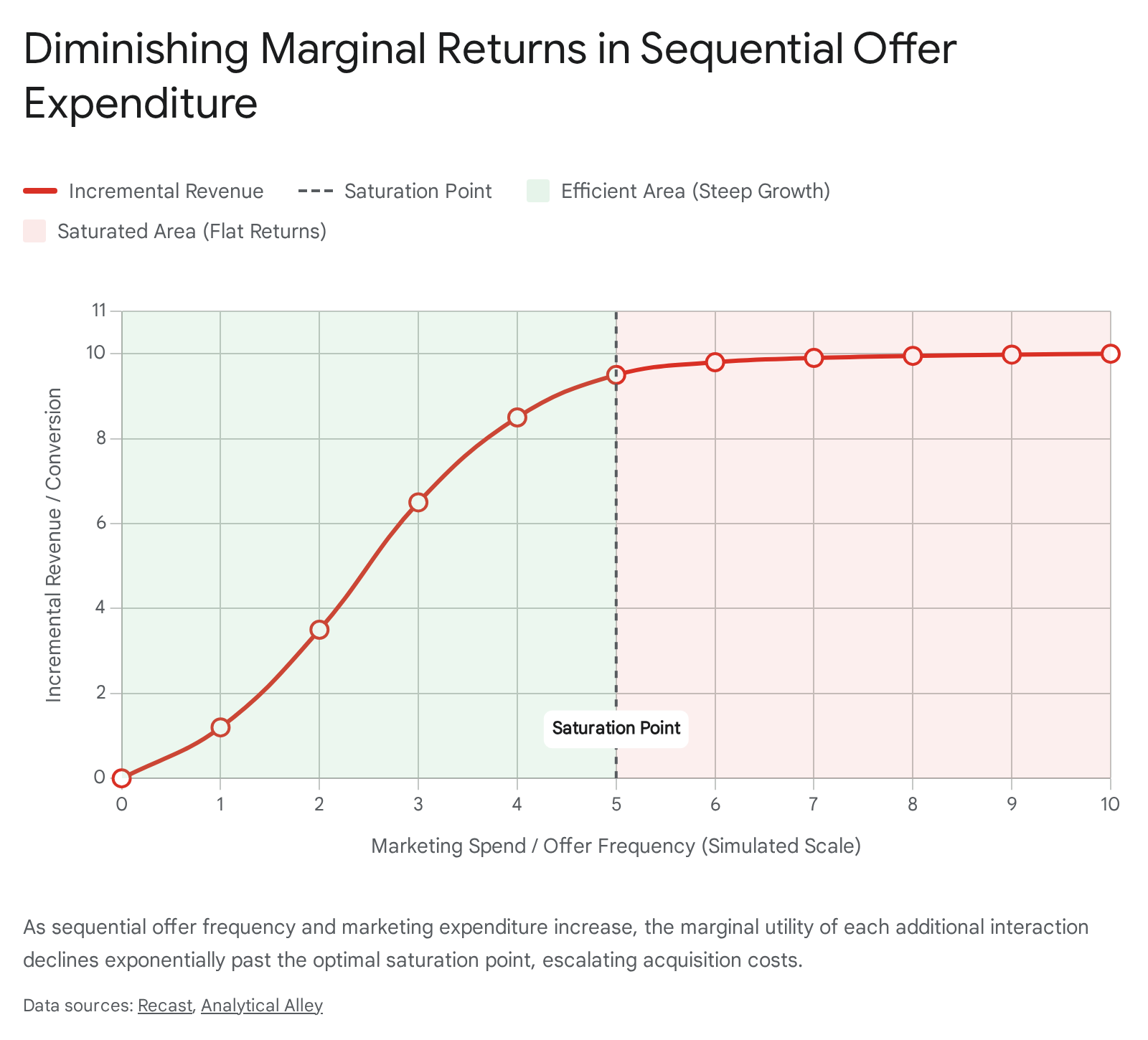
The highest-intent consumer cohort converts rapidly; subsequent expansion requires extracting capital from increasingly resistant, deliberative consumers, resulting in heightened Customer Acquisition Costs (CAC) 2729. For example, econometric modeling reveals that aggressively scaling ad spend in a saturated channel can drop return on investment (ROI) from 2.8:1 down to 1.2:1 28. Reallocating that budget toward earlier funnel awareness can increase incremental sales by 18% without raising total aggregate spend 28. Consequently, aggressive, uninterrupted sequential upselling eventually triggers choice fatigue and psychological reactance, damaging long-term Customer Lifetime Value (CLV) if not capped strategically 3037.
Cross-Cultural Variances in Offer Acceptance
The psychological response to sequential selling is not universally uniform; it is heavily moderated by cultural dimensions, particularly individualism, uncertainty avoidance, and power distance. E-commerce platforms that fail to adapt their upselling architectures to localized cognitive styles experience significant conversion drop-offs 313932.
| Cultural Dimension | Western Markets (US/Europe) | Eastern Markets (Asia) | Upselling Strategy Implications |
|---|---|---|---|
| Self-Concept | High Individualism; emphasizes self-expression and uniqueness. | High Collectivism; emphasizes group harmony and social identity. | US markets respond well to premium upgrades highlighting individual status. Asian markets respond better to cross-sells based on social proof and collective trends 3933. |
| Uncertainty Avoidance | Generally lower; greater tolerance for new or unexpected checkout flows. | Highly variable (e.g., Japan/Taiwan high; China/Singapore low). | High uncertainty avoidance cultures require transparent, multi-step reassurances during the upsell process rather than aggressive 1-click surprises 31. |
| Communication Style | Direct, explicit, and straightforward. | Implicit, delicate, and highly context-dependent. | European/US upselling can be humorous or aggressive. East Asian upselling requires subtle, emotionally resonant framing 39. |
| Privacy Sensitivity | High; strong resistance to perceived data exploitation. | Historically lower; higher acceptance of personalized data sharing. | Western consumers display greater reactance to AI-driven personalization if it feels invasive, whereas Asian markets show higher tolerance for deep personalization 34. |
In Western contexts, consumers are highly motivated by status-signaling and the personalization of luxury, making them prime targets for direct upselling (upgrading) based on exclusivity and individual identity 239. However, Western consumers also report significantly higher skepticism and privacy concerns regarding foreign-based platforms; for example, European consumers express higher perceived risk utilizing Asian platforms like Alibaba compared to domestic equivalents, impacting trust at the checkout phase 31.
Conversely, in Eastern cultures, purchasing decisions are strongly influenced by collective identity and social harmony. Consequently, cross-selling strategies that recommend what "others in your group purchased" perform exceptionally well by mitigating social risk and reinforcing group cohesion 3935. Cross-border platforms must dynamically adjust their user interfaces - ranging from the assertiveness of pop-ups to the types of payment gateways offered - to respect these ingrained cultural thresholds 393336.
Applied Sequential Architectures in Digital Ecosystems
The translation of psychological theory into applied software architecture represents the operational frontier of sequential selling. Digital platforms utilize behavioral triggers and algorithmic automation to engineer commitment momentum.
Software as a Service Upselling Dynamics
In the Software as a Service (SaaS) sector, upselling is primarily executed through feature gating and contextual prompts embedded directly within the user workflow. Top-quartile SaaS companies achieve average upsell conversion rates of 42.3% by aligning their offers with immediate utilitarian needs 2122.
Platforms deploy specific behavioral triggers to prompt upgrades. For instance, the collaboration software Miro restricts users to three active boards on free tiers; an upsell prompt is triggered precisely when a user attempts to create a fourth board, leveraging loss aversion by warning that existing boards will become view-only unless the account is upgraded 37. Similarly, platforms like Asana provide temporary free trials of premium features, allowing freemium users to habituate to advanced functionality before imposing a paywall, effectively creating an endowment effect that drives subsequent purchases 2537. Other architectures, such as those used by Zapier and Dropbox, rely on persistent, usage-based notifications that trigger contextual upgrade prompts the moment processing limits or storage capacities are reached 2537. By timing the upsell to coincide with high-friction moments in the user's workflow, SaaS platforms maximize the perceived value of the premium tier.
Artificial Intelligence and Agentic Commerce Flows
As digital commerce evolves, the deployment of sequential offers is increasingly managed by autonomous algorithms. The most significant architectural shift in recent commerce is the rise of "agentic commerce," formalized by the establishment of the Universal Commerce Protocol (UCP) in April 2026 by a consortium of hyperscalers and payment networks 46. Under this paradigm, AI agents negotiate directly with a merchant's backend API, dynamically discovering catalogs, stacking complex discounts, and processing transactions without the user navigating a traditional visual website interface 46.
When the merchant retains control of the AI within their proprietary ecosystem, conversion metrics are formidable. Implementations like Microsoft Copilot Checkout have demonstrated a 53% increase in purchases within 30 minutes when active shopping intent is detected 46. By compressing the distance between the deliberative search phase and the implemental checkout phase, AI reduces the friction that traditionally causes cart abandonment 47.
However, this hyper-optimization is bounded by a new constraint: consumer trust 48. As AI models optimize pricing and promotional eligibility in real-time based on granular user data, the boundary between helpful relevance and perceived manipulation narrows 48. If an AI engine dynamically alters the price of a primary item upon the rejection of an upsell, or implements overly aggressive scarcity timers, consumers perceive an immediate loss of fairness. Personalization fails not due to algorithmic inaccuracy, but because the consumer experiences psychological reactance against algorithmic opacity, resulting in sudden cart abandonment and long-term brand erosion 48. Furthermore, early empirical studies indicate that third-party AI aggregator referrals currently convert at significantly lower rates than organic search or traditional affiliate links, highlighting that AI cannot entirely replace the trust built by direct merchant-consumer relationships 46.
Regulatory Scrutiny of Psychological Manipulation
The aggressive optimization of upselling and continuity programs has drawn unprecedented regulatory scrutiny globally, fundamentally altering how companies can sequence offers. Regulatory bodies have recognized that the psychological friction preventing a consumer from canceling an offer is often weaponized to trap them in continuous billing cycles.
Dark Patterns and Interface Interference
Regulatory attention is heavily focused on "dark patterns," which are manipulative user interface designs constructed to exploit cognitive biases - such as loss aversion, inattention, and fatigue - to steer consumers into decisions counter to their intent 385039.
| Dark Pattern Typology | Mechanism of Action | Regulatory Impact |
|---|---|---|
| Interface Interference | Privileging specific actions through visual hierarchy (e.g., hiding opt-out buttons, minimizing font sizes for costs) 4041. | Directly violates clear and conspicuous disclosure mandates 4042. |
| Confirm Shaming | Guilt-inducing language designed to trigger social or emotional discomfort (e.g., "No thanks, I don't want to save money") 383941. | Explicitly targeted in FTC enforcement actions as manipulative 3941. |
| Forced Continuity / Action | Requiring users to perform tangential actions (creating accounts, accepting trials) to access primary functions, often converting to paid subscriptions automatically 3840. | Prohibited under updated negative option frameworks globally 4043. |
| Misleading Scarcity | Utilizing fake countdown timers or low-stock indicators to artificially induce the fear of missing out 3850. | Investigated by consumer protection networks as deceptive advertising 38. |
The Amazon "Iliad Flow" Precedent
The clearest manifestation of regulatory intervention against psychological manipulation occurred in September 2025, when the U.S. Federal Trade Commission (FTC) secured a historic $2.5 billion settlement against Amazon, comprising a $1 billion civil penalty and $1.5 billion in consumer refunds 414457. The core of the FTC's complaint centered on Amazon's use of dark patterns to trap consumers in Prime subscriptions 394158.
The FTC specifically targeted Amazon's cancellation architecture, internally dubbed the "Iliad Flow" after Homer's epic 3941. The Iliad Flow forced consumers seeking to cancel through a labyrinthine four-page, six-click, fifteen-option process laden with emotional friction, misleading buttons, and aggressive sequential upsells offering alternative discounts 4445. The process deliberately preyed upon decision fatigue, resulting in a 14% drop in successful cancellations as consumers simply gave up 3941. The settlement established a massive legal precedent: user interface design and cancellation architecture are now treated as legally actionable conduct under the Restore Online Shoppers' Confidence Act (ROSCA) 46. The FTC's actions definitively classify forced sequential friction during cancellation as an illegal deceptive practice 46.
Evolution of the Federal Trade Commission Negative Option Rule
Following widespread litigation regarding dark patterns, the FTC enacted sweeping amendments to its "Negative Option Rule," effective January 14, 2025 4347. The rule governs subscriptions, auto-renewals, and continuity plans where a consumer's silence is interpreted as consent to be charged 4748.
The regulatory framework imposes strict architectural requirements on e-commerce platforms and expands to cover B2B transactions 49. Most notably, it mandates a "click-to-cancel" mechanism that is as simple and frictionless as the initial sign-up process, expressly forbidding businesses from forcing consumers to navigate multiple pages of retention upsells, interact with chatbots, or transfer to live customer service agents to terminate digital agreements 495051. Furthermore, the rule strictly separates consent; businesses can no longer embed recurring billing consent within general terms of service or a generic "Accept All" button 49. Sellers must clearly disclose the existence of the negative option, its total cost, and cancellation procedures prior to capturing billing information, effectively neutralizing the element of surprise that aggressive upsell funnels previously relied upon 424347.
European Union Digital Omnibus Integration
Parallel to U.S. developments, the European Union is restructuring digital commerce regulation through the Digital Omnibus Act, projected for enforcement in mid-to-late 2026 52. This legislative package consolidates overlapping directives across the General Data Protection Regulation (GDPR), AI Act, ePrivacy Directive, NIS2, and the Digital Services Act (DSA) into a unified interoperable framework 5253.
Under the preexisting DSA, the EU already explicitly banned dark patterns and the display of targeted advertisements based on sensitive personal data 5455. The 2026 Digital Omnibus goes further by targeting the friction inherent in sequential consent models. It mandates "single-click accept/reject" standards for data collection and marketing consent, eliminating the practice of hiding opt-out buttons behind complex menus 52. It also introduces a mandatory six-month moratorium on prompting consumers for consent after a refusal, legally prohibiting the "nagging" practices common in SaaS upselling architectures 3852. While the European Commission estimates these consolidations will save businesses EUR 5 billion by 2029 through reduced compliance duplication, the stringent rules effectively outlaw the highest-friction sequential selling tactics previously utilized to manufacture psychological compliance 52.