
Commitment and consistency in foot-in-the-door consumer compliance
Theoretical Foundations of Behavioral Compliance
The foot-in-the-door technique represents a foundational compliance strategy within the disciplines of social psychology and consumer behavior. The core premise of the strategy dictates that an individual who agrees to an initial, modest request becomes significantly more likely to comply with a subsequent, much larger request 123. The empirical foundation for this phenomenon was established in 1966 by researchers Jonathan Freedman and Scott Fraser at Stanford University 23. In their seminal field experiment, the researchers contacted California homeowners with an initial, trivial request to either sign a petition for safe driving or place a small, unobtrusive "Drive Carefully" sticker in their window or vehicle 3456. Two weeks later, a different researcher approached the same homeowners with a much larger, highly intrusive request: to install a massive, poorly lettered public service billboard on their front lawns 5.
The results of the Freedman and Fraser study demonstrated a profound shift in human compliance. Among the subjects who had agreed to the initial small request, compliance rates for the large billboard request surged to 76% 67. In contrast, a control group of homeowners who were only presented with the large request exhibited compliance rates of less than 20% 7. Further variations of the experiment, such as asking subjects to answer eight brief survey questions about household soaps before later requesting that a team of men physically enter their homes to conduct a two-hour inventory, yielded similar results. The initial small request resulted in a 52% compliance rate for the home intrusion, compared to just 22% for the control group 2458. This staggering differential provided early, robust evidence that securing minor behavioral compliance could subconsciously pave the way for massive behavioral escalation without the application of external coercion 589.
Cognitive Mechanisms of the Technique
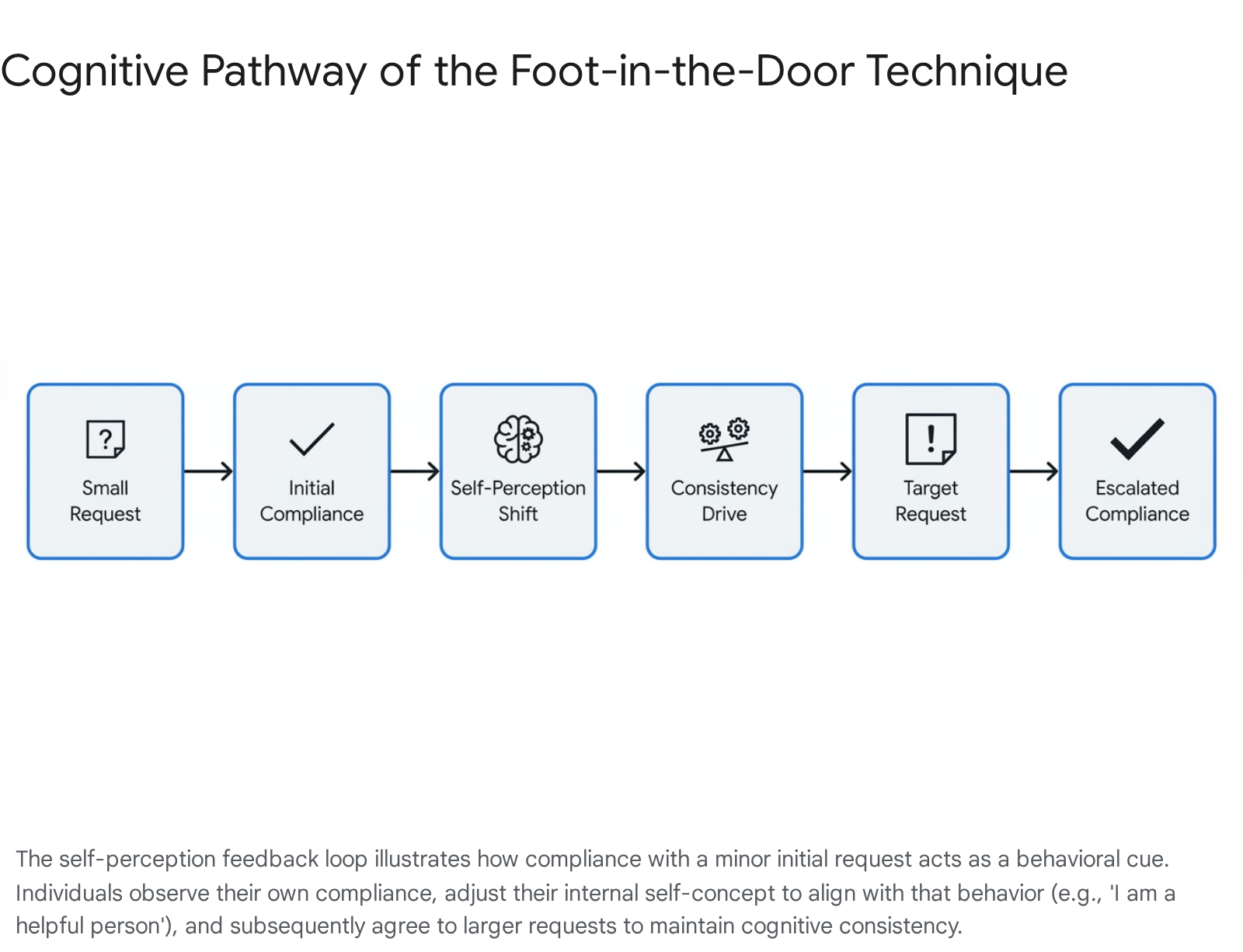
The efficacy of the foot-in-the-door phenomenon does not rely on overt pressure, financial incentives, or authoritarian demands. Instead, persuasion researchers indicate that the technique operates by triggering subtle internal psychological shifts within the target subject, primarily utilizing mechanisms of self-perception, the desire for cognitive consistency, and the subconscious escalation of commitment 101112.
Self-Perception Theory and Internal Attribution
The most dominant theoretical framework used to explain the foot-in-the-door effect is Daryl Bem's self-perception theory, proposed in the early 1970s 291113. Self-perception theory challenges the notion that human beings have direct, privileged insight into their own stable attitudes. Instead, the theory posits that when internal states are weak, newly formed, or ambiguous, individuals infer their own beliefs and dispositions by observing their own overt behavior and the situational context in which it occurs, much like an outside observer would 5814.
When a consumer is asked to perform a minor task - such as signing a digital petition, completing a brief market survey, or trying a free software sample - and complies without obvious external pressure, they engage in a subconscious attribution process 5811. Crucially, for the technique to work, the initial compliance must appear voluntary. If the consumer is offered significant financial compensation or is heavily coerced to complete the first task, the self-perception shift is aborted; the consumer attributes their behavior to the external reward or threat rather than their own identity 1115. A 1979 study by Zuckerman et al. demonstrated this boundary condition, showing that subjects were far more likely to agree to a larger subsequent request if they had not been paid for the first request, reinforcing the premise that internal attribution is the active ingredient 11.
Absent external rewards, the individual attributes their initial compliance to an internal disposition, concluding, for example, that they are "the type of person who supports environmental causes" or "a helpful, cooperative individual" 29131617. By resetting the psychological reference point, the initial request shifts the individual's self-schema, making them susceptible to further requests that align with this newly recognized identity 21216. Environmental and social marketing initiatives frequently utilize a corollary technique known as "positive cueing," which highlights the pro-social impact of a consumer's existing behaviors to encourage further sustainable actions based on an updated self-concept 14.
Commitment and Cognitive Consistency
Coupled tightly with self-perception is the psychological drive for commitment and consistency 3101718. Decades of social psychology research, heavily influenced by Leon Festinger's theory of cognitive dissonance and Fritz Heider's balance theory, establish that humans possess a fundamental desire for their attitudes, beliefs, and subsequent actions to align cohesively 9131717. Once an individual makes an active, voluntary, and public commitment to a course of action, they face intense internal and interpersonal pressure to behave consistently with that initial stance 161718.
In the context of the foot-in-the-door technique, refusing the second, larger request after actively agreeing to the initial request introduces cognitive dissonance 21318. If the consumer has already established an internal narrative of being cooperative or supportive of a specific brand via their initial minor compliance, a sudden refusal conflicts violently with this newly solidified identity. Consequently, the consumer complies with the escalated request not necessarily because they inherently desire the outcome of the second task, but to honor their initial commitment and avoid the psychological discomfort of behavioral inconsistency 2111718. Because the mechanism relies on deep internal changes to self-identity, the foot-in-the-door effect exhibits temporal durability. Research indicates the technique can remain effective even when the delay between the first and second request spans several days or weeks, provided the initial request was substantial enough to trigger the identity shift 51517.
Comparative Persuasion Paradigms
To fully understand the structural utility of the foot-in-the-door technique, it must be contextualized alongside alternative sequential request strategies, most notably the door-in-the-face technique and the low-ball technique 4131619.
While the foot-in-the-door strategy relies on escalating commitment through a small-to-large request sequence, the door-in-the-face (DITF) strategy utilizes the exact inverse: an extreme, unreasonable request that is expected to be rejected, immediately followed by a smaller, target request 41316. The DITF technique operates on the principles of perceptual contrast and reciprocal concession 1319. Following a massive request, a moderate target request seems negligible by comparison. Furthermore, the target feels socially obligated to compromise because the requester appeared to concede by lowering their demand 1319. Meta-analyses comparing the two strategies reveal that both generally yield small but statistically reliable compliance effects across varied populations 1520. However, DITF requires almost immediate succession between requests to capitalize on the acute social pressure of reciprocal concession, whereas the foot-in-the-door technique requires no such immediacy, as self-perception shifts are more persistent 515.
| Sequential Compliance Technique | Request Sequence Architecture | Primary Psychological Mechanisms | Temporal Constraints |
|---|---|---|---|
| Foot-in-the-Door (FITD) | Small initial request $\rightarrow$ Large target request | Self-perception, Commitment, Cognitive Consistency | Effective over long delays; relies on durable, internalized identity shifts. |
| Door-in-the-Face (DITF) | Extreme initial request (rejected) $\rightarrow$ Moderate target request | Perceptual Contrast, Reciprocal Concession | Requires immediate succession to leverage the social pressure of a perceived compromise. |
| Low-Ball Technique | Target request (accepted) $\rightarrow$ Hidden costs or effort revealed | Escalation of Commitment, Sunk Cost Fallacy | Occurs within a single transaction timeline; commitment to the decision precedes full data. |
| Foot-in-the-Face | Integrated procedure combining elements of both sequential requests | Attention capture, Behavioral habituation | Minimal pressure generation; shifts focus to immediate task continuity. |
Psychologists have also tested hybrid models, such as the "foot-in-the-face" procedure, which combines initial engagement without generating acute external pressure, showing that repeated low-stress interactions can effectively capture and hold target attention prior to complex requests 21. Another notable alternative, the low-ball technique, secures an initial agreement to a target request before subsequently increasing the cost or effort required, exploiting the sunk cost fallacy rather than an escalating series of independent requests 91122.
Cross-Cultural Variances in Compliance Mechanisms
While the foot-in-the-door technique relies on cognitive drives that appear universal, extensive empirical research demonstrates that overarching cultural orientations - specifically the spectrum of individualism versus collectivism - significantly moderate its efficacy and mechanisms of action 17232425. Social norms, decision-making frameworks, and the conceptualization of the self vary drastically across cultures, determining whether internal consistency or social proof serves as the dominant driver of consumer compliance 23262729.
Individualism and Internal Consistency
Individualistic cultures, predominately found in the United States, Western Europe, and parts of the Anglosphere, place the highest cultural premium on personal autonomy, self-expression, and the pursuit of individual goals 2526292829. In these societies, the "self" is viewed as an independent, autonomous entity whose internal attributes - attitudes, traits, and distinct preferences - should serve as the primary engine for external behavior 24. Individualists prioritize maintaining an internally consistent personal history; a failure to align current actions with past actions is viewed as a severe character flaw, a lack of authenticity, or hypocrisy 1724.
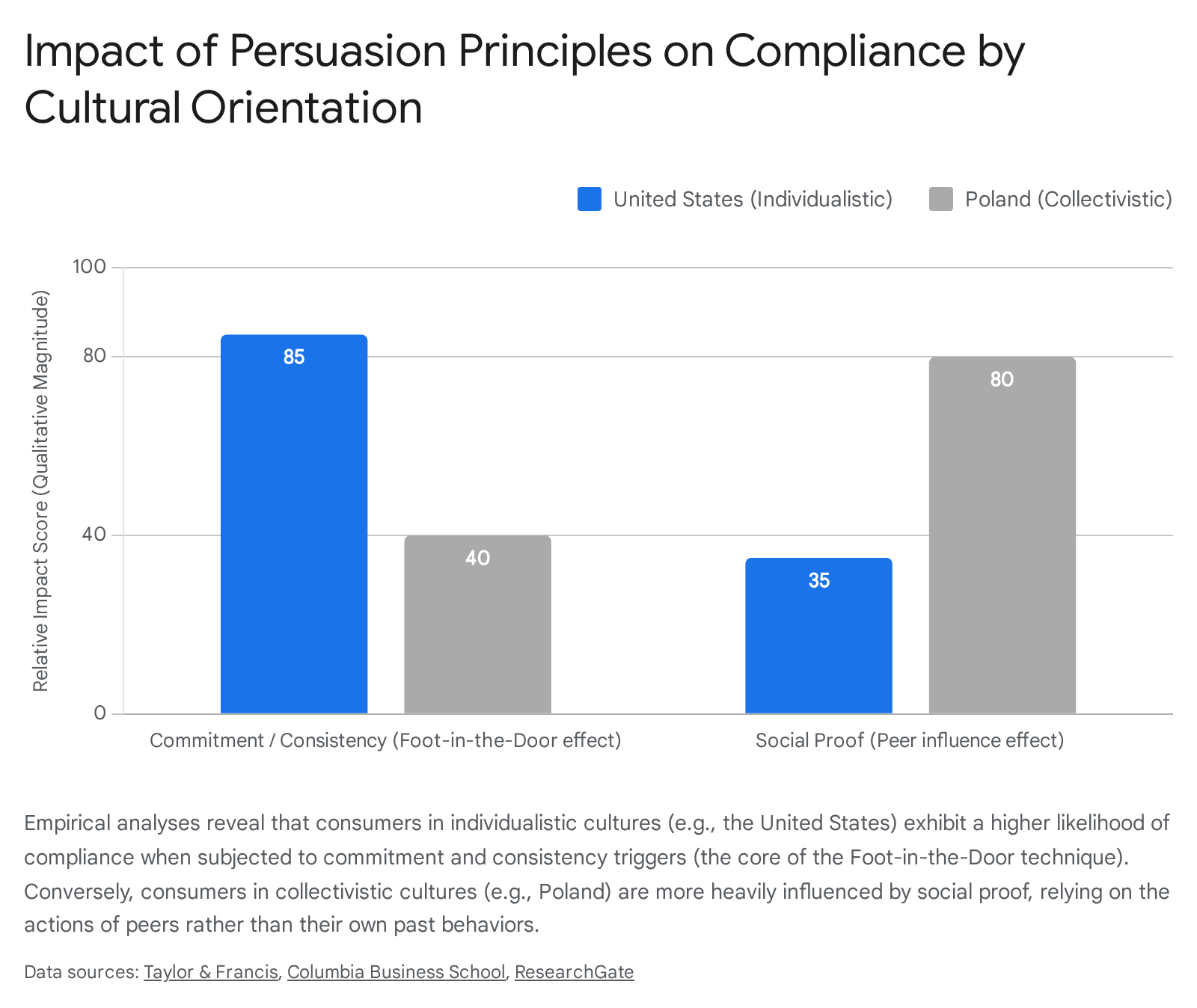
Because the foot-in-the-door technique relies precisely on the target looking inward to their own past behavior to guide future decisions, it is exceptionally potent in individualistic environments 1724. A landmark cross-cultural study by Cialdini, Wosinska, Barrett, Butner, and Gornik-Durose (1999) compared consumer compliance in the United States (highly individualistic) and Poland (which exhibits strong collectivistic trends) 172430. When subjects were asked to comply with an unpaid, 40-minute marketing survey, American participants were significantly more influenced by the commitment and consistency principle. Specifically, being reminded of their own past compliance to similar requests was a far stronger predictor of their subsequent behavior than it was for Polish participants 1724.
The divergence in mindset extends heavily into consumer behavior and product evaluation. Studies published in Psychological Science indicate that individualistic thinkers tend to assess an item's intrinsic value in isolation, rendering them highly willing to split up product sets to achieve a specific personal goal 29. Furthermore, individualist consumers exhibit a more pronounced susceptibility to maladaptive consumer behaviors driven by individual pleasure and achievement. Data sets comparing Polish and American consumer bases reveal that the impact of hedonism and personal achievement on driving compulsive buying tendencies is twice as large in the United States 30.
Collectivism and Social Proof
Conversely, collectivist cultures - common in East Asia, parts of Eastern Europe, and Latin America - place a higher premium on social harmony, group cohesion, institutional norms, and familial ties over individual autonomy 17252627292831. Decision-making in these societies is frequently guided by consensus, societal perception, and the behavior of one's peers 2931. This environment generates a high degree of "situational strength," where organizational environments with clear behavioral expectations heavily restrict or guide individual actions to promote conformity and minimize variance 26. A 2024 study surveying 608 participants across South Korea, Japan, Finland, and Germany found that individuals in collectivist societies experience significantly higher levels of situational strength due to pervasive societal and organizational pressure, which can suppress individual self-efficacy while elevating behavioral conformity 26.
In highly collectivist settings, the internal drive for consistency - the core engine of the foot-in-the-door technique - is frequently overshadowed by external social cues and peer review 17232631. The 1999 Cialdini study demonstrated that Polish consumers were far more responsive to social proof (information regarding how their peers had responded to the request) than to individual reminders of their own past commitments 17. Because the self is viewed as interdependent rather than independent, private thoughts and past individual actions become secondary to publicly expressed group norms 24.
This psychological orientation does not render sequential request techniques entirely ineffective in collectivist cultures; rather, it suggests that compliance is achieved through a different cognitive routing. If a small initial request is framed as a community norm or a prosocial duty, collectivist consumers may comply heavily out of a desire for group alignment rather than individual consistency 233132. Interestingly, research into cultural self-insight indicates that members of collectivist cultures may be significantly more accurate in their self-predictions regarding prosocial compliance, avoiding the "holier-than-thou" overestimation bias prevalent in individualist societies where subjects routinely overestimate their likelihood of engaging in altruistic or moral behaviors 28. Gender roles also intersect with collectivist norms; laboratory research indicates that women, who are often subject to stronger cultural expectations of warmth, communal qualities, and compliance, exhibit slightly higher rates of social conformity than men, compounding the effects of situational strength 2533.
Digital Application and Software Architecture
As commercial interactions have transitioned from face-to-face encounters to automated digital interfaces, the foot-in-the-door technique has been seamlessly integrated into software design, e-commerce architecture, and digital marketing funnels 79163634. The phenomenon known as the "electronic foot-in-the-door" has proven equally as effective as synchronous interpersonal requests 734.
In a landmark digital experiment, researchers emailed half of a participant group asking for a minor favor regarding a file conversion issue. Following compliance, they were subsequently asked to fill out an unrelated 40-question survey. A staggering 76% of the initial respondents completed the massive survey, compared to only 44% of the control group who received the survey request directly 734. Further research into human-computer interaction suggests the technique operates completely independently of human empathy. A 2018 study by Lee and Liang demonstrated that robots could successfully execute the foot-in-the-door technique on humans; participants exhibited a strong FITD compliance effect when asked by a robot to perform pattern recognition tasks, and crucially, this effect was not dependent on the robot's performance, anthropomorphism, or perceived credibility 233435. This confirms that the preference for consistency moderates attitudes and behaviors at a source-independent level 23.
Freemium Models and Software-as-a-Service
One of the most profound structural applications of the foot-in-the-door technique in the digital economy is the freemium business model, an architecture that has become the dominant go-to-market strategy for Software-as-a-Service (SaaS) platforms and mobile gaming companies 3640373839. The freemium model offers a permanently free, basic version of a product while charging subscription fees for premium features, expanded capacity, or accelerated progress 4038. In 2023, nearly 97% of applications on the Google Play Store utilized a free-to-download baseline strategy 39.
By inviting a user to create a free account - a highly frictionless, exceptionally small initial request - companies initiate the self-perception loop. Users invest time customizing their profiles, inputting operational data, and integrating the software into their daily workflows, thereby building a pattern of consistent behavioral usage 163738. The psychological escalation occurs when the user inevitably hits a feature gate or usage limit. Upgrading to a paid subscription (the large target request) is seamlessly rationalized by the consumer to maintain consistency with their prior investment of time, data, and established workflow 183739.
However, empirical data analyzing conversion across B2B software products reveals highly nuanced outcomes based on the exact structure of the initial "foot-in-the-door" 403740. A critical strategic distinction exists between freemium models (permanent but limited access) and free trials (temporary but full access) 40. ChartMogul analytics from software startups highlight that while freemium dramatically lowers customer acquisition costs by utilizing the product as its own marketing channel, its ultimate conversion efficacy relies heavily on precise friction engineering 403840.
| Software Entry Model Architecture | Primary Structural Characteristics | Median Free-to-Paid Conversion Rate | Dominant Psychological Leverage |
|---|---|---|---|
| Freemium (Ungated) | Indefinite access to basic features. Focuses heavily on bottom-up adoption, internal champions, and massive network effects. | 2% - 5% 4045 (Up to 9% if highly optimized 40) | Habituation and Escalation of Commitment. Gradual escalation occurs as artificial usage limits or feature gates are approached over time. |
| Free Trial (No Credit Card) | Time-limited access to all premium features without requiring upfront financial data. | 4% - 8% 40 | Reciprocity and Perceived Ownership. Acute loss aversion is triggered abruptly when the trial period expires. |
| Free Trial (Credit Card Required) | Time-limited access, requiring valid payment details prior to entry. | ~30% 40 | High initial commitment filter. Utilizes consumer inertia and default compliance (automatic billing) upon trial expiration. |
The data indicates that requiring a credit card upfront for a free trial yields an exponentially higher conversion rate (approximately 30%, over five times higher than ungated models) 40. While frictionless freemium entry generates vast user bases and invaluable product feedback, it risks total failure of the sequential escalation if the free boundary is set too generously, inadvertently eliminating the pressure to upgrade 4038. A fully optimized model requires hybrid constraints. A case study of a B2B analytics platform, CloudMetrics, demonstrated that moving from a simple feature-gated model to a hybrid freemium model (imposing both feature gates and hard usage limits) increased their free-to-paid conversion from 3.8% to 7.4%, while achieving a massive 127% net revenue retention from product-led cohorts 37. In the mobile gaming sector, microtransactions (e.g., loot boxes, extra lives for $0.99) operate on similar incremental consistency loops, leveraging loss aversion and the fear of lost progress to extract small, continuous payments that multiply into massive revenue streams 364142. While effective, adult and youth populations increasingly report feelings of guilt, being "tricked," or feeling an artificial obligation to continue playing after utilizing microtransactions 414243.
E-Commerce Checkout Optimization
The architecture of digital checkout flows represents a daily, high-stakes behavioral battleground for consumer compliance. Research from the Baymard Institute indicates that e-commerce merchants lose approximately 70.22% of initiated shopping carts to abandonment, making the structural presentation of the payment request a critical determinant of bottom-line revenue 44455146. The intense industry debate between implementing a "one-page checkout" versus a "multi-step checkout" is fundamentally a debate over how best to manage consumer commitment, progressive disclosure, and cognitive load 4451474849.
Multi-step checkout architectures are active, deliberate deployments of the foot-in-the-door technique 444550. The average U.S. checkout flow contains over 23 form elements; presenting this massive, intimidating request for highly sensitive information (shipping, billing, credit card details) all at once generates acute cognitive fatigue 444551. The multi-step process breaks the transaction down into micro-commitments 444748. The user is first asked for a low-friction piece of data, such as an email address. Having complied with this minor request, the user's psychological commitment to the transaction incrementally increases. As they progress through subsequent screens, the "sunk cost fallacy" and the drive for consistency make them increasingly reluctant to abandon the process, even as the requests become substantially more demanding (e.g., entering secure credit card details) 4750525354.
Conversely, one-page checkouts present all required fields on a single, continuous screen, emphasizing rapid speed and absolute data transparency over gradual commitment building 44514748. This format minimizes page loads and navigational friction, which is particularly vital for mobile users who suffer from "step fatigue" and are prone to abandoning processes if forced to click "Next" more than three times 485155.
Empirical conversion data from optimization testing reveals that neither approach is universally superior; the optimal architecture is highly context-dependent 5147495055:
| Checkout Architecture | Optimal Context Profile | Core Psychological Advantage | Typical Conversion Impact |
|---|---|---|---|
| Multi-Step Checkout | First-time buyers, High Average Order Value (AOV > $150), Complex or regulated products, Desktop users. | Progressive Commitment: Segments cognitive load, allows for progressive disclosure of shipping costs, builds trust incrementally through micro-agreements. | Reduces anxiety for high-value items; reveals predictable drop-off points (e.g., 15% at shipping) for targeted optimization 4749505455. |
| One-Page Checkout | Returning customers, Low AOV impulse purchases (< $75), Mobile users. | Friction Reduction: Eliminates page-load delays and creates immediate transparency of the full request scope, catering to users who already possess brand trust. | Typically converts 7.5% better on average for standard retail; users complete purchases 23% faster than in multi-step flows 46474950. |
| Hybrid Approach | Stores with diverse traffic sources and balanced AOV. | Device-Matched Context: Multi-step on mobile mitigates step-fatigue on small screens, while one-page on desktop leverages broader visual processing fields. | Consistently outperforms single-format constraints on roughly 60% of tested stores, maximizing strengths of both devices 47485055. |
Underlying all these e-commerce applications is the strict management of cognitive load. While the foot-in-the-door technique conceptually relies on escalating commitment, functional digital implementation requires aggressively de-escalating friction at the top of the funnel 454753. UI techniques like progressive disclosure - revealing complex information or secondary requests only after a user has navigated primary, simple options - serve as the visual manifestation of the technique 4453566357. By keeping the initial interaction cognitively light, digital platforms ensure the user steps through the "door" before realizing the full depth of the impending data or financial request 505357.
Manipulative Design and Dark Patterns
As digital platforms have rigorously optimized the foot-in-the-door technique to maximize key performance indicators, the boundary between persuasive design and outright manipulation has blurred considerably. When the inherent human drive for consistency and the psychological discomfort of backing out are deliberately weaponized against the consumer's best interests, these strategies are officially classified by researchers and regulators as "dark patterns" (or deceptive design) 6558596061.
Coined by UX researcher Harry Brignull in 2010, dark patterns are deliberate interface design choices that exploit cognitive biases to steer users into actions they did not intend to take, such as surrendering excess personal data, accepting tracking cookies, or committing to recurring financial subscriptions 5859606162. They frequently hijack the foot-in-the-door mechanism by extracting a minor, seemingly harmless initial consent, which is then aggressively escalated while exit paths are obscured.
Prominent manifestations of this weaponized compliance include: * The Roach Motel: An architectural system that is effortlessly simple to enter (the "foot in the door") but structurally hostile to exit. For instance, a subscription service allowing frictionless one-click sign-up via a mobile app, but requiring a physical letter, a prolonged phone call, or navigation through deeply buried menus to cancel the service 6063. This exploits the user's sunk cost and relies heavily on inertia and decision fatigue to maintain ongoing compliance 60. * Confirmshaming: Utilizing guilt-laden language to manipulate choice via negative framing. After a user is presented with a small request (e.g., an email newsletter pop-up), the option to decline is framed to attack the user's self-perception (e.g., "No thanks, I prefer paying full price" or "I don't care about the environment"). This directly attacks the exact self-perception mechanisms that the FITD technique relies on, attempting to force compliance through social shame rather than value 5960. * Interface Interference and Default Bias: Pre-selecting the option most favorable to the business (e.g., a brightly colored, pre-ticked "Accept All Cookies" box) while hiding the rejection option in muted text. Users, operating on cognitive heuristics and fast System 1 thinking, often accept the default to remove the barrier 65596364. By the time they realize the consequence of the data concession, the psychological burden of reversing the commitment deters them from taking corrective action 6563.
The Phenomenon of Privacy Nicks
The escalation of commitment inherent in the foot-in-the-door technique has profound, systemic implications for global data privacy and consumer surveillance. Legal and privacy scholars, notably in publications like the Washington University Law Review, have identified a phenomenon termed "privacy nicks" - the insidious process by which incremental, seemingly minor infringements on privacy acclimate consumers to increasingly invasive surveillance ecosystems 6566.
Unlike a "privacy chop" - defined as a sudden, massive breach of data or an egregious surveillance deployment (like facial recognition stalking) that triggers immediate societal rejection - privacy nicks operate stealthily on a sequential request model 6566. A case study of Amazon Ring doorbells perfectly illustrates this trajectory. A consumer may first agree to install a smart doorbell strictly to monitor package deliveries (a highly normalized, small request) 6566. Over nearly a decade, through software updates and ecosystem integration, the device's capability expands to monitor neighborhood traffic, generate heatmaps, and seamlessly share data with local law enforcement 6566. Because the consumer has already financially and psychologically committed to the hardware ecosystem, the psychological threshold for accepting these subsequent, highly invasive data practices is drastically lowered 65. Through repeated exposure to these micro-intrusions, consumers become resigned to surveillance. This normalization leverages the exact mechanics of the foot-in-the-door effect to systematically redraw societal baselines for reasonable expectations of privacy 6566.
The real-world consequences of these digital escalations extend far beyond consumer marketing. In employment law, algorithms are literally serving as digital doors. In a 2024 California federal discrimination lawsuit against Workday, a judge ruled that AI recruitment screening software does not merely execute employer criteria, but actively participates in decision-making by deciding which applicants get their "foot in the door" for an interview, allowing the suit to proceed 75. In an even more severe context, sociological case studies regarding image-based digital sexual violence (DSV) in South Korea reveal that perpetrator networks frequently utilize classic foot-in-the-door mechanisms. Secretive forums require new members to pass "verification" by uploading minor illicit images; this incremental compliance builds behavioral commitment, slowly escalating members into participating in severe deepfake exploitation and peer-based humiliation 76.
Global Regulatory Frameworks
The widespread proliferation of these deceptive compliance architectures has prompted a severe, coordinated backlash from consumer protection agencies and global legislative bodies 6559606264. Recognizing that dark patterns circumvent informed consent and actively distort economic behavior, international regulators have shifted from issuing mild warnings to aggressive financial enforcement 6559.
- European Union (EU): The EU has established the most aggressive regulatory stance globally. Under the General Data Protection Regulation (GDPR), consent must be "freely given, specific, informed, and unambiguous." This renders FITD-style manipulative cookie banners that rely on pre-ticked boxes or asymmetric effort illegal 65596063. Furthermore, the Digital Services Act (DSA), enforced fully for digital platforms in 2024, explicitly bans manipulative interfaces that impair user autonomy, choice, or decision-making. Violations under the DSA can result in catastrophic financial penalties of up to 6% of a platform's global annual turnover 596061.
- United States: The Federal Trade Commission (FTC) issued an enforcement policy statement in 2021 categorizing the use of dark patterns - specifically those trapping consumers in recurring subscriptions - as unfair or deceptive practices liable under the FTC Act 655864. At the state level, the California Consumer Privacy Act (CCPA) and the California Privacy Rights Act (CPRA) explicitly prohibit companies from using manipulative tactics or asymmetric friction (e.g., making it structurally harder to opt-out than to opt-in) to obtain consent for data processing 6558.
- International Coordination: Organizations like the International Consumer Protection and Enforcement Network (ICPEN) and the Global Privacy Enforcement Network (GPEN) frequently conduct global audits. A comprehensive 2024 review across 26 countries found that nearly 76% of examined subscription websites and mobile apps employed at least one potential dark pattern, with 67% utilizing multiple manipulative techniques, highlighting the deeply systemic nature of these engineered compliance tactics across the global digital economy 64.