
Cognitive load effects on consumer persuasion and impulse purchasing
Modern digital commerce operates in an environment characterized by extreme information density and unprecedented technological velocity. As the global digital ecosystem pivots from static storefronts to algorithmic, infinite-scroll architectures, the cognitive demands placed on consumers have fundamentally altered the mechanics of persuasion. Top-tier consumer psychology and marketing literature, spanning publications such as the Journal of Consumer Research and the Journal of Marketing, increasingly views consumer decision-making not merely through the lens of rational utility, but as an exercise in cognitive resource management. When choice architectures are designed to either minimize cognitive friction or intentionally overwhelm working memory, the consumer's vulnerability to persuasive marketing tactics shifts dramatically.
This comprehensive report provides an exhaustive analysis of how cognitive load dictates consumer susceptibility to digital marketing persuasion and impulse purchasing. It addresses the contemporary evolution of ego depletion models following the psychological replication crisis, dissects the psychological impact of short-form video and user experience (UX) dark patterns, and provides a comparative analysis of Western digital silos against the unified ecosystems of Asian super-apps. Furthermore, the analysis details counter-intuitive behavioral outcomes, such as choice paralysis and online shopping cart abandonment, highlighting the critical thresholds where persuasive design collapses into cognitive failure.
The Tripartite Framework of Cognitive Load in Digital Environments
Cognitive Load Theory, originally formulated by educational psychologist John Sweller in the 1980s, posits that the human brain possesses a highly limited working memory capacity 12. While classical psychological paradigms suggested that working memory could handle five to nine discrete items simultaneously, contemporary neuroscientific research has updated this threshold, demonstrating a strict limit of merely four items for complex cognitive tasks 23. In the context of consumer behavior and digital commerce, the total cognitive load a shopper experiences is categorized into three distinct theoretical domains: intrinsic, extraneous, and germane load 234. Understanding the dynamic interaction between these dimensions is paramount for marketers seeking to design optimal choice architectures and persuasive digital environments.
Intrinsic cognitive load refers to the inherent complexity of the task or product being evaluated 14. In e-commerce, this represents the foundational mental effort required to understand a product's utility, specifications, and pricing structure. For instance, purchasing a complex financial derivative or a highly technical enterprise software subscription carries a naturally high intrinsic cognitive load compared to purchasing a standardized consumer packaged good. This load cannot be eliminated; it can only be managed through sequential information disclosure and careful pedagogical scaffolding within the marketing interface 36. Because human working memory relies on a multicomponent system comprising a central executive, a phonological loop for verbal information, and a visuospatial sketchpad for visual stimuli, intrinsic load must be balanced across these sensory channels to prevent immediate saturation 33.
Extraneous cognitive load is generated by the environment and the manner in which information is presented to the consumer 2. This domain serves as the central battleground for digital user experience and interface design. Confusing navigation architectures, fragmented product displays, intrusive pop-up advertisements, and poorly translated website languages all generate remarkably high extraneous load 65. Recent empirical studies utilizing structural equation modeling demonstrate that forcing consumers to process information in a secondary language or through a convoluted interface drastically elevates extraneous cognitive load, directly correlating with lower consumer satisfaction, reduced brand trust, and diminished repurchase intentions 56. When a platform's design imposes excessive extraneous load, the consumer's limited working memory is exhausted merely navigating the interface, leaving insufficient cognitive bandwidth to evaluate the actual product or process persuasive messaging.
Germane cognitive load represents the effort dedicated to processing, constructing schemas, and committing information to long-term memory 124. In a marketing context, germane load is highly desirable. It is the cognitive process by which a consumer internalizes a brand narrative, understands a unique value proposition, or develops long-term brand loyalty. Effective marketing aims to radically reduce extraneous load precisely so that working memory resources can be reallocated toward germane processing 134.
To quantify these loads in digital environments, researchers frequently deploy the NASA Task Load Index (NASA-TLX), widely regarded as the gold standard for measuring subjective workload across human-machine interfaces 107. Originally developed by the NASA Ames Research Center, the index derives an overall workload score based on a weighted average of ratings across six subscales: mental demand, physical demand, temporal demand, performance, effort, and frustration 1078. In recent e-commerce studies from 2023 and 2024, linear regression models mapping NASA-TLX scores to shopping behaviors revealed that interfaces utilizing limited-time cues and complex layouts significantly spiked the frustration and temporal demand subscales 910. When novice consumers engaged with augmented reality shopping applications, the NASA-TLX recorded pronounced initial spikes in extraneous load related to interface manipulation, which correlated strongly with high abandonment rates before the users could adapt to the technology 10.
The Fall of Ego Depletion and the Rise of Robust Resource Models
For nearly two decades, the study of consumer persuasion and impulse purchasing relied heavily on the "strength model" of self-control, commonly known in psychological literature as ego depletion 111213. Originating from Roy Baumeister's foundational work in the late 1990s, the theory posited that willpower and self-regulation functioned analogously to a physical muscle, drawing upon a finite reservoir of psychological or metabolic fuel 1112. When consumers made successive choices, navigated complex interfaces, or exerted self-control to resist advertising, this internal resource was drained. According to this classic paradigm, a depleted consumer was left highly susceptible to impulse purchasing, heuristic reliance, and persuasive manipulation because they lacked the energetic capacity to engage in rational deliberation 111814.
However, the broader field of psychology has recently navigated a severe replication crisis, and ego depletion found itself at the epicenter of this methodological reckoning 121521. The crisis peaked with a 2016 large-scale, multi-lab preregistered replication attempt spearheaded by Hagger et al., which failed to find a reliable, generalized ego depletion effect across 23 participating laboratories 1316. While early meta-analyses, such as a 2010 study examining 198 tests, had concluded that ego depletion possessed a medium-to-large effect size, these later stringent tests suggested that the phenomenon was highly fragile, heavily dependent on specific experimental tasks, and heavily inflated by publication bias 121321. This sparked intense, ongoing debate within leading publications regarding the validity of resource-drain models in marketing literature, prompting journals to adopt stricter open-science mandates and registered report formats to combat questionable research practices 161718.
In response to the replication crisis, contemporary researchers have not abandoned the phenomenon of cognitive fatigue entirely, but have fundamentally replaced the flawed "depletable physical resource" metaphor with highly robust, mathematically grounded models of bounded rationality and motivational shifting 121319. The prevailing contemporary framework in top-tier consumer behavior research is the Opportunity-Cost Model of Cognitive Control 13. This model argues that cognitive fatigue is not a physiological loss of fuel, but an adaptive, subjective reallocation of attention based on internal reward structures. When a consumer engages in prolonged, high-effort decision-making, the brain registers an increasing opportunity cost for maintaining that analytical focus. Eventually, a subconscious, motivational shift occurs: the consumer's priority shifts from "have-to" tasks, such as deliberate analytical reasoning, to "want-to" tasks, which prioritize reward-seeking, immediate gratification, and heuristic processing 13.
This modern paradigm effectively reconciles the anomalies that the old muscle metaphor could never explain. For example, it elucidates why monetary incentives or strong intrinsic motivation can instantly "cure" so-called ego depletion; if the resource were truly physically exhausted, no amount of motivation could restore it 13. For digital marketers, this shift in theoretical understanding is profound. It indicates that cognitive exhaustion in consumers is fundamentally an emotional and motivational pivot. When platforms subject users to high cognitive strain, consumers do not lose the biological ability to think rationally; rather, they lose the motivation to do so, defaulting to path-of-least-resistance heuristics, social proof, and impulsive affective triggers to satisfy immediate emotional needs 111320.
The System 2 to System 1 Processing Shift and Threshold Failure
The vulnerability of consumers to both algorithmic persuasion and manipulative interface design is best understood through the structural lens of Dual-Process Theory, popularized by behavioral economist Daniel Kahneman. The human brain operates via two distinct, parallel pathways for decision-making: System 1, which is intuitive, fast, automatic, heuristic-driven, and highly emotional; and System 2, which is deliberative, slow, analytical, and effortful 142128.
The sheer processing disparity between these two systems dictates the boundaries of digital consumer behavior. Neuroscientific and cognitive estimates suggest that the unconscious, automatic System 1 processes upwards of 11 million bits of information per second 2230. Operating entirely below the threshold of conscious awareness, it scans for danger, interprets facial expressions, assesses aesthetic fluency, and reads social cues instantaneously. In stark contrast, the conscious, working-memory-dependent System 2 can process a mere 40 to 60 bits of information per second 223123. Out of the roughly 10 million bits of data bombarding the human sensory apparatus every second, barely 0.0005% is devoted to deliberate, conscious thought 3031.
Because the conscious processing threshold is so remarkably low, digital environments that flood the user with sensory stimuli, complex choice matrices, and artificial time pressure immediately overrun System 2's capacity 2130. When cognitive load exceeds this ~50 bits/second threshold, the brain acts to conserve metabolic and cognitive resources.
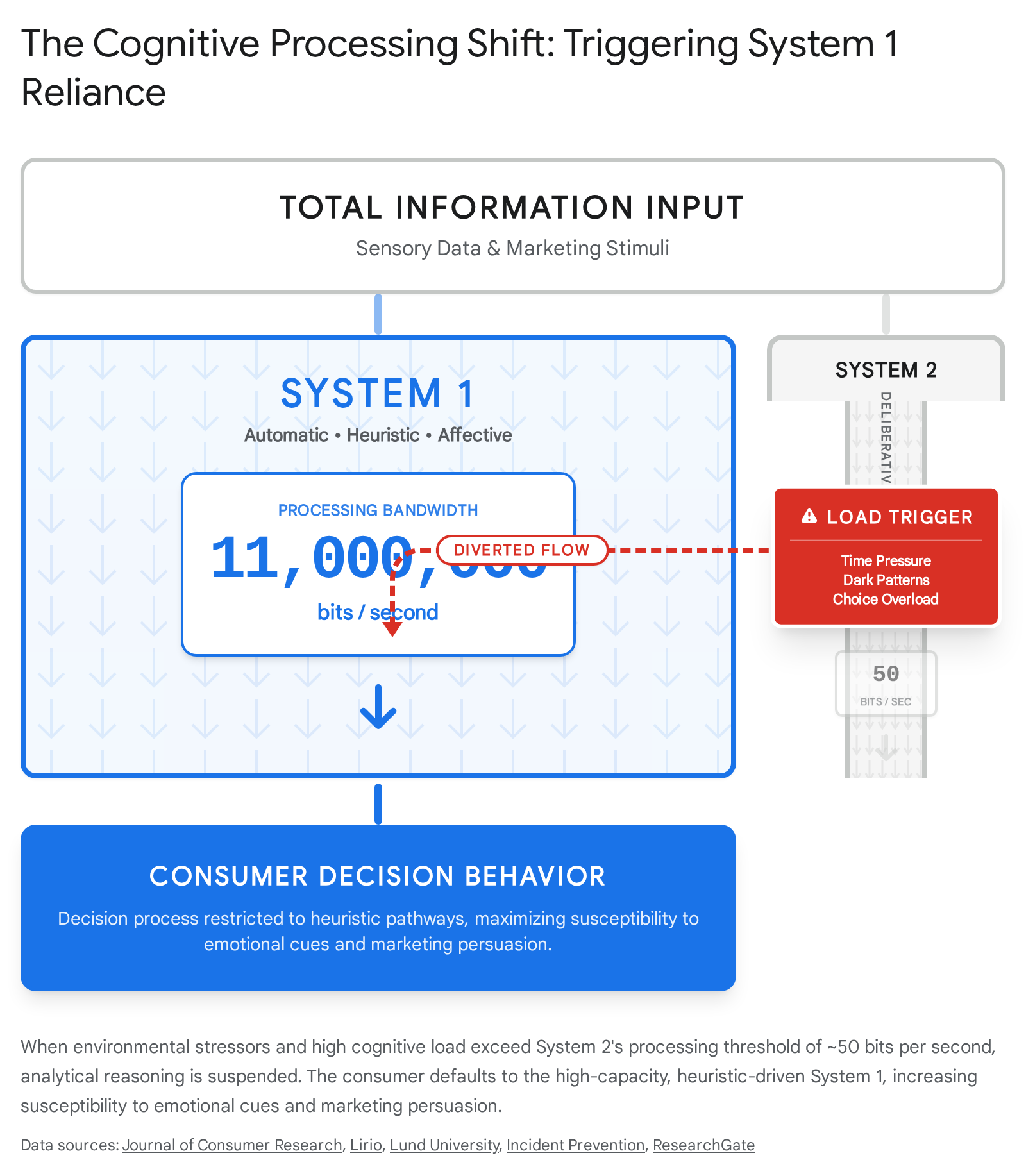
It executes a forced processing shift, suspending System 2's error-checking, analytical, and logical functions, and delegating the decision entirely to the high-capacity System 1 142131.
In this state of cognitive overload, the consumer's inherent "anti-persuasion system" collapses completely 33. They default to mental shortcuts, becoming highly responsive to processing fluency, perceived scarcity, authority biases, and algorithmic nudges 3134. Marketers often leverage "processing fluency" - the ease with which information is digested - as a heuristic for truth and quality, ensuring that high-load environments prioritize visually salient, simple messaging that System 1 accepts without friction, even if the underlying product details are unfavorable 2034.
High-Velocity Persuasion: Short-Form Video and Algorithmic Curation
The shift from desktop-based search commerce to mobile-first, algorithmically curated feeds represents a structural evolution in the mechanics of consumer persuasion 24. Short-form video platforms such as TikTok, Instagram Reels, and YouTube Shorts have fundamentally altered the impulse buying landscape by replacing user-initiated, linear product searches with system-driven, personalized recommendation feeds 2526. In these high-velocity environments, content is not actively sought out but passively received, creating a continuous loop of sensory input that exploits cognitive vulnerabilities.
In traditional e-commerce settings, consumers navigate linear architectures, allowing for self-paced evaluation of product placement, pricing, and visual appeal 25. Conversely, short-form video environments optimize for rapid, swipeable engagement, characterized by heavily constrained processing time, rapid cue turnover, and aggressive algorithmic curation 26. These platforms create a unique psychological context marked by high-frequency immersion, where persuasive urges are triggered rapidly and often completely bypass cognitive awareness 25.
A comprehensive 2024 meta-analysis published in the Psychological Bulletin, encompassing over 100,000 participants across 71 distinct studies, revealed alarming data regarding this format. The research found that heavy consumption of short-form video is highly correlated with diminished working memory performance, shortened attention spans, and severely deteriorated impulse control 27. Cognitive load theory explains the exact mechanism at play here: rapid, disconnected fragments of high-salience media overwhelm the visuospatial sketchpad and phonological loop, preventing the transfer of information into germane cognitive schemas 2327. The viewer is kept trapped in a state of high physiological arousal but low cognitive elaboration, effectively rendering them incapable of deploying critical persuasion knowledge 2527.
To accurately map this new reality, recent consumer behavior research has adapted classical behavioral paradigms, notably the Stimulus-Organism-Response (S-O-R) paradigm and the Cognitive-Affective-Conative (CAC) model 2829. In short-form live commerce, the traditional cognitive pathway to purchase is severely compressed. Instead, rapid algorithmic exposure serves as the stimulus, triggering immediate emotional arousal and "Fear Of Missing Out" (FOMO) within the organism, which directly drives the conative impulse buying response 2930. This is heavily supported by the Pleasure-Arousal-Dominance (PAD) theory, which posits that the visual and interactive features of flash sales and algorithmically curated feeds maximize emotional arousal while minimizing the consumer's sense of dominance or control over the pacing of information 30.
Interestingly, high-velocity feeds impose such immense cognitive load that marketers must actively reduce the complexity of their own creative assets to achieve persuasion. Extensive field experiments and laboratory studies published in late 2024 and 2025, involving over 8,000 participants, demonstrated that in short-form video feeds, a "single-actor" casting strategy significantly outperforms "multi-actor" executions 26. Multi-actor narratives introduce too much extraneous cognitive load for a 15-second format, requiring the viewer to map social relationships rather than process the product offering. By utilizing a single actor, cognitive load drops, processing fluency increases, and viewers make immediate, heuristic-based inferences of brand authenticity. This perceived authenticity functions as a high-leverage summary signal that rapidly converts fleeting attention into firm purchase intentions 26.
UX Dark Patterns: The Weaponization of Cognitive Constraints
While legitimate UX design seeks to minimize extraneous load to foster a seamless consumer journey, a massive and growing segment of digital commerce intentionally weaponizes cognitive load through the deployment of "Dark Patterns." Coined by UX designer Harry Brignull in 2010, dark patterns are deceptive, intentionally manipulative user interfaces designed to exploit cognitive biases, heuristic reliance, and user fatigue to steer consumers into actions they would not freely choose, such as unauthorized data sharing, unintended subscriptions, or hidden fee acceptance 424344.
Recent 2024 and 2025 ontological research classifies these manipulative practices into several distinct strategic categories that target specific cognitive vulnerabilities 4344. The most prominent categories include: * Obstruction (Roach Motels): Intentionally escalating the intrinsic and extraneous load of a task the user wants to accomplish. This is characterized by an asymmetric effort distribution, such as an effortless, one-click subscription process paired with a labyrinthine, multi-step cancellation flow that requires phone calls or navigating hidden menus 424431. * Interface Interference and Sneaking: Utilizing visual salience to hide true costs or pre-selecting disadvantageous default options. "Sneak into Basket" tactics exploit the status quo bias, betting that the cognitive load required to review and uncheck a pre-selected insurance or add-on fee is higher than the user's available bandwidth at checkout 434647. * Social Engineering and False Urgency: Fabricating scarcity cues or employing countdown timers to induce anxiety. This elevates emotional arousal, effectively shutting down analytical System 2 processing and forcing a hasty, impulsive decision 313249. * Confirmshaming: Utilizing framing effects to induce guilt or cognitive dissonance. Interfaces present the opt-out choice using manipulative language (e.g., "No thanks, I prefer paying full price"), exploiting social compliance heuristics when the user is mentally fatigued 424344.
Controlled experiments published in 2024 and 2025 confirm that cognitive load acts as a powerful catalyst for dark pattern effectiveness. When consumers are placed under high cognitive load - such as being forced to memorize digit sequences while shopping in a simulated environment - their susceptibility to "Sneak into Basket" and "Pop-up Bundling" dark patterns increases exponentially compared to users under low load 4647. The depleted working memory simply cannot engage in the error-checking necessary to detect the deception.
Counter-intuitively, the threat of dark patterns extends beyond human psychology into the realm of artificial intelligence. Groundbreaking studies conducted in late 2025 introduced the TrickyArena framework to test Large Language Model (LLM) web agents navigating e-commerce sites. The research revealed that even advanced algorithmic agents acting on behalf of users are highly susceptible to dark patterns, falling for deceptive UI structures an average of 41% of the time when attempting to complete automated tasks 50. Because these agents parse HTML code and visual hierarchy heavily influenced by dark pattern design, they frequently subscribe to unwanted services or accept hidden fees, highlighting a critical vulnerability in the automation of digital commerce 50.
While extreme dark patterns create massive short-term spikes in conversion metrics and revenue, longitudinal data indicates a severe erosion of brand trust, consumer autonomy, and long-term customer lifetime value 314933. Consequently, global regulators have initiated aggressive crackdowns. In 2024, the U.S. Federal Trade Commission (FTC) instituted strict "Click-to-Cancel" rules and imposed significant financial penalties on major platforms like Amazon for utilizing obstruction tactics in their Prime subscription cancellation flows 443134. Concurrently, the European Union's Digital Services Act (DSA) and the UK's Competition and Markets Authority (CMA) have explicitly targeted interface architectures that manipulate user choice through cognitive exploitation, classifying false urgency and hidden opt-outs as unfair trade practices 4431.
Persuasion Tactics by Cognitive Load Dependency
Because consumers operate dynamically across a broad spectrum of cognitive capacity, marketing strategies must be meticulously calibrated to the user's specific state of mental load to be effective. A central theoretical framework in this domain is the Persuasion Knowledge Model (PKM), which dictates a consumer's ability to recognize, evaluate, and defend against marketing manipulation 3536.
The activation of persuasion knowledge is highly dependent on the availability of System 2 working memory resources 3536. When cognitive load is low, consumers actively access their persuasion knowledge. They view covert marketing tactics, such as product placement in media or ambiguous advertising claims, with high skepticism, accurately assigning ulterior motives to the brand and resisting the persuasive attempt 3536. Conversely, when cognitive load is high, this critical defense mechanism collapses. The overloaded brain lacks the processing power to infer manipulative intent, and covert tactics are processed smoothly, resulting in positive affective brand associations 35.
The following table categorizes predominant marketing and persuasion tactics based on their efficacy under varying states of consumer cognitive load, outlining the psychological mechanisms that drive their success or failure:
| Persuasion Tactic / Strategy | Cognitive Load Dependency | Mechanism of Action & Theoretical Outcome |
|---|---|---|
| Limiting Choice / Curation | Highly Effective under High Load | Drastically reduces extraneous choice overload. Bypasses decision paralysis by distilling options to 3-4 optimal choices, restoring processing fluency and increasing decision confidence 345537. |
| Scarcity & False Urgency | Highly Effective under High Load | Imposes artificial time constraints (e.g., countdown timers). Induces anxiety and fear of missing out (FOMO), triggering a forced shift to System 1 heuristics and impulsive behavior 303249. |
| Narrative / Storytelling | Effective under Moderate/High Load | Leverages germane cognitive load. A compelling narrative distracts the analytical mind, preventing the activation of persuasion knowledge and reducing skepticism toward the ad's ulterior motives 43536. |
| Covert Product Placement | Highly Effective under High Load | When cognitive capacity is maxed out, consumers fail to detect the underlying manipulative intent of product placement, resulting in positive affective brand associations 3536. |
| Algorithmic Personalization | Highly Effective under High Load | Serves as an ultimate heuristic. The system does the cognitive sorting on behalf of the user, substituting the user's deliberation with the platform's predictive algorithmic trust 242532. |
| Confirmshaming / Guilt | Effective under High Load | A dark pattern that exploits emotional framing. When mentally depleted, users lack the capacity to rationalize the manipulative text and comply to avoid cognitive dissonance and guilt 424938. |
| Complex Pricing Tiers | Requires Low Load | Forces the consumer to utilize System 2 to calculate long-term value. If attempted under high load, it triggers severe price sensitivity, analysis paralysis, and cart abandonment 3458. |
| Two-Sided Arguments | Requires Low Load | Presenting pros and cons requires the user to hold competing variables in working memory. Effective for building deep trust with analytical consumers, but fails entirely if the user is fatigued 3339. |
Ecosystems of Load Management: Asian Super-Apps vs. Western Silos
The management of cognitive load is not merely a tactical user interface decision deployed by individual brands; it forms the foundational architecture of entire digital ecosystems. A macro-level comparative analysis between Western e-commerce environments and non-Western Asian markets highlights fundamentally divergent approaches to resolving extraneous cognitive load and managing digital consumer behavior.
In Asian markets, particularly in China and Southeast Asia, the digital landscape is heavily dominated by the "Super-App" paradigm, exemplified by platforms such as WeChat, Alipay, Grab, Gojek, and Kaspi.kz 404162. A super-app is a unified, closed-loop mobile platform that aggregates a vast array of seemingly disparate services - including instant messaging, social media, ride-hailing, food delivery, financial services, and e-commerce - into a single, cohesive interface 406342.
From a cognitive psychology perspective, super-apps are masterpieces of extraneous load reduction. Because the user remains within a single architectural environment for virtually all digital tasks, the interface rules, navigational hierarchies, payment credentials, and trust signals remain constant 4041. The consumer does not have to expend precious working memory learning a new UI for a food delivery service versus a banking service. This consistent "processing fluency" builds immense user trust and completely eliminates the cognitive friction associated with platform-switching 3440. Furthermore, by centralizing vast amounts of cross-functional user data, super-apps deploy hyper-personalized algorithmic feeds that accurately predict consumer needs, further bypassing System 2 deliberation and encouraging seamless, high-frequency transactions 434445.
However, while super-apps effectively minimize extraneous load, they dramatically alter the intrinsic nature of shopping by unleashing specific behavioral archetypes, most notably the "Maximizer" consumer profile. Southeast Asian markets exhibit intense optimizing behaviors, which are culturally encoded in concepts like Singapore's Kiasu - a Hokkien word translating to the fear of losing out or being bested 68. Research indicates that consumers exhibiting high Kiasu traits score significantly higher on maximization scales than their Western counterparts, driven by a deep-seated prevention focus and extreme price sensitivity 68. Because super-apps offer instant algorithmic price comparisons across thousands of vendors, gamified flash sales, and limitless options within one ecosystem, they encourage consumers to engage in exhaustive optimization 68. The "Digital Leapfrog Effect" in these mobile-first economies has created a cohort of digital natives who view hyper-comparison not as a cognitive burden, but as a mandatory routine, heavily reliant on the super-app's algorithmic recommendation engine to sort the overwhelming data flow on their behalf 6268.
In stark contrast, Western digital ecosystems in North America and Europe remain highly siloed. Consumers rely on disparate, specialized applications for discrete tasks - Uber for ride-hailing, Amazon for e-commerce, WhatsApp for messaging, and distinct banking apps for financial services 4146. While players like Uber and European neobanks like Revolut are attempting to unbundle and aggregate services to mimic the super-app model, their progress is heavily constrained by structural and cultural barriers 6370.
Western consumers experience significantly higher cognitive dissonance regarding single-app reliance due to deep-seated privacy concerns and a reluctance to centralize their digital footprint 62. Furthermore, stringent regulatory frameworks like the EU's General Data Protection Regulation (GDPR) and the California Consumer Privacy Act (CCPA) legally prevent the aggressive, seamless cross-functional data sharing that gives Asian super-apps their predictive algorithmic power 416243. Consequently, Western consumers consistently face higher extraneous load as they context-switch between disparate apps, forcing them to rely heavily on established brand loyalty rather than hyper-optimized, algorithmic discovery 4670.
Counter-Intuitive Outcomes: Choice Overload and Cart Abandonment
Classical economic theory operates on the foundational assumption of the rational agent, positing that maximizing consumer choice inherently maximizes consumer utility and satisfaction 375847. However, robust empirical evidence from behavioral economics reveals a highly counter-intuitive reality: pushing cognitive load past a critical threshold via excessive options results not in optimized purchasing, but in total system failure.
Often referred to as the "Paradox of Choice" or "Choice Overload," this phenomenon occurs when the sheer volume of product alternatives exceeds the limited 4-item capacity of human working memory 2183747. Seminal psychological research, most notably the famous "Jam Study" conducted by Sheena Iyengar and Mark Lepper, demonstrated that while large assortments attract high initial attention, they cause a massive, disproportionate drop in actual purchase conversions. In their experiment, an extensive display of 24 jams attracted more foot traffic but resulted in a dismal 3% conversion rate, whereas a limited display of only 6 jams yielded a 30% conversion rate 554849.
When faced with dozens of permutations, the cognitive cost of evaluating pairwise comparisons becomes metabolically exhausting 1847. Instead of making a choice, the consumer experiences acute emotional ambivalence, anxiety, and decision fatigue 1848. To resolve this severe psychological discomfort, the brain opts for the safest evolutionary response: avoidance, deferment, and inaction 183750.
In the digital realm, this choice paralysis is the primary psychological driver of Online Shopping Cart Abandonment (OSCA), a metric that plagues global e-commerce and costs retailers billions annually 344849. Research indicates that abandonment is rarely due to technical glitches or simple pricing disputes; rather, it functions as a psychological defense mechanism against cognitive strain 4849. Environments characterized by information overload induce specific types of cognitive strain, namely ambiguity confusion and similarity confusion. When consumers are faced with conflicting online reviews, or when products are poorly differentiated, it creates profound cognitive dissonance. To avoid the negative emotional outcomes of post-purchase regret and dissatisfaction, consumers simply abandon the cart as a form of self-protection 495051.
This paralyzing effect is particularly devastating among consumers identified as "Maximizers" or perfectionists. For a maximizer, decision paralysis arises from a cyclical, non-transitive evaluative mechanism 58. Instead of evaluating the absolute utility of what an option offers, the overloaded brain begins penalizing each alternative for its specific deficiencies compared to the myriad of other options available. This creates a psychological preference cycle (Option A is better than Option B, Option B is better than Option C, but Option C possesses a minor feature missing in Option A), trapping the consumer in an endless loop of deliberation that ultimately concludes with exhaustion and an abandoned cart 58. Marketers who fail to understand this dynamic often exacerbate the problem, providing ever more detailed specification sheets and options in a misguided attempt to satisfy the consumer, thereby driving cognitive load even higher and guaranteeing abandonment.
Conclusion
The intersection of cognitive psychology and digital commerce reveals an undeniable reality: human attention and working memory are the ultimate scarce resources in the modern economy. As the psychological replication crisis has forced a refinement of our understanding of ego depletion, it is clear that cognitive fatigue is not merely a biological loss of energy, but a critical, adaptive motivational shift. This shift renders consumers highly vulnerable to external heuristics, affective triggers, and manipulative design. The meteoric rise of short-form algorithmic video feeds and the covert, pervasive deployment of UX dark patterns both capitalize on these exact cognitive limits, intentionally bypassing System 2 deliberation to farm impulsive, System 1 responses.
While Asian super-apps have successfully mitigated extraneous cognitive load by centralizing entire digital ecosystems, facilitating unprecedented transactional volume, the universal threat of choice paralysis remains a limiting factor across all cultural contexts. Ultimately, the future of ethical and effective digital marketing lies not in bombarding consumers with endless options, aggressive algorithmic pressure, or deceptive urgency. Instead, it relies on the deliberate curation of choice architectures that respect the strict, biological limitations of human working memory. Platforms that prioritize processing fluency, minimize extraneous load, and guide consumers toward germane understanding will not only capture short-term conversions but will secure resilient, long-term consumer trust in an increasingly saturated digital economy.