
Behavioral economics of pricing and consumer value perception
The Maturation of Behavioral Economics: Moving Beyond the Replication Crisis
For the first two decades of the twenty-first century, behavioral economics enjoyed an unprecedented period of academic prestige and widespread corporate adoption. The discipline, popularized by foundational texts such as Daniel Kahneman's Thinking, Fast and Slow and Dan Ariely's Predictably Irrational, reshaped how governments, retail corporations, and digital marketers understood human decision-making 11. The core premise - that human beings are "predictably irrational" and subject to systematic, exploitable cognitive biases - birthed the "nudge" revolution 12. Retailers and digital platforms eagerly adopted behavioral interventions, operating under the assumption that subtle, cost-free tweaks to choice architecture could effortlessly guide consumer purchasing behavior and enhance profitability.
However, the field has recently undergone a severe methodological reckoning. The broader psychological replication crisis, which began gaining momentum in the mid-2010s, has increasingly targeted the foundational pricing and behavioral studies that once defined the discipline 3465. A significant portion of the early behavioral economic literature relied heavily on small sample sizes, underpowered laboratory experiments, and highly specific contexts to achieve statistically significant results 345. The "R-Index," a forensic statistical metric designed to estimate the true statistical power and credibility of a body of literature, revealed that many highly cited studies from the early 2000s capitalized heavily on chance 3. In some retrospective analyses of classic chapters detailing priming and anchoring, the R-Index fell drastically below 50, suggesting that the original findings were mathematically highly unlikely to be reproducible 3.
The Re-evaluation of Foundational Scholars and Studies
The credibility of several cornerstone behavioral studies has been severely compromised by subsequent replication failures and, in some high-profile cases, explicit data fabrication. The most prominent example involves the work of Dan Ariely, who historically served as one of the most visible and influential proponents of behavioral economics. A highly influential 2012 study co-authored by Ariely, which claimed that having individuals sign an honesty pledge at the beginning of a document rather than the end significantly reduced dishonest reporting, was fully retracted in 2021 48610. The retraction occurred after independent researchers at Data Colada published a rigorous forensic analysis demonstrating that the underlying data, allegedly provided by an auto insurance company, had been egregiously fabricated 458. The data manipulation was exposed through anomalies in typographic fonts and statistical impossibilities within the dataset's distribution 87. Even prior to the discovery of fraud, massive multi-lab replication attempts between 2019 and 2020 had already failed to reproduce the "signing at the top" effect 867. Furthermore, other foundational experiments outlined in Predictably Irrational, such as those concerning the strict enforcement of deadlines to overcome procrastination, have similarly failed modern, preregistered replication attempts, showing negligible effects on performance metrics 8.
This scandal catalyzed a broader, retrospective scrutiny of earlier behavioral pricing and consumer choice literature. Concepts that were once treated as universal laws of human behavior have been systematically downgraded to context-dependent phenomena. For example, the "Identifiable Victim Effect" - a principle often used by marketers to justify premium pricing for ethical, fair-trade, or charitable consumer goods based on the assumption that consumers will pay more for a single, identifiable narrative - has suffered repeated replication failures 13. Recent high-powered Bayesian meta-analyses suggest that consumers are not genuinely demonstrating a preference for an identifiable victim, but are instead suffering from "scope-insensitivity," making the original theory highly unreliable for practical application 13. Similarly, the extensive literature on "ego depletion," which posited that willpower is a finite resource that, when exhausted, leaves consumers highly susceptible to impulsive purchasing and premium up-selling, has been largely dismissed. Meta-psychologists and massive replication attempts involving over 2,000 participants failed to show any real effect once publication bias was controlled 9.
Meta-Analytic Corrections and the Real-World Efficacy of "Nudges"
The replication crisis has profoundly altered how modern behavioral economists and pricing strategists evaluate interventions. Instead of relying on single, clever laboratory studies, the discipline now demands rigorous, preregistered meta-analyses and large-scale field trials.
A pivotal 2024 debate surrounding the fundamental efficacy of "nudging" perfectly illustrates this paradigm shift. When a comprehensive meta-analysis initially suggested that choice architecture is a universally effective behavior change tool, independent re-analyses correcting for "moderate publication bias" found that the underlying evidence for the effectiveness of standard nudges virtually vanished 2. Researchers then compared academic studies to large-scale, real-world randomized controlled trials (RCTs) conducted by institutional "Nudge Units" (teams embedded within governments and large corporations). The disparity in effect sizes was stark. While academic journals previously reported interventions yielding an massive 8.7 percentage point increase in desired consumer behaviors over control groups, the large-scale institutional field trials reported a much smaller, albeit statistically significant, 1.4 percentage point impact 2. Furthermore, multi-stage field experiments attempting to use behavioral nudges to alter commuting habits across nearly 70,000 employees found an absolute zero effect, reinforcing the limitations of superficial psychological interventions 2.
The consensus in 2024 and beyond is not that behavioral economics is entirely "dead," but rather that the discipline has shed its naive optimism 613. The blind application of isolated cognitive biases without considering cultural fit, prior consumer knowledge, ethical framing, or fundamental economic utility is obsolete 6. Today, the efficacy of a pricing strategy relies on understanding complex, interactive cognitive mechanisms rather than relying on the "magic" of a single nudge.
Re-Examining the Boundaries of Choice Architecture: Anchoring and the Decoy Effect
Despite the replication crisis, certain cognitive phenomena related to numerical processing have proven remarkably resilient, though their commercial application has been heavily refined and constrained. Chief among these are the Anchoring Effect and the Decoy Effect (Asymmetric Dominance).
The Evolution of the Anchoring Effect
The anchoring effect - the tendency for individuals to rely too heavily on an initial piece of information when making subsequent quantitative judgments - remains one of the most robust psychological phenomena in judgment and decision-making literature 10111213. A monumental meta-analysis encompassing fifty years of anchoring research and over 2,130 effect sizes confirmed that numeric anchoring exerts a large overall effect ($d = 0.88$) on estimations and willingness-to-pay (WTP) metrics, maintaining its significance even after stringent publication-bias corrections 1314. The effect has been demonstrated not only in single point estimates (the mean) but also persists when eliciting entire subjective distribution beliefs, heavily influencing how consumers perceive price ranges 12.
However, recent studies have nuanced the traditional, somewhat extreme understanding of "arbitrary coherence" 151617. Arbitrary coherence, heavily promoted by early behavioral economists, proposed that completely random numbers could permanently anchor price preferences, meaning consumers did not have stable internal valuations but simply generated them on the fly based on environmental cues 101523. While early experiments suggested consumers would blindly adhere to these arbitrary anchors, recent longitudinal replications utilizing "learning design contingent valuation" models demonstrate that preferences actually converge toward standard economic expectations through processes of repetition, learning, and market exposure 15. Consumers are not permanently trapped by arbitrary anchors; rather, they experience a temporary "illusion of order" that dissipates as they gain market experience and access to comparative pricing distributions 1517.
Furthermore, the relevance of the anchor matters significantly in real-world pricing. Meta-regression analyses reveal that non-random, compatible anchors (e.g., a "manufacturer's suggested retail price," a competitor's historical price, or an algorithmic baseline) produce substantially higher anchoring effects than the bizarre, unrelated anchors often used in legacy laboratory studies 111418.
The Decoy Effect (Asymmetric Dominance)
The Decoy Effect posits that introducing a third, inferior option (the decoy) shifts consumer preference toward a more expensive, dominating target option 19262720. The classic demonstration involved The Economist magazine subscription options: offering a digital subscription for $59, a print-only subscription for $125 (the decoy), and a print-and-digital bundle for $125 19262729. The print-only option, being clearly inferior to the bundle at the same price point, was designed not to be sold, but to reframe the premium bundle as a massive value gain 2620. In early experiments, introducing the decoy boosted selection of the premium option from 32% to 84% 2720.
While the fundamental mechanism of asymmetric dominance survives, recent peer-reviewed replications have heavily circumscribed its optimal domain. A comprehensive 2024 integrative review analyzing four decades of work found that out of 91 attempts to reproduce the attraction effect across 23 different product categories, only 11 produced highly reliable, commercially viable results 30.
Modern research indicates that the decoy effect operates effectively only under highly specific boundary conditions: 1. Perceptual Clarity and Status Quo: The consumer must clearly perceive the decoy as inferior. If the choice set is too ambiguous, or if the consumer has a strong pre-existing preference (status quo bias), the decoy is ignored entirely 3021. In fact, status quo bias often overpowers the decoy effect when the two are in direct competition 30. 2. Cognitive Load and Fluency: In complex digital marketplaces, introducing multiple decoys can cause cognitive overload. A 2024 empirical study on online diamond marketplaces demonstrated that while a single decoy increases target preferences (yielding up to a 14.3% gross profit increase), adding a third or fourth decoy cancels out the effect entirely, bringing choice shares back to baseline levels due to choice paralysis 3022. 3. Value-Based vs. Perceptual Constraints: The decoy effect struggles to replicate in pure perceptual tasks (e.g., visual discrimination of physical sizes) compared to value-based economic decisions, indicating that it is deeply tied to the higher-order psychological calculation of subjective value rather than a basic flaw in human sensory processing 33.
Foundational Mechanisms: Prospect Theory and Non-Linear Perception
To fully understand modern pricing architectures, analysis must extend beyond isolated environmental "nudges" to the foundational, evolutionary mechanisms of human cognition, primarily governed by Prospect Theory and psychophysics.
Loss Aversion and Internal Reference Prices
Developed by Daniel Kahneman and Amos Tversky, Prospect Theory fundamentally altered the understanding of value by introducing the concept of a "reference point." Value is not absolute; it is perceived as a gain or a loss relative to a consumer's internal reference price, which is heavily influenced by past purchases, market norms, and prominent environmental anchors 192335.
The principle of loss aversion dictates that the psychological pain of losing a specific amount is significantly more intense than the pleasure of gaining that exact same amount 1936. In pricing strategy, this mechanism explains why surcharges, dynamic price hikes, or shipping fees are vastly more damaging to consumer conversion rates than missing out on an equivalent dollar-value discount. Decoys and premium bundles work by exploiting this exact feature; they reframe a higher absolute price as a "gain" in relative value, sparing the consumer the psychological penalty of a perceived financial loss 1930.
However, contemporary meta-reviews have introduced a critical caveat to the universality of loss aversion. While it undeniably exists for high-stakes decisions and large monetary amounts, early behavioral studies vastly overstated its presence in low-value, everyday transactions 2. Modern consumers, conditioned by decades of volatile retail pricing, do not experience severe loss aversion over minor price fluctuations, indicating that loss aversion scales non-linearly and is heavily context-dependent 2.
The Weber-Fechner Law of Price Perception
The non-linear scaling of price perception is mathematically modeled by the Weber-Fechner Law, a foundational principle of sensory psychophysics that maps seamlessly onto behavioral economics 373824. The law consists of two components: Weber's Law states that the "Just Noticeable Difference" (JND) in a stimulus is a constant proportion of the original stimulus intensity, while Fechner's Law proposes that the subjective, perceived intensity of a stimulus increases logarithmically with the actual, physical intensity 3724.
In behavioral pricing, the Weber-Fechner Law ($\Delta I / I = k$) dictates that the psychological impact of a price change is entirely relative to the baseline price 382425. A $5 discount on a $20 software subscription is perceived as a massive gain (a 25% change), whereas a $5 discount on a $1,000 luxury handbag is psychologically invisible, failing to cross the threshold of the Just Noticeable Difference 3738.
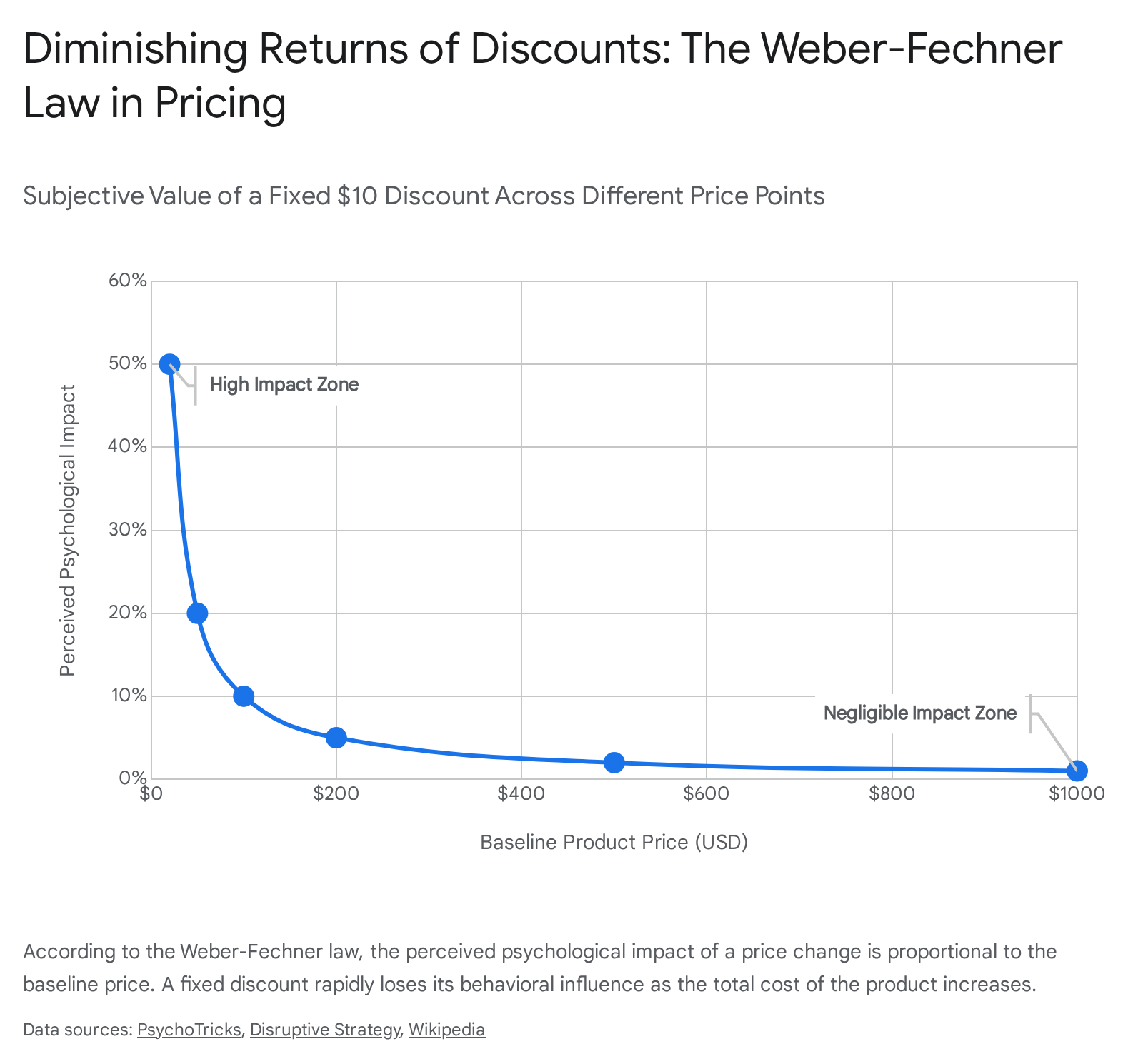
Recent neurophysiological models suggest this phenomenon emerges from recurrent attractor networks and choice circuits computing categorical decisions based on global inhibition, although minor deviations (a mild convex relationship) are observed at extremely low-intensity ranges 2541.
This logarithmic perception of price changes dictates tiered promotional strategy across the retail spectrum. Retailers operating in low-price tiers (e.g., $20 to $99) must rely heavily on percentage discounts to trigger the perception of value, whereas luxury retailers or enterprise SaaS providers operating in the thousands of dollars must use massive absolute dollar discounts to cross the psychological threshold of the Just Noticeable Difference 3738.
Global Variations and the Boundary Conditions of Charm Pricing
One of the most ubiquitous behavioral pricing tactics globally is "charm pricing" (also known as odd pricing or just-below pricing) - the practice of ending a price in .99 or .95 (e.g., $9.99 instead of $10.00). The traditional cognitive mechanism driving this is the "left-digit bias" or left-digit drop-off 362643. Because Western consumers read and encode numbers from left to right, the brain anchors on the magnitude of the leading digit before fully processing the fractional decimal values. Thus, the psychological distance between $3.99 and $4.00 feels vastly larger than the mathematical one-cent difference, as the consumer intuitively categorizes the $3.99 item as a "$3-range" product 362643.
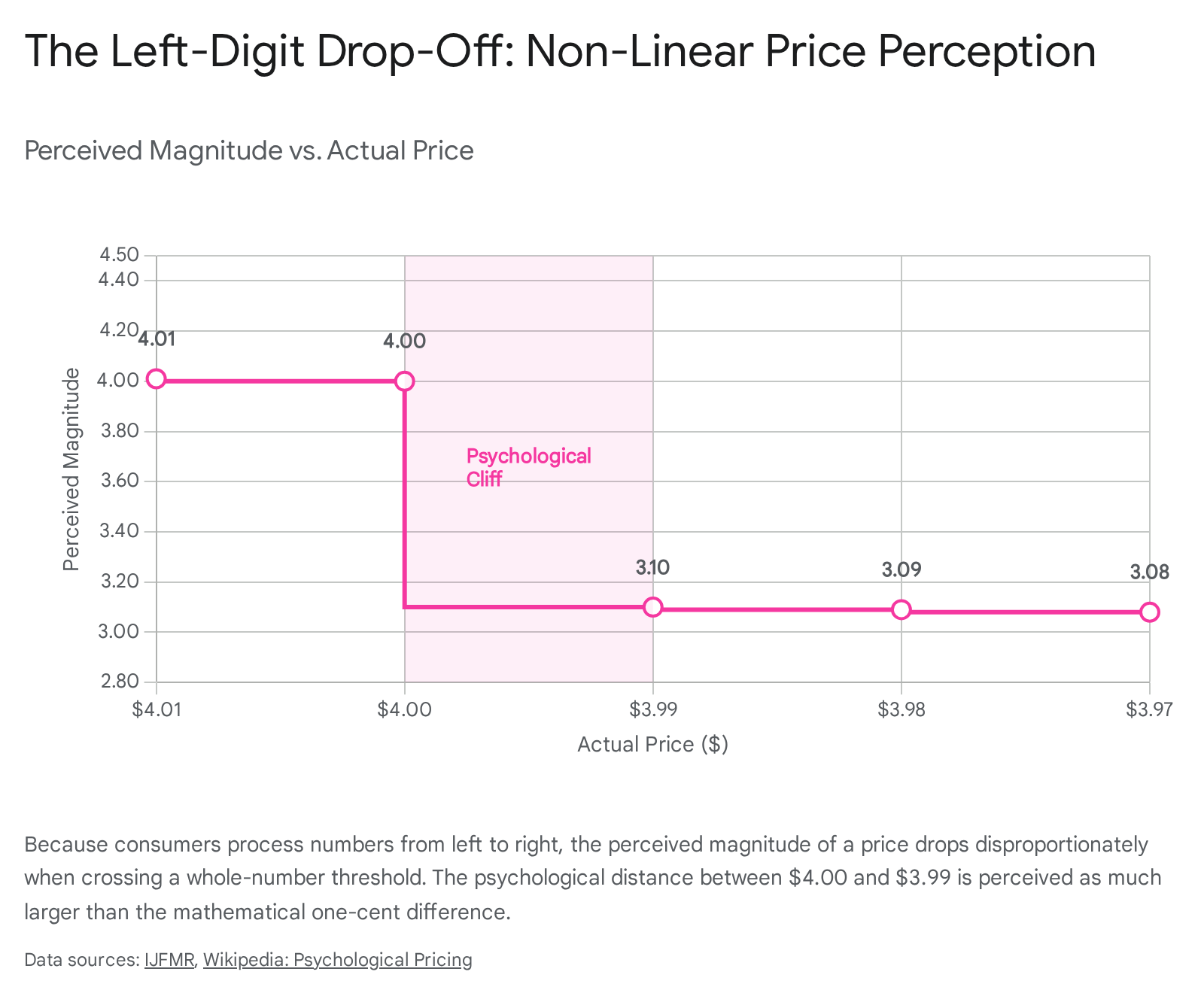
However, extensive recent meta-analyses highlight severe misconceptions regarding the universal applicability of charm pricing. It is not a universally optimal strategy; it carries distinct signaling costs and is subject to profound cultural and sectoral boundary conditions.
Cultural Divergence: Low-Context vs. High-Context Markets
A critical failure of early behavioral economics was the assumption that cognitive heuristics derived from Western, educated, industrialized, rich, and democratic (WEIRD) populations applied globally 62728. The application of price endings is profoundly dictated by cultural context, specifically the divergence between low-context and high-context cultures, alongside linguistic numerology 284629.
In low-context Western cultures (e.g., the United States, Canada, and Northern Europe), prices ending in '9' dominate, appearing in roughly 44% of retail transactions 46. Western consumers extract information directly from the explicit message of the price tag, accepting the '9' as a standard market signal for value or a discounted state 2829.
Conversely, in high-context Asian markets (such as Japan, China, Hong Kong, and Singapore), the digits '0' and '8' dominate price endings, while the use of '9' is significantly lower 27464830. High-context consumers evaluate the entire ecosystem of a transaction, and frequently view odd-ending prices with skepticism, perceiving them as manipulative attempts by the retailer to artificially lower the perceived cost, thereby eroding brand trust 284629. An interesting exception exists in Eastern Europe; research indicates that consumers in Poland similarly reject 9-ending prices, viewing them unfavorably due to a legacy of confrontational bargaining cultures inherited from the ex-Soviet era 29.
Furthermore, phonetics and cultural superstitions heavily dictate optimal pricing. In Chinese and Cantonese-speaking markets, the number '8' is phonetically similar to the word for "wealth" or "multiply" 27464850. This linguistic alignment transforms the '8-ending' price from a mere mathematical figure into a powerful signal of luck, prosperity, and goodwill 4830. Empirical analyses show that the digit '8' is used up to 18% of the time as a price ending in Asia, compared to just 8% in the United States 48. In Japan, the digit '8' visually resembles the shape of a mountain, signifying growth, while rounded '0' endings are preferred for signaling honesty and straightforwardness 464851.
| Pricing Metric | Low-Context Cultures (e.g., US, UK) | High-Context Cultures (e.g., Japan, China) | Primary Cultural Driver |
|---|---|---|---|
| '9' Endings Frequency | 44% | 23% | Strong reliance on left-digit bias and explicit discount signaling in the West. |
| '0' Endings Frequency | 30% | 50% | Preference for honesty, straightforwardness, and relationship trust in the East. |
| '8' Endings Frequency | < 8% | 18%+ | Phonetic association with wealth ("multiply") and visual association with growth. |
Consequently, global brands must aggressively localize their pricing architectures; implementing a rigid $9.99 strategy in Tokyo or Beijing actively works against the brand's psychological positioning 4651.
Premium Signaling and the Round Number Effect
Beyond geographic variations, charm pricing faces a strict sectoral boundary condition: it fundamentally degrades the perceived quality of the product 364328. A robust body of evidence generated between 2023 and 2025 demonstrates that for luxury goods, recreational services, and premium SaaS tiers, charm pricing backfires, reducing gross revenue 4331.
In premium markets, consumers rely on "odd-even pricing" heuristics where round numbers (e.g., $200.00) are processed with higher cognitive fluency 43. This fluency is subconsciously associated with honesty, completeness, and premium quality 2831. A meta-analysis of over 360 effect sizes confirmed that while just-below prices increase standard purchase decisions, round prices have no negative effect on perceived product quality and maintain a prestigious brand image 32.
The preference for whole numbers is deeply ingrained when consumers exert autonomy. In pay-what-you-want (PWYW) digital experiments, such as the World of Goo video game release, 57% of consumers across 104 countries naturally gravitated toward round, whole-dollar amounts, reflecting a deep psychological preference for clean integers when paying for intrinsic value 31. Analyses of massive securities market datasets (over 134 million transactions) further reveal a disproportionate volume of trades executing exactly at round integer prices, demonstrating that even sophisticated financial actors succumb to cognitive rounding heuristics 33. Therefore, charm pricing optimizes conversion for hedonic, utilitarian, and highly competitive low-cost goods, whereas round numbers are mandatory for establishing prestige, quality, and consumer trust 432832.
The Psychology of Price Perception in High-Inflation Economies
The global inflationary shocks of the post-pandemic era have provided a vast, involuntary field experiment regarding how consumers process prices during periods of macroeconomic volatility 553435. Behavioral studies tracking consumer sentiment in high-inflation environments (such as the UK, US, and EU), alongside deeply volatile economies like Argentina and Turkey, reveal a persistent disconnect between actual macroeconomic inflation rates and perceived inflation 55343637.
Sticky Expectations and the Role of "Price Mavens"
In economies where inflation has rapidly decelerated to normalized targets (e.g., the US achieving ~2.9% by mid-2024), consumer perception of inflation remains stubbornly high 343536. This occurs due to "sticky" psychological anchoring. Consumers do not evaluate prices sequentially quarter-over-quarter; they anchor their internal reference prices to distinct historical eras, most notably pre-pandemic 2020 levels 3638. Because the absolute price level has not fallen - it is simply rising at a slower rate - consumers perceive the vast cumulative gap (e.g., a 24.68% cumulative increase in food-at-home prices since 2020) as evidence of rampant, ongoing inflation 36.
This perception is heavily amplified by a demographic cohort categorized as "Price Mavens." These are highly engaged, price-sensitive shoppers who actively utilize comparison tools and promotions, accounting for up to 65% of all public "noticings" and complaints regarding price hikes, despite making up only 12% of the consumer base 55. These individuals dictate the social narrative around pricing 55. Furthermore, behavioral tracking indicates that the narrative behind a price increase is significantly more powerful than the mathematical increase itself. A price hike attributed to corporate profiteering triggers intense brand abandonment and lowers enterprise value, whereas an equivalent or even a 16% higher price increase attributed to transparent supply-chain costs is tolerated by consumers as fair 55.
The Behavioral Scars of Argentina and Turkey
In economies experiencing chronic, extreme inflation, the standard cognitive mechanisms of pricing completely break down, forcing populations to adopt radical behavioral adaptations.
In Turkey, which experienced inflation exceeding 33% into late 2025 alongside a rapidly depreciating lira, erratic central bank policies and massive minimum wage hikes (including sequential jumps of 55%, 34%, and 49% across 2023 and 2024) created a self-fulfilling wage-price spiral 396240. Consumers, anticipating that holding lira guarantees a loss of purchasing power, accelerate their consumption of durable goods to lock in value, thereby driving aggregate demand and prices even higher 39.
In Argentina, where inflation breached 160% in late 2023 before settling near 33.6% following President Javier Milei's radical "shock therapy" interventions, decades of currency devaluation have trained the populace to cognitively anchor all large purchases to the US Dollar, mentally bypassing the peso entirely 39624041. In these high-friction markets, standard behavioral nudges like "charm pricing" are mathematically obliterated by daily or weekly price updates. Instead, retail survival relies on constant algorithmic indexing and real-time dynamic pricing to match the decaying value of the nominal anchor 4165.
Modern Digital Pricing: Dynamic Algorithms and Regulatory Backlash
As behavioral economics transitions from academic laboratories into the frictionless digital economy, the focus of pricing strategy has shifted from static choice architecture (like printing a decoy option on a restaurant menu) to dynamic, algorithmic pricing. This evolution allows firms to exploit cognitive biases at an individual level and at immense scale, but it has simultaneously triggered massive regulatory scrutiny.
Drip Pricing and the "Junk Fee" Crackdown
Drip pricing is a deceptive design pattern (widely classified as a "dark pattern") where a firm advertises an artificially low baseline price to lure a consumer into the sales funnel, only to reveal mandatory or unavoidable fees at the final checkout stage 664243444546. This tactic weaponizes two powerful cognitive biases: 1. The Anchoring Effect: The consumer anchors their perceived value to the initial low price, making transparently priced competitor products appear artificially expensive from the outset 434672. 2. The Sunk Cost Fallacy & Loss Aversion: By the time the final fees are revealed, the consumer has already invested significant time and emotional energy into the transaction process. Abandoning the cart feels like a loss of effort, compelling them to proceed despite the financial penalty 4672.
Recognizing the immense consumer harm - estimated at tens of millions of hours in wasted search time and over $11 billion in hidden costs over a decade in the US alone, alongside massive trust erosion representing 1.1% of GDP across OECD countries - regulatory bodies launched an aggressive crackdown in 2024 and 2025 434547. The U.S. Federal Trade Commission (FTC) introduced a sweeping Section 18 "Junk Fees Rule" specifically targeting live-event ticketing and short-term lodging, mandating explicit "all-in pricing" up front 667247. Simultaneously, state legislatures took unprecedented action; California enacted SB-478 (the "Honest Pricing Law") and Minnesota enacted similar statutes in 2024 and 2025, rendering drip pricing illegal and forcing complete price transparency from the first consumer impression 664243.
Algorithmic Anchoring and Surveillance Pricing
The current frontier of behavioral pricing is "Surveillance Pricing," also known as algorithmic personalized pricing 744849. Utilizing vast troves of consumer data - including browsing history, geographic location, device type, demographic profiles, and past purchase behavior - algorithms dynamically calculate an individual consumer's exact willingness-to-pay (WTP) in real-time 74484950.
This mechanism extends far beyond standard "surge pricing" (which adjusts prices based on aggregate market demand, famously utilized by Uber) 48. Surveillance pricing allows a retailer to set a unique price for each individual user. For instance, journalistic investigations in 2024 revealed that hotel and retail apps were showing prices varying by hundreds of dollars depending on the user's IP address or physical proximity to a competitor's physical store 48. In the housing market, algorithmic pricing platforms like RealPage have been utilized by property managers to centrally coordinate and artificially inflate rental prices across entire metropolitan areas, circumventing traditional supply-and-demand mechanics 484951.
While highly profitable, algorithmic pricing introduces severe behavioral risks related to consumer trust and perceived fairness. Empirical studies indicate that when consumers discover they are subject to AI-driven price discrimination based on personal data, they experience a profound loss of agency, triggering retaliatory behaviors, negative brand attributions, and immediate market disengagement 495051. The perception of fairness relies heavily on market norms; consumers somewhat accept dynamic pricing for airline tickets due to decades of exposure, but reject it aggressively when applied to hardware, groceries, or fast food via digital electronic shelf labels 4849.
In response, 2024 and 2025 saw a massive legislative push. Over 50 bills were introduced at the U.S. state level targeting algorithmic price-fixing (specifically rent-setting software) and mandating strict consumer disclosures when AI is used to manipulate individual pricing 484952. At the federal level, the FTC utilized its administrative subpoena power to investigate eight major dynamic pricing vendors, signaling that the era of unchecked digital behavioral manipulation is facing unprecedented legal and regulatory boundaries 7449. Consumers are also adopting behavioral counter-strategies, such as strategically deleting cookies or abandoning carts to "bargain" with the algorithm, purposely signaling a low WTP to trigger subsequent discount offers 52.
Comparative Analysis of Pricing Architectures
The following table synthesizes the core pricing strategies utilized in modern behavioral economics, detailing their cognitive mechanisms, optimal domains, and critical limitations based on the latest empirical replications.
| Pricing Strategy | Primary Cognitive Mechanism | Optimal Market Domain | Known Boundary Conditions & Limitations |
|---|---|---|---|
| Anchoring Effect | Heuristic reliance on initial information; insufficient cognitive adjustment. | B2B negotiations, real estate, SaaS tiering, initial discount baselines. | Requires a plausible, relevant anchor. Outlandish or arbitrary anchors lose efficacy rapidly as consumers learn and access comparative data. |
| Decoy Effect (Asymmetric Dominance) | Relative valuation; loss aversion. Modifies the internal reference point to favor a specific target. | Subscription models, hardware configurations, layered consumer services. | Frequently fails replication. Fails if the decoy is not strictly dominated, or if the choice set is too complex (adding 3+ decoys causes cognitive overload). |
| Charm Pricing (Left-Digit Effect) | Left-to-right cognitive processing; rapid magnitude encoding causing an artificial perception cliff. | FMCG, retail groceries, fast fashion, low-context Western digital marketplaces. | Signals low quality. Actively damages brand equity and trust in luxury sectors, premium services, or high-context Asian markets (where '0' or '8' are preferred). |
| Round Number Effect | Cognitive fluency; symbolic signaling of completeness, prestige, and honesty. | Luxury goods, tipping, professional services, pay-what-you-want (PWYW). | Ineffective for utilitarian or low-cost goods where consumers are actively hunting for a "deal" or explicit discount signals. |
| Drip Pricing | Sunk cost fallacy; sequential anchoring. Artificially lowers the initial barrier to entry. | Historically: Airlines, live-event ticketing, short-term digital rentals. | Highly Regulated. Faces severe legal crackdowns (FTC, State laws in 2024/2025). Causes massive long-term trust erosion and brand damage. |
| Algorithmic Dynamic Pricing | Real-time calculation of personalized Willingness-to-Pay (WTP) using big data variables. | Ride-sharing, e-commerce platforms, hyper-local retail, digital advertising. | Extremely high risk of perceived unfairness. Subject to increasing antitrust and surveillance privacy legislation (e.g., RealPage rent-setting). |
Conclusion
The landscape of behavioral economics and pricing strategy has matured significantly from the initial, highly optimistic era of Predictably Irrational. The replication crisis served as a painful but necessary scientific crucible, burning away unreliable, underpowered laboratory tricks, exposing instances of data fabrication, and leaving behind a core set of resilient, albeit heavily nuanced, cognitive mechanisms.
Modern pricing strategy is no longer about finding a universal "nudge." It requires a highly sophisticated understanding of boundary conditions and systemic psychophysics. A pricing architect must recognize that while a $9.99 price tag will drive conversion for a commodity, it will systematically destroy the prestige of a luxury brand. They must understand that the number '8' carries the weight of prosperity in Asian markets, completely invalidating Western odd-even pricing heuristics. Furthermore, they must navigate the psychological scarring of macroeconomic inflation, recognizing that consumer reference prices are sticky and heavily influenced by the narrative supplied by "Price Mavens."
Ultimately, the future of pricing lies in the digital realm, where algorithmic architectures, surveillance pricing, and dynamic market structures have replaced static printed menus and physical decoys. However, as regulatory bodies like the FTC, the OECD, and state legislatures aggressively step in to curb deceptive practices like drip pricing and algorithmic collusion, the successful commercial entities of the future will be those that balance the optimization of cognitive biases with the fundamental, unalterable necessity of consumer trust and perceived economic fairness.