
Psychology of reciprocity in promotional marketing models
Foundational Theories of Reciprocity in Consumer Behavior
The psychological principle of reciprocity operates as a fundamental engine of human social interaction and economic exchange. Rooted in evolutionary biology and sociological frameworks, the norm of reciprocity posits that when an individual receives a benefit, gift, or concession, they experience a powerful psychological drive to return the favor 112. Initially explored in depth by sociologist Alvin Gouldner in the 1960s, and subsequently popularized in consumer psychology by Robert Cialdini, reciprocity serves as the invisible architecture of relational marketing 34. It shifts consumer behavior away from pure transactional utility - the concept of homo economicus - and engages the relational, moral, and emotional dimensions of human decision-making, increasingly conceptualized as homo virtus 5. Quantitative models analyzing human well-being and behavioral functions suggest that the homo virtus dimension, which relies heavily on concepts like reciprocal obligation and virtue, accounts for a substantial weight in holistic behavioral outcomes 5.
In modern marketing ecosystems, businesses operationalize the norm of reciprocity through strategies that provide upfront value without the immediate requirement of compensation 6. By offering free samples, gifts-with-purchase (GWP), or freemium software access, marketers aim to trigger a psychological sequence characterized by an initial stimulus, a subsequent feeling of indebtedness, and an ultimate behavioral response 7810. Rather than relying solely on the persuasive power of traditional advertising, these models alter the consumer's cognitive state. The consumer transitions from an independent evaluator of a product to an active participant in an implicit social contract 11. This dynamic moves transactions along a continuum from purely market-mediated commodity exchanges toward non-market relational exchanges governed by balanced or negative reciprocity norms 9.
However, the application of reciprocity in marketing is not a uniform mechanism that guarantees increased revenue. The effectiveness of reciprocity is heavily moderated by the context of the offer, the perceived motives of the firm, and the inherent cognitive biases of the consumer 101112. When deployed incorrectly, reciprocity-based marketing can trigger psychological reactance, wherein the consumer feels their autonomy is threatened by manipulative tactics, resulting in a severe backfire effect 131714. Furthermore, extended exposure to free value can induce hedonic adaptation and consumer entitlement, transforming a generous gesture into a rigid baseline expectation 191516. To understand how reciprocity functions across various commercial landscapes, it is necessary to examine the distinct psychological mechanics underlying free sample marketing, gift-with-purchase strategies, and digital deferred-monetization models.
Cognitive and Affective Mechanisms in Free Sample Marketing
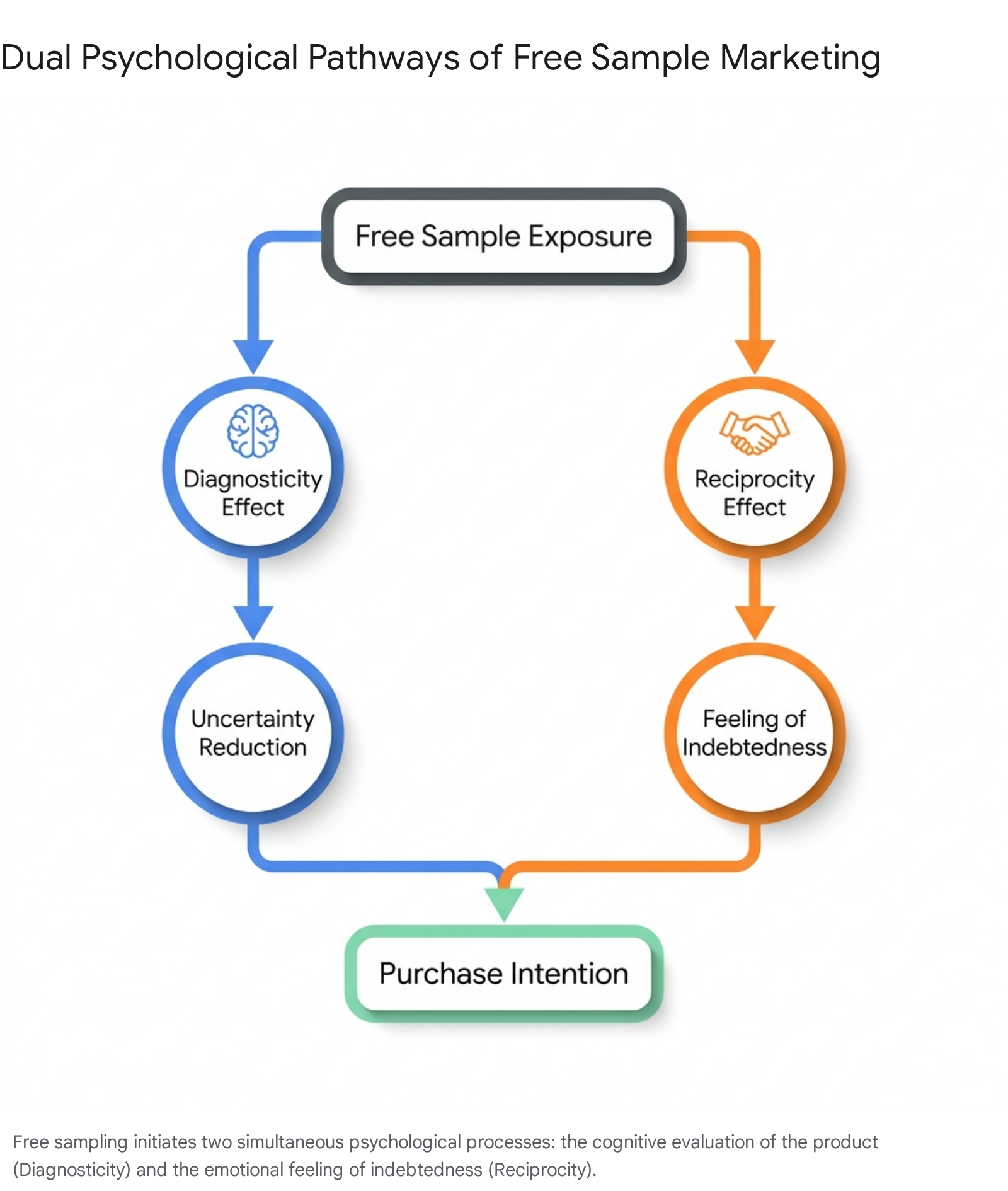
Free sample marketing represents one of the most direct and historically established applications of the reciprocity principle. By providing a tangible, cost-free experience of a product, brands seek to eliminate financial risk while simultaneously triggering a social obligation to purchase 117. The behavioral mechanics of free sampling operate simultaneously on two distinct psychological tracks: the diagnosticity effect (cognitive) and the reciprocity effect (affective) 1819.
Diagnosticity and Uncertainty Reduction
From an information-processing perspective, consumers face inherent uncertainty when evaluating new products 19. Consumer purchase behavior typically follows a phased process involving search, consumption, and post-purchase evaluation 20. In markets characterized by asymmetric information, consumers lack direct past experience during the search phase and are forced to rely on proxy signals such as brand reputation, packaging, or third-party reviews, heavily limiting their attention span 20. Free samples bypass these proxies by providing direct experiential data. This phenomenon is known as the diagnosticity effect, or the uncertainty-reduction effect 1819.
When a consumer tests a free sample, they gain a highly accurate understanding of specific product attributes, such as taste, texture, or usability. This direct experiential knowledge helps the consumer align the product with their specific needs, effectively lowering the cognitive load and the perceived risk associated with the purchase decision 19. By reducing the gap between expectation and actual consumption, diagnosticity limits the potential for expectation disconfirmation 19.
Empirical academic research underscores the sheer magnitude of these combined effects. In-store sampling can boost sales of the promoted product by 300% to 500% on the day of the promotion, as the physical presence of the product and the human element of a demonstrator dramatically reduce uncertainty and stimulate immediate reciprocal obligation 1721. The effect is particularly pronounced in smaller retail environments with limited assortments, where the sample easily captures consumer attention without overwhelming them 22. Furthermore, responsiveness to free samples demonstrates demographic moderation; studies frequently identify younger consumers and female consumers as exhibiting higher responsiveness to in-store sampling events 1721.
However, the diagnosticity effect must be managed carefully in relation to campaign unit economics. Empirical models tracking sales lift suggest that for a sampling event to remain profitable over the long term, the incremental cost of the event must not exceed 15 times the unit price of the product being sampled 22.
Environmental Context and Distribution Channels
The psychological impact of a free sample is intrinsically linked to the environment in which it is received. The context shapes baseline consumer expectations, which in turn dictate long-term engagement and customer lifetime value (LTV) 23. A longitudinal study tracking household consumer behavior over an 18-month period revealed significant variances in promotional efficacy based entirely on the distribution channel utilized 23.
| Distribution Channel | Immediate Conversion Impact | Long-Term Engagement / LTV | Primary Psychological Mechanism |
|---|---|---|---|
| In-Store Sampling | Very High (up to 500% lift on day of promotion) 17 | Weak / Rapid Decay | Immediate reciprocity; temporal urgency combined with direct sensory input in a high-stimulus environment 1723. |
| Direct Mail Sampling | Moderate | Very Strong | Unexpected value delivery creating a grounded, memorable experience that exceeds baseline expectations outside a commercial setting 23. |
| Online Request Sampling | Moderate to High | Strong (High Social Influence) | Active opt-in behavior increasing cognitive commitment; strong catalyst for electronic word-of-mouth (eWOM) and digital advocacy 1823. |
While in-store sampling leverages the immediate physical presence of the product to drive short-term sales, its long-term effects often decay rapidly, with studies indicating that end-of-aisle display momentum fades after merely two weeks 2223. The retail environment is saturated with commercial stimuli, making it difficult for a single sample to forge a lasting brand connection. Conversely, receiving a sample via direct mail introduces an element of surprise into a non-commercial environment (the home). This unexpectedness creates a more concrete and grounded psychological experience, fostering a deeper sense of reciprocity that translates into sustained repeat purchases and higher lifetime value 23.
Equity Theory and Digital Reciprocity
Online product sampling has introduced new dimensions to the reciprocity effect. Programs like Amazon Vine distribute free physical products to targeted consumers in exchange for online reviews 1824. In these digital ecosystems, the reciprocity effect is bipartite: consumers may reciprocate by purchasing the product in the future, or they may discharge their obligation by leaving higher ratings and more detailed qualitative reviews 18.
The behavior of users in these environments is often analyzed through the lens of Equity Theory, which posits that individuals strive to maintain fairness in social exchanges 24. When a consumer receives a product of high value for free, the psychological ledger becomes imbalanced. To restore equity, the consumer provides extensive labor in the form of a review. Empirical data indicates that receiving a free product sample online can increase subsequent review ratings by approximately 1.1% to 2.25%, demonstrating that the feeling of indebtedness is often discharged through digital advocacy 1824. However, if the platform forces the review as a strict condition, it risks violating the autonomy required for genuine reciprocity, shifting the interaction from a gift economy back to a transactional one, and potentially suppressing review quality through psychological reactance 24.
Gift-With-Purchase Strategies and Affective Forecasting
The Gift-with-Purchase (GWP) model operates on a slightly different psychological premise than free sampling. While a sample is a trial of the primary product meant to reduce uncertainty, a GWP is an entirely supplemental item provided conditionally upon the purchase of a core product 25. The primary objective of a GWP is to augment the perceived value of the transaction, thereby increasing immediate purchase satisfaction, alleviating post-purchase dissonance, and fostering long-term brand loyalty 25.
The Stimulus-Organism-Response (S-O-R) Framework
The effectiveness of a GWP strategy relies heavily on its ability to elicit immediate positive emotional responses, specifically surprise, joy, and warmth 162526. According to the Stimulus-Organism-Response (S-O-R) framework commonly applied in consumer psychology, the GWP acts as the external stimulus, triggering a positive affective state within the consumer (the organism), which subsequently drives higher satisfaction, loyalty, and future purchase intentions (the response) 27.
Research indicates that the perceived usefulness and perceived quality of the gift are the paramount variables determining the strength of the organismic response 25. If a consumer views the gift as a high-quality, practical item that enhances their daily life, the resulting happiness significantly bolsters their satisfaction with the overall transaction 25. Conversely, a "trivialization effect" occurs if the monetary value or utility of the gift is perceived to be less than the consumer's baseline expectation, which can actively damage brand perception 16.
Personalization further amplifies the reciprocity effect within GWP models. When a brand offers a customized gift, or includes highly personal touches such as handwritten thank-you notes, it signals that the brand values the relationship beyond mere financial extraction 1728. This tailored approach strengthens the emotional bond, moving the interaction from a commodity exchange toward a non-market, relational exchange 916. Consumers perceive personalized gifts as possessing higher psychological value, which necessitates a more robust reciprocal response 228.
The Backfire Effect of Corporate Branding
Despite the generally positive outcomes associated with GWPs, marketing psychology research reveals a significant boundary condition: the detrimental impact of aggressive corporate branding on gifts. A series of experiments has demonstrated that prominently branded business gifts (e.g., items featuring large corporate logos) can actively suppress the consumer's motivation to reciprocate 10.
This suppression occurs because explicit branding alters the consumer's attribution of the firm's motives. When a gift is heavily branded, consumers perceive the gesture not as an act of altruism or genuine appreciation, but as an egoistic, manipulative marketing tactic designed to turn them into walking advertisements 71110. This perception diminishes "brand warmth" - a critical construct related to trustworthiness and social perception 10. Consequently, the psychological contract of reciprocity is voided. The consumer accepts the item but feels no moral obligation to return the favor. Research suggests that in many relationship-building contexts, unbranded or subtly branded gifts are significantly more effective at eliciting genuine reciprocity and subsequent purchase intent, with self-brand connection moderating the severity of this backfire effect 10.
Hedonic Adaptation and the Trivialization of Rewards
A pervasive challenge in sustained GWP marketing and loyalty programs is hedonic adaptation. Hedonic adaptation refers to the psychological tendency of individuals to habituate to the impact of repeated affective experiences, causing the initial joy or pleasure of an event to inevitably diminish over time 1629.
In the context of continuous promotional gifting, consumers quickly adapt to the reception of free items 29. As the novelty wears off, the emotional spike of happiness flattens, and the gifts lose their persuasive power 1630. Consumer behavior research exploring affective forecasting reveals that humans are generally poor at predicting hedonic adaptation; they overestimate how long a positive experience will bring them joy 29. Furthermore, the very act of anticipating or predicting a routine reward tends to accelerate the adaptation process, encouraging a faster cycle of consumption and eventual boredom 29.
To combat hedonic adaptation, marketers frequently introduce elements of uncertainty into their reward structures. High uncertainty can activate the brain's dopaminergic reward system, enhancing behavioral motivation, risk-taking propensity, and slowing the adaptation process 31. Concepts such as "blind boxes" or randomized promotional rewards leverage this psychological mechanism. When a consumer does not know exactly what gift they will receive, the unpredictability sustains their emotional engagement and expectations, thereby prolonging the efficacy of the GWP strategy and triggering impulse consumption 31. Furthermore, gratitude-based marketing interventions - rather than merely satiating material desires - have been shown to effectively lower psychological entitlement and reduce perceived resource scarcity, actively combating the rapid onset of hedonic adaptation 32.
Reciprocity and Conversion Dynamics in Freemium and Free Trial Models
In the modern digital economy, particularly within Software-as-a-Service (SaaS), gaming, and mobile applications, the reciprocity principle is structurally embedded into the core product architecture through freemium and free trial models. These paradigms replace traditional upfront sales with a deferred monetization strategy, allowing users to experience software value before committing financial resources 33344035.
Structural Typologies and Psychological Commitments
While often conflated in general marketing parlance, freemium and free trial models operate on divergent psychological principles and yield vastly different conversion metrics.
| Deferred Monetization Model | Structural Definition | Primary Psychological Driver | Average Conversion Rate |
|---|---|---|---|
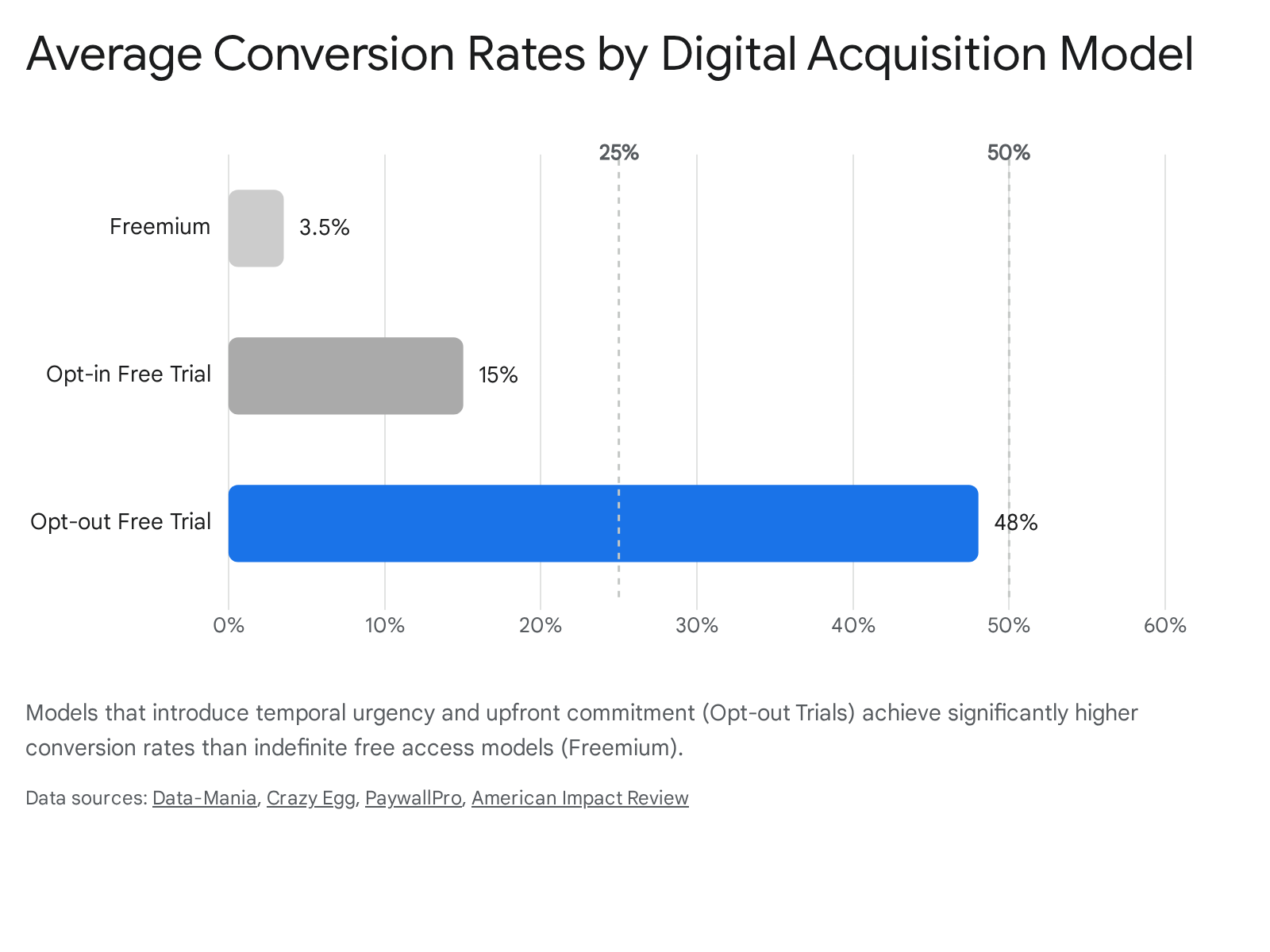
| Freemium (Feature-Limited) | Indefinite access to a basic version of a product, with core functionalities restricted behind paywalls 3436. | Zero-price effect; gradual habituation; network externalities 3537. | 2% - 5% 34353839 |
| Opt-in Free Trial (Time-Limited) | Full premium access for a strict duration (e.g., 14 days) without requiring upfront payment details 343839. | Temporal urgency; scarcity; rapid diagnosticity of value 3839. | 10% - 25% 343839 |
| Opt-out Free Trial (Time-Limited) | Full premium access requiring credit card information upfront; automatically bills upon trial expiry 3839. | High immediate switching costs; loss aversion; filtering of low-intent users 3839. | 48% - 50% 343839 |
| Reverse Trial (Hybrid) | Users receive full premium access initially, then face an involuntary downgrade to a permanent free tier 3539. | Severe loss aversion; psychological loss of established workflows 3539. | 15% - 40% higher than pure freemium 39 |
The psychological strategy of the pure freemium model relies on lowering the barrier to entry to absolute zero, attracting a massive volume of users through the "zero-price effect," which creates an irresistible draw where consumers systematically overestimate the value of free offerings 37. The reciprocity value exchange here is ongoing; the platform provides continuous utility, hoping to eventually trigger an upgrade 3438. However, because the user is permanently satisfied by the free tier, the urgency to convert is remarkably low. Consequently, freemium models typically exhibit low conversion rates 343839.
Free trials, conversely, induce temporal urgency and psychological scarcity. The opt-out trial is particularly effective because it forces cognitive commitment immediately. By requiring payment information upfront, the model creates a high psychological barrier to entry that filters out "window shoppers," capturing only users who are genuinely evaluating the product for long-term integration 3839.
The Push-Pull-Mooring Framework and Switching Costs
The transition from a free user to a paid subscriber - frequently termed the "free-to-fee switch" - relies extensively on the principles of behavioral economics rather than simple reciprocity 40. The mechanics of this transition can be effectively analyzed using the Push-Pull-Mooring (PPM) theory. Users must be pushed by limitations in the free tier, pulled by the relative advantage of premium features, and moored by accumulated switching costs 36.
Freemium models do not merely rely on user gratitude; they depend on the strategic cultivation of operational dependency. As users integrate the free software into their daily routines, they undergo habituation 414243. The software becomes the default status quo. Once habituation occurs, the platform leverages loss aversion and the endowment effect 3741. The endowment effect dictates that individuals value an item more highly simply because they possess or control it 37. In freemium contexts, users begin to feel psychological ownership of the digital environment they have customized, the proprietary data they have uploaded, and the specific workflows they have established 3741.
When a user eventually hits a feature paywall or a strict usage limit, the psychological framing of the decision changes entirely. It is no longer evaluated as acquiring a new benefit (a gain); it is evaluated as preventing the loss of productivity or the disruption of an established habit. Behavioral studies demonstrate that pricing or upgrade messaging framed around the loss of capabilities boosts conversion rates by up to 21% to 32% compared to gain-focused messaging 37. The psychology of sunk costs accelerates this mooring effect. As users invest immense time and effort into learning a platform's interface, their switching costs increase exponentially 364144. The cognitive load required to abandon the platform, migrate data structures, and learn a competitor's system becomes a formidable barrier 4546. At this juncture, the user's decision to upgrade is often driven not by a calculation of fair monetary value, but by a negotiation for relief - the overriding desire to remove operational friction, stop evaluating alternatives, and maintain continuity 41.
A compelling demonstration of these mechanics in B2B SaaS is found in the optimization of hybrid freemium models. Case studies indicate that transitioning from a purely feature-gated model to a product-led growth strategy with personalized, usage-based conversion triggers can radically improve unit economics. By targeting users at the precise moment their sunk costs and network externalities peak, platforms can increase free-to-paid conversions from an average of 3.8% to 7.4%, while simultaneously driving net revenue retention to 127% among acquired cohorts 35.
The Prosecutor's Fallacy in Conversion Optimization
A critical vulnerability in managing freemium models lies in the interpretation of massive sets of user data, specifically regarding the identification of users likely to convert. Because baseline conversion rates in freemium are inherently low (e.g., 5%), statistical modeling and predictive classification algorithms suffer from severe base rate fallacies 53.
If a product maintains a true 5% conversion rate, a highly naive classification algorithm could achieve 95% accuracy simply by classifying every single user as a non-payer 53. Furthermore, when growth marketers analyze behavioral data to identify conversion triggers, they frequently fall victim to the "prosecutor's fallacy," a statistical confusion of the inverse 53. Marketers may observe that 80% of their paying subscribers utilize a specific advanced dashboard feature. They incorrectly conclude that aggressively pushing free users to engage with this specific dashboard will result in an 80% probability of conversion 53. However, this analytical flaw ignores the vast denominator of free users who may also interact with the feature without ever intending or having the capacity to pay. Misinterpreting these conditional probabilities results in misallocated marketing budgets and the aggressive gating of features that do not genuinely cultivate the reciprocity or dependency required for a successful free-to-fee switch 53.
The Dark Side of Promotional Reciprocity: Reactance and Entitlement
While reciprocity remains a powerful driver of positive consumer behavior, the aggressive, uncalibrated, or prolonged application of free-value marketing can inadvertently trigger two highly destructive psychological states: psychological reactance and consumer entitlement.
Psychological Reactance and The Inductive Reactance Model
Psychological reactance, a foundational theory introduced by Jack W. Brehm in 1966, occurs when an individual perceives a direct threat to their behavioral freedom or autonomy 171424. When humans feel manipulated, coerced, or cornered into making a purchase decision, they experience an intense, defensively oriented motivational state directed toward reestablishing their lost freedom 1714. In marketing, this manifests as a severe "backfire effect," where consumers actively resist the intended persuasion and develop deep-seated negative attitudes toward the brand 12132447.
In digital marketing ecosystems and freemium funnels, reactance is frequently triggered by manipulative UI/UX designs, often referred to as dark patterns, or artificially restrictive choice architectures 1117. For example, if a freemium product is deliberately crippled to the point of being practically unusable, or if a free trial aggressively hides the cancellation pathway, the user feels trapped rather than empowered 617. The Inductive Reactance Model (IRM) suggests that as social media users and digital consumers become more savvy regarding persuasive intent - such as encountering highly imperative Call-To-Action (CTA) buttons like "Buy Now" or "Upgrade Immediately" - they automatically raise a psychological shield 14. The initial goodwill generated by the free sample or open software evaporates, rapidly replaced by skepticism and resentment. Instead of feeling a reciprocal obligation to support the developer, the user views the interaction as an adversarial bait-and-switch, leading to rapid churn and negative electronic word-of-mouth (eWOM) 614.
Reactance is also heavily influenced by how product recommendations are framed. Broad, consultative recommendations preserve the consumer's decision autonomy, minimizing reactance. Conversely, narrow, highly prescriptive recommendations - especially unsolicited advice from platforms - are likely to be rejected outright as consumers seek to reassert their independence 12.
Consumer Entitlement and the Normalization of Free Access
If psychological reactance represents the acute, immediate rejection of manipulation, consumer entitlement represents the chronic, long-term degradation of gratitude. Consumer entitlement theory describes a psychological state in which individuals develop a self-inflated prerogative, believing they inherently deserve special treatment, unearned rewards, or perpetual free access from service providers simply by virtue of their presence 154849.
Prolonged exposure to free samples, GWPs, and open-ended freemium models fundamentally alters the consumer's psychological baseline. When an application is continuously offered for free, or a retailer consistently includes free luxury samples with every standard order, the consumer habituates to the surplus value 4250. The free item ceases to be viewed as a generous "gift" that triggers reciprocal obligation and instead crystallizes into a standard, expected component of the transaction 29.
Once this normalization occurs, any disruption to the free service is viewed not as the cessation of a temporary privilege, but as the aggressive violation of a fundamental consumer right. This behavioral pattern is frequently observed in the live-service gaming and subscription SaaS industries. When free tiers or freemium servers experience unscheduled downtime, users routinely exhibit intense outrage and demand immediate financial compensation, despite not having paid for the core service 19. The feeling of entitlement completely overrides the logical economic reality of the transaction 19. The psychological sequence shifts violently from gratitude to grievance; the consumer places their individual convenience and narcissistic expectations above the operational realities of the business, a phenomenon often linked to higher levels of societal individualism 1551.
Furthermore, attempts to reward customer loyalty through preferential treatment can paradoxically breed entitlement. Research into VIP programs and free upgrades reveals that such tactics can evoke a sense of elevated status in consumers, leading to opportunistic, self-serving behaviors that become highly costly for the enterprise 48. Consumers who feel advantaged by their status frequently become excessively picky, complain with higher frequency, and exploit generous return policies or customer service resources, operating under the assumption that their elevated status insulates them from standard commercial behavioral norms 4849. This entitlement can even manifest as the "price entitlement effect," where upper-class consumers justify the purchase of socially or environmentally costly products by reasoning that their willingness to pay a premium price entitles them to consume resources without standard moral constraints 52. Within organizations, feelings of entitlement generated by perceived unreciprocated loyalty can even lead to Unethical Pro-organizational Behavior (UPB) or workplace deviance 53.
Cross-Cultural Moderation of Relational Reciprocity
The psychological mechanisms driving reciprocity and relational marketing are not universally identical; they are subject to significant cross-cultural moderation 4. Effective execution of reciprocity-based marketing across global markets necessitates an understanding of cultural variations in how gifts and obligations are processed 4.
Cross-cultural marketing research indicates that the underlying dimensions of reciprocity - specifically equivalence (the value of what is exchanged) and immediacy (the time frame in which the exchange occurs) - impact relationship quality differently depending on national culture 4. In highly individualistic societies, consumer entitlement tends to be higher, and relationships are often viewed through a highly transactional, short-term lens, making immediate reciprocity and strict equivalence highly prioritized 415. Conversely, in collectivistic cultures, relationships are often viewed over a longer time horizon, allowing for delayed reciprocity and placing higher value on the relational intent rather than exact financial equivalence 415.
These cultural nuances are increasingly relevant as digital globalization expands. For instance, analyses of South-South economic integration, specifically analyzing bilateral trade and relationship marketing between Latin America and Africa, highlight that cultural adaptation is a mandatory prerequisite for fostering customer loyalty 545556. While businesses in these regions share similar challenges regarding development and technological adoption, generating trust through relationship marketing requires tailoring communication and promotional strategies to local norms 545556. Firms that attempt to export generic, transactional freemium or sampling models without adapting to the local cultural expectations surrounding communication directness and relationship building frequently fail to generate the trust required to sustain long-term customer loyalty 56.
Synthesis and Strategic Implications
The application of reciprocity in free sample marketing, gift-with-purchase strategies, and digital freemium models represents a sophisticated manipulation of human social programming. Across all promotional formats, the core mechanism remains structurally consistent: providing unprompted value generates a psychological state of indebtedness, which businesses subsequently attempt to monetize through increased sales, localized brand advocacy, or premium recurring subscriptions.
However, the transition from psychological indebtedness to actual economic conversion is fraught with complexity. In physical product sampling, success hinges on the precise capability of the sample to reduce uncertainty (diagnosticity) and the selection of distribution channels that foster unexpectedness to secure long-term engagement. In GWP models, managing the emotional valence of surprise and happiness is paramount, requiring brands to carefully navigate the trivialization effect and avoid aggressive corporate branding that triggers cynical motive attributions. In the digital realm of freemium and free trials, pure reciprocity is heavily augmented - and often superseded - by the potent cognitive biases of habituation, loss aversion, and accumulated switching costs.
Ultimately, the long-term sustainability of any reciprocity-based marketing initiative depends on maintaining a delicate psychological equilibrium. Firms must provide enough upfront value to trigger a reciprocal obligation without inducing rapid hedonic adaptation. Concurrently, they must carefully architect their monetization pathways to avoid the catastrophic pitfalls of psychological reactance and the chronic erosion of gratitude into consumer entitlement. When executed with a precise understanding of these cognitive boundary conditions, reciprocity ceases to be a mere promotional tactic and functions as the foundational mechanism for sustainable, long-term relational marketing.