
Psychological Effects of Zero-Price Offers on Consumer Behavior
Foundational Economic Theories and the Zero-Price Anomaly
In classical and neoclassical economic theory, consumer decision-making is fundamentally modeled on a linear utility framework governed by rational cost-benefit analyses. According to this standard theoretical perspective, an individual faced with multiple purchasing options will evaluate the relative attributes of each good, subtract the associated acquisition costs, and select the option that yields the highest net benefit 123. A core assumption of this model is that demand curves respond continuously to price changes. For instance, a price reduction from $0.15 to $0.14 should theoretically produce a similar marginal increase in demand as a price reduction from $0.01 to $0.00, provided the comparative cost-benefit differential remains constant 14.
However, empirical research in behavioral economics refutes this assumption of linearity at the zero-price boundary. When a product's price transitions from a marginal positive cost to exactly zero, the resulting behavioral shift is disproportionately massive - a phenomenon formally defined as the "zero-price effect" 156. Consumers do not merely calculate zero as another point on the pricing continuum; instead, they treat "free" as a distinct psychological category 7. Rather than simply subtracting zero cost from the objective utility of the good, consumers behave as though the intrinsic value of the good itself has been artificially magnified 13. The perception of the zero-price option becomes distorted, prompting consumers to overemphasize the product's benefits while simultaneously ignoring potential downsides or opportunity costs 4.
The foundational demonstration of this effect was articulated by researchers Shampanier, Mazar, and Ariely in a seminal series of experiments involving consumer preferences for chocolate 156. The researchers established a choice architecture offering a premium chocolate (a Lindt truffle) and a standard chocolate (a Hershey's Kiss) under distinct pricing conditions to test the validity of the linear cost-benefit model.
In the initial "cost condition," the premium chocolate was priced at 15 cents and the standard chocolate at 1 cent. Under these parameters, the majority of consumers acted according to standard utility maximization, with 73% selecting the premium chocolate and demonstrating a willingness to pay for higher perceived quality 48. In the subsequent "free condition," the prices of both items were reduced by an identical amount - one cent - bringing the premium chocolate to 14 cents and the standard chocolate to 0 cents. Despite the relative price difference between the two items remaining exactly 14 cents, the consumer preference completely inverted.
| Pricing Condition | Lindt Truffle Price | Hershey's Kiss Price | Relative Price Difference | Consumer Preference (Lindt) | Consumer Preference (Hershey's) |
|---|---|---|---|---|---|
| Baseline Cost | $0.15 | $0.01 | $0.14 | 73% | 8% |
| Zero-Price (Free) | $0.14 | $0.00 | $0.14 | 31% | 69% |
| Control Discount | $0.27 | $0.02 | $0.25 | 73% | 8% |
| Control Discount 2 | $0.26 | $0.01 | $0.25 | 73% | 8% |
To rule out alternative economic explanations, the researchers implemented control conditions where both items were discounted by one cent without either reaching zero (e.g., dropping from 27 cents/2 cents to 26 cents/1 cent). In these non-zero discounting scenarios, no preference reversal occurred, proving that the shift in demand is uniquely tied to the absolute zero price point 38. This preference reversal cannot be explained by standard transaction costs or a simple re-evaluation of budget constraints; it isolates zero as a special price that uniquely manipulates human cognition 139.
Psychological Mechanisms of Valuation
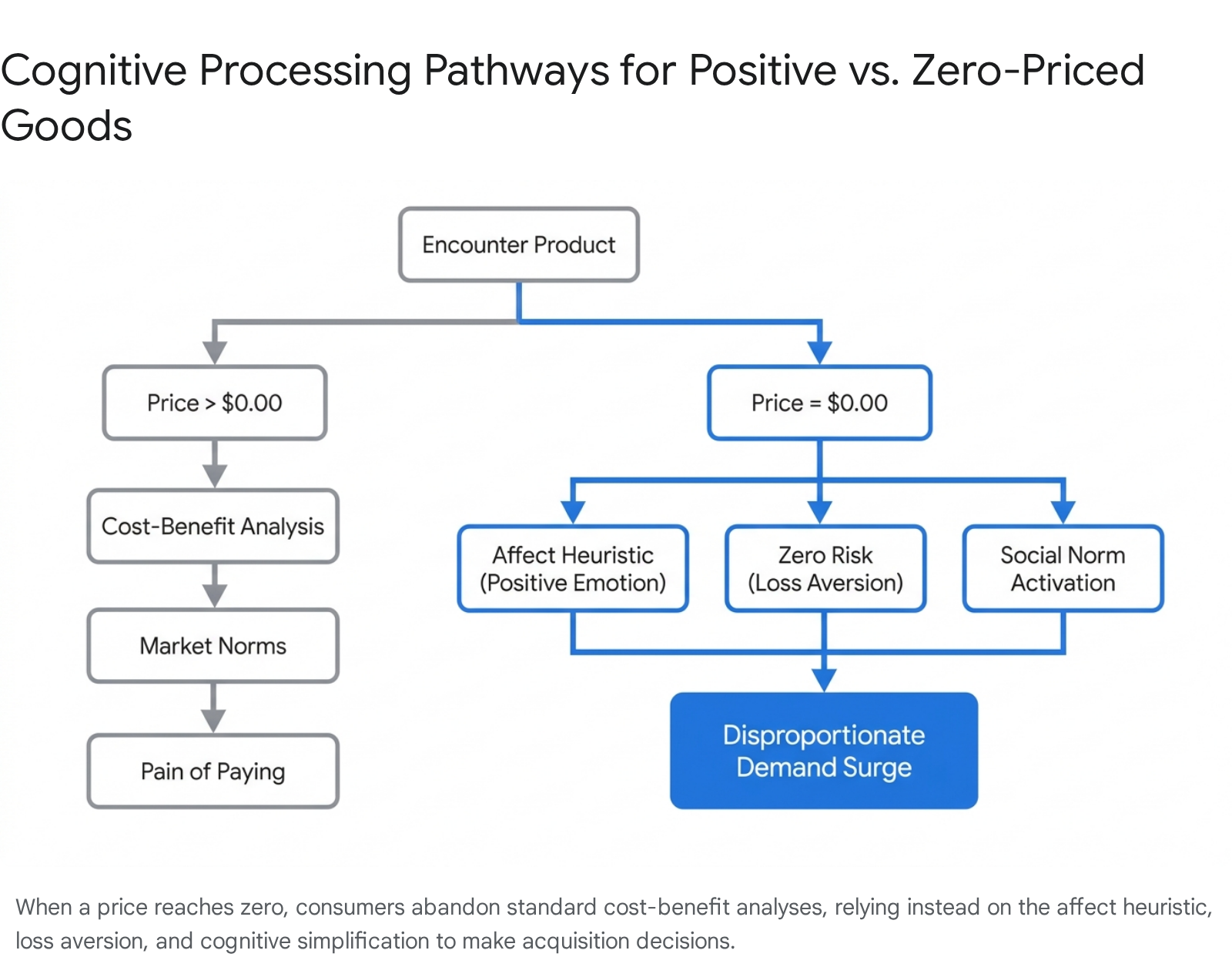
The zero-price effect operates through a confluence of cognitive biases and emotional heuristics that override analytical processing. When consumers encounter a zero-price offer, the decision-making apparatus shifts from a deliberate, rational calculation to an intuitive, affect-driven response.
The Affect Heuristic
The primary psychological driver of the zero-price effect is the affect heuristic - a mental shortcut where current emotions heavily influence decision-making 4. Encountering a free product acts as a powerful affective trigger, generating an immediate positive emotional response, often correlated with the release of dopamine in the brain's reward centers . Neuroscience suggests that the brain interprets a "free" acquisition as a direct reward, unmitigated by the usual psychological pain of paying 10.
Because individuals rely on these affective cues as inputs for their subsequent choices, the positive emotion associated with the transaction is misattributed to the intrinsic value of the product itself 149. Consequently, consumers exhibit a "benefit-inflation effect," where the perceived utility of the free item is artificially heightened purely because the transaction induces happiness 11. This effect is notably more pronounced for hedonic goods (e.g., chocolate, coffee, entertainment) compared to utilitarian goods (e.g., bags of sugar or basic software utilities). Hedonic goods inherently align with emotional and pleasure-seeking neural pathways, amplifying the affect heuristic when combined with a zero price 412.
Loss Aversion and Risk Elimination
Prospect theory establishes that human beings are fundamentally loss-averse, experiencing the psychological pain of losing something much more acutely than the pleasure of gaining something of equivalent objective value 713. In any standard economic transaction involving a positive price, the consumer assumes a baseline level of financial risk: the risk that the utility derived from the product will not justify the monetary expenditure.
A zero price completely eliminates this downside risk from the consumer's cognitive equation 7. Because no monetary capital is exchanged, the transaction is categorized strictly as a "gain." The absence of potential financial loss disarms consumer skepticism and accelerates the decision-making process, causing an irrational surge in demand for free goods even when the absolute quality of the item is sub-par 1314. This zero-risk bias explains why consumers are willing to invest disproportionate amounts of non-monetary resources - such as standing in a queue for several hours - to obtain a low-value item, such as a free scoop of ice cream at a promotional event 4.
Mental Accounting and Transactional Friction
Mental accounting is the cognitive process by which individuals categorize, allocate, and track their financial resources across different subjective "buckets" 131516. When evaluating a positively priced item, consumers must engage the cognitive friction of determining which mental account the funds will be drawn from, evaluating the opportunity cost of spending that specific allocation 7. Field experiments utilizing cash transfers have demonstrated that structured mental accounting (e.g., separating funds into physical envelopes for specific purposes) significantly alters consumption, indicating that human beings rely heavily on these rigid categorizations to maintain financial discipline 1719.
Products priced at zero bypass this cognitive architecture entirely. Free items fit into a separate, distinct "no-cost" mental category that requires no budgeting, no tracking, and no evaluation of trade-offs 713. Furthermore, receiving a free item often triggers the "house-money effect," wherein consumers view windfall gains as distinct from earned income, leading to different, often looser, subsequent valuation behaviors 1518. By circumventing the rigorous mental accounting framework applied to earned capital, zero pricing acts as a mechanism of cognitive simplicity. Consumers favor the path of least cognitive resistance; removing the financial variable from the choice equation makes the decision remarkably easy, resulting in behavioral over-selection of the free option 514.
Social Norms Versus Market Norms
The zero-price effect not only alters internal cognitive valuation but fundamentally shifts the environmental context of the transaction. Economic sociology divides human interactions into two distinct relationship modes: market norms and social norms 419.
Pricing as an Indicator of Exchange Type
Market norms are transactional, characterized by explicit cost-benefit exchanges, wage calculations, and the pursuit of individual utility maximization. In contrast, social norms are governed by community expectations, altruism, fairness, and politeness 19. The introduction of money - even a marginal amount like a single cent - signals to participants that they are operating under market norms. Conversely, the absence of a price tag strips the transaction of its commercial framing, abruptly shifting the consumer's mindset into the realm of social norms 4.
This dynamic is clearly illustrated in Gneezy and Rustichini's classic study on late pickups at daycares 4. When the daycare operated under social norms (no financial penalty for being late), parents felt guilt for inconveniencing the staff, which kept late pickups relatively low. However, when the daycare introduced a small financial fine for tardiness, late pickups paradoxically increased. The introduction of a positive price transformed the infraction into a market transaction; parents interpreted the fine as a "fee" for extended child care, effectively buying off their guilt and discarding the social norm of punctuality 4.
Price and Quantity Demanded
The switch from market norms to social norms at the zero-price boundary creates a fascinating paradox regarding the aggregate quantity of goods demanded. According to the standard law of demand, as price decreases, the quantity demanded increases. However, behavioral experiments demonstrate that while a zero price increases the number of people who demand a product, it simultaneously decreases the quantity of the product each individual takes 19.
In an experiment offering Starburst candies to students, researchers manipulated the price between one cent and free. Under the market norm condition (one cent per candy), the average participant maximized their utility by purchasing 3.45 candies . When the price was dropped to zero, triggering social norms, the number of participants approaching the stand surged, but the average quantity taken plummeted to 1.09 candies per person .
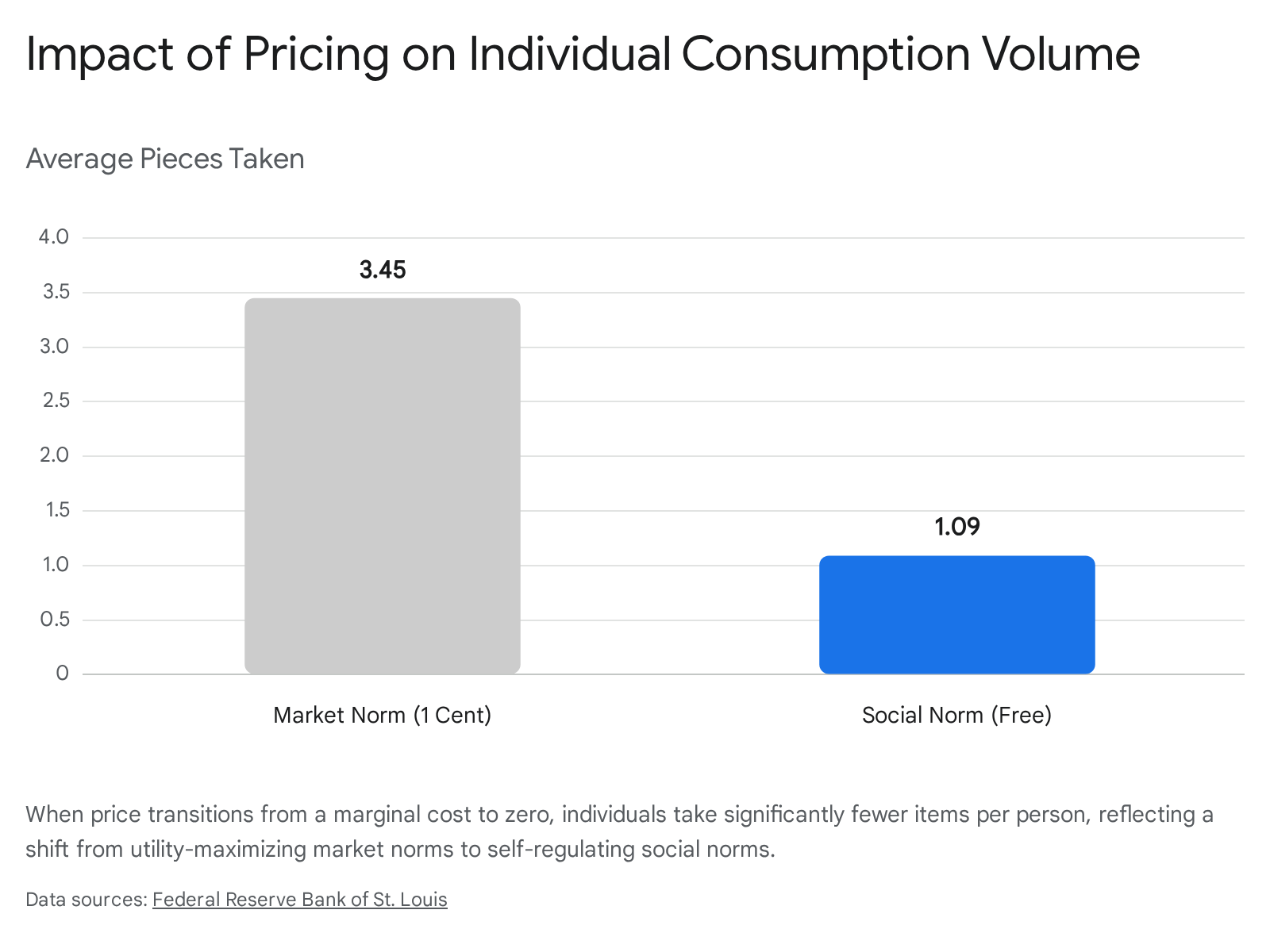
When goods are free, consumers recognize that resources are shared and apply unwritten rules of fairness and politeness. Taking a large handful of free candy violates social etiquette and projects greed; therefore, individuals self-regulate 19. In market conditions, paying for the good absolves the consumer of social responsibility, allowing them to act selfishly and maximize personal acquisition.
The Dual-Process Model and Incidental Costs
Despite its pervasive influence, the zero-price effect is not absolute. Recent empirical research has identified boundary conditions where the irrational appeal of "free" breaks down, fails to manifest, or paradoxically causes a reduction in consumer demand.
The Boomerang Effect
The standard zero-price effect assumes that transaction costs and incidental frictions are either non-existent or constant across choices. However, when acquiring a free product demands high non-monetary sacrifices - termed "incidental costs" (e.g., a lengthy commute, providing sensitive personal data, physical risk, or investing significant time) - the zero-price effect can collapse, leading to a phenomenon known as the "boomerang effect" 12.
Fan, Cai, and Bodenhausen (2022) proposed a dual-process model to explain this divergence. A zero price simultaneously triggers two competing cognitive pathways: a positive affective pathway (the joy of getting something for nothing) and a negative scrutiny pathway (heightened suspicion) 12. Because a price of exactly zero violates standard market transaction norms, it is inherently surprising. This surprise momentarily halts the consumer's automated processing, affording them the motivation and cognitive capacity to scrutinize the offer's incidental costs 12.
When incidental costs are low, the affective pathway dominates, and demand surges. However, when incidental costs are high, the scrutiny pathway overrides the affective response 12. Under these conditions, consumers become acutely sensitive to the non-monetary sacrifices required. Ironically, charging a very low positive price (e.g., $1) satisfies the expected market norm, preventing the activation of the scrutiny pathway and resulting in higher demand than if the product were offered for free 12.
| Pricing Condition | Incidental Costs | Primary Cognitive Pathway | Impact on Consumer Demand |
|---|---|---|---|
| $0.00 (Free) | Low / Negligible | Positive Affective Pathway | Disproportionate Surge (Zero-Price Effect) |
| > $0.00 (Low Cost) | High | Routine Cost-Benefit | Moderate / Baseline |
| $0.00 (Free) | High | Negative Scrutiny Pathway | Significant Decrease (Boomerang Effect) |
Consumer Skepticism and Quality Inferences
In traditional economic models, price acts as a heuristic for quality; higher prices infer superior materials, craftsmanship, or efficacy. The total absence of a price tag directly challenges this heuristic, occasionally triggering intense consumer skepticism 132021.
When products are offered for free - particularly if they are unbundled from premium purchases - consumers often engage in negative quality inferences. In what is termed the "freebie devaluation" effect, consumers deduce that a company could not successfully sell the product on its own merits without relying on a zero-price marketing gimmick 22. Consequently, the intrinsic value of the good is psychologically downgraded. Once a brand anchors a product's value at zero, successfully transitioning consumers to pay for that identical product in the future becomes exceedingly difficult, as the reference price has been fundamentally compromised 5. This skepticism is prevalent across specific categories; for instance, US consumers display high skepticism regarding environmental and sustainability claims, demanding structural transparency rather than relying on promotional framing 2023.
Impact of Time Constraints
The cognitive simplification inherent to the zero-price effect requires a specific environmental context. When consumers are placed under severe time pressure, their evaluation mechanics shift. While initial hypotheses posited that time pressure might exacerbate reliance on the affect heuristic (and thus heighten the zero-price effect), subsequent research reveals that time constraints can actually neutralize it 24.
Under high time pressure, consumers prioritize risk mitigation. The absence of a price tag elevates the "perceived performance risk" of the item (the fear that the free product will not function properly or fulfill its intended utility) 2427. When rushed, consumers prefer to anchor their rapid decisions on established market signals. A monetary price serves as a reliable proxy for quality and functionality. Therefore, under stringent time constraints, consumers are frequently more inclined to select a paid option over a free alternative, utilizing price to assure themselves against performance failure 24.
Reciprocity in Zero-Price Transactions
While the zero-price effect eliminates immediate financial costs, it frequently establishes an implicit psychological debt. When a brand provides something of value to a consumer without exacting a financial toll, it triggers the innate human instinct of reciprocity 2526. Rooted in evolutionary psychology as a mechanism for stabilizing cooperation and social cohesion, reciprocity compels individuals to return favors, even if the initial gift was unsolicited and acting dishonestly is required to fulfill the reciprocal obligation 27.
In commercial settings, the strategic deployment of free samples, complimentary trials, or high-value content leverages this instinct. Consumers who receive zero-priced offerings often feel a subtle, subconscious obligation to compensate the provider 2526. If they cannot or do not wish to reciprocate via a direct financial purchase, they often fulfill this psychological debt through alternative means, such as providing electronic word-of-mouth (eWOM), leaving positive online reviews, or engaging in brand advocacy 11. Research in multichannel retailing demonstrates that online reviews are significantly impacted by free service offerings; consumers rate products higher and judge non-monetary costs (like advertising interruptions) more leniently when the base service is free, effectively inflating the product's perceived benefits as a reciprocal gesture 11. Additionally, studies on platforms like Airbnb show that reputation systems heavily rely on reciprocal behavior; obscuring reviews until both parties submit feedback has been shown to alter review patterns, proving that reciprocity is a fundamental variable in digital reputation economies 1128.
Applications in Digital Markets and Software
The digitization of the global economy has transformed the zero-price effect from a retail pricing anomaly into a foundational architecture for modern business models, particularly within software, media, and data aggregation.
Freemium Models and Conversion Inefficiencies
In the Software as a Service (SaaS) and digital application sectors, the "freemium" model relies entirely on the zero-price effect to eliminate acquisition friction. By offering a basic tier of service at no cost, companies bypass the consumer's cost-benefit calculation, driving exponential user adoption and establishing network effects 714.
However, the psychological forces that make free acquisition so successful paradoxically undermine long-term monetization. Because consumers place zero-priced goods into a distinct "no-cost" mental accounting bucket, introducing a paywall for premium features attempts to force a transition from a social/free norm back to a market norm. Users exhibit extreme loss aversion when asked to give up their free status; they overvalue the free utility they already possess and routinely reject premium upgrades 1427.
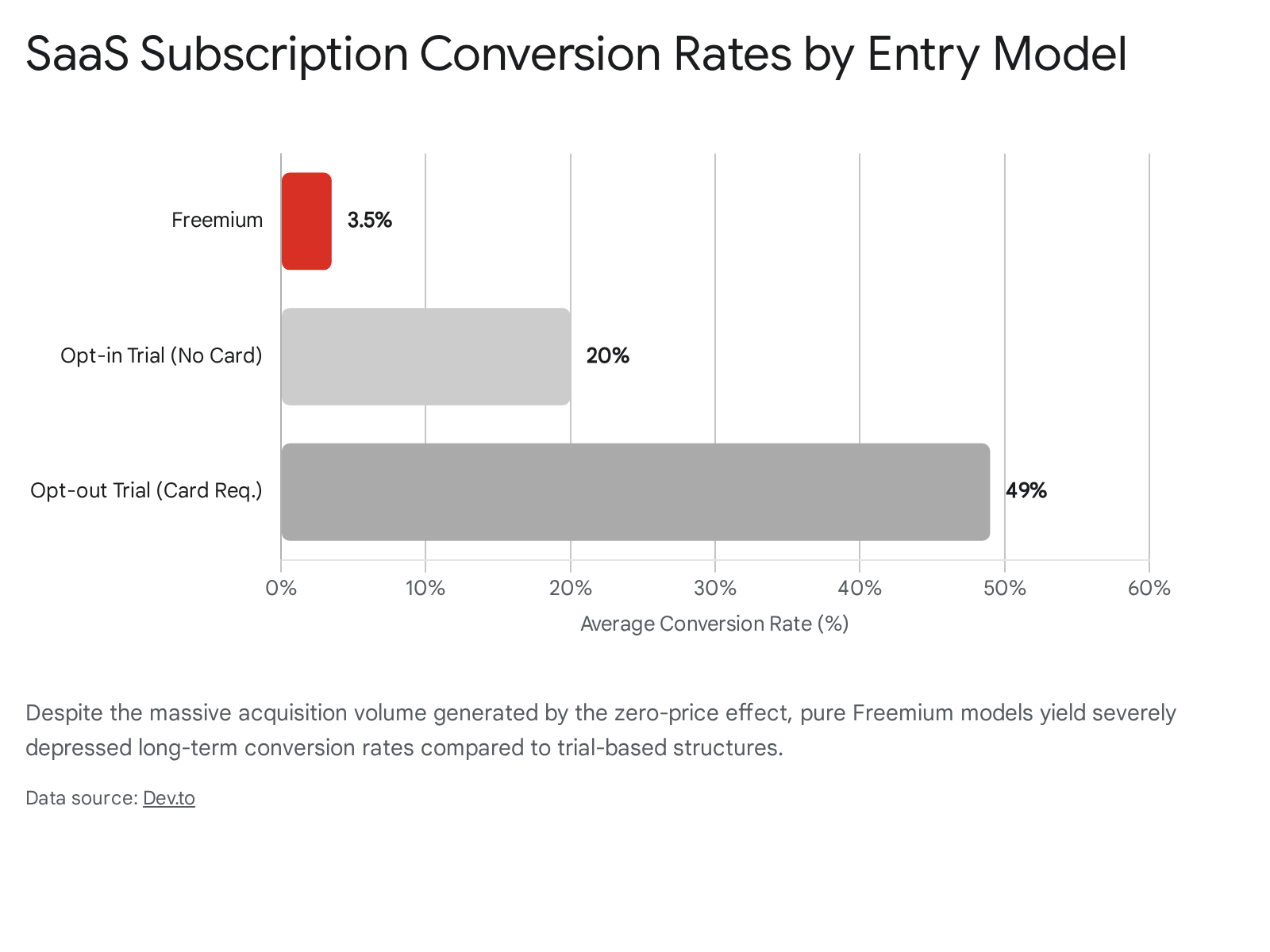
As a result, freemium conversion rates are chronically depressed, hovering historically between 2% and 5% 29. Because the remaining 95% to 98% of free users contribute zero direct revenue while consuming infrastructure and customer support resources, the SaaS industry is increasingly shifting away from pure freemium toward "reverse trials" and high-intent, paid-entry thresholds to filter out users who are immune to monetization 29. Recent market data highlights this shift: SaaS customer acquisition cost (CAC) ratios climbed 14% while growth endurance dropped, prompting companies to abandon frictionless acquisition in favor of opt-out trials (requiring a credit card upfront), which secure much higher conversion rates ranging from 48% to 50% 29.
The Personal Data Economy and Spendception
The contemporary internet is predicated on a "data-as-payment" paradigm. Platforms provide ostensibly free search engines, social media networks, and content repositories. In reality, the price is not zero; the currency has simply shifted from fiat money to personal data 333031.
The zero-price effect is highly potent in this environment because consumers exhibit "Spendception" - a psychological decoupling of consumption and payment in digital contexts 10. Because data extraction occurs invisibly and frictionlessly in the background, consumers do not physically experience the "pain of paying" 10. They categorize the service as entirely free, engaging the affect heuristic and overlooking the severe, long-term privacy costs associated with commercial surveillance 430.
When platforms attempt to reverse this model - offering a "pay-for-privacy" (PFP) tier where users pay a monetary fee to prevent data mining - adoption is notoriously low 3031. Surveys conducted on digital wellbeing services consistently reveal widespread reluctance to pay for privacy; because the baseline service is anchored at a nominal price of zero, consumers perceive the introduction of a privacy fee as an unfair market penalty rather than a legitimate exchange of value 3032. This dynamic underscores how deeply the zero-price anchor distorts subsequent financial evaluations in digital ecosystems 30.
Macroeconomic and Sector-Specific Implications
The implications of the zero-price effect extend beyond retail and software, heavily influencing macroeconomic policy, particularly in sectors subsidized by public capital.
Zero Pricing in Healthcare Systems
In public health and social welfare, the implementation of zero-priced services often leads to complex behavioral hazards. A comprehensive field study analyzing municipal subsidies for child healthcare in Japan explicitly quantified the zero-price effect outside of a laboratory. The dataset covered 10 years of healthcare utilization and found that offering healthcare at a strictly zero price discontinuously boosted demand far beyond what standard price elasticities would predict 33.
The zero-price effect in this sector encouraged healthier individuals to over-utilize services and exacerbated medical resource strain, including the inappropriate consumption of antibiotics. The study demonstrated that an infinitesimal price increase from a zero price (e.g., establishing a nominal copayment of just USD 2 per visit) reduced the probability of physician visits by 4.8%. This minor cost introduction engaged the market norm and mitigated moral hazard without imposing a substantial financial burden on the population, proving that zero pricing requires careful strategic deployment in public policy to prevent system overload 33.
The Zero-Comparison Effect
A corollary to the zero-price effect is the "zero-comparison effect," which applies the psychology of zero to product attributes rather than monetary cost. When a highly desirable attribute of a product (such as nutritional calories, processing time, or carbon footprint) shifts from a small positive number to exactly zero, consumer selection for that product spikes disproportionately 3435. This indicates that the cognitive categorization of "zero" as a special, risk-free boundary extends to non-monetary evaluations, influencing how markets label and position sustainable or health-conscious goods.
Cultural and Socioeconomic Moderators
The zero-price effect is primarily rooted in human cognitive architecture, but its magnitude is moderated by cultural norms and socioeconomic contexts, meaning it is not a universally uniform law of economic behavior.
Individualism Versus Collectivism
Cultural dimensions, specifically the spectrum of individualism versus collectivism, play a significant role in moderating responses to zero-price offers. Individualistic cultures (e.g., the United States, Western Europe) generally prioritize personal utility maximization and autonomy. Collectivist cultures (e.g., East Asia, the Middle East) prioritize group harmony, social proof, and interpersonal relationships 363738.
When subjected to zero-price scenarios (such as dictator and ultimatum economic games), individuals from collectivist backgrounds tend to be hyper-aware of the social norms activated by free goods. Because community perception is paramount, collectivist consumers demonstrate stronger self-regulation and adherence to fairness norms - for instance, taking fewer free items to ensure availability for others, or exhibiting higher tolerance for allocation fairness - compared to their individualistic counterparts 3638. Furthermore, collectivist consumers may view a zero-price item with greater suspicion if it lacks social validation or peer reviews, as their quality inferences are heavily reliant on community consensus rather than isolated individual evaluation 36.
Socioeconomic Status and Geographic Variances
Socioeconomic status (SES) also influences susceptibility to the zero-price effect. Baseline price sensitivity naturally varies; individuals from lower-SES backgrounds possess tighter budget constraints and are inherently more responsive to price reductions and bargains 39. Consequently, the immediate utility derived from removing a monetary cost is theoretically higher for lower-SES consumers, amplifying the zero-price effect.
However, recent empirical data reveals significant geographic and macroeconomic nuances that complicate this assumption. A behavioral pricing parametrization study by Buynomics tested the zero-price effect across multiple countries using telecommunication data plans. Consumers were offered a choice between a 3 GB plan for €1 and a 5 GB plan for €0 (for the first six months). Despite the 5 GB plan being objectively superior in utility and lower in cost, the zero-price effect failed to universally dictate behavior. In Spain, 64% of customers rejected the free plan, preferring to pay €1 for data; similarly, 46% of French consumers and 90% of German consumers resisted the zero-price option 5. These findings indicate that in mature markets - perhaps conditioned by hidden fees, predatory auto-renewals, or high technological literacy - the cognitive scrutiny pathway completely overrides the affect heuristic, rendering consumers immune to the traditional allure of free offers 5.