
Cause marketing effects on consumer guilt, altruism, and loyalty
Cause-related marketing functions as a strategic confluence of commercial objectives and philanthropic initiatives. Tracing its formal origin to the 1983 American Express campaign supporting the restoration of the Statue of Liberty, the practice has evolved from a short-term promotional tactic into a foundational element of corporate social responsibility and brand equity management 1. The effectiveness of these initiatives is governed by complex psychological mechanisms, wherein consumer emotions, cognitive appraisals, and moral identities interact to dictate behavioral outcomes.
Central to the psychological architecture of cause-related marketing are the simultaneous effects of consumer guilt and altruism. Marketers frequently deploy guilt appeals to highlight moral transgressions or social inequalities, aiming to trigger a restorative purchase. Simultaneously, campaigns leverage altruistic motives - encompassing both pure concern for others and the self-serving warm-glow effect - to facilitate moral satisfaction. The delicate calibration of these psychological drivers ultimately determines whether a campaign generates transient purchase intentions, fosters enduring brand loyalty, or inadvertently triggers consumer skepticism and reactance.
Theoretical Frameworks in Cause-Related Marketing
To understand the simultaneous impacts of guilt and altruism, researchers typically employ structural frameworks to map the cognitive and affective pathways of the consumer. The Stimulus-Organism-Response (S-O-R) theory is frequently utilized, positing that external campaign stimuli (such as the specific cause, donation magnitude, and messaging tone) influence the consumer's internal psychological state (the organism), which subsequently drives behavioral outcomes (the response) 23. Within this framework, guilt and altruism serve as the primary internal mediators.
Additionally, the Theory of Planned Behavior operates as a core framework for understanding how rational evaluations and affective responses jointly shape consumption intentions 34. Under this theory, altruism serves as a core antecedent of pro-environmental and prosocial attitudes, while self-congruity with a brand enhances the consumer's perceived behavioral control and subjective norms 34. By integrating these models, researchers can isolate the specific variables that elevate a consumer from a single-transaction participant to a highly engaged brand advocate.
Typology of Consumer Guilt
Consumer guilt is a negative, aversive emotion elicited when an individual perceives a discrepancy between their actual behavior and their internalized moral or social standards 56. In marketing communication, guilt is not a monolithic construct. It manifests in three distinct psychological forms based on temporal orientation and the locus of responsibility. Recognizing these distinctions is critical, as each form necessitates different messaging strategies and yields divergent behavioral outcomes.
Existential Guilt Dynamics
Existential guilt, frequently termed social-responsibility guilt, arises from a cognitive awareness of systemic inequalities and the discrepancy between the consumer's own state of well-being and the suffering or deprivation of others 789. Unlike other forms of guilt, the consumer experiencing existential guilt has not directly caused the suffering; rather, the emotion is generated by the mere privilege of their position relative to the victim 610.
In cause-related marketing, existential guilt is frequently utilized in campaigns addressing global poverty, hunger, humanitarian aid, or systemic injustice. Because it is driven by empathy and a broad sense of moral responsibility, existential guilt appeals are highly effective in social marketing contexts, provided the consumer feels a degree of psychological or cultural proximity to the cause 810. However, empirical data indicates that while existential guilt effectively evokes moral responsibility, it can sometimes negatively impact attitudes toward the sponsoring brand if the consumer perceives the brand as exploiting structural inequalities for profit 911.
Anticipatory Guilt Mechanisms
Anticipatory guilt is a prospective emotion experienced when a consumer contemplates a potential future violation of their ethical standards or considers the negative consequences of their inaction 579. It acts as a preventative psychological mechanism, regulating self-control and ethical decision-making before a transgression occurs 1213.
In environmental and sustainability marketing, anticipatory guilt is a primary driver of behavior. By forcing consumers to confront the future catastrophic effects of present-day consumption, marketers encourage pre-emptive remedial action 14. Studies indicate that anticipatory guilt substantially influences ethical choices, motivating consumers to select products with fair-trade, organic, or cruelty-free certifications to alleviate the anticipated negative emotion before it materializes 3715. The effectiveness of anticipatory guilt is heavily dependent on the consumer's perceived self-efficacy; the consumer must believe that purchasing the cause-linked product will genuinely mitigate the anticipated harm 15.
Reactive Guilt and Retrospective Evaluation
Reactive guilt is a retrospective emotion triggered as a direct response to a past action or inaction that violated personal or societal standards 59. It is the most traditional conceptualization of guilt, prompting immediate reparative or compensatory behaviors to undo perceived harm 6.
In marketing contexts, reactive guilt is often stimulated by highlighting a consumer's past environmentally damaging behaviors, their failure to support a community initiative, or their indulgence in unhealthful consumption. The cause-linked product is subsequently offered as a mechanism for immediate moral restitution. While highly effective at generating short-term compliance, reactive guilt appeals must be managed carefully, as reminding consumers of their explicit failures can induce defensive psychological posturing if the messaging is perceived as overly accusatory 69.
| Guilt Typology | Temporal Orientation | Psychological Trigger | Primary Behavioral Response | Common Marketing Application |
|---|---|---|---|---|
| Existential Guilt | Present / Ongoing | Awareness of systemic inequality and unearned privilege relative to others. | Empathy-driven donation; desire to bridge the well-being gap. | Humanitarian aid, poverty alleviation, global health campaigns. |
| Anticipatory Guilt | Future | Contemplation of a potential ethical violation or the consequences of inaction. | Preventative ethical consumption; avoidance of moral transgression. | Environmental sustainability, fair-trade purchasing, cruelty-free products. |
| Reactive Guilt | Past | Reflection on an actual behavioral violation of personal or social norms. | Compensatory action; immediate moral reparation. | Carbon offset purchases, local community restoration funds. |
Emotional Thresholds and the Inverted-U Function
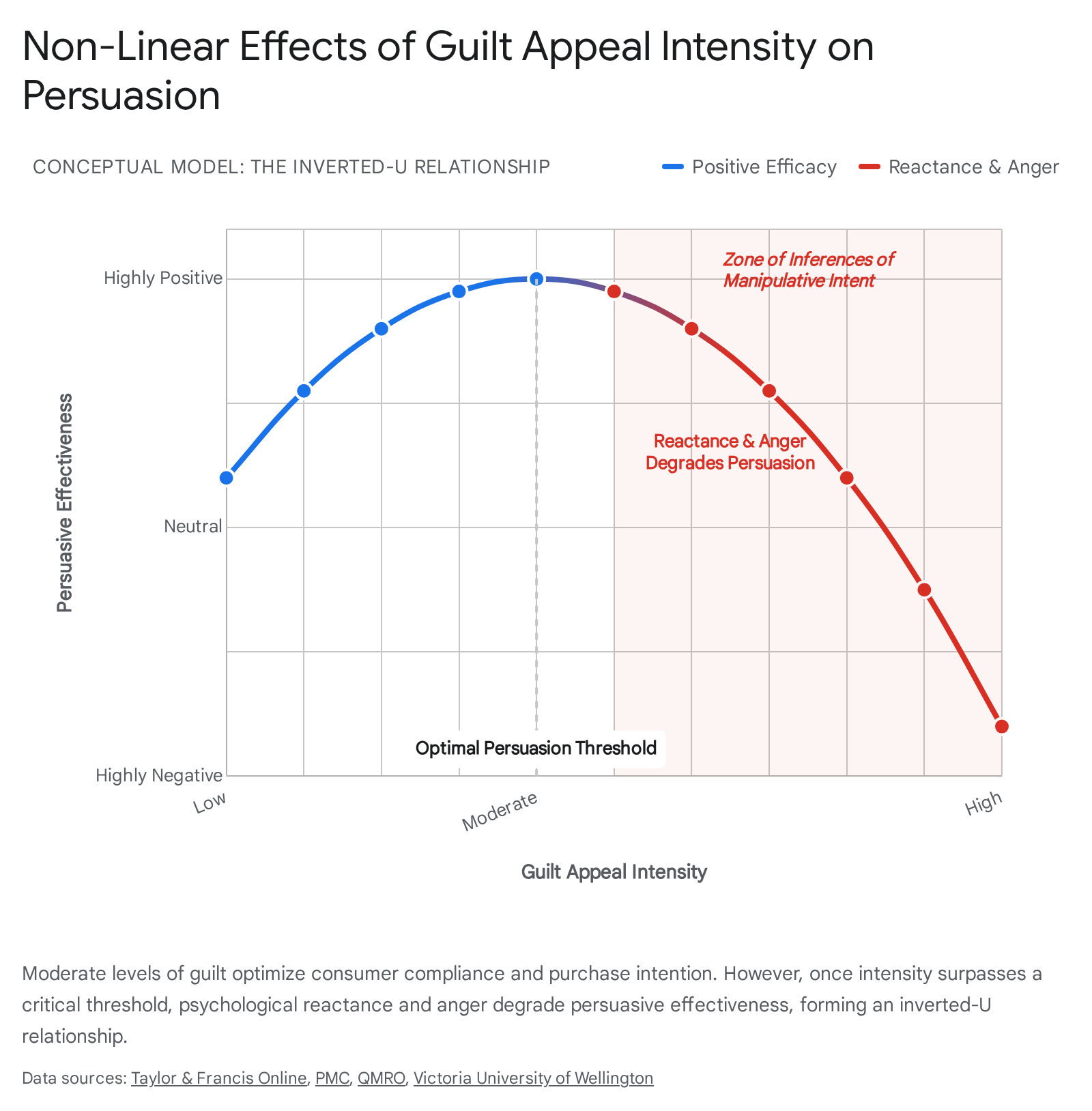
While the elicitation of guilt is a proven mechanism for driving compliance and purchase intention, empirical evidence highlights the significant risks associated with excessive emotional stimulation. Persuasion researchers widely debate the precise functional form of guilt appeals, but a substantial body of literature, including meta-analytic reviews, supports an inverted-U relationship between the intensity of a guilt appeal and the consumer's persuasive response 16171819.
Inferences of Manipulative Intent and Reactance
According to the Persuasion Knowledge Model, consumers actively evaluate advertising messages to infer the sponsor's underlying motives. When a cause-related marketing campaign employs moderate levels of guilt, it successfully activates the consumer's self-regulatory processes, prompting them to resolve the aversive emotional state through the purchase of the cause-linked product 1216. At moderate levels, the emotion remains productive, directing attention toward the availability of a reparative action.
However, when guilt appeals cross a specific intensity threshold - becoming overly graphic, hyper-personalized, accusatory, or emotionally manipulative - the psychological dynamics shift abruptly. High-intensity guilt appeals trigger defense mechanisms based on psychological reactance theory. Consumers experience a loss of perceived behavioral autonomy, leading them to resist the persuasion attempt 820. At this tipping point, the consumer's attention shifts away from the social cause and toward the manipulative intent of the advertiser. Inferences of manipulative intent severely degrade ad credibility and generate secondary emotional responses, predominantly anger, hostility, and resentment directed at the brand 15161821.
Consequently, excessive guilt appeals paradoxically yield lower purchase intentions and degraded brand attitudes compared to moderate or low-intensity appeals 161722. Studies utilizing Likert-scale measurements of emotional arousal confirm that while perceived guilt increases linearly with appeal intensity, persuasive outcomes drop off sharply after the optimal moderate threshold is breached 161920.
Contextual Moderation of the Tipping Point
The precise location of this emotional tipping point is subject to contextual moderation. Research indicates that the source motive plays a critical role: non-profit organizations and social marketers are generally afforded more leeway to use higher-intensity guilt appeals without triggering anger, as their motives are perceived as purely altruistic 2022. Conversely, commercial brands utilizing cause-related marketing face a much lower threshold for perceived manipulation, as consumers retain latent skepticism regarding the profit motive 22. Furthermore, individual consumer disposition influences receptivity; individuals with a high baseline propensity for guilt (guilt proneness) are less likely to exhibit the inverted-U reactance, instead demonstrating a more linear positive response to increasingly intense appeals 1218.
Tipping Point Framing in Donation Thresholds
The concept of the tipping point is not limited to emotional intensity; it is also a highly effective structural mechanism for campaign design. Social-threshold incentives - where a campaign promises an increased donation or a matched contribution once a specific aggregate participation threshold is met - leverage collective psychological dynamics 2324.
Research shows that framing the individual consumer as the explicit tipping point (i.e., informing the consumer that their specific purchase will push the total campaign over the threshold, activating rewards for all participants) significantly maximizes participation 23. This framing strategy heightens the consumer's sense of personal impact and amplifies feelings of obligation toward fellow participants 2324. It effectively converts latent anticipatory guilt into immediate altruistic action, proving more motivating than equivalent-in-value direct financial incentives for the consumer 2324.
Altruistic Motivation and the Warm-Glow Effect
While guilt operates as a negative, aversive driver of campaign participation, altruism serves as the primary positive, approach-oriented psychological mechanism. Altruism in consumer behavior is theoretically segmented into two paradigms: pure altruism and impure altruism (commonly referred to as the warm-glow effect).
Pure Altruism versus Impure Altruism
Pure altruism reflects an intrinsic concern for the welfare of others, the environment, or society, motivating actions that prioritize collective well-being strictly over individual gain 2526. Consumers driven by high pure altruism evaluate cause-related marketing campaigns based on the tangible impact of the initiative and the severity of the cause 27.
Conversely, the warm-glow effect represents a form of self-serving, or impure, altruism. First conceptualized in economic literature, warm-glow describes the internal psychological reward, moral satisfaction, and boost to self-esteem that an individual experiences from the sheer act of giving, independent of the actual utility provided to the recipient 272829.
In highly effective campaigns, these motives operate simultaneously and synergistically. Warm-glow altruism enhances the immediate emotional satisfaction derived from a purchase, functioning as an intrinsic psychological benefit that offsets price premiums 27. Meanwhile, pure altruism operates as an underlying value system that increases the consumer's sensitivity to social cues and their perceived ethical obligation to participate in the marketplace 325.
Value-Belief-Norm Theory and Altruistic Values
Altruistic values significantly moderate how consumers process brand sustainability claims and perceived psychological benefits. Grounded in the Value-Belief-Norm theory, researchers demonstrate that personal norms regarding environmental or social care dictate behavioral intentions 30. When a consumer with high altruistic tendencies encounters a cause-related marketing campaign, they experience enhanced self-brand congruity - a deep alignment between the brand's identity and their own moral self-concept 43132.
This alignment reduces cognitive strain in decision-making and amplifies customer citizenship behavior, encouraging the consumer to advocate for the brand, engage in positive word-of-mouth, and exhibit a higher tolerance for price premiums 2533. For these consumers, purchasing a cause-linked product is viewed not merely as a functional transaction, but as an expressive vehicle for their ethical identity 3.
| Dimension of Altruism | Psychological Mechanism | Consumer Focus | Marketing Implication |
|---|---|---|---|
| Pure Altruism | Intrinsic concern for recipient welfare. | Tangible impact, cause severity, utility to the beneficiary. | Campaigns must provide transparent data on outcomes and efficiency. |
| Warm-Glow (Impure) | Extrinsic psychological reward from the act of giving. | Self-esteem, moral satisfaction, emotional uplift. | Campaigns should emphasize the consumer's role as a "hero" and provide immediate positive feedback. |
| Self-Brand Congruity | Alignment of brand values with consumer's moral identity. | Expressive identity, ethical signaling. | Brands must maintain long-term consistency in social messaging to foster deep attachment. |
Structural Integration of Brand Loyalty Pathways
The simultaneous interaction of guilt mitigation and altruistic satisfaction serves as the psychological engine for generating brand loyalty.
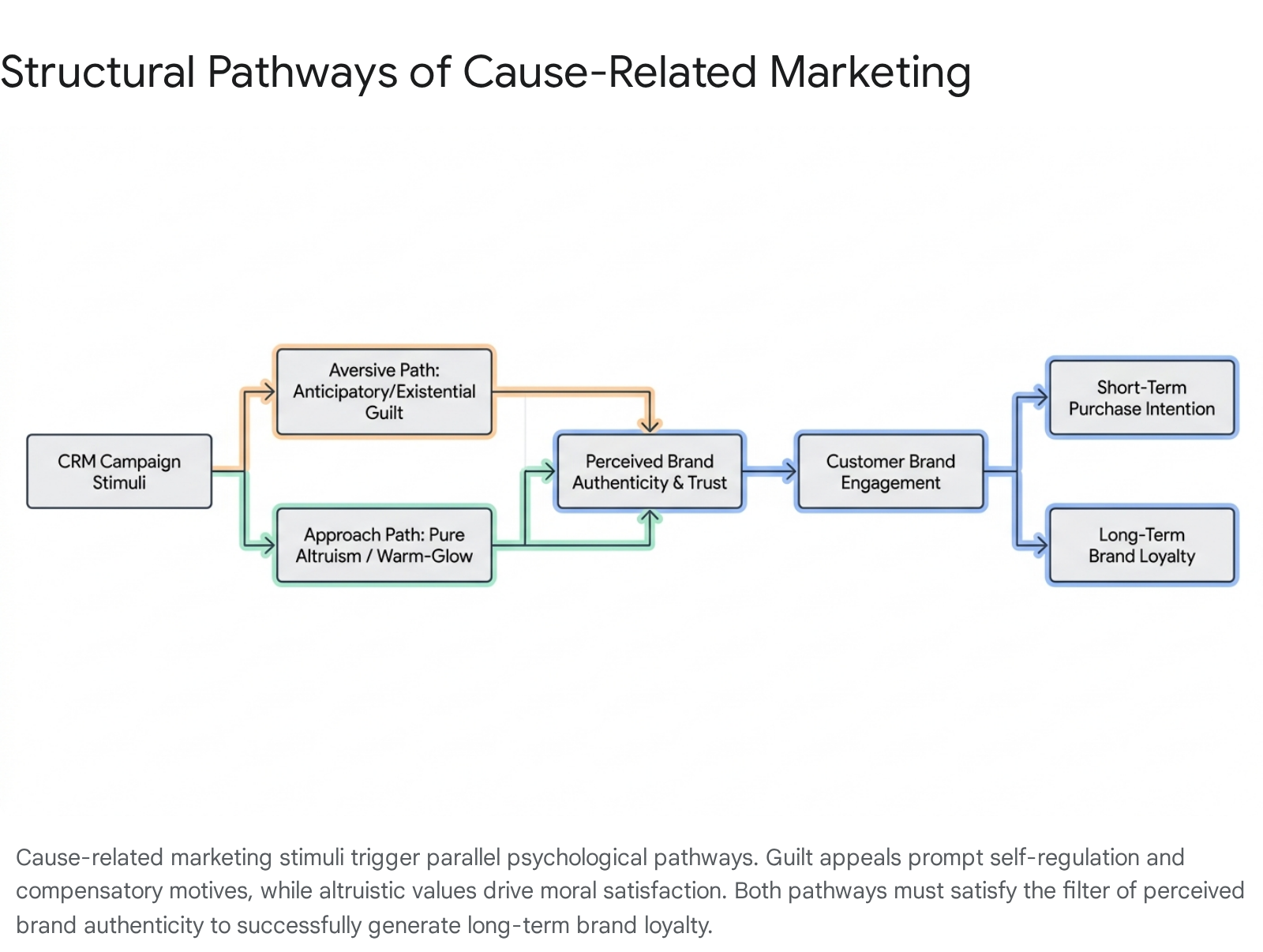
However, loyalty in consumer psychology is multidimensional, encompassing both short-term behavioral metrics (purchase intention) and long-term psychological bonds (attitudinal loyalty).
Supply Chain Volatility and the Bullwhip Effect
Cause-related marketing initiatives are highly effective at driving short-term purchase intentions. By offering a temporary mechanism to alleviate existential or anticipatory guilt while securing warm-glow satisfaction, campaigns routinely generate immediate sales spikes 3435. In fast-moving consumer goods (FMCG) sectors, research indicates that these campaigns produce a notable weekly sales increase (averaging roughly 4.9%) with sustained growth during the promotion window 36.
However, this short-term behavioral loyalty can be fragile and operationally problematic. Research spanning the retail supply chain reveals a structural challenge associated with cause-related marketing demand. The artificial inflation of demand during a campaign often fails to translate into sustained post-campaign sales, leading to extreme demand variability 35. Inventory planners frequently misinterpret these temporary psychological purchase spikes as sustained structural demand, leading them to over-forecast. As actual retail store sales wane post-campaign, this results in the bullwhip effect - excess inventory and operational inefficiencies upstream 35. This operational reality underscores that without deeper psychological engagement, a cause-related campaign functions identically to a standard price promotion, capturing transient switchers rather than forging hardcore brand advocates 37.
Attitudinal Loyalty and Customer Brand Engagement
To secure long-term, attitudinal loyalty, the emotional arousal generated by the campaign must translate into persistent brand trust and customer brand engagement 373838. This transition requires the fulfillment of basic functional expectations alongside the ethical appeal. Utilizing the SERVQUAL model, researchers note that reliability, assurance, and empathy remain fundamental prerequisites; a brand cannot substitute poor product quality or service with social initiatives 3839.
When functional quality is maintained, the moral satisfaction derived from altruism and the successful regulation of guilt foster an affective loyalty 37. Affective loyalty roots the consumer's relationship with the brand in emotional attachment rather than mere transactional habit 33. Trust acts as the critical intermediary: when consumers perceive the brand's commitment to the cause as genuine, the resulting trust solidifies the psychological link, rendering the consumer less price-sensitive and more likely to exhibit oppositional brand loyalty - defending the brand against competitors 383940.
The Vulnerabilities of Moral Licensing and Purpose-Washing
The psychological benefits of cause-related marketing are highly vulnerable to contextual disruptions, primarily through the dual threats of consumer moral licensing and corporate purpose-washing.
Mechanisms of the Moral Licensing Paradox
While authentic marketing fosters loyalty, it can inadvertently trigger negative spillover effects through moral licensing. Moral licensing occurs when an individual engages in an ethical or prosocial act, which subsequently boosts their moral self-concept and provides psychological justification to engage in later indulgent, unethical, or less prosocial behaviors 424142.
In consumer behavior, purchasing a cause-linked product or a green brand deposits "moral credits" into the consumer's psychological bank account 41. Because their need for moral self-signaling has been temporarily satiated, the consumer may subsequently choose to buy a luxury item, refrain from further charitable donations, or engage in wasteful behavior 34243. Experimental studies demonstrate that this effect operates via two pathways: licensing via credits (withdrawing from a moral bank account) and licensing via credentials (where a past good deed alters the construal of a subsequent transgression) 41. Consequently, while a campaign may boost initial sales, it can cannibalize a consumer's broader altruistic behavior. Marketers must navigate this by positioning the cause-linked product not as a finite moral transaction, but as an ongoing component of the consumer's long-term ethical identity 3.
Purpose-Washing and Ambiguous Brand Responsibility
As value-driven marketing becomes ubiquitous, consumers exhibit rising skepticism regarding brand authenticity. "Purpose-washing" - the superficial promotion of social values without tangible, systemic commitment - severely damages consumer trust 444546. When consumers detect a disconnect between a campaign and a brand's operational realities, it triggers an attributional mindset where ulterior motives are assumed 4447.
This skepticism disrupts the altruistic warm-glow and transforms potential guilt relief into psychological reactance. Brands accused of purpose-washing suffer cumulative reputational damage, leading to boycotts, brand avoidance, and the destruction of existing brand equity 4448. The risk is amplified by ambiguous brand responsibility within complex global value chains, where consumers may assign blame to a brand for systemic failures upstream, requiring robust, transparent communication to maintain moral credentials 41. Authentic social purpose branding requires alignment across institutional logics, ensuring the cause-brand fit is logically sound and operationally supported 3146.
Strategic Campaign Variables
The structural design of the marketing campaign directly modulates the intensity of guilt and altruistic response. Campaign managers must strategically calibrate donation sizes, cause-brand fit, and campaign communication styles to optimize the psychological outcomes.
Donation Magnitude and Framing
Counterintuitively, larger donation amounts do not uniformly yield superior consumer responses. While substantial donations can signal firm sincerity and enhance the warm-glow effect, excessively large donations (either in absolute dollars or percentages) often activate consumer skepticism 29. Consumers may perceive heavily funded campaigns as desperate attempts to mask corporate malfeasance or buy consumer goodwill, generating inferences of manipulative intent 2949.
Research suggests that framing donations in absolute, easily comprehensible dollar terms (rather than complex percentages) increases transparency and perceived fairness. This clarity results in consumers perceiving the campaign as more altruistic, which acts as a mediator to increase participation intention 28. Furthermore, setting maximum total donation limits can deter consumers who feel their individual contribution is negligible, whereas setting attainable minimum goals reinforces the perception of collective impact 50.
The Role of Cause-Brand Fit
The degree of congruence, or "fit," between the corporate brand and the chosen social cause is a persistent variable in marketing effectiveness 3451. High cause-brand fit enhances associative learning, streamlining the consumer's cognitive evaluation of the campaign and validating the brand's authenticity 3452.
However, findings on fit are nuanced. While low-congruence campaigns can negatively impact brand image by appearing opportunistic 53, some literature suggests that if a brand explicitly outlines a broad social purpose mandate as part of its core identity, unrelated causes may still be accepted by consumers without friction 56. In crowded retail environments, visual cues and brand leadership often override subjective perceptions of fit; category leaders frequently see higher returns on cause-related promotions simply due to higher baseline visibility 36.
| Strategic Variable | Psychological Impact | Optimal Implementation Strategy |
|---|---|---|
| Donation Magnitude | Too small appears trivial; too large triggers skepticism and inferences of manipulative intent. | Moderate, highly transparent donations. |
| Donation Framing | Abstract percentages reduce perceived efficacy. | Absolute dollar terms to increase perceived fairness and transparency. |
| Threshold Design | High maximums deter action; minimums encourage collective effort. | Tipping point framing; making the consumer the catalyst for a broader reward. |
| Cause-Brand Fit | High fit lowers cognitive strain and boosts perceived authenticity. | Align causes directly with product sector unless the brand has a pre-established broad social mandate. |
Cultural Contexts in Social Marketing
The psychological processing of guilt, altruism, and brand loyalty is not universally uniform; it is heavily mediated by cultural and regional value systems. The application of cause-related marketing strategies must account for these macro-environmental differences to avoid miscalibrating the emotional appeal.
Guilt Cultures versus Shame Cultures
Psychological and sociological frameworks differentiate between individualist "guilt cultures" (predominantly European and North American) and collectivist "shame cultures" (predominantly Asian) 5455. In guilt cultures, moral regulation is internalized; consumers evaluate their behavior against personal standards of harm prevention, fairness, and caregiving 54. Guilt appeals here are highly effective because they target individual responsibility and the desire to alleviate internal dissonance.
Conversely, in shame cultures, moral regulation is externalized and relational, prioritizing the preservation of social harmony, hierarchal respect, and avoiding the negative judgment of the collective 5455. Consequently, consumers in collectivist societies tend to respond less to traditional, individualized anticipatory guilt appeals. Instead, they demonstrate higher responsiveness to campaigns framed around social norms, group obligations, and the avoidance of public stigma or "loss of face" 55.
Regional Variations in Cause Marketing Efficacy
Regional market dynamics necessitate highly localized adaptations of cause-related campaigns.
- Japan: The Japanese market requires profound cultural sensitivity. Marketing initiatives align closely with the traditional business philosophy of Sanpo Yoshi (benefits for the buyer, the seller, and society) 56. Japanese consumers demand subtlety, high transparency, and measurable evidence of societal contribution. Aggressive guilt appeals or overt purpose-washing face intense skepticism and operate under strict advertising regulations regarding verifiable claims 5660.
- China: The Chinese market is characterized by rapid shifts, high competition, and a dual focus on trend responsiveness and price competitiveness alongside quality 57. Cause-related marketing in China operates effectively when linked to clear, tangible outcomes and strong social media validation, balancing the need for speed-to-market with socially responsible signaling 57. Disclosures regarding the use of AI in marketing generation have been shown to increase skepticism in this market, requiring careful deployment 28.
- The Middle East: There is a rapidly rising demand for corporate social responsibility and cause marketing in the Middle East, driven by a young, value-conscious demographic 62. Successful campaigns in this region rely on deep cultural resonance, focusing on structural issues like financial literacy, education, community upliftment, and women's empowerment 62. These campaigns must be strictly adapted to local nuances, observing religious holidays and halal norms to ensure the altruistic messaging aligns with the regional moral framework 62.
Conclusion
The psychology of cause-related marketing operates on a highly sensitive equilibrium between emotional taxation and moral reward. Marketers must strategically harness existential and anticipatory guilt to prompt ethical self-reflection, while carefully avoiding the intense tipping point that breeds inferences of manipulative intent and psychological reactance. Simultaneously, campaigns must facilitate altruistic satisfaction - combining pure concern for societal welfare with the intrinsic warm-glow effect - to elevate the consumer experience from a transactional purchase to an expression of moral identity.
When executed with structural transparency, optimized cause-brand fit, and a genuine commitment that bypasses the dual pitfalls of purpose-washing and moral licensing, this psychological interplay secures far more than a short-term spike in sales. It builds profound self-brand congruity, fosters deep-seated trust, and solidifies the affective, long-term brand loyalty necessary to thrive in an increasingly values-driven global marketplace.