
Psychological ownership and consumer attachment in access models
The fundamental nature of consumption has undergone a profound transformation over the past decade. Modern economies are rapidly shifting away from a paradigm of permanent, legal ownership of physical goods toward an access-based economy characterized by temporary use, liquid experiential goods, and digital subscriptions 123. In this new paradigm, consumers frequently engage with products, services, and platforms - ranging from ride-sharing and fashion rentals to cloud-based software and streaming media - without ever holding the legal title to them 12. Despite the explicit absence of formal property rights, individuals routinely develop deep, enduring, and sometimes irrational attachments to these targets. This phenomenon is driven by "psychological ownership" - the cognitive and affective state wherein an individual feels that a target, whether tangible or intangible, is inherently "theirs" 14.
As participation in the sharing economy and the subscription-based Software-as-a-Service (SaaS) sector accelerates well into the late 2020s, understanding the mechanisms that generate psychological ownership has become an imperative for researchers and practitioners. The global subscription economy, valued at approximately $650 billion in 2020, is projected to exceed $1.5 trillion by 2030, driven by a compound annual growth rate of over 14% 56. Consequently, the ability to engineer a sense of ownership without transferring legal title is a core strategic competency.
This exhaustive research report explores how psychological ownership operates in the absence of legal ownership across rental, trial, and freemium models. It delineates the concept from adjacent psychological constructs, examines the timeline of non-legal attachment, and delves into the contemporary digital frontier of AI co-creation and personal data investment. Furthermore, it addresses the "dark side" of these attachments, including consumer territoriality and extreme frustration, while contextualizing these behaviors within cross-cultural differences between Western individualistic societies and non-Western collective orientations.
The Conceptual Foundations and Chronological Evolution of Psychological Ownership
To comprehend the application of psychological ownership in modern access-based markets, one must trace its conceptual lineage. The notion that an individual can feel ownership over something they do not legally possess is rooted in early psychological and philosophical treatises on the nature of the self.
Historical Timeline of the Construct
The chronological development of psychological ownership progresses from its roots in early philosophy to its modern conceptualization as a deep psychological attachment within consumer behavior 6.
- Late 19th to Mid-20th Century (Foundational Period): The intellectual foundation of psychological ownership was laid by psychologist William James in 1890, who described the "Self" as the sum total of all a person can call theirs, encompassing not only their body and psychic powers but also their material possessions 6. Subsequent foundational thinkers, including Beaglehole (1932), Isaacs (1933), and Litwinski (1942), explored the psychology of "mine" and property. Jean-Paul Sartre's 1943 assertion that "What is mine is myself" highlighted the ontological fusion between possession and self-identity 6.
- Late 1970s to Early 1980s (Organizational Roots): Federal legislation in the United States popularized Employee Stock Ownership Plans (ESOPs), creating a surge of academic interest in employee ownership as an organizational arrangement 6.
- 1991 to 2003 (Formalization of the Theory): A critical 1991 review by Pierce, Rubenfeld, and Morgan suggested that formal (legal) ownership does not automatically lead to positive morale or performance. These effects only occur if employees subjectively feel as though they are owners. Between 1995 and 2003, Jon L. Pierce, Tatiana Kostova, and Kurt T. Dirks formalized the "Theory of Psychological Ownership," defining it as the state in which individuals feel a target is "theirs" and identifying the core motivational roots and behavioral routes to this state 467.
- 2009 to 2013 (Integration into Consumer Psychology): Researchers such as Joann Peck and Suzanne Shu began exploring psychological ownership in consumer behavior, explicitly linking physical touch (haptics) and imagery to perceived ownership and economic valuation 368.
- 2017 to Present (Digital Application and the Dark Side): Research expanded into the consequences of psychological ownership in the digital sphere, applying the construct to explain emotional attachment to virtual items, streaming platforms, SaaS subscriptions, and the "dark side" of ownership, such as territoriality and psychological reactance 69.
Throughout this timeline, scholars have continuously emphasized that psychological ownership is distinctly separate from legal rights. Legal ownership is a socio-legal construct defined by a host country's legal system, whereas psychological ownership is a psychological state defined entirely by the individual and legitimized through their own internal cognition and affective bonds 6.
Delineating the Constructs: Psychological Ownership, The Endowment Effect, and Brand Loyalty
To accurately analyze consumer behavior in non-legal access models, it is essential to explicitly distinguish psychological ownership from conceptually related but functionally distinct phenomena, specifically the endowment effect and general brand loyalty 4. While often conflated in colloquial business discourse, consumer psychology literature draws sharp boundaries between these mechanisms.
Psychological Ownership: The Underlying Mechanism
Psychological ownership is the foundational subjective sense that a target is "MINE" 4. It is composed of both a cognitive element (the intellectual awareness and belief of possession) and an affective element (the emotional attachment to the target). This state occurs when a person exercises control over a target, invests themselves in it, or gains intimate knowledge of it, causing the target to become fused with their self-concept 4. In a digital context, when a consumer invests time curating a profile on a streaming platform, they develop psychological ownership over that digital space, even though the platform legally owns the data infrastructure 10. It ceases to be an external tool and becomes an extension of the self - a phenomenon that satisfies intrinsic consumer motives related to self-identity, efficacy, and the need for a "home" or secure place to dwell 111213.
The Endowment Effect: The Behavioral Consequence
The endowment effect describes the phenomenon wherein individuals inflate the perceived economic value of an object simply because they possess it 414. It is critical to recognize that the endowment effect is a behavioral consequence of psychological ownership, rather than the mechanism itself 4.
The scientific validation of this effect was famously established in an experiment by Kahneman, Knetsch, and Thaler (1991), where university students were given identical coffee mugs. Sellers who owned a mug demanded an average of $7.12 to part with it, while buyers who did not own one offered an average of only $2.87. Ownership alone inflated the perceived value by approximately 2.5 times 4. When psychological ownership is established, the target is incorporated into the consumer's endowment. Consequently, the prospect of relinquishing the target triggers acute loss aversion 4. Applied to modern loyalty programs or freemium models, points or digital assets create an endowment that the member fears losing; that loss feels approximately twice as large as the equivalent gain elsewhere, creating immense switching costs 4.
Brand Loyalty: The Downstream Outcome
Brand loyalty refers to a consumer's consistent preference for and repeated purchase of a specific brand over time, often driven by habit, satisfaction, or perceived quality. While many organizations rely on satisfaction to drive loyalty, recent scholarship establishes psychological ownership as a parallel, and often more powerful, independent pathway to loyalty 4.
Satisfaction is necessary but not sufficient; a consumer can be satisfied with a rental service and still easily switch to a competitor. However, a consumer who feels psychological ownership over their specific rental profile or status will exhibit fierce loyalty because leaving the brand equates to a painful psychological loss 4. Psychological ownership sits at the "highest stair" of the customer relationship ladder, surpassing mere engagement or satisfaction 4. Members become loyal not because of the rational value of rewards, but because leaving the program means losing a part of their identity 4.
The Architecture of Attachment: The Three Pathways
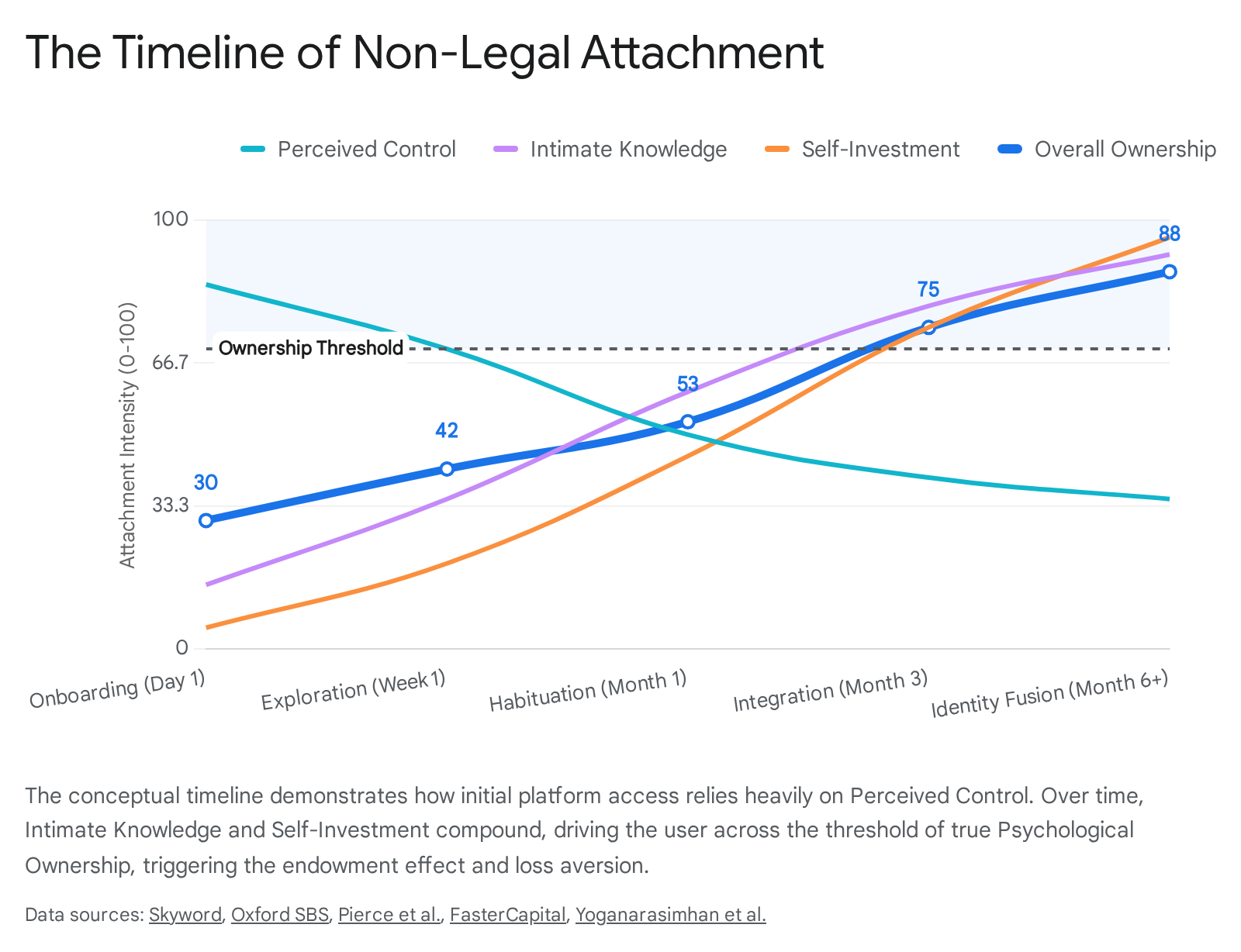
Psychological ownership does not materialize spontaneously. Foundational theories dictate that consumers develop feelings of ownership through three distinct behavioral and cognitive pathways, or "routes": Perceived Control, Intimate Knowledge, and Investment of the Self 151617. In access-based models, platforms must carefully engineer these routes to compensate for the lack of legal ownership.
1. Perceived Control
The ability to use, direct, modify, or restrict access to a target generates a sense of ownership. Control allows individuals to shape their environment, fulfilling basic efficacy and effectance motives 1217. In physical access models, control is instantiated through touch and physical manipulation 6. In digital and non-legal access models, control is often achieved through customization options, user settings, and algorithmic inputs 1518. The more freedom a user has to customize a service (e.g., editing playlists, adjusting software dashboards), the higher their sense of control, workload, and ultimately, psychological ownership 10. Conversely, "fractional ownership" models - where control is shared among hundreds of strangers - inherently threaten this pathway by diluting the individual's autonomy over the object 12.
2. Intimate Knowledge
Continuous interaction and deep familiarity with a target foster a sense of cognitive fusion. The more a consumer understands the intricacies, hidden features, or history of a product or service, the more it feels like theirs 1617. This route is heavily leveraged in subscription and SaaS models, where complex interfaces demand learning and habituation 16. Through prolonged exposure, the service ceases to be a novel external entity and becomes a familiar, predictable extension of the user's daily routine. Building intimate knowledge requires a timeline of consistent access; thus, models that encourage daily or weekly active use are far more successful at generating attachment than infrequent, transactional access 16.
3. Investment of the Self
The investment of time, physical effort, psychic energy, and, increasingly, personal data into a target embeds the user's identity into the product. Known colloquially in product design as the "IKEA effect," targets that require the consumer's active input are highly susceptible to psychological ownership 1519. When consumers dedicate their own resources to co-creating value - whether by building a complex financial model in SaaS software, establishing an avatar in a virtual game, or painstakingly reviewing hosts on a peer-to-peer platform - they are projecting their identity onto the service 1619. The service becomes a repository of the consumer's labor, drastically increasing the psychological friction of abandonment.
Comparative Dynamics: Rental, Trial, and Freemium Models
The application of these three pathways varies significantly across different non-legal access structures. The following section analyzes how psychological ownership is cultivated - or hindered - within three dominant models: the Rental Model, the Trial Model, and the Freemium Model.
The Rental Model (Physical and Digital)
In the rental model (e.g., fashion rentals, car-sharing, short-term lodging), access is explicitly temporary and transactional. Psychological ownership is inherently threatened by the impermanence and shared nature of the goods 13. Because consumers know they must return the item, they often evaluate it from an access mindset rather than an ownership mindset. The expectation of future loss shifts the reference point, treating the use as a temporary gain rather than integrating the object into the consumer's permanent endowment 20. Furthermore, "attachment cues" associated with previous renters can actually inhibit renting, as consumers wish to avoid the responsibility of caring for a valued possession or face contamination concerns 2021.
However, the rental sector has adapted by artificially stimulating ownership. Hybrid "lease-to-own" or subscription-based models blur the lines between temporary access and full ownership 22. For example, a car-subscription service that assigns a vehicle to a specific user over a month allows for personalization, storage of preferences (e.g., radio presets, seat positioning), and deep familiarity, partially replicating ownership feelings 22. By providing high perceived control during the rental window, platforms can generate a localized, gradient form of psychological ownership, proving that the phenomenon is not strictly binary 22.
The Trial Model
The trial model grants full, unrestricted access to a premium product for a strictly limited duration. This model front-loads perceived control and intimate knowledge. Users are encouraged to fully integrate the tool into their daily workflows, building high intimacy rapidly 23. However, the acute awareness of the impending expiration date creates psychological tension. The trial acts as an emotional trap: it accelerates the endowment effect so that when the trial ends, the user faces severe loss aversion regarding the progress and familiarity they have established.
Recent massive field experiments in the global SaaS industry underscore the complexities of trial duration. A two-year randomized field experiment involving over 680,000 new users compared 3-day versus 7-day trials. While shorter trials in traditional models can effectively boost immediate conversions by concentrating conversion pressure within a tight window, longer trials allow for enhanced learning effects and deeper self-investment 23. Users with longer trials responded more favorably to feature-based promotions, having had the time to develop intimate knowledge of the product's capabilities 23. The trial model is designed specifically to convert psychological attachment into legal (or premium subscription) ownership by using the pain of loss as a catalyst 2325.
The Freemium Model
The freemium model offers perpetual access to a basic version of a product, with advanced features gated behind a paywall. Because access to the core platform is perpetual, the threat of impermanence is removed, allowing for deep, long-term habituation and intimate knowledge acquisition 2325.
Psychological ownership in freemium models relies heavily on the "Investment of Self" and the "zero-price effect," which inflates the perceived value of the product due to the absence of financial risk 2526. Users spend months or years uploading personal data, configuring workspaces, and building networks. Empirical studies on freemium cloud storage services reveal that the existence of referral programs and network interactions contributes to 65% of the value of a free consumer (valued at approximately $22 per year) 24.
The transition from free to paid is heavily moderated by the user's existing psychological ownership. A 2026 factorial experiment on cloud-based note-taking services revealed that users with high psychological ownership respond more positively to attribute-based advertising (which details specific features and functionalities) because they already possess intimate knowledge of the platform 25. Conversely, users with low psychological ownership are more effectively persuaded by benefit-based advertising (which emphasizes experiential advantages) 25. By leveraging the endowment effect - where temporary ownership increases the item's worth in the user's eyes - freemium models create an intense desire for the "complete" experience, utilizing the gated features as an upgrade incentive 2526.
Comparative Table: Access Models and Psychological Pathways
The following table summarizes how the three primary pathways operate across the distinct access paradigms.
| Access Model | Perceived Control | Self-Investment | Intimate Knowledge | Psychological Ownership Threat / Catalyst |
|---|---|---|---|---|
| Rental Model | Moderate: High during active use, but legally restricted and ultimately revoked upon return. | Low: Minimal permanent data or effort invested; the product is returned as-is to the provider. | Low to Moderate: Depends entirely on the frequency of repeat rentals of the exact same specific item. | Threat: Impermanence and shared usage limit identity fusion. Catalyst: Deep, temporary customization during the rental window. |
| Trial Model | High: Full, unrestricted access granted immediately, perfectly simulating premium ownership. | Moderate: Users invest critical workflow data, but often hesitate due to the impending expiration. | High: Intensive learning curve designed to demonstrate the core value proposition quickly. | Threat: Imminent expiration creates cognitive distance. Catalyst: Rapid onset of the endowment effect via immediate full access. |
| Freemium Model | Variable: Basic control is perpetual; advanced control is gated behind a paywall. | Very High: Continuous, long-term accumulation of personal data, preferences, and social networks. | Very High: Deep habituation over time without the pressure of a hard expiration date. | Threat: "Feature-limiting" reminds users they are not premium owners. Catalyst: Irreversible data integration and the zero-price effect. |
The Digital Frontier (2023+): SaaS, Artificial Intelligence, and Personal Data
As consumption rapidly shifts from solid material goods to liquid digital experiences, the mechanics of psychological ownership have evolved 12. In the modern digital economy, particularly post-2023 with the explosion of generative Artificial Intelligence (AI) and complex SaaS environments, legal ownership is almost entirely obsolete. Users do not "own" their streaming algorithms, their CRM databases, or their AI instances. Yet, they fiercely protect them 1029.
Personal Data as the Ultimate Self-Investment
In the subscription economy, the primary currency for generating psychological ownership is personal data 829. When a consumer continuously feeds behavioral data, preferences, and personal files into a cloud-based SaaS platform, they are engaging in the deepest form of self-investment. The software algorithmically curates a hyper-personalized environment, creating an "illusion of infinite choice" while dynamically narrowing options to match the user's exact psychological profile 29. Netflix's recommendation engine, for example, drives 80% of content consumption through this algorithmic curation, shifting the psychological ownership from the movie to the platform itself 29.
This massive data investment shifts the platform from being a generic utility to a bespoke reflection of the user's identity 8. A study evaluating regular Facebook users found that the consciousness of data being a tradable asset, combined with a sense of psychological ownership of their Timeline data, heavily influenced their valuation of personal data 8. The platform effectively holds a piece of their extended self. Consequently, when users connect AI to their private data (e.g., allowing an AI tool to analyze their personal email, health records, or financial transactions), their engagement skyrockets. Recent 2026 industry analytics spanning over 120,000 respondents reveal that users who connect AI to their private data convert to paid subscriptions at three times the rate of those performing basic tasks (32% vs. 9% conversion) 30. Data privacy concerns remain a massive hurdle - privacy scores across the AI ecosystem sit at an abysmal -30 cNPS - yet, when the psychological value of personalized ownership is established, users frequently override these concerns in pursuit of utility 830.
Interestingly, demographic data reveals that Millennials, not Gen Z, are the heaviest habitual users of AI, with daily usage peaking in the 30-44 age bracket at 36% (compared to 31% for 18-to-29-year-olds) 30. This is largely because mid-career knowledge workers face tasks that align with transformation capabilities, providing a rich context for the integration of private workflow data, thereby establishing deep psychological ownership over their enterprise SaaS tools 30.
Artificial Intelligence, Co-Creation, and the "Effort Heuristic"
The integration of generative AI into consumer and enterprise workflows introduces a fascinating paradox regarding psychological ownership. Traditionally, collaborating with another entity (human or machine) dilutes individual authorship 26. However, empirical research from 2024 and 2025 demonstrates that human-AI co-creation often enhances the user's psychological ownership over the generated output 262728.
This phenomenon is driven by the "effort heuristic" and the illusion of agency 26. When a user inputs a detailed prompt into a generative AI tool, the resulting output - even if 99% generated by the machine learning algorithm - is perceived as a direct extension of the user's creative will. The disproportionate input-output scenario leads the user to view their initial prompt as the necessary "creative spark" 26. The user views the AI not as an autonomous collaborator, but as an instrument or tool, similar to a paintbrush 2628. Because the user exercised initial control (via the prompt parameters) and invested their conceptual idea, they lay robust psychological claim to the final product 26.
Furthermore, psychological ownership serves as a critical boundary condition in AI recommendation agent credibility. Algorithms inherently suffer from "algorithm aversion" and credibility deficits compared to human sources 1829. However, allowing users to customize their AI recommendation agents (e.g., naming the AI, adjusting its tone) generates psychological ownership, which in turn reduces the credibility gap. High psychological ownership fosters self-agent congruence, transforming the AI from an impersonal system into a personally relevant entity, making consumers significantly more likely to trust and act upon the AI's recommendations 1829. By engineering AI systems to maximize user input and perceived control, modern SaaS platforms are generating unprecedented levels of psychological ownership over purely digital, non-human entities 1927.
The Dark Side: Territoriality, Reluctance, and Reactance
While businesses aggressively strive to foster psychological ownership to drive loyalty, retention, and willingness-to-pay, this intense emotional bond carries significant negative consequences. When the psychological line between "mine" and "not mine" blurs in shared or rented environments, friction inevitably ensues. Research refers to this as the "dark side" of psychological ownership, manifesting in territoriality, tragedy of the commons, and extreme consumer backlash 93031.
Consumer Territoriality in Shared Spaces
One of the most prominent negative outcomes of psychological ownership in the physical sharing economy is consumer territoriality 9323833. Territoriality occurs when an individual perceives an infringement upon a target they psychologically own and reacts defensively, often with hostility, to protect their claim 3238.
In access-based models, such as cafes acting as "third places" or peer-to-peer rental platforms like Airbnb, consumers frequently engage in behaviors to assert dominance over a space they do not own 33. A customer might leave a jacket on a chair to claim a table, or heavily rearrange the furniture in a rental cabin to reflect their personal taste, communicating to others that intrusion is unwelcome 933. A multi-method investigation of cafe culture revealed that the purchase or use of branded items gives customers a sense of territorial rights, decreasing turnover and forcing employees to mediate territorial disputes 33.
A recent 2026 experimental study on rental transactions demonstrates that consumers actually feel stronger psychological ownership when renting from corporate providers than from individual person providers 9. Consequently, they are more willing to exhibit territorial behaviors against corporate entities. These behaviors impose real costs on rental providers through increased operational burdens and property damage, as consumers actively "defend" or alter their temporary psychological territory against perceived corporate intruders 9.
Reluctance to Return and Contamination Concerns
In rental and borrowing models, strong product attachment can severely inhibit the fluidity required for the circular economy to function. When consumers invest heavily in a rented item, the resultant psychological ownership breeds a deep reluctance to return it 2134. Attachment cues actually inhibit renting; if a consumer knows a previous owner was emotionally attached to an item, or if the item shows heavy signs of use, it triggers contamination concerns and disgust, significantly lowering purchase or rental intentions 2021.
Conversely, if a system relies on shared, collective use (like a communal car-share) and fails to establish any ownership, users suffer from the opposite problem. Recognizing that the item is used interchangeably by strangers shatters personal psychological ownership. Without a sense of "MINE," users fail to engage in stewardship behaviors, leading to a "tragedy of the commons" where shared items are mistreated, damaged, or neglected 2021.
Freemium Backlash, Psychological Reactance, and Disloyal Design
In digital freemium models, the dark side manifests as extreme consumer frustration and backlash. Because users develop deep psychological ownership over a freemium service through years of free use, they begin to view the platform's features as an inherent right rather than a commercial privilege 2641.
When a SaaS company attempts to monetize by suddenly removing previously free features or aggressively pushing a paywall, it triggers intense psychological reactance 35. To the user, the feature removal is not a simple change in terms of service; it is an acute theft of their psychological property 426. The endowment effect amplifies the pain of this loss, transforming previously satisfied free users into highly vocal detractors. Furthermore, companies that employ manipulative payment structures, such as "pay-to-win" mechanics in gaming or interface "dark patterns," are perceived as highly unethical 4136.
Legal scholars refer to these manipulative interface choices as "disloyal design," wherein a company takes advantage of user vulnerabilities or attachments to the detriment of the user 36. This psychological shift explains why minor changes to the user interface, algorithmic output, or feature access in platforms like cloud storage providers or streaming media often result in disproportionate public outcry 264136. The company is merely modifying its proprietary code, but psychologically, it is vandalizing the user's extended self, prompting devastating reputational damage 2636.
Cross-Cultural Perspectives: Western Individualism vs. Non-Western Collectivism
The conceptualization of psychological ownership, and its subsequent behavioral manifestations, is heavily moderated by cultural paradigms. Historically, consumer psychology research has suffered from a Western, Educated, Industrialized, Rich, and Democratic (WEIRD) bias, tacitly assuming that the desire to claim objects as uniquely "MINE" is a universal human trait 37. However, recent cross-cultural scholarship reveals profound differences in how ownership is constructed, perceived, and experienced between Western and non-Western societies 3839404142.
The Western Paradigm: Independence, Authentic Value, and the Extended Self
Western societies, particularly the United States and parts of Europe, are fundamentally rooted in an individualistic cultural orientation. This orientation fosters an "independent self-construal," wherein individuals view themselves as autonomous, self-directed entities fundamentally separate from their social context 404250. Cognitive processes in the West tend to be more analytic, focusing heavily on observing and judging objects in isolation based on their specific attributes 4250.
Consequently, in Western cultures, psychological ownership is heavily tied to the concept of the "extended self" 39. Possessions are utilized to signal unique identity, status, and personal accomplishment, separating the individual from the crowd 41. Western consumers exhibit a strong desire for authenticity and original items, driven by essentialist thinking - the belief that objects carry the unique "essence" of their creator or owner 39.
This essentialist, individualistic drive explains why the endowment effect is highly pronounced in Western samples 1439. For instance, a recent cross-cultural study asked Western (mostly US) and Eastern (mostly Indian) adults to value authentic items, such as a celebrity sweater, and then value an exact machine-made duplicate. Western adults valued the original significantly higher, imbuing the item with the unique essence of the celebrity 39. Because Westerners anchor their identity in unique possessions, they are far more prone to individual territoriality when their personal psychological ownership is threatened by the sharing economy 3839.
The Non-Western Paradigm: Interdependence, Holistic Thinking, and Collective Use
Conversely, Eastern and many non-Western cultures (e.g., China, Japan, India) are characterized by a collectivist orientation and an "interdependent self-construal." Individuals view themselves primarily as interconnected nodes within a broader social network, prioritizing group harmony, relationships, and contextual integration over individual uniqueness 404250. Cognitive processes tend to be more holistic, evaluating objects based on their relationship to the overall environment and social field rather than in isolation 4250.
In the context of the sharing economy and access-based consumption, these fundamental cultural differences yield vastly divergent behaviors and attitudes toward ownership.
- Attenuation of the Endowment Effect: Studies reveal that the endowment effect and essentialist attachment to objects are not culturally universal 39. In the aforementioned celebrity sweater study, Eastern adults saw the machine-made duplicate as not significantly different from the original in value. Because identity is less anchored in unique, individual possessions, the psychological friction of moving from ownership-based consumption to access-based sharing is often lower in non-Western contexts 39. Similarly, research on the Tanzanian Hazda hunter-gatherer tribe revealed they do not exhibit the endowment effect at all, reflecting their highly egalitarian, sharing-based society 39.
- Collective Psychological Ownership ("OURS"): Non-Western consumers are highly predisposed to developing Collective Psychological Ownership (CPO) - the feeling that a target belongs to "us" rather than strictly to "me" 434445. In collectivist societies, shared resources, public spaces, and communal digital platforms are easily integrated into the group identity. Research demonstrates that CPO leads to perceived group responsibility, which fosters profound stewardship behaviors and cooperative maintenance of shared assets 454647. This aligns perfectly with the ethos of collaborative consumption, enabling successful car-sharing and community access models that might otherwise fall victim to the tragedy of the commons in individualistic societies. However, CPO can also lead to severe intergroup conflicts. For example, territorial disputes between the State of Israel and the Negev Bedouin community highlight how powerful historical Collective Psychological Ownership can violently clash with formal legal ownership frameworks 44.
- Value Systems in Collaborative Consumption: A 2026 cross-cultural study comparing collaborative consumption drivers in the US and China found that while utilitarian and hedonic values drive sharing economy participation globally, the role of social norms differs drastically. In the individualistic US, subjective norms (perceptions of what peers think) drive intention, whereas in China, internalized personal norms and group harmony exert a stronger influence 38. Marketers must realize that access-based consumption in the West is often adopted to signal prosocial behavior or status, whereas in the East, it is driven by holistic integration and community stewardship 338.
Conclusion
The transition toward a global access-based economy does not eradicate the fundamental human desire for ownership; it merely detaches it from legal frameworks and shifts it entirely into the psychological realm. In rental, trial, and freemium models, consumer attachment is systematically engineered through perceived control, intimate knowledge, and profound self-investment. As digital platforms advance, leveraging artificial intelligence and vast repositories of personal data, platforms are creating hyper-personalized environments that consumers claim as intrinsic extensions of their own identities.
However, brands and platform architects must navigate this terrain with extreme caution. While fostering psychological ownership guarantees high retention, fierce loyalty, and increased conversion rates, it simultaneously exposes companies to the volatility of consumer territoriality, reluctance to relinquish goods, and extreme psychological reactance. When a platform suddenly alters its freemium features, employs disloyal design, or when a rental system changes its access rules, they are no longer merely updating a commercial service; they are trespassing on the consumer's psychological property.
Furthermore, successfully scaling these access models globally requires a nuanced, culturally adaptive understanding of these paradigms. Strategies that rely heavily on individualistic self-expression to drive ownership in the West may fail spectacularly in non-Western markets, where interdependent self-construals demand platforms designed around collective psychological ownership and shared stewardship. Ultimately, the future of the digital and sharing economy belongs to organizations that master the delicate architecture of making consumers feel that they own the experiences they merely access, while ethically managing the profound emotional weight that accompanies that feeling.