
Psychology of the Peak-End Rule in Customer Experience
The assessment of past experiences is a foundational driver of human behavior, economic decision-making, and brand loyalty. However, the human brain does not function as an objective recording device that continuously logs and averages every moment of an encounter. Instead, memory acts as a highly selective meaning-making system. Grounded in behavioral economics and cognitive psychology, the peak-end rule posits that individuals evaluate experiences disproportionately based on two distinct temporal anchors: the most emotionally intense moment (the peak) and the final moment (the end) 12.
Understanding the psychological architecture of the peak-end rule provides a critical lens through which to examine customer experience. By dissecting the cognitive mechanisms of duration neglect, the evolutionary utility of emotional snapshots, and the boundary conditions where the rule falters, researchers and practitioners can model how brand perceptions are forged. This report provides an exhaustive analysis of the peak-end rule, exploring its neurobiological underpinnings, cross-cultural variances, application across high- and low-involvement purchasing decisions, and its implications for modern, AI-mediated customer journey design.
Cognitive Foundations of Retrospective Evaluation
The peak-end rule was first formalized in the early 1990s by Nobel laureate Daniel Kahneman and psychologist Barbara Fredrickson 12. Through a series of laboratory and field studies, they demonstrated that retrospective evaluations of an event deviate significantly from the objective, moment-to-moment sum of the experience.
Dual-System Cognition and the Remembering Self
To understand the peak-end rule, one must first delineate the dichotomy between the "experiencing self" and the "remembering self." The experiencing self lives in the continuous present, evaluating moment-to-moment utility 2. It implicitly answers the question, "How does this feel right now?" Conversely, the remembering self evaluates the episode after its conclusion, synthesizing it into a cohesive narrative to guide future choices 45.
Daniel Kahneman's dual-system framework of cognition contextualizes this division. System 1 operates rapidly, intuitively, and emotionally, relying on heuristic shortcuts. System 2 operates slowly and deliberately, applying logical analysis 56. Retrospective evaluation is largely a System 1 operation. The human brain conserves cognitive load by substituting the complex calculation of an experience's total emotional valence with a simplified heuristic based on the most salient data points 7. Consequently, the remembering self exercises a "tyranny" over the experiencing self; future decisions - such as whether to repeat a purchase, renew a software subscription, or recommend a brand - are dictated entirely by the remembering self 45.
Experimental Evidence of Duration Neglect
A direct corollary of the peak-end rule is the phenomenon of duration neglect. Duration neglect asserts that the temporal length of an episode exerts minimal influence on the retrospective evaluation of its affective intensity 234.
This principle was established through classic psychological experiments involving physical discomfort. In one pivotal study, participants underwent a "cold pressor" test, submerging their hands in painfully cold water maintained at 14 degrees Celsius. In the first condition, they endured the cold water for 60 seconds. In the second condition, they endured the exact same 60 seconds of 14-degree water, but the experience was extended by 30 additional seconds during which the water temperature was raised by one degree, slightly reducing the acute pain 5105. Even though the second condition contained a greater total sum of objective pain (90 seconds versus 60 seconds), participants overwhelmingly rated the longer trial as less aversive and preferred to repeat it, simply because it ended on a milder note 55.
Similar findings emerged from clinical studies involving medical procedures such as colonoscopies. Patients who experienced a longer procedure, but whose procedure concluded with a period of diminished discomfort, rated the entire experience as significantly less painful than those whose shorter procedure ended at a peak of discomfort 2256.
The phenomenon is not limited to short-term episodes; it translates to longitudinal evaluations of entire life spans. In research investigating the "James Dean Effect," participants were asked to evaluate the desirability of a hypothetical life. Researchers found that adding five moderately pleasant years to the end of an intensely joyful 30-year life actually diminished the observer's rating of that life's overall desirability. Conversely, adding five moderately painful years to the end of an intensely miserable life raised the overall evaluation 7. This indicates that the cognitive tendency to average the peak and the end - while neglecting cumulative duration - scales from experiences lasting minutes to those spanning decades.
The Representativeness Heuristic
The translation of these clinical findings to commercial and service environments is robust. A customer navigating a lengthy but ultimately successful software onboarding process will likely remember the experience more favorably than a shorter process that ends abruptly in an unresolved error 48.
The representativeness heuristic drives this bias. Rather than utilizing a comprehensive mental ledger, the mind extracts "snapshots" of the most intense and the final moments. It treats these isolated frames as representative prototypes for the entire event, effectively overriding the continuous data stream 2. From an evolutionary perspective, retaining snapshots of peak emotional arousal (e.g., moments of acute danger or extreme reward) and final outcomes is highly adaptive for rapid survival decision-making 4. However, in modern commercial contexts, this biological shortcut means that uniform satisfaction is neurologically forgettable.
Neurobiological Frameworks and Temporal Integration
Recent advancements in computational neuroscience suggest that the peak-end rule - specifically the heavy weighting of the final moment - may be rooted in the brain's fundamental temporal integration processes rather than operating solely as a high-level cognitive bias.
Leaky Integration of Sensory Evidence
Psychological and physiological studies examining adaptive decision-making have modeled temporal weighting using a framework characterized as a "leaky integrator of sensory evidence" 9. According to this computational model, as the human brain accumulates sensory and emotional data over time, older information "leaks" or decays in cognitive prominence 9.
Unless historical sensory evidence reaches an exceptionally high threshold of intensity (a peak) that forces the brain to encode it persistently, the data naturally fades. As a mathematical corollary of this leaky integration, the most recent information (the end) is naturally overweighted because it has had the least amount of time to decay through the integration process 9. This creates a "peak-at-end" weighting profile that mirrors the behavioral observations of Kahneman and Fredrickson. This finding suggests that the peak-end heuristic is a fundamental feature of the brain's neuro-computational architecture, governed by the same gain-control mechanisms that adjust sensory inputs relative to local context 9.
Quantitative Meta-Analytical Validation
The robustness of this heuristic has been extensively documented in the literature. A comprehensive 2022 meta-analysis by Alaybek et al. aggregated data from 174 effect sizes across various domains of psychological and economic research 110.
The meta-analysis found strong, generalized support for the peak-end rule, noting a large effect size (r = 0.581) on retrospective summary evaluations 1. The study confirmed that the peak and the end episodes exert a substantially stronger influence on memory than the trend of the experience, the variability of the experience, or the initial (beginning) episode. Furthermore, the analysis confirmed that the effect of the experience's duration was "essentially nil," providing vast quantitative backing for the concept of duration neglect 110.
Structural Dynamics in Customer Journey Architecture
While the peak-end rule provides a robust framework for understanding memory formation, its application in practical business settings reveals complex structural nuances. Customer journeys are rarely linear, and the deliberate engineering of brand memories requires a sophisticated manipulation of emotional sequence and contrast.
The Necessity of Emotional Contrast
For a peak to be encoded as highly salient, it must be contextualized by the baseline experience that surrounds it. Experience designers have observed that a uniform, moderately positive experience across all touchpoints is highly forgettable. To forge a powerful memory, there must be emotional contrast, an extension of the theory sometimes referred to as the "Peak-Valley-End" dynamic 11.
This modification suggests that a peak is most memorable when it is preceded or surrounded by a period of low emotional intensity, mundane routine, or even mild friction (a valley) 11. Placid, forgettable moments juxtaposed against a sudden high point enlarge the psychological gap, reinforcing the salience of the peak in the customer's memory 11. For example, a mild wait time in a queue (a valley) followed immediately by an enthusiastic, personalized greeting and rapid service resolution (the peak) creates a stronger memory than if the entire process had been flatly efficient but devoid of emotional elevation 11.
Consequently, organizations are advised against spreading resources thinly in a futile attempt to perfect every minor touchpoint. Instead, businesses achieve higher returns by allowing non-critical moments to remain unmemorable (or slightly frictional) while aggressively concentrating investments on architecting steep positive peaks and flawless endings 111819.
The Service Recovery Paradox
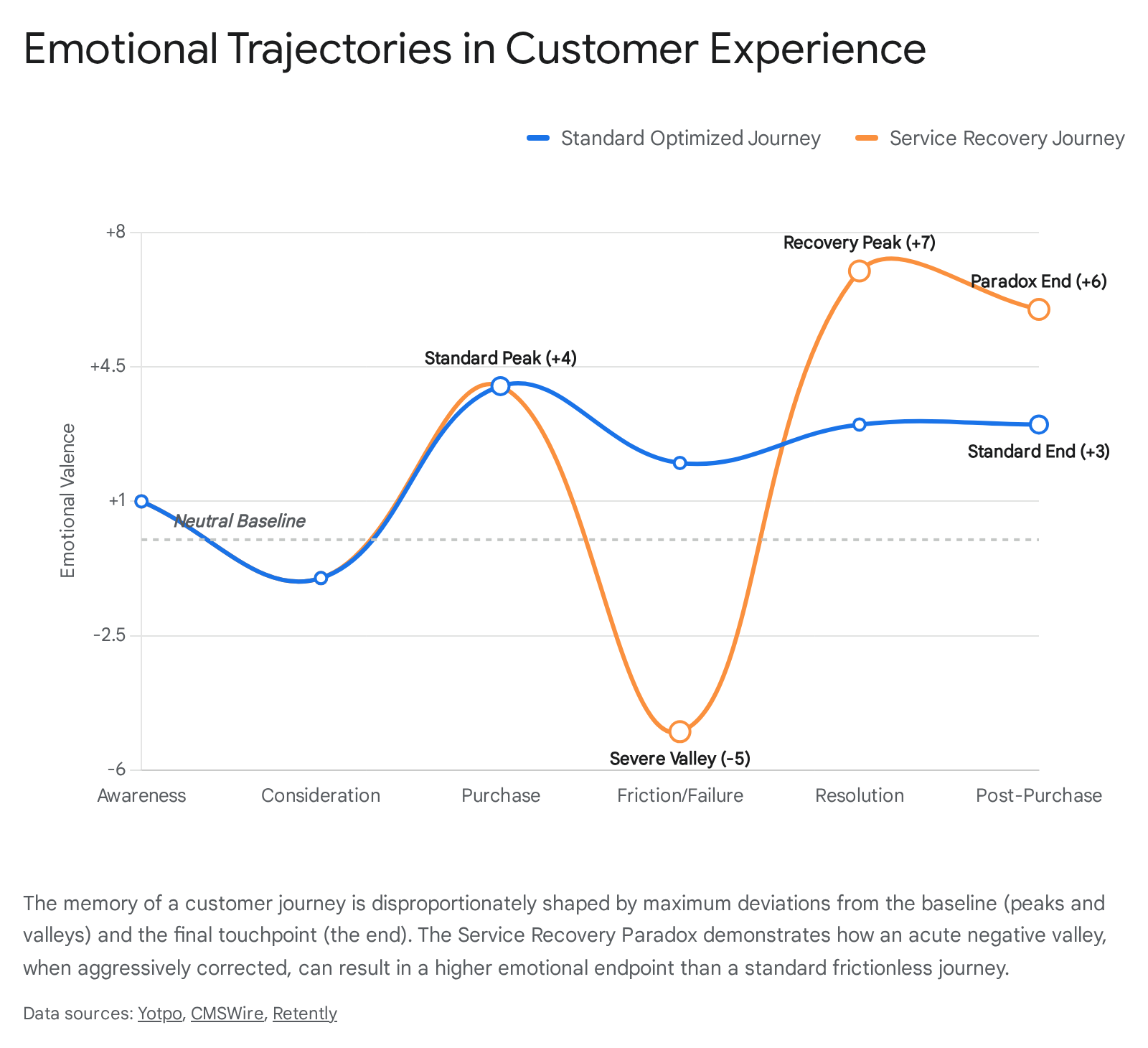
One of the most potent demonstrations of the peak-end rule in commercial environments is the Service Recovery Paradox (SRP). The SRP describes a scenario where a customer experiences a severe service failure (an acute negative peak) but the company subsequently executes an exceptional, empathetic, and rapid recovery (an overwhelming positive end) 12.
Studies frequently indicate that customers who undergo a successful service recovery exhibit higher subsequent brand loyalty, engagement, and positive word-of-mouth than customers who experienced a standard, frictionless transaction from start to finish 12.
For instance, industry research notes that 78% of customers who receive highly satisfactory resolutions to a severe complaint remain loyal to the brand, demonstrating resilience against competitor pricing pressure 12.
The peak-end rule explains this counterintuitive outcome. The initial failure sharply disrupts the customer's baseline, creating high emotional arousal. When the company intervenes and resolves the issue brilliantly, that high arousal transfers from frustration to relief and gratitude, creating an intense positive peak that simultaneously serves as the definitive end of the episode. Because the memory is dominated by this final, highly positive resolution, the customer's retrospective evaluation of the brand improves dramatically 12. However, researchers strictly caution against utilizing the SRP as a deliberate strategy. The risk of failing the recovery attempt is immense; leaving the customer with both a severe negative peak and a negative end practically guarantees churn and reputational damage 12.
Taxonomy of Customer Experience Metrics
Because human memory is distorted by the peak-end rule and duration neglect, the measurement systems organizations use to quantify customer experience must be carefully selected. Metrics differ vastly based on whether they capture the objective reality of the experiencing self or the biased, longitudinal loyalty of the remembering self.
Transactional Metrics and the Experiencing Self
To evaluate the ongoing operational health of a customer journey, organizations rely on transactional metrics deployed immediately following a specific interaction (e.g., closing a support ticket, completing a checkout, or finalizing a web navigation session) 1314. The two most prominent examples are the Customer Satisfaction Score (CSAT), which asks customers to rate their happiness on a scale typically ranging from 1 to 5, and the Customer Effort Score (CES), which measures the ease of the interaction 131415.
Metrics captured in real-time reflect the unfiltered state of the experiencing self. By querying the customer before memory decay or heuristic alteration occurs, these metrics are tactically vital for identifying specific operational friction points and mapping the objective "valleys" in a journey 1415. However, if an organization relies solely on CSAT, it may achieve an artificially high view of its performance. It risks measuring satisfactory but unmemorable micro-interactions, failing to detect that a lack of emotional peaks is depressing long-term loyalty 1118.
Relational Metrics and the Remembering Self
Conversely, relational metrics are surveyed outside the immediate context of a specific transaction, often weeks or months later. The Net Promoter Score (NPS) is the industry standard in this category, asking consumers to evaluate their overall willingness to recommend the brand on a scale of 0 to 10, categorizing them as Promoters, Passives, or Detractors 131416. Another critical relational metric is Customer Lifetime Value (CLV), tracking cumulative financial behavior over time 1516.
These retrospective metrics explicitly capture the remembering self. NPS does not reflect a mathematical average of the customer's historical interactions; it is a direct numerical reflection of the customer's peak and end memories 21317. These evaluations are heavily shaped by the peak-end rule and are utilized at the macro level to determine strategic growth, referral intent, and long-term brand advocacy 1317. Relying solely on NPS, however, obscures the granular operational failures that create the baseline valleys, making it difficult to engineer the journey at the root level. Comprehensive journey optimization requires triangulating both transactional and relational data to serve both the experiencing and remembering selves 1617.
Moderating Variables in Purchasing Behavior
The psychological impact of the peak-end rule is heavily moderated by the nature of the consumer's decision-making process. Behavioral economics divides purchasing behavior into two broad categories: high-involvement and low-involvement decisions 181928. The mechanisms of memory and brand perception function differently across these spectrums.
Heuristics in Low-Involvement Decisions
Low-involvement decisions pertain to routine, frequent, and relatively inexpensive purchases that pose minimal financial, functional, or social risk to the consumer 181928. Examples include fast-moving consumer goods (FMCG) like groceries, basic toiletries, snacks, or cleaning supplies.
In these contexts, consumers seek to minimize cognitive load, engaging in habitual buying behavior driven almost entirely by System 1 processing. Information search is minimal, and decisions rely on the peripheral route of persuasion - heuristics, visual cues, packaging, brand familiarity, and immediate accessibility 1928. For low-involvement products, the peak-end rule is primarily leveraged through rapid, sensory touchpoints. For instance, the tactile unboxing experience of a consumer product serves as an engineered peak, while a frictionless, one-click checkout serves as the positive end 6. Because duration neglect is absolute in low-involvement scenarios - consumers rarely recall the time spent walking down a grocery aisle - the entire brand perception hinges on these fleeting snapshots 628.
Analytical Processing in High-Involvement Decisions
Conversely, high-involvement decisions involve significant financial investment, high perceived risk, and long-term consequences 181928. Examples encompass real estate acquisitions, enterprise software (SaaS) procurement, industrial machinery, and premium automobiles.
These decisions deeply engage System 2 thinking. Consumers undertake extended problem-solving, gathering comprehensive information from multiple sources, extensively comparing alternatives, and building consensus among stakeholders 1820. In business-to-business (B2B) environments, the complexity scales dramatically; the average enterprise purchase involves roughly 6.8 distinct decision-makers, and buyers spend 83% of their purchasing journey conducting independent research and building internal consensus rather than interacting directly with the supplier 30.
Despite the dominance of analytical processing during the research phase, the peak-end rule profoundly influences the post-purchase reality of high-involvement decisions 1821. High-involvement purchases are highly susceptible to post-purchase dissonance (commonly known as buyer's remorse) 1820. A poorly managed final touchpoint - such as a cumbersome installation process, hidden fees revealed at contract signing, or a lack of post-sale support - can trigger intense anxiety, completely tainting months of careful deliberation and rational analysis 8.
To mitigate this, successful B2B and high-involvement strategies aggressively engineer the endpoint. The conclusion of the transaction is not treated as a finish line, but as a transitional peak. Exceptional onboarding processes, proactive outreach, customized training, and highly personalized executive summaries transform the close of the sale into a psychological peak, reinforcing confidence and securing the foundation for long-term retention 5830.
The application of behavioral heuristics must be structurally calibrated to the specific realities of the market model, as summarized below.
| Dimension of Comparison | Business-to-Consumer (B2C) Profile | Business-to-Business (B2B) Profile |
|---|---|---|
| Cognitive Driver | Emotional resonance, impulse, visual appeal 302223. | Logic, risk mitigation, ROI calculation, consensus 3034. |
| Decision Processing | Fast, intuitive (System 1); solitary decision-maker 623. | Slow, deliberate (System 2); average 6.8 stakeholders 30. |
| Sales Cycle Duration | Short to immediate; single-session conversions 2335. | Long, multi-stage, extending over months or years 2235. |
| Primary Risk Profile | Low financial/social risk; high tolerance for experimentation 1835. | High financial/operational risk; career implications for buyers 2335. |
| Peak-End Application | Checkout speed, unboxing thrills, surprise discounts 26. | Implementation success, executive business reviews, renewal ease 28. |
| Loyalty Mechanism | Habituation and brand identity alignment 1736. | Deep integration, switching costs, and trusted advisory relationships 1723. |
Boundary Conditions and Heuristic Limitations
Despite its widespread acceptance in psychological literature, the peak-end rule is not universally applicable without caveat. Rigorous psychological research has identified critical boundary conditions where the heuristic fails to accurately predict retrospective evaluations. Acknowledging these limitations is essential for calibrating experience design strategies.
Complexity in Heterogeneous Experiences
The seminal studies supporting the peak-end rule typically utilized short, monotonous, and unidimensional experiences. Examples include enduring the cold pressor test, tolerating clinical pain, or viewing plotless, low-stimulation film clips 62425. In these emotionally homogeneous settings, isolating the peak and the end serves as a highly reliable proxy for the whole.
However, real-world experiences are often complex, extended, and emotionally heterogeneous. In scenarios involving intricate narratives, multiple shifting contexts, and a blend of distinct emotions (e.g., joy, fear, frustration, relief interacting sequentially), the human mind struggles to reduce the event to just two structural snapshots 24. In an empirical study analyzing audience emotional engagement during a 90-minute theatrical performance - utilizing biometric wristbands to measure skin conductance and heart rate - researchers found that the predictive power of the peak-end rule diminished significantly 25. For rich, heterogeneous experiences, the average valence and arousal across the entire episode served as vastly superior predictors of the audience's retrospective evaluation than the peak and end metrics alone 1024.
Furthermore, the predictive durability of the peak-end rule appears to decay over time in complex scenarios. While peak and end measures may accurately predict remembered valence in the short term (up to three weeks post-event), longitudinal studies suggest that after extended periods (e.g., seven weeks), "average valence" overtakes the peak-end heuristic as the most accurate predictor of how a complex event is remembered 1024.
The Dominance of Emotional Arousal
Traditional applications of the peak-end rule focus heavily on emotional valence - whether an experience was coded as positive or negative. However, research into complex experiences indicates that emotional arousal (the intensity of the physiological or psychological activation) is an equally, if not more, critical parameter in memory formation 2426.
According to the model of evaluation by moments and range-frequency theory, arousal tends to increase as a consumer approaches the culmination of a goal, such as the final purchase stage of a transaction 26. High-arousal peaks, even if they contain elements of stress or anxiety (such as finalizing a high-stakes financial contract or navigating a thrilling theme park ride), strongly anchor memory. Arousal parameters have been shown to be more persistent in their predictive value over long time horizons than simple positive or negative valence 24. Consequently, designers must account for the intensity of the engagement, acknowledging that high arousal - regardless of immediate pleasantness - cements the structural memory of the event.
Cross-Cultural Variance in Affective Memory
The foundational research on the peak-end rule and duration neglect was largely conducted within Western, Educated, Industrialized, Rich, and Democratic (WEIRD) societies 2527. Extrapolating these findings globally risks imposing a severe methodological bias, as cross-cultural psychology reveals profound differences in how human beings process memory, interpret narrative, and weigh emotional valence 27.
Analytic Versus Holistic Processing
Cognitive processing styles differ significantly along cultural lines. Western cultures, historically characterized by independent self-construals and individualist values, predominantly utilize analytic thinking. This processing style breaks events down into discrete, linear components, focusing heavily on central figures, acute focal points, and dominant emotional peaks while relegating background information 2829. Consequently, the peak-end rule - which is intrinsically a reductive, snapshot-based heuristic - aligns closely with Western cognitive defaults.
In contrast, Eastern cultures, characterized by interdependent self-construals and collectivist values, lean toward holistic processing. Holistic thinking views events as interconnected fields, paying extensive attention to context, background variables, and the relational dynamics between elements 2728. Research indicates that individuals from Eastern cultures display a "holistic memory pattern," meaning they are more likely to integrate the entirety of an experience into their retrospective evaluation 2729. Because holistic processors consider the context and the true average of the experience rather than isolating the extreme highs or lows, the magnitude of duration neglect and the dominance of the isolated peak-end heuristic are often attenuated in these populations 1027.
Narrative Expectations and Mixed Emotions
Cultural orientation also dictates how different types of emotions are weighted. In Western paradigms, happiness is often defined strictly as the maximization of positive affect and the minimization of negative affect. Western consumers exhibit a strong cognitive bias toward remembering positive peaks and associating them directly with a successful outcome 29.
Eastern philosophical and cultural traditions, however, often embrace dialectical thinking, recognizing that positive and negative emotions can co-exist and are mutually dependent. Studies on cross-cultural memory show that while European Americans heavily weight recalled positive affect when evaluating past experiences (such as a vacation or friendship), Asian Americans and Japanese participants consider both positive and negative affect simultaneously. They acknowledge mixed emotional states (subjective ambivalence) without the intense cognitive dissonance observed in Western cohorts 2930.
Furthermore, structural expectations regarding how an experience should end vary widely. Western narrative structures are deeply influenced by the "Hero's Journey" and a traditional three-act structure that demands a climactic peak followed immediately by a decisive, usually triumphant, resolution 31. Eastern narratives often utilize alternative frameworks, such as the Japanese Kishōtenketsu, a four-act format that relies on introduction, development, a sudden twist or shift in perspective (rather than an aggressive climax), and a conclusion that is often open-ended, ambiguous, or reflective rather than decisive 31.
For global experience designers, this variance implies that manufacturing an aggressive, highly positive "Western-style" peak-end may feel artificial or structurally jarring to consumers in Eastern markets. A culturally attuned approach requires modulating the intensity of the peak and respecting the holistic, aggregate average of the service delivery.
The Impact of Artificial Intelligence on Final Impressions
The modern customer journey is undergoing a rapid architectural shift due to the integration of generative artificial intelligence (AI) and automated chatbots. Research firms project that AI will handle upwards of 80% of routine customer interactions by the end of the current decade, fundamentally altering how the critical "end" phase of a customer journey is constructed and experienced 45.
The Efficiency-Empathy Tradeoff
From a strict operational standpoint, AI agents excel at creating positive endpoints for low-involvement, routine queries. They offer infinite scalability, 24/7 availability, and near-instantaneous response times 4532. By eliminating wait times - a common source of prolonged emotional valleys - AI resolves issues with high functional efficiency, satisfying the cognitive requirement for a quick, painless conclusion to a task 4547.
However, the peak-end rule dictates that the quality of the end moment carries disproportionate psychological weight. When a customer interaction involves high complexity, ambiguity, or emotional distress, AI systems frequently fail to provide a satisfactory conclusion. While advanced large language models (LLMs) can simulate conversational tone, they possess mechanical intelligence rather than empathetic intelligence 3233. They cannot authentically read non-verbal cues, interpret subtext, or contextually adjust to human anxiety 32. If a customer's journey ends in a recursive loop of unhelpful automated responses, the peak-end rule guarantees that the entire brand experience will be encoded as deeply frustrating, regardless of how seamless the earlier stages of the journey may have been 849.
Friction in Human-to-Machine Handoffs
To mitigate the limitations of pure automation, organizations are increasingly adopting hybrid models, utilizing AI as an initial triage layer that seamlessly hands off to human agents for complex resolution. The psychological success of this hybrid model hinges entirely on the friction of the transition.
A 2025 field experiment conducted by Harvard Business School researchers analyzed over 250,000 chat conversations to assess the impact of AI assistance on customer service representatives. The study found that when human agents were supported by AI-generated suggestions (using tools developed by Loris.ai), response times dropped by 22%, and customer sentiment increased by 0.45 points on a standard five-point scale 34. For less experienced agents, the AI scaffolding was even more transformative, reducing response times by an astounding 70% while boosting sentiment by 1.63 points 34.
Yet, the precise timing of the "end" interaction proved critical. The study revealed a psychological boundary condition: when customers were transferred from the automated chatbot to the human agent, if the AI-assisted human responded too quickly, customer sentiment improvements were severely blunted. The rapid response caused cognitive dissonance; customers assumed they were still speaking to an unhelpful machine rather than a human capable of empathy 34. This finding highlights a vital nuance in experience engineering: processing speed must be carefully balanced against the human psychological need for authentic closure. The end of an experience must not only be efficient, but it must also feel socially and emotionally resonant to successfully encode a positive brand memory 3451.
Synthesis of the Psychological Architecture
The psychology of the peak-end rule demonstrates that consumer memory is not a democratic ledger of events, but an autocratic summary dictated by emotional extremes and final outcomes. Duration neglect proves that simply prolonging a moderately positive experience yields diminishing returns, whereas engineering a precise moment of delight or executing a flawless conclusion commands outsized, lasting loyalty.
However, the application of this heuristic requires rigorous contextual calibration. Practitioners must account for the boundary conditions where the rule weakens, specifically in prolonged, highly complex narratives where average arousal and valence take precedence over isolated snapshots. Furthermore, cultural dimensions - specifically the divide between analytic Western processing and holistic Eastern processing - dictate that experience design cannot be uniformly applied across global markets. As the digital landscape increasingly delegates the "end" of the customer journey to artificial intelligence, understanding the deep psychological parameters of memory formulation remains the defining differentiator between mere transactional processing and the cultivation of genuine, durable brand loyalty.