
Sensory Congruence in Retail and Packaging Design
Sensory congruence refers to the strategic alignment of cross-modal correspondences (CMCs) - the brain's inherent cognitive ability to subconsciously map perceptual features across different sensory modalities. In the context of consumer environments and product packaging, CMCs dictate how visual, auditory, olfactory, tactile, and gustatory inputs interact to form a cohesive, multisensory perceptual experience. When sensory inputs align with pre-existing cognitive expectations, they generate processing fluency, which subsequently influences consumer behaviors, brand perception, and economic valuation 123. Multisensory integration operates continuously to refine perceptions, guiding perceptual decision-making in varying consumer environments and digital marketplaces 45.
Recent neuroimaging and electroencephalography (EEG) research provides a robust physiological foundation for these phenomena. Behavioral data integrated with neurally informed drift-diffusion modeling demonstrates that cross-modal congruency fundamentally modulates neural activity during sensory encoding rather than merely altering higher-order decision thresholds 14. Specifically, researchers utilizing the Implicit Association Test (IAT) combined with concurrent EEG measurements have identified an "Early" neural component that enhances sensory encoding when subjects process congruent trials. Concurrently, a "Late" component affects evidence accumulation, becoming particularly active during incongruent trials where the brain must resolve conflicting sensory data 14. These findings suggest that cross-modal congruency influences the raw processing and accumulation of sensory information. The resulting cognitive fluency typically enhances reaction times and accuracy, ultimately translating into behavioral performance improvements in consumer settings, reducing cognitive friction, and lowering price sensitivity 46.
Mechanisms of Cross-Modal Correspondences
To engineer effective retail atmospheres and packaging, an exhaustive understanding of the underlying cognitive and neurophysiological mechanisms driving cross-modal correspondences is required. Theoretical frameworks generally divide these mechanisms into four distinct categories: statistical, structural, semantic, and emotional 789. While these categories represent distinct functional pathways, they are not mutually exclusive and often operate concurrently within the consumer's cognitive architecture to shape product perception 9.
Statistical and Environmental Co-occurrences
The statistical account posits that cross-modal correspondences originate from the repeated co-exposure of specific stimulus pairs in the natural environment 91110. The human sensory system adapts to natural scene statistics, effectively learning that certain physical features reliably co-occur. For example, the physical laws of acoustic resonance dictate that larger objects produce lower-frequency sounds due to greater resonating mass. Consequently, humans naturally associate lower acoustic pitch with larger visual size 911.
This pitch-size mapping is observed consistently across populations and relies on veridical, real-world features rather than isolated sensory or retinotopic representations 1112. In a study assessing pitch discrimination paired with visual stimuli varying in their sensory (retinotopic) or representational (scene-integrated) nature, results indicated that only representational visual stimuli produced cross-modal congruency effects 1112. In retail applications, this statistical grounding means consumers subconsciously expect the visual and auditory dimensions of products, such as the visual bulk of a package and the acoustic sound it makes when handled, to adhere strictly to the physical constraints of the natural world.
Structural and Neurophysiological Pathways
The structural account argues that certain correspondences arise from innate neural architectures, where different sensory modalities activate common brain regions through supramodal properties such as intensity or magnitude 913. Under this framework, high-intensity stimuli in one modality (e.g., bright lighting or highly saturated colors) map naturally onto high-intensity stimuli in another modality (e.g., loud music or pungent scents).
Evidence supporting structural pathways is prominently observed in developmental studies involving infants and comparative behavioral research involving non-human species. Phenomena like pitch-to-size matching occur spontaneously in chimpanzees, monkeys, and dogs without significant prior environmental learning 14. Similarly, research demonstrates that tortoises successfully match pitch to size in spatial choice tasks, though they fail at pitch-luminance associations, a mapping where baboons and poultry chicks also demonstrate inconsistent results 14. This suggests a fundamental, evolutionary organizing principle in the vertebrate brain that predisposes consumers to link certain sensory dimensions inherently, bypassing conscious associative learning 1415.
Semantic and Lexical Mediation
The semantic mediation hypothesis suggests that CMCs are facilitated by shared linguistic labels or overlapping semantic networks in human language 713. When two distinct sensory experiences are described using the identical terminology - such as "high" pitch and "high" spatial elevation, or "sharp" taste and "sharp" geometric shapes - the semantic overlap reinforces the perceptual correspondence 111116.
Behavioral experiments involving speeded classification tasks and cross-modal category learning reveal that cross-modal transfer can occur between audio-visual stimuli when specifically mediated by these category labels 16. Furthermore, semantic CMCs are powerful enough to influence high-level language ambiguity resolution. Changes in irrelevant visual features, such as elevation or lightness, can bias a listener's judgment of spoken intonation, leading them to classify ambiguous utterances as questions or statements based purely on concurrent visual stimuli 11. In packaging and branding, semantic mediation underscores the importance of naming conventions, textual claims, and brand terminology aligning precisely with the physical and sensory attributes of the product 1718.
Affective and Emotional Mediation
The affective or emotional mediation account asserts that cross-modal correspondences occur because different unimodal stimuli evoke similar emotional valences or arousal levels 71920. For instance, the reliable mapping of sweet tastes to round shapes and pink colors is hypothesized to be mediated by the positive, pleasant emotions that all three stimuli generate independently 7. Conversely, sharp, angular shapes and bitter tastes often evoke mild negative affect or higher physiological arousal, prompting the brain to bind them associatively 1921.
This framework is particularly critical for retail atmospherics, as environments designed with arousal-congruent stimuli (e.g., matching high-arousal ambient scents with high-arousal background music) yield highly cohesive emotional states 22. The emotional regulation stimulated by these sensory inputs frequently serves as a coping mechanism in consumer behavior, profoundly influencing impulsive buying tendencies and subjective product satisfaction 23.
Visual and Gustatory Correspondences in Packaging
The integration of visual cues with taste and flavor expectations represents a foundational pillar of multisensory consumer goods design. Because humans prioritize visual data, packaging shape, color saturation, and typographical choices serve as primary antecedents to gustatory experiences, pre-programming the consumer's palate before the product is physically consumed 102026.
Shape, Geometry, and Curvilinearity Mappings
Research into the morphology of packaging consistently demonstrates that the physical shape of a product or its label systematically influences flavor expectations. The phenomenon is most famously illustrated by the "Bouba-Kiki" effect, which demonstrates a universal cognitive tendency to pair soft, rounded shapes with the phonetically soft word "Bouba," and sharp, angular shapes with the phonetically harsh word "Kiki" 1018. This correspondence extends directly into gustatory perception: consumers reliably associate rounded, curvilinear shapes with sweet tastes, while angular, asymmetrical shapes are mapped to sour, salty, or bitter tastes 71920.
In practical commercial applications, beverage brands utilizing rounded bottles or circular typography are perceived as sweeter, independent of the product's actual sucrose content. Conversely, brands marketing carbonated waters, highly caffeinated energy drinks, or bitter dark chocolates frequently employ angular geometries to visually communicate the sharpness, astringency, or carbonation of the product 1021. This curvilinearity-taste mapping exhibits high cross-cultural stability, suggesting a fundamental cognitive linkage between visual angularity and gustatory intensity 2021.
Color and Flavor Expectations
Color functions as an immediate, highly salient heuristic for flavor identification, guiding approach or avoidance behaviors. Mappings between specific hues and basic tastes are thoroughly documented in consumer psychology: red and pink are overwhelmingly associated with sweetness; yellow and green with sourness; white and blue with saltiness; and black or brown with bitterness 7102024. When packaging colors align with these biological expectations, consumers exhibit faster product recognition, higher processing fluency, and greater overall satisfaction 25.
However, when visual color cues conflict with actual gustatory inputs, the resulting incongruence disrupts sensory integration and causes cognitive dissonance. For instance, in an experiment investigating packaging for potato crisps (chips) in the United Kingdom, participants evaluated the conflicting color-flavor conventions that exist for "salt and vinegar" versus "cheese and onion" varieties across competing brands 25. Participants displayed higher error rates and significantly slower response times when identifying flavors from incongruently colored packets. Furthermore, when subjects blindly tasted crisps from incongruently colored packets, a notable percentage were entirely unable to identify the flavor correctly, demonstrating how visual dominance can override physical gustation 25.
Color intensity and saturation also play a vital role. Darker packaging hues have been shown to increase expectations of flavor intensity, such as saltiness in soy sauce, suggesting that color saturation directly mediates perceived concentration and formulation strength 24.
Packaging Weight and Haptic Transference
Packaging operates not merely as a protective vessel but as an active, haptic interface that initiates the product experience. Haptic transference occurs when the physical sensations derived from touching a package alter the cognitive evaluation of the product contained within. The physical mass and weight of product packaging are highly diagnostic non-visual cues.
Experimental evidence confirms that increasing the physical mass of packaging directly heightens the perceived flavor intensity of the food or beverage it contains 2627. This psychological effect follows a precise serial mediation pathway: heavier packaging signals greater product density, quality, and investment, which subconsciously elevates perceived flavor intensity. This intensified flavor perception subsequently enhances overall flavor evaluation, ultimately leading to an increased willingness to pay (WTP) 26. Material choices amplify this dynamic. Substrates that provide specific textural feedback, such as matte, rough, or embossed surfaces, can prime expectations of naturalness, healthfulness, or artisanal quality, which texturally smooth, mass-produced glossy packaging routinely fails to convey 28.
Visual Size and Proportion Constraints
The visual size of packaging serves as an independent variable capable of manipulating psychological flavor expectations. Counterintuitively, research indicates a negative correlation between packaging size and perceived flavor intensity for certain categories. Small-format packaging often yields significantly higher ratings for taste perception intensity and product attractiveness compared to large-format, bulk packaging 29. This phenomenon is particularly pronounced for foods characterized by stimulating, spicy, or highly concentrated flavors. The visual compression of the package implies a concentrated delivery of sensory input, leading the consumer to anticipate a more robust gustatory experience 29.
Cross-Cultural Dimensions of Sensory Design
While certain visual-gustatory correspondences exhibit universal biological properties, substantial cross-cultural deviations underscore the influence of environmental learning, geographic flora, and deep dietary heritage. Culturally coded sensory systems dictate that consumers interpret color, shape, and flavor strictly through the lens of their local culinary traditions 103034.
Cultural Anthropology and Ecological Systems Theory provide comprehensive frameworks for understanding how these dynamic interactions between individuals and their cultural contexts shape specific flavor preferences 30. For example, the analysis of tens of thousands of online recipes reveals molecular-level flavor distinctions: Chinese culinary traditions balance sweet and savory almost equally, whereas North American recipes index heavily toward sweet flavor profiles, and German recipes demonstrate a pronounced preference for savory structures 31. These underlying dietary norms directly alter how cross-modal correspondences manifest across global demographics.
Table 1 details notable cross-cultural variations in visual-gustatory correspondences, highlighting the necessity for localized packaging and branding strategies in multinational markets.
| Visual Feature | Dominant Taste Mapping | Observed Cultural Variance | Underlying Mechanism |
|---|---|---|---|
| Color: Yellow | Sour | Generally consistent globally, but noticeably absent or significantly weaker among Indian demographics 20. | Statistical learning based on regional citrus availability and local culinary palettes. |
| Color: White | Salty | Highly consistent in Western demographics; reported significantly less often in mainland China 20. | Dietary traditions; Asian cuisines rely less on raw white salt, utilizing dark soy or fermented sources for sodium 31. |
| Color: Black | Bitter / Umami | Perceived as negative, artificial, or unappetizing in the US; accepted neutrally or positively as umami/bitter in Japan 26. | Cultural familiarity with naturally black foods (e.g., squid ink, kelp, seaweed) in Eastern diets 26. |
| Shape: Angular | Bitter / Carbonation | Strongly mapped to bitter tastes and carbonation in Western cultures; mapping entirely absent in the Himba tribe of Namibia 21. | Lack of lifetime exposure to artificially carbonated beverages and modern Western packaging geometries 21. |
| Scent: Bamboo/Green Tea | Fresh / Elegant | Highly resonant in Japanese markets representing ethereal elegance; less resonant as a premium scent in Latin America 34. | Alignment with the wabi-sabi aesthetic and subtlety of local Japanese flora and flavors 34. |
These findings dictate that global brands cannot apply a monolithic sensory design strategy. While a stark, black-colored package may effectively convey premium bitterness, sophistication, or deep umami profiles in Japanese or European markets, it may evoke negative affective responses, confusion, or perceptions of artificiality among North American consumer bases 26.
Auditory Correspondences and Product Variables
The auditory domain - encompassing environmental retail soundscapes, the acoustic properties of brand names, and the pitch of spoken marketing communications - interacts dynamically with visual and gustatory expectations. Cross-modal analogies demonstrate that non-synesthetic consumers routinely and reliably map basic acoustic properties onto physical dimensions and complex taste profiles 32.
Pitch, Size, and Elevation
The correspondence between auditory pitch and visual size is one of the most robust and heavily replicated phenomena in multisensory research. Participants consistently associate higher-pitched sounds with smaller, lighter, and more spatially elevated objects. Conversely, lower-pitched sounds are mapped onto larger, heavier, and lower-elevation objects 911121633.
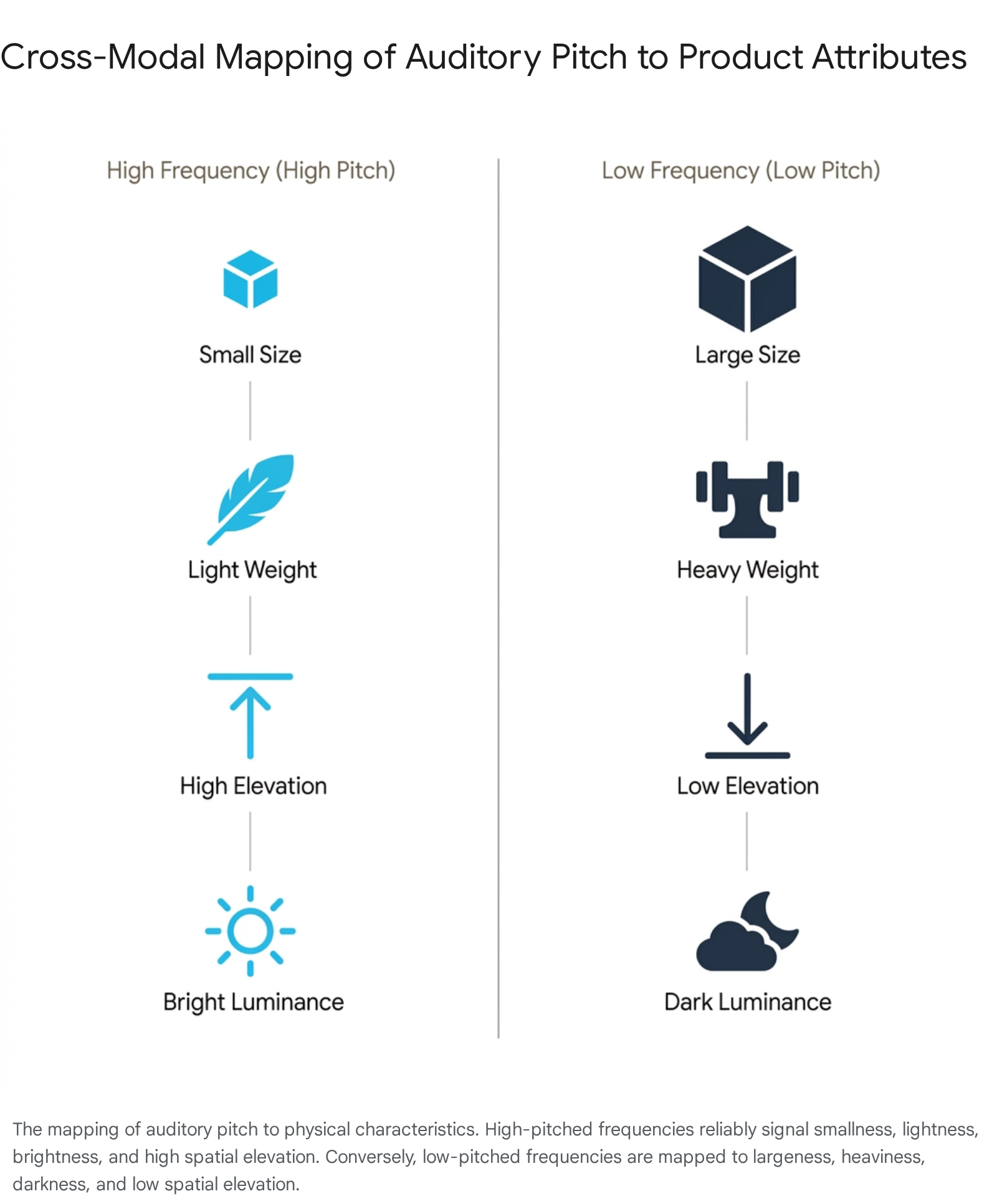
This mapping is deeply embedded in human cognition and immediately affects speeded classification tasks: subjects judge the size of a visual stimulus significantly faster when it is accompanied by a congruent auditory pitch, and suffer performance degradation when paired incongruently 1533.
In product design and branding, this principle guides the acoustic engineering of packaging - such as the calculated sound of a heavy luxury car door closing or the high-pitched snap of a tamper-evident seal - as well as the phonetics of brand names. Brand names containing high-frequency vowels (like the "i" in "mini") implicitly communicate smallness, sharpness, speed, and lightness. Conversely, names utilizing low-frequency vowels (like the "o" or "u" in "bouba") communicate largeness, roundness, durability, and volume 1834.
The Frequency Code in Marketing Communications
Beyond the physical sound of the product, the acoustic characteristics of spoken advertising and digital marketing significantly shape consumer perceptions of status, size, and competence. Studies examining the acoustic pitch of voiceovers reveal that lower-pitched voices lead consumers to infer larger product sizes, superior durability, and higher premium quality 35.
The "frequency code" theory in linguistics proposes that low fundamental frequency (F0) and lower formant frequencies are universally associated with the vocal expression of dominance, authority, and confidence 36. A cross-cultural meta-analysis of polite speech across 101 speakers from seven different languages verified this, demonstrating that lower pitch is frequently utilized to convey assertiveness and threat, while higher pitch signals submissiveness, lack of confidence, or politeness 36. Consequently, in advertising, low vocal pitch is generally perceived as more authoritative, dominant, and credible, generating more favorable brand attitudes when promoting high-status, expensive, or utilitarian goods 353637.
Conversely, high-pitched voices combined with fast speech rates are often deployed when conveying specific forms of excitement, lightness, or approachability. Fast speakers are frequently judged as more fluent, emphatic, and energetic, though speech rates exceeding 180 words per minute can disrupt semantic processing and degrade the advertising message 37.
Sonic Seasoning and Gustatory Matching
Auditory-gustatory correspondences reveal that consumers reliably match basic tastes with specific musical parameters, a practice commonly referred to as "sonic seasoning." Experiments demonstrate that sweet tastes are consistently paired with high-pitched, smooth, and continuous sounds (e.g., legato piano compositions). Bitter and sour tastes, meanwhile, are mapped to low-pitched, rough, and staccato sounds, frequently associated with brass instruments like the trombone 1332.
Retailers, restaurateurs, and food marketers apply these findings by engineering ambient soundscapes. For example, background music featuring high frequencies and harmonious chords can accentuate the perceived sweetness of a dessert, while low-frequency, dissonant soundscapes can highlight the robust, bitter notes of dark coffee or stout beer 3238. When the auditory environment is congruent with the gustatory profile of the product being consumed, consumers report heightened flavor intensity, reduced requirement for added sugars, and greater hedonic enjoyment.
Sensory Congruence vs. Strategic Incongruence
In brick-and-mortar and digital retail environments, atmospherics - the deliberate design of the physical environment using sensory stimuli - operate continuously to influence shopper behavior. The dominant theoretical model, the Stimulus-Organism-Response (S-O-R) paradigm, dictates that environmental stimuli (lighting, music, ambient scent) affect the organism's internal affective state (arousal, pleasure, emotional mediation), which subsequently drives behavioral responses (dwell time, purchasing, brand loyalty) 394440.
Arousal Congruence and Processing Fluency
The efficacy of retail sensory design is contingent upon its congruence across multiple thematic and arousal-based associations. Research evaluating the interplay of ambient light, scent, and music demonstrates that high multisensory congruity yields significantly higher store evaluations and approach behaviors compared to low congruity or the presence of an isolated cue 241.
The specific dimension of physiological arousal requires careful calibration. Studies assessing combinations of background music, scent, and color demonstrate that environments designed with two arousal-congruent stimuli (e.g., high-arousal fast-tempo music paired with a high-arousal citrus scent, or low-arousal lavender paired with slow-tempo music) lead to more positive consumer responses and higher WTP than environments that mix high and low arousal cues 224442.
However, rigid boundaries exist regarding sensory density. Combinations of three highly arousing stimuli simultaneously (e.g., bright red lighting, fast music, and pungent scent) can induce sensory overload, sharply decreasing consumer satisfaction and truncating store visits. In retail cases involving three or more sensory inputs, a moderate level of incongruity - such as two high-arousal cues balanced by one low-arousal cue - acts as a psychological buffer against overload, allowing the consumer to process the environment without cognitive exhaustion 2243.
Serendipitous Incongruity in Retail Contexts
While the bulk of literature champions strict sensory congruence to achieve processing fluency, specific forms of incongruity can be leveraged strategically to disrupt habituation and capture consumer attention. When environmental cues perfectly match expectations, cognitive processing is fluent but potentially unremarkable, causing the experience to fade into the background. Incongruent cues, however, demand cognitive resources to resolve the sensory discrepancy, leading to processing disfluency. In general applications, this disfluency lowers perceived environmental unity and negatively impacts product evaluations 64445.
Yet, under carefully controlled boundary conditions, incongruity becomes highly beneficial. If an incongruent sensory cue is unexpected but positively valenced, it can trigger a state of "serendipitous incongruity." This mismatch introduces emotional contrast and triggers affective processing, particularly for consumers possessing hedonic-oriented shopping motivations rather than task-oriented goals 464748.
For example, encountering a highly novel, pleasant floral scent in a utilitarian hardware store, or pairing unexpected haptic materials with utilitarian items like sleepwear, might momentarily disrupt processing but ultimately evoke surprise and delight 465449. This emotional contrast increases time spent browsing and lifts WTP for impulsive, hedonic goods. Retailers must apply strategic incongruity with precision, ensuring it serves to delight rather than confuse or alienate the shopper.
Retail Atmospherics and Economic ROI
The economic implications of properly calibrated retail atmospherics are substantial and statistically validated. When sensory dimensions are layered congruently, retailers observe compounding benefits across virtually all key performance indicators. Multi-sensory settings combining two or more congruent stimuli are demonstrably more effective than single-sensory cues at reducing perceived waiting times, encouraging casual browsing, and increasing overall store dwell time 394450.
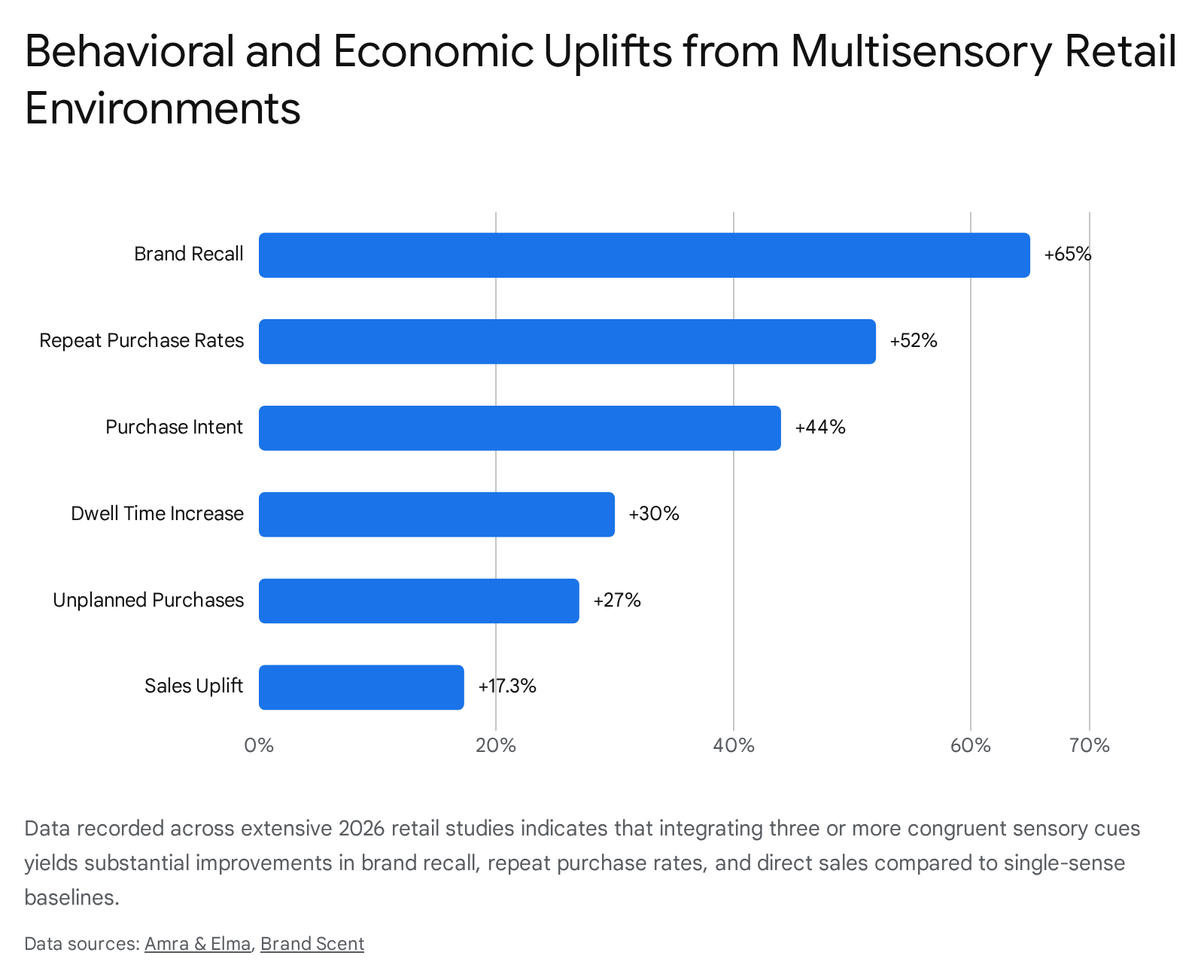
Industry data tracked through global retail analysis provides concrete metrics regarding the return on investment (ROI) for multisensory environments. Table 2 summarizes the behavioral and economic uplifts associated with specific sensory marketing interventions.
| Sensory Intervention | Behavioral / Economic Metric | Documented Uplift | Operational Context |
|---|---|---|---|
| Synchronized Scent, Music & Lighting | In-Store Dwell Time | +30% (+9.4 minutes) | Increased dwell time directly translated into a 14.6% larger average basket size across 1,200 tracked stores 4257. |
| Ambient Scent + Tempo-Matched Music | Unplanned Purchase Rate | +27% | Curated scent identified as the most persuasive variable for converting casual browsing into impulse buys 57. |
| 4-Sense Integrated Campaigns | Direct Sales Uplift | +17.3% | Outperformed the 10% baseline seen in single or dual-sense campaigns across 640 North American and European brand activations 57. |
| Cross-Platform Sensory Identity | Memory Retention | +41% | Aligning spatial scent with product touch and auditory branding raised long-term recall 5758. |
| Multisensory Consistency | Repeat Purchase Rates | +52% | Full-journey consistency tracked over 24 months across 14 industries elevated consumer loyalty 57. |
These metrics confirm that sensory marketing is not a peripheral aesthetic choice but a central driver of retail profitability. Furthermore, specialized experiential retail formats heavily reliant on sensory engagement have seen explosive economic growth. For example, the global paint-and-sip studio market - an experiential model combining guided painting (visual/tactile) with social drinking (gustatory) - reached $1.8 billion in 2025 and is projected to expand at a 7.9% CAGR through 2034, driven primarily by consumers' willingness to pay premium rates for multi-sensory social leisure 59. Similarly, the projection mapping market, which overlays dynamic visual textures onto physical merchandise to reduce retail returns, is expanding at a nearly 20% CAGR, validating the commercial ROI of immersive visual-tactile alignment 60.
Neural Valuation and Willingness to Pay
The ultimate commercial goal of guiding perception through cross-modal correspondences is to positively influence the consumer's economic valuation of the product. Willingness to pay (WTP) serves as a primary metric for brand equity, representing the maximum monetary sacrifice a consumer will make for perceived utility and emotional satisfaction 5152.
The Neural Correlates of Bidding and Valuation
To understand how sensory inputs alter economic behavior, neuroimaging meta-analyses (such as Activation Likelihood Estimation, or ALE) have mapped the brain centers responsible for encoding WTP. These studies, aggregating data across hundreds of participants and multiple fMRI foci, reveal that WTP is processed through distributed networks associated with reward processing, goal-directed action, and rigorous cost-benefit calculation 53. Bidding and valuation decisions consistently activate the bilateral inferior frontal gyrus (IFG), the bilateral insula, the left caudate, and the anterior cingulate cortex (ACC) 53.
Sensory marketing directly interfaces with these exact neural networks by modulating the inputs to the consumer's internal cost-benefit calculation. When a consumer interacts with a product exhibiting high multisensory congruence - such as a heavy glass bottle (haptic quality) containing a dark amber liquid (visual intensity) accompanied by a low-pitched auditory brand signature (acoustic weight) - the cognitive fluency facilitates rapid, positive affective encoding. The insula and ACC process this harmonious sensory array as low-risk and high-reward, effectively reducing price sensitivity, mitigating perceived purchase risk, and shifting the WTP threshold significantly upward 265853.
Differentiating Functional and Emotional Value
The impact of sensory design on WTP is further moderated by the specific type of value the consumer seeks and their individual level of self-congruence. Functional value - encompassing utility, ease of use, and physical performance - is amplified when actual self-congruence is high, meaning the product aligns with how the consumer currently views their practical identity.
However, empirical surveys and structural equation modeling reveal that emotional value exerts a significantly stronger overall impact on premium WTP than functional value 52. When a multisensory experience resonates with a consumer's ideal self-congruence (how they wish to be perceived or the lifestyle they aspire to), the emotional value scales exponentially. This dual-pathway model indicates that while functional cues justify a baseline purchase, it is the emotional resonance generated by congruent sensory aesthetics that drives a much higher willingness to pay a premium margin 52.
Digital, Virtual, and XR Sensory Environments
As global commerce transitions increasingly to digital platforms, the principles of sensory congruence are rapidly adapting to overcome the physical limitations of screen-based interfaces. Online retail historically prioritized visual and auditory stimuli, leading to a recognized "sensory gap" due to the total absence of haptic, olfactory, and gustatory feedback, which traditionally enrich emotional engagement and decision-making 54.
Sensory Compensation in E-Commerce and Social Commerce
To bridge this digital sensory gap, digital marketers employ sensory compensation strategies, utilizing visual and auditory cross-modal correspondences to simulate the missing senses. For example, high-resolution textures, macro-photography, and visual weight simulate haptic feedback, while specific color palettes and digital soundscapes simulate thermal or olfactory cues 6566. When consumers browse products via augmented reality (AR) or mobile apps, the strategic use of visual depth, dynamic animation curves, and acoustic user-interface feedback can trigger affective responses that mimic physical touch and product handling 6768.
In the realm of social commerce and influencer marketing, parasocial interactions substitute for physical retail staff. Influencers utilizing congruent visual and auditory cues (e.g., matching their physical attractiveness and vocal pitch to the product's attributes) generate high levels of parasocial engagement. Meta-analyses of parasocial engagement reveal that this congruence directly drives brand associations and impulsive purchase intentions, effectively compensating for the lack of tactile product interaction 6955.
Extended Reality (XR) and Virtual Environments
In advanced extended reality (XR) and virtual reality (VR) environments, the impact of sensory congruity is magnified significantly. XR advertising transcends traditional one-way communication by utilizing multi-sensory presentations, intelligent interaction, and non-linear narrative approaches 56.
Adding a pleasant, contextually congruent ambient scent to an embodied VR experience directly impacts affective reactions, reduces simulator sickness, and enhances the user's "ease of imagination" and sense of spatial presence 444572. Studies testing pitch-color associations in VR environments (such as a simulated "forest" versus "space") demonstrate that the specific virtual environment heavily dictates cognitive load and user engagement with cross-modal tasks 72. Conversely, applying incongruent olfactory cues in virtual reality has been shown to induce severe cognitive interference, pulling the user out of immersion and negatively affecting ad evaluations 44.
The Rise of Digital Mindfulness
A parallel shift occurring in digital retail spaces is the movement toward "digital mindfulness." Recognizing that excessive digital sensory stimulation - such as autoplaying videos, aggressive pop-ups, rapid color shifts, and notification pings - can lead to severe sensory overload, anxiety, and banner blindness, leading platforms are adopting minimalist, highly intentional sensory designs 2366.
Digital mindfulness promotes deliberate consumer interaction, utilizing muted color palettes, ample whitespace, and calm, low-arousal auditory cues to create stabilizing online environments 66. This intentional reduction of sensory noise allows core product features to stand out, improving cognitive fluency and accommodating consumers who are actively seeking self-regulation and emotional balance in their digital consumption 66. By intentionally limiting sensory intensity, brands achieve a balanced emotional state that is highly conducive to positive, long-term brand engagement 666.
Conclusions
The application of cross-modal correspondences in retail and packaging design represents a sophisticated fusion of cognitive neuroscience, environmental psychology, and behavioral economics. The extensive neural and behavioral data confirm that human sensory channels do not operate in isolation; they are deeply interconnected networks where visual shapes dictate taste expectations, auditory pitches define physical mass, and ambient scents moderate financial valuations.
For packaging designers, leveraging structural and semantic CMCs - such as ensuring that heavy substrates encase intense flavors, or that curvilinear fonts represent sweet profiles - reduces cognitive friction and maximizes product trial, particularly across diverse cultural boundaries. In the physical and digital retail space, orchestrating atmospheric congruity across lighting, sound, and scent acts as a primary catalyst for prolonged dwell time, heightened emotional engagement, and increased sales velocity. Ultimately, retail environments and brands that master multisensory congruence successfully transition their offerings from mere functional commodities into immersive, deeply resonant cognitive experiences.