
Peak-end rule effects on consumer memory and satisfaction ratings
Theoretical Foundations of the Peak-End Heuristic
Consumer behavior and satisfaction measurement have historically operated under the assumption that individuals evaluate experiences rationally, calculating an aggregate average of their emotional states throughout a given interaction. This classical economic view aligns with Jeremy Bentham's utility framework, which posits that pleasure and pain act as the sovereign masters of human decision-making, suggesting a continuous, moment-by-moment integration of "experienced utility" 12. However, modern research in behavioral economics and cognitive psychology reveals that human memory is highly selective, reconstructive, and subject to systematic biases. The most prominent framework explaining this phenomenon is the peak-end rule, a cognitive heuristic identified by psychologists Daniel Kahneman and Barbara Fredrickson 345. According to this principle, individuals do not assess the totality of an experience by averaging their minute-by-minute sensations. Instead, their retrospective evaluation - their "remembered utility" - is disproportionately anchored to two distinct points: the moment of highest emotional intensity (the peak) and the final moment of the episode (the end) 3678.
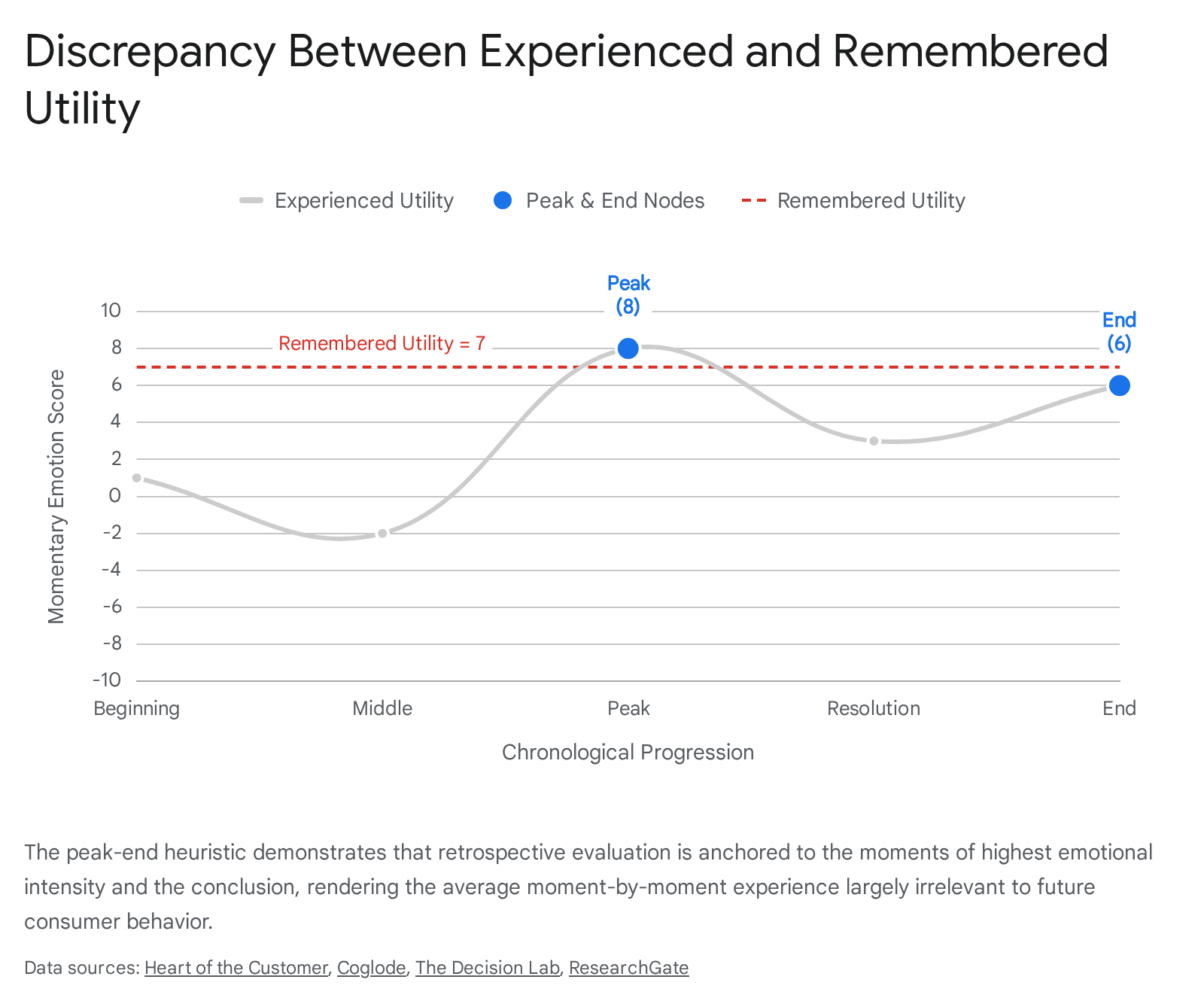
The formulation of the peak-end rule emerged from empirical observations indicating that decisions frequently deviate from the rational path of temporal monotonicity, which presupposes that extending a painful or pleasurable experience objectively worsens or improves the overall evaluation 9. The foundational experiments involved visceral, highly salient physical experiences. In one notable study, participants were subjected to the cold pressor task, submerging their hands in painfully cold water under varying conditions. Participants consistently rated a longer duration of exposure as more tolerable if the final moments involved slightly warmer water, despite the longer trial containing a greater absolute volume of objective pain 31010. Similar outcomes were recorded in clinical settings regarding colonoscopy procedures. In a trial involving 682 patients, subjects preferred a modified, longer procedure with diminished pain at the conclusion over a shorter procedure with an abrupt, painful ending. The group experiencing the extended procedure reported 10% less retrospective pain and exhibited a 10% increase in attendance for follow-up procedures 3111213.
These findings established the concept of "duration neglect," demonstrating that the temporal length of an experience has a negligible impact on its retrospective evaluation compared to the intensity of its key moments 141516. In consumer markets, duration neglect implies that a customer waiting in a service queue or navigating a digital interface does not encode the objective time elapsed but rather the emotional friction of the most frustrating moment and the relief or satisfaction of the eventual resolution 1817. The discrepancy between the objective reality of the event and the subjective memory dictates subsequent consumer behavior, challenging organizations to rethink resource allocation in experience design 218.
Cognitive Mechanisms Governing Experience Evaluation
The translation of the peak-end rule from clinical psychology to customer experience management requires an understanding of the underlying cognitive architecture. Memory consolidation is not an objective recording device; it is a meaning-making system that actively reconstructs narratives, fills gaps, and smooths over inconsistencies based on cognitive limitations and cultural expectations 519. Because the human brain cannot process and store every minute detail of prolonged exposure to stimuli, it utilizes heuristics to simplify complex tasks and yield rapid solutions 9.
The peak-end rule operates at the intersection of three distinct cognitive biases: the representativeness heuristic, memory bias, and recency bias. The representativeness heuristic causes an individual to remember an experience in distinct episodic snapshots rather than in its continuous entirety 1920. Memory bias refers to the enhanced encoding of events accompanied by high emotional arousal, as the amygdala signals the hippocampus to prioritize emotionally charged information for long-term storage 2021. Finally, recency bias ensures that the conclusion of an event is more easily retrieved from short-term or working memory, disproportionately coloring the retrospective evaluation of the preceding sequence 20.
These mechanisms explain why objective duration is often neglected. In a field study of consumer behavior, researchers demonstrated that retrospective memory is frequently more extreme than in-the-moment experiences, as the cognitive system relies on the most salient data points - the peaks - to approximate the whole 2225. Consequently, the remembered utility, driven by emotional intensity and finality, supersedes the continuous experienced utility when a consumer forms behavioral intentions, such as brand advocacy or repurchase decisions 171823.
Emotional Salience and Brand Interaction Peaks
In the context of brand interactions, a "peak" represents an emotional extreme, which can manifest as either profound delight or severe frustration. These peaks overshadow mundane, adequately functioning touchpoints. A seamless onboarding process or a standard transaction does not generate the necessary emotional valence to form a durable episodic memory 24.
Negative peaks are particularly detrimental due to the phenomenon of loss aversion and negativity bias, wherein losses are evaluated as more unpleasurable than commensurate gains are evaluated as pleasurable 25. A single moment of severe frustration - such as a denied insurance claim, a malfunctioning payment gateway, or an unhelpful support interaction - can contaminate the entire relationship 1826. This dynamic is encapsulated in the "100-1=0" management principle, which suggests that a single critical failure can negate a history of prior satisfactory experiences 27. To mitigate this, organizations are advised to map the customer journey to identify the highest-friction moments and either eliminate them or transform them into moments of delight 3.
Conversely, positive peaks can be engineered to elevate the baseline perception of a brand. In advertising, neuroscientific testing utilizing electroencephalography (EEG) and facial coding demonstrates that commercials featuring distinct emotional peaks result in significantly higher brand recall and subsequent sales effectiveness than those maintaining a flat emotional trajectory 2128. Strategic interventions, such as unexpected personalization, complimentary upgrades, or empathetic human support during a crisis, serve as positive peaks that dominate the consumer's retrospective evaluation 2930.
The Service Recovery Paradox
The intersection of negative peaks and final impressions creates the foundation for the "service recovery paradox." When a failure occurs, it acts as a severe negative peak. However, if the organization resolves the issue with exceptional speed, empathy, and effectiveness, the resolution itself becomes an even stronger positive peak that coincides with the end of the experience 2431.
A comparative analysis of customer loyalty following a service recovery highlights this counterintuitive dynamic. A negative peak (a service failure) followed by an exceptionally positive end (a successful resolution) frequently yields higher final loyalty scores than a journey that is flawless but emotionally mediocre. Data from the property and casualty insurance sector underscores this mechanism. In analyzing claims journeys, customers whose issues were initially frustrating but ultimately resolved with high emotional intelligence often transitioned from detractors to loyal promoters 32.
| Customer Journey Type | Initiation | Mid-Point Experience | Conclusion (End) | Resulting Memory & Loyalty |
|---|---|---|---|---|
| Flawless but Mediocre | Standard, low-friction entry. | No failures, but no emotional peaks. Routine processing. | Standard, unmemorable sign-off. | Baseline satisfaction; low emotional attachment; vulnerable to competitor defection 24. |
| Failure and Recovery | Standard entry. | Critical failure occurs (severe negative peak). | Rapid, empathetic resolution with overcompensation (high positive end). | Elevated loyalty; high brand advocacy; the strong ending overrides the initial negative peak 3132. |
| Pleasant Start, Poor End | Highly positive, personalized entry. | Smooth continuous service. | Abrupt failure or frustrating billing process (negative end). | High churn risk; the negative end dictates the retrospective evaluation, negating earlier positive sentiment 2932. |
An effective recovery can leave a customer with a higher relationship Net Promoter Score (NPS) than if no failure had occurred, provided the resolution serves as a highly salient, positive conclusion. This confirms that the trajectory and conclusion of the experience dictate future behavior more heavily than the mathematical average of the interaction 2631.
Impact on Customer Satisfaction Metrics
The reliance on the peak-end rule challenges the efficacy of traditional customer experience measurement frameworks. Standardized surveys frequently aggregate responses across multiple touchpoints, yielding an average score that fails to capture the emotional reality of the consumer's memory 1836.
Limitations of Traditional Satisfaction Averages
Customer Satisfaction (CSAT) scores, while useful for measuring immediate, transactional reactions, often present a misleading picture of long-term loyalty 1833. Because CSAT metrics are frequently deployed immediately following specific touchpoints, they capture "experienced utility" rather than the "remembered utility" that drives future behavior 1836. An organization may boast a consistently high average CSAT score across 90% of its customer journey, yet suffer from high churn if the remaining 10% contains a severe negative peak or a frustrating conclusion 1829.
The "McNamara Fallacy" - the mistake of making decisions based solely on quantifiable averages while ignoring qualitative, emotional extremes - plagues many operational programs 34. Averages mathematically smooth out the peaks and valleys, actively hiding the specific moments that determine whether a consumer becomes a vocal advocate or abandons the brand entirely 1836.
Net Promoter Score and Timing Optimization
The Net Promoter Score (NPS) is widely utilized as a predictor of long-term loyalty and revenue stability, as it explicitly measures intent to recommend - a behavior driven entirely by remembered utility 353637. Empirical data indicates that a sustained 10-point drop in NPS can precede churn increases of 5 to 7 percent 35. However, the predictive validity of NPS is highly dependent on when the survey is administered.
Deploying NPS surveys mid-journey or immediately post-purchase captures transactional emotion rather than the consolidated memory of the complete experience 35. A study analyzing the claims journey in the mobile insurance sector demonstrated that mid-journey feedback was a poor predictor of final outcomes. While 88% of customers who began as "Promoters" ended as Promoters, a remarkable 30% of initially frustrated "Detractors" were converted into Promoters by the conclusion of the claim resolution 32. Consequently, the most reliable NPS data - the data that accurately predicts 90-day post-claim attrition - is captured after the service episode is fully concluded, allowing the consumer's memory to anchor to the final resolution 32.
Customer Effort Score and Emotion Measurement
To complement NPS, organizations increasingly rely on the Customer Effort Score (CES), which evaluates the ease of interaction 3342. CES is particularly effective in identifying negative peaks in utilitarian journeys; high-effort touchpoints directly correlate with massive drops in loyalty, with some research indicating that 94% of customers reporting low-effort experiences exhibit intent to repurchase, compared to only 4% of those experiencing high effort 33.
Longitudinal data reveals a persistent disconnect between functional metrics (effort, success) and emotional metrics. Over a 14-year period tracking consumer studies across multiple industries, consumer emotion ratings consistently lagged behind success and effort ratings by an average of 11 points, representing a structural gap in experience delivery that persisted even through macroeconomic volatility 29. Companies that optimize for emotional peaks rather than just functional averages - termed "emotion leaders" - outperformed industry benchmarks by 10 percentage points, whereas emotion laggards fell 26 points behind, demonstrating the direct financial impact of managing the peak-end heuristic 29.
| Metric Category | Primary Focus | Relationship to Peak-End Rule | Predictive Value for Loyalty |
|---|---|---|---|
| CSAT (Customer Satisfaction) | Immediate transactional satisfaction. | Weak. Captures isolated "experienced utility" rather than holistic memory; smooths out peaks through averaging. | Moderate for short-term fixes; poor for long-term behavior prediction 183633. |
| CES (Customer Effort Score) | Ease of task completion; friction removal. | Strong for identifying negative peaks. High effort serves as a salient, negative emotional anchor. | High in utilitarian contexts; accurately flags points of failure driving churn 3342. |
| NPS (Net Promoter Score) | Overall brand advocacy and sentiment. | Strong. When administered at the end of a full journey, it directly measures the consolidated "remembered utility" 32. | High. Highly correlated with revenue stability, retention, and word-of-mouth growth 3537. |
Interplay with Competing Cognitive Biases
The peak-end rule must be balanced against competing cognitive biases, most notably the primacy effect and serial position effects. The primacy effect dictates that the first piece of information encountered disproportionately influences subsequent perception and evaluation, establishing an anchor for the entire interaction 443.
In survey design and user experience research, the primacy effect frequently dictates initial engagement. Users evaluating a software interface or a list of survey options exhibit a strong bias toward the first items presented, which colors their subsequent responses. For instance, a survey with 15 options increases cognitive load, prompting respondents to select from the top of the list rather than evaluating all options equally 3839. Furthermore, in experiences involving sequential tasks or aesthetic judgments, tentative judgments about preference are often made early and remain resistant to change, demonstrating a "leader-driven" primacy effect 440.
The tension between primacy and recency is evident in service environments. A study evaluating retrospective enjoyment of classical music concerts found that placing modern music at the beginning of the sequence enhanced satisfaction, aligning with the primacy effect. However, placing romantic music in the middle or at the end generated higher overall satisfaction, whereas concluding with less preferred baroque music diminished the retrospective rating of the entire event, highlighting the dominance of the end impression 40. Thus, while the peak and end govern retrospective memory, the primacy effect establishes the initial lens through which those peaks and ends are interpreted.
Boundary Conditions and Contextual Limitations
While the peak-end rule is a robust heuristic, it is not a universal constant. Extensive empirical research indicates that its applicability is constrained by the nature of the transaction, the duration of the relationship, and the semantic category of the experience 42247. Recognizing these boundary conditions is vital to avoid misapplying the framework to experiences governed by different cognitive processes.
Hedonic Versus Utilitarian Consumption
The predictive power of the peak-end rule varies significantly between hedonic (pleasure-seeking) and utilitarian (goal-oriented) consumption. Hedonic purchases, such as vacations, luxury dining, or experiential entertainment, are inherently evaluated based on affective intensity. In these contexts, consumers actively seek memorable highs, rendering the peak-end rule highly applicable in determining retrospective happiness and future choice 6111448.
Conversely, utilitarian consumption - such as routine software usage, grocery shopping, or basic banking transactions - is driven by efficiency, reliability, and the minimization of effort. In these scenarios, consumers prioritize consistency and speed over emotional peaks. If a utilitarian system functions perfectly 99 times but fails once, the negative peak is heavily weighted; however, creating an artificial positive peak in a routine task (e.g., forced gamification in accounting software) may yield diminishing returns or even annoy the user 474841. In purely utilitarian contexts, minimizing the frequency and intensity of negative peaks takes precedence over engineering positive ones.
Low-Involvement and Routine Experiences
Further research indicates that the peak-end rule may fail or diminish in significance during small, simple, or highly repetitive positive experiences. A study examining recurring, day-to-day eating experiences found minimal evidence of peak-end effects, suggesting that individuals tend to average their judgments for routine activities rather than relying on extreme anchors 22. Similarly, investigations involving minor positive stimuli, such as children evaluating sequences of candies, demonstrated that the traditional summation or averaging of experiences often prevailed over the peak-end heuristic 22.
When experiences lack a discrete narrative structure or lack sufficient emotional intensity to trigger episodic memory consolidation, the brain defaults to different evaluation models 419. Retrospective evaluations of complex, multi-day events - such as extended vacations or protracted medical recoveries - also display boundary conditions where the average of emotional ratings and the presence of low points hold significant predictive weight alongside the peak and end 1222.
| Experience Category | Primary Cognitive Driver | Applicability of Peak-End Rule | Design Focus |
|---|---|---|---|
| Hedonic / Experiential (e.g., tourism, fine dining, live events) | Emotional intensity, pleasure-seeking, memory creation. | High. Consumers actively seek and remember intense positive peaks and strong conclusions 1114. | Engineering massive positive peaks; crafting dramatic and satisfying final impressions. |
| Utilitarian / Goal-Oriented (e.g., banking, software tools, grocery shopping) | Efficiency, reliability, low cognitive effort. | Moderate. Negative peaks dominate recall; positive peaks yield diminishing returns if they impede efficiency 4748. | Friction removal; eliminating negative peaks; ensuring clean, fast, and seamless endings. |
| Routine / Low-Involvement (e.g., daily meals, repetitive small purchases) | Habituation, averaging of minute sensations. | Low. Subjects tend to average the experience rather than anchoring to extremes 22. | Consistency; maintaining baseline standards without focusing on artificial highs. |
Artificial Intelligence and Automated Service Journeys
The integration of Artificial Intelligence (AI), predictive analytics, and automated chatbots into the service ecosystem has fundamentally compressed and fragmented the traditional customer journey 4251. As organizations deploy agentic AI to handle vast portions of customer triage and resolution autonomously, the application of the peak-end rule must adapt to hybrid human-AI interactions.
Algorithmic Handoffs as Peak Moments
In an automated environment, routine tasks are increasingly handled by AI, rendering the majority of the journey functionally efficient but emotionally unmemorable 2451. Consequently, the moments that do require intervention become hyper-concentrated peaks. The transition point - the "handoff" from an automated agent to a human representative - has emerged as a critical moment of truth 51.
If a customer is forced to repeat information during this transfer, the friction generates a severe negative peak. Conversely, if the AI seamlessly passes contextual data to an empowered human agent who immediately addresses the emotional weight of the query (e.g., a complex insurance inquiry or a fraud alert), the interaction serves as a powerful positive peak 242951. Research indicates that hybrid models - where AI manages routine volume and humans manage high-stakes tension - optimize the peak-end rule by reserving human empathy for the moments that matter most 2452.
Sentiment Analysis and Predictive Modeling
Advancements in natural language processing (NLP) and machine learning allow organizations to measure peak-end variables dynamically, without relying solely on post-interaction surveys 43. Real-time sentiment analysis of call transcripts and text interactions enables systems to map the emotional trajectory of a conversation. Models can identify specific lexical markers of frustration (negative peaks) or relief (positive ends) based on word choice and conversational pacing 43.
In practice, global financial institutions have utilized sentiment analysis to validate the peak-end rule empirically. By breaking service calls into distinct temporal segments, analyses revealed that the sentiment of the final quartile of the call was the most predictive variable of overall satisfaction. This insight has prompted shifts in agent coaching, moving away from optimizing the entire duration of the call to explicitly engineering positive emotional peaks and ensuring authoritative, warm closures 29. Furthermore, AI-driven interventions at the point of conclusion - such as highly personalized, polite sign-offs from chatbots or automated follow-ups - leverage the recency bias to artificially elevate the final impression, effectively buffering minor frustrations that may have occurred earlier in the sequence 2051.
Cross-Cultural Variations in Memory Evaluation
While the peak-end rule is a foundational principle of behavioral economics, its universality is increasingly scrutinized by cross-cultural psychology. The vast majority of early cognitive research was conducted on WEIRD (Western, Educated, Industrialized, Rich, Democratic) populations 44. Extending these findings to global markets requires calibrating the heuristic against differing cultural norms regarding memory processing, emotional expression, and conceptions of happiness 444546.
Holistic Versus Atomistic Processing
Cultural variations fundamentally alter how information and events are encoded into episodic memory. Western populations typically employ an "atomistic" cognitive strategy, focusing on specific features, distinct details, and salient objects extracted from their context. In contrast, East Asian populations tend to utilize a "holistic" strategy, allocating attention broadly to relationships, background contexts, and the interconnectedness of events 4748.
This distinction impacts the peak-end rule directly. An atomistic memory system naturally prioritizes isolated, highly intense moments (peaks) and discrete endpoints. A holistic memory system, however, may integrate the ambient environment, the social context, and the continuous flow of the experience more heavily into the retrospective evaluation 4748. In a cross-cultural study of peak experiences, individuals from Hong Kong (a collectivist society) provided narratives that were more socially focused and less specific than those of their Brazilian counterparts, highlighting that the nature of a "peak" shifts from individual external achievement toward developmental or interpersonal landmarks depending on the cultural lens 48.
Cultural Expectations of Emotion and Display Rules
The evaluation of "peaks" is inherently tied to emotional arousal. However, the cultural coding of emotion - and the rules governing its display - vary significantly 49. Western cultures generally associate high arousal and emotional release (e.g., exuberant joy, visible frustration, crying) with authenticity, making emotional peaks highly legible and easily measurable via sentiment or behavioral analysis 49.
Conversely, many collectivist cultures adhere to strict display rules that prioritize social harmony, modesty, and emotional restraint 49. In Japan, for instance, a smile may be deployed to mask discomfort or embarrassment rather than to signal delight, creating a potential misattribution of the "peak" by an observing system or foreign analyst 49. Furthermore, cultural definitions of happiness diverge; Western perspectives often lean toward hedonic happiness (maximizing temporary pleasure peaks), whereas Eastern philosophies frequently emphasize eudaimonic happiness, focusing on balance, meaning, and sustained well-being rather than chasing fleeting emotional extremes 6050.
| Cultural Dimension | Western (WEIRD) Populations | East Asian / Collectivist Populations | Implications for Peak-End Design |
|---|---|---|---|
| Cognitive Strategy | Atomistic (focus on specific, isolated features and events) 47. | Holistic (focus on context, relationships, and continuous flow) 47. | Western design can rely on isolated dramatic moments; Eastern design must ensure ambient contextual quality. |
| Emotional Arousal | High arousal preferred; emotional expression viewed as authentic 49. | Low arousal preferred; emotional restraint valued to preserve social harmony 49. | High-energy "surprise and delight" tactics may succeed in the US but cause discomfort in Japan. |
| Definition of Happiness | Hedonic (pleasure-seeking, maximizing positive peaks) 60. | Eudaimonic (balance, serenity, interpersonal harmony) 60. | Peaks in Eastern markets should be engineered around trust and reliability rather than sheer excitement. |
Strategic Implications for Experience Design
The empirical validation of the peak-end rule dictates a shift in how organizations allocate resources. Rather than attempting the financially exhaustive and operationally impossible task of perfecting every individual touchpoint, businesses should adopt a targeted approach based on choice architecture and psychological framing 173151.
Resource Allocation and Choice Architecture
Service design must prioritize the strategic placement of friction. Because the end of an experience carries disproportionate weight, negative or high-effort tasks should be sequenced as early in the journey as possible 51. For example, requiring customers to complete complex identity verification or process payments at the initiation of a service encounter prevents these necessary frictions from contaminating the final impression 2951.
Conversely, unexpected moments of delight, personalized interactions, or complimentary offerings should be staged near the conclusion to leverage recency bias 2051. The objective is to engineer a journey characterized by an early absorption of friction, a competent and largely unmemorable middle, and a highly salient, positively charged conclusion 18.
Employee Engagement and Peak Delivery
The execution of memorable peaks is fundamentally dependent on the frontline workforce. Employees who are disengaged or restricted by rigid operational scripts are incapable of delivering the authentic empathy or creative problem-solving required to generate positive emotional anchors 3141. Operational models must empower employees with the autonomy to recognize tension and deploy unscripted, high-value interventions. Whether recovering from a service failure or elevating a routine transaction, the human element remains the most potent mechanism for creating the emotional intensity required to activate the peak-end rule 242631.