
Psychology and consumer fairness perceptions of dynamic pricing
Introduction
For much of the modern retail era, pricing was treated as a static, uniform variable. Following the mid-nineteenth-century innovations of department store pioneers like John Wanamaker, who popularized the fixed price tag to promote efficiency and transparency, consumers grew accustomed to stable and predictable pricing models 1. For decades, the exchange of goods relied on the heuristic assumption that the price displayed on a shelf or a tag was a universal constant, applicable to all consumers equally. However, the advent of digital commerce, big data analytics, and advanced artificial intelligence has catalyzed a return to fluid pricing methodologies, executing price shifts on a massive, automated scale 23.
Today, algorithms continuously ingest vast quantities of real-time data - ranging from aggregate market demand and supply chain constraints to granular, individual browsing behaviors and geographic locations - to adjust prices dynamically 14. While these algorithmic systems offer unprecedented revenue optimization, yield management, and inventory clearing capabilities for firms, they routinely clash with deeply entrenched consumer expectations regarding price stability and economic justice 25. The intersection of behavioral economics, consumer psychology, and digital commerce reveals that the long-term viability of dynamic and personalized pricing hinges not merely on computational accuracy, but on maintaining consumer trust 67. When algorithmic pricing violates psychological norms of fairness, it risks triggering severe consumer backlash, precipitating brand damage, and inviting aggressive regulatory intervention 7810.
The primary challenge facing modern enterprises is an epistemological disconnect between market economics and human emotion. From an economic standpoint, dynamic pricing perfectly clears the market by matching supply with real-time willingness to pay. From a psychological standpoint, consumers do not evaluate prices in an objective vacuum; they assess them relative to internal standards, social comparisons, and perceived corporate motives 910. Understanding the mechanisms by which consumers encode pricing data, attribute intent to corporate entities, and react to algorithmic agency is paramount for navigating the contemporary retail landscape.
Foundational Psychological Theories of Price Fairness
To understand consumer resistance to fluctuating prices, it is necessary to examine the foundational psychological frameworks that govern human evaluations of economic transactions.
Dual Entitlement and Reference Prices
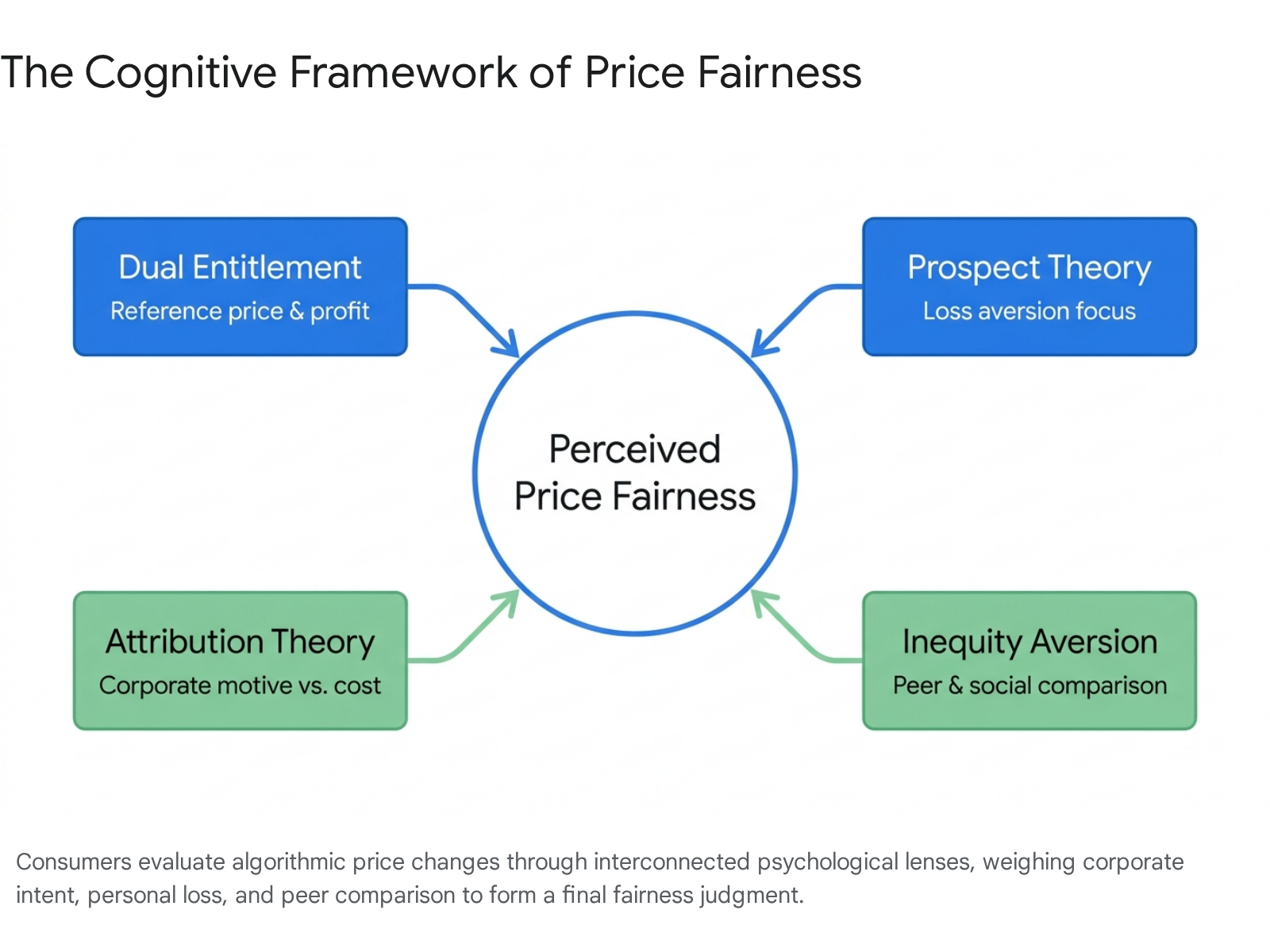
The principle of dual entitlement, originally articulated by behavioral economists Kahneman, Knetsch, and Thaler, provides the bedrock for understanding baseline price fairness. The theory posits that consumers believe they are entitled to a reasonable reference price, just as firms are entitled to a reasonable reference profit 11. According to this framework, price increases are generally deemed fair and acceptable if they are driven by verifiable, external increases in the firm's costs - such as rising wages, raw material shortages, or generalized inflation 111213. In these scenarios, the firm is perceived as merely protecting its historical baseline profit margin, an action consumers accept as a standard mechanism of commerce.
Conversely, consumers react intensely negatively when a firm raises prices strictly to exploit a surge in demand or a temporary supply shortage without a corresponding increase in operational costs 61112. In such cases, the firm is perceived to be violating the dual entitlement principle by extracting excess, unearned profit at the consumer's expense. For instance, raising the price of a hotel room during a major localized event, or escalating the cost of essential hardware supplies during a severe weather crisis, is frequently characterized by the public as price gouging 1614. Research confirms that a consumer's internal reference price is continuously calibrated by prior purchases, perceived seller sacrifice, and general market knowledge 1315. When an algorithmic price suddenly exceeds this internal anchor without a clear cost-basis justification, the transaction is immediately flagged by the consumer's cognitive systems as fundamentally unjust.
Prospect Theory and Loss Aversion
Consumer reactions to price fluctuations are inherently asymmetrical, a phenomenon extensively documented in Prospect Theory. Developed by Kahneman and Tversky, Prospect Theory outlines how individuals evaluate economic outcomes not in absolute terms, but as subjective gains or losses relative to a neutral reference point 1620. A core tenet of this structural approach to decision-making is loss aversion: the psychological pain and cognitive dissonance resulting from a loss are significantly more intense than the pleasure derived from an equivalent economic gain 2017.
In the context of dynamic pricing, paying a price higher than the established reference point is encoded cognitively as a loss, whereas paying a lower price is encoded as a gain 17. Because consumers are hyper-sensitive to losses, unexpected dynamic price increases trigger strong negative emotional responses, including anger, annoyance, and feelings of betrayal 1718. These negative affective states mediate behavioral responses, driving consumers toward retaliatory actions such as store switching, spreading negative word-of-mouth, and filing formal complaints 1718. Furthermore, even when pricing algorithms fluctuate downward to offer a discount, the positive impact on consumer satisfaction is mathematically muted compared to the outsized reputational damage caused by equivalent upward fluctuations 1719. Consequently, businesses operating dynamic models must manage the asymmetric risk that the goodwill generated by off-peak discounts will be entirely eclipsed by the resentment generated by peak-hour surcharges.
Attribution Theory and Consumer Inferences
Attribution Theory provides a highly nuanced framework for understanding how individuals assign causality to the events and behaviors they observe in the marketplace. Developed originally by Fritz Heider and later expanded by Harold Kelley and Bernard Weiner, the theory differentiates between internal (dispositional) attributions and external (situational) attributions 202122. According to Weiner's dimensions of attribution, individuals assess locus of control, stability, and controllability when evaluating an outcome 23.
When a consumer encounters an unexpected algorithmic price increase, they instinctively engage in causal reasoning to determine the origin of the change. If the consumer attributes the price hike to the firm's internal, controllable traits - such as corporate greed, exploitative management, or opportunistic profit-seeking - the perception of fairness plummets 1220. However, if the consumer can attribute the price increase to external, uncontrollable situational variables - such as government mandates, global supply chain failures, or unavoidable macroeconomic pressures - they are far more likely to accept the new price as fair 1224.
A persistent psychological bias known as the "Fundamental Attribution Error" often leads consumers to default to internal attributions, systematically overestimating the influence of a firm's greedy disposition while underestimating the impact of complex situational market pressures 2021. Furthermore, under Kelley's Covariation Model, consumers use consensus information to make these judgments; if only one specific platform has dynamically raised the price of a good while competitors have not, the lack of consensus forces an internal attribution of corporate exploitation 2122.
Self-Interested Inequity Aversion
The digital commerce environment inherently increases price transparency, making it trivial for consumers to discover what their peers have paid for equivalent services. This visibility triggers a psychological mechanism known as "self-interested inequity aversion" 25. Consumers experience deep psychological disutility and resentment when they discover they have paid more than another individual for the exact same product or service - a state defined in behavioral economics as disadvantaged inequality 252627.
While traditional economic utility models might suggest that advantaged inequality (paying less than a peer) would yield maximum consumer satisfaction, psychological research reveals a more complex reality. Even consumers who directly benefit from a lower dynamic price may experience guilt or reduced trust in the vendor, as the seemingly arbitrary nature of the algorithmic pricing mechanism violates broader societal norms of equity and procedural justice 1225. Empirical studies demonstrate that when consumers learn a vendor engages in opaque differential pricing, overall institutional trust falls dramatically, with up to 56% of aware consumers claiming they will abandon the purchase entirely rather than participate in an unequal system 21828.
Dynamic Versus Personalized Pricing Paradigms
While the terms are frequently conflated in public discourse and media reporting, behavioral economists and regulatory bodies draw sharp, critical distinctions between dynamic pricing and personalized pricing. The distinction is not merely semantic; consumer tolerance, ethical implications, and regulatory scrutiny vary significantly between the two models 1.
Aggregate Market Fluctuations
Dynamic pricing, in its orthodox definition, involves adjusting the price of a product or service across the entire market based on aggregate, external factors. The variables driving these algorithmic adjustments include real-time supply constraints, broader demand trends, competitor pricing matrices, global inventory levels, time of day, and seasonal fluctuations 116. In a pure dynamic pricing model, the price is volatile over time, but at any exact, given moment, every consumer looking at the product is offered the identical price 19. Traditional examples include ride-share surge pricing during inclement weather, airline ticketing algorithms reacting to dwindling seat capacity, and utility companies utilizing off-peak energy tariffs 116. Because the pricing logic is tethered to observable macro-conditions, consumers are generally more capable of rationalizing the changes, even if they find them frustrating.
Individualized Algorithmic Discrimination
Personalized pricing - frequently referred to in academic literature as first-degree or algorithmic price discrimination, and by privacy advocates as "surveillance pricing" - operates on an entirely different technological and ethical axis. This model relies on highly specific, user-level data to calculate and extract an individual's maximum theoretical willingness to pay 12529. Algorithms utilized in personalized pricing continuously ingest granular surveillance data, including past purchase history, granular web browsing patterns, precise geolocation, device type (e.g., distinguishing between premium smartphone users and desktop users), and inferred socioeconomic status 48927. Based on this deep consumer profile, the algorithm generates different prices for different consumers for the exact same product at the exact same millisecond 49.
Comparative Fairness Perceptions
Consumer behavior research consistently demonstrates that personalized pricing provokes far stronger negative reactions and perceptions of unfairness than aggregate dynamic pricing 6930. When consumers are subjected to a segmented or market-wide dynamic price, they often attribute the fluctuation to impersonal market forces, effectively externalizing the cause 9. However, when prices are individualized, the practice is almost universally viewed as an opportunistic, predatory exploitation of personal privacy 49.
A comprehensive experimental study published in the Journal of Revenue and Pricing Management empirically verified that consumers evaluate individual prices as significantly less fair than segment-based prices 9. Furthermore, the specific category of personal data utilized by the algorithm dictates the severity of the consumer outrage. Personalized pricing based on geographic location (geopricing) is perceived as deeply unfair and highly discriminatory, whereas personalized pricing framed as a discount based on prior purchase history or brand loyalty is tolerated marginally better 9. When consumers suspect that their digital footprints are being weaponized against them to inflate costs, baseline institutional trust is severely compromised, hardening the brand relationship into an adversarial, zero-sum game 43137.
The Role of Algorithmic Agents in Consumer Trust
The widespread delegation of pricing authority from human merchandising managers to artificial intelligence introduces profound new complexities into the consumer-brand relationship. Algorithmic dynamic pricing (ADP) systems process multivariate data and alter prices at speeds and frequencies completely impossible for human operators, optimizing revenue but fundamentally altering consumer purchasing behavior and brand trust 23233.
Algorithmic Opacity and Trust Erosion
A 2024 longitudinal study published in the International Journal of Research in Marketing meticulously examined the psychological effects of ADP on consumer trust and subsequent behavior. Across multiple field studies and incentive-based experimental scenarios, researchers concluded that the implementation of ADP significantly reduces a consumer's trust in the retailer 2533. This erosion of trust is particularly acute when the algorithmic price changes are highly frequent or when the variables driving the changes are completely opaque to the end user 233.
As a direct behavioral response to this diminished trust, consumers subjected to ADP proactively alter their shopping habits; specifically, they significantly prolong their price-search duration. Consumers spend more time actively seeking out competitors and price-comparison tools to verify whether they are receiving a fair deal from the algorithm, effectively reducing the frictionless convenience that e-commerce platforms strive to provide 533. However, the researchers also documented a critical psychological habituation effect: the negative impact on trust gradually diminishes over extended timeframes as consumers become socially accustomed to the algorithmic norms of a specific digital market 5. Retailers can actively accelerate this habituation and mitigate the loss of trust by employing aggressive price-matching guarantees and transparently communicating that their algorithms are strictly reactive to external market conditions, rather than exploitative of hidden personal data 533.
Human Versus Algorithmic Price Discrimination
Interestingly, while algorithms generally erode baseline trust through their opacity, their non-human nature can sometimes shield firms from the most intense accusations of demographic discrimination. A 2024 empirical study from Columbia Business School investigated consumer reactions to "advantaged" versus "disadvantaged" price discrimination, specifically isolating whether the discrimination was implemented by a human agent or an algorithmic agent 263435.
The research uncovered a counter-intuitive phenomenon: when consumers suffer disadvantaged price discrimination (i.e., paying more than others) based on personal demographic factors, they perceive the outcome as significantly less unfair if the higher price was set by an algorithm rather than a human sales manager 2635. Because consumers cognitively construct algorithms as rigid, rule-based, and inherently devoid of personal animus or emotional prejudice, they are far less likely to attribute the high price to malicious intent or conscious bias 35. Conversely, consumers are highly prone to externalize human-led price discrimination as a deliberate, personal slight. This finding suggests that while algorithmic pricing introduces broad transparency concerns, its impersonal, mathematical nature can occasionally buffer companies against highly sensitive accusations of active demographic discrimination 2635.
Sectoral Variances and Industry Case Studies
Consumer acceptance of dynamic pricing is not a universal constant; it is deeply contextual, heavily dependent on the historical norms of the industry, and closely tied to the psychological necessity of the goods being purchased.
High-Acceptance Sectors: Travel and Hospitality
Industries that face rigid, immovable supply constraints combined with highly perishable inventory - most notably airlines, hotels, and event-based parking - have utilized dynamic yield management methodologies for decades 363738. Over generations, consumers have largely habituated to the reality that booking a hotel room or an airline flight during peak holiday seasons or major conferences will demand a premium price 37.
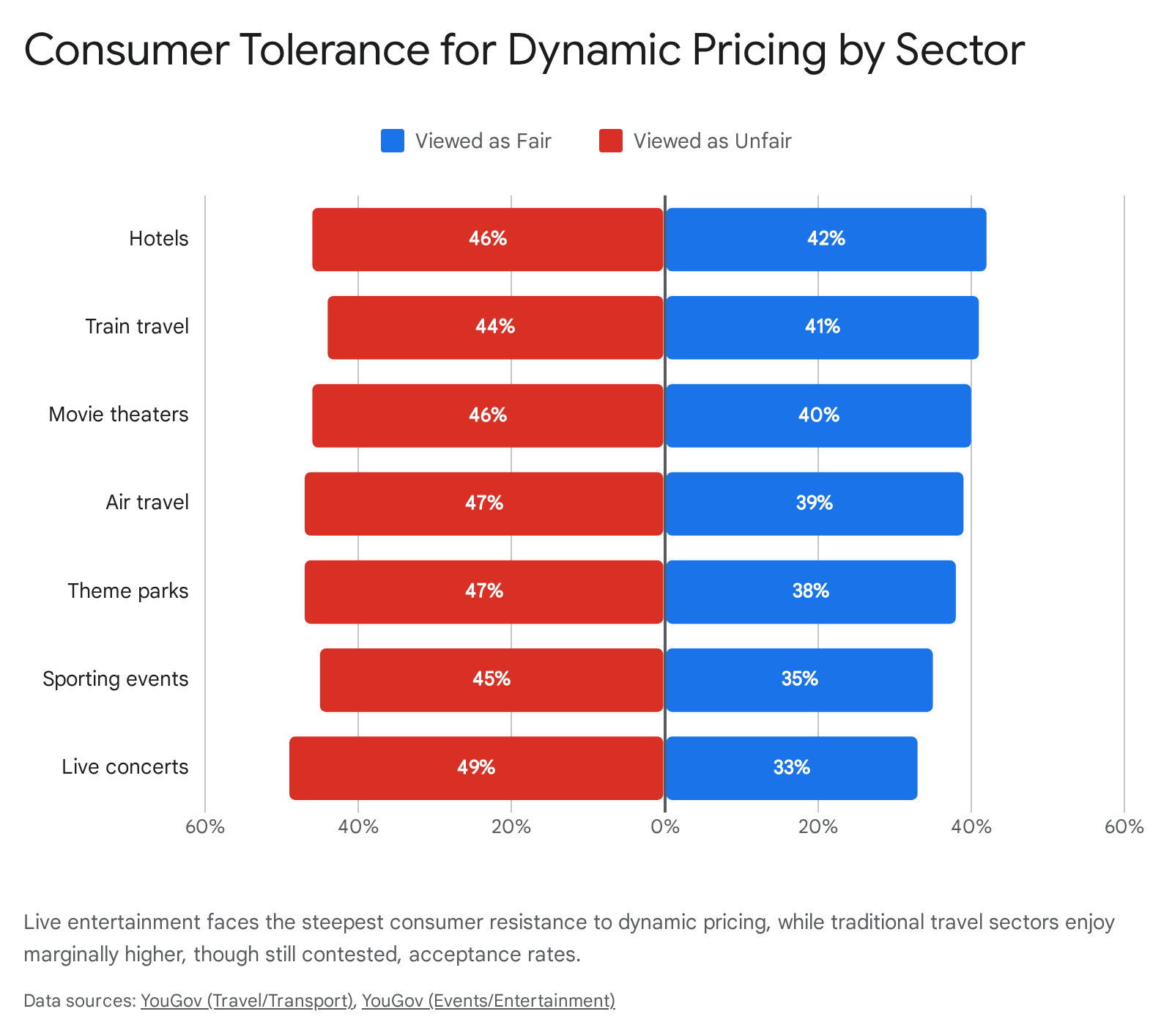
However, the economic welfare effects of this widespread dynamic pricing are debated. A highly detailed 2022 working paper assessing the welfare effects of dynamic price competition in the airline industry revealed that while algorithmic dynamic pricing actually expands total market output (by filling seats that would otherwise fly empty), it counterintuitively lowers total consumer welfare compared to uniform pricing 19. The analysis demonstrated that advanced dynamic pricing algorithms effectively soften price competition between competing airlines as the departure date approaches, leading to higher surplus extraction from last-minute travelers despite featuring lower aggregate average prices overall 19. Despite these welfare mechanics, public tolerance remains highest in these sectors. According to recent polling, 42% of consumers globally view dynamic pricing for hotel stays as fair, and 39% view it as fair for airlines 39. While these statistics still indicate substantial public resistance, they represent the empirical ceiling of consumer tolerance for fluctuating prices 39.
Low-Acceptance Sectors: Fast Food and Routine Dining
Tolerance for price volatility plummets dramatically when dynamic algorithms encroach upon non-discretionary goods, habitual daily purchases, or low-involvement transactions 1420. This vulnerability was vividly illustrated in the Quick Service Restaurant (QSR) sector in early 2024.
During an earnings call, the CEO of the fast-food chain Wendy's announced a $20 million investment in digital menu boards designed to test dynamic pricing and daypart offerings by 2025 244041. The financial media rapidly interpreted and framed this initiative as "surge pricing" for hamburgers, triggering a massive, immediate social media backlash 41. Consumers, already deeply fatigued by post-pandemic inflation and cumulative industry-wide menu price increases exceeding 22% over three years, viewed the application of algorithmic pricing to habitual, low-cost convenience meals as pure corporate price gouging 4142. Fast food represents a predictable, low-involvement heuristic purchase; introducing volatility via digital boards disrupted this cognitive convenience 4042. The public relations crisis was severe enough that Wendy's was forced to issue rapid clarifications to major news outlets, explicitly stating they had no plans to raise prices during peak lunch hours, but rather intended to utilize the technology to offer targeted discounts during slow periods 4043. Tracking by YouGov BrandIndex confirmed a significant drop in consumer sentiment and a spike in negative word-of-mouth exposure during the crisis, demonstrating that consumers draw a hard, unforgiving line at unpredictable pricing for routine conveniences 4043.
Low-Acceptance Sectors: Live Events and Monopolistic Scarcity
Live concerts registered the lowest fairness scores across all measured industries in global surveys, with only 33% of consumers viewing dynamic pricing as fair, and nearly half (49%) explicitly deeming it unfair 44.
The implementation of algorithmic dynamic pricing by ticketing monopolies, notably Ticketmaster, has caused immense cultural and regulatory friction 28.
In 2024, the highly anticipated rollout of tickets for the Oasis reunion tour in the United Kingdom utilized algorithms that escalated face-value prices by vast multiples within hours as desperate fans waited in digital queues 7164552. The algorithms ran continuously, matching fixed stadium supply against unprecedented global demand, driving prices to levels that priced out the core demographic 52. The backlash was so intense that the UK's Competition and Markets Authority (CMA) launched a formal investigation into potential consumer protection law breaches regarding opaque sales tactics 716. In direct response to the psychological damage inflicted on their fan base, Oasis explicitly banned dynamic pricing for the subsequent North American leg of the tour, calling it an "unacceptable experience" 71646. Because live events represent an absolute monopoly on a highly emotional, non-substitutable experience, consumers view demand-based price spikes not as market efficiency, but as deeply unethical exploitation 728.
Low-Acceptance Sectors: Groceries and Retail Essentials
The rapid expansion of electronic shelf labels (ESLs) in major supermarkets has raised widespread alarms about the impending normalization of dynamic pricing for essential household goods 13647. Data analytics from proxy service providers like Decodo revealed that major retailers are already executing massive volumes of algorithmic price changes online; for example, Amazon executed over 116,000 price adjustments in a specific tracking period, while Walmart and Kroger executed approximately 68,000 and 55,000 adjustments respectively 48.
While retail executives argue that digital tags and algorithms are primarily utilized to increase labor efficiency, instantly match competitor discounts, and quickly markdown expiring perishable goods, consumers view the technology with deep, entrenched suspicion 364748. Consumer advocates argue that applying dynamic algorithms to essential groceries crosses an ethical boundary, directly threatening food security for vulnerable populations 14. If algorithms are perceived as altering the price of necessities like bread or baby formula based on real-time store foot traffic, localized weather events, or individual zip codes, retail experts warn it will trigger unprecedented consumer backlash, boycotts, and brand abandonment 41447.
Industry Comparison of Consumer Tolerance
The following table summarizes global consumer sentiment regarding the perceived fairness of dynamic pricing across different economic sectors, drawing on extensive 2024 polling data across 17 distinct international markets 3944:
| Service/Industry Category | Viewed as "Fair" (%) | Viewed as "Unfair" (%) | Don't Know (%) | Market Context |
|---|---|---|---|---|
| Hotel Stays | 42% | 46% | 12% | Long history of yield management; seasonal expectations. |
| Train Travel | 41% | 44% | 15% | Accepted in some regions (e.g., Europe/Asia) for load balancing. |
| Movie Theaters | 40% | 46% | 14% | Emerging trend for opening weekends vs. matinees. |
| Airlines | 39% | 47% | 14% | Highly visible, though consumers strongly dislike holiday surging. |
| Theme Parks | 38% | 47% | 15% | Growing use of tier-based date pricing to manage crowds. |
| Sporting Events | 35% | 45% | 20% | High emotional investment; captive local audience. |
| Live Concerts | 33% | 49% | 18% | Lowest tolerance; extreme scarcity and monopoly on artists. |
Mitigation and Cognitive Framing Strategies
Given the intense psychological friction and reputational risk associated with algorithmic pricing, firms must employ careful, empirically tested communication strategies to justify price variance and mitigate consumer alienation.
Transaction Dissimilarity and Discounts
Rooted deeply in Prospect Theory's concept of loss aversion, the most effective mitigation strategy is framing dynamic pricing as an opportunity for an earned discount rather than an arbitrary penalty for peak demand 1620. Because consumers evaluate surcharges (losses) much more critically than discounts (gains), manipulating the framing of the reference price alters the entire cognitive appraisal of the transaction 20. Furthermore, establishing "transaction dissimilarity" - where consumers perceive that they are receiving a different or lesser service than those paying full price - helps justify the variance 49.
For example, extensive research conducted by the Yale School of Management suggests that if a restaurant wishes to implement daypart pricing to manage demand, framing the baseline price at the higher dinner rate and offering a visible "lunch discount" is vastly superior to setting a lower baseline and applying a "dinner surcharge" 24. The mathematical and financial outcome for the firm is completely identical, but the psychological encoding shifts dramatically from an unfair penalty to a rewarded, prosocial behavior 2024. Consumers feel a sense of agency and achievement when securing a discount. When Wendy's attempted to salvage their 2025 technology rollout, they quickly pivoted to this exact messaging strategy, emphasizing that dynamic capabilities would be utilized exclusively to offer targeted discounts during slow periods, successfully attempting to reframe the narrative from exploitation to value 4043.
Profit Versus Cost Justifications
When raw material costs or market dynamics dictate that prices must absolutely increase, the explicit rationale provided to the consumer dramatically influences the attribution process. Quantitative studies reveal that if a firm raises prices and quietly attributes the hike to generic "service fees" or simply allows consumers to infer it is due to high demand, consumers perceive the action as deeply unfair, and purchase intent drops precipitously 24.
However, if the firm explicitly links the price increase to a structural, external necessity - such as funding staff wage increases, offsetting specific global supply chain disruptions, or paying government tariffs - perceptions of fairness actually rise 1224. By firmly tying the algorithmic price adjustment to the Dual Entitlement principle (protecting costs rather than padding profit), firms can successfully manage price increases without permanently destroying consumer loyalty or triggering retaliatory attributions.
Cross-Cultural Perspectives on Dynamic Pricing
Psychological reactions to price fairness are not universally homogenous; they are heavily mediated by embedded cultural dimensions, communication styles, and regional economic maturity.
Individualism Versus Collectivism
Cultural differences, particularly regarding high/low-context communication styles and the individualism-collectivism spectrum established by Hofstede, fundamentally alter how pricing algorithms are perceived across the globe. Studies comparing Western (low-context, highly individualistic) and Non-Western (high-context, highly collectivist) markets reveal distinct cognitive patterns.
Western retail markets frequently utilize "threshold" or psychological pricing (e.g., ending prices in .99) to project value and trigger automatic purchase heuristics 50. However, in high-context Eastern cultures (such as China, Japan, and Hong Kong), these precise fractional strategies are often viewed as overly manipulative and can actively erode brand trust; consumers in these regions exhibit a strong preference for rounded prices or culturally symbolic "lucky" numbers (such as prices ending in 8, which signifies prosperity in Feng Shui philosophy) 5051.
Furthermore, collectivist societies place a much higher emphasis on relational harmony, group equity, and in-group loyalty. Research analyzing cross-cultural reactions to personalized dynamic pricing indicates that Chinese consumers react far more severely to relational price unfairness than American consumers 5260. If a loyal, repeat customer in a collectivist market discovers they are paying more than a first-time buyer via a personalized algorithm (a common customer acquisition tactic), the resulting feelings of betrayal are much stronger than they would be in a highly individualistic, transaction-oriented market 5260. Collectivist consumers also rely more heavily on social norms and word-of-mouth from "market mavens" to calibrate their reference prices, making opaque dynamic pricing particularly disruptive to their culturally ingrained decision-making processes 60.
Regional Market Dynamics
Southeast Asia: The e-commerce sector in Southeast Asia - a massive digital market projected to exceed $410 billion by 2030 - has historically been driven by extreme consumer price sensitivity, massive synchronized discount events, and highly transparent, subsidized voucher systems 75354. However, as major digital platforms transition out of their high-burn growth phases and pivot toward sustainable unit economics, they are rapidly deploying opaque, AI-driven personalized pricing to extract maximum margin from their acquired user bases 7. Because consumers in this region were thoroughly habituated to transparent discounts and flash sales, discovering algorithmic price discrepancies for identical goods feels fundamentally unfair, threatening the baseline trust required to sustain long-term digital growth in the region 754.
The Middle East: In dynamic markets like the United Arab Emirates (UAE) and the Kingdom of Saudi Arabia (KSA), macroeconomic pressures, inflation, and rising costs of living have forged a new, highly price-sensitive consumer base 5556. Data from the Voice of the Consumer 2025 report indicates that nearly half of consumers in the Gulf are actively cutting back on discretionary spending, trading down to cheaper private-label brands, and aggressively seeking promotions 5657. The implementation of dynamic pricing in this highly sensitized region requires extreme transparency. Because consumers are actively recalibrating their budgets, unexpected algorithmic price spikes in daily essentials or fast-moving consumer goods (FMCG) risk immediate consumer defection to local, stable-priced competitors who rely on traditional trade formats 555657.
Global Regulatory Frameworks and Legal Challenges
As dynamic and algorithmic pricing practices proliferate across every sector of the global economy, regulatory bodies are aggressively shifting from passive observation to active, ex-ante enforcement, addressing overlapping concerns spanning data privacy, consumer protection, and antitrust law 858.
European Union Regulations
The European Union currently operates the most comprehensive and stringent regulatory environment regarding data-driven and algorithmic pricing. The foundation of this oversight is the General Data Protection Regulation (GDPR), which mandates strict transparency and requires explicit, informed consumer consent before any personal data can be processed or profiled to generate a personalized price 15960.
Building upon the GDPR, the newly enacted EU AI Act introduces a rigorous horizontal regulatory layer. Under this act, AI-driven pricing models utilized in critical sectors like e-commerce, insurance, and ride-sharing can be classified as high-risk systems 6162. The Act mandates that companies conduct thorough fundamental rights impact assessments to ensure that their self-learning pricing algorithms do not inadvertently result in demographic exclusion, unfair price discrimination, or the financial exploitation of vulnerable societal groups 616263. The inherently opaque nature of personalized dynamic pricing is directly challenged by statutory requirements that consumers must be provided with clear, accessible information regarding exactly how their data influences the prices they encounter 61.
United States Enforcement Trends
In the United States, regulatory enforcement regarding algorithmic pricing is intensifying across multiple federal and state agencies, blending consumer protection with aggressive antitrust theories. In 2024, the Federal Trade Commission (FTC) launched a highly publicized 6(b) market study specifically targeting "surveillance pricing" - defined as the use of highly granular personal data (such as precise location, credit history, and microscopic browsing habits) to set individualized prices 1864.
Concurrently, the Department of Justice (DOJ) is actively pursuing algorithmic pricing as a modern, high-tech vector for horizontal price-fixing 6566. The DOJ argues that when competing firms in an industry (such as real estate or hospitality) delegate their pricing authority to shared, third-party, self-learning algorithms, it constitutes a per se violation of the Sherman Act 6566. Crucially, the DOJ maintains this stance even in the absence of direct human communication or explicit collusive intent between the competitors, signaling a major paradigm shift in antitrust enforcement 6566. At the state level, legislative action is frequently outpacing federal guidelines; New York enacted the Algorithmic Pricing Disclosure Act, legally requiring retailers to post conspicuous, all-caps warnings if prices are individualized using personal data, while other states are actively debating outright bans on surveillance-driven price discrimination 8146466.
Emerging Markets Responses
Rapidly developing digital economies in Latin America and Asia are also establishing firm legal boundaries against algorithmic exploitation, often utilizing robust consumer protection statutes.
In Latin America, Brazil's National Consumer Secretariat (SENACON) recently set a major international precedent by issuing a multi-million Real fine against the prominent travel platform Decolar.com for engaging in illegal "geopricing" and "geoblocking" 1067. The platform's algorithms were found to be systematically offering accommodations at rates up to 29% higher for consumers searching from Brazilian IP addresses compared to foreign ones. SENACON decisively ruled this an abusive practice, a violation of consumer freedom of choice, and illegal discrimination based on geographic location 10. Concurrently, Brazil's Data Protection Authority (ANPD) is pushing for principle-based AI regulations that align with data privacy norms, aiming to prevent algorithmic models from generating harmful or exploitative outcomes 606768. Mexico's antitrust authority (COFECE) has similarly launched digital market studies to evaluate how algorithms might facilitate tacit collusion and price discrimination in e-commerce 69.
In India, the rapid digitalization of a massive consumer base has brought similar issues to the forefront. The Competition Commission of India (CCI) is grappling with the unprecedented challenges of "digital profiteering" and algorithmic cartels 587071. Regulatory officials warn that reinforcement-learning AI systems are fully capable of establishing and maintaining supra-competitive pricing equilibriums autonomously, achieving the results of a cartel without human intent 70. Because India's current Competition Act of 2002 lacks explicit statutory provisions addressing non-human algorithmic collusion, legal scholars and authorities are urgently calling for legislative amendments to enforce mandatory algorithmic audits, regulate opaque personalized pricing, and restrict the self-preferencing tactics of dominant e-commerce platforms 58707172.
Conclusion
The psychology underpinning dynamic pricing is a complex, volatile interplay of inherent cognitive biases, socio-cultural norms, and rigorous cognitive appraisals. While advanced algorithms provide modern businesses with the sheer technical capability to analyze vast data sets and extract maximum willingness-to-pay from every discrete transaction, doing so without a profound regard for consumer psychology is a perilous, short-sighted strategy. When pricing mechanisms violate the foundational dual entitlement principle, induce severe loss aversion through unexpected, poorly justified surcharges, or trigger inequity aversion through opaque, surveillance-based personalization, the resulting erosion of trust inflicts deep, often permanent damage on brand equity.
To navigate this highly sensitive landscape successfully, firms must execute a strategic pivot from merely maximizing algorithmic efficiency to consciously optimizing for perceived fairness. This transition requires sophisticated communication strategies: framing variable pricing as an opportunity for consumer savings and value, utilizing highly transparent, cost-based justifications when price increases are unavoidable, and strictly avoiding "surveillance pricing" tactics that weaponize personal consumer data. Furthermore, as global regulatory bodies - from the EU and the US FTC to Brazil's SENACON and India's CCI - increasingly view unchecked algorithmic pricing as a systemic threat to consumer rights, data privacy, and market competition, ethical data governance is no longer a peripheral marketing strategy. It is an absolute, non-negotiable compliance imperative for the future of digital commerce.