
Psychology of influencer marketing and parasocial trust transfer
The rapid evolution of digital media has fundamentally restructured the global marketing landscape, transitioning the locus of consumer trust from institutional brand messaging to peer-to-peer digital networks. Central to this paradigm shift is the phenomenon of influencer marketing, a mechanism that leverages the perceived authenticity, expertise, and sociability of digital content creators to drive consumer behavior 12. While traditional advertising relies on mass broadcast models that frequently trigger consumer skepticism, advertising blindness, and resistance, influencer marketing operates on the psychological foundation of human connection, mimicking organic social interactions 2.
At the core of this interaction is a complex psychological architecture where one-sided media consumption evolves into a perceived interpersonal relationship. Consumers invest emotionally in the lives, narratives, and curated personas of influencers, treating their commercial endorsements not as paid advertisements, but as recommendations from a trusted peer or advisor 23. This phenomenon necessitates a rigorous academic examination of how parasocial trust is cultivated in digital spaces and the specific psychological mechanisms through which that trust is transferred to endorsed products and brands.
As the global influencer marketing industry approaches a projected valuation of $480 billion by 2027 4, understanding these underlying psychological drivers is an imperative within consumer psychology. The intersection of relational trust, cognitive heuristics, and digital media architecture presents a nuanced ecosystem. An exhaustive analysis of the theoretical frameworks governing influencer trust reveals the divergent impacts of influencer scale, cross-cultural variations in consumer reception, the neurological and behavioral impacts of sponsorship disclosures, and the emerging disruptions caused by artificial intelligence (AI) personas and algorithm fatigue.
Theoretical Foundations of Influencer Trust
To deconstruct how influencer marketing successfully bypasses traditional advertising defense mechanisms, it is necessary to examine the intersecting psychological theories that explain social influence, relationship formation, and cognitive evaluation. The efficacy of influencer endorsements is predominantly explained through Source Credibility Theory, Social Exchange Theory, and Parasocial Interaction Theory.
Source Credibility Theory
Source Credibility Theory, originally rooted in communication psychology, posits that the persuasive power of a message is heavily dependent on the perceived attributes of the communicator 15. In the context of social media influencers, credibility is generally disaggregated into three core dimensions: expertise, trustworthiness, and attractiveness 56.
Expertise refers to the perceived knowledge, experience, or specialized skills the influencer possesses regarding a specific product category 7. When consumers face high levels of uncertainty or cognitive risk in a purchase decision, they rely on the influencer's expertise as a heuristic to reduce cognitive load and information asymmetry 7. Trustworthiness measures the perceived honesty, integrity, and benevolence of the influencer 89. It is driven by consistent, unbiased communication, such as the willingness to share negative reviews alongside positive ones 2. Attractiveness encompasses both physical appeal and social attractiveness, which facilitates an aspirational connection with the audience 110.
Research utilizing the Stimulus-Organism-Response (S-O-R) framework demonstrates that these specific traits act as external stimuli that internalize as perceived credibility within the organism, which subsequently drives the behavioral response of brand trust and purchase intention 78. The continuous signaling of these traits establishes a foundational baseline of cognitive trust, upon which deeper emotional connections are built. Furthermore, Social Exchange Theory suggests that this dynamic operates on a reciprocity principle: influencers provide entertainment, inspiration, and informational value, and in exchange, followers provide engagement, loyalty, and commercial action 911.
Parasocial Interaction and Relationship Development
While Source Credibility Theory explains the logical evaluation of a communicator, Parasocial Interaction (PSI) Theory - and the subsequent formation of Parasocial Relationships (PSR) - explains the profound emotional bonds that consumers form with digital creators 212. Originally conceptualized by Horton and Wohl to describe the one-sided relationships television viewers formed with broadcast personalities, the theory has found unprecedented relevance and scale in the social media era 712.
Influencers cultivate parasocial relationships through consistent social presence, high levels of self-disclosure, and the sharing of intimate, unscripted moments that dissolve the traditional boundaries between a public figure and a private individual 313. This repeated exposure fosters an illusion of face-to-face relationship 14. Unlike traditional celebrities, influencers frequently interact directly with their audiences via comments, live streams, and direct messages, enhancing the perceived mutuality and closeness of the relationship 1115.
The development of a parasocial relationship is not instantaneous; it follows a progressive trajectory through distinct sequential stages derived from Relationship Development Theory. The integration of consumer psychology into these stages illustrates how trust scales over time.
| Relationship Stage | Description of Follower Behavior | Psychological Mechanism | Advertising Outcome Potential |
|---|---|---|---|
| Awareness | The consumer recognizes the influencer and views initial content over a short period (days). | Superficial alignment; initial assessment of physical or social attractiveness. | Low. Minimal persuasive power as cognitive trust is not yet established. |
| Exploration | The follower actively engages with the content, seeking homophily (similarity) and monitoring consistency. | Activation of cognitive trust; evaluation of the influencer's expertise and reliability. | Moderate. The follower may take low-risk actions based on recommendations. |
| Expansion | The follower repeatedly relies on the influencer for information or entertainment over months. | Deepening of affective trust; heightened emotional connection and perceived mutuality. | High. The influencer is viewed as an inspirational figure; strong engagement metrics. |
| Commitment | The influencer becomes embedded in the follower's daily routine and social identity over a long term. | Absolute behavioral trust; the follower perceives a reciprocal, peer-like relationship. | Highest. The follower acts as a brand advocate, exhibiting strong purchase intention and eWOM. |
| Data synthesized from models of follower-influencer relationship development 1116. |
The strength of these parasocial bonds effectively lowers skepticism and defense mechanisms. When an influencer in the commitment stage promotes a brand, the recommendation bypasses the critical scrutiny usually reserved for commercial messaging. The consumer processes the information through the neurological and cognitive pathways associated with friendship and peer advice, rendering the endorsement highly persuasive 23.
Mechanisms of Psychological Trust Transfer
The conversion of influencer affinity into brand equity is governed by the specific mechanisms of Trust Transfer Theory, the Halo Effect, and the Meaning Transfer Model.
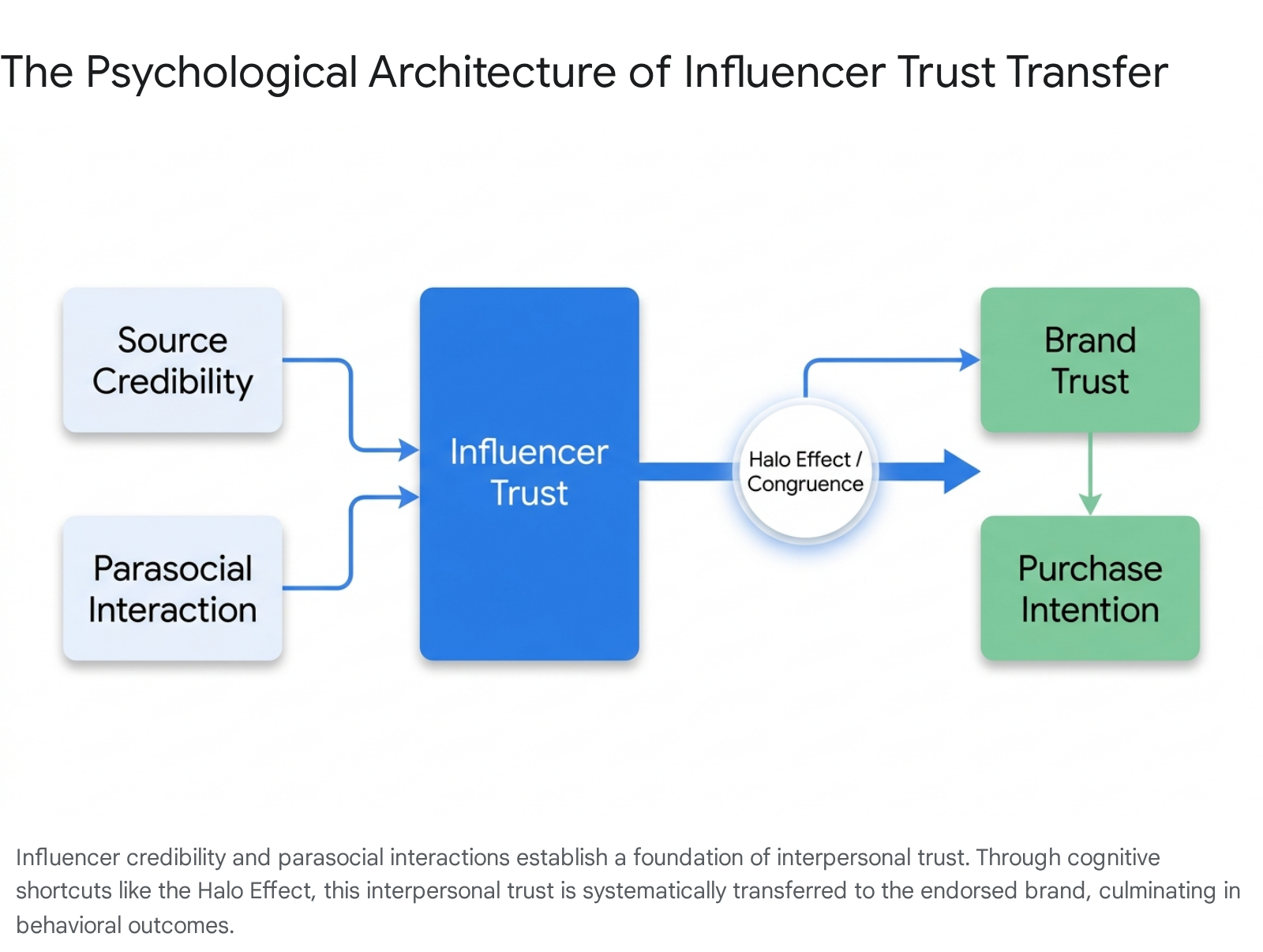
Trust Transfer Theory argues that trust is a highly transferrable asset; it can migrate from a known, trusted source (the influencer) to an unknown or secondary entity (the brand) 917. This process operates on the principle of cognitive consistency. If a consumer maintains a high level of trust in an influencer, and the influencer publicly aligns with a brand, the consumer unconsciously extends that trust to the brand to avoid cognitive dissonance 917.
Dimensions of Transferred Trust
This transfer encompasses three specific psychological dimensions. Cognitive trust reflects the belief in the brand's performance and competence, based on the influencer's endorsement. Affective trust represents the emotional bond and positive sentiment generated toward the brand. Behavioral trust is the ultimate willingness to depend on the brand for a purchase or lifestyle decision 9. Empirical structural equation modeling indicates that cognitive and behavioral trust are the most readily transferable dimensions, heavily mediated by the perceived congruence or "fit" between the influencer's persona and the brand's identity 9.
The Halo Effect and Cognitive Consistency
Operating in tandem with Trust Transfer is the Halo Effect, a cognitive bias wherein the positive perception of an individual in one area influences the evaluation of their traits in entirely unrelated areas 1819. In influencer marketing, the halo of the creator's authenticity, enthusiasm, or attractiveness envelopes the endorsed product 1820.
The Halo Effect serves as a powerful psychological shortcut. Because human cognition inherently seeks to conserve energy, consumers rely on their overarching positive sentiment toward the influencer rather than conducting an objective, data-driven analysis of the product itself 1920. Furthermore, cultural conformity plays a significant role in this effect. Humans possess an instinctual drive to fit into social groups; adopting the consumption habits of highly regarded influencers triggers neurological reward pathways associated with conformity and group belonging 20.
The Meaning Transfer Model
Further elucidating the complexities of trust transfer is the Meaning Transfer Model (MTM). Initially developed by McCracken for celebrity endorsements, the MTM suggests that marketing communications act as a conduit for cultural meanings, moving them from the culturally constituted world, to an endorser, to a product, and finally to the consumer's own identity 2122.
In the modern digital landscape, influencers embody specific, distinct cultural meanings - ranging from minimalist sustainability to hyper-luxurious aestheticism 23. When an influencer endorses a product, the symbolic properties of the influencer are mapped onto the brand. Recent literature extending the MTM to social media influencers demonstrates a critical nuance: consumers are significantly more likely to transfer an influencer's distinctive attributes to a brand rather than traits that are shared broadly across the influencer ecosystem 2324.
This presents a strategic vulnerability. If an influencer is distinctively known for a negative attribute, that negative meaning will transfer to the brand more readily than a redundant positive attribute 2324. Consequently, for successful meaning transfer, brands must conduct rigorous psychological profiling of creators, ensuring that the influencer's distinct cultural markers perfectly align with the intended brand positioning, allowing consumers to safely internalize those specific symbolic meanings to construct their own social identities 22.
Influencer Scale and Audience Reception
The psychological efficacy of an influencer is not uniformly distributed across follower counts. The influencer ecosystem is heavily stratified, and consumer psychology reacts differently to creators depending on their audience size. The industry generally categorizes influencers into four distinct tiers: Nano (1,000 - 10,000 followers), Micro (10,000 - 100,000 followers), Macro (100,000 - 1,000,000 followers), and Mega or Celebrity (over 1,000,000 followers) 252627.
The Credibility Gap and the Paradox of Scale
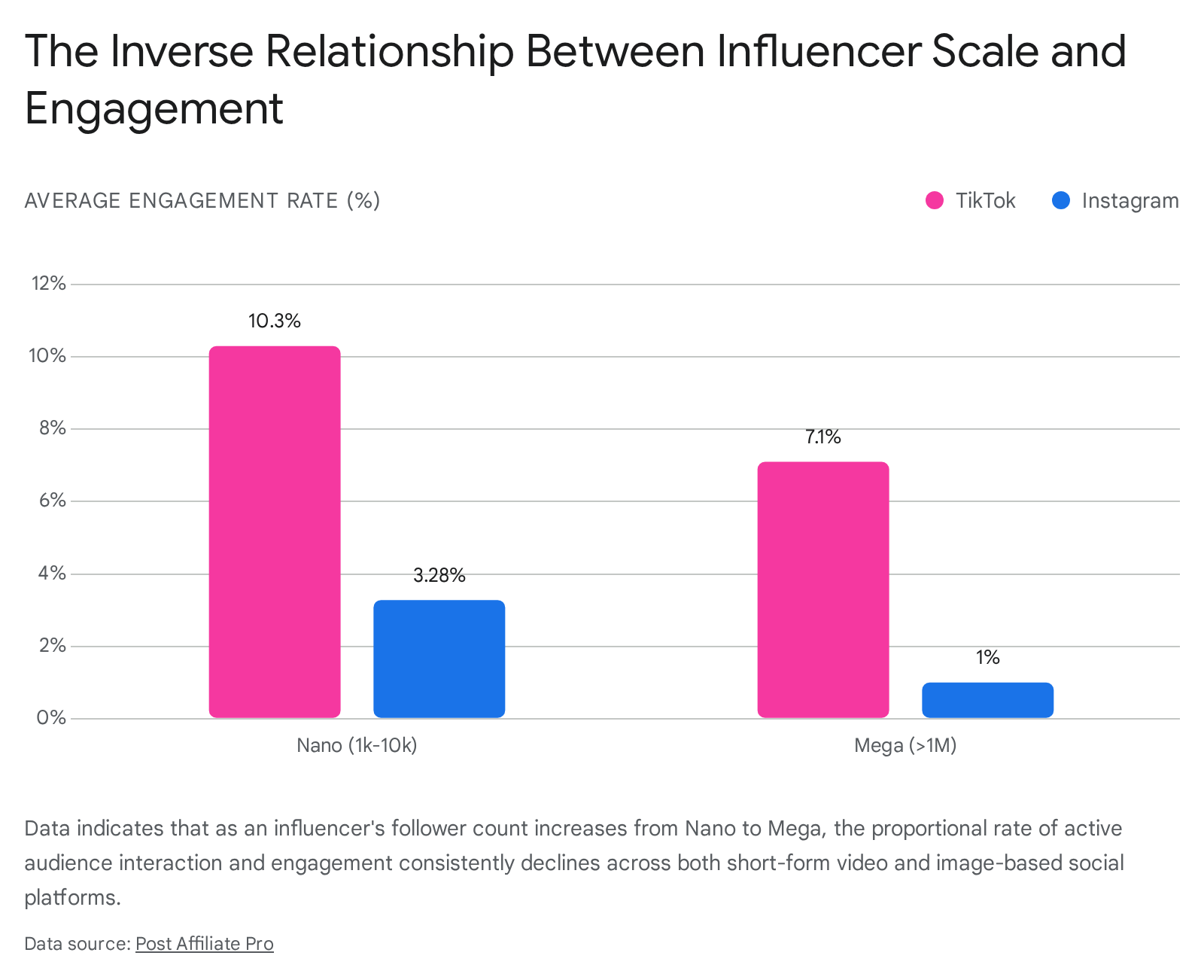
Traditional advertising logic operates on a volume-based assumption: wider reach generates proportionately greater outcomes. However, digital influencer marketing exhibits an inverse relationship between audience size and consumer engagement rates, a phenomenon driven by the psychological concept of the "credibility gap" 28. As follower counts rise, the perceived intimacy, relatability, and authenticity of the influencer experience a precipitous decline 2729.
Mega-influencers are widely utilized for top-of-funnel mass awareness due to their expansive visibility 2930. However, their psychological footprint mimics that of traditional celebrities; they are perceived as distant, highly commercialized, and aspirational rather than relatable 3132. Because they frequently partner with numerous brands, their endorsements trigger consumer skepticism, and followers may doubt the genuineness of the recommendation, viewing it as a financially motivated transaction rather than a peer review 2732.
Conversely, nano- and micro-influencers function within the "friend zone" of digital marketing 28. Because they operate within highly specific, niche communities, their followers view them as peers, neighbors, or community members 2829. This peer-to-peer dynamic significantly enhances homophily - the tendency for individuals to bond with and trust those who are similar to themselves in attitudes, values, and demographics 933. Nano-influencers maintain the capacity to respond to comments and direct messages, sustaining a two-way dialogue that solidifies parasocial trust into active behavioral loyalty 2932.
The statistical disparity reflecting these psychological differences is stark. On platforms optimizing for short-form video, such as TikTok, nano-influencers regularly achieve interaction rates exceeding 10.3%, compared to a 7.1% rate for mega-influencers 28. Similarly, on image-centric platforms like Instagram, nano-influencer engagement rates range from 2.71% to 3.86%, vastly outperforming the 0.8% to 1.2% generated by celebrity accounts 28.
Categorical Performance Across Funnel Stages
To systematically compare how psychological variables map across the influencer hierarchy, the current academic consensus on perceived authenticity, source credibility, parasocial intensity, and marketing funnel impact must be structured for comparative analysis.
| Influencer Tier | Follower Count | Perceived Authenticity | Primary Credibility Dimension | Parasocial Intensity | Optimal Funnel Impact |
|---|---|---|---|---|---|
| Nano | < 10,000 | Very High; viewed as genuine peers and community members. | Relatability, Homophily, and specific niche expertise. | Highest; maintains two-way dialogs and strong emotional bonds. | Conversion & Loyalty; high-intent peer recommendations. |
| Micro | 10,000 - 100,000 | High; balances professionalism with accessible, everyday storytelling. | Trustworthiness and dedicated category expertise. | High; active community management fosters relational closeness. | Consideration & Conversion; drives strong purchase intention. |
| Macro | 100,000 - 1,000,000 | Moderate; perceived as professional content creators with commercial motives. | Attractiveness and broad industry authority. | Moderate; interaction is largely one-way and broadcast-oriented. | Awareness & Consideration; provides brand validation at scale. |
| Mega / Celebrity | > 1,000,000 | Low; heavily commercialized, triggering skepticism regarding genuine product use. | Aspirational Attractiveness and global recognition. | Low; parasocial bonds resemble traditional celebrity worship. | Mass Awareness; prestige association and vast reach. |
| Data synthesized from tier-based evaluations of influencer credibility and engagement 2526272930323435. |
In terms of capital allocation, brands are increasingly shifting toward the "nano-army model" rather than relying on single mega-influencers 28. By distributing a set media budget across hundreds of micro-creators, brands bypass the celebrity credibility gap, aggregate a comparable total reach, and yield sales volumes up to nine times higher due to the high-intent nature of peer-to-peer traffic 2628.
Key Opinion Leaders versus Key Opinion Consumers
This emphasis on the psychological value of the micro-scale is highly formalized in the Asian digital landscape, particularly in China, where influencer categories are bifurcated into Key Opinion Leaders (KOLs) and Key Opinion Consumers (KOCs) 3637.
KOLs align closely with Western macro and mega-influencers; they possess massive reach, professionalize their content, and provide broad brand prestige 3738. However, the modern Chinese consumer journey relies heavily on KOCs - everyday shoppers with highly engaged, albeit small, followings who provide unfiltered, authentic product reviews 3638. KOCs satisfy the psychological need for intense peer validation, which is critical for mitigating financial risk in purchasing decisions, particularly for luxury or foreign goods 38. On platforms like Xiaohongshu (frequently termed the "Instagram of China"), the algorithm explicitly rewards genuine engagement, saves, and shares over raw follower counts, structurally elevating the visibility of KOC content and ensuring that peer-to-peer trust supersedes traditional vanity metrics 3637.
Cultural Variations in Consumer Psychology
The psychological processing of influencer marketing is deeply intertwined with macro-cultural orientations. Theoretical models of consumer behavior emphasize that Western and Eastern consumers operate on divergent cognitive frameworks - analytic versus holistic thinking - which directly impacts how they receive and interpret influencer endorsements 39.
Individualism and Analytic Cognition in Western Markets
Western consumers (predominantly in North America and Western Europe) largely reside within individualistic cultures. Their purchasing decisions are primarily driven by personal inclinations, internal preferences, and the pursuit of individual autonomy and self-expression 40. Furthermore, Western cognitive patterns are generally "analytic," meaning consumers focus heavily on the specific attributes, features, and functional merits of a focal object or product in isolation 39.
Consequently, Western audiences often react favorably to influencer content that highlights utilitarian value, individualistic lifestyle enhancement, and explicit product attributes 3941. In the West, social media is primarily utilized for personal communication and content sharing, with commerce operating as a secondary layer driven by discrete targeted advertising campaigns 42. Because of this separation, excessive or highly commercialized advertisements from influencers are frequently met with irritation and skepticism 43.
Collectivism and Holistic Cognition in Asian Markets
Conversely, Chinese consumers are situated within a highly collectivist culture characterized by "holistic" thinking 3941. Holistic thinkers evaluate objects in relation to their broader environment, prioritizing context and relational harmony over isolated attributes 39. In this cultural paradigm, consumption is frequently a social act governed by the indigenous concept of mianzi or "face" - the necessity to maintain and elevate one's social prestige, reputation, and image within the community 40.
Because behavioral deviance is less tolerated in collectivist societies, social normative influence is exceptionally strong 40. As a result, Chinese consumers rely heavily on "social proof" provided by influencers 740. Online shopping in China is frequently driven by the motivation for "observed buying" - purchasing goods that signal status and integration to peers, rather than the "unobserved shopping" typical of Western utility-driven consumption 40.
| Psychological Dimension | Western Consumer Market | Chinese/Asian Consumer Market |
|---|---|---|
| Cognitive Framework | Analytic (focuses on object attributes). | Holistic (focuses on relational context). |
| Cultural Orientation | Individualistic (values autonomy, personal preference). | Collectivist (values group harmony, social norms). |
| Primary Purchasing Motivator | Utilitarian value and unobserved utility. | Social proof and "observed buying" to maintain mianzi (face). |
| Influencer Expectations | Transparency, authenticity, boundary maintenance between organic and paid content. | Immersion, direct guidance, high responsiveness in live-commerce environments. |
| Platform Architecture | Separated: Social networking distinctly separated from e-commerce checkouts. | Integrated: "Super-apps" combining social, loyalty, and instant purchasing. |
| Comparison of macro-cultural frameworks affecting consumer reception of influencer marketing 3940414243. |
Influencers in China, particularly through immersive formats like live-streaming e-commerce, serve as vital cultural navigators. When an influencer demonstrates strong social relevance and popularity, it generates a robust parasocial relationship that assures the consumer their purchase aligns with societal expectations, thereby protecting and enhancing their "face" 740. These psychological differences manifest structurally in platform architecture. Western platforms traditionally separate personal networking from e-commerce, whereas Chinese "super-apps" like WeChat deeply integrate social communication, loyalty programs, and direct purchasing into a seamless, immersive social commerce loop 42.
Sponsorship Disclosure and Persuasion Knowledge
A critical tension within the psychology of influencer marketing is the management of authenticity amidst required commercialization. Regulatory bodies, such as the Federal Trade Commission (FTC) in the United States, mandate that influencers explicitly disclose material connections to brands to prevent deceptive advertising 4445. The introduction of sponsorship disclosures triggers complex cognitive and affective responses in consumers, primarily explained through the Persuasion Knowledge Model.
Activation of Consumer Skepticism
When consumers encounter a disclosure (e.g., #ad, #sponsored), it activates their "persuasion knowledge" - their awareness that they are the target of a marketing tactic and that the influencer has an ulterior, financial motive 4546. This activation fundamentally alters how the content is processed. Instead of engaging with the post as an organic, altruistic peer recommendation, the consumer adopts a defensive, critical posture 4647.
This shift often results in increased skepticism, diminished perceived authenticity, and reduced purchase intention 464748. Research consistently shows that disclosures can damage the short-term effectiveness of a campaign, as followers question the influencer's integrity and perceive bias in the review 4647. For example, empirical studies on online consumer reviews indicate that sponsorship disclosure actively decreases consumer attitudes and purchase intentions when a review is positive, as the positivity is attributed to the financial incentive rather than product quality 47.
Mitigating Variables in Disclosure Efficacy
However, the psychological fallout of disclosures is highly nuanced and moderated by several contextual variables, dictating whether trust is eroded or maintained.
The tier of the influencer is a primary moderator. The negative impact of persuasion knowledge is most severe for macro- and mega-influencers. Because these influencers already suffer from a credibility gap and are viewed as commercial entities, a sponsored tag confirms suspicions of opportunistic commercialism 46. Conversely, nano- and micro-influencers are largely shielded from this backlash. Because their baseline parasocial trust is high, followers often view brand sponsorships as a justified reward for the creator's hard work, maintaining or even enhancing their perceived credibility 4649.
Furthermore, the detrimental effects of disclosure are heavily mitigated when there is high congruence between the brand and the influencer's established identity 46. If an influencer who consistently advocates for sustainable fashion posts a sponsored disclosure for an ethical clothing brand, the perceived authenticity remains intact 46. The framing of the disclosure also dictates consumer response. Brief, formulaic hashtags like "#ad" are more likely to trigger negative reactance than a genuine "sponsorship announcement" where the influencer openly discusses the nature of the partnership and their rationale for the collaboration 48. A transparent narrative approach fosters goodwill and respects consumer intelligence 4648.
While disclosures may depress immediate conversion metrics, the long-term psychological cost of non-disclosure is catastrophic for trust transfer. Consumers value ethical communication above superficial authenticity. The discovery of hidden sponsorships, deceptive reviews, or undisclosed financial incentives results in a profound trust crisis 5051. According to consumer index reports, 70% of consumers feel deceived upon discovering an undisclosed partnership 51. When an influencer breaches the psychological contract of honesty, the resulting parasocial betrayal severely damages both the creator's reputation and the reputation of the endorsed brand, halting any future trust transfer 4651. In the long term, transparent compliance acts as a vital governance mechanism that safeguards brand equity 50.
Artificial Intelligence and Synthetic Personas
As the digital economy advances, human influencers are increasingly competing with Artificial Intelligence (AI) virtual influencers - algorithmically generated personas with hyper-realistic aesthetics, complex backstories, and carefully curated narratives (e.g., Lil Miquela) 1352. The psychological reception of these synthetic entities challenges traditional notions of trust, authenticity, and parasocial relationship formation.
AI influencers offer distinct commercial advantages to brands. They provide absolute creative control, eliminate the risk of human scandal, ensure continuous engagement availability, and are significantly more cost-effective to scale 5253. Furthermore, their capacity to leverage massive datasets allows for hyper-personalized content delivery that appeals to specific consumer gratifications algorithmically 52.
The Computers Are Social Actors Paradigm
The academic debate centers on whether consumers can form genuine parasocial relationships with non-human entities. Empirical studies utilizing the "Computers Are Social Actors" (CASA) paradigm suggest that users, particularly digital natives in Generation Z, effortlessly apply human social scripts to virtual agents 141654. Research indicates that individuals can progress through the standard stages of parasocial relationship formation with AI influencers just as they do with humans 1655. Participants interacting with AI personas experience emotional closeness, self-disclosure, and digital belonging 1655. In contexts prioritizing novelty, aesthetics, and targeted personalization, AI influencers generate engagement metrics comparable to, or occasionally exceeding, their human counterparts 5256.
The Relatedness Paradox and Mental Humanlikeness
However, deeper psychological analyses reveal a phenomenon termed the "Relatedness Paradox." While interactions with AI influencers can satisfy the basic psychological need for superficial connection and entertainment, they simultaneously frustrate the need for genuine, reciprocal empathy 55. The fundamental limitation of an AI influencer is its lack of lived human experience, moral relatability, and physical vulnerability 52. When users require deep emotional support or seek authentic evaluations of physical products (e.g., the texture of a skincare cream or the fit of a garment), the synthetic nature of the AI creates an "artificial void," breaking the parasocial illusion 55.
Trust in an AI influencer is heavily dependent on "mental humanlikeness" - the perception that the AI possesses a mind, intentions, and the capacity for self-disclosure - rather than merely "physical humanlikeness" (visual realism) 13. Despite advancements in rendering technology, human influencers continue to significantly outperform AI entities on metrics of perceived authenticity, source credibility, and long-term trust-building 5257. AI personas often fail to bridge the credibility gap when financial risk or emotional depth is required 5257. Consequently, while AI influencers are potent tools for top-of-funnel brand awareness and highly controlled visual campaigns, they cannot substitute human creators when the marketing objective requires deep emotional resonance and authentic peer-to-peer trust transfer 5257.
Algorithmic Saturation and Cognitive Fatigue
The proliferation of digital content, compounded by highly efficient recommendation algorithms, has subjected the modern consumer to an unprecedented psychological and cognitive burden. Users are constantly bombarded by hyper-targeted advertisements, repetitive sponsored content, and algorithmic filtering designed to maximize engagement metrics 5859. This relentless sensory and informational saturation has given rise to the phenomenon of "digital fatigue" or "algorithm fatigue" 5860.
The Attention Economy and Digital Exhaustion
Digital fatigue is characterized by cognitive exhaustion, reduced attention spans, emotional disillusionment, and a systemic decline in motivation to engage with digital platforms 5860. Within the Stimulus-Organism-Response (S-O-R) framework, the overwhelming volume of branded content acts as an aversive environmental stimulus. This triggers an internal state of cognitive overload and boredom within the organism, which ultimately leads to behavioral disengagement, passive lurking, or active platform avoidance 61.
A central psychological driver of this fatigue is the perceived loss of consumer autonomy. As machine learning models predict and dictate user feeds, consumers increasingly feel that their choices are manipulated by opaque algorithmic logic rather than personal agency 62. When algorithms fail to accurately reflect consumer desires - resulting in repetitive, irrelevant, or invasive recommendations - it breaches the implicit data-value exchange, breeding deep frustration and a breakdown in platform trust 63. Consumers begin to actively mute their digital environments to escape the algorithmic overload 63.
The De-Influencing Phenomenon
As a direct psychological counter-response to algorithm fatigue and the hyper-commercialization of the influencer industry, the "de-influencing" trend emerged prominently in 2023 6465. De-influencing features content creators explicitly advising their audiences against purchasing specific products, critiquing overhyped trends, promoting affordable alternatives, and advocating for mindful, sustainable consumption 6667.
Initially perceived as a threat to traditional public relations and marketing structures, de-influencing is psychologically rooted in a consumer desire to reclaim authenticity. Generation Z consumers, demonstrating high levels of media literacy and skepticism toward traditional influencer endorsements, are driving this demand for transparency 6466. They suffer from influencer fatigue, viewing constant positive endorsements as shallow, uncritical, and purely financially motivated 6064.
De-influencing functions as a powerful psychological recalibration tool. By willingly sharing negative reviews and foregoing potential affiliate commissions, de-influencers demonstrate extreme integrity and unbiased expertise 6869. This strategy immediately restores their source credibility and strengthens the parasocial bond with their audience, as it signals that the influencer prioritizes the community's financial and emotional well-being over corporate interests 6769.
Empirical data indicates that de-influencing is a highly persuasive behavioral driver. Surveys reveal that up to 67% of social media users report that a negative product review sways their purchasing decision, and consumers are significantly more likely to refrain from buying a product based on a de-influencer's warning than they are to purchase a product based on a traditional influencer endorsement 68. Paradoxically, de-influencing does not dismantle the influencer ecosystem; it represents a sophisticated evolution of it 66. By leveraging skepticism and consumer resistance, de-influencing subtly redirects consumer attention toward alternative ideologies or value-aligned brands, maintaining the core dynamic of social influence while satisfying the modern consumer's demand for radical honesty and cognitive relief 6667.