
Psychology of brand trust in the digital age
The foundation of brand trust is rooted in evolutionary biology and human psychology. Before a consumer consciously evaluates the logical merits of a product, the brain conducts a subconscious scan for risk and uncertainty 1. Purchasing decisions inherently involve varying degrees of risk, and the human brain seeks to eradicate that uncertainty as rapidly as possible by searching for recognizable patterns, stability, and predictable outcomes 1. When a brand presents familiar and consistent cues, cognitive conflict diminishes, and psychological safety is established 1. This neurological baseline dictates that winning brands in the digital age are not necessarily the most innovative or vocal, but rather the most predictable; predictability engineers the feeling of safety, which acts as the bedrock for long-term consumer trust 1.
Psychological Foundations of Trust
In contemporary consumer psychology, trust is conceptualized not as a monolithic entity, but as a multidimensional construct driven by both logic and emotion. Purchasing choices are overwhelmingly emotional at their core, subsequently justified through logical rationalization 2. A compelling brand narrative activates empathy, allowing consumers to project their identities and aspirations onto the brand, thereby converting transient emotional attachment into durable loyalty 2.
Cognitive and Affective Trust Dimensions
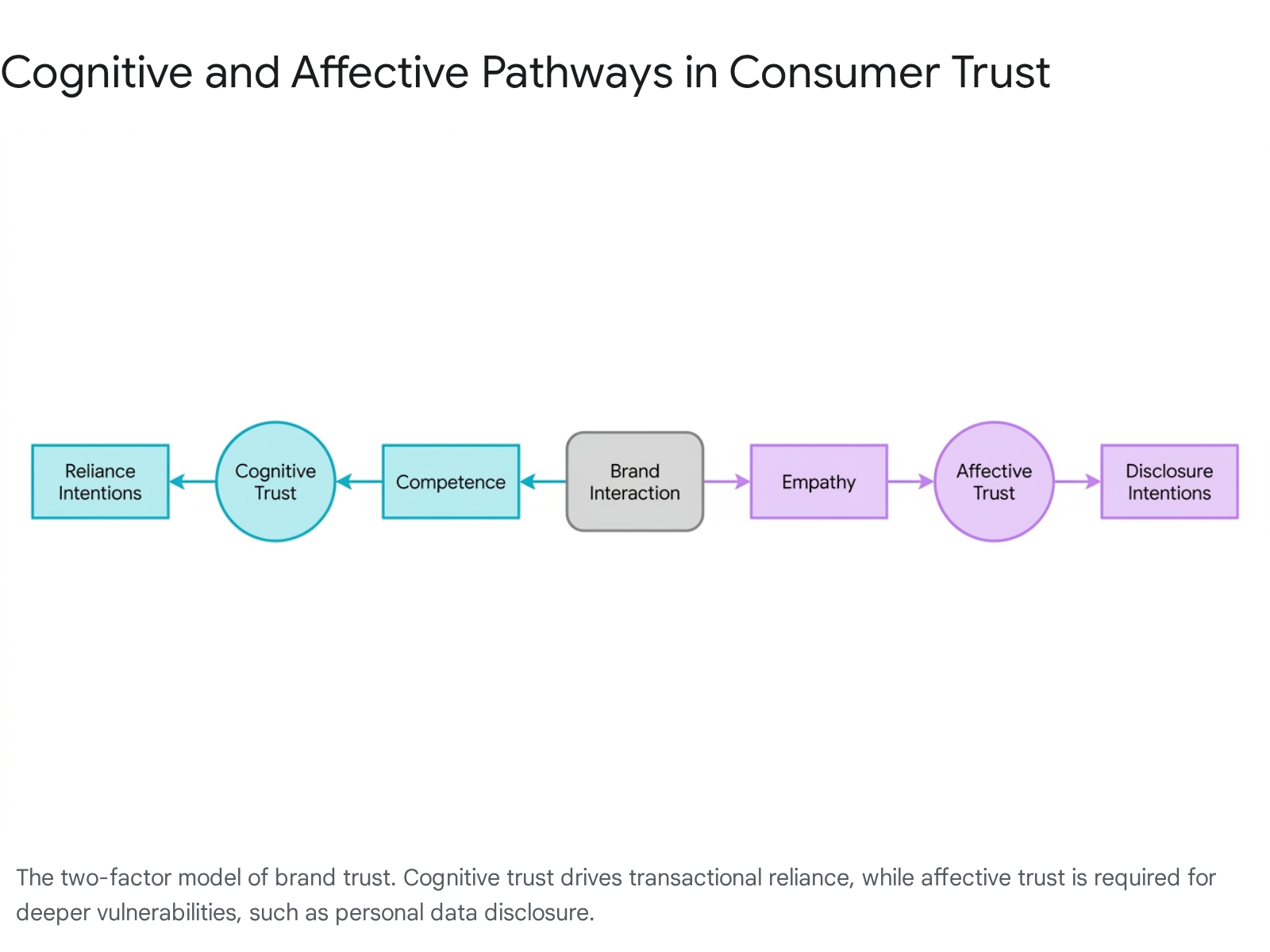
Psychological and organizational research identifies a two-factor conceptualization of trust: cognition-based trust and affect-based trust 23. These distinct dimensions of attitude relate differently to consumer behaviors and form the psychological architecture of brand relationships 34.
Cognition-based trust operates as the rational dimension, predicated on objective assessments of a brand's competence, reliability, and integrity 23. It answers the foundational consumer question of whether a company is capable of delivering on its core promises 2. In digital retailing, website quality, transparent security policies, and an established reputation directly nurture cognitive trust, driving customer satisfaction 5. A study examining Indian e-commerce consumers demonstrated that cognitive trust acts as a critical mediating variable between perceived website quality and long-term loyalty intentions 5.
Affect-based trust represents a deeper, relational dimension grounded in emotional bonds, empathy, and perceived reciprocal care 36. It is characterized by the consumer's feeling of being understood and respected by the brand 2. Theoretical models suggest that affect-based trust builds upon a foundation of cognitive trust over time through repeated, positive interactions 34.
Experimental research indicates that these dimensions dictate different thresholds of consumer vulnerability. High cognition-based trust is generally sufficient to encourage reliance intentions, meaning consumers will transact with or depend on the brand for standard services 6. However, affect-based trust is essential for driving disclosure intentions, such as the willingness to share sensitive personal data with a company 6.
Furthermore, when cognition and affect are in conflict - or in situations of ambivalence - affective trust predominantly influences the final behavioral outcome 3. Because it is rooted in emotional bonding, high affect-based trust is significantly more difficult for market competitors to replicate or substitute than basic cognitive reliability 36.
Familiarity and Cognitive Load Reduction
The mere exposure effect, a well-documented psychological phenomenon, posits that the more frequently individuals encounter a stimulus, the more they tend to like and trust it 27. Brands that consistently present familiar visual identities, messaging, and service standards across channels capitalize on this effect, wiring themselves into the collective memory and reducing perceived transaction risk 2. Research indicates that brands maintaining consistent messaging across channels are perceived as three to four times more trustworthy than those exhibiting disconnected communication styles 8.
Familiarity and consistency function as mechanisms for reducing consumer cognitive load 2. In saturated digital markets, consumers face decision fatigue; a trusted brand serves as a mental shortcut, saving the mental energy required for endless comparative analysis 2. This psychological convenience is a highly valuable asset, prompting repeat purchases without conscious deliberation 27. Conversely, brands that erratically modify their identities or strategic positioning risk confusing their audiences, inadvertently alienating consumers and destabilizing long-term loyalty 7.
Parasocial Relationships and Influencer Dynamics
The democratization of content creation has shifted marketing paradigms away from traditional celebrity endorsements toward social media influencers. The influencer economy, projected to surpass $32 billion by 2025, relies heavily on a psychological phenomenon known as parasocial relationships (PSRs) 9.
Mechanisms of Parasocial Trust
A parasocial relationship is defined as a one-sided emotional bond wherein consumers feel a genuine sense of intimacy, closeness, and friendship with an influencer, despite the lack of reciprocal interaction 91011. While the concept originated in 1956 to describe television audience behavior, contemporary social media platforms amplify PSRs through consistent, seemingly unmediated content that mimics peer-to-peer communication 911.
Influencers cultivate these relationships through authentic self-presentation and direct community management, such as responding to comments and addressing followers directly in video content 911. By blending personal narratives with product endorsements, influencers effectively bypass traditional advertising skepticism 9. Quantitative research into the Trust Mediation Model demonstrates that while an influencer's perceived credibility (expertise and honesty) directly impacts campaign attitudes, it is the strength of the parasocial bond that most reliably converts passive followers into trusting consumers and brand advocates 1012.
Platform Nuances and Vulnerabilities
The depth of these parasocial ties correlates strongly with platform interactivity and follower involvement. Research comparing Instagram and TikTok usage highlights that higher perceived levels of interactivity directly strengthen relational ties, leading to elevated brand credibility and purchase intention 11. Furthermore, the influencer's audience scale plays a significant role in trust formation. Studies on Generation Z consumers indicate that nano-influencers and micro-influencers generate stronger purchase intent than macro-influencers, largely due to heightened perceived authenticity and emotional resonance 13. Superficial engagement metrics alone cannot predict conversion; trust-based connections are the critical mediating variable 13.
However, the psychological closeness of a parasocial relationship introduces unique vulnerabilities. Because parasocial trust is entirely dependent on perceived authenticity, the introduction of overt commercialization or misalignment with the influencer's established values can trigger rapid disillusionment 9. Influencers face intense pressure to avoid appearing as if they are "selling out," as a single overly promotional campaign can irreparably damage the emotional connection that built their legitimacy, subsequently transferring that distrust to the endorsed brand 9.
Artificial Intelligence and Algorithmic Authenticity
The integration of generative artificial intelligence (GenAI) into customer communications, marketing campaigns, and product design presents a profound challenge to modern brand trust 1415. As the technology scales, consumer sentiment remains highly polarized.
The Generative AI Trust Paradox
Recent consumer behavior data reveals a "Trust Paradox" regarding artificial intelligence 14. Survey data indicates that 51% of U.S. consumers are excited about GenAI's potential, and approximately 70% believe its benefits outweigh the associated risks 16. Consumers frequently report high satisfaction with the speed, efficiency, and instantaneous query resolution that autonomous AI agents provide in customer service contexts 141516.
Concurrently, however, consumers express deep-seated anxieties over data privacy, algorithmic surveillance, and the proliferation of fabricated content 1416. Studies reveal that 67% of consumers cite fake news and content as top concerns, while 63% worry about privacy and cybersecurity vulnerabilities introduced by AI 16. Global surveys indicate that despite the rapid adoption of AI tools, only 17% of consumers fully trust organizations to manage their personal identity data effectively 17.
This dichotomy exposes the risk of the "Average Trap" in digital interactions 14. While GenAI can generate content instantly, an overreliance on automation risks producing generic, standardized responses devoid of emotional depth or a unique brand voice 14. When interactions feel excessively automated or drift into the "uncanny valley" of synthetic communication, consumer perception suffers drastically 14.
The Transparency and Authenticity Deficit
Data shows that 46% of consumers trust a brand less if they discover it used AI for services they assumed were handled by a human 19. This finding suggests that deception - or a lack of algorithmic transparency - degrades brand equity far more than the actual use of the technology 1920. A 2024 benchmark report on customer conversations found that 77% of consumers believe it is essential for companies to explicitly disclose when GenAI is used in communications, and 81% demand human oversight for AI-generated content 21.
In advertising, exposing the use of AI can have mixed results. In luxury contexts, disclosing AI-generated imagery often lowers perceived brand effort and authenticity, producing negative consumer reactions, though this penalty may diminish if the imagery demonstrates exceptional creativity 18. When consumers perceive that a brand is using AI to bypass human effort rather than augment it, empathy and ad credibility weaken 18. To mitigate these risks, industry analysts advocate for a shift in corporate key performance indicators (KPIs). Rather than prioritizing operational efficiency metrics like Average Handle Time (AHT), brands must focus on the "Authenticity Metric" and "Value-Per-Interaction" (VPI) to sustain the human empathy necessary for long-term relationships 14.
Consumer Empowerment Through Collaborative AI
Despite the risks to authenticity, AI can foster trust when deployed as an interactive, collaborative tool. Academic experiments show that when AI is utilized transparently to allow consumers to co-create branded images or content, it transforms audiences from passive viewers into active participants 19.
Researchers analyzing collaborative AI campaigns (such as those by Coca-Cola and Heinz) developed a "3C framework" to explain this phenomenon 19. First, the collaborative nature of the campaign fosters a sense of agency. Second, the reciprocal nature of human-AI communication boosts consumer confidence and control. Finally, facilitating consumer creativity through AI builds stronger psychological relationships and reinforces positive brand associations 19. When AI shifts from a tool of corporate automation to a tool of consumer empowerment, trust metrics improve significantly.
Algorithmic Pricing and the Psychology of Fairness
The psychological impact of data algorithms extends beyond communication into dynamic pricing models 2021. E-commerce platforms, ride-hailing applications, and airlines frequently utilize real-time supply and demand data to adjust pricing continuously 2022.
Algorithmic Price Discrimination
While consumers possess a baseline acceptance of pricing fluctuations driven by broad macroeconomic forces, the use of individual behavioral data to execute personalized algorithmic price discrimination triggers severe psychological reactance 2223. Advanced algorithms process granular personal data - including location, browsing history, purchase urgency, and demographic markers - to identify the maximum willingness to pay on an individual basis 2123.
Research analyzing interpersonal price differences reveals that when consumers discover they have paid a premium compared to a peer due to algorithmic sorting, they experience acute perceived betrayal 23. This reaction is governed by perceived price fairness; consumers use peer pricing as the primary reference point to evaluate market equity 23. High levels of perceived betrayal reliably correlate with public complaints, boycotts, and immediate reputational damage 23.
The Trust Gap and Market Search Behavior
According to range-frequency theory, algorithmic dynamic pricing (ADP) universally reduces immediate trust in the retailer 24. When consumers recognize that prices are fluctuating based on opaque algorithmic criteria, their purchasing behavior fundamentally shifts. ADP prolongs consumer price search durations; as consumers gain experience with dynamic pricing, they spend more time verifying prices across competitors to avoid being penalized by the algorithm 24.
Transparency in algorithmic pricing does not automatically yield trust 22. Explicitly informing consumers that their personal data is being used to increase their prices often exacerbates feelings of exploitation rather than mitigating them 22. Consumers view personalized pricing as inherently unfair, testing their capacity to discern legitimate market value 2225. To counteract this trust gap, researchers suggest that retailers implementing ADP should actively build trust through price-matching guarantees or by explicitly communicating that their pricing algorithms are reactive to competitor pricing rather than exploitative of individual consumer data 24.
Regional Data Privacy Frameworks
As digital tracking and algorithmic profiling grow, the stewardship of consumer data has become a fundamental pillar of brand trustworthiness 26. Brands operating in the global digital economy face divergent regulatory and technological ecosystems, demanding distinct approaches to privacy compliance and trust-building 27.
European Data Protection Standards
In Europe, the digital ecosystem operates as an "open archipelago" of specialized, interoperable platforms 27. The General Data Protection Regulation (GDPR), fully implemented in 2018, forces companies to prioritize explicit consent and strict data minimization 2728. The GDPR establishes universal data subject rights, including the right to data portability and the right to be forgotten 29.
Compliance with GDPR is increasingly viewed by European businesses as a competitive advantage rather than merely a legal hurdle. Surveys indicate that over 80% of EU companies now view a balance between effective marketing and privacy compliance as achievable 30. Furthermore, nearly 66% of executives report that GDPR compliance actively builds trust with their consumer base, and 79.7% believe the regulation is inherently important for market stability 30. Despite ongoing logistical challenges regarding inconsistent application by national Data Protection Authorities (DPAs) and divergent legal interpretations, the European model successfully earns consumer trust through legally enforceable autonomy, backed by severe penalties of up to 4% of a company's global turnover 2829.
Asian Super-Application Ecosystems
Conversely, the Asian digital market is dominated by centralized super-applications (superapps) such as Grab, Gojek, Kakao, and WeChat 31. These platforms bundle services ranging from ride-hailing and e-commerce to medical bookings and financial services into a single, mobile-first interface 31. To facilitate this, superapps consolidate vast amounts of behavioral and financial data to offer highly frictionless experiences 31.
In this ecosystem, identity verification (IDV) is becoming deeply embedded, utilizing biometric data and behavioral analytics to create continuous, passive authentication environments 3233. While this maximizes user convenience and reduces fraud, it centralizes consumer trust into a single corporate entity 32. Trust is established and maintained with minimal user effort, making seamless IDV a core competitive advantage 32.
Regulatory approaches in the Asia-Pacific (APAC) region are highly fragmented. While frameworks like Singapore's Personal Data Protection Act (PDPA) and Japan's Act on the Protection of Personal Information (APPI) share conceptual similarities with the GDPR, they lack the same breadth of individual rights; for instance, the APPI does not recognize the right to data portability 29. The APEC Cross-Border Privacy Rules (CBPR) system exists to facilitate data flow, but it is a voluntary framework with limited universal adoption 29. Furthermore, a rapid rise in stringent data sovereignty laws across the APAC region - mandating that citizen data remain within physical national borders - highlights a growing regional emphasis on national security and economic protectionism over the fragmented individual consent models seen in the West 3233.
| Framework / Ecosystem | European Union (GDPR Model) | Asia-Pacific (Superapp & Sovereignty Model) |
|---|---|---|
| Market Structure | Fragmented, specialized platforms ("Open Archipelago") 27 | Consolidated, multi-service super-applications 31 |
| Primary Value Proposition | Data privacy, explicit consent, user control 2830 | Frictionless convenience, embedded IDV, integrated services 3233 |
| Data Governance Focus | Universal data subject rights (e.g., portability) 29 | National data sovereignty, localized storage 3233 |
| Psychology of Trust | Earned through transparent compliance and legal accountability 30 | Earned through utility, seamlessness, and passive authentication 32 |
| Regulatory Enforcement | Extraterritorial application, fines up to 4% global turnover 29 | Fragmented national standards, voluntary frameworks (CBPR) 2931 |
Expectancy Violations and Crisis Management
Brand crises represent a critical psychological juncture where established trust is tested. The mechanics of how consumers react to a controversy can be analyzed through Expectancy Violations Theory (EVT) 3435.
The Mechanics of Expectancy Violations Theory
EVT is a communication theory that analyzes how individuals respond to unanticipated violations of established social norms and expectations 36. While originally developed in the 1970s to study nonverbal communication and personal space, the theory has been widely adapted to explain corporate communication and consumer behavior 3637.
According to EVT, consumers enter relationships with corporate brands holding a set of established, often unspoken, expectations regarding service, quality, and ethics 35. When a brand's behavior diverges from these predictive expectations, it triggers psychological arousal and compels the consumer to initiate a cognitive appraisal of the violation 36. The valence (positive or negative value) assigned to this violation determines the future of the brand relationship 36.
A negative expectancy violation occurs when a previously positive expectation is abruptly unmet 38. For instance, if a brand known for corporate social responsibility (CSR) and high moral standards is implicated in an ethical scandal, the violation of expectations is exceptionally severe. Research demonstrates that this specific misalignment - where the type of consumer expectation (e.g., morality) clashes directly with the domain of the crisis - generates profound generalized distrust 38. Paradoxically, a brand that historically set very low ethical expectations may suffer minimal reputational damage from a misstep, as the behavior aligns with pre-existing low expectations, preventing a significant psychological violation 35.
Cancel Culture and the Social Media Apology Cycle
In the current digital ecosystem, EVT plays out publicly via "cancel culture," which operates as a highly networked, algorithm-fueled accountability mechanism 4344. Reputational damage that previously took weeks to manifest in traditional media can now escalate globally overnight through social media comment sections and viral trends 434539.
Consumer expectations for crisis response times (CRTE) have shortened drastically. Studies investigating brand crises on social media reveal that consumers with strict speed expectations reward timely engagement with trust gains, while slow or silent responses rapidly erode empathy and exponentially increase negative word-of-mouth 3439.
However, speed must be paired with substantive, tangible action. The contemporary social media apology cycle demonstrates that hollow apologies and defensive posturing severely aggravate negative expectancy violations. Recent case studies highlight this dynamic: * Bumble's Relaunch Campaign: The dating app faced intense backlash over tone-deaf advertisements mocking celibacy. While the brand responded quickly by removing the ads and issuing an apology, analysts noted that long-term trust recovery depends entirely on subsequent structural follow-through, as words without action are insufficient for modern consumers 40. * Boeing's Safety Crisis: Following mechanical failures and safety defects, Boeing's initial public statements were perceived as cold and vague. This lack of empathy and transparency eroded public trust further, ultimately leading to leadership resignations and intensified regulatory scrutiny 40. * SwiftSip Greenwashing: When a beverage brand was exposed on TikTok for falsely claiming a bottle was 100% plant-based, the brand successfully mitigated the crisis by quietly acknowledging the misstep, explaining the actual chemical composition, and launching a tangible recycling initiative. The transparency and immediate corrective action satisfied critics 41.
| Crisis Phase | Necessary Brand Actions | Metrics of Success |
|---|---|---|
| 0-24 Hours | Acknowledge issue publicly, take responsibility, address immediate safety concerns 4950 | Stabilization of social sentiment, containment of media narrative 50 |
| 24-72 Hours | Detail the root cause, announce a comprehensive remediation plan, communicate with stakeholders 4450 | Shift from negative outrage to neutral questioning, reduced search volatility 50 |
| 1-4 Weeks | Implement new policies, launch internal training, report on operational progress 4950 | Improvement in online reviews, stabilization of customer retention 50 |
| 1-6 Months | Document long-term results, demonstrate industry leadership, verify structural changes 4150 | Recovery of market share, stock performance stabilization 50 |
Successful reputation restoration requires brands to move beyond performative public relations into operational remediation 44. Brands that survive cancel culture do so by treating the comment section as a primary forum for active engagement rather than broadcasting, addressing the root problems transparently, and instituting verifiable standards to prevent recurrence 454149.
Brand Safety Versus Brand Suitability
As companies seek to protect their reputations in unpredictable digital environments, the advertising industry has clearly delineated the psychological boundaries between brand safety and brand suitability 5142. While frequently conflated, they serve fundamentally different functions in trust maintenance.
Brand safety is a defensive, baseline requirement. It describes the measures a company takes to ensure that its marketing assets do not appear adjacent to harmful, explicit, illegal, or fraudulent content 5142. Failure in brand safety results in immediate negative associations and a withdrawal of consumer trust, as audiences often interpret unsafe ad placement as a tacit, intentional endorsement of the surrounding negative content 42. The market impact is severe; digital platforms that fail to enforce content moderation see rapid advertiser exodus due to perceived reputational contamination 53. For example, declining trust in content moderation on the platform X (formerly Twitter) resulted in a net 26% of marketers planning to cut ad spend on the platform in 2025, driven by fears of brand safety violations 53.
Brand suitability, conversely, is an offensive, nuanced strategy 42. It moves beyond merely avoiding harm to identifying contexts that positively align with a brand's core values, target demographics, and psychological positioning 5142. Just as affective trust requires a deeper connection than baseline cognitive reliability, brand suitability requires marketers to actively match their messaging with environments that reinforce their specific brand identity 42. By focusing on positive adjacency, brands engineer environments where consumers are most likely to engage favorably, thereby actively building trust rather than simply protecting it 5142.